# Glossary (/docs/product/glossary)
One concept, one word. Every domain term in these docs is defined here, and every page links to the entry the first time it uses the term. If you meet a word the docs don't define, that's a gap: tell your strategist.
## Agent [#agent]
An automated worker inside GrowthOS. Agents research your market, propose opportunities, write drafts, and score the pages you already have. Every agent stops at a proposal: nothing publishes and nothing moves forward until you review it and decide.
See
[Agents draft, you decide](/docs/product/concepts/agents-draft-you-decide)
.
## AI Search split [#ai-search-split]
The breakdown of your traffic that arrives from an answer engine rather than from a search result, shown by engine.
See
[At a Glance](/docs/product/workspace/at-a-glance)
.
## AI Visibility Segment [#ai-visibility-segment]
A slice of your market that GrowthOS watches inside AI answer engines: where you are cited, and who is cited instead.
See
[AI Viz Segments](/docs/product/context-and-voice/ai-viz-segments)
.
## Analysis zone [#analysis-zone]
The part of your site GrowthOS crawls and analyzes. Zone scope drives analysis cost, so zones are set deliberately rather than defaulting to the whole site.
See
[Analysis zones](/docs/product/admin/analysis-zones)
.
## Annotation [#annotation]
A note you leave on a draft saying what is off and why, instead of silently rewriting it. Annotations accumulate as pending feedback and fold into your [writing profile](#writing-profile) when someone clicks **Update profile**. Annotating is what teaches the next draft; editing is not.
## Answer engine [#answer-engine]
An AI product that answers questions directly instead of returning a list of links: ChatGPT, Perplexity, Google's AI Overviews.
## Brief [#brief]
The plan for one page: the research, structure, and targeting a draft is written from.
See
[Briefs](/docs/product/briefs)
.
## Cluster [#cluster]
A group of related [opportunities](#opportunity) built around one topic, worked as a set. Deleting a cluster removes the territory itself (its topics and their questions); opportunities it already produced survive, losing only the cluster link.
## Connector [#connector]
A link from GrowthOS to Google Analytics or Google Search Console. Connectors feed every traffic figure in the product. GrowthX sets them up; if one reports a problem, raise it with your strategist.
See
[Websites](/docs/product/admin/websites)
.
## Context [#context]
What GrowthOS knows about your company: what you do, the market you sit in, the buyers you write for, and how you sound. Held on 8 screens, and every agent reads context before it does anything.
See
[Context & voice](/docs/product/context-and-voice)
.
## Crawl [#crawl]
GrowthOS reading your sitemap (the file listing every page on your site) to build its copy of your pages. Page counts come from the crawl, not from Google, so they appear even before analytics are connected.
## Foundation [#foundation]
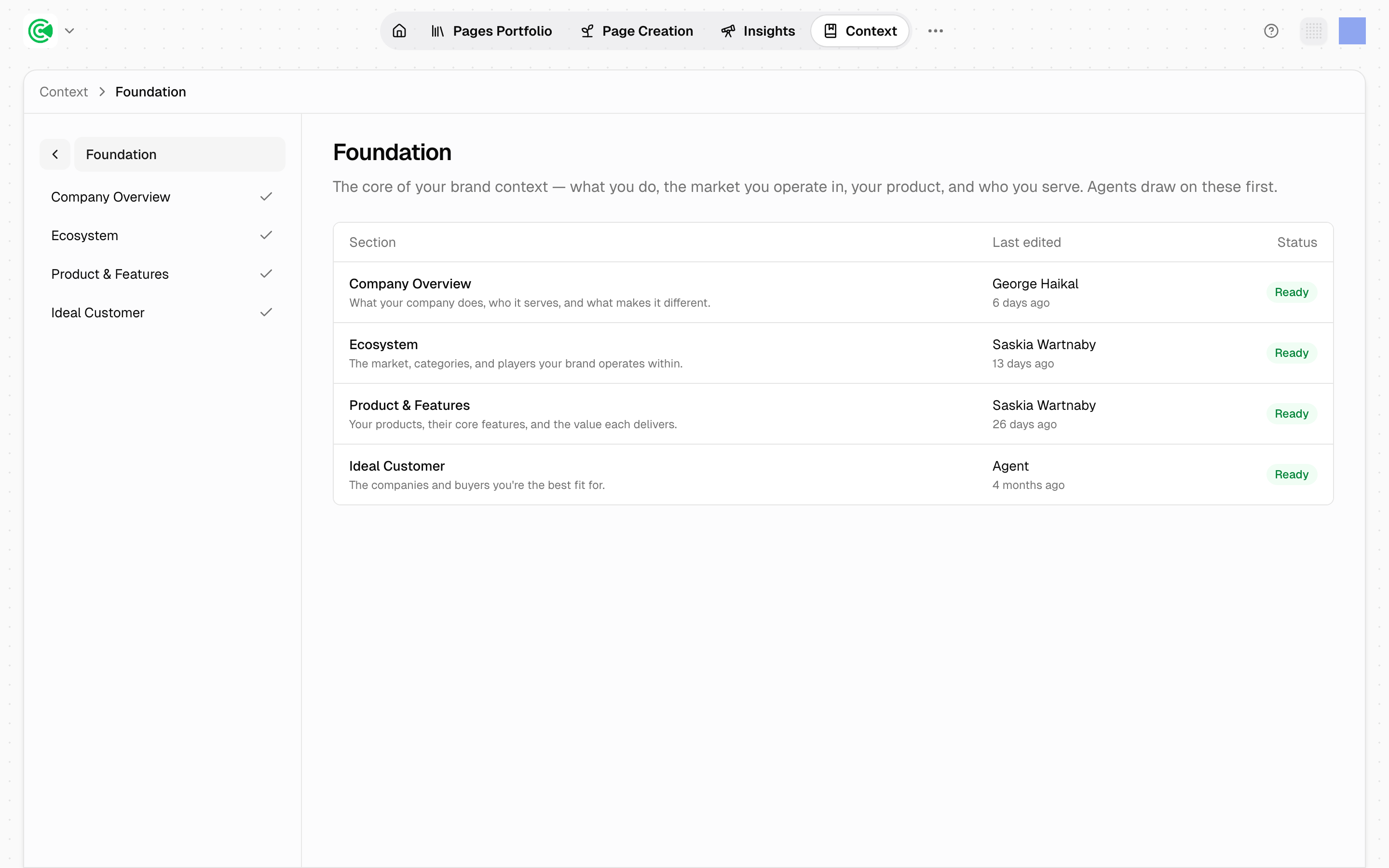
The base layer of your context: 4 documents covering what your company does (Company Overview), the market it sits in (Ecosystem), what you sell (Product & Features), and who you sell it to (Ideal Customer).
See
[Foundation](/docs/product/context-and-voice/foundation)
.
## Grouping [#grouping]
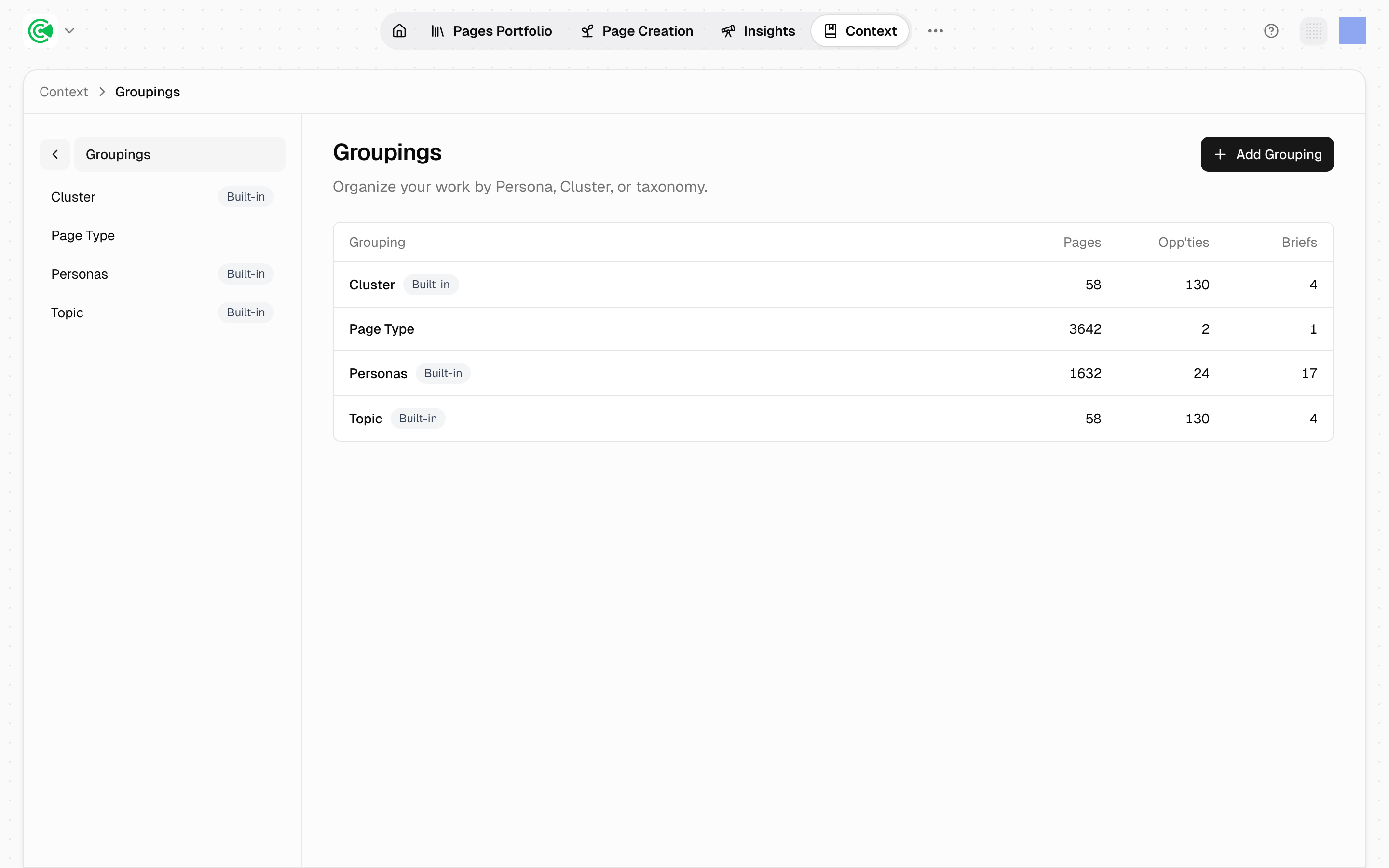
An axis your content portfolio can be sliced along in the [Pages Portfolio](#pages-portfolio), such as funnel stage or product line.
See
[Groupings](/docs/product/context-and-voice/groupings)
.
## Opportunity [#opportunity]
A page worth writing or rewriting, proposed by an agent with the reasoning attached. Opportunities wait for your triage: accepting one is what starts production.
See
[Opportunities](/docs/product/briefs/opportunities)
.
## Pages Portfolio [#pages-portfolio]
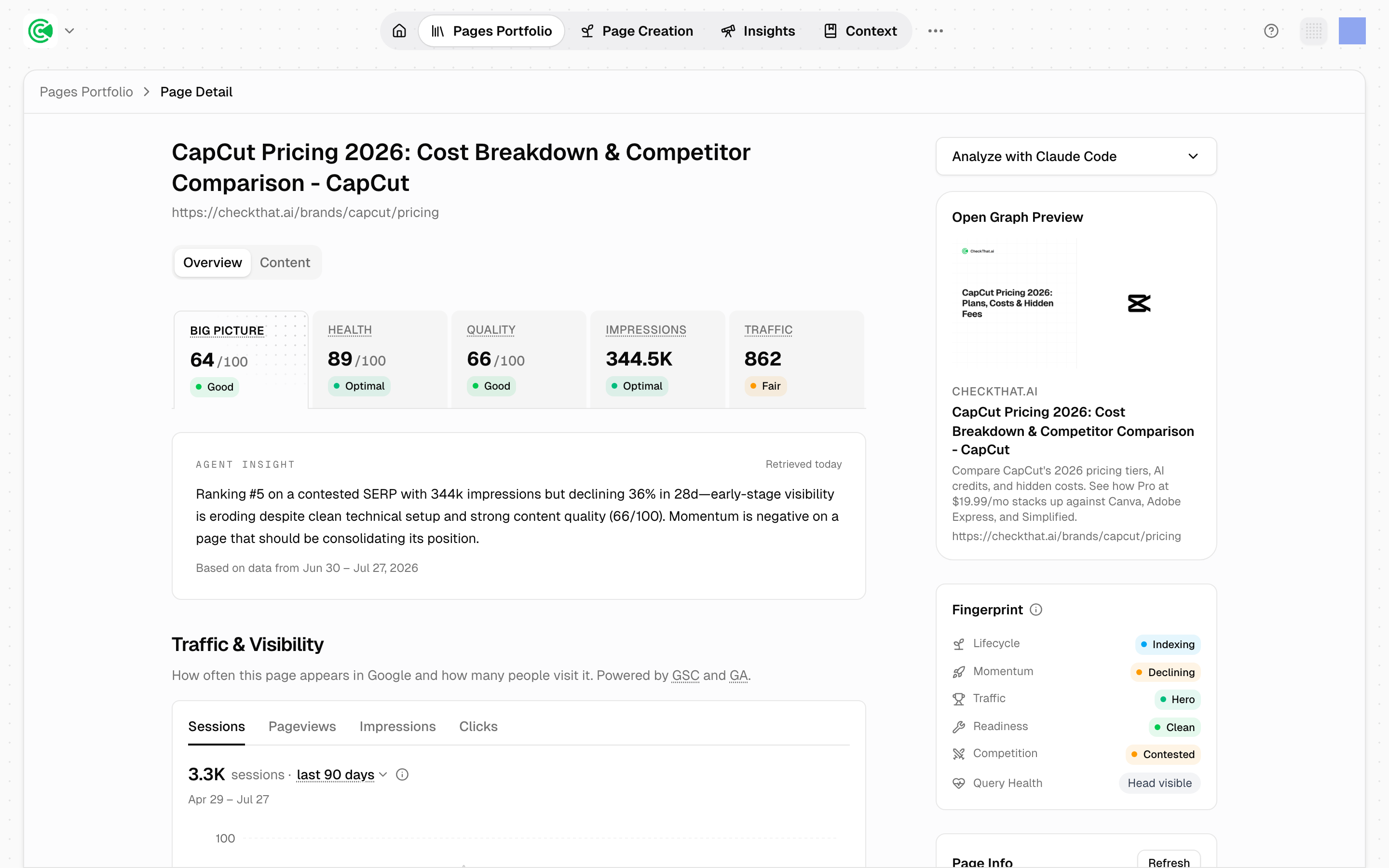
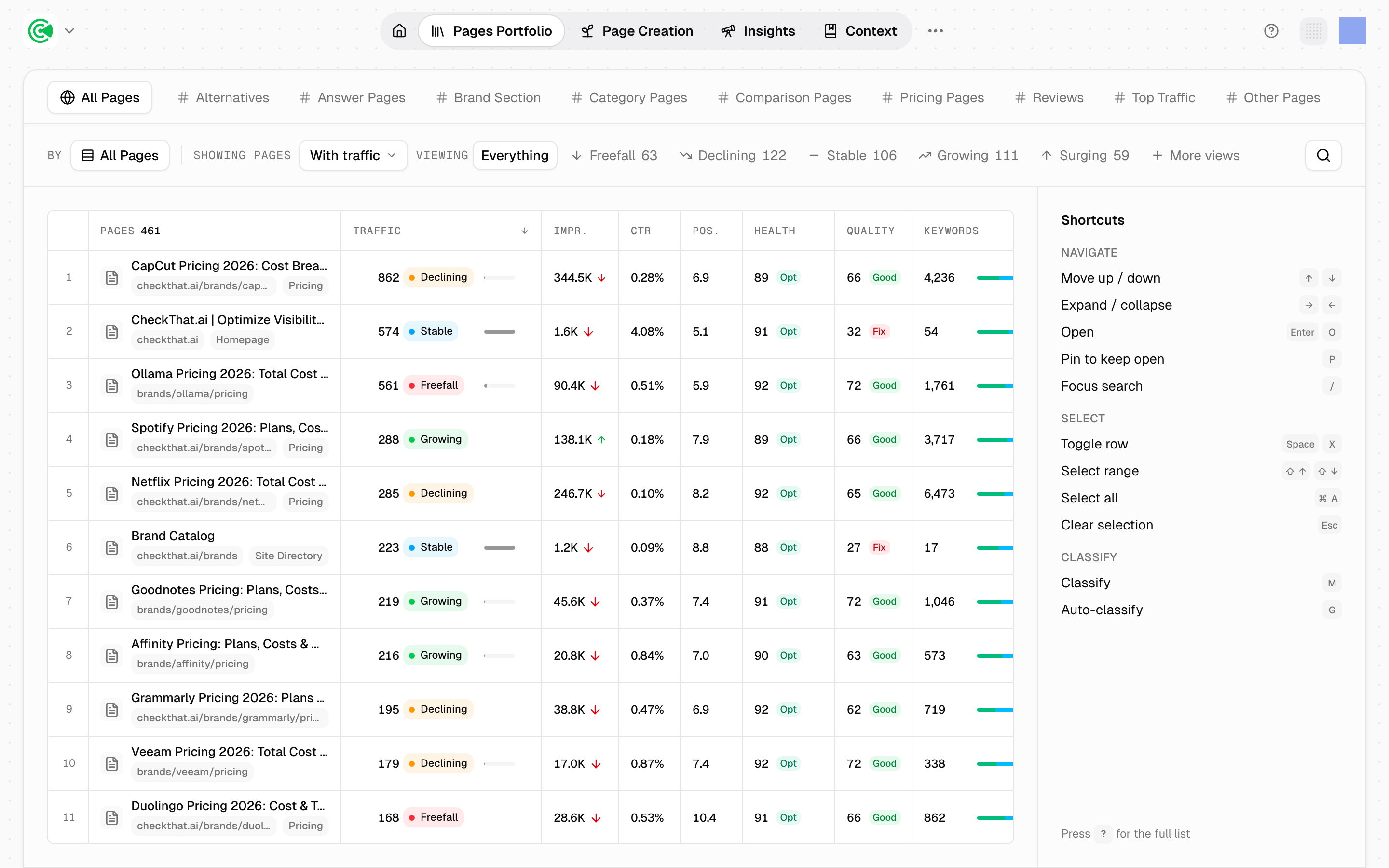
The list of every URL on your site, scored individually. This is where the page-level numbers behind a workspace-level change live.
See
[Pages Portfolio](/docs/product/pages/pages-portfolio)
.
## Performance band [#performance-band]
One of 5 labels describing the direction of a page's traffic against the previous period: **Freefall**, **Declining**, **Stable**, **Growing**, **Surging**. A band describes a direction, not a level. Pages with no traffic sit outside the bands entirely.
## Persona [#persona]
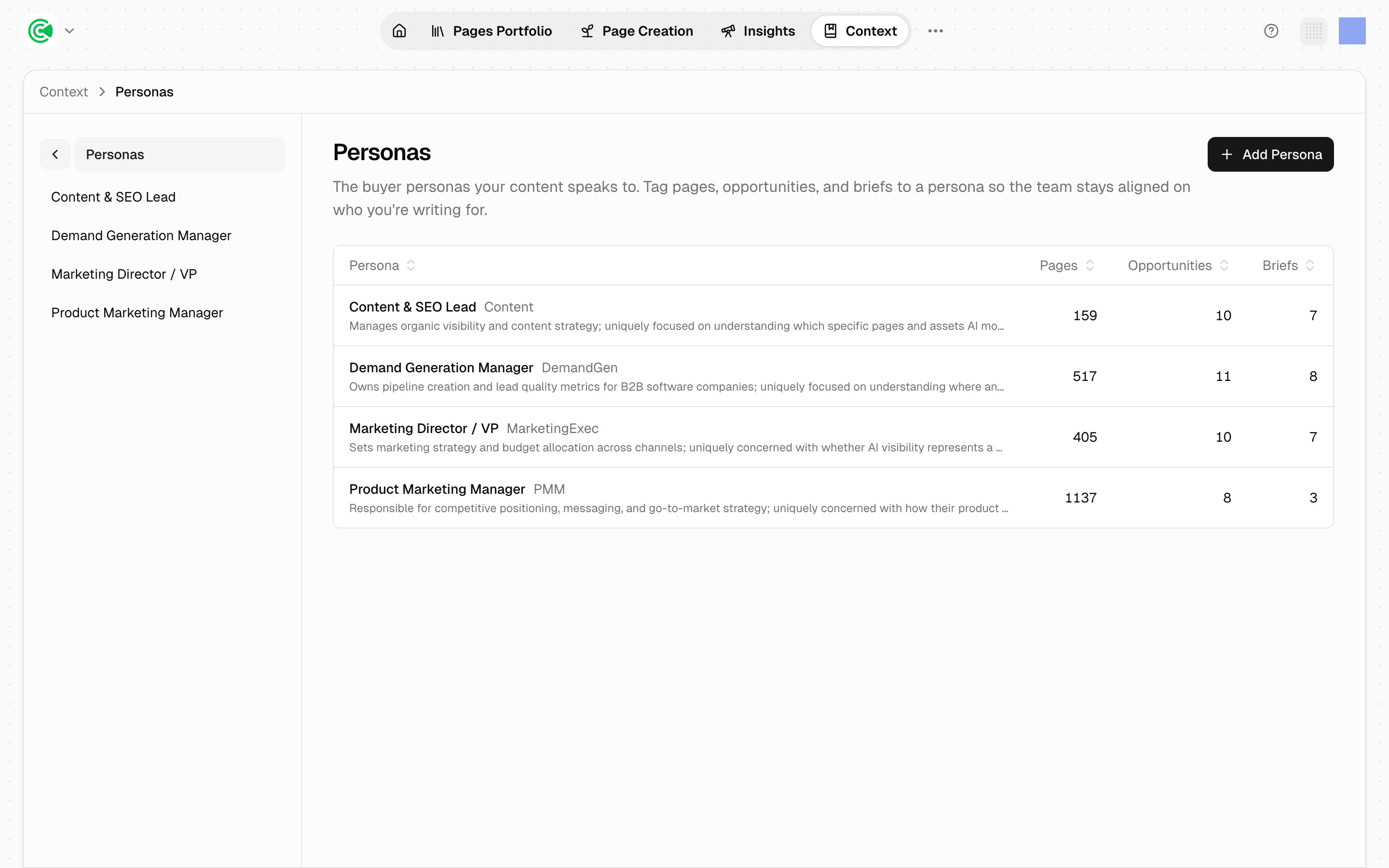
A buyer your content speaks to, and what that buyer is trying to find out.
See
[Personas](/docs/product/context-and-voice/personas)
.
## Setup Autopilot [#setup-autopilot]
The chain of agents GrowthX runs before you first sign in. It researches your company and market from public sources and drafts your context. What you meet is the result, not the run, and correcting that result is your first real task in a new workspace.
## Site sync [#site-sync]
The connection that keeps GrowthOS's copy of your site current. GrowthX configures site sync.
See
[Site sync](/docs/product/admin/site-sync)
.
## Strategist [#strategist]
Your GrowthX contact: the person who configures your workspace, runs the parts of the product that sit outside it, and takes the corrections only you can catch.
## Taxonomy [#taxonomy]
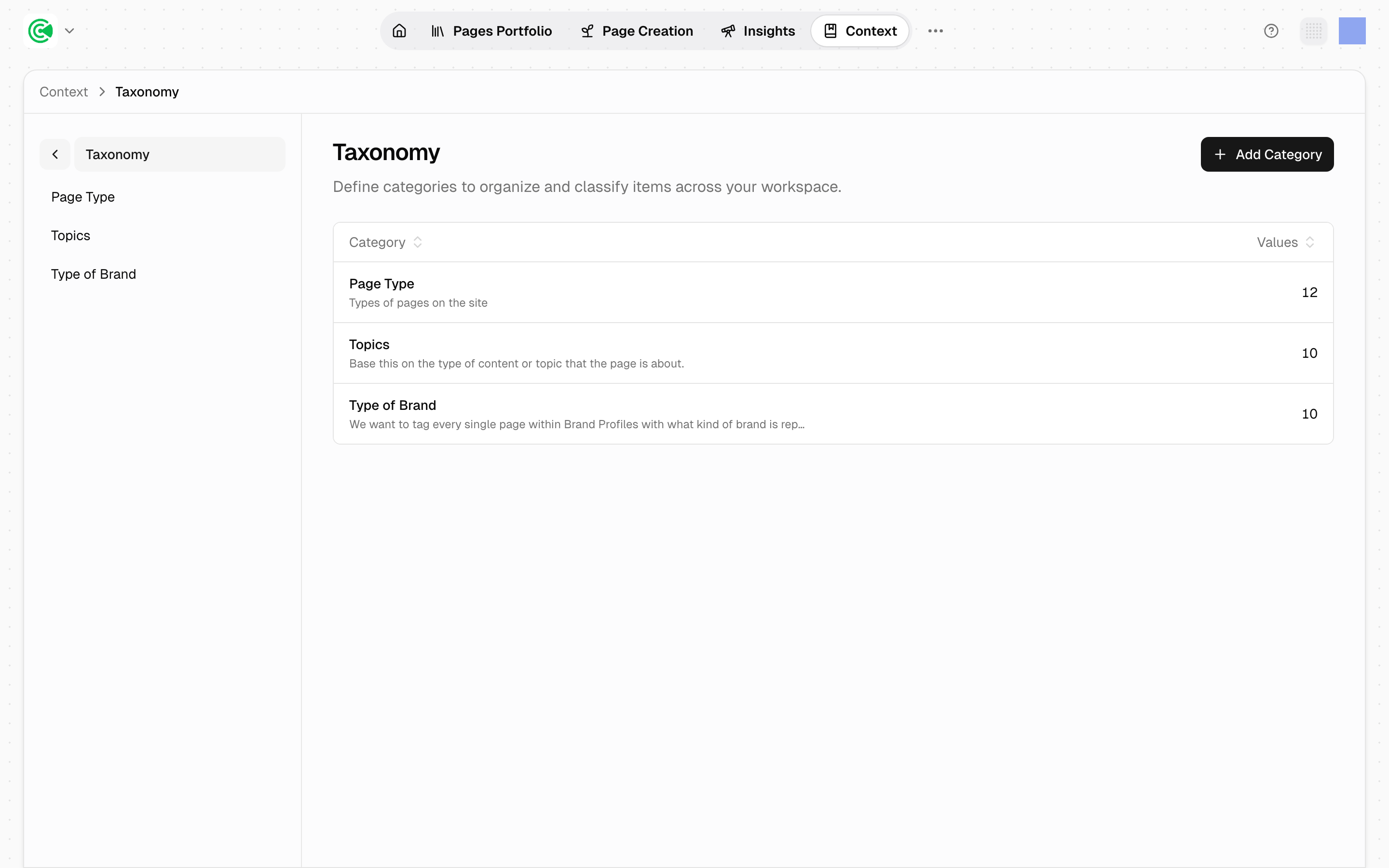
Your own categories for classifying content, such as funnel stage or product line.
See
[Taxonomy](/docs/product/context-and-voice/taxonomy)
.
## Topic [#topic]
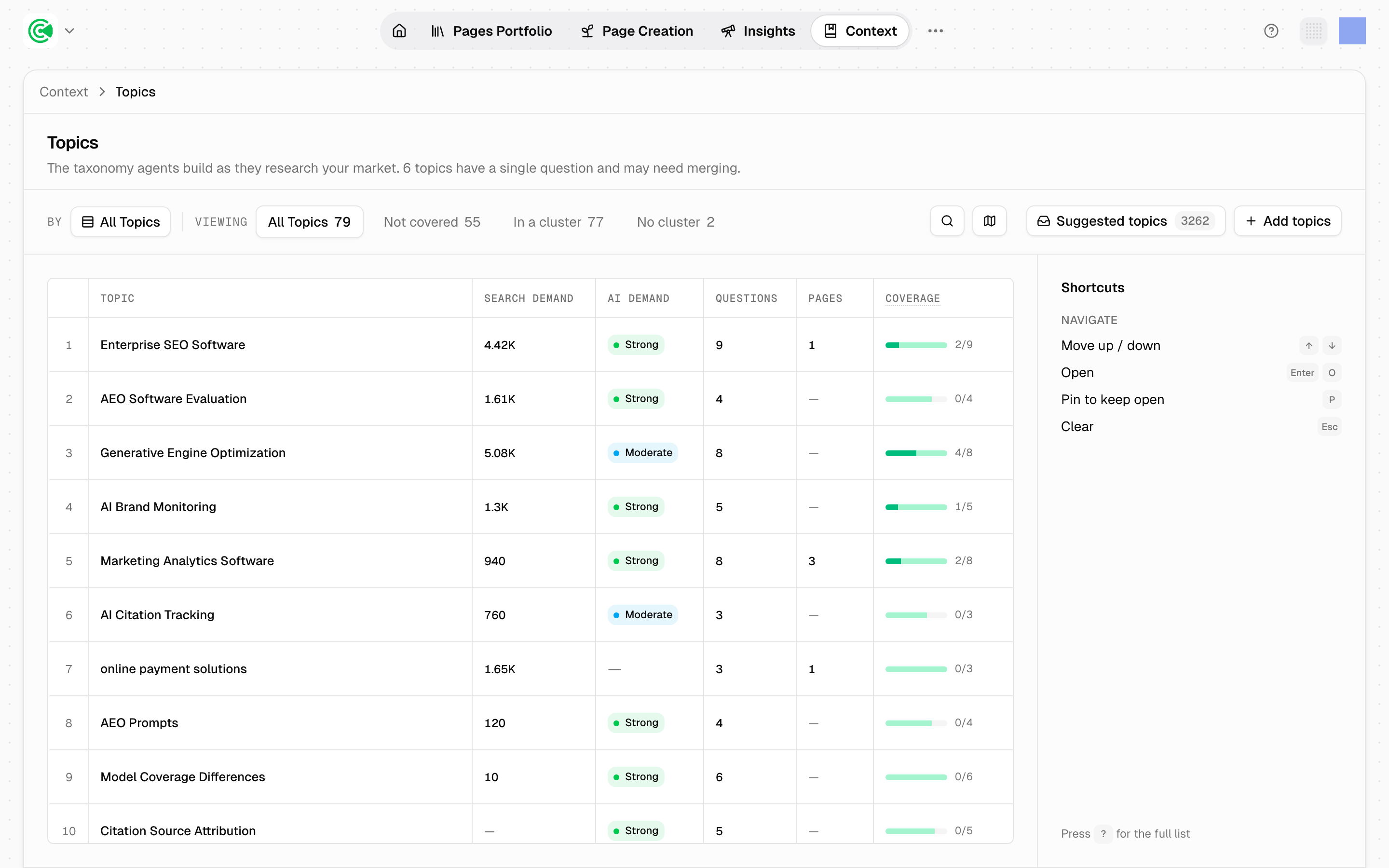
An entry in the map of what your market is asking about, and how much of it your site answers today.
See
[Topics](/docs/product/context-and-voice/topics)
.
## Workspace [#workspace]
Everything GrowthOS knows and does for one brand. Every figure, page, and agent in your workspace covers that brand only.
## Writing profile [#writing-profile]
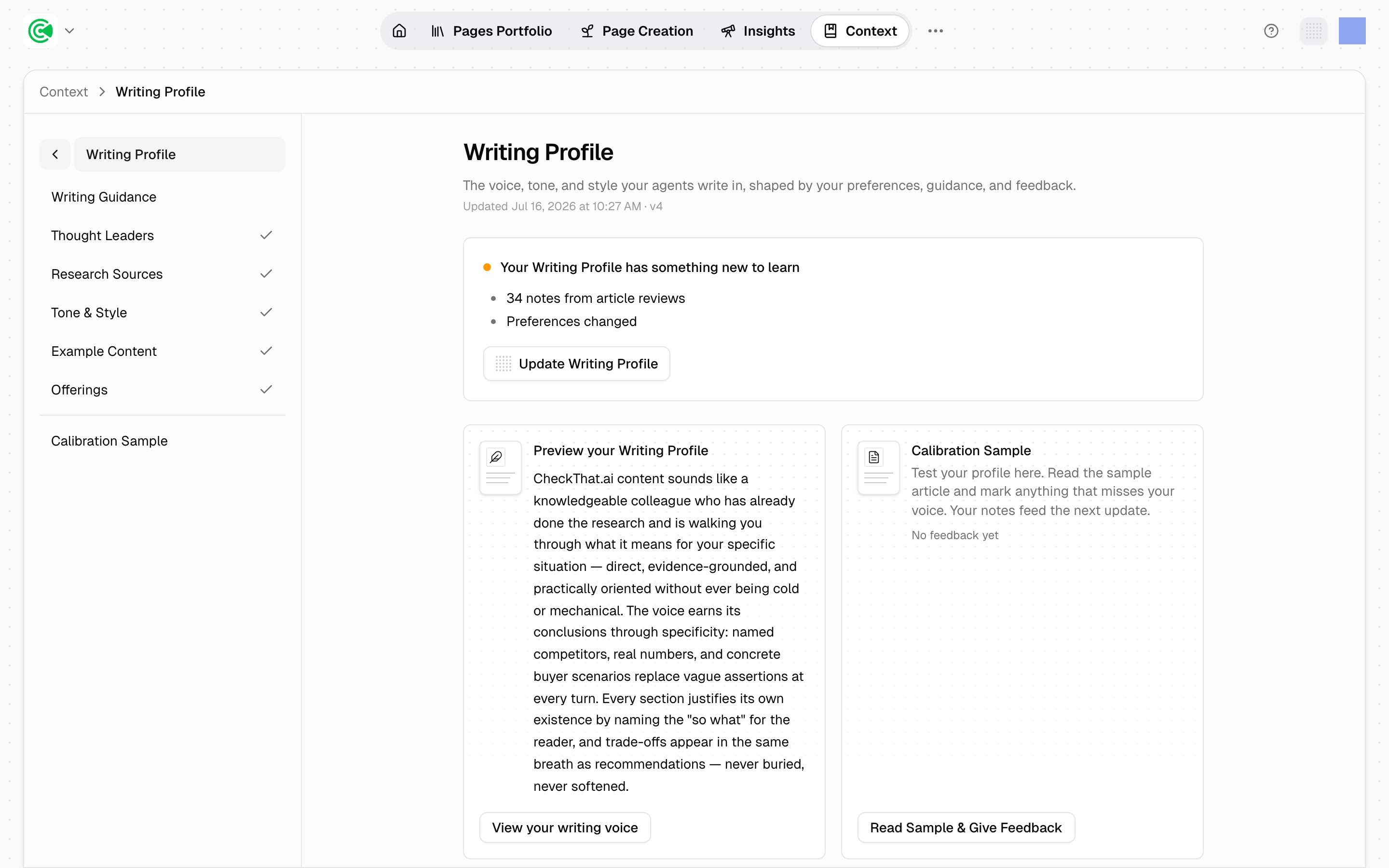
The compiled version of how you sound. Every draft starts from it, and it is the only place [annotations](#annotation) become voice: pending feedback folds in when **Update profile** is clicked.
See
[Writing Profile](/docs/product/context-and-voice/writing-profile)
.
# Product docs (/docs/product)
Reference for every screen in GrowthOS. Each page covers one place in the product: what it shows, what every field means, and the states it can be in.
These pages are written to be arrived at, not read through: come here mid-task, find the screen you are on, get the answer. If you want the guided path instead, start with [the Tutorial](/docs/tutorial), which does the steps in order. Every domain term the docs use is defined once in [the glossary](/docs/product/glossary), and each page links a term to its entry the first time it appears.
Where you land, what the headline numbers say, and how a new
[workspace](/docs/product/glossary#workspace) (everything GrowthOS knows
and does for one brand) gets filled.
What GrowthOS knows about your company, your market and how you sound.
Finding what to write, deciding what is worth doing, and drafting it.
Your published pages as one scored inventory, and the full record behind any one of them.
The underlying performance data, and the reports you hand to someone else.
Access, branding, the sites you track, how they get
[crawled](/docs/product/glossary#crawl), and the MCP connection.
The 5 ideas the product is built on. Read these when a screen is not behaving the way you expected.
# Tutorial (/docs/tutorial)
This tutorial takes you from a brand-new [workspace](/docs/product/glossary#workspace) (everything GrowthOS knows and does for one brand) to a published page, and then to a publishing rhythm you run on your own. It follows the same order your workspace opens up: you grant access and share materials, GrowthOS builds your workspace, you calibrate what it learned, you back a direction, and then you create, review, and publish.
The 28 steps below are grouped into 8 stages, in the order your workspace opens up. Read them straight through the first time; after that, every step stands alone, so when a teammate joins mid-engagement, point them at the stage you're in.
## What GrowthOS does, what you do [#what-growthos-does-what-you-do]
[Agents](/docs/product/glossary#agent), the automated workers inside GrowthOS, do the production. You steer. That split holds through the whole journey, and every guide in this tutorial is about your side of it.
| GrowthOS | You |
| ------------------------------------------------------------------------------------------------------------------------------------------------------------------------------------------------------------------------- | --------------------------------------------------------------------------------------------------------------------------- |
| Crawls your site, builds your [Pages Portfolio](/docs/product/glossary#pages-portfolio) (one scored record per URL), and drafts your business [context](/docs/product/glossary#context), what it knows about your company | Correct what you can, flag the rest |
| Researches [opportunities](/docs/product/glossary#opportunity), pages worth writing or rewriting, and scores every one | Accept the ones worth a page, dismiss the rest |
| Writes drafts in your calibrated voice, compiled as your [writing profile](/docs/product/glossary#writing-profile) | [Annotate](/docs/product/glossary#annotation) what's off, as notes rather than silent rewrites, so the next draft is closer |
| Prepares the finished article, meta and cover, and hands it to your CMS (the system your site publishes from) as a draft | Take the final look and press publish in your own CMS |
## The 8 stages [#the-8-stages]
Steps 1.1 to 1.3
Steps 2.1 to 2.4
Steps 3.1 to 3.3
Steps 4.1 to 4.3
Steps 5.1 to 5.4
Steps 6.1 to 6.2
Steps 7.1 to 7.6
Steps 8.1 to 8.3
# Admin (/docs/product/admin/admin)
**App route:** `/admin`
Workspace Admin is where the [workspace](/docs/product/glossary#workspace) itself, everything GrowthOS knows and does for your brand, is configured: who can get in, how it's branded, how content gets made, where its data comes from, and which tools the team connects. It's a hub rather than a screen: each item in the sidebar is a separate area, and the landing page points at them.
Most of it is set once during setup and rarely revisited. **Your team edits the access and branding areas; GrowthX configures and maintains the rest**, which your team reads and verifies. Who can change what is covered in [Roles and permissions](/docs/product/admin/roles-and-permissions).
**Doing this rather than looking it up?** The Tutorial walks this screen step by step in [2.1 · Connect your data](/docs/tutorial/set-up/connect-your-data).
## Reference [#reference]
The sidebar groups the areas into 4 sections:
| Section | Areas |
| ------------------------ | ------------------------------------------ |
| **Workspace** | Manage Users ✏️ · Workspace Name & Logo ✏️ |
| **Content Creation** | CMS Connections ✏️ |
| **Websites & analytics** | Websites · Site Sync · AI Visibility |
| **Tools** | API Tokens · Activity Feed |
✏️ = yours to edit. Everything else is set up and maintained by your GrowthX team. Owners and Operators can both manage CMS Connections.
The landing page carries no controls of its own. Everything happens inside a section.
### Who can change what [#who-can-change-what]
The full breakdown of what each role can edit, what's read-only, and the guardrails that apply to everyone lives on [Roles and permissions](/docs/product/admin/roles-and-permissions). The short version: your team edits Manage Users, Workspace Name & Logo and CMS Connections; GrowthX changes everything else here, and you read it. If a control looks inert, that's the design, not a bug.
**Setup order matters more than it looks.** Websites and [Site Sync](/docs/product/glossary#site-sync), the connection that keeps GrowthOS's copy of your site current, feed everything downstream: no [connectors](/docs/product/glossary#connector) means no traffic data, and no sitemap means no [Pages Portfolio](/docs/product/glossary#pages-portfolio). Branding and templates can wait; those 2 cannot.
**Content templates are a quiet lever, and GrowthX holds it.** A template's defaults apply to every page created from it, so one that is subtly wrong produces a subtly wrong page every time rather than one visible failure. GrowthX manages templates on your behalf, so the check that is yours is the output: if drafts keep arriving in a shape you did not ask for, raise it with your [strategist](/docs/product/glossary#strategist), your GrowthX contact.
**The Activity Feed is the answer to "why did this change?"** When a score moves or context shifts and nobody remembers touching it, this is where you look first.
# How your analysis zones work (/docs/product/admin/analysis-zones)
**App route:** `/admin/site_sync/analysis_zones`
**Zone scope drives analysis cost.** Every page a [zone](/docs/product/glossary#analysis-zone) matches gets deep analysis at the zone's frequency, so scope and frequency together decide how much analysis runs. That is why zones are set deliberately rather than defaulting to the whole site, and why a scope change is worth a conversation with your GrowthX team rather than a quick request.
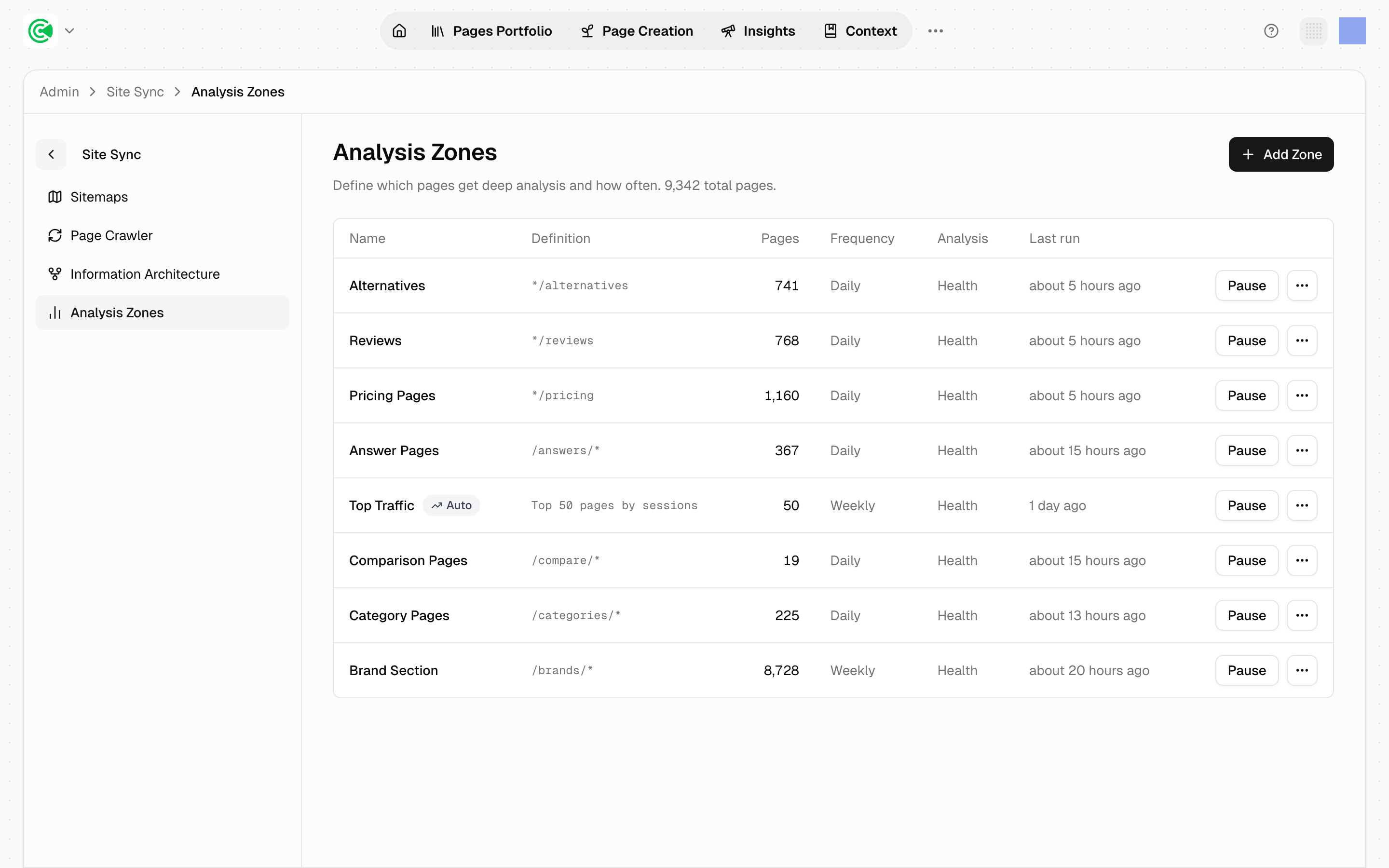
Analysis Zones: URL pattern or auto rule, plus frequency
Zones become the tabs across the top of the [Pages Portfolio](/docs/product/glossary#pages-portfolio), the list of every page on your site, so the way the site is divided here is the way you navigate it every day. That's the reason to read this screen even though [GrowthX maintains it](/docs/product/admin/roles-and-permissions).
Their other job is scheduling: zones decide which parts of your site get deep analysis and how often. GrowthX creates the zones, sets their frequency, and runs them. Your input is the judgement call underneath: how you want to read your site. When the tabs don't match how you think about it, tell your GrowthX team what the 4 or 5 groupings should be.
**Doing this rather than looking it up?** The Tutorial covers your side of the decision in [2.2 · Choose your zones](/docs/tutorial/set-up/choose-your-zones).
## Reference [#reference]
| Column | What it holds |
| -------------- | --------------------------------------------------------------------------------------------------------------- |
| **Name** | What the zone is called: the label that appears as a Portfolio tab. Rule-based zones carry an `Auto` badge here |
| **Definition** | The URL pattern, the rule text (`Top 50 pages by sessions`), or `Manually selected pages` |
| **Pages** | How many pages currently match |
| **Frequency** | Daily, Weekly or Monthly, with `(N sampled)` appended when the zone is sampled rather than run whole |
| **Analysis** | What analysis runs: see the caveat below |
| **Last run** | When it last completed |
The header shows total pages in the [workspace](/docs/product/glossary#workspace), which is the number to read your zone page-counts against.
**Frequency is elapsed time, not a calendar.** Weekly means "at least 7 days since this zone last ran", not "every Monday". So a zone whose last run is 6 days old on a weekly cadence isn't late, and a fresh result may land any time after the period elapses.
**Zones can overlap**, and a page can match more than one.
**A zone's scope change changes what gets analyzed and how much.** Widening a zone or raising its frequency increases the analysis run every cycle. GrowthX makes these changes; when you ask for one, say what you want the tabs to show, and let your team set the scope and frequency to match.
**Auto rules keep working as the site changes.** A `Top 50 by sessions` zone always covers your most valuable pages, including ones that didn't exist when it was created. Pattern zones only cover what the pattern matches, which is exactly right for structural sections and wrong for "the important stuff."
### What "Analysis" actually runs [#what-analysis-actually-runs]
Every zone has 4 analysis settings (**health**, the technical audit; **keywords**; **search intent**; and **AI Visibility**), each of which can be turned on or off per zone, and quality scoring cascades off the intent leg. Changes to a zone's analysis toggles appear in **Workspace Admin → Activity Feed** with the previous and new values.
The **Analysis** column reads `Health` on every row today. That is a display
bug, not the behaviour: the column checks for an analysis key named `serp` that
was renamed to `keywords` on the backend, so the keywords and intent legs never
render. All 3 analyses do run. A fix is tracked; read the column as
under-reporting until it lands.
# Admin & connections (/docs/product/admin)
Configuration rather than daily work. Your team manages users and branding; GrowthX configures the rest, and those screens are yours to read and verify. Check them when a site, a data source or a teammate changes.
Workspace Admin is the configuration hub: what you can edit, what you can see, and who can do what.
What Operators and Owners can edit, what everyone can only read, and the guardrails that apply to every workspace.
Websites is where you check that your site's analytics data is landing.
Site Sync is how GrowthOS learns what pages exist on your site and keeps that picture current. GrowthX configures it; you check the page count.
Zones become your Portfolio tabs and schedule deep analysis. GrowthX builds them; you decide how the site divides.
The MCP server gives an AI agent read-only access to your workspace from wherever you already work.
## Related [#related]
The Tutorial walks through granting access and connecting your first site: [see the guided path](/docs/tutorial/set-up).
# MCP server (/docs/product/admin/mcp-server)
**App route:** `/mcp_connection`
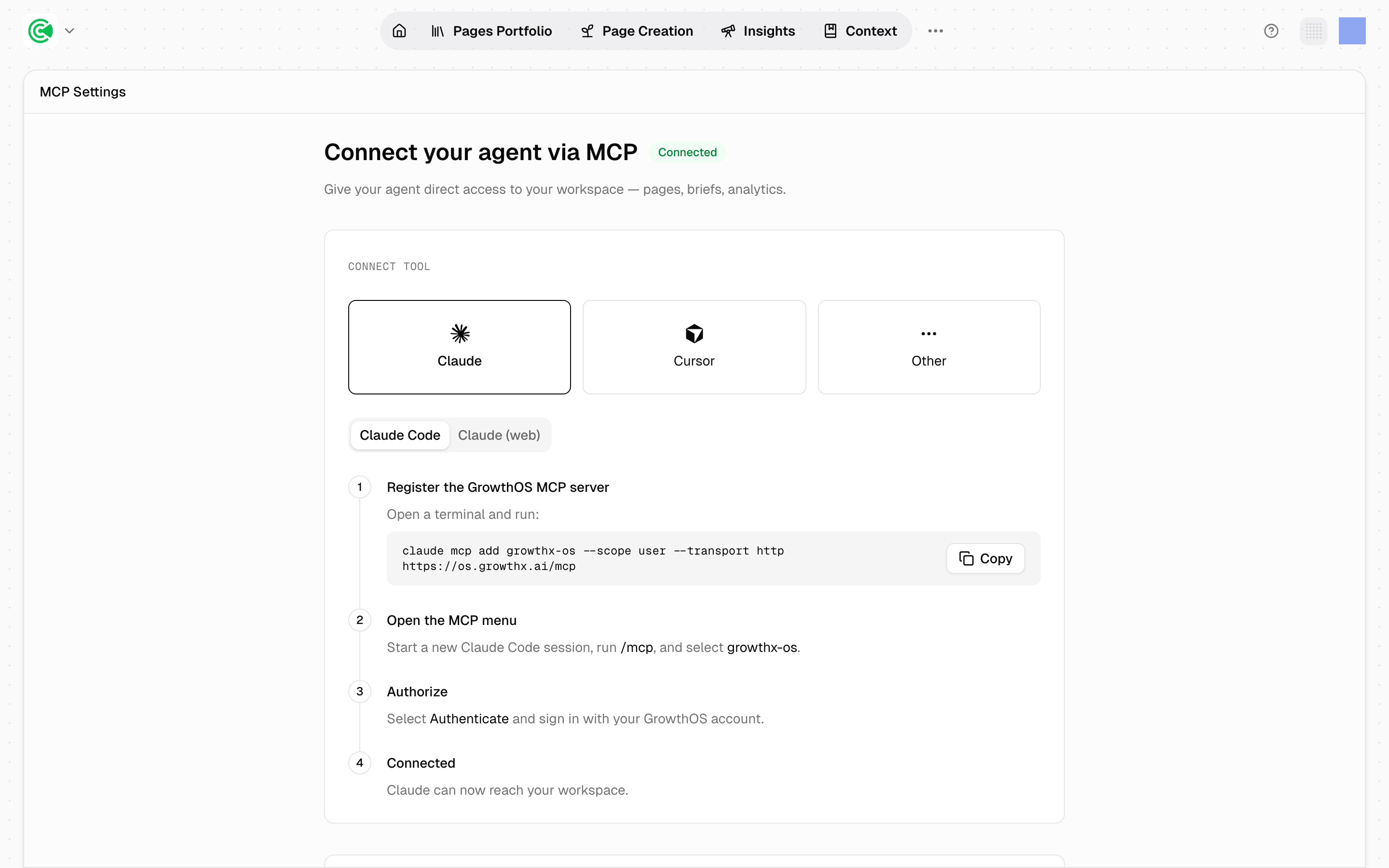
MCP connection setup, per client
The MCP server gives an AI agent direct access to your [workspace](/docs/product/glossary#workspace) (pages, [briefs](/docs/product/glossary#brief), [context](/docs/product/glossary#context) and analytics) from wherever you already work, read-only by default. A brief is the plan a draft is written from; context is what GrowthOS knows about your company. Instead of exporting a report to ask a question about it, you ask the question against live workspace data.
Setup takes about 10 minutes and is per-client: connecting Claude doesn't connect Cursor.
**Doing this rather than looking it up?** The Tutorial walks this screen step by step in [2.3 · Connect your agent via MCP](/docs/tutorial/set-up/mcp-setup).
## Reference [#reference]
**The default scope is read-only.** The screen groups the tools into 3 areas (Pages, Page Creation and Context), and **Show all tools** lists everything your account can reach. Some tools are reserved for the GrowthX team, so the list reflects your own access rather than the full server.
Read-only is the default, not the ceiling. Out of the box an agent can read your portfolio, your scores, your briefs and your context, and nothing it does can change the workspace. Letting it make changes is a separate, per-person opt-in on the sign-in screen, granted area by area and previewed change by change; [8.2 · Give your agent write access](/docs/tutorial/mcp/write-access) covers it.
`--scope user` in the registration command installs the server for your user account rather than a single project, so it's available in every session rather than one directory.
**The connection carries your permissions.** It isn't scoped to the workspace you happened to set it up from: in the rare case your account can reach several workspaces, the agent can query all of them. Worth knowing before you connect an agent on a shared machine.
**Connected means "has connected", not "is connected now."** The badge is set the first time an authenticated request arrives and is never cleared, so it won't tell you whether the link is live today.
### Disconnecting [#disconnecting]
**You disconnect on the client, not in GrowthOS.** There is no in-product button that
severs an MCP connection. The credential lives in your AI client, so removing it there
is what ends the connection:
```bash
claude mcp remove growthx-os
```
For Cursor and other clients, delete the `growthx-os` entry from the client's MCP
configuration.
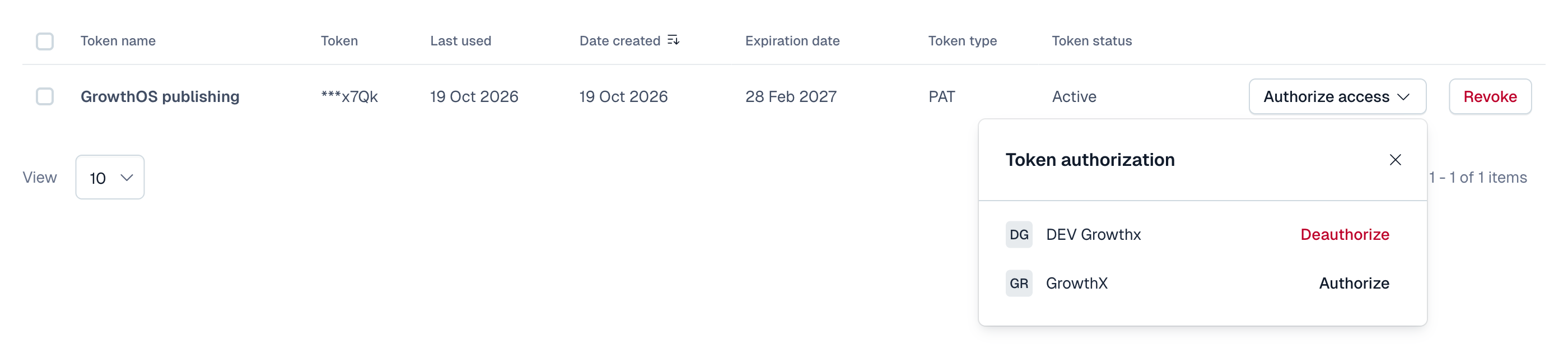
The **Revoke** button under **Tools → API Tokens** is a different credential, one
[GrowthX manages](/docs/product/admin/roles-and-permissions). It governs
programmatic API access and has no bearing on MCP: revoking a token won't
disconnect an agent, and removing an agent won't invalidate a token.
Two properties of the connection matter more than a disconnect button, and both work
in your favour:
**The authorization is short-lived.** The access token the connection uses expires
after 1 hour and is renewed against your account; the renewal credential itself
expires after 30 days. An abandoned connection stops working on its own.
**Access is re-resolved on every request.** The connection doesn't hold a snapshot of
what you could see when you set it up: each request looks up the workspaces your
account can reach right now. So removing someone from a workspace immediately removes
it from what their agent can query, and deactivating their account ends the connection
entirely. Account access is the real control here.
**It turns the workspace into something you can ask questions of.** The product answers the questions its screens were designed for. An agent with MCP access answers the ones nobody built a screen for: "which pricing pages lost position this month and share a persona", "summarise every brief in review against our writing profile."
**The read-only default is what makes it safe to hand to an agent.** The worst outcome of a bad query is a wrong answer, not a published page. That constraint is why the connection can be set up in 10 minutes without a review process. Write access is the deliberate exception, opted into per person and per area, with [its own rails](/docs/tutorial/mcp/write-access).
**It pays off most alongside creation and reporting.** Early in an engagement there isn't much in the workspace to interrogate. Once there's a scored portfolio and a few months of history, it becomes the fastest way to work.
### Agent kit [#agent-kit]
The connection decides what an agent can reach and whether it can write. The optional **GrowthOS agent kit** supplies the operating instructions: resolve the workspace before answering, read a full list before reporting a count, read a document before proposing a rewrite, and preview every change before applying it.
Installing the kit does not change permissions. A read-only connection stays read-only.
[8.3 · Install the GrowthOS agent kit](/docs/tutorial/mcp/agent-kit) walks the install and the verification prompts. The kit itself lives at [github.com/growthxai/growthos-agent-kit](https://github.com/growthxai/growthos-agent-kit).
# Roles and permissions (/docs/product/admin/roles-and-permissions)
Every question about a greyed-out control resolves to one of 3 tiers, so they're worth stating once.
## The 3 tiers [#the-3-tiers]
* **Yours to edit**: Manage Users, Workspace Name & Logo, and CMS Connections. In [Context](/docs/product/glossary#context), what GrowthOS knows about your company: [Personas](/docs/product/glossary#persona), [Taxonomy](/docs/product/glossary#taxonomy), Competitors and the [Writing Profile](/docs/product/glossary#writing-profile).
* **Visible but read-only**: Websites, [Site Sync](/docs/product/glossary#site-sync), AI Visibility, API Tokens, Activity Feed, and the generated context documents (Company Overview, Product Features, Ecosystem Map, ICP). GrowthX configures and corrects these; when something in them is wrong, tell your team rather than looking for the edit button.
* **GrowthX-managed**: a few configuration areas, content templates among them, are operated by GrowthX and appear only to the GrowthX team.
If a control looks inert, it's the tier, not a bug.
## Operator and Owner [#operator-and-owner]
[Workspace](/docs/product/glossary#workspace) membership is **Operator** or **Owner**. Both can research, brief, write, read analytics, and invite teammates. Both can also connect a CMS, map collections, and publish articles: CMS publishing is no longer Operator-only.
The invite dialog may describe Owner as also covering workspace transfer, workspace deletion and billing. Those aren't capabilities the product has, in either role: the copy is being corrected. GrowthX handles ownership transfer, deletion and billing; ask your [strategist](/docs/product/glossary#strategist), your GrowthX contact.
A separate **Admin** badge can appear next to a person's name. That's a GrowthX platform role, not a workspace role, and it's independent of the Operator/Owner column.
## The guardrails [#the-guardrails]
3 rules apply to everyone, in every workspace:
* You can't remove yourself.
* You can't change your own role.
* A workspace must keep at least one Operator, so the last one can't be removed or demoted.
These exist so a workspace can't strand itself. When you genuinely need one of these changes, your GrowthX team makes it.
## Access is by invitation [#access-is-by-invitation]
You see the workspaces you've been enrolled in, and nothing else. A workspace you expect but can't see means a missing invitation, not a missing filter: ask a workspace Owner or Operator to invite you.
# Site Sync (/docs/product/admin/site-sync)
**App route:** `/admin/site_sync`
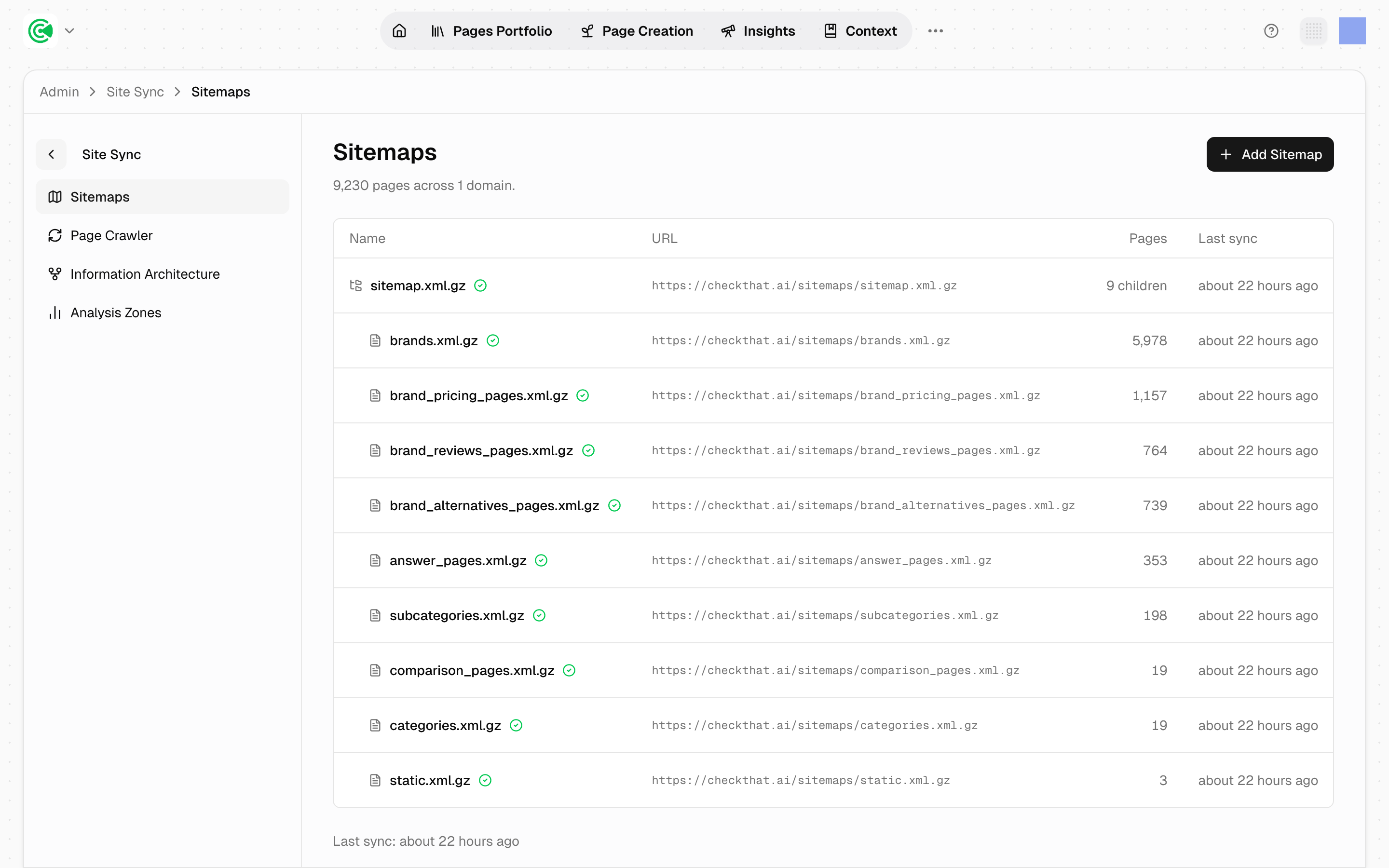
Site Sync: sitemaps and the page crawler
[Site Sync](/docs/product/glossary#site-sync) is how GrowthOS learns what pages exist on your site and keeps that picture current. Your sitemaps define the set of pages; the [crawler](/docs/product/glossary#crawl) visits them and records what it finds. Everything in the [Pages Portfolio](/docs/product/glossary#pages-portfolio), the list of every page on your site, starts here: a page that Site Sync can't see does not exist as far as the rest of the product is concerned.
GrowthX registers the sitemaps, sets the sync cadence, and [maintains this screen](/docs/product/admin/roles-and-permissions). Your job here is to read it and check it, and there is one check that's genuinely yours: whether the page count matches what you believe your site contains.
**Doing this rather than looking it up?** The Tutorial covers your side of it, the count check, in [2.1 · Connect your data](/docs/tutorial/set-up/connect-your-data).
## Reference [#reference]
Site Sync has 4 areas in its sub-navigation: **Sitemaps**, **Page Crawler**, **Information Architecture**, and **Analysis Zones**.
The Sitemaps table lists each sitemap with:
| Column | What it holds |
| ------------- | ------------------------------------------------- |
| **Name** | The sitemap filename |
| **URL** | Where it's fetched from |
| **Pages** | Pages found, or `N children` for an index sitemap |
| **Last sync** | When it was last read |
The header gives the totals (pages across domains), and a single **Last sync** timestamp for the whole set sits at the bottom.
Compressed sitemaps (`.xml.gz`) are supported, and the crawler reads index sitemaps recursively.
### What the crawler checks [#what-the-crawler-checks]
The crawl feeds a page's **Health** score: a technical audit of **77 checks** grouped into **13 categories**. (The crawl and the audit are separate steps: the crawler fetches pages, and a health audit scores them.)
| Category | Examples of what it checks |
| --------------- | ----------------------------------------------------------------------------- |
| `crawlability` | indexability, canonical chains, redirect chains, sitemap coverage, robots.txt |
| `core_seo` | title, meta description, H1, canonical, charset, Open Graph, Twitter cards |
| `content` | word count, heading hierarchy, freshness, duplicate descriptions, author info |
| `links` | broken internal and external links, dead ends, HTTPS downgrades |
| `performance` | TTFB, compression, cache headers, CSS/JS weight, render-blocking resources |
| `schema` | Article, FAQ, Breadcrumb, Organization, Product, Review, JSON-LD validity |
| `url_structure` | length, hyphens, case, parameters, stop words, trailing slash |
| `images` | alt text, broken images, file size |
| `security` | HTTPS, mixed content |
| `social` | OG image, og:url matching canonical, social profile tags |
| `i18n` | `lang` attribute, hreflang |
| `local_seo` | NAP consistency via LocalBusiness or Organization schema |
| `analytics` | Tracking and consent: tag-manager presence, consent-mode integration |
Every check returns **pass**, **warn** or **fail** with a human-readable message and the underlying values: a failing TTFB check names the measured value and the limit, a title-length warning names the count and the recommended range. Each category gets its own score, and the page's overall Health is derived from them, so a page can sit at 89 overall while carrying a category at 50.
Read the individual checks on [Page detail](/docs/product/pages/page-detail) rather than here: this screen defines the crawl's scope, it doesn't display results.
**Your sitemap decides your portfolio.** This is the single most consequential fact about Site Sync. If a section of the site is missing from the sitemap, it's missing from the Portfolio, missing from scoring, and missing from every report: silently. There's no error state for "pages you never told us about." Comparing the page total against what your own CMS says is the one check that catches it, and it's yours to run.
**Sync frequency is a data-freshness lever, not a performance one.** A sitemap synced daily reflects new pages within a day; on a fast-publishing site, a weekly sync means the Portfolio lags reality by up to a week. GrowthX sets the cadence, so if your publishing pace has outgrown it, raise it with your [strategist](/docs/product/glossary#strategist), your GrowthX contact.
**Segmented sitemaps are worth the effort.** Splitting by section (one sitemap per content type rather than a single monolith) makes the page counts on this screen diagnostic. When a count drops, you know which part of the site changed. Your site generates the sitemaps, so this split is yours to make; GrowthOS picks the pieces up from the index automatically.
# Websites (/docs/product/admin/websites)
**App route:** `/admin/websites`
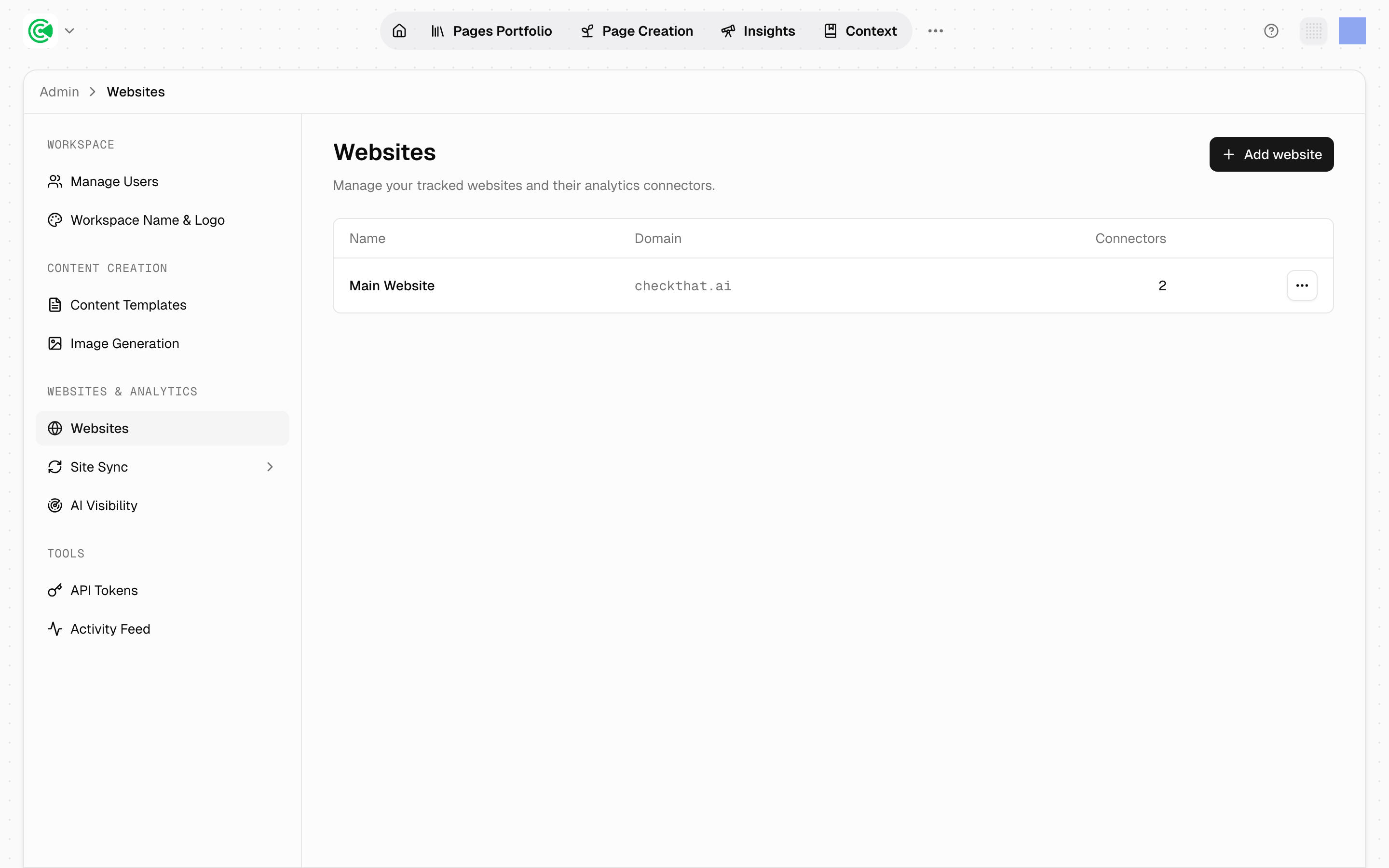
Websites, with the GA4 and GSC connectors
Websites is where you check that your site's data is landing. GrowthX registers the site and wires its [connectors](/docs/product/glossary#connector), the links to Google Analytics and Search Console, during onboarding. Your part happens in GA4 and Search Console, where you add the service account, and [GrowthX maintains this screen](/docs/product/admin/roles-and-permissions): you come here to verify that what you granted actually arrived.
The 2 connectors that matter are **Google Analytics** and **Google Search Console**. Between them they supply every traffic and visibility number in the product, so checking them is the whole job here.
**Doing this rather than looking it up?** The Tutorial walks this screen step by step in [2.1 · Connect your data](/docs/tutorial/set-up/connect-your-data).
## Reference [#reference]
| Status | Meaning |
| ---------------- | ------------------------------------------------------------------------------------------------- |
| **Connected** | Access was granted and accepted |
| **Synced** | Data has actually landed, with a timestamp |
| **Sync failed** | Access was accepted but the pull didn't complete |
| **Disconnected** | The connector's access token expired or was revoked, so pulls have stopped until it's reconnected |
**Connected is not Synced.** Access can be granted correctly and data still not arrive. Read the timestamp, not the badge.
**Sync failed almost always means the service account is missing** from the property, or was added to the wrong one. On a site with several GA4 properties, the account must be on the property that actually covers the domain GrowthOS manages.
**Disconnected means access itself was lost**, not that a pull failed. Revoking the service account, or an agency rotating credentials, lands here rather than in Sync failed. Restore the account's access in GA4 or Search Console, then tell your GrowthX team so they can reconnect.
**One website, one set of connectors.** Most [workspaces](/docs/product/glossary#workspace) track a single site, so there is one pair of connectors to check. If your workspace tracks several sites, each site connects separately: check the connector status per site, not once.
**Everything downstream is a read of this data.** Traffic bands, impressions capture, the Big Picture score, half of every report: all of it resolves back to GA4 and Search Console. A workspace with no connectors still produces Health scores, because those come from the [crawl](/docs/product/glossary#crawl), GrowthOS reading your sitemap to build its copy of your pages, but every performance number will be empty.
**Read-only by design.** The service account is a viewer. Nothing GrowthOS does can alter your analytics configuration, which is why granting access is a low-risk step that doesn't need a change window.
**Grant access before anything else is worth doing.** Setup, scoring and opportunity research all reason about performance. Running them before the connectors land produces confident output built on nothing, which is why adding the service account is the first step of the tutorial.
# Analytics & reports (/docs/product/analytics-and-reports)
Insights is where data from your [Pages Portfolio](/docs/product/glossary#pages-portfolio), the list of every page on your site, becomes something you can hand to someone else: a report with a narrative, not a dashboard with a date range.
Insights is where portfolio data becomes something you can hand to someone else.
## Related [#related]
The Tutorial walks through generating and sharing a report: [see the guided path](/docs/tutorial/report).
# Insights (Reports) (/docs/product/analytics-and-reports/insights-reports)
**App route:** `/reports`
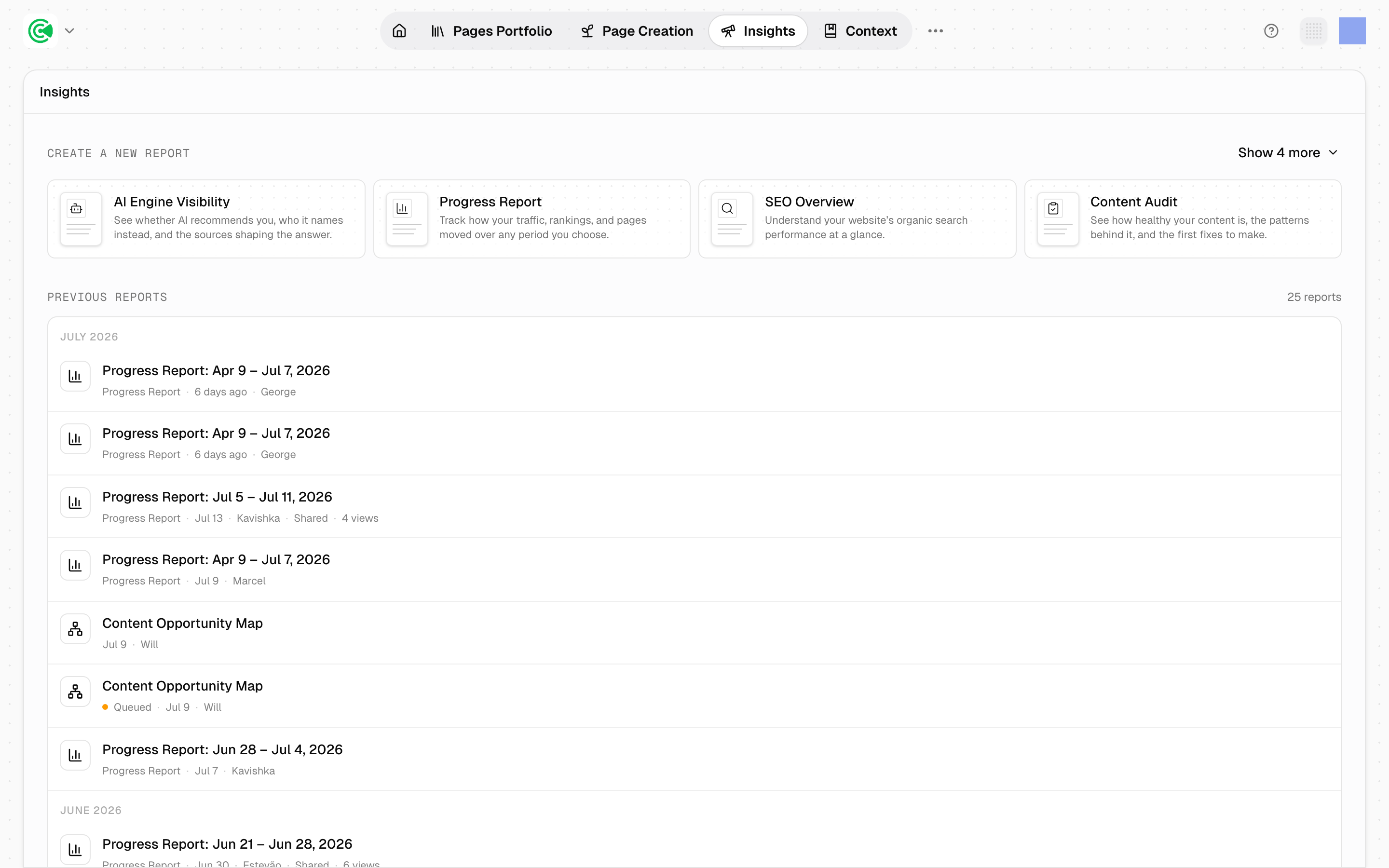
The report list and the 8 report types
Insights is where data from your [Pages Portfolio](/docs/product/glossary#pages-portfolio), the list of every page on your site, becomes something you can hand to someone else. Pick a report type, set its scope, generate it, and share it as a link that needs no login.
**Doing this rather than looking it up?** The Tutorial walks this screen step by step in [6.1 · Read your reports](/docs/tutorial/report/insight-reports).
## Reference [#reference]
**The 8 report types:**
| Report | What it shows |
| ---------------------------- | -------------------------------------------------------------------------------------------------------------------------------------------------------------------------------------------------------- |
| **AI Engine Visibility** | How AI answer engines see and cite you: citation status, visibility scoring, per-engine rankings |
| **SEO Overview** | Domain performance: traffic, rankings, authority, performance by page type, competitive position |
| **Competitive Landscape** | Competitor tiering, keyword overlap, traffic and growth trends |
| **Information Architecture** | URL taxonomy, page-type distribution, structural depth, hub analysis |
| **Content Audit** | Per-page Coverage, where it's enabled for your workspace, against traffic and Health, with pages flagged for attention |
| **Content Opportunity Map** | [Opportunity](/docs/product/glossary#opportunity) [clusters](/docs/product/glossary#cluster) (groups of pages worth creating or rewriting around one theme) against current coverage, with a phased plan |
| **Progress Report** | A date-range snapshot: sessions, impressions, rank movers, what was created, each rewrite's before-and-after effect, and what new pages earned |
| **Custom Report** | Your own off-platform research, in the same format |
3 further types (Competitor Deep Dive, Content Traffic Trends and Zone Deep Dive) are registered but not yet available.
**Some reports have prerequisites.** SEO Overview needs a Company Overview; Competitive Landscape needs at least 1 competitor; AI Engine Visibility needs subscribed [AI visibility segments](/docs/product/glossary#ai-visibility-segment), and won't run until the AI engines have been asked about your brand. A report that can't run says which input is missing.
**A rendered report is an argument, not a data dump.** Each one opens with a headline finding, then the metric tiles and sections that support it. That shape exists because the audience is usually someone who won't log in and doesn't want a table.
**Progress is the one to reach for repeatedly.** The others describe a state; Progress describes a change, which is what most reporting conversations actually need.
**Shareable without a login is a deliberate trade.** Sending a report is pasting a link, and that same property means a link is a credential: revoke it when the engagement or the audience changes.
# Clusters (/docs/product/briefs/clusters)
**App route:** `/topic_clusters`
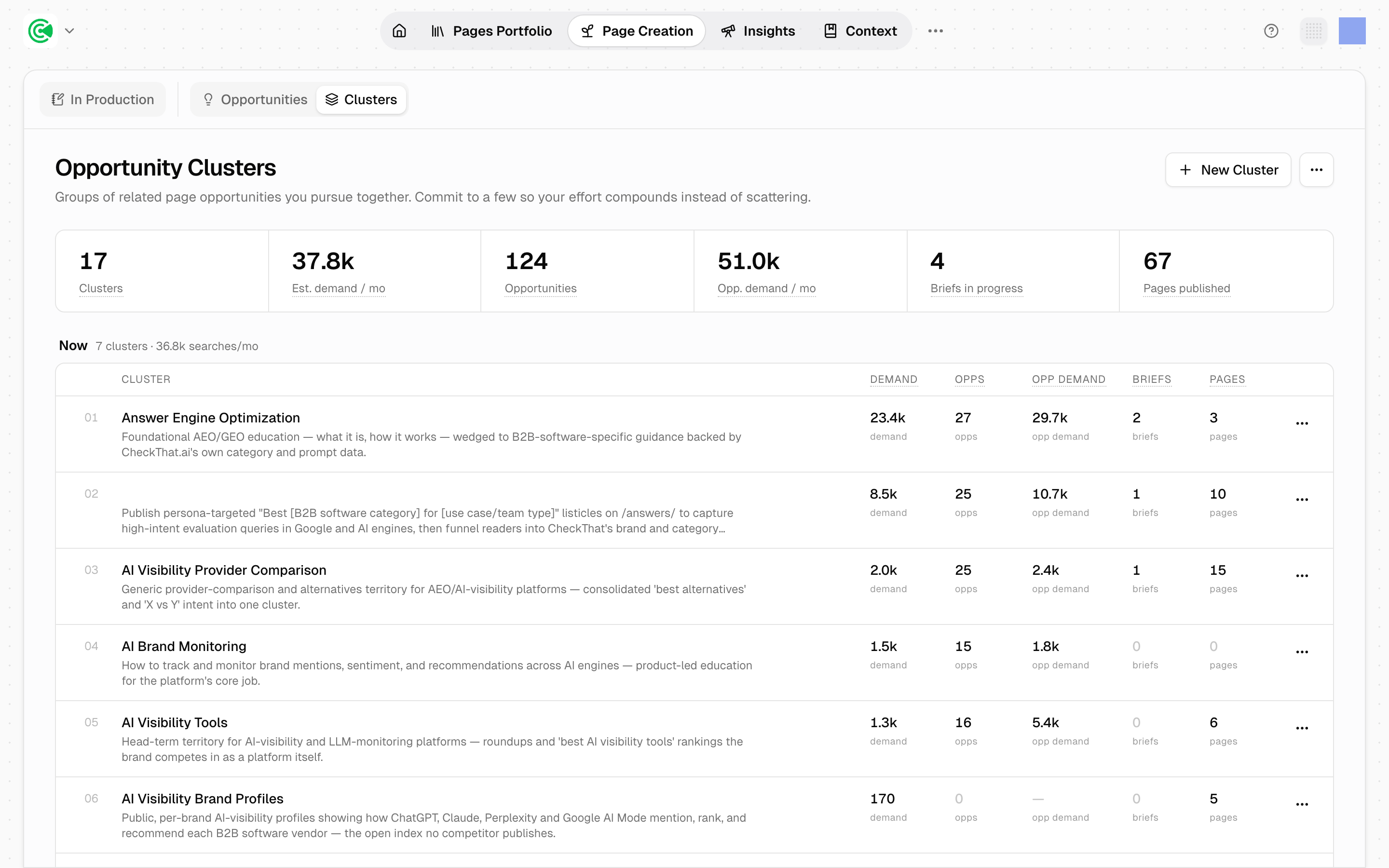
Clusters, grouped into Now / Next / Later / Unprioritized
A [cluster](/docs/product/glossary#cluster) is a territory you've decided to own: a group of related [opportunities](/docs/product/glossary#opportunity) (pages worth writing or rewriting, proposed by an [agent](/docs/product/glossary#agent)) built around one topic and worked as a set. Clusters are where strategy actually enters the product: [Topics](/docs/product/context-and-voice/topics), the map of what your market asks about, shows you the demand, and a cluster is you committing to answer a coherent slice of it.
It's also the default path into production. Most work reaches a [brief](/docs/product/glossary#brief), the plan for one page, through a cluster rather than through a single opportunity picked off a list.
**Deleting a cluster removes the territory itself: its topics and their questions.** Opportunities the cluster already produced survive, losing only the cluster link. A cluster you might come back to belongs in Later rather than the bin.
**Doing this rather than looking it up?** The Tutorial walks this screen step by step in [4.1 · Align on strategy](/docs/tutorial/find/content-clusters).
## Reference [#reference]
The header summarizes the whole set: total clusters, estimated monthly demand, opportunity count, opportunity demand, briefs in progress, and pages published.
Each cluster row carries:
| Column | What it means |
| -------------- | ----------------------------------------------------------- |
| **Cluster** | A rank number, the name, and the territory description |
| **Demand** | Estimated monthly search demand across the cluster's topics |
| **Opps** | Opportunities generated inside it |
| **Opp demand** | Monthly demand represented by those opportunities |
| **Briefs** | Briefs currently in production |
| **Pages** | Pages already published into the territory |
**Opportunity demand often exceeds cluster demand.** That isn't an error: opportunities include long-tail queries beyond the topics that defined the cluster.
**Each band is its own group**, with its own cluster count and demand subtotal. Empty bands are hidden, so a [workspace](/docs/product/glossary#workspace) (everything GrowthOS knows and does for one brand) using only Now and Next looks like a 2-band screen.
**Row numbers are position within a band, not priority.** Rows sort by demand descending, then alphabetically. Priority lives in the band header: the number beside a cluster says nothing about how it ranks against the one below it.
**The funnel columns are a diagnostic.** High demand with many opportunities and no briefs is a cluster you committed to and never started. Many pages with low demand is one you over-served. Reading across a row is faster than any report.
## Why it works this way [#why-it-works-this-way]
* [Why committing to a few compounds](/docs/product/concepts/committing-to-a-few)
# In Production (/docs/product/briefs/in-production)
**App route:** `/page_briefs`
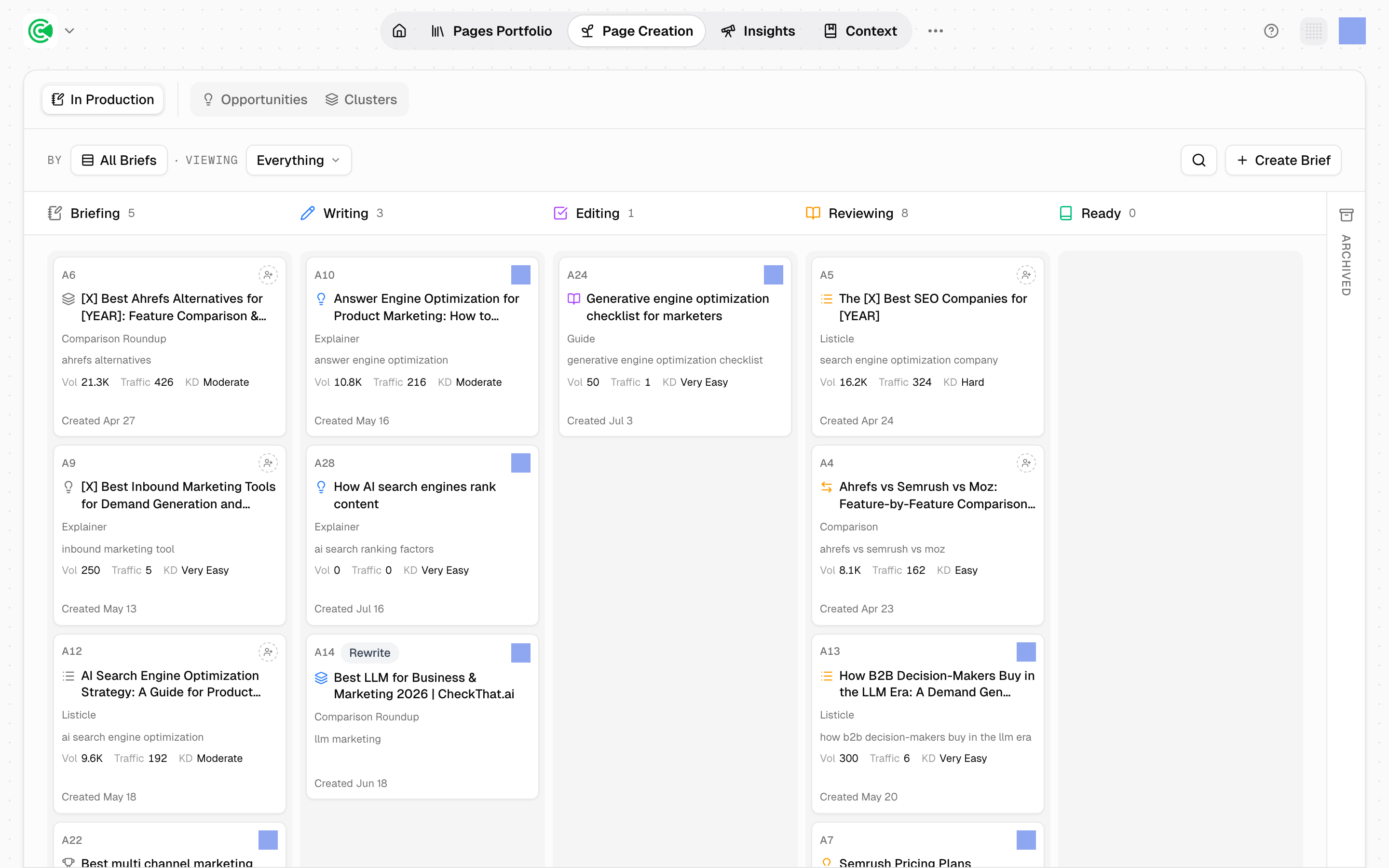
The In Production kanban: Briefing → Ready
In Production is the board where [briefs](/docs/product/glossary#brief), the plans a page is written from, become pages. Each card is one piece of work moving left to right, with an owner and a due date at every stage.
**Doing this rather than looking it up?** The Tutorial walks this screen step by step in [5.1 · Four ways to start a page](/docs/tutorial/write/start-a-page).
## Reference [#reference]
**7 board columns, in order:**
`Briefing → Writing → Editing → Reviewing → Ready → Published → Archived`
Editing comes **before** Reviewing. Editing is your own polish pass on the draft; Reviewing is where you invite other people to comment. Getting that order the wrong way round is a common misreading: the board is arranged so your pass happens first and other people see something you already stand behind.
**Published and Archived are collapsed columns at the end of the board** that expand in place, with Published open by default. You can restore an archived brief to the column it came from.
**Brief modes:** `creation` (new page), `rewrite` (tied to an existing URL), and `import` (a draft you supply). The product term is **rewrite**, not "refresh".
**5 inputs make a brief dispatchable:** title, primary keyword, search intent, [personas](/docs/product/glossary#persona) (the buyers your content speaks to), and a content template. Accepting an [opportunity](/docs/product/glossary#opportunity), a candidate page an agent proposed, fills most of them in.
**A rewrite keeps the original URL.** The brief attaches to the live page and pre-fills its slug, so the page's history stays intact rather than a near-duplicate appearing alongside it.
**Ready is not published.** Ready means the work is finished and the metadata is set. Publishing is a separate, deliberate act.
## Why it works this way [#why-it-works-this-way]
* [Reading a portfolio](/docs/product/concepts/reading-a-portfolio)
* [Why committing to a few compounds](/docs/product/concepts/committing-to-a-few)
# Opportunities & briefs (/docs/product/briefs)
This is where work gets chosen and made. [Opportunities](/docs/product/glossary#opportunity), pages worth writing or rewriting that an [agent](/docs/product/glossary#agent) proposes, surface the candidates; a [cluster](/docs/product/glossary#cluster), a group of related opportunities worked as a set, commits you to a territory; and the editor turns a [brief](/docs/product/glossary#brief), the plan for one page, into a draft.
Accepting an opportunity is the only action that starts production, so triage is where your judgement matters most.
Opportunities are candidate pieces of work, scored and queued.
Not every opportunity means a new page.
A cluster is a territory you have decided to own: related topics you intend to cover properly rather than glance at.
In Production is the board where briefs become pages.
The page editor is where a brief becomes a page.
## Related [#related]
The Tutorial walks from triaging opportunities to publishing a page: [see the guided path](/docs/tutorial/find).
# Opportunities (/docs/product/briefs/opportunities)
Triage here has 1 action with real consequence: **accepting**. Accepting an opportunity creates a brief and starts production; every other move (considering, dismissing, archiving) only reorders the backlog. Read this page with that asymmetry in mind.
**App route:** `/opportunities`
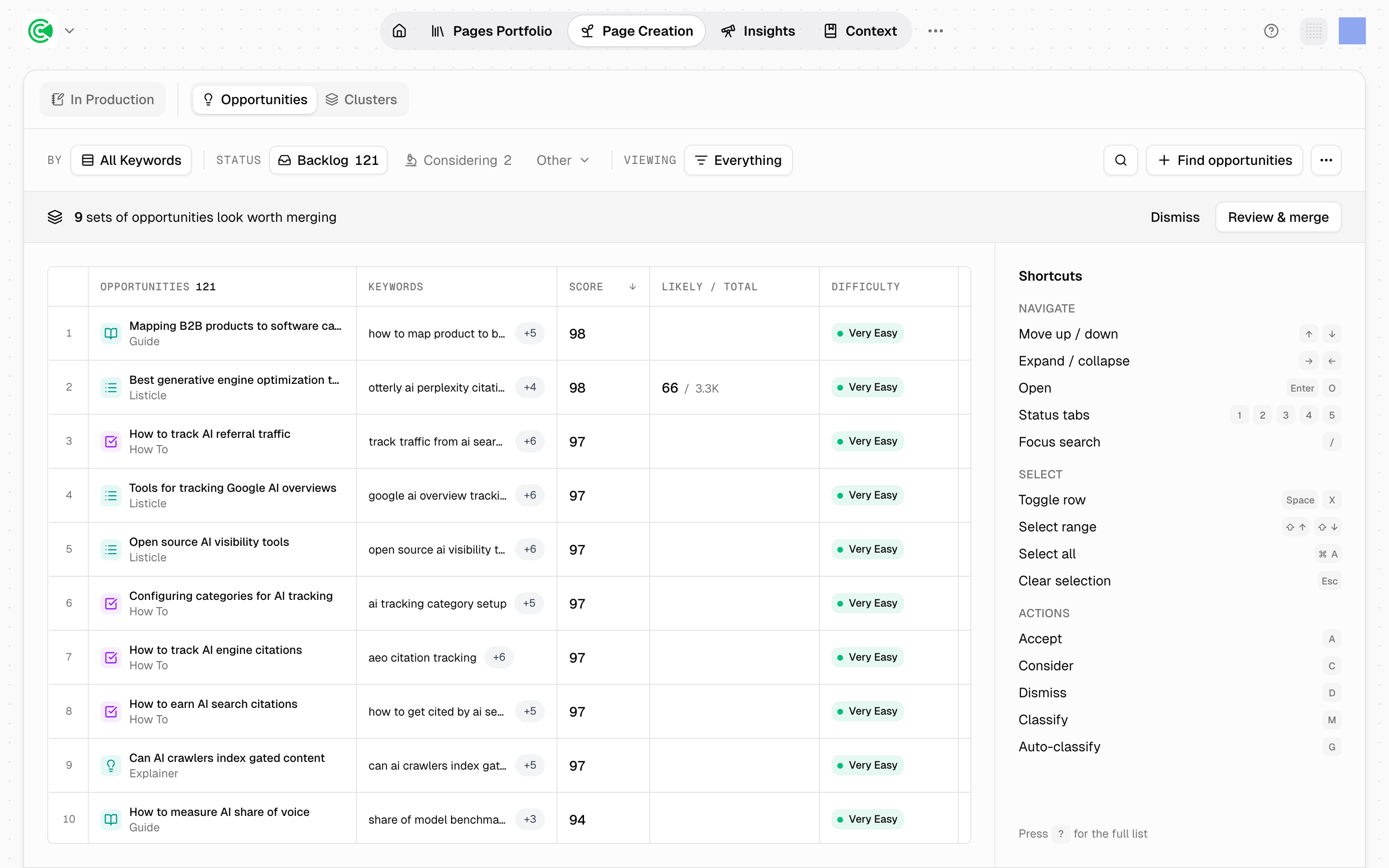
Opportunities triage: score, difficulty, accept / dismiss
[Opportunities](/docs/product/glossary#opportunity) are candidate pieces of work, scored and queued. Research [agents](/docs/product/glossary#agent), the automated workers inside GrowthOS, surface them from your [clusters](/docs/product/glossary#cluster) (groups of related opportunities built around one topic) and from your own ideas; your job is to triage: accept the ones worth a page, dismiss the rest, and keep the backlog honest.
**Doing this rather than looking it up?** The Tutorial walks this screen step by step in [4.2 · Generate opportunities](/docs/tutorial/find/find-opportunities).
## Reference [#reference]
**7 states**, not all of them visible as columns:
| State | Meaning |
| ------------- | ------------------------------------------------------------------------------- |
| `seed` | Raw idea you pasted in, not yet developed |
| `developing` | An agent is working it up |
| `backlog` | Scored and waiting for triage |
| `considering` | Shortlisted |
| `accepted` | Became a [brief](/docs/product/glossary#brief), the plan a page is written from |
| `dismissed` | Rejected |
| `archived` | Cleared out of the way |
`seed` and `developing` are the intake path for your own ideas and appear in their own lane. `backlog` and `considering` are the only 2 the system counts as open.
**Considering does nothing on its own.** Moving an opportunity there is a bookmark, not a commitment: nothing is generated, no brief is created, and no agent starts work. It exists so you can empty the Backlog in one pass without deciding everything at once, then come back to a shortlist you have already thought about.
**Accepting is the only action that starts production.** Accept an opportunity and it becomes a brief on the [In Production](/docs/product/briefs/in-production) board. If you are not ready to commit, move it to `considering` instead.
**The score is a weighted blend of 6 signals**: relevance carries the most weight, then demand, then difficulty and cluster priority, with intent and coverage contributing least. A missing signal is neutral rather than a penalty, so a sparse opportunity isn't pushed down for being sparse.
**Badges flag things the score can't express**: that your brand already ranks for the term, or that the opportunity likely overlaps a page you've already published.
**Overlap is flagged, not resolved.** When an opportunity looks like a page you already have, GrowthOS marks it. Deciding whether that means a rewrite instead of a new page is still yours.
## Why it works this way [#why-it-works-this-way]
* [Why committing to a few compounds](/docs/product/concepts/committing-to-a-few)
# Opportunity types (/docs/product/briefs/opportunity-types)
**App route:** `/opportunities · /page_briefs · /pages`
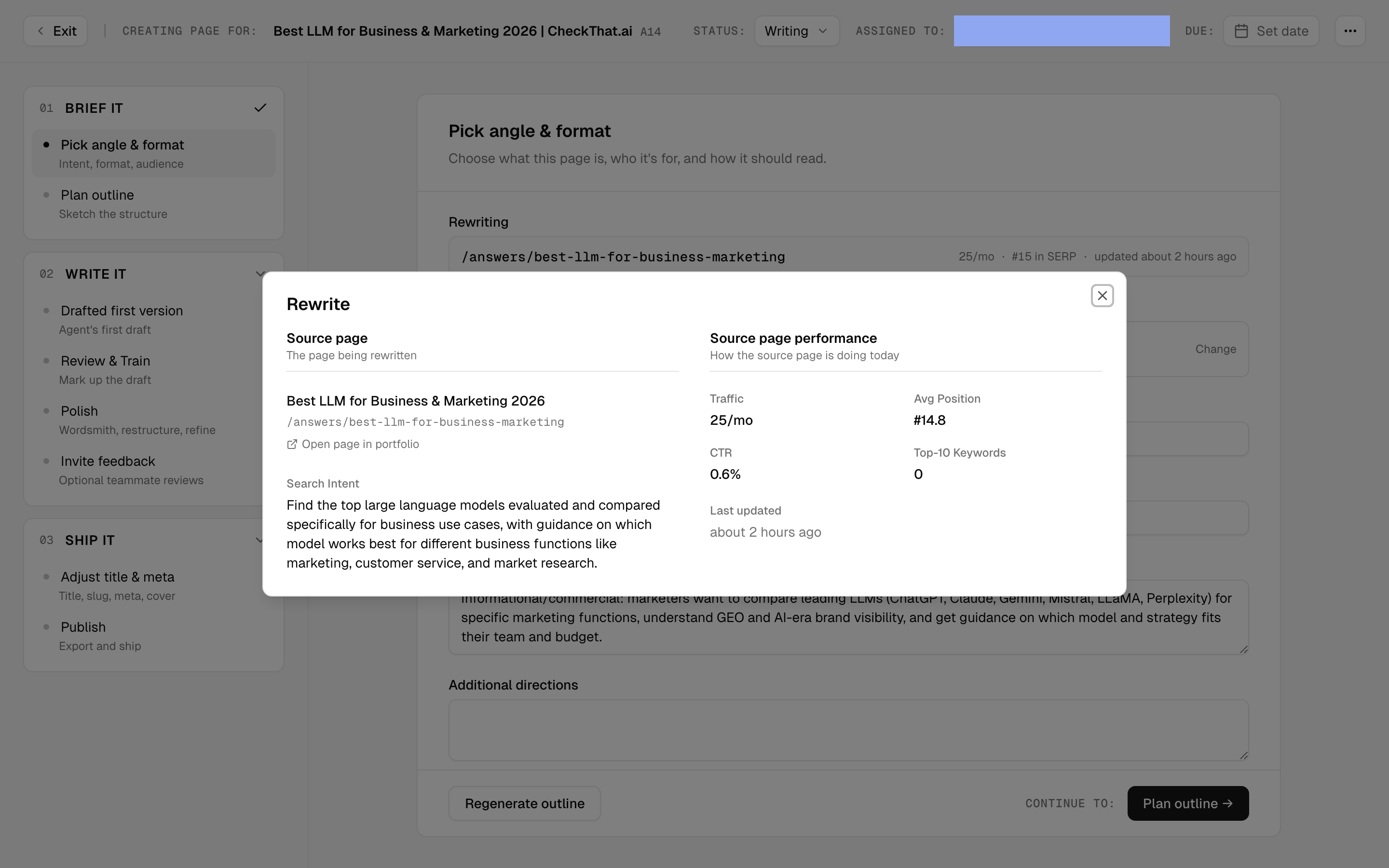
A rewrite opportunity, showing the live page it is attached to and how that page performs today
Not every [opportunity](/docs/product/glossary#opportunity), a page worth writing or rewriting that an [agent](/docs/product/glossary#agent) proposes, means a new page. Most of the work a mature site needs is fixing, consolidating and rewriting what's already there, and the opportunity surface reflects that.
**Doing this rather than looking it up?** The Tutorial walks this screen step by step in [4.3 · Manage opportunities](/docs/tutorial/find/triage-opportunities).
## Reference [#reference]
**There are 2 kinds of opportunity.** Accepting either one creates a [brief](/docs/product/glossary#brief), the plan a page is written from, and starts production:
| Kind | What accepting it does |
| ------------ | -------------------------------------------------------------------- |
| **New page** | Creates a brief for a URL that doesn't exist yet |
| **Rewrite** | Creates a brief attached to a live page, keeping its URL and history |
Everything else you'll see on an opportunity is a **signal on one of those 2**, not a separate kind:
* **Cannibalization**: a note on the opportunity describing pages of yours that compete with each other.
* **Coverage overlap**: a badge meaning this likely duplicates something you've published.
* **Internal links**: link suggestions are available to an agent through the MCP connection rather than as an opportunity you accept.
A rewrite brief skips the template choice at acceptance; you pick it when you set the angle.
**The badge is a prompt, not a decision.** Overlap detection is good at spotting similarity and bad at knowing whether 2 pages *should* be distinct. That judgement stays with you.
## Why it works this way [#why-it-works-this-way]
* [Why committing to a few compounds](/docs/product/concepts/committing-to-a-few)
# Page editor (/docs/product/briefs/page-editor)
**App route:** `/page_briefs/{id}`
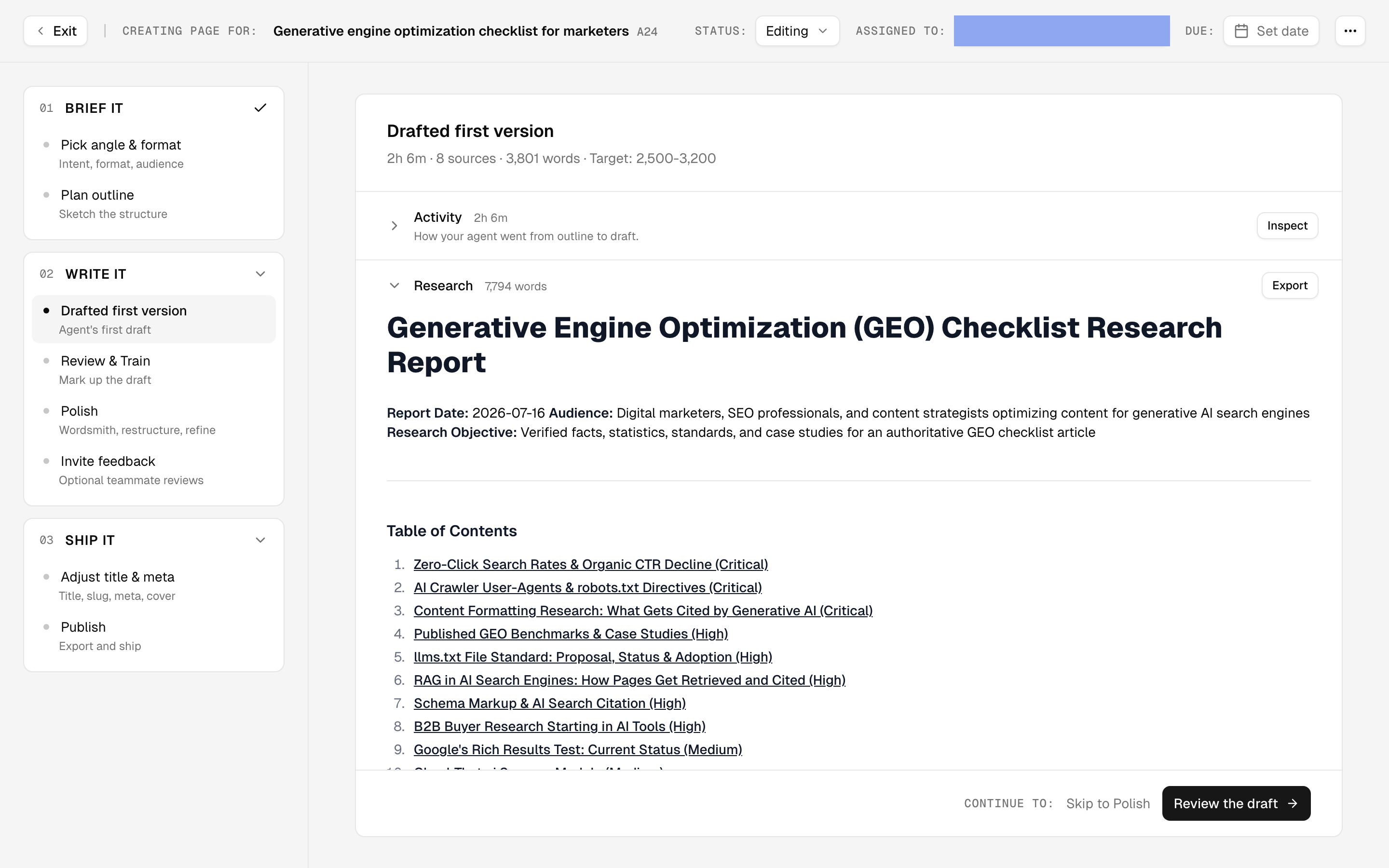
The page editor at the Write it step, with the 8 steps down the rail
The page editor is where a [brief](/docs/product/glossary#brief), the plan for one page, becomes the page itself. It runs as 8 steps across 3 phases (brief it, write it, ship it), with an [agent](/docs/product/glossary#agent)(an automated worker) doing the production and you steering at each handoff.
**Doing this rather than looking it up?** The Tutorial walks this screen step by step in [5.2 · The briefing process](/docs/tutorial/write/brief-anatomy).
## Reference [#reference]
**Annotation scope:** just this article or every article. An [annotation](/docs/product/glossary#annotation) is a note you leave on a draft saying what is off and why, instead of silently rewriting it. The composer has no type picker: pick **Just this article** for a one-off fix, or **Every article** to make the note a standing rule for future drafts once it folds into the [writing profile](/docs/product/glossary#writing-profile), the compiled version of how you sound. Notes you save as a workspace member show their scope underneath; notes left through a guest review link do not.
**Annotations train nothing until the profile updates.** They accumulate as pending feedback and fold into the writing profile when **Update profile** is clicked on [Writing Profile](/docs/product/context-and-voice/writing-profile), or when a rewrite runs with the profile update toggle on. Turn the toggle off in the rewrite dialog to defer the teaching part when you only want the edits.
**Content templates** decide the funnel stage, the outline structure, the post-processing an agent runs after drafting, and which agents run at all. You can create your own; the stock set is a starting point rather than a fixed menu.
**A template is not a page type.** Page type classifies pages that already exist. A template is an input that shapes one you're making.
**Metadata fields set at Ship it:** title, meta title, meta description and slug, plus the article's author when the collection you publish to has an author field mapped. Meta title and description carry the usual length guidance.
**Sharing for review** issues a link that invites someone by email. External reviewers annotate in the same surface your team does, but they cannot set a note's scope.
## Why it works this way [#why-it-works-this-way]
* [Agents draft, you decide](/docs/product/concepts/agents-draft-you-decide)
# Agents draft, you decide (/docs/product/concepts/agents-draft-you-decide)
GrowthOS is built on one division of labour: [agents](/docs/product/glossary#agent), the automated workers that research, draft and score, do production, and you do judgement. Every stage produces a proposal and stops. Nothing advances on your behalf, and nothing publishes itself.
Some runs do start on their own: [Setup Autopilot](/docs/product/glossary#setup-autopilot), the chain of agents that drafts your context before you first sign in, runs when a [workspace](/docs/product/glossary#workspace) (everything GrowthOS knows and does for one brand) is created, and your GrowthX [strategist](/docs/product/glossary#strategist) triggers analysis runs. What they produce is still a proposal waiting on you.
That constraint is what makes it safe to let an agent write. It's also the thing most likely to make the product feel slow if you were expecting automation, and the thing that makes it compound if you work with it rather than around it.
## Speed bought with assumptions [#speed-bought-with-assumptions]
A new workspace is usable within hours instead of after a research engagement. Autopilot buys that speed by making assumptions from public sources, and the price is that some of those assumptions are wrong in ways only you can see.
The failure mode is specific: every stage produces *plausible* prose. Nothing in the product distinguishes an agent's guess from a human-confirmed fact. Research can only find what is public, so the gaps are predictable:
* positioning you have changed recently
* the customers you actually convert, as opposed to the ones you target
* anything you say in sales calls but never publish
That is why the first real task in a new workspace is reading [Foundation](/docs/product/context-and-voice/foundation), the 4 base [context](/docs/product/glossary#context) documents (Company Overview, Ecosystem, Product & Features, Ideal Customer), end to end rather than skimming it.
**Reading is the job here, because you are the only one who can catch what is wrong.** When you find something, correct it yourself: each document opens in an editor, you type over the wrong claim, and it saves as you type. **Last edited** changes from `Agent` to your name. When a document is wrong from top to bottom, ask your strategist to regenerate it instead of editing line by line. Either way, that correction is worth more than any single page edit, because every later draft reads from it.
## Ready does not mean checked [#ready-does-not-mean-checked]
A document's status in Context reads **Ready** when it has text in it, and nothing more. GrowthOS sets that status when the text lands; it does not record that a person has read it.
The **Last edited** column is the review log: anything still attributed to `Agent` has never been looked at by a person. Track your own review pass, because the product will not track it for you.
## Annotation is the training signal. Editing is not. [#annotation-is-the-training-signal-editing-is-not]
This is the single habit that separates a workspace that improves from one that stays generic.
When a draft is wrong, you can silently rewrite it or you can leave an [annotation](/docs/product/glossary#annotation), a note saying what is off and why. Both produce a correct page. Only one of them teaches the next draft.
The first few pieces cost real editorial time either way. Put that time into annotations and the pieces that follow need less of it. Put it into silent rewrites and you're still paying the same price 40 pieces later.
**And annotations do not train anything until the profile updates.** They fold into your voice through the [Writing Profile](/docs/product/context-and-voice/writing-profile), the compiled version of how you sound, when a rewrite runs with its profile update on. A toggle in the rewrite dialog lets you skip that update on rounds where you only want the edits.
Each rewrite round shows which Writing Profile shaped it, and whether that profile is newer than the one the previous round used, so you can check that your annotations are teaching the agent instead of assuming they did.
The same logic applies to [Competitors](/docs/product/context-and-voice/competitors), where research answers "who ranks near you" and only you can answer "who shows up in deals". The difference between those two lists is exactly where your calibration earns its keep.
## Publishing is always a separate act [#publishing-is-always-a-separate-act]
Ship It prepares everything: title, slug, meta, and a cover image generated from the styles your strategist configures.
Pushing it live is its own step, taken by you. If your workspace has a CMS connection, GrowthOS stages the article in Contentful, Sanity, Storyblok, Strapi, Webflow or WordPress **as a draft**; you publish it there. Otherwise you take it out as markdown or an export bundle. Either way, you paste the live URL back to mark the [brief](/docs/product/glossary#brief) (the plan the page was written from) Published.
## Where this shows up [#where-this-shows-up]
* Setup Autopilot, the run your strategist operates before you first sign in, is what makes the assumptions.
* [Foundation](/docs/product/context-and-voice/foundation) is where you check and correct them.
* [Writing Profile](/docs/product/context-and-voice/writing-profile) is where annotation compounds into voice.
* [Page editor](/docs/product/briefs/page-editor) is where the proposal-and-wait pattern is most visible.
# Why committing to a few territories compounds (/docs/product/concepts/committing-to-a-few)
The same principle shows up in 5 different screens in GrowthOS, and it is the one most likely to be ignored: concentration beats coverage.
## 15 pages, one territory [#15-pages-one-territory]
15 pages across a single territory build a body of work that search engines and [answer engines](/docs/product/glossary#answer-engine) (AI products like ChatGPT and Perplexity that answer questions directly) both read as authority.
The same 15 pages spread across 15 subjects read as 15 unrelated posts. Same effort, same word count, a fraction of the result.
This is why [Clusters](/docs/product/briefs/clusters) have priority bands. A [cluster](/docs/product/glossary#cluster) is a group of related opportunities built around one topic, worked as a set. The bands exist to force the choice rather than let it happen by accident, and they are why the default path into work is via a cluster rather than an individual [opportunity](/docs/product/glossary#opportunity), a page worth writing or rewriting that an agent has proposed. You *can* accept a standalone opportunity, and sometimes that is right: a competitor launches something and you respond. But the default is via clusters, because that is what accumulates.
## Triage is the point, not the queue length [#triage-is-the-point-not-the-queue-length]
A research run can produce more opportunities than anyone will write in a quarter. The value isn't in the size of the backlog.
It's in the ordering, and in the confidence to dismiss. A backlog nobody prunes stops being a decision aid and becomes a source of guilt.
**Relevance outweighs volume deliberately.** A high-volume term your buyers do not search is worth less than a modest one they do. The scoring encodes that, which is why the top of the list is not the biggest numbers.
## Most opportunities are fixes, not new pages [#most-opportunities-are-fixes-not-new-pages]
On a site with real history, the fastest gains come from pages that already rank somewhere. They have links, indexing and measurable behaviour.
A rewrite inherits all of it. A new URL starts from nothing and competes from zero.
**Cannibalization is the cheapest version of this.** Two of your own pages splitting the same intent means neither wins. Consolidating them usually beats writing a third.
This is why the Rewrite path exists in [In Production](/docs/product/briefs/in-production): to make the better bet the default choice rather than the disciplined one.
## Fewer axes, used consistently [#fewer-axes-used-consistently]
The same logic governs the things you define rather than the things you write.
* **Personas.** A [persona](/docs/product/glossary#persona) is a buyer your content speaks to. Each one divides attention across the portfolio. A persona earns its place when it would lead a writer to a genuinely different page, not only a different job title in the intro.
* **Taxonomy categories.** Your [taxonomy](/docs/product/glossary#taxonomy) is the set of categories you define for classifying content. Every category multiplies the ways the portfolio can be sliced, and an axis nobody groups by is overhead on every classification run.
In both cases the instinct to add one more is the instinct to avoid a decision.
## Where this shows up [#where-this-shows-up]
* [Clusters](/docs/product/briefs/clusters) is where you commit to a territory.
* [Opportunities](/docs/product/briefs/opportunities) is where you triage.
* [Opportunity types](/docs/product/briefs/opportunity-types) is where fix-versus-new gets decided.
* [Personas](/docs/product/context-and-voice/personas) and [Taxonomy](/docs/product/context-and-voice/taxonomy) are where the same restraint applies to your axes.
# Context is the shared source of truth (/docs/product/concepts/context-is-the-source-of-truth)
[Context](/docs/product/glossary#context), what GrowthOS knows about your company, is not documentation that sits to one side of the work. It is the input every [agent](/docs/product/glossary#agent) (the automated workers that research, draft and score) starts from.
That is the whole reason it exists as its own area rather than a settings page, and the reason a thin Context is expensive in ways that are hard to trace back.
## Vague in, vague out [#vague-in-vague-out]
A vague Company Overview produces vague [opportunities](/docs/product/glossary#opportunity) (the pages an agent proposes writing or rewriting), vague [briefs](/docs/product/glossary#brief) (the plans drafts are written from), and drafts that could describe any vendor in your category.
The damage is diffuse. Nothing breaks visibly. You get content that competes on the wrong axis, which is much harder to notice than content that is outright wrong.
**The prose is what agents read.** Not the labels, not the field names. A [persona](/docs/product/glossary#persona) (a buyer your content speaks to) written as 3 bullet points and a job title gives an agent almost nothing to work with. The same applies to [taxonomy](/docs/product/glossary#taxonomy), your own categories for classifying content: agents classify against the *description* rather than the name, so a category called "Funnel Stage" with a thin description produces tagging that looks plausible and sorts badly. Write them as if briefing a new hire.
## Two kinds of Context surface [#two-kinds-of-context-surface]
Which surfaces you build and which you correct matters here, because the fix for a thin Context is different in each case.
* **Yours to build.** Personas, Taxonomy, Competitors and the [Writing Profile](/docs/product/glossary#writing-profile), the compiled version of how you sound. These are the judgement calls, and no research run produces them.
* **Yours to correct.** Company Overview, Ecosystem, Product & Features and Ideal Customer are drafted by agents on [Foundation](/docs/product/context-and-voice/foundation). When one is thin or wrong, open it and type over the wrong claim; it saves as you type. When one is wrong throughout, ask your [strategist](/docs/product/glossary#strategist) (your GrowthX contact) to regenerate it.
Correcting isn't the lesser job. Those 4 are the documents everything else reads from, so a correction there is worth more than any single page edit.
## Personas and AI Visibility Segments are not the same thing [#personas-and-ai-visibility-segments-are-not-the-same-thing]
This is the distinction most worth holding onto, because the two sit next to each other in the sidebar and do unrelated jobs. An [AI Visibility Segment](/docs/product/glossary#ai-visibility-segment) is a slice of your market GrowthOS watches inside AI answer engines.
| | [Personas](/docs/product/context-and-voice/personas) | [AI Visibility Segments](/docs/product/context-and-voice/ai-viz-segments) |
| ---------------------- | ---------------------------------------------------- | ------------------------------------------------------------------------- |
| What it is | A person you write **for** | A slice of the market you want to be **cited in** |
| What it shapes | Angle, depth, vocabulary | Nothing about the draft |
| Can you tag work to it | Yes | No |
Conflating them produces content aimed at a query pattern rather than a reader.
## Topics is a bridge, not a voice input [#topics-is-a-bridge-not-a-voice-input]
[Topics](/docs/product/context-and-voice/topics), the map of what your market asks about, feeds Page Creation. It has nothing to do with how you sound; that is the [Writing Profile](/docs/product/context-and-voice/writing-profile).
It sits in Context because it is part of the model of your market, not because it shapes drafts. It is also the layer strategic territories are built on: a [cluster](/docs/product/glossary#cluster) (a group of related opportunities worked as a set) owns topics, and a topic's questions are what its coverage is measured against.
## Taxonomy is the axis nobody else can give you [#taxonomy-is-the-axis-nobody-else-can-give-you]
Health, Quality and momentum are computed. Funnel stage, product line and industry are judgement calls about your business.
Taxonomy is where that judgement gets recorded so it can be used at scale. No amount of research produces it, which is why it is worth the time it costs.
**Competitors works the same way.** The roster shapes reports, gap analysis, and the framing of opportunities, not only comparison pages. Research answers "who ranks near you"; only you can answer "who shows up in deals".
## Where this shows up [#where-this-shows-up]
Every screen under [Context & voice](/docs/product/context-and-voice) is an input to this. [Foundation](/docs/product/context-and-voice/foundation) is the one to get right first, because the rest read from it.
# How pages are scored (/docs/product/concepts/how-pages-are-scored)
GrowthOS scores a page on 6 axes (lifecycle, momentum, traffic, query health, readiness and competition) and resists blending them into one number. That's a deliberate design choice, and it's the reason the scores are useful rather than decorative.
## Health and Coverage stay separate on purpose [#health-and-coverage-stay-separate-on-purpose]
A broken page and a thin page need opposite work. One needs an engineer, the other needs a writer.
A blended number would tell you neither. So Health and Coverage are computed and shown separately. Coverage is the question-based score that replaces Quality on live pages, and it is being switched on workspace by workspace; until your workspace has it, no Coverage number appears and Big Picture is calculated without it. Big Picture does roll up (Health, Coverage, impressions capture and traffic capture into one status), but only after you've been shown the parts.
## Multiple axes separate problems a single score merges [#multiple-axes-separate-problems-a-single-score-merges]
A page can sit at Competing, Freefall and Clean at once: rankings settled, traffic falling sharply (Freefall is a [performance band](/docs/product/glossary#performance-band), a label for the direction of a page's traffic), nothing technically wrong.
That combination is informative. Rankings have stopped moving and traffic is dropping anyway, with a clean technical read, which points at content or competition rather than at anything you'd find in a technical audit. One number would have hidden it, and you'd have gone looking in the wrong place.
## "Against its own potential" is the idea that matters [#against-its-own-potential-is-the-idea-that-matters]
The scores do not ask *is this page good*. They ask *how much of what this page could earn does it earn*.
That reframing changes what the numbers mean:
* A page ranking 3rd for a term nobody searches isn't succeeding.
* A page capturing 4% of an enormous keyword set isn't failing. It may be among the largest opportunities on the site.
Capture is the metric that carries this idea. Read it before you read position.
Capture is only as good as its inputs: it's computed from Google Analytics and Search Console, so a [workspace](/docs/product/glossary#workspace) (everything GrowthOS knows and does for one brand) missing either [connector](/docs/product/glossary#connector), the link that feeds those traffic figures, reads blind here.
## Incomplete is not a bad score [#incomplete-is-not-a-bad-score]
**Incomplete** means fewer than 2 pillars are available, usually because the page is too new or is not inside an [analysis zone](/docs/product/glossary#analysis-zone), the part of your site GrowthOS crawls and analyzes.
Treat it as "not yet measured", never as "measured badly". Acting on an Incomplete score is acting on an absence of data.
## Where this shows up [#where-this-shows-up]
* [Page detail](/docs/product/pages/page-detail) shows every scorecard for one URL.
* [Pages Portfolio](/docs/product/pages/pages-portfolio), the list of every URL on your site scored individually, shows the axes across the whole site.
# Concepts (/docs/product/concepts)
The rest of the product docs describe what each screen shows. These 5 pages explain why it is built that way.
They are worth reading when something is not behaving the way you expected, or when a score, a queue or a suggestion seems wrong. Most of the time the answer is not a bug, it is a design decision you have not met yet.
An [agent](/docs/product/glossary#agent) is an automated worker that researches, drafts and scores. Most produce a proposal and wait for your call. Why that constraint exists, where it doesn't apply, and how your feedback compounds.
Health, Quality and capture measure different things on purpose. A blended number would hide the problem you need to see.
Distribution is the honest read of a site. Averages hide what you needed to act on.
15 pages across one territory build authority. The same 15 spread thin read as 15 unrelated posts.
Every agent starts from [Context](/docs/product/glossary#context), what GrowthOS knows about your company. Vague in, vague out, in ways that are hard to trace back.
# Reading a portfolio (/docs/product/concepts/reading-a-portfolio)
Most reporting on a large site reaches for an average. Average position, average engagement time, total sessions. Those numbers move slowly, look reassuring, and tell you almost nothing about what to do on Monday.
GrowthOS is built around distribution instead.
## Bands beat averages [#bands-beat-averages]
A site's average position moving from 12 to 11 tells you almost nothing.
50 pages moving from Stable to Declining tells you where to spend the week. Stable and Declining are [performance bands](/docs/product/glossary#performance-band), labels for the direction of a page's traffic against the previous period.
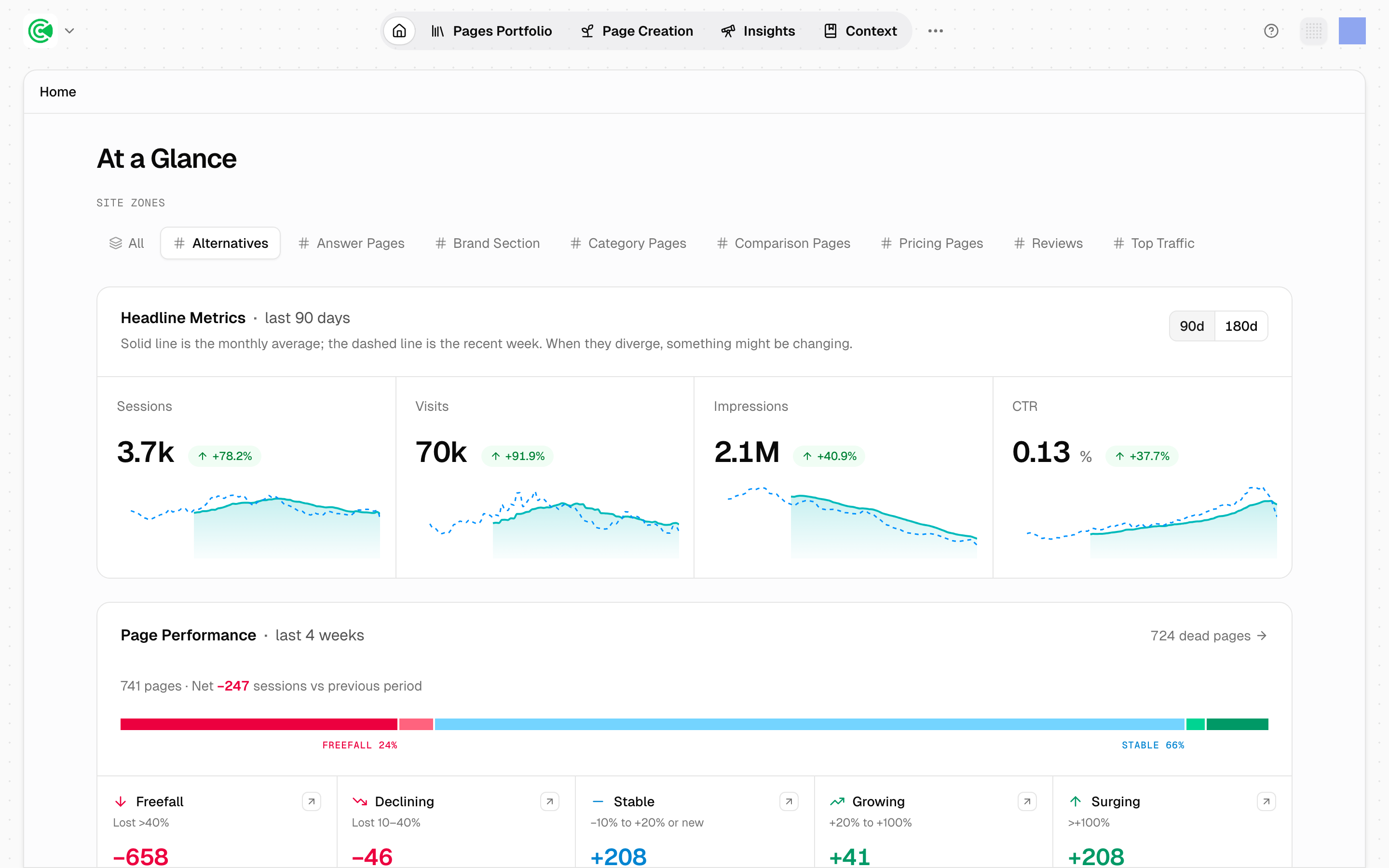
Distribution is the honest read of a portfolio. The mean hides it, which is why performance bands, not averages, are the headline on [At a Glance](/docs/product/workspace/at-a-glance).
## "No traffic" is not the bottom of the scale [#no-traffic-is-not-the-bottom-of-the-scale]
Pages with no traffic are counted separately from the bands, because they are a different condition rather than a worse one.
* A **Freefall** page had something and is losing it. That needs diagnosis: open it, read its scores, and refresh it if the content is the cause.
* A **no-traffic** page never landed. That usually needs a decision about whether it should exist at all.
Folding the second into the bottom of the first would turn a decision into a diagnosis, and you would spend the week fixing pages that should have been deleted.
*Worth knowing before you make that call: GrowthOS won't remove a live page. Retiring or redirecting one happens in your own CMS, the same as publishing.*
## Grouping is where a portfolio becomes strategy [#grouping-is-where-a-portfolio-becomes-strategy]
9,000 URLs sorted by traffic is a spreadsheet. The same URLs grouped by [persona](/docs/product/glossary#persona), a buyer your content speaks to, is a question about who you are neglecting.
* Sorted by traffic, it is a list.
* Grouped by persona, it is a coverage question.
* Grouped by [cluster](/docs/product/glossary#cluster), a group of related opportunities worked as a set, it is a progress report on the territories you committed to.
[Grouping](/docs/product/glossary#grouping) is the difference between looking at your content and reading it. It is also why [Groupings](/docs/product/context-and-voice/groupings) sits in Context rather than in a settings screen: the axes you choose determine the questions you are able to ask.
**The caveat worth holding onto:** a grouping that only touches part of the portfolio still renders a complete-looking view. Check the coverage counts before drawing a conclusion from a grouped view.
## The same read applies to work in progress [#the-same-read-applies-to-work-in-progress]
Throughput has a distribution too. 10 cards in Briefing and none in Ready is a different problem from 10 cards in Reviewing. The first is a planning bottleneck; the second is a people one.
Reading across the columns of [In Production](/docs/product/briefs/in-production) is faster than any report about velocity.
## Where this shows up [#where-this-shows-up]
* [At a Glance](/docs/product/workspace/at-a-glance) for the workspace-level distribution.
* [Pages Portfolio](/docs/product/pages/pages-portfolio), the list of every URL on your site scored individually, for the page-level one.
* [Groupings](/docs/product/context-and-voice/groupings) for the axes you read it along.
* [In Production](/docs/product/briefs/in-production) for throughput.
# AI Viz Segments (/docs/product/context-and-voice/ai-viz-segments)
**App route:** `/brand_context/ai_visibility_segments`
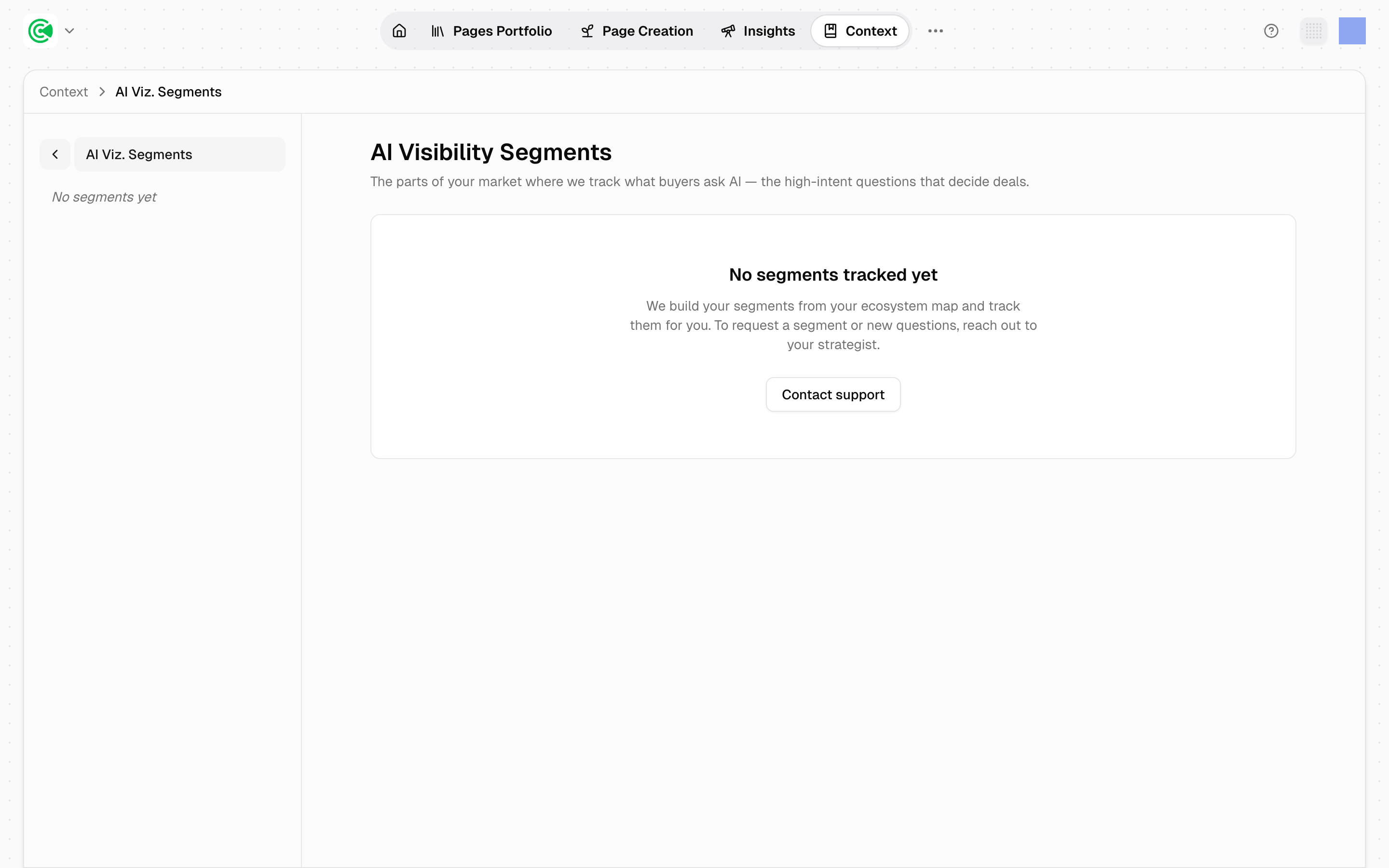
AI Visibility segments
[AI Visibility Segments](/docs/product/glossary#ai-visibility-segment) are the slices of your market that GrowthOS watches inside AI [answer engines](/docs/product/glossary#answer-engine), the AI products that answer questions directly instead of returning links. For each segment it asks a panel of buyer questions across the engines and records whether you were cited, who was cited instead, and which sources the answers drew on. This is where you learn whether the engines answering your market mention you at all, which is the read the rest of your content work responds to.
GrowthX manages this screen, and you read it rather than edit it. Segments are derived from your ecosystem map by an [agent](/docs/product/glossary#agent): if a segment is missing or wrong, that's a conversation with your [strategist](/docs/product/glossary#strategist), not a form to fill in.
**Doing this rather than looking it up?** The Tutorial walks this screen step by step in [3 · Context & voice](/docs/tutorial/context-and-voice).
## Reference [#reference]
| Field | What it means |
| ------------------------ | ------------------------------------------------------------------------------------------------------ |
| **Visibility score** | Share of the segment's prompts where you were cited |
| **Status** | `cited`, `absent`, or `unprobed`: unprobed means the question hasn't been asked yet, not that you lost |
| **Buyer questions** | The prompt panel the segment is measured on |
| **Cited domains / URLs** | What the engines actually pointed at, yours and everyone's |
| **Vendor rankings** | Who the engines name in this segment, per engine |
**Engines covered on this screen:** Google AI Overviews, ChatGPT, Perplexity and Claude. The AI Engine Visibility report covers a slightly wider set, adding Google AI Mode. Note that the Google surfaces are included: they're where most citation volume sits, and a summary that omits them understates the picture.
The buyer questions in a segment come from a shared panel GrowthX maintains rather than being written for you alone. What's yours is the result.
**Absent is a result, not a gap in the data.** A segment where you're consistently absent while 3 competitors are cited is the clearest signal in the product: the market is being answered, and not with you.
**Per-page citation tracking exists too.** Pages inside an [analysis zone](/docs/product/glossary#analysis-zone) (the part of your site GrowthOS crawls and analyzes) get registered for tracking individually, and a page's own AI Visibility panel shows its citation status, cited prompts and per-engine ranking. This screen is the market-level read; the page detail is the page-level one.
Acting on a segment finding is a manual step today. Segments are read-only, and
nothing turns a finding into an [opportunity](/docs/product/glossary#opportunity) or a
[brief](/docs/product/glossary#brief): the only consumers are
this screen, the AI Engine Visibility report and the MCP tools. Closing that
loop is tracked. Meanwhile, take a weak segment to Page Creation yourself and
raise it with your strategist.
## Why it works this way [#why-it-works-this-way]
* [Context is the shared source of truth](/docs/product/concepts/context-is-the-source-of-truth)
# Competitors (/docs/product/context-and-voice/competitors)
**App route:** `/brand_context/competitors`
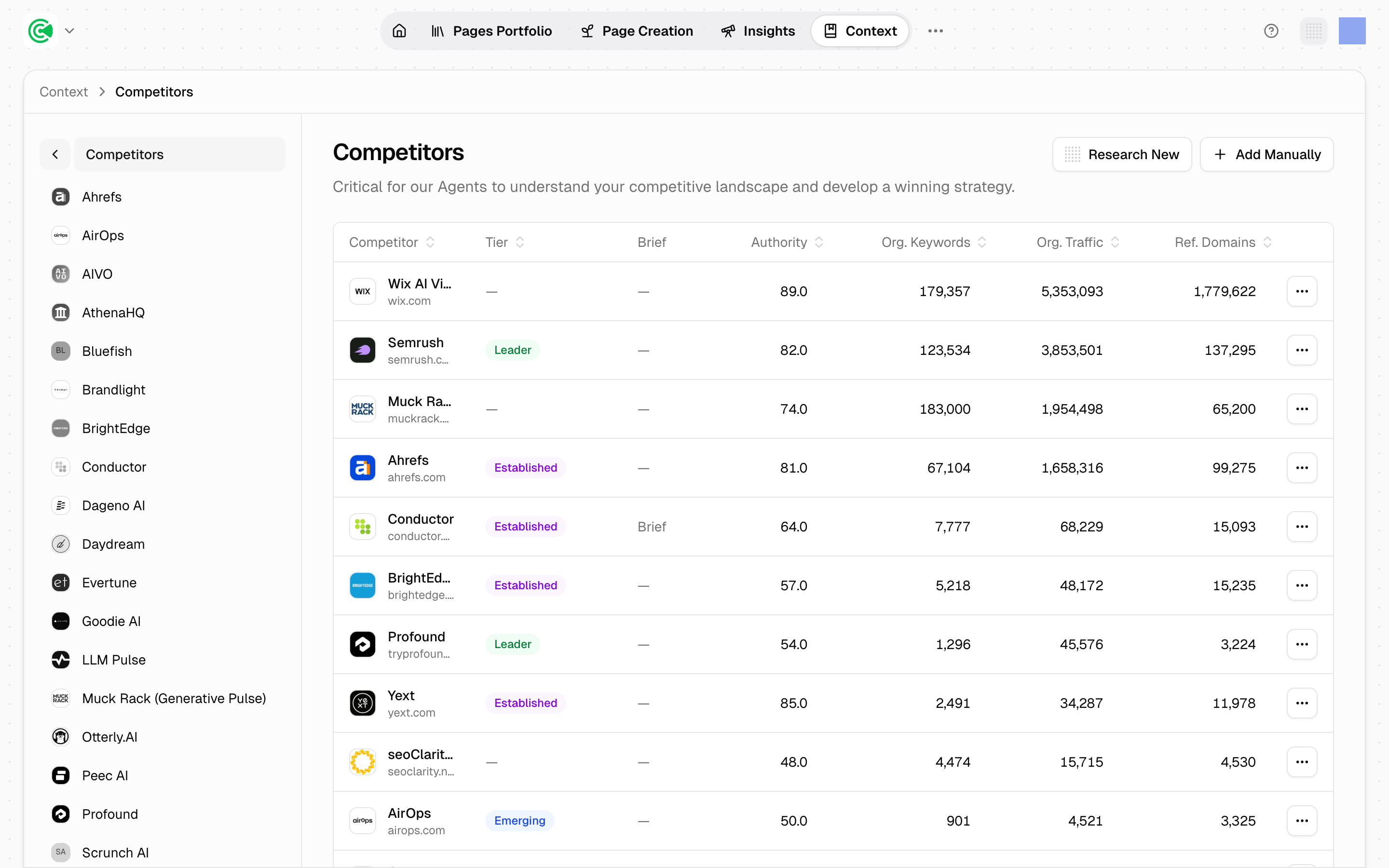
Competitors, which feed reports and opportunities
Competitors is the roster your market is measured against. Every content gap, every competitive comparison, and every position your pages stake out is calculated relative to this list: so a list that matches your real market produces gaps that matter, and a list that doesn't produces noise.
The initial set comes from research [agents](/docs/product/glossary#agent) (the automated workers that research, draft and score) during setup: the rivals you named in your materials, plus the ones research surfaced on its own. It usually needs a pass, because research finds who ranks near you rather than who you actually lose deals to.
**Doing this rather than looking it up?** The Tutorial walks this screen step by step in [3.2 · Calibrate your competitors](/docs/tutorial/context-and-voice/competitors).
## Reference [#reference]
| Column | What it holds |
| ----------------- | ---------------------------------------------------------------------------------------- |
| **Competitor** | Name and domain |
| **Tier** | `leader`, `established`, `emerging`, `niche`, or unset: assigned by agents, not editable |
| **Brief** | Whether a competitor brief has been generated |
| **Authority** | Domain authority score |
| **Org. Keywords** | Organic keywords the domain ranks for |
| **Org. Traffic** | Estimated organic traffic |
| **Ref. Domains** | Referring domains |
Each record also carries an **enriched** flag: whether SEO and traffic data has been pulled for it. An un-enriched competitor still counts everywhere; it shows dashes in the metric columns.
The 4 metric columns are all *market-wide*, not relative to you. A competitor can carry enormous organic traffic and still be irrelevant to your buyers: large horizontal tools frequently top this table while competing with you on almost nothing.
### Adding a competitor [#adding-a-competitor]
Add the rivals your sales calls surface that research missed. **The competitive story from your sales calls is the highest-value input here.** It's usually sharper than anything published on your website, and it's precisely what research cannot find.
**A competitor added without triggering start research keeps an empty brief.** Adding the record puts it in every calculation, but its brief stays empty until you click **start research**. Add the competitor and start the research in the same sitting.
### What tier does, and doesn't [#what-tier-does-and-doesnt]
Tier is **descriptive, not operational**. Nothing inside the product filters, weights, ranks or scores on it: not [opportunity](/docs/product/glossary#opportunity) generation, not gap analysis, not report gating. It's a badge, a sort key on this table, and a piece of context passed to the writing and research agents.
3 consequences worth knowing:
* **An unset tier costs you nothing.** Null-tier competitors are included in every calculation exactly like the rest. They sort to the bottom of the table, and show either a `Manual` badge if you added them by hand or a dash if research did.
* **Automatic competitor briefing picks by organic traffic, not tier.** The top competitors by traffic get auto-briefed, so a `leader` with modest traffic won't be prioritized by tiering it.
* **The Competitive Landscape report uses a different tier entirely.** That report classifies threats as *Direct*, *Indirect* or *Marginal*, worked out from the ecosystem map. It never reads this field, and the 2 vocabularies don't line up. Same word, unrelated meaning.
So tier is best treated as a note to your team about who matters, not as a control. If you want a competitor weighted more heavily, the lever is the roster and the enrichment behind it, not the label.
## Why it works this way [#why-it-works-this-way]
* [Agents draft, you decide](/docs/product/concepts/agents-draft-you-decide)
* [Context is the shared source of truth](/docs/product/concepts/context-is-the-source-of-truth)
# Foundation (/docs/product/context-and-voice/foundation)
**App route:** `/brand_context/foundation`
Foundation: company, ecosystem, product, ideal customer
Foundation is the base layer of your context: what your company does, the market it sits in, what you sell, and who you sell it to.
It holds 4 documents, and every [agent](/docs/product/glossary#agent) reads all 4 before it researches a topic, scores a page or drafts a sentence.
**All 4 are already drafted, so your job here is to correct them.** A wrong sentence in one of these becomes a wrong claim in every draft that follows.
**Doing this rather than looking it up?** The Tutorial walks this screen step by step in [3.1 · Review your context](/docs/tutorial/context-and-voice/review-context).
## The 4 documents [#the-4-documents]
| Document | What it holds |
| ---------------------- | ------------------------------------------------------------------ |
| **Company Overview** | What your company does, who it serves, and what makes it different |
| **Ecosystem** | The market, categories and players your brand operates within |
| **Product & Features** | Your products, their core features, and the value each delivers |
| **Ideal Customer** | The companies and buyers you are the best fit for |
**Check Ideal Customer most carefully.** Research has the least to go on here, because who you actually win is not something a website says. That knowledge sits in your sales calls. Be specific: if the description would fit your closest competitor equally well, it is still too general.
## Start with the Last edited column [#start-with-the-last-edited-column]
It is the fastest read on the screen. **Last edited** shows a name once a person has edited the document, which may be someone on your team or your GrowthX [strategist](/docs/product/glossary#strategist). It reads `Agent` while the text is still exactly as it was first drafted.
**Anything still showing `Agent` has never been read by a person, and it is already shaping every draft.** That column is your to-do list.
## What Status tells you [#what-status-tells-you]
| Status | What it means |
| --------- | ------------------------------ |
| **Ready** | The document has text in it |
| **Empty** | The document has no text in it |
That is the whole test, and GrowthOS sets it. **Ready tells you the document has been written, not that anyone has read it.** **Last edited** is the column that tells you that.
If you find one Empty, tell your strategist. Most of the work that follows will not start until it has text.
## Correct a document [#correct-a-document]
Read each one the way you would read a new hire's summary of your company after their first week: mostly right, and wrong in ways only you can catch. What you are looking for is the confident claim that is out of date, such as positioning you have moved on from or a market you have left.
1. Click the document name to open it. It opens in a full editor.
2. Type over what is wrong. Edits save automatically as you type, and **Last edited** changes from `Agent` to your name.
You have done enough when a skeptical colleague could read all 4 and not wince.
**Done Editing** is navigation only: it returns you to the document list and plays no part in saving.
Before a large rework, click **History** and save a named version first. Restoring is one click, and restoring is itself undoable. Autosaves between named versions are pruned over time, so a named version is the durable checkpoint.
One person edits a document at a time. If someone else has it open, you see their name and a **Take over** button. That person may be your GrowthX strategist rather than someone on your team.
Selecting text gives you an **AI** option in the floating toolbar, for changes to style and structure. It has no research access, so it cannot add facts, statistics or sources. Those stay yours. [3.3 · Editing and versioning](/docs/tutorial/context-and-voice/edit-context) covers the editor in full.
## When a document is wrong throughout [#when-a-document-is-wrong-throughout]
Editing is the right fix when a document is mostly right. When one is wrong from top to bottom, it can be regenerated instead, which rewrites it from scratch and takes a note from you to steer the rewrite. Ask your strategist if you want one regenerated.
**Regenerating replaces the document rather than editing it.** Nothing anyone wrote is merged into the result. Save a named version from **History** before it runs.
Only one document regenerates at a time, so if another is already running, that one waits. **Ecosystem** alone takes 20–30 minutes and occasionally an hour, so a document that looks stuck is usually still running. There is no regenerate-all.
## Your corrections reach new work only [#your-corrections-reach-new-work-only]
Agents read these documents at the moment they work, so the next opportunity researched and the next draft written start from your corrected version.
**Work already in production keeps the facts it was written with.** A brief drafted last week does not heal when you fix the document behind it. If you correct something material, go back through the open briefs that relied on the old version rather than assuming they picked up the change.
## Related [#related]
The guided read of all 4 documents, including what a confident-but-wrong claim looks like and when you have done enough.
The other 7 screens this one feeds, and the order worth working through them in.
Why this is its own area rather than a settings page.
What an agent does and where it stops.
# Groupings (/docs/product/context-and-voice/groupings)
**App route:** `/brand_context/groupings`
Groupings, which power Portfolio "Group by"
[Groupings](/docs/product/glossary#grouping) are the axes your content portfolio can be sliced along. They're what populates **Group by** in the [Pages Portfolio](/docs/product/pages/pages-portfolio), the list of every page on your site: pick a grouping and the wall of URLs reorganizes into a set of decisions: by buyer, by territory, by page type. The groupings defined here decide which questions the portfolio can answer at all, so a missing axis means a view nobody can pull.
Most of them ship with the workspace. The screen exists so you can see which slices are available, how much of the portfolio each one actually covers, and add your own.
**Doing this rather than looking it up?** The Tutorial walks this screen step by step in [3.3 · Editing and versioning](/docs/tutorial/context-and-voice/edit-context).
## Reference [#reference]
| Column | What it holds |
| ------------ | ---------------------------------------------------------------------------------------------------------- |
| **Grouping** | The name, and a `Built-in` badge if the system provides it |
| **Pages** | Pages covered by this slice |
| **Opp'ties** | [Opportunities](/docs/product/glossary#opportunity) (pages an agent proposes writing or rewriting) covered |
| **Briefs** | [Briefs](/docs/product/glossary#brief) (the plans drafts are written from) covered |
The built-in groupings are **Cluster**, **Persona** and **Topic**. **Page Type** sits alongside them without the badge because it isn't system-managed: it's an ordinary grouping built over a [taxonomy](/docs/product/glossary#taxonomy) category, and it can be edited or removed like any other. The badge is earned by having a single axis that is either a persona or a cluster, or by carrying one of the 3 reserved names.
A grouping is defined by one or more *axes*, and an axis points at a [persona](/docs/product/glossary#persona) (a buyer your content speaks to), a [cluster](/docs/product/glossary#cluster) (a group of related opportunities worked as a set), or a taxonomy category: though only the first and last are offered when you create one. Topic and Page Type are both taxonomy-category axes: the difference is only that Topic's category is system-managed and Page Type's is yours. That's what makes groupings composable: a grouping isn't a fixed report, it's a way of asking the portfolio a question.
Counts vary widely and that's expected. In a mature workspace, Page Type may cover thousands of pages while Cluster covers a few dozen: the first is a property every page has, the second only applies to pages you've deliberately committed to a territory.
**Coverage is the caveat.** A grouping that only touches part of the portfolio still renders a complete-looking view. The counts on this screen are the only place that limitation is visible, which is the main reason to come here at all.
## Why it works this way [#why-it-works-this-way]
* [Reading a portfolio](/docs/product/concepts/reading-a-portfolio)
# Context & voice (/docs/product/context-and-voice)
Context holds what GrowthOS knows about your company: what you do, the market you sit in, the buyers you write for, and how you sound. It is 8 screens, and this page is the map of them.
Every [agent](/docs/product/glossary#agent) in the product reads these screens before it does anything. An agent is an automated worker that takes the heavy work off you: it researches your market, proposes opportunities (the pages worth writing or rewriting), writes the drafts and scores the pages you already have. Every agent stops at a proposal, so nothing publishes and nothing moves forward until you review it and decide.
## Your job here is review, not setup [#your-job-here-is-review-not-setup]
These screens are not blank when you arrive. Before you were given the workspace, GrowthX ran [Setup Autopilot](/docs/product/glossary#setup-autopilot), a chain of agents that researched your company and market from public sources and drafted your context for you. What you meet is the result rather than the run.
Reading it through is worth your time, because **everything downstream inherits whatever is written here, including the mistakes.**
Research only finds what is public, so it misses the things you know best: how you position yourself today, the customers you actually win, and the competitors that come up on sales calls but never in search results.
Correct those and every opportunity, brief and draft that follows is built on them. Leave them and the work still arrives, sounding like any other vendor in your market.
## The 8 screens [#the-8-screens]
They read from each other, so working through them in this order means you do not redo anything. The last 2, **Topics** and **AI Viz Segments**, are screens you read rather than edit.
Correct what your company does, the market it sits in, what you sell and who you sell it to.
Check the buyers your content speaks to, and what each one is trying to find out.
Check the competitors your content is measured against, and add any that are missing.
Build the voice guidance every draft starts from.
Define your own categories for classifying content, such as funnel stage or product line.
Choose how your pages can be grouped in the [Pages Portfolio](/docs/product/pages/pages-portfolio), the list of every page on your site.
See what your market asks about, and how much of it your site answers today.
See where you are cited in AI answer engines like ChatGPT and Perplexity, and who is cited instead.
**Editing works the same way on all 8 screens: changes save automatically as you type.** **Done Editing** is navigation only and plays no part in saving.
A saved correction then applies going forward. Pages already drafted keep the facts they were written with until they are regenerated.
## Related [#related]
The guided path through reviewing and correcting what the setup run inferred, in 3 steps, including how autosave, version history and locks work.
Why this is its own area rather than a settings page, and what vague context costs downstream.
# Personas (/docs/product/context-and-voice/personas)
**App route:** `/brand_context/personas`
Buyer personas
Personas are the buyers your content speaks to. Each one is a short profile of a role: what they own, what they're measured on, and what they're specifically trying to find out. Every [agent](/docs/product/glossary#agent) (the automated workers that research, draft and score) reads these profiles before it writes, so a persona that describes the wrong buyer misdirects every draft aimed at them. Correct the set here and everything downstream speaks to the buyers you actually win.
Pages, [opportunities](/docs/product/glossary#opportunity) (pages an agent proposes writing or rewriting) and [briefs](/docs/product/glossary#brief) (the plan a draft is written from) can all be tagged to a persona, which is how the team stays aligned on who a given piece is for.
Like the rest of [context](/docs/product/glossary#context), personas arrive drafted by agents from market research and are yours to correct.
**Doing this rather than looking it up?** The Tutorial walks this screen step by step in [3.1 · Review your context](/docs/tutorial/context-and-voice/review-context).
## Reference [#reference]
The table lists each persona with a short code and 3 counts.
| Column | What it tells you |
| ----------------- | --------------------------------------------------------------------------------------------------------------------------------------------- |
| **Persona** | The role name, its **Short Name** (`PMM`, `DemandGen`) and a one-line description. The full profile lives on the persona's own page, not here |
| **Pages** | Pages tagged to this persona |
| **Opportunities** | Opportunities tagged to them |
| **Briefs** | Briefs tagged to them |
**All 3 counts are lifetime totals, not current state.** They tally every tagged record regardless of status, so Opportunities includes dismissed and archived ones, and Briefs includes published and discarded ones. Read them as "how much work has ever pointed at this persona", not "how much is live". A persona with nothing in any column is either genuinely irrelevant or an oversight, and it's worth knowing which.
Persona profiles are written to a consistent shape: what the role owns, followed by what they are *uniquely* concerned with. That second half is the part that changes what a writer does.
**Short Name** is optional and falls back to the persona's name. The table only shows it when it differs, and it's editable on the persona's page rather than in the create form.
### Changing the set [#changing-the-set]
Personas are added and removed one at a time. Add one when a real buyer has no profile; remove one when no real buyer matches it, because the set here defines who agents write for.
**There is no batch regeneration for personas.** Each one is added and removed individually, so work through the set persona by persona rather than expecting a single rebuild.
## Why it works this way [#why-it-works-this-way]
* [Context is the shared source of truth](/docs/product/concepts/context-is-the-source-of-truth)
* [Why committing to a few compounds](/docs/product/concepts/committing-to-a-few)
# Taxonomy (/docs/product/context-and-voice/taxonomy)
**App route:** `/brand_context/taxonomy_categories`
Taxonomy categories across the portfolio
[Taxonomy](/docs/product/glossary#taxonomy) is how you classify your own content. A **category** is a dimension (Funnel Stage, Product, Industry), and its **values** are the options within it. Tag pages against those values and the portfolio becomes sliceable along axes that mean something to your business rather than only the ones GrowthOS ships. The descriptions you write here are what [agents](/docs/product/glossary#agent) (the automated workers that research, draft and score) classify every page against, so a vague description spreads vague tags across the whole portfolio.
The categories here are yours. The system-managed **Topic** taxonomy is deliberately not shown on this screen; it's derived from research and lives on [Topics](/docs/product/context-and-voice/topics).
**Doing this rather than looking it up?** The Tutorial walks this screen step by step in [3.3 · Editing and versioning](/docs/tutorial/context-and-voice/edit-context).
## Reference [#reference]
The screen lists your user-managed categories with a count of the values inside each.
| Concept | What it is |
| --------------- | ---------------------------------------------------------------------------------- |
| **Category** | A classification dimension: the question you're asking about a page |
| **Value** | One answer within that dimension. Unique per category |
| **Description** | Required on both, up to 2,000 characters. This is the text agents classify against |
A category is not the same as a page's **type**. Page type is a fixed property GrowthOS derives during analysis; a taxonomy category is a dimension you invented. They coexist, and both can be grouped on.
### Generation is a starting point, not a routine [#generation-is-a-starting-point-not-a-routine]
Taxonomy generation exists to give a new workspace a first set of categories to
react to. It is a **bootstrap step, run once during setup**. After that, categories
are designed by hand.
That distinction matters because regenerating is destructive rather than additive.
The generator deletes every user-managed category before it runs and again after,
so anything hand-authored is lost, not merged. Once you have shaped the taxonomy
yourself, regenerating throws that work away and replaces it with a fresh proposal.
Regeneration rebuilds from scratch. Every user-managed category and value is
deleted first, including ones you added or edited, and nothing is merged
forward. Treat it as a setup-time action. To change an established taxonomy,
edit the categories directly.
## Why it works this way [#why-it-works-this-way]
* [Context is the shared source of truth](/docs/product/concepts/context-is-the-source-of-truth)
* [Why committing to a few compounds](/docs/product/concepts/committing-to-a-few)
# Topics (/docs/product/context-and-voice/topics)
**App route:** `/topics`
Topics: demand and coverage map
Topics is the map of what your market is asking about, and how much of it you currently answer. [Agents](/docs/product/glossary#agent) (the automated workers that research, draft and score) build it as they research your market, so it isn't a taxonomy you author: it's a picture of demand you read. What you accept or dismiss here shapes the question set every coverage number and research pass draws on.
It's the bridge between research and production. Topics is where you see that a subject has real demand and thin coverage; [Clusters](/docs/product/briefs/clusters), the groups of related [opportunities](/docs/product/glossary#opportunity) worked as a set, is where you commit to doing something about it.
**Doing this rather than looking it up?** The Tutorial walks this screen step by step in [4.1 · Align on strategy](/docs/tutorial/find/content-clusters).
## Reference [#reference]
| Column | What it means |
| ----------------- | --------------------------------------------------------------------------------------------------------------------------------------------------------------- |
| **Topic** | The subject, as research named it |
| **Search demand** | Traditional search volume for the topic |
| **AI demand** | Strong, Moderate, Emerging, or a dash: see below for what it actually measures |
| **Questions** | Distinct questions research found inside the topic |
| **Pages** | Live pages mapped to it: which is why this won't reconcile with the [Pages Portfolio](/docs/product/glossary#pages-portfolio), where archived pages still count |
| **Coverage** | Questions answered out of questions found (e.g. `2/9`) |
**AI demand is a proxy, and worth understanding before you lean on it.** Nobody can measure query volume inside AI assistants: no such API exists. So the grade is inferred from the Google SERP instead: how many People-Also-Ask questions the topic's prompts pull, with the presence of an AI Overview setting a floor. Both signals come from the same keyword data as search volume, read differently.
That makes it a genuine signal about how question-shaped and answer-engine-ready a topic is, but not a measurement of AI traffic. A topic with negligible search volume and Strong AI demand is one the SERP treats as a question rather than a destination.
**Coverage counts questions, not pages.** 22 pages against a topic with `0/4` coverage means you've published a lot about the subject without answering what people actually ask. The uncovered remainder is split further behind the scenes: a question already on an accepted opportunity or an in-progress [brief](/docs/product/glossary#brief) (the plan a draft is written from) counts as neither covered nor a gap.
### Suggested topics [#suggested-topics]
*Suggested topics* is a **triage queue**, not a filter on the list above, which is why its count runs into the thousands while the topic list stays small. Proposals live in their own store and only become topics once resolved.
Each one is **pending**, **accepted** or **dismissed**. Accepting mints a real topic and moves any questions and opportunities that were waiting on it across, which is why accepting is the step that puts a subject's demand into your coverage numbers.
**Dismissing is durable.** A rejected name is remembered and won't be proposed again, so dismiss only the subjects you're sure don't belong in your market.
Proposals arrive from 5 places: a broad market sweep, discovery from a URL you shared, the opportunity finder hitting a subject with no topic yet, a cluster's own topic developer, and gaps found on a live page. Some of those accept themselves automatically; the ones raised by cluster development and by page analysis wait for a person.
**Pending proposals don't count toward coverage.** Their demand isn't in the question set yet, so a topic area can look thinner than it is while its proposals sit unresolved. They aren't inert, though: opportunities can be parked on a proposal, clusters own theirs, and pending names are fed back to the research agents so the same subject isn't proposed twice.
**The Topic taxonomy is system-managed.** You can't edit it the way you edit other [taxonomies](/docs/product/glossary#taxonomy): it's derived from research rather than authored, and it's hidden from the Taxonomy screen entirely. It does still appear as a built-in [grouping](/docs/product/glossary#grouping) in the Portfolio's **Group by**; what you can't do is build a *new* grouping on the Topic category. It's also the layer strategic territories are built on: a [cluster](/docs/product/glossary#cluster) owns topics, and a topic's questions are what its coverage is measured against.
**Cluster is the word; you may still meet "Bet."** The API and the MCP tools call the
same object a **Bet**: a rename that landed in the backend vocabulary and not in the
front end. **Cluster is canonical**, and these docs use it throughout. If you query the
API or point an agent at the MCP server and get back `bets`, that is this same
object under its older name.
**Demand without coverage is the only signal that matters here.** High demand with high coverage is a subject you already own. Low demand is a subject to skip. The whole screen is a way of finding the third case, and everything else on it is context for that read.
## Why it works this way [#why-it-works-this-way]
* [Context is the shared source of truth](/docs/product/concepts/context-is-the-source-of-truth)
# Writing Profile (/docs/product/context-and-voice/writing-profile)
**App route:** `/writing_calibration/writing_profile`
Writing Profile tuning inputs and the compiled voice profile
The [Writing Profile](/docs/product/glossary#writing-profile) is the compiled version of how you sound. You supply the raw material (reference writers, sources you trust, tone settings, examples of your own work), and a compile turns it into the voice guidance every drafting [agent](/docs/product/glossary#agent) reads.
It's the single most important screen for a writer, because every draft in the workspace starts from this profile and is checked against it afterwards. A profile that misses your voice puts that miss into every draft until the next compile.
**Your edits and pending annotations do nothing until you click Update profile.** They sit as pending input; the profile agents actually read only changes when the compile runs. Changed an input or left annotations? Click **Update profile**, or the next draft sounds exactly like the last one.
**Doing this rather than looking it up?** The Tutorial walks this screen step by step in [3 · Context & voice](/docs/tutorial/context-and-voice).
## Reference [#reference]
**What a compile reads:** your calibration inputs, your Company Overview and Product & Features, your [personas](/docs/product/glossary#persona) (the buyers your content speaks to), the current profile, and your annotations.
**What counts as an [annotation](/docs/product/glossary#annotation)** (a note left on a draft saying what is off and why) is narrower than it looks:
* Annotations on the **calibration sample** all count.
* Annotations on **real drafts** count only if the review is complete. Notes no longer have types; when you save one you choose its scope. **Every article** notes carry through as standing rules for future drafts, while **Just this article** notes fix that draft but never shape the profile.
* Annotations from **invited external reviewers** count too, but notes left through a guest review link cannot set scope.
**Direct edits to a draft do not feed the profile.** Rewriting a sentence in the editor improves that page and teaches the system nothing. If you want the change to stick, leave a note saying what was wrong.
**Versioning.** Each compile snapshots the outgoing profile before replacing it, and the header shows the version and compile date. Research Sources are ranked in tiers, and there's a negative list for sources to avoid.
**A missing profile doesn't stop drafting.** If nothing has been compiled, agents fall back to default writing guidelines. So output looks fine and sounds like nobody. Silence here is the failure mode, not an error message.
**Company Overview and Product & Features gate the compile.** Both must have content before a profile can be built, which is why [Foundation](/docs/product/context-and-voice/foundation) comes first.
## Why it works this way [#why-it-works-this-way]
* [Agents draft, you decide](/docs/product/concepts/agents-draft-you-decide)
# Pages (/docs/product/pages)
Everything already live on your site. The [Pages Portfolio](/docs/product/glossary#pages-portfolio), the list of every URL on your site scored individually, is the inventory view; page detail is the full record for a single URL.
The Pages Portfolio is every URL on your site as one inventory, each page scored and classified.
Page detail is the full record for one URL: scorecards, traffic and visibility history, intent and classification.
# Page detail (/docs/product/pages/page-detail)
**App route:** `/pages/{id}`
Page detail: scorecards, traffic and taxonomy on one screen
Page detail is the full record for one URL: the scorecards, the traffic and visibility history, what the page is trying to answer, and how it's classified. It's where a flag from the [Pages Portfolio](/docs/product/glossary#pages-portfolio), the scored list of every URL on your site, turns into a decision about what to actually change.
**Doing this rather than looking it up?** The Tutorial walks this screen step by step in [6.2 · Run the loop yourself](/docs/tutorial/report/weekly-loop).
## Reference [#reference]
**The scorecards:**
| Tile | What it is |
| --------------- | -------------------------------------------------------------- |
| **Big Picture** | The roll-up, 0–100, with a label |
| **Health** | Technical quality, 0–100 |
| **Coverage** | Question-based score for live pages; rolling out per workspace |
| **Impressions** | Impressions earned against potential |
| **Traffic** | Traffic earned against potential |
**Big Picture is an average of up to 4 pillars** (Health, Coverage, impressions capture and traffic capture), each weighted equally, and it needs at least 2 of them before it will score at all. Its labels: **Optimal** (67+), **Good** (34+), **Fair** (1+), **Needs Work**, and **Incomplete** when there isn't enough data to judge.
Only 2 of those pillars are potential-relative. Impressions and traffic capture are measured against the page's own keyword volume; Health and Quality enter as absolute scores.
**Coverage is measured against the question the page targets:** whether the page answers it, covers what readers ask next, covers what the top pages cover, and adds what the top pages leave out.
**Health decomposes into 13 categories** across 77 checks: see [Site Sync](/docs/product/admin/site-sync), the connection that keeps GrowthOS's copy of your site current, for the full list.
## Why it works this way [#why-it-works-this-way]
* [How pages are scored](/docs/product/concepts/how-pages-are-scored)
# Pages Portfolio (/docs/product/pages/pages-portfolio)
**App route:** `/pages`
The Pages Portfolio, with metric columns and Fingerprint
The [Pages Portfolio](/docs/product/glossary#pages-portfolio) is every URL on your site as one inventory, each page scored and classified. It's the screen for deciding where the week goes: sort, filter and group until a wall of URLs becomes a short list of decisions.
[Analysis zones](/docs/product/glossary#analysis-zone), the parts of your site GrowthOS crawls and analyzes, become the tabs across the top, so the way the site is divided in [Analysis Zones](/docs/product/admin/analysis-zones) is the way you navigate it here. GrowthX builds the zones, so when the tabs don't match how you think about the site, raise it with your [strategist](/docs/product/glossary#strategist), your GrowthX contact, rather than looking for a setting.
**Doing this rather than looking it up?** The Tutorial walks this screen step by step in [4 · Find](/docs/tutorial/find).
## Reference [#reference]
**The table columns:**
| Column | What it shows |
| ------------- | --------------------------------------------------------------------------------- |
| **Pages** | Title and URL |
| **Traffic** | Sessions, with a trend |
| **Impr.** | Impressions |
| **CTR** | Click-through rate |
| **Pos.** | Average position |
| **Health** | Technical score, 0–100 |
| **Coverage** | How well the page answers its target question, rolling out workspace by workspace |
| **Keywords** | Keywords the page ranks for |
| **Capture** | How much of its potential traffic the page earns |
| **Published** | When the page was published, sortable |
| **Updated** | When the page was last updated, sortable |
There's no Big Picture column here: that lives on [Page detail](/docs/product/pages/page-detail). The portfolio-level equivalent is **Capture**.
### The default filter hides your quietest pages [#the-default-filter-hides-your-quietest-pages]
**The portfolio opens filtered.** Pages under 10 visits are hidden by default, so the count you see on arrival is smaller than the number of pages on your site. This is the single most common reason a page looks missing.
Before concluding a page was never [crawled](/docs/product/glossary#crawl) (read from your sitemap into GrowthOS's copy of your pages), clear the filter. If it appears, it was always there and sat below the threshold. If it still does not, the cause is upstream in [Site Sync](/docs/product/admin/site-sync), the connection that keeps GrowthOS's copy of your site current, not here.
**"No traffic" is a filter value, not a [band](/docs/product/glossary#performance-band).** Pages with no traffic at all are counted separately from Freefall through Surging, because they are a different condition rather than a worse one.
**Page type** is a fixed classification: 12 types, each with finer subtypes, covering content, product, pricing, homepage and the rest.
**Fingerprint** is 6 independent axes, and it's the most useful read on the screen:
| Axis | Values |
| ---------------- | ------------------------------------------------------------------------------------ |
| **Lifecycle** | Pre-index · Indexing · Competing · Plateaued · Declining · Dormant |
| **Momentum** | Surging · Growing · Stable · Declining · Freefall |
| **Traffic** | Hero · Workhorse · Contributor · Long-tail · Low traffic |
| **Readiness** | Clean · Minor debt · Meaningful debt · Broken |
| **Competition** | Open · Soft · Contested · Locked · Zero-click |
| **Query health** | Head winning · Head visible · Head losing · Tail winning · Off target · No footprint |
## Why it works this way [#why-it-works-this-way]
* [How pages are scored](/docs/product/concepts/how-pages-are-scored)
* [Reading a portfolio](/docs/product/concepts/reading-a-portfolio)
# At a Glance (/docs/product/workspace/at-a-glance)
**App route:** `/workspaces/{slug}`
At a Glance is the first screen in your [workspace](/docs/product/glossary#workspace), behind the **Home** tab. A workspace holds everything GrowthOS knows and does for one brand, and every figure on this screen covers that brand only.
It answers three questions:
* how your websites performed over the most recent period,
* how your pages are spread across performance bands, and
* how much of your traffic now arrives from AI answer engines like ChatGPT, Perplexity and Google's AI Overviews.
**It groups your pages by what's happening to them rather than averaging them into one number.** A site-wide average can hold steady while 50 pages quietly start losing traffic.
For the page-level numbers behind a change, open the [Pages Portfolio](/docs/product/pages/pages-portfolio). It lists every URL on your site, scored individually.
Headline metrics, the five page buckets and the AI Search split
**Doing this rather than looking it up?** The Tutorial walks this screen step by step in [1.3 · Find your way around](/docs/tutorial/getting-started/navigate-growthos).
## Reference [#reference]
### The performance bands [#the-performance-bands]
Every page that has traffic falls into one of 5 [bands](/docs/product/glossary#performance-band), measured against the previous period of the same length.
| Band | What it means |
| ------------- | ----------------------------- |
| **Freefall** | Traffic falling sharply |
| **Declining** | Traffic slipping steadily |
| **Stable** | Traffic holding roughly level |
| **Growing** | Traffic rising steadily |
| **Surging** | Traffic climbing sharply |
**Every band describes a direction, not a level.** Freefall means the page earned traffic and is losing it, not that it never had any. A high-traffic page can sit in Declining while a small one sits in Surging.
### Pages with no traffic [#pages-with-no-traffic]
Pages with no traffic at all are counted separately, outside the five bands.
**A Freefall page needs a diagnosis; a no-traffic page needs a decision.** One had something and is losing it. The other never landed, which is usually a question about whether it should exist at all.
### The AI Search split [#the-ai-search-split]
Shows how many visits arrive from an [answer engine](/docs/product/glossary#answer-engine) rather than from a search result, broken down by engine. That tells you whether your visibility is broad or concentrated in one.
**It's shown separately from organic search on purpose.** AI volume is small next to unpaid search listings, and folding the two together would hide a number that's small but growing.
### Where each number comes from [#where-each-number-comes-from]
Every block on the screen names its own data source.
| Block | Source | What that means |
| ------------------------ | --------------------- | ------------------------------------------------------------------------------------------ |
| Traffic figures | Google Analytics | Sessions and users: visits, and the people making them |
| Impressions and position | Google Search Console | How often your pages appeared in search results, and where they ranked |
| Page counts | The crawl | The pages GrowthOS found by reading your sitemap, the file listing every page on your site |
**When two blocks disagree, the source line is usually the explanation.** They come from different systems counting different things.
Page counts still appear when no analytics are connected, because they come from the [crawl](/docs/product/glossary#crawl) rather than from Google. If the traffic blocks are empty, check your connectors on [Websites](/docs/product/admin/websites). Those are the links to Google Analytics and Search Console. GrowthX sets those up, so if one reports a problem, raise it with your strategist rather than trying to fix it there.
### Reading the chart [#reading-the-chart]
The solid line is the monthly average. The dashed line is the most recent week.
**Where the dashed line pulls away from the solid one, something changed too recently for the average to absorb it.** That divergence is why both are drawn.
### If the numbers look wrong [#if-the-numbers-look-wrong]
**A period that hasn't finished yet can look like a decline.** A figure measured against the period before it holds fewer days of traffic than the one it's compared against. 28-day trends are the exception: each window ends no later than the last day its source has synced data, and the current and previous windows are always the same length.
Read on the 21st, a month-to-date figure is 21 days of traffic sitting next to a full previous month of 30. The gap is the 9 missing days, not a drop in performance. Check which period you're looking at before treating any fall as real.
## Related [#related]
Every URL on your site, scored individually. This is where the page-level numbers behind a change live.
Why distribution is the honest read of a site, and what averages hide.
The analytics connectors every traffic figure on this screen depends on.
The guided tour of the five areas, including this one.
# Workspace (/docs/product/workspace)
Every session starts here, on your [workspace](/docs/product/glossary#workspace)'s home screen. A workspace holds everything GrowthOS knows and does for one brand, and every figure on these screens covers that brand only.
At a Glance is your home headline: recent performance, how pages spread
across [performance bands](/docs/product/glossary#performance-band), and
your [AI search](/docs/product/glossary#ai-search-split) share.
Open At a Glance when you want to read the numbers on the screen in front of you. If you are setting up a new workspace instead, follow the Tutorial below: it does the steps in order.
## Related [#related]
The Tutorial walks a new workspace from first login to a working setup: [see the guided path](/docs/tutorial/getting-started).
# 7.6 · Connect Contentful (/docs/tutorial/connect-your-cms/connect-contentful-publishing)
GrowthOS can publish finished articles straight into your Contentful space: pick a content type, click publish, and the article lands as a draft entry with the body converted to Contentful rich text and images uploaded as Contentful assets. Every publish writes only the fields you mapped, in your space's default locale, so your editors' other fields and every translation survive. The connection is a one-time setup of about ten minutes, most of it creating the token. This guide covers when you need it, what to gather before you start, the setup wizard step by step, and what publishing looks like once it's live.
## When to connect [#when-to-connect]
Connect Contentful as soon as your [workspace](/docs/product/glossary#workspace) (everything GrowthOS knows and does for your brand) is producing articles that end up on your Contentful-powered site. The signals that it's overdue:
* **Someone is copy-pasting.** Articles are finished in GrowthOS, then manually recreated in Contentful's entry editor: headings rebuilt, images uploaded to the media library, meta fields retyped. Every article costs 15 to 30 minutes of pure transcription, and every transcription is a chance to drift from the reviewed version.
* **The SEO entry gets forgotten.** If your content model keeps the meta title and description on a separate linked entry, a draft published without one goes live with no search metadata. GrowthOS can create that entry with every article.
* **Publishing volume is ramping.** Moving from a couple of articles a month to a weekly cadence makes the copy-paste tax immediate. Connect before the ramp, not after.
If your site is not on Contentful, the same flow exists for [Webflow](/docs/tutorial/connect-your-cms/connect-webflow-publishing), [WordPress](/docs/tutorial/connect-your-cms/connect-wordpress-publishing), [Sanity](/docs/tutorial/connect-your-cms/connect-sanity-publishing), [Strapi](/docs/tutorial/connect-your-cms/connect-strapi-publishing), and [Storyblok](/docs/tutorial/connect-your-cms/connect-storyblok-publishing); only the credentials step differs. And with no connection at all, GrowthOS still supports manual publishing (mark the article published and paste the live URL), so nothing blocks while you wait on access.
## What you'll need [#what-youll-need]
* **A Contentful organization admin**, to invite a dedicated GrowthOS user to the space.
* **A mailbox for that user** that someone on your team reads. Contentful sends the invitation and the token expiry warnings there.
* **Your Space ID**, under **Settings → General settings** in Contentful, and your environment's ID if you don't publish into `master`.
* **A GrowthOS login that can manage publishing.** If you don't see **CMS Connections** under Workspace Admin, or there's no Contentful card there, ask your GrowthX team to enable it.
* Ten minutes, with both tabs open, plus however long it takes to accept the invitation.
## How to connect [#how-to-connect]
### Invite a dedicated user to the space [#invite-a-dedicated-user-to-the-space]
A Contentful personal access token has no permissions of its own: it can do everything its user can do, in every space that user reaches. A dedicated user who belongs to this one space keeps the token's reach to exactly that space, and keeps it working when people on your team come and go.
An organization admin does this step. In Contentful, open the organization's **Users** page (from the space: the gear icon at the top right → **Users** → the **organization settings** link) and click **Invite users**:
* **User email(s)**: the dedicated mailbox, for example `growthos@example.com`.
* **Choose an organization role**: **Member**, which can only access spaces and teams it's added to.
* **Add to spaces**: pick your space, then in **Select a space role** choose **Editor**.
Click **Send invitations**, then accept the invitation from that mailbox and finish signing up. The user now shows on the space's **Users** list.
Editor can create, edit, and publish entries and assets, which covers drafts and live publishing. If your plan also offers an **Author** role, it's enough for drafts only: an Author can't publish, so live publishing from GrowthOS would be refused.
### Create a personal access token [#create-a-personal-access-token]
Sign in to Contentful as the dedicated user. In the space, click the gear icon at the top right, choose **CMA tokens**, and click **Create personal access token**:
* **Token name**: something like "GrowthOS publishing".
* **Expiration date**: 30, 60, or 90 days, or **Custom...** for a longer period. Pick the longest your security policy allows. If your organization sets an expiration limit, stay within it: a token that expires later than the limit can't be authorized in the next step.
The Create personal access token dialog, opened from the space's CMA tokens page.
Click **Generate** and copy the token. Contentful shows it only once. When it nears its expiration date, Contentful emails the dedicated mailbox; when it expires, publishing stops until you paste a new token on the connection's settings screen in GrowthOS.
Use a **personal access token** from **CMA tokens**, not a key from the
space's **API keys** page. API keys are for reading content, so GrowthOS can't
write a draft with one and rejects it at the connect step.
### Authorize the token for your organization [#authorize-the-token-for-your-organization]
Contentful organizations can require every token to be authorized before it can reach their spaces. When that's on, an unauthorized token is refused on every request, and the connect step in GrowthOS fails. Authorizing takes one click, and the token's own user does it, not an admin.
On the same **CMA tokens** page, find the token's row and click **Authorize access**. The **Token authorization** panel lists every organization the dedicated user belongs to. Click **Authorize** next to the organization that owns your space. The button turns into **Deauthorize**, which means the token is authorized there.
Authorize access on the token's row. Click Authorize next to the organization that owns your space; an organization showing Deauthorize is already authorized.
An organization admin can check whether the organization requires this under the organization's **Tokens** page → **Settings** → **Require user authorization**. The same dialog shows the organization's token expiration limit.
### Connect the CMS in GrowthOS [#connect-the-cms-in-growthos]
In GrowthOS, go to **Workspace Admin → CMS Connections** and click **Connect a CMS**. Pick Contentful from the cards and fill in the form:
* **Personal access token**: the token from step 2.
* **Space ID**: the ID under **Settings → General settings** in Contentful.
* **Environment** (optional): the environment ID to publish into, from **Settings → Environments**. Leave it blank for `master`. If you publish through an alias, enter the alias exactly as Contentful shows it.
* **Region** (optional): `eu` if your space uses Contentful's EU data residency, otherwise leave it blank. You can tell from the address bar: EU spaces open on `app.eu.contentful.com`.
* **Public site URL** (optional): your website's address, for example `https://www.example.com`. Contentful never knows your page URLs, so a published article's link is this URL plus its slug. You can add it later, but live publishing won't run without it.
Leave the live-publishing switch off for now; it's the right default, and you can flip it later from this same screen once you trust the pipeline (see [how publishing works](#how-publishing-works-after-setup)).
Submitting lands you on the connection's settings screen, and GrowthOS immediately reads your environment's content types. Within a few moments the header fills in with how many it found. If your content model changes later, **Re-read** refreshes the picture without disturbing anything already set up.
### Add the blog content type [#add-the-blog-content-type]
Click **Add a content type** and pick the one your articles use (something like `blogPost` or `article`). The dialog lists your environment's active content types and warns you if the one you picked has no rich-text field, which usually means it's the wrong one. Confirming opens that content type's setup wizard.
If one space feeds more than one site, the content type's page has its own **Public base URL** under **Content type settings**, which overrides the connection's Public site URL for that content type.
### Review and confirm the field mapping [#review-and-confirm-the-field-mapping]
Click **Propose mapping**, and an [agent](/docs/product/glossary#agent) (an automated worker inside GrowthOS) proposes a mapping from GrowthOS's article fields (title, slug, body, meta title, meta description, cover image) to the content type's fields, with a confidence and a reason for each suggestion. Review it in the confirm form: required fields are listed first and marked, each field has a source picker, and anything GrowthOS shouldn't touch can be left unmapped or given a fixed value. The form blocks you if a required field is uncovered or the article body has no home, so you can't confirm a broken mapping. When it's right, click **Confirm mapping**.
Fields that reference other entries, like an author or a category, get a picker of those entries for their fixed value. Author can stay mapped with a default: the default is preselected on each article's Publish step, and you can change it per article.
If your content type links a separate entry for SEO, like an **SEO Metadata** entry with the meta title and description, its row offers **Create a new SEO Metadata with each article**. Click it and the row opens into that entry's own fields (Title, Description, Image, and so on), each with its own source picker. GrowthOS then creates one of those entries with every article, fills it, and links it; if an article already links one, GrowthOS fills that one instead. **Link an existing entry instead** closes it again. The agent can suggest this but never turns it on for you, because a wrong choice here would create a new entry with every article.
Contentful checks required fields when an entry is published, not when a draft is saved. A required field the article doesn't fill needs a fixed value here, or publishing it will be refused.
### Run the test article [#run-the-test-article]
Click **Send a test article**. Within a few seconds the wizard creates a sample article as a draft entry, plus its SEO entry if you set one up, then shows you exactly what Contentful received, field by field, with a link to open the real entry. This is your proof the mapping works before any real content moves. Check that the body kept its structure (headings, lists, links) and that every mapped field carries the right value. Reference fields show as Contentful entry IDs rather than names; that's expected.
### Finish [#finish]
The last step recaps the content type, the mapping, and the test round trip. Click **Finish setup**: the content type's page opens, marked ready. Finishing deletes the sample entry, and its SEO entry, from your space, so nothing is left behind. You can add more content types to the same connection later; each gets its own mapping and its own wizard pass.
## How publishing works after setup [#how-publishing-works-after-setup]
Every article in GrowthOS now has a working **Publish** step. Pick the content type, publish, and watch the card update as the article lands.
* **Draft first, always.** A new article is created as a draft entry. On an entry that's already live, the update shows as changed in Contentful, and the live page keeps its published version until someone publishes again. Promoting from GrowthOS only works when the connection's live-publishing switch is on (it starts off); until then, going live happens in Contentful on your terms.
* **Only your mapped fields change.** A publish writes the mapped fields and fixed values in the default locale, and nothing else. Fields outside the mapping, every other locale, and tags stay as your editors left them. An editor's change to a *mapped* field reverts on the next publish from GrowthOS. Republishing an unchanged article writes nothing, so it never marks a live entry as changed.
* **Images are Contentful assets.** Inline images and the cover upload to your space's media as assets, with the image's alt text as their title. Republishing reuses the assets already uploaded instead of duplicating them.
* **The body fits the field's toolbar.** Headings, lists, links, quotes, tables, and inline formatting arrive as standard Contentful rich text. Where the rich-text field's settings turn something off, GrowthOS adapts instead of failing: a disabled table becomes paragraphs, a heading level that isn't allowed moves to the nearest allowed one, and a disabled link becomes plain text. Contentful has no code block, so code arrives as code-formatted text.
In draft mode, the article's images and its SEO entry are drafts too. When
your editors publish the article in Contentful, they need to publish those
with it. An article published without them goes live with missing images, or
without its search metadata. Contentful flags unpublished references when you
publish an entry; publish them first.
Going live publishes everything the article needs. With live publishing on,
GrowthOS publishes the article's images, then its SEO entry, then the article
itself. Each one is published in its current state, so any pending edits your
editors made to them go live too. Check them in Contentful before promoting.
## Known limitations [#known-limitations]
These hold as of 2026-10-20:
* **One locale.** GrowthOS writes the environment's default locale only and never touches the others. If a field is required in another locale, Contentful refuses to publish until that locale is filled.
* **Some field types are never written.** JSON objects, locations, cross-space references, media lists, and reference lists that accept several content types show as "Managed in Contentful" in the mapping. Keep managing them in Contentful.
* **No embedded entries in the body.** Call-to-action blocks, code snippets, and other entries embedded in rich text stay your editors' to add. Links in the body are URLs, not links to other entries.
* **No Launch, Releases, Workflows, scheduled publishing, or tags.** GrowthOS publishes immediately or not at all, and leaves tags as they are.
* **A shared SEO entry is never changed.** If another article links the same SEO entry, GrowthOS refuses to edit it, because the change would show on that page too.
## Troubleshooting [#troubleshooting]
* **Every request says Contentful rejected the token.** If your organization requires token authorization, the token can't do anything until its user authorizes it (see [the authorization step](#authorize-the-token-for-your-organization)). An organization admin may also have deauthorized it: authorize it again from the same panel. Otherwise the token was revoked or has expired: create a new one and paste it on the connection's settings screen.
* **Contentful can't find the space or environment.** Check the Space ID and the Environment, and set Region to `eu` if your space uses EU data residency. A wrong region fails exactly like a wrong space.
* **Contentful refused the request because the user can't do something.** The dedicated user's role doesn't allow it. Drafts need a role that can create and edit entries and assets; live publishing needs one that can publish. Change the role in Contentful, then publish again.
* **A publish fails because the entry is archived.** Archiving is an editor's decision, so GrowthOS won't undo it. Unarchive the entry in Contentful, or delete it so the next publish creates a fresh one.
* **A publish fails because another entry already has that slug.** GrowthOS won't write over an entry this article didn't create. Change the article's slug, or resolve the duplicate in Contentful, then publish again. If it's the test article that collides, an earlier sample was left behind: delete it in Contentful and send the test article again.
* **Someone was editing the entry while GrowthOS saved.** Nothing was written, so nothing was lost. Publish again in a minute.
* **Going live is refused because a field needs a value.** A required field is empty in the default locale or another one. Fill it in Contentful, or give it a fixed value in the mapping, then publish again.
* **Going live is refused with a message about the site URL or slug.** Add a Public site URL on the connection's settings screen and map a slug field, because that pair is how GrowthOS builds the link to your published page.
* **Going live is refused because an image is still processing.** Contentful processes each uploaded image before it can be published. Publish again in a minute.
* **A publish is refused because the SEO entry is shared.** Another article links the same SEO entry. In Contentful, give this article its own SEO entry, then publish again.
* **A publish is refused because the content type changed.** Someone renamed, added, or removed a field in the content model, and GrowthOS pauses that content type rather than publish into a structure it no longer recognizes. Reordering fields doesn't count. Open the content type in CMS Connections and re-run the mapping against the refreshed model; other content types on the connection keep publishing throughout. Step by step: [Fix a paused collection](/docs/tutorial/connect-your-cms/fix-paused-publishing).
* **The entry was deleted in Contentful.** Publish the article again; GrowthOS creates it fresh.
## Where to go next [#where-to-go-next]
The full path an article takes from draft to published, including the review
loop before the Publish step.
Put your connected agent to work on the workspace: diagnose pages, check the
portfolio, audit sourcing, and more.
# 7.3 · Connect Sanity (/docs/tutorial/connect-your-cms/connect-sanity-publishing)
GrowthOS can publish finished articles straight into your Sanity project: pick a document type, click publish, and the article lands as a native Sanity draft with the body converted to Portable Text and images uploaded as real Sanity assets. The connection is a one-time setup of about five minutes. This guide covers when you need it, what to gather before you start, the setup wizard step by step, and what publishing looks like once it's live.
## When to connect [#when-to-connect]
Connect Sanity as soon as your workspace is producing articles that end up on your Sanity-powered site. The signals that it's overdue:
* **Someone is copy-pasting.** Articles are finished in GrowthOS, then manually recreated in the Studio: headings rebuilt block by block, images re-uploaded, meta fields retyped. Portable Text makes this worse than most CMSes, because there's no clean way to paste rich content into the Studio without losing structure.
* **Formatting keeps breaking in the move.** Lists lose nesting, links drop, or images end up as pasted URLs instead of real assets. The publishing pipeline converts article HTML to proper Portable Text blocks, so this whole class of problem disappears.
* **Publishing volume is ramping.** Moving from a couple of articles a month to a weekly cadence makes the copy-paste tax immediate. Connect before the ramp, not after.
If your site is not on Sanity, the same flow exists for [Webflow](/docs/tutorial/connect-your-cms/connect-webflow-publishing), [WordPress](/docs/tutorial/connect-your-cms/connect-wordpress-publishing), [Strapi](/docs/tutorial/connect-your-cms/connect-strapi-publishing), [Storyblok](/docs/tutorial/connect-your-cms/connect-storyblok-publishing), and [Contentful](/docs/tutorial/connect-your-cms/connect-contentful-publishing); only the credentials step differs. And with no connection at all, GrowthOS still supports manual publishing (mark the article published and paste the live URL), so nothing blocks while you wait on access.
## What you'll need [#what-youll-need]
* **An Editor-role API token for your Sanity project**, which needs admin access to the project to create.
* **Your project ID and dataset name** (usually `production`), both visible in your Studio's `sanity.config` or at sanity.io/manage.
* **A GrowthOS login that can manage publishing.** If you don't see **CMS Connections** under Workspace Admin, ask your GrowthX team to enable it.
* Five minutes with both tabs open.
## How to connect [#how-to-connect]
### Create an API token in Sanity [#create-an-api-token-in-sanity]
At [sanity.io/manage](https://www.sanity.io/manage), open your project and go to **API → Tokens**, then add a token with **Editor** permissions. Editor is the right level: it lets GrowthOS create and update drafts and upload image assets, without project-admin powers it doesn't need.
### Connect the CMS in GrowthOS [#connect-the-cms-in-growthos]
In GrowthOS, go to **Workspace Admin → CMS Connections** and click **Connect a CMS**. Pick Sanity from the cards and fill in the form:
* **API token**: the Editor token from step 1.
* **Project ID** and **Dataset**: which project and dataset to publish into.
* **Public site URL** (optional): where your published pages live, for example `https://example.com/blog`. Sanity itself never knows your page URLs, so this is what GrowthOS uses to hand you a working link after a live publish. You can add it later, but live publishing won't run without it.
* **Studio URL** (optional): your Studio's address. With it, every staged draft gets a link that opens directly in the Studio editor; without it, drafts have no view link.
Leave the live-publishing switch off for now; it's the right default, and you can flip it later from this same screen once you trust the pipeline (see [how publishing works](#how-publishing-works-after-setup)).
Submitting lands you on the connection's settings screen, and GrowthOS immediately reads your project's document types from the deployed schema. Within a few moments the header fills in with how many document types it found. If your schema changes later, **Re-read** refreshes the picture without disturbing anything already set up.
### Add the blog document type [#add-the-blog-document-type]
Click **Add a document type** and pick the type your articles live in (usually something like `post` or `article`). The dialog lists every document type in your schema and warns you if the one you picked has no rich-text field, which usually means it's the wrong one. Confirming opens that document type's setup wizard.
### Review and confirm the field mapping [#review-and-confirm-the-field-mapping]
GrowthOS proposes a mapping from its article fields (title, slug, body, meta title, meta description, cover image) to the document type's fields, with a reason for each suggestion. Review it in the confirm form: required fields are listed first and marked, each field has a source picker, and anything GrowthOS shouldn't touch can be left unmapped or given a fixed value. The form blocks you if a required field is uncovered or the article body has no home, so you can't confirm a broken mapping.
Map a slug field here if you ever want live publishing: promoting a draft needs it to build the public link.
### Run the test article [#run-the-test-article]
The wizard stages a sample article in your dataset as a draft, then shows you exactly what Sanity received, field by field, with a link to open the real document. This is your proof the mapping works before any real content moves. Check that the body kept its structure (headings, lists, links) and that every mapped field carries the right value.
### Finish [#finish]
The last step recaps the document type, the mapping, and the test round trip. Finishing marks the document type ready and deletes the sample draft from your dataset, so nothing is left behind. You can add more document types to the same connection later; each gets its own mapping and its own wizard pass.
## How publishing works after setup [#how-publishing-works-after-setup]
Every article in GrowthOS now has a working **Publish** step. Pick the document type, publish, and watch the card update as the article lands.
* **Draft first, always.** Publishing creates a native Sanity draft (the `drafts.` document the Studio shows with the draft badge). If the article was already live, your published version stays untouched until the draft is promoted. Promoting from GrowthOS only works when the connection's live-publishing switch is on (it starts off); until then, going live happens in the Studio on your terms.
* **Updates flow through the same button.** Edit the article in GrowthOS and publish again; the existing document is updated in place. Republishing an unchanged article does nothing rather than creating a duplicate.
* **Images are Sanity-native.** Inline images and the cover image upload to your project as real Sanity image assets, referenced the way the Studio expects and served from Sanity's CDN. The published page never loads assets from GrowthOS, and republishing reuses the assets already uploaded instead of duplicating them.
* **The body is real Portable Text.** Headings, lists, links, quotes, and inline formatting arrive as proper blocks your Studio and frontend already know how to render.
## Known limitations [#known-limitations]
* **Tables and code blocks need Studio plugins.** They ship in the standard `@sanity/table` and `@sanity/code-input` shapes. If your Studio doesn't have those plugins installed, the blocks show as "unknown type" in the editor; the content is safely stored either way, and installing the plugins makes it editable.
* **Heading levels follow your schema.** If your body field declares styles only up to H4, deeper headings are stepped up to the nearest level your schema allows, because a style the Studio doesn't declare would break its editor. Declare H5/H6 in your schema if you want them preserved.
* **Very large images fail the publish.** Sanity has no fetch-from-URL, so GrowthOS downloads each image and uploads it to your project; images over 25MB, or hosted somewhere GrowthOS can't reach, fail with a clear error.
## Troubleshooting [#troubleshooting]
* **The connect step rejects the credentials.** Check all three values together: the token must be Editor-role, and it must belong to the same project and dataset you entered. A token from another project fails exactly like a bad token.
* **A publish is refused because the schema changed.** Someone changed the Studio schema and deployed it, and GrowthOS pauses that document type rather than publish into a structure it no longer recognizes. Open the document type in CMS Connections and re-run the mapping against the refreshed schema; other document types on the connection keep publishing throughout. Step by step: [Fix a paused collection](/docs/tutorial/connect-your-cms/fix-paused-publishing). Note the trigger is the deployed schema: after changing your Studio's schema, redeploy it so GrowthOS can see the new shape.
* **Live publish is refused with a message about the site URL or slug.** Live publishing needs the connection's Public site URL and a mapped slug field, because that pair is how GrowthOS builds the link to your published page. Add the URL on the connection's settings screen and the slug in the mapping.
## Where to go next [#where-to-go-next]
The full path an article takes from draft to published, including the
review loop before the Publish step.
Put your connected agent to work on the workspace: diagnose pages, check
the portfolio, audit sourcing, and more.
# 7.5 · Connect Storyblok (/docs/tutorial/connect-your-cms/connect-storyblok-publishing)
GrowthOS can publish finished articles straight into your Storyblok space: pick a content type, click publish, and the article lands as a draft story in the folder you chose, with the body converted to Storyblok richtext and images uploaded to your asset library. Republishing merges into the story instead of replacing it, so everything your editors set outside the mapping survives. The connection is a one-time setup of about five minutes. This guide covers when you need it, what to gather before you start, the setup wizard step by step, and what publishing looks like once it's live.
## When to connect [#when-to-connect]
Connect Storyblok as soon as your [workspace](/docs/product/glossary#workspace) (everything GrowthOS knows and does for your brand) is producing articles that end up on your Storyblok-powered site. The signals that it's overdue:
* **Someone is copy-pasting.** Articles are finished in GrowthOS, then manually recreated in the Visual Editor: headings rebuilt, images re-uploaded to the asset library, meta fields retyped. Every article costs 15 to 30 minutes of pure transcription, and every transcription is a chance to drift from the reviewed version.
* **Formatting keeps breaking in the move.** Tables collapse, lists lose nesting, or links drop when content is pasted into the richtext field. The publishing pipeline builds native Storyblok richtext, so this whole class of problem disappears.
* **Publishing volume is ramping.** Moving from a couple of articles a month to a weekly cadence makes the copy-paste tax immediate. Connect before the ramp, not after.
If your site is not on Storyblok, the same flow exists for [Webflow](/docs/tutorial/connect-your-cms/connect-webflow-publishing), [WordPress](/docs/tutorial/connect-your-cms/connect-wordpress-publishing), [Sanity](/docs/tutorial/connect-your-cms/connect-sanity-publishing), [Strapi](/docs/tutorial/connect-your-cms/connect-strapi-publishing), and [Contentful](/docs/tutorial/connect-your-cms/connect-contentful-publishing); only the credentials step differs. And with no connection at all, GrowthOS still supports manual publishing (mark the article published and paste the live URL), so nothing blocks while you wait on access.
## What you'll need [#what-youll-need]
* **A Storyblok login with access to the space**, to create a personal access token. The token belongs to that login and stops working when its access does, so a dedicated GrowthOS user in your Storyblok organization is the safest owner.
* **Your Space ID and server location**, both on your space's **Settings → Space** screen in Storyblok.
* **A GrowthOS login that can manage publishing.** If you don't see **CMS Connections** under Workspace Admin, ask your GrowthX team to enable it.
* Five minutes with both tabs open.
## How to connect [#how-to-connect]
### Create a personal access token in Storyblok [#create-a-personal-access-token-in-storyblok]
In Storyblok, click **My account** at the bottom of the left sidebar, open **Personal Access Tokens**, and click **Generate New Token**. Fill in the panel:
* **Name**: something like "GrowthOS publishing".
* **Expiration**: as long as your security policy allows. When the token expires, publishing stops until you paste a new one on the connection's settings screen.
* **Full user permission (no scope/space restriction)**: leave it off.
* **Spaces**: **Only selected spaces**, then pick your space.
* **Select scopes**: open each of these groups and tick exactly these boxes:
* **Stories**: **Read**, **Write**, and **Publish**
* **Assets**: **Read** and **Write**
* **Components**: **Read**
* **Spaces**: **Read**
Stories lets GrowthOS create and update draft stories, and Publish lets it take them live once you turn on live publishing, so you never need a new token for that. Assets lets it upload article images, Components lets it read your content types to build the field mapping, and Spaces lets the mapping list your space's languages. Components and Assets are checked when you connect, and Stories as soon as the wizard lists your folders, so a missing scope shows up during setup rather than on your first article.
The Generate New Token panel set up for GrowthOS. Every other scope group stays at 0.
Click **Generate Token** and copy the token. Storyblok shows it only once.
Use a **personal access token**, not one from the space's **Settings → Access
Tokens** tab. Those are Content Delivery tokens for reading published content,
and none of them can write a story, so GrowthOS rejects them at the connect
step.
### Connect the CMS in GrowthOS [#connect-the-cms-in-growthos]
In GrowthOS, go to **Workspace Admin → CMS Connections** and click **Connect a CMS**. Pick Storyblok from the cards and fill in the form:
* **Personal access token**: the token from step 1.
* **Space ID**: the number under **Settings → Space** in Storyblok, without the leading `#`. The copy button next to it copies the `#` too, and GrowthOS accepts digits only.
* **Region** (optional): the **Server Location** shown beside the Space ID, in lowercase: `eu`, `us`, `ca`, or `ap` (Australia). Leave it blank for an EU space.
* **Public site URL** (optional): your website's address, for example `https://www.example.com`. Storyblok is headless and never knows your page URLs, so a published article's link is this URL plus the story's full path in Storyblok (`blog/my-article`, say). You can add it later, but live publishing won't run without it.
Space ID and Server Location sit side by side on the space's Settings → Space screen. Enter the ID without the #.
Leave the live-publishing switch off for now; it's the right default, and you can flip it later from this same screen once you trust the pipeline (see [how publishing works](#how-publishing-works-after-setup)).
Submitting lands you on the connection's settings screen, and GrowthOS immediately reads your space's content types. Within a few moments the header fills in with how many it found. If your block library changes later, **Re-read** refreshes the picture without disturbing anything already set up.
### Add the blog content type [#add-the-blog-content-type]
Click **Add a content type** and pick the one your articles use (usually something like `article` or `post`). The dialog lists your space's content type blocks (nestable blocks aren't publish targets) and warns you if the one you picked has no richtext, markdown, or textarea field, which usually means it's the wrong one. Confirming opens that content type's setup wizard.
If one space feeds more than one site, the content type's page has its own **Public base URL** under **Content type settings**, which overrides the connection's Public site URL for that content type.
### Review and confirm the field mapping [#review-and-confirm-the-field-mapping]
Click **Propose mapping**, and an [agent](/docs/product/glossary#agent) (an automated worker inside GrowthOS) proposes a mapping from GrowthOS's article fields (title, slug, body, meta title, meta description, cover image) to the content type's fields, with a confidence and a reason for each suggestion. Review it in the confirm form: required fields are listed first and marked, each field has a source picker, and anything GrowthOS shouldn't touch can be left unmapped or given a fixed value. The form blocks you if a required field is uncovered or the article body has no home, so you can't confirm a broken mapping. When it's right, click **Confirm mapping**.
Three rows are Storyblok's own and don't appear in your block schema, because Storyblok keeps them on the story rather than in its content:
* **Story name** and **Slug**, proposed as the article's Title and Slug. Keep Slug on the article's Slug: it's how GrowthOS finds the story again on later publishes.
* **Folder**, where new stories are created (your `blog` folder, say). The agent never picks it, so choose it yourself from the list of every folder in the space. Changing it later never moves stories already created, so give each content type its own folder.
Fields that point at other stories, like an author or a category, get a picker of those stories for their fixed value, and a language field picks from your space's languages (**Default language** is your space's main one). Author can stay mapped with a default: the default is preselected on each article's Publish step, and you can change it per article. Tag-style fields such as topics are best left unmapped, so your editors keep choosing them in Storyblok.
Storyblok checks required fields when a story goes live, not when a draft is saved, so a required field the article doesn't fill (a category, say) needs a fixed value here, or going live will be refused.
### Run the test article [#run-the-test-article]
Click **Send a test article**. Within a few seconds the wizard stages a sample article in your folder as a draft story, then shows you exactly what Storyblok received, field by field, with an **Open it in Storyblok** link to the real story. Reference fields and the folder show as Storyblok IDs rather than names; that's expected. This is your proof the mapping works before any real content moves. Check that the body kept its structure (headings, lists, links) and that every mapped field carries the right value.
### Finish [#finish]
The last step recaps the content type, the mapping, and the test round trip. Click **Finish setup**: the content type's page opens, marked ready. Finishing marks the content type ready and deletes the sample story from your space, so nothing is left behind. You can add more content types to the same connection later; each gets its own mapping and its own wizard pass.
## How publishing works after setup [#how-publishing-works-after-setup]
Every article in GrowthOS now has a working **Publish** step. Pick the content type, publish, and watch the card update as the article lands.
* **Draft first, always.** A new article is created as an unpublished story. On a story that's already live, the update is saved as unpublished changes, and the live page keeps its current version until the story is published again. Promoting from GrowthOS only works when the connection's live-publishing switch is on (it starts off); until then, going live happens in Storyblok on your terms.
* **Updates merge into the story.** Edit the article in GrowthOS and publish again; the existing story is updated in place. Only the mapped fields and fixed values are rewritten; everything else your editors set in Storyblok (topics, hero blocks, CTAs) stays as they left it. An editor's change to a *mapped* field, like the author or the meta description, reverts on the next publish from GrowthOS. Republishing an unchanged article does nothing rather than creating a duplicate.
* **A live story keeps its name and slug.** Storyblok applies a story's name and slug to the live page the moment they change, even from a draft save. So once a story is live, GrowthOS never changes either; rename a live article in Storyblok.
* **Images live in your asset library.** Inline images, and the cover when the content type has an asset field, upload to your space's assets and serve from Storyblok's CDN. The published page never loads assets from GrowthOS, and republishing reuses the assets already uploaded instead of duplicating them.
* **The body is native richtext.** Headings, lists, links, quotes, code blocks, tables, and inline formatting arrive as standard Storyblok richtext nodes, the same ones the editor creates, so your frontend renders them the way it renders everything else.
Going live publishes the whole story. Storyblok publishes a story as one unit,
so when you turn on live publishing, every promote from GrowthOS also takes
your editors' pending draft edits on that story live. Check the story in
Storyblok before promoting it.
## Known limitations [#known-limitations]
These hold as of 2026-10-01:
* **One language per content type.** A language field takes a fixed value in the mapping, and GrowthOS never adopts or overwrites a story in another language, even one at the same slug. Storyblok's field-level translations aren't written.
* **Some field types are never written.** Nested blocks, table fields, multi-asset fields, and plugin fields show as "Managed in Storyblok" in the mapping, because writing part of one would replace the whole value. Keep managing them in Storyblok.
* **Headings run from H2 to H5.** An H1 in the article becomes H2 and an H6 becomes H5.
* **Internal links are URL links**, not Storyblok story links: they point at the page's address, so a page moved in Storyblok doesn't update the links to it.
* **Stories are found in the picked folder only.** An existing story elsewhere in the space, including a subfolder of the picked one, isn't found when the article is first published.
* **Four regions.** The connection works with spaces in the EU, US, Canada, and Australia; spaces in Storyblok's China region can't connect.
## Troubleshooting [#troubleshooting]
* **The connect step rejects the token.** Check, in order: it's a personal access token, not a space Access Token; under **Only selected spaces** it includes this space; it has every scope box from [step 1](#create-a-personal-access-token-in-storyblok); and the Space ID matches. A wrong Space ID fails exactly like a token without access, and a Space ID pasted with its leading `#` is refused with a message asking for the Space ID. If all of that checks out, confirm the region.
* **Every publish starts failing with a rejected token.** The token expired, or its owner lost access to the space. Generate a new one and paste it on the connection's settings screen; nothing else needs redoing.
* **A publish fails because a story already has that slug.** Another story in the folder already uses the article's slug, and it isn't one this article published. It may be another language's version, another content type's story, or a page someone else owns, so GrowthOS won't write over it. Change the article's slug, or resolve the collision in Storyblok, then publish again. If it's the test article that collides, an earlier sample was left behind: delete it in Storyblok and send the test article again.
* **Going live is refused because a field can't be blank.** A required field in the content type is empty. Fill it in Storyblok, or give it a fixed value in the mapping, then publish again.
* **Going live is refused with a message about the site URL.** Add a Public site URL on the connection's settings screen (or a Public base URL on the content type), because that's how GrowthOS builds the link to your published page.
* **A publish says the folder is missing or gone.** The content type has no folder picked, or the picked folder was deleted. Pick a folder in the content type's mapping and publish again.
* **A publish is refused because the content type changed.** Someone renamed, added, or removed a field in the block library, and GrowthOS pauses that content type rather than publish into a structure it no longer recognizes. Reordering fields doesn't count. Open the content type in CMS Connections and re-run the mapping against the refreshed schema; other content types on the connection keep publishing throughout. Step by step: [Fix a paused collection](/docs/tutorial/connect-your-cms/fix-paused-publishing).
* **The story was deleted in Storyblok.** Publish the article again; GrowthOS creates it fresh in the picked folder.
## Where to go next [#where-to-go-next]
The full path an article takes from draft to published, including the review
loop before the Publish step.
Put your connected agent to work on the workspace: diagnose pages, check the
portfolio, audit sourcing, and more.
# 7.4 · Connect Strapi (/docs/tutorial/connect-your-cms/connect-strapi-publishing)
GrowthOS can publish finished articles straight into your Strapi instance: pick a collection type, click publish, and the article lands as a Strapi draft with formatting intact and images in your media library. The connection is a one-time setup of about five minutes; the token permissions are the only fiddly part, and this guide lists them exactly. It covers when you need it, what to gather before you start, the setup wizard step by step, and what publishing looks like once it's live.
## When to connect [#when-to-connect]
Connect Strapi as soon as your workspace is producing articles that end up on your Strapi-powered site. The signals that it's overdue:
* **Someone is copy-pasting.** Articles are finished in GrowthOS, then manually recreated in the Strapi admin: headings rebuilt, images re-uploaded through the media library, meta fields retyped. Every article costs 15 to 30 minutes of pure transcription, and every transcription is a chance to drift from the reviewed version.
* **Formatting keeps breaking in the move.** Lists lose structure, links drop, or rich-text content pastes as one flat block. The publishing pipeline writes your body field in its native format, so this whole class of problem disappears.
* **Publishing volume is ramping.** Moving from a couple of articles a month to a weekly cadence makes the copy-paste tax immediate. Connect before the ramp, not after.
If your site is not on Strapi, the same flow exists for [Webflow](/docs/tutorial/connect-your-cms/connect-webflow-publishing), [Sanity](/docs/tutorial/connect-your-cms/connect-sanity-publishing), [WordPress](/docs/tutorial/connect-your-cms/connect-wordpress-publishing), [Storyblok](/docs/tutorial/connect-your-cms/connect-storyblok-publishing), and [Contentful](/docs/tutorial/connect-your-cms/connect-contentful-publishing); only the credentials step differs. And with no connection at all, GrowthOS still supports manual publishing (mark the article published and paste the live URL), so nothing blocks while you wait on access.
## What you'll need [#what-youll-need]
* **A Strapi v5 instance** and admin access to it, enough to create an API token under Settings.
* **A GrowthOS login that can manage publishing.** If you don't see **CMS Connections** under Workspace Admin, ask your GrowthX team to enable it.
* Five minutes with both tabs open.
## How to connect [#how-to-connect]
### Create a custom API token in Strapi [#create-a-custom-api-token-in-strapi]
In your Strapi admin, go to **Settings → API Tokens** and create a token with token type **Custom**. The Read-only and Full access presets won't work: Read-only can't write articles, and presets don't carry the schema-reading permission GrowthOS needs. Grant the custom token exactly this:
* **The collection type you publish into** (for example Article): find, findOne, create, update, delete
* **Any collection type its relations point at** (for example Category or Author): find, findOne
* **Upload**: upload, find, destroy
* **Content-type-builder**: getContentTypes
The last one is the easy miss: it's what lets GrowthOS read your content structure to build the field mapping. Copy the token when Strapi shows it; it appears only once.
### Connect the CMS in GrowthOS [#connect-the-cms-in-growthos]
In GrowthOS, go to **Workspace Admin → CMS Connections** and click **Connect a CMS**. Pick Strapi from the cards and fill in the form:
* **Strapi URL**: your instance's address, for example `https://cms.example.com` (pasting the `/admin` link works too).
* **API token**: the custom token from step 1.
* **Public site URL** (optional): your website's address. Strapi never knows your page URLs, so a published article's link is this URL plus its slug; without it, GrowthOS can't hand you a working live link.
Leave the live-publishing switch off for now; it's the right default, and you can flip it later from this same screen once you trust the pipeline (see [how publishing works](#how-publishing-works-after-setup)).
Submitting lands you on the connection's settings screen, and GrowthOS immediately reads your instance's collection types. Within a few moments the header fills in with how many it found. If your content structure changes later, **Re-read** refreshes the picture without disturbing anything already set up.
### Add the blog collection type [#add-the-blog-collection-type]
Click **Add a collection type** and pick the one your articles live in (usually Article or Post). The dialog lists your collection types (single types aren't publish targets) and warns you if the one you picked has no rich-text field, which usually means it's the wrong one. Confirming opens that collection type's setup wizard.
### Review and confirm the field mapping [#review-and-confirm-the-field-mapping]
GrowthOS proposes a mapping from its article fields (title, slug, body, meta title, meta description, cover image) to the collection type's fields, with a reason for each suggestion. Review it in the confirm form: required fields are listed first and marked, each field has a source picker, and anything GrowthOS shouldn't touch can be left unmapped or given a fixed value. If your collection type has a required relation (say every article needs a Category), you pick the entry it should point at right here. The form blocks you if a required field is uncovered or the article body has no home, so you can't confirm a broken mapping.
### Run the test article [#run-the-test-article]
The wizard stages a sample article in your instance as a draft, then shows you exactly what Strapi received, field by field, with a link that opens the real entry in your admin. This is your proof the mapping works before any real content moves. Check that the body kept its structure (headings, lists, links) and that every mapped field carries the right value.
### Finish [#finish]
The last step recaps the collection type, the mapping, and the test round trip. Finishing marks the collection type ready and deletes the sample draft from your instance, so nothing is left behind. You can add more collection types to the same connection later; each gets its own mapping and its own wizard pass.
## How publishing works after setup [#how-publishing-works-after-setup]
Every article in GrowthOS now has a working **Publish** step. Pick the collection type, publish, and watch the card update as the article lands.
* **Draft first, always.** Publishing writes the entry's draft version, using Strapi v5's native draft-and-publish. If the article is already live, your published version stays untouched until the draft is promoted, relations and all. Promoting from GrowthOS only works when the connection's live-publishing switch is on (it starts off); until then, going live happens in the Strapi admin on your terms.
* **Updates flow through the same button.** Edit the article in GrowthOS and publish again; the existing entry is updated in place. Republishing an unchanged article does nothing rather than creating a duplicate.
* **Images live in your media library.** Inline images and the cover upload to Strapi's media library and the entry references them there. The published page never loads assets from GrowthOS, and republishing reuses the files already uploaded instead of duplicating them.
* **The body arrives in your field's native format.** A classic rich-text field gets markdown; a blocks field gets native block content. Either way your frontend renders it the way it renders everything else.
## Known limitations [#known-limitations]
* **Tables in a blocks field become code blocks.** Strapi's block format has no table element, so a table arrives as a code block holding the table's text: readable and recoverable, but not rendered as a table. Classic rich-text fields don't have this problem, since markdown tables pass straight through.
* **Component and dynamic-zone fields are never written.** Writing part of a component or dynamic zone would replace your whole structure, so GrowthOS leaves those fields alone; they show as "Managed in Strapi" in the mapping. Keep managing them in the Strapi admin.
* **Strapi v5 only.** The connection speaks Strapi 5's API. A v4 instance needs upgrading before it can connect.
## Troubleshooting [#troubleshooting]
* **The connect step rejects the token.** Almost always a preset token instead of a custom one, or a custom token missing a permission from the checklist above (Content-type-builder's getContentTypes is the usual gap). Recreate the token with the exact list and paste it again.
* **Articles publish but images fail.** The token is missing the Upload permissions. Edit the token to add upload, find, and destroy under Upload, then republish; the entry itself doesn't need to be recreated.
* **A publish is refused because the collection type changed.** Someone changed the content structure in Strapi, and GrowthOS pauses that collection type rather than publish into a structure it no longer recognizes. Open the collection type in CMS Connections and re-run the mapping against the refreshed schema; other collection types on the connection keep publishing throughout. Step by step: [Fix a paused collection](/docs/tutorial/connect-your-cms/fix-paused-publishing).
## Where to go next [#where-to-go-next]
The full path an article takes from draft to published, including the
review loop before the Publish step.
Put your connected agent to work on the workspace: diagnose pages, check
the portfolio, audit sourcing, and more.
# 7.1 · Connect Webflow (/docs/tutorial/connect-your-cms/connect-webflow-publishing)
GrowthOS can publish finished articles straight into your Webflow CMS: pick a collection, click publish, and the article lands in Webflow as a draft with formatting intact and images hosted on Webflow's own CDN. The connection is a one-time setup of about five minutes. This guide covers when you need it, what to gather before you start, the setup wizard step by step, and what publishing looks like once it's live.
## When to connect [#when-to-connect]
Connect Webflow as soon as your workspace is producing articles that end up on your Webflow site. The signals that it's overdue:
* **Someone is copy-pasting.** Articles are finished in GrowthOS, then manually recreated in Webflow's editor: headings rebuilt, images re-uploaded, meta fields retyped. Every article costs 15 to 30 minutes of pure transcription, and every transcription is a chance to drift from the reviewed version.
* **Formatting keeps breaking in the move.** Tables collapse, lists lose their structure, or embedded images point at the wrong host. The publishing pipeline ships article HTML built to survive Webflow, so this whole class of problem disappears.
* **Publishing volume is ramping.** Moving from a couple of articles a month to a weekly cadence makes the copy-paste tax immediate. Connect before the ramp, not after.
If your site is not on Webflow, the same flow exists for [Sanity](/docs/tutorial/connect-your-cms/connect-sanity-publishing), [WordPress](/docs/tutorial/connect-your-cms/connect-wordpress-publishing), [Strapi](/docs/tutorial/connect-your-cms/connect-strapi-publishing), [Storyblok](/docs/tutorial/connect-your-cms/connect-storyblok-publishing), and [Contentful](/docs/tutorial/connect-your-cms/connect-contentful-publishing); only the token step differs. And with no connection at all, GrowthOS still supports manual publishing (mark the article published and paste the live URL), so nothing blocks while you wait on access.
## What you'll need [#what-youll-need]
* **Admin access to your Webflow site**, enough to generate an API token in the site settings. You don't need to be the site's owner: any Admin on a full seat works, as long as their access covers this site (workspaces using site-specific access can scope a person away from a site; the test is whether you can open that site's settings at all).
* **A GrowthOS login that can manage publishing.** If you don't see **CMS Connections** under Workspace Admin, ask your GrowthX team to enable it.
* Five minutes with both tabs open.
## How to connect [#how-to-connect]
### Generate a site API token in Webflow [#generate-a-site-api-token-in-webflow]
In Webflow, open your **site's** settings (from the dashboard, hover the site card and click the settings gear; or in the Designer, open the top-left menu → Site settings) and go to **Apps & Integrations → API access**:
API access sits at the bottom of the site's Apps & Integrations settings.
Click **Generate API token**, name it (something like "GrowthOS"), and set these scopes:
* **CMS**: read and write
* **Sites**: read
* **Assets**: read and write
Webflow's token dialog. Careful: their example leaves Assets on "No access"; yours needs Assets on Read and write.
The Assets scope is easy to skip and shouldn't be: it's what lets GrowthOS upload article images as native Webflow assets. Without it, articles still publish but inline images arrive unlinked.
Generate the token from the **site's** settings, not the workspace. Workspace
settings has a near-identical Apps & Integrations panel, but it issues
workspace tokens, and GrowthOS needs a token scoped to exactly one site; a
workspace token is rejected at the connect step. You're on the right screen
when the settings header shows your site's name.
### Connect the CMS in GrowthOS [#connect-the-cms-in-growthos]
In GrowthOS, go to **Workspace Admin → CMS Connections** and click **Connect a CMS**. Pick Webflow from the cards and paste the token. Leave the live-publishing switch off for now; it's the right default, and you can flip it later from this same screen once you trust the pipeline (see [how publishing works](#how-publishing-works-after-setup)).
Submitting lands you on the connection's settings screen, and GrowthOS immediately reads your site's collections. Within a few moments the header fills in with how many collections it found. If your site's structure changes later, **Re-read** refreshes the picture without disturbing anything already set up.
### Add the blog collection [#add-the-blog-collection]
Click **Add a collection** and pick the collection your articles live in (usually Blog Posts). The dialog lists every collection on your site and warns you if the one you picked has no rich-text field, which usually means it's the wrong one. Confirming opens that collection's setup wizard.
### Review and confirm the field mapping [#review-and-confirm-the-field-mapping]
GrowthOS proposes a mapping from its article fields (title, slug, body, meta title, meta description, cover image) to the collection's fields, with a reason for each suggestion. Review it in the confirm form: required Webflow fields are listed first and marked, each field has a source picker, and anything GrowthOS shouldn't touch can be left unmapped or given a fixed value. The form blocks you if a required field is uncovered or the article body has no home, so you can't confirm a broken mapping.
### Run the test article [#run-the-test-article]
The wizard stages a sample article in the collection as a draft, then shows you exactly what Webflow received, field by field, with a link to open the real item. This is your proof the mapping works before any real content moves. Check that the body kept its structure (headings, lists, links) and that every mapped field carries the right value.
### Finish [#finish]
The last step recaps the collection, the mapping, and the test round trip. Finishing marks the collection ready and deletes the sample draft from Webflow, so nothing is left behind. You can add more collections to the same connection later (a resources section, a glossary); each gets its own mapping and its own wizard pass.
## How publishing works after setup [#how-publishing-works-after-setup]
Every article in GrowthOS now has a working **Publish** step. Pick the collection, publish, and watch the card update as the article lands.
* **Draft first, always.** Publishing saves the article as a draft in Webflow. Nothing appears on your live site until someone promotes it, and promoting from GrowthOS only works when the connection's live-publishing switch is on (it starts off). Until then, going live happens in Webflow on your terms.
* **Updates flow through the same button.** Edit the article in GrowthOS and publish again; the existing Webflow item is updated in place. Republishing an unchanged article does nothing rather than creating a duplicate.
* **Images are Webflow-native.** Inline images and the cover image upload to Webflow's asset library and serve from Webflow's CDN. The published page never loads assets from GrowthOS.
* **Formatting survives.** Article HTML is built to hold up in Webflow, including through an edit-and-save round trip in Webflow's own editor.
## Known limitations [#known-limitations]
Draft edits belong in GrowthOS, not Webflow's Designer. The Designer rewrites
rich text on save and can damage tables, lists, and some links in staged
drafts. Draft links from GrowthOS open Webflow's read-only preview for exactly
this reason; if a change is needed, make it in GrowthOS and publish again.
* **Tables and code blocks are embeds.** Webflow's editor has no native table or code element, so GrowthOS ships them as embedded blocks. They render perfectly on the published page, but Webflow's editor can't modify them; edit those sections in GrowthOS and republish.
* **The live URL follows Webflow's slug.** If someone changes the item's slug in Webflow, the published URL GrowthOS reports follows what's actually live.
## Troubleshooting [#troubleshooting]
* **The connect step rejects the token.** Almost always a workspace token instead of a site token (the rejection message says how many sites the token can see). Regenerate from the site's own settings.
* **You can't find API access in the site settings.** Your Webflow role on that specific site isn't Admin, or your seat is a limited one. Ask a workspace admin to raise your role on the site, or have any site Admin generate the token; who creates it doesn't matter to GrowthOS.
* **Articles publish but images are missing or unlinked.** The token lacks the Assets read-and-write scope. Regenerate the token with all three scopes and replace the credentials on the connection's settings screen.
* **A publish is refused because the collection changed.** Someone edited the collection's fields in Webflow, and GrowthOS pauses that collection rather than publish into a structure it no longer recognizes. Open the collection in CMS Connections and re-run the mapping against the refreshed schema; other collections on the connection keep publishing throughout. Step by step: [Fix a paused collection](/docs/tutorial/connect-your-cms/fix-paused-publishing).
## Where to go next [#where-to-go-next]
The full path an article takes from draft to published, including the
review loop before the Publish step.
Put your connected agent to work on the workspace: diagnose pages, check
the portfolio, audit sourcing, and more.
# 7.2 · Connect WordPress (/docs/tutorial/connect-your-cms/connect-wordpress-publishing)
GrowthOS can publish finished articles straight into your WordPress site: pick a post type, click publish, and the article lands as a WordPress draft with formatting intact, images in your media library, and the cover set as the featured image. The connection is a one-time setup of about five minutes. This guide covers when you need it, what to gather before you start, the setup wizard step by step, and what publishing looks like once it's live.
## When to connect [#when-to-connect]
Connect WordPress as soon as your workspace is producing articles that end up on your WordPress site. The signals that it's overdue:
* **Someone is copy-pasting.** Articles are finished in GrowthOS, then manually recreated in the block editor: headings rebuilt, images re-uploaded, the featured image and slug set by hand. Every article costs 15 to 30 minutes of pure transcription, and every transcription is a chance to drift from the reviewed version.
* **Formatting keeps breaking in the move.** Tables collapse, lists lose their structure, or pasted content drags along styling that fights your theme. The publishing pipeline ships clean article HTML that WordPress accepts as-is, so this whole class of problem disappears.
* **Publishing volume is ramping.** Moving from a couple of articles a month to a weekly cadence makes the copy-paste tax immediate. Connect before the ramp, not after.
If your site is not on WordPress, the same flow exists for [Webflow](/docs/tutorial/connect-your-cms/connect-webflow-publishing), [Sanity](/docs/tutorial/connect-your-cms/connect-sanity-publishing), [Strapi](/docs/tutorial/connect-your-cms/connect-strapi-publishing), [Storyblok](/docs/tutorial/connect-your-cms/connect-storyblok-publishing), and [Contentful](/docs/tutorial/connect-your-cms/connect-contentful-publishing); only the credentials step differs. And with no connection at all, GrowthOS still supports manual publishing (mark the article published and paste the live URL), so nothing blocks while you wait on access.
## What you'll need [#what-youll-need]
* **A WordPress user who can publish posts** (Editor or Administrator role), and access to their profile to create an application password.
* **Your site served over HTTPS.** WordPress only offers application passwords on secure sites.
* **A GrowthOS login that can manage publishing.** If you don't see **CMS Connections** under Workspace Admin, ask your GrowthX team to enable it.
* Five minutes with both tabs open.
## How to connect [#how-to-connect]
### Create an application password in WordPress [#create-an-application-password-in-wordpress]
In your WordPress admin, go to **Users → Profile** for the user GrowthOS should publish as, scroll to **Application Passwords**, name one (something like "GrowthOS"), and create it. Copy the generated password immediately; WordPress shows it only once.
An application password is not the user's login password: it's a revocable key scoped to API access, and you can delete it from the same screen at any time without touching the account.
Published posts carry this user as the author, so pick the account you want
on the byline (or a dedicated publishing user), not whoever happens to be
setting up the connection.
### Connect the CMS in GrowthOS [#connect-the-cms-in-growthos]
In GrowthOS, go to **Workspace Admin → CMS Connections** and click **Connect a CMS**. Pick WordPress from the cards and fill in the form:
* **WordPress site URL**: your site's address, for example `https://blog.example.com`.
* **Username**: the user the application password belongs to.
* **Application password**: the value from step 1.
Leave the live-publishing switch off for now; it's the right default, and you can flip it later from this same screen once you trust the pipeline (see [how publishing works](#how-publishing-works-after-setup)).
Submitting lands you on the connection's settings screen, and GrowthOS immediately reads your site's post types. Within a few moments the header fills in with how many it found: posts, pages, and any custom post types your site registers. If your site's structure changes later, **Re-read** refreshes the picture without disturbing anything already set up.
### Add the blog post type [#add-the-blog-post-type]
Click **Add a post type** and pick where your articles live (usually Posts). The dialog lists every publishable post type on your site and warns you if the one you picked has no content field, which usually means it's the wrong one. Confirming opens that post type's setup wizard.
### Review and confirm the field mapping [#review-and-confirm-the-field-mapping]
GrowthOS proposes a mapping from its article fields (title, slug, body, meta title, meta description, cover image) to the post type's fields, with a reason for each suggestion. Custom fields your site exposes over the REST API, including ACF fields, are discovered and mappable too. Review it in the confirm form: required fields are listed first and marked, each field has a source picker, and anything GrowthOS shouldn't touch can be left unmapped or given a fixed value. The form blocks you if a required field is uncovered or the article body has no home, so you can't confirm a broken mapping.
### Run the test article [#run-the-test-article]
The wizard stages a sample article on your site as a draft, then shows you exactly what WordPress received, field by field, with a link to open the real post. This is your proof the mapping works before any real content moves. Check that the body kept its structure (headings, lists, links, tables) and that every mapped field carries the right value.
### Finish [#finish]
The last step recaps the post type, the mapping, and the test round trip. Finishing marks the post type ready and deletes the sample draft from your site, so nothing is left behind. You can add more post types to the same connection later (pages, a resources post type); each gets its own mapping and its own wizard pass.
## How publishing works after setup [#how-publishing-works-after-setup]
Every article in GrowthOS now has a working **Publish** step. Pick the post type, publish, and watch the card update as the article lands.
* **New articles arrive as drafts.** Publishing creates the post with draft status; nothing appears on your live site until someone presses Publish in WordPress, or GrowthOS promotes it with the connection's live-publishing switch on (it starts off).
* **Updates flow through the same button.** Edit the article in GrowthOS and publish again; the existing post is updated in place. Republishing an unchanged article does nothing rather than creating a duplicate.
* **Images live in your media library.** Inline images upload to the media library and the body references them there; the cover image uploads too and is set as the post's featured image. The published page never loads assets from GrowthOS.
* **Formatting survives.** The article ships as clean structural HTML that holds up through WordPress's own content filtering, tables and code blocks included.
## Known limitations [#known-limitations]
WordPress has no separate staging layer for a post that is already live.
Updating an already-published post writes the live page immediately, even
with live publishing off; the draft state only protects posts that have
never been published. Once an article is live, treat a republish from
GrowthOS as a live edit.
* **SEO fields depend on what your site exposes.** WordPress doesn't accept writes to fields the site never registered for API access, so meta title and description are mappable only when your SEO setup exposes them (most SEO plugins can). If they don't appear in the mapping, that's the reason; ask your GrowthX team about exposing them.
* **Inline images re-upload on each publish.** Republishing an edited article uploads its inline images to the media library again rather than reusing the earlier copies. Harmless for the published page, but a heavily-republished article accumulates copies in the library.
## Troubleshooting [#troubleshooting]
* **The connect step rejects the credentials.** Check the pair together: the username must be exactly the account the application password was created under, and the site URL must be the address your admin actually lives at (if your site redirects, use the final address). Application passwords also require HTTPS; on a plain-HTTP site WordPress disables them entirely.
* **A post type you expected isn't listed.** Only post types exposed through the REST API are discoverable. Standard posts and pages always are; a custom post type registered without REST support won't appear until your developer enables it.
* **A publish is refused because the post type changed.** Your site's fields changed (a plugin update, an ACF change), and GrowthOS pauses that post type rather than publish into a structure it no longer recognizes. Open the post type in CMS Connections and re-run the mapping against the refreshed schema; other post types on the connection keep publishing throughout. Step by step: [Fix a paused collection](/docs/tutorial/connect-your-cms/fix-paused-publishing).
## Where to go next [#where-to-go-next]
The full path an article takes from draft to published, including the
review loop before the Publish step.
Put your connected agent to work on the workspace: diagnose pages, check
the portfolio, audit sourcing, and more.
# 7.7 · Fix a paused collection (/docs/tutorial/connect-your-cms/fix-paused-publishing)
If publishing into one collection suddenly fails while the rest of your CMS connection keeps working, someone changed that collection's fields in your CMS. Re-run the field mapping from **CMS Connections** and the collection publishes again, usually in about 2 minutes.
A field change means added, renamed, removed or re-typed fields, or a field that became required. Reordering fields doesn't count. GrowthOS mapped its article fields to the old structure, so it pauses that collection rather than guess where each part of the article belongs now. Nothing is lost, and other collections keep publishing.
## How to recognize it [#how-to-recognize-it]
* **The publish card refuses the article** for that collection, where publishing into it worked before.
* **The collection's setup screen shows a banner** reading **Webflow's fields changed** (or your CMS's name in place of Webflow), which says publishing into it is paused.
* **Other collections still publish.** The pause is per collection: a blog collection can be paused while a resources collection on the same connection publishes normally.
The same pause applies on every supported CMS: a Webflow collection, a WordPress post type, a Sanity document type, a Strapi collection type, or a Storyblok or Contentful content type. On Sanity, the trigger is the deployed Studio schema, so redeploy the Studio after a schema change before you remap.
## How to fix it [#how-to-fix-it]
### Open the collection [#open-the-collection]
Go to **Workspace Admin → CMS Connections**, open the connection, and click the paused collection. If the collection shows **Finish setting up**, click that instead; it opens the same screen.
The **fields changed** banner sits at the top, with 3 numbered steps below it.
### Let an agent propose the mapping [#let-an-agent-propose-the-mapping]
Under **Let an agent propose the mapping**, click **Propose mapping**. An [agent](/docs/product/glossary#agent), a GrowthOS worker that drafts for you to approve, reads the collection's current fields and suggests an article field for each one.
When it finishes, each row it can place is filled in with a suggestion, a confidence and a reason; the rest are left for you to pick in the next step. Nothing is saved yet.
### Review and confirm the mapping [#review-and-confirm-the-mapping]
Under **Confirm the mapping**, check every row. Rows the agent filled in carry an **Inferred** tag. Rows it couldn't place show **Choose an article field…** and need you to pick one.
Check these first:
* **Required fields**, marked with a red asterisk. Each one needs an article field or a fixed value. A newly required field, like a category the site recently made mandatory, is a common cause of the pause. If every article gets the same entry, pick it as a fixed value.
* **The body field.** Exactly 1 field receives the article body. The wrong field here publishes an empty article.
* **Anything you're unsure of.** Ask whoever changed the CMS, or your GrowthX team, before confirming.
Click **Confirm mapping**. The button stays disabled until every required field is covered and the body has a home, so you can't confirm a mapping that would fail.
### Test with a sample [#test-with-a-sample]
Under **Test with a sample**, run the test. GrowthOS sends a throwaway article into the collection as a draft and reads it back, field by field. Nothing goes live, and the test article is deleted afterwards.
You see what your CMS received for each field. Check that the body kept its headings, lists and links, and that each field landed where you expected.
### Finish and republish [#finish-and-republish]
Click finish. The banner clears and the collection is ready. Open the article that was refused and publish it again from its publish card.
## Stop it from catching you on a deadline [#stop-it-from-catching-you-on-a-deadline]
There is no setting to skip the pause. (Verified 2026-10-22.) Publishing into a structure GrowthOS no longer recognizes could put content in the wrong fields or drop it entirely, so the pause holds until someone confirms a mapping.
* **Remap right after a CMS change.** Run the steps above as soon as anyone edits a connected collection's fields, before the next article is due.
* **Ask your web team for a heads-up** before they rename, add a required field to, or change the type of a field in a connected collection.
* **Any Owner or Operator can remap.** You don't need GrowthX for this; see [Roles and permissions](/docs/product/admin/roles-and-permissions).
## Where to go next [#where-to-go-next]
The full setup wizard, including the first mapping and test article.
Reference for the CMS Connections screen and the rest of Workspace Admin.
# 7 · Connect your CMS (/docs/tutorial/connect-your-cms)
Every stage so far ends with a finished article; this one removes the last manual step between that article and your site. A CMS connection makes the [Publish step](/docs/tutorial/write/polish-and-publish) one click: the article lands in your CMS as a draft with formatting intact, images in your own media library, and the meta fields filled in. The connection is a one-time setup of about five minutes.
Unlike the earlier stages, the setup guides are alternatives, not a sequence: pick the one for your platform. The last guide is for later, when a connected collection stops publishing.
When to connect your Webflow CMS, the API token to generate, and the setup wizard through to the first published draft.
When to connect your WordPress site, how to create an application password, and the setup wizard through to the first published draft.
When to connect your Sanity project, the Editor token and project details to gather, and the setup wizard through to the first published draft.
When to connect your Strapi instance, the custom API token with its exact permissions, and the setup wizard through to the first published draft.
When to connect your Storyblok space, the personal access token and space details to gather, and the setup wizard through to the first published draft.
When to connect your Contentful space, the dedicated user and personal access token to set up, and the setup wizard through to the first published draft.
Publishing into one collection stopped after someone changed its fields in your CMS. Re-run the mapping to get it publishing again.
If your CMS isn't on this list, nothing blocks: manual publishing (mark the article published and paste the live URL) always works, and [publishing via your agent](/docs/tutorial/write/polish-and-publish) covers any CMS with an MCP integration of its own.
## Reference [#reference]
When you need detail on the CMS Connections screen itself rather than the setup path, see [Admin & connections](/docs/product/admin) in the product docs.
# 3.2 · Calibrate your competitors (/docs/tutorial/context-and-voice/competitors)
Open **Competitors** in your **Context** area. You are looking at the roster [agents](/docs/product/glossary#agent), the automated workers that research, draft and score, measure you against. The initial set comes from the research agents that studied your market and product during onboarding: the rivals you named in your materials plus the ones research surfaced. Every content gap, every competitive comparison, and every position your articles stake out against the market starts from this list.
**It deserves its own calibration pass because research finds who ranks near you, and you know who actually shows up in deals.** A list that matches your real market means gaps measured against rivals who matter, and comparisons that read like you wrote them.
## What a competitor record holds [#what-a-competitor-record-holds]
Each competitor opens into a profile carrying the data agents reach for when they compare you against the market. Use it to understand how your competitors are performing and where they are winning.
| Data | What it tells you |
| --------- | ----------------------------------------------------------------------------------------------- |
| Profile | Who they are, where they play, and how they overlap with you |
| Authority | How much weight their domain carries in search |
| Traffic | The audience their content actually reaches |
| Content | What they cover and where they rank: the raw material for gap analysis |
| Brief | An agent-researched write-up of who they are and how they position, refreshed from the row menu |
You do not maintain these numbers by hand. Agents enrich competitor data over time, and **Enrich** on a competitor's page pulls fresh numbers on demand.
## Calibrate the roster [#calibrate-the-roster]
The bar for who belongs is not "companies in our industry": it is who you lose deals to and who your buyers compare you against. Research cannot tell those apart, and you can. Add, remove, or edit any competitor so the system understands how you see and prioritize your market.
| To | Do this |
| ----------------------------------- | ----------------------------------------------------------------------------------------------------------------- |
| Drop a rival that does not matter | Archive it: restore it later if it becomes relevant again |
| Add the one research missed | Click **Add Manually**: a name, a domain, and any notes |
| Sweep your market for missing names | Click **Research New**: another research pass over your market, product, and existing competitors to surface gaps |
| Refresh a competitor's numbers | Click **Enrich** on that competitor's page |
**A competitor added without start research keeps an empty brief.** Adding the record does not research it: click **start research** on the new competitor to have its brief written.
**A focused list beats an exhaustive census.** Every name here widens the gap analysis, so a roster padded with companies you never compete with turns into noise in your backlog of [opportunities](/docs/product/glossary#opportunity), the pages agents propose writing or rewriting.
## How competitors flow downstream [#how-competitors-flow-downstream]
The list is not a reference page; it is an input agents read whenever competitive judgment is involved:
| Surface | What the list drives |
| ---------------------------- | -------------------------------------------------------------------------------------------------------- |
| Content Opportunity Map | The report reads your competitor set to find unclaimed territory. It needs at least 3 competitors to run |
| Comparison content | Articles that position against the market draw their claims from these profiles |
| Competitive Landscape report | Your position against these exact rivals. The report dialog tells you if competitors are missing |
Calibrate once and every surface inherits the fix, the same way every [context edit flows forward](/docs/tutorial/context-and-voice/edit-context).
## Common questions [#common-questions]
**How many competitors do I keep?** Enough to cover who you actually meet in deals, and no more. The list is the denominator for gap analysis, so precision matters more than coverage.
**A new competitor entered our market. Now what?** The list is not frozen: click **Add Manually** the moment you hear the name, or run **Research New** periodically to let an agent sweep for entrants.
**Do I need this before running reports?** The Competitive Landscape report is built from this list, and the report dialog tells you if competitors are missing. If you calibrated during [context review](/docs/tutorial/context-and-voice/review-context), you are already set.
# 3.3 · Editing and versioning (/docs/tutorial/context-and-voice/edit-context)
[Context](/docs/product/glossary#context) documents, the record of what GrowthOS knows about your company, open in an editor that autosaves as you type, keeps history you can restore, and locks documents so 2 people never overwrite each other. This guide covers the mechanics, then the part that matters more: what happens to your edits after you save.
## The editor [#the-editor]
Context documents open in a full document editor. Type `/` for the block menu: headings, lists, task lists, quotes, code blocks, dividers, tables, and images. Changes save automatically as you type, and the footer shows **Saved** or **Saving**. Cmd+S saves on demand.
**Done Editing** is navigation only: it closes the editor and returns you to the document list. It plays no part in saving; your edits are already saved as you type.
One person edits a document at a time. If a document is open elsewhere, you see who has it and a **Take over** button to claim it. That person may be your [strategist](/docs/product/glossary#strategist), your GrowthX contact, rather than someone on your team.
## AI quick edits [#ai-quick-edits]
Select any text and choose **AI** in the floating toolbar to describe a change in your own words, or pick a preset:
| Preset | What it does |
| ---------------------- | ---------------------------------------------------------------- |
| Humanize | Strips hyperbole and AI clichés, varies rhythm so it reads human |
| Tighten | Cuts padding and redundancy while keeping every point |
| Break up the wall | Splits dense paragraphs, adds bullets where they help scanning |
| Match our voice | Rewrites to follow your brand writing guidelines |
| Answer first | Leads with the key point, then support |
| Fix grammar & spelling | Corrects errors only, leaves voice and structure untouched |
Quick edits work on style and structure only. As the menu itself says: no research access, so it cannot add new facts, statistics, or sources. Facts stay your job in this area, which is the point.
## Version history [#version-history]
On your [foundation](/docs/product/glossary#foundation) documents, the 4 base documents of your context, the **History** button opens Named Versions. Every change autosaves regardless, and on top of that you can:
**Save a named version** before a big rework, so there is a labeled point to come back to.
**Compare** any version against the current draft, side by side.
**Restore** a version when a rework went wrong. Your current draft is kept in history too, so restoring is itself undoable.
Save a named version before a big rework and nothing is lost. Autosaves between named versions are pruned over time, so a named version is the durable checkpoint.
## What happens after you edit [#what-happens-after-you-edit]
Your edits do not sit in a document waiting to be noticed. Context flows downstream in 2 ways:
* **Immediately**: agents read context documents at the moment they work, so the next [opportunity](/docs/product/glossary#opportunity) researched (the pages agents propose writing or rewriting) and the next draft written start from the calibrated version.
* **On recalibration**: your accumulated context edits get folded into the [Writing Profile](/docs/product/glossary#writing-profile), the compiled version of how you sound, and refreshed drafts, so the voice and claims stay in sync with what you calibrated.
This is why stage 3 of the tutorial comes before creating anything. An hour of calibration here quietly improves every page of the hundreds that follow.
## Common questions [#common-questions]
**Can I break something by editing?** Not if you checkpoint: History keeps the [agent](/docs/product/glossary#agent)'s original draft plus every version you named, restore is one click, and restore itself is undoable. Autosaves between checkpoints get pruned over time, so name a version before a big rework.
**Do I edit the document or regenerate it?** Edit when the document is mostly right. When it misses broadly, ask your strategist to regenerate it, with a note from you to steer the rewrite: regenerating replaces the document rather than editing it, so save a named version first.
**Does fixing context fix the drafts I already have?** No. A context change applies to work generated after it. Drafts already in production keep the facts they were written with until you regenerate them, so if you correct something material, sweep the open briefs that relied on the old version rather than assuming they picked up the change.
**Do we keep our context somewhere else and paste it in?** No. Edit it here. History, named versions and locking exist so the in-app copy is the safe place to work, and a copy maintained elsewhere goes stale the moment an agent updates something.
# 3 · Context & voice (/docs/tutorial/context-and-voice)
Stage 3 is where you review and correct your [context](/docs/product/glossary#context): what GrowthOS knows about your company. Every [agent](/docs/product/glossary#agent), the automated workers that research, draft and score, reads context before it does anything, so a correction here reaches every draft that follows.
Work through these in order.
Read the shared source of truth agents draw on: what you do, who you serve, and how you sound.
Check the roster agents measure you against, and add the competitors only your sales calls know about.
How the editor works: saving, restorable history, and locks so 2 people cannot collide on a document.
## Reference [#reference]
When you need detail on a single screen rather than the path through it, see [Context & voice](/docs/product/context-and-voice) in the product docs.
# 3.1 · Review your context (/docs/tutorial/context-and-voice/review-context)
Open the **Context** tab. You are looking at your [context](/docs/product/glossary#context), the shared source of truth for your brand: what you do, who you serve, how your content is organized, and how you sound. [Agents](/docs/product/glossary#agent), the automated workers that research, draft and score, drew all of it from your site, your materials, and market research, and they read it for every piece of work they do.
**Your review matters because research only finds what is public.** You know things research cannot, and every correction you make here is an insider truth agents honor over their own findings, on every article after.
This guide walks the review in the order that pays off fastest: foundation documents, then personas, then competitors, then taxonomy.
## The Context area at a glance [#the-context-area-at-a-glance]
| Section | What it holds |
| ---------------------------------------------------------------- | ------------------------------------------------------------------------------------------------------------------------------------------- |
| [Foundation](/docs/product/glossary#foundation) | 4 documents: Company Overview, Ecosystem, Product & Features, Ideal Customer |
| [Personas](/docs/product/glossary#persona) | The buyers your content speaks to |
| Competitors | Profiles of your rivals, with SEO and AI visibility data |
| [AI Viz. Segments](/docs/product/glossary#ai-visibility-segment) | The market segments where AI visibility gets tracked. Curated for you, read-only |
| [Taxonomy](/docs/product/glossary#taxonomy) | The categories your work gets classified with |
| [Groupings](/docs/product/glossary#grouping) | Custom lenses that power the Group by in the [Pages Portfolio](/docs/product/glossary#pages-portfolio), the list of every page on your site |
| [Topics](/docs/product/glossary#topic) | The subjects your market covers, kept tidy by agents |
| [Writing Profile](/docs/product/glossary#writing-profile) | Your voice: reference writers, tone and style, and the calibration sample |
## The review, in order [#the-review-in-order]
### Read the 4 foundation documents [#read-the-4-foundation-documents]
Go to **Foundation**. Each document shows a status: **Ready** means it has text, **Empty** means it has none. **Last edited** is the review log: it reads `Agent` until a person has edited the document, so anything still showing `Agent` has never been read by a person. That column is your to-do list.
Read each document the way you would read a new hire's summary of your company after their first week: mostly right, wrong in ways only you can catch. Look hardest for the confident-but-wrong claim: a product described by its old positioning, a market you have exited, a differentiator you would never lead with. Fix those directly in the document. Edits save automatically as you type, and **Last edited** changes from `Agent` to your name. **Done Editing** is navigation only: it returns you to the document list and plays no part in saving.
Editing is the right fix when a document is mostly right. When one misses the mark from top to bottom, ask your [strategist](/docs/product/glossary#strategist), your GrowthX contact, to regenerate it, with a note from you to steer the rewrite.
### Sharpen the personas [#sharpen-the-personas]
Open **Personas**. Personas steer the writing: the agent drafts for the personas you pick, and each draft gets a per-persona read at the article stage. Check that these are your actual buyers: right titles, right pains, right vocabulary.
Edit any field directly; changes save as you type. Click **Add Persona** for a buyer who is missing. Click **Regenerate** on a persona that is off: it rewrites the full profile in about 1 minute, and you can steer it with a note.
**There is no batch regeneration for personas.** Each one regenerates individually, so work through the set persona by persona.
### True up the competitors [#true-up-the-competitors]
Open **Competitors**. The competitor list is the baseline your gaps get measured against, so it needs to match your real market. Archive rivals that do not matter: you can restore them later. Click **Add Manually** for the one research missed. Click **Research New** to have an agent sweep your market for names not on the list. Each competitor page carries authority, traffic, and content data, and **Enrich** pulls fresh numbers when you need them. [3.2 · Calibrate your competitors](/docs/tutorial/context-and-voice/competitors) walks this screen in full.
### Skim the taxonomy [#skim-the-taxonomy]
Open **Taxonomy**. Taxonomy is the vocabulary everything gets classified with: categories like client segment or product line, and the values inside them. Rename anything that does not match how you think, because these labels appear in filters everywhere. Each category can regenerate its values from scratch if a whole dimension is off.
## How much calibrating is enough [#how-much-calibrating-is-enough]
**You are done when** a skeptical teammate could read the foundation documents and not wince, the personas are your real buyers, and the competitor list matches your real market. Perfection is not the bar: agents keep enriching context over time, and you can edit any of this whenever. But the claims that would embarrass you in a published article need to die here, because this is what articles are written from.
## Common questions [#common-questions]
**Do my edits actually change anything?** Yes, structurally. Context documents are inputs to every agent, so a calibrated Company Overview changes how [opportunities](/docs/product/glossary#opportunity), the pages agents propose writing or rewriting, get scored, how drafts get framed, and what claims articles make. [3.3 · Editing and versioning](/docs/tutorial/context-and-voice/edit-context) covers how edits propagate.
**What is AI Viz. Segments, and why can't I edit it?** It is the set of market segments where your AI visibility gets tracked, curated and tuned for you. If a segment looks wrong, use the support link on that page to request a change.
# 4.1 · Align on strategy (/docs/tutorial/find/content-clusters)
Clusters, grouped into Now / Next / Later / Unprioritized
[Clusters](/docs/product/glossary#cluster) are groups of related [opportunities](/docs/product/glossary#opportunity), the pages worth writing or rewriting that agents propose, built around one topic and worked as a set. GrowthX's content strategy work shapes the cluster portfolio you arrive to; you confirm and own the direction, and the platform executes it. Clusters are the connection point, the place where your strategy is represented in the product.
If you have done editorial strategy work before, clusters are the topic territories that fall out of a content map. The difference is what happens after: here, each cluster becomes a living surface that generates and organizes [opportunities](/docs/tutorial/find/find-opportunities), so committing to one puts research behind it.
## Where they live [#where-they-live]
Open **Page Creation**, then the **Clusters** view. The page is titled Opportunity Clusters, and its one-line definition is worth internalizing: groups of related page opportunities you pursue together. Commit to a few so your effort compounds instead of scattering.
Clusters sit in priority bands:
| Band | What it means |
| ------------- | --------------------------------------------------------------------------- |
| Now | The territories you are actively pursuing. Opportunity scoring favors these |
| Next | Committed, but queued behind Now |
| Later | Believed in, not yet resourced |
| Unprioritized | Not yet triaged into the roadmap |
Each cluster row shows its demand, how many opportunities it holds, and how many [briefs](/docs/product/glossary#brief) (the plan a page is built from) and published pages it has driven, so the list doubles as a strategy scoreboard.
## What's inside a cluster [#whats-inside-a-cluster]
Open a cluster and you see its pattern (the page-shape bet, like Pillar + spokes for a hub with supporting pages, or Comparison set for head-to-head pages), its [persona](/docs/product/glossary#persona) and [taxonomy](/docs/product/glossary#taxonomy) chips (the buyers it speaks to and the categories it is classified with), and 2 tabs:
* **Opportunities**: every opportunity in this territory, with scores and statuses.
* **Cluster Brief**: the written rationale. If it is empty, **Write the brief** opens the editor for you to write one. The brief is where the "why this territory" argument lives, and it is worth reading before you back the cluster.
The **Find Opportunities** button on each cluster puts an [agent](/docs/product/glossary#agent), an automated researcher, to work on the territory and streams scored opportunities into your backlog. That is covered in [4.2 · Generate opportunities](/docs/tutorial/find/find-opportunities).
## Your job: back them or challenge them [#your-job-back-them-or-challenge-them]
Your workspace arrives with a proposed cluster portfolio, built from your [context](/docs/product/glossary#context) (what GrowthOS knows about your company) and market. Treat it as a hypothesis to challenge, not a plan to approve. For each cluster, ask:
1. **Is this a territory we should own?** If your strategy says no, delete it or push it to Later. A cluster you do not believe in produces opportunities you will keep rejecting.
2. **Is it sharp enough?** Good clusters are few and specific. If 2 overlap, use **Merge into** from the row menu; if one is really 2 bets, carve the second out with **New Cluster**. There is no one-click split.
3. **Is the priority honest?** Now should stay small. Cluster priority feeds opportunity scoring, so an inflated Now band blurs the signal that ranking is supposed to give you.
**Deleting a cluster removes the territory itself: its topics and their questions.** Opportunities the cluster already produced survive, losing only the cluster link. A cluster you might come back to belongs in Later rather than the bin.
Edit freely: name, description, priority, and brief are all yours to change, and **New Cluster** adds a territory the proposal missed.
## Why backing them explicitly matters [#why-backing-them-explicitly-matters]
Everything downstream inherits this decision. Opportunities are scored partly by cluster priority, briefs carry their cluster's context, and your portfolio gets read cluster by cluster in reports. A direction you genuinely backed means the research works on things you will actually ship. A direction you rubber-stamped means you fight the backlog one opportunity at a time, which is slower than fixing the clusters once.
## Common questions [#common-questions]
**How many clusters belong in Now?** Fewer than feels natural. 2 or 3 territories pursued hard beat 6 pursued politely, and you can promote from Next as pages ship.
**Our strategy changed. What do I do here?** Re-band the clusters, edit the briefs, add or merge territories. The portfolio follows within days: scoring shifts with the new priorities and new research lands in the territories you promoted.
# 4.2 · Generate opportunities (/docs/tutorial/find/find-opportunities)
Clusters, grouped into Now / Next / Later / Unprioritized
An [opportunity](/docs/product/glossary#opportunity) is the unit of decision in GrowthOS: one concrete page worth creating, researched and scored so you can say yes or no in seconds. You never start from a blank keyword list. [Agents](/docs/product/glossary#agent), the automated workers that research, draft and score, fill your backlog from the territories you backed, and you add your own whenever you have an idea, because your instincts about your market are a discovery method the agents do not have.
This guide covers the 2 ways opportunities get generated. [The next one](/docs/tutorial/find/triage-opportunities) covers deciding.
**Your backlog starts empty, and that is expected.** Opening Opportunities on a new [workspace](/docs/product/glossary#workspace) (everything GrowthOS knows and does for your brand) shows "no opportunities" because nothing has been researched yet. That screen is not waiting on GrowthX; it is waiting on you to run one of the 2 paths below. The first run takes a few minutes and typically returns more than you will write in a quarter, so treat the emptiness as a starting line rather than a fault.
## From your clusters [#from-your-clusters]
On any [cluster](/docs/product/glossary#cluster), a group of related opportunities worked as a set, click **Find Opportunities** to put an agent to work researching that territory. Results stream into your Backlog, scored, within minutes. Behind that one button sit 2 research strategies: keyword research across the territory's search universe, and prompt discovery, the questions buyers ask AI assistants and what the answers cite. You do not pick; the research runs both. Up to 3 of these research runs can be in flight at once.
## From your own ideas [#from-your-own-ideas]
Open **Page Creation**, then **Opportunities**, and click **Find opportunities**. The intake page asks one question: what do you want to be found for?
### Type your ideas, one per line [#type-your-ideas-one-per-line]
An idea, a question your buyers ask, or a competitor link. Up to 25 lines per batch. This is where sales-call gold goes: the question a prospect asked yesterday is a better starting point than anything a keyword tool suggests.
### Continue, and review the routing [#continue-and-review-the-routing]
Click **Continue**. Before anything runs, each line gets classified and checked. New ideas are marked ready to research. Links get read, with opportunities researched for every topic they cover. Duplicates of existing or previously dismissed opportunities get flagged and skipped, with a "Research anyway" override if you disagree.
### Research [#research]
Click **Research N ideas**. Each idea lands in your Backlog as a scored opportunity in about 5 minutes.
## Reading the score [#reading-the-score]
Every opportunity carries a 0 to 100 score, and every score is explainable: click it and the breakdown shows how each signal weighed in.
| Signal | The question it answers |
| ---------------- | ----------------------------------------------------- |
| Relevance | Is this on-topic for your business? Weighted heaviest |
| Search demand | How much search volume sits behind it? |
| Difficulty | How hard is the ranking fight? |
| Cluster priority | Is it in a territory you backed? |
| Buyer intent | Is the searcher browsing or ready to buy? |
| Coverage gap | Is it already covered by an existing page? |
2 scoring rules worth knowing, because they cut against keyword-tool instincts. A missing signal is neutral, never a penalty. And zero search volume means unknown, not worthless: a high-fit question your buyers genuinely ask can outrank a high-volume, mediocre keyword. The score optimizes for pages worth having, not for volume.
## Common questions [#common-questions]
**Do I wait for the backlog to fill before adding my own?** No. Add your ideas on day 1. Your ideas and the agents' research dedupe against each other, so nothing collides.
**An idea I added got flagged as already dismissed.** That is the memory working: something similar was dismissed before, and dismissals are durable so the same idea does not keep resurfacing. If this time is different, override with "Research anyway."
**Can I be found for things people ask AI assistants rather than Google?** Yes. Demand is measured on both surfaces, search volume and AI-assistant volume, and prompt discovery (what people ask assistants, and what the answers cite) is one of the 2 research strategies.
# 4 · Find (/docs/tutorial/find)
Stage 4 is where you fill a backlog of [opportunities](/docs/product/glossary#opportunity), pages worth writing or rewriting proposed with the reasoning attached, and decide which ones enter production.
Work through these in order.
Confirm the territories you intend to own, so effort compounds instead of scattering across subjects.
Research a cluster or your own ideas into scored opportunities you can accept or dismiss in seconds.
Work the backlog one decision at a time: accept it into a brief, hold it, or dismiss it confidently.
## Reference [#reference]
When you need detail on a single screen rather than the path through it, see [Opportunities & briefs](/docs/product/briefs) in the product docs.
# 4.3 · Manage opportunities (/docs/tutorial/find/triage-opportunities)
A scored backlog is only useful if someone decides. Triage is that decision, made one [opportunity](/docs/product/glossary#opportunity) (a page worth writing or rewriting, proposed by an agent) at a time: accept it and it becomes a Page [Brief](/docs/product/glossary#brief), the working record a page gets built in and where you spend stage 5; dismiss it and it stays dismissed. The system is built so decisions stick, which means you can move fast without re-litigating the same ideas next month.
Aim for roughly 20 accepted opportunities as your first working plan. That is enough to keep production moving while staying small enough that every acceptance was a real choice.
## The views [#the-views]
The Opportunities list opens on **Backlog**, with **Considering** beside it and Accepted, Dismissed, and Archived behind the **Other** menu. Backlog is where new research lands; Considering is your shortlist. Open any opportunity and the sidebar carries the actions, all with single-key shortcuts: **Accept** (a), move to considering (c), dismiss (d).
Watch for the warning badges on rows: "Brand already ranks" and "May overlap an existing page" are the system telling you a page might cannibalize what you already have. Those deserve a skeptical read before accepting.
## The 3 decisions [#the-3-decisions]
**Accepting is the only action that starts production.**
| Decision | When | What happens |
| -------- | ---------------------------------------------------- | ---------------------------------------------------------------------------------------------- |
| Accept | The page is worth having and fits a backed territory | A Page Brief is created and the [agent](/docs/product/glossary#agent) starts on it immediately |
| Dismiss | Not this page, not for us | Durable: it will not resurface, and future research dedupes against it |
| Consider | Worth it, but not sure yet | Parks it on your shortlist for the next pass |
One habit that separates good triage from keyword-list thinking: judge the search intent, not the literal keyword. An awkwardly-phrased opportunity backed by a question your buyers really ask beats a clean-looking keyword nobody means.
## Accepting well [#accepting-well]
Accept opens a short dialog, and it is worth the extra 30 seconds because everything in it shapes the page:
### Check the title and intent [#check-the-title-and-intent]
Both are editable. If the framing is close but not quite your angle, fix it here rather than in review later.
### Confirm the personas [#confirm-the-personas]
The [personas](/docs/product/glossary#persona) are the buyers this page is for. Required, because Quality gets judged per persona.
### Confirm the content template [#confirm-the-content-template]
The format comes pre-selected as your best chance of winning this opportunity, based on what actually ranks for it. You can override it (pick a listicle, a how-to, whatever you prefer), but treat the pre-selection as advice from the research.
Click **Accept** and you see it confirmed: the brief is created, it is now in Page Creation under In Production, and generation has already started. You stay on the list, so triage keeps its rhythm.
## Keep the backlog clean [#keep-the-backlog-clean]
2 tools keep a growing backlog decision-ready:
* **Combine similar opportunities** (in the overflow menu): an agent sweeps the backlog for overlaps and proposes merge groups. Nothing merges automatically; you review each suggestion and Combine or Skip. You can also select rows yourself and use **Combine into one**.
* **Refine**: when an opportunity is right in spirit but wrong in framing, refine it with a direction instead of dismissing it.
**You are done when** roughly 20 opportunities sit in Accepted, each one a page you would defend, and the Backlog holds nothing you have already mentally rejected. That is a working plan, and production is already moving on it.
## Common questions [#common-questions]
**What if I accept something and regret it?** The brief can be archived in Page Creation. But the cheaper fix is upstream: most regretted accepts trace back to a [cluster](/docs/product/glossary#cluster) (a group of related opportunities worked as a set) that does not belong in Now.
**Does dismissing hurt anything?** No, and it helps: every dismissal teaches research what not to bring you again. Dismiss freely and honestly.
**20 accepted feels like a lot.** It is a queue, not a promise to publish everything this month. Production pulls from it at your pace, and a healthy queue is what makes the weekly rhythm in stage 6 possible.
# 1 · Getting started (/docs/tutorial/getting-started)
Work through these 3 steps in order: each one feeds the next, so materials shared in 1.1 shape the [workspace](/docs/product/glossary#workspace) (everything GrowthOS knows and does for your brand) that 1.2 describes being built.
What to send and what each item becomes. Research finds what is public; your materials carry the rest.
What happens while agents crawl your site and assemble the workspace, and the order the areas open up.
Accept the invitation, sign in, and learn the 5 areas GrowthOS is organized around.
## Reference [#reference]
When you need detail on a single screen rather than the path through it, see [Workspace](/docs/product/workspace) in the product docs.
# 1.3 · Find your way around (/docs/tutorial/getting-started/navigate-growthos)
Accept the email invitation sent to you, sign in (Google, or email and password), and you land in your [workspace](/docs/product/glossary#workspace), the container holding everything GrowthOS knows and does for your brand. From there, GrowthOS is organized around the work, not around features: one area to see where you stand, one to manage your pages, one to create new ones, one for reports, and one that holds what the system knows about your business. Once you know which door leads where, nothing in the product is more than 2 clicks deep.
This guide tours the layout, explains the two roles, and covers both ways to bring teammates in.
## The areas [#the-areas]
The top bar carries 5 tabs. During onboarding some arrive locked and open in stages, which is covered in [the previous guide](/docs/tutorial/getting-started/workspace-build).
| Tab | What lives there |
| --------------- | ---------------------------------------------------------------------------------------------------------------------------------------------------------------------------------------------------------------------------------------------------- |
| Home | [At a Glance](/docs/product/workspace/at-a-glance): your workspace's current state, momentum, and what needs attention |
| Pages Portfolio | The [Pages Portfolio](/docs/product/glossary#pages-portfolio): every page on your site, scored and classified, one record per URL |
| Page Creation | The production floor, in 3 views: In Production, [Opportunities](/docs/product/glossary#opportunity) (proposed pages worth writing or rewriting), and [Clusters](/docs/product/glossary#cluster) (groups of related opportunities around one topic) |
| Insights | Your reports, ready to read and share |
| Context | Your [context](/docs/product/glossary#context), what GrowthOS knows about your business: foundation docs, personas, competitors, taxonomy, and your [writing profile](/docs/product/glossary#writing-profile), the compiled version of how you sound |
A rough map to the rest of this tutorial: stage 3 happens in Context, stage 4 in Page Creation's Opportunities and Clusters views, stage 5 in In Production, and stage 6 in Insights.
## The two roles [#the-two-roles]
A teammate with a seat holds one of two roles.
| Role | What it's for |
| -------- | ---------------------------------------------------------------------------------------------------- |
| Operator | Runs content operations day to day: research, assignments, and publishing to connected CMS platforms |
| Owner | Full workspace access, including CMS publishing |
Both roles see and manage the same day-to-day surfaces: pages, opportunities, drafts, reports, and context. The differences sit at the edges: the person who will push pages live needs Operator, and the person who owns the account needs Owner. The full breakdown is in [Roles and permissions](/docs/product/admin/roles-and-permissions).
## Invite a teammate [#invite-a-teammate]
### Open Manage Users [#open-manage-users]
Click the workspace logo in the top left and choose **Workspace Admin**, then **Manage Users** in the left rail. The Team Members page lists everyone with access and what they can do.
### Send the invitation [#send-the-invitation]
Click **Invite**, enter their email, pick a role, and click **Send Invitation**. They get an email with a signup link, and the moment they finish signing up they land in the workspace with the role you chose. If they already have a GrowthOS account, they're added instantly with no email step.
Pending invitations appear below the members list, where you can resend, change the role, or cancel. From a member's row menu you can change their role or remove them later.
3 guardrails apply to everyone: no one can remove themselves, no one can change their own role, and a workspace must keep at least one Operator. When you genuinely need one of those changes, ask your GrowthX team.
## No seat needed: magic links [#no-seat-needed-magic-links]
Not everyone who touches the work needs an account. Two kinds of magic link give someone exactly one job's worth of access:
| Link | What the recipient can do | Where you create it |
| ----------- | ----------------------------------------------------------- | -------------------------------------------------- |
| Review link | Read a draft, highlight passages, and leave notes. No login | A draft's Invite Feedback step, covered in stage 5 |
| Report link | View a finished report | The Share button on any report, covered in stage 6 |
The rule of thumb: if someone will do this weekly, give them a seat. If you need their eyes once, send a link. Both link types are revocable at any time.
## Common questions [#common-questions]
**Who should get seats first?** The person running content day to day (Operator) and the person who owns the engagement (Owner). Add subject-matter reviewers later as magic-link guests, and upgrade them to seats only if they end up in the workspace weekly.
**Why can't I invite my GrowthX contacts?** GrowthX team members have their own access path, so the invite form only takes emails from your own team.
# 1.1 · Share your materials (/docs/tutorial/getting-started/share-materials)
GrowthOS researches your business on its own, but research can only find what's public. The materials you share carry the insider truths: how you actually talk, who you actually sell to, what you say when a deal gets competitive. Every item you send becomes calibration input, and the more you share early, the less correcting you do later.
Send materials in whatever form they exist today. Polished brand books and messy internal decks are equally useful, because [agents](/docs/product/glossary#agent), the automated workers inside GrowthOS, read them either way.
## What to share, and what it becomes [#what-to-share-and-what-it-becomes]
| Material | What it becomes in GrowthOS |
| -------------------------------------------------------- | -------------------------------------------------------------------------------------------------------------------------------- |
| Brand and writing guidelines | Writing Calibration, so drafts sound like you from the first page |
| Example content you're proud of (and content you're not) | Voice reference: what to emulate, what to avoid |
| Design references and visual guidelines | Cover image templates matched to your visual identity |
| ICP and persona docs | Sharper [personas](/docs/product/glossary#persona) (the buyers your content speaks to) and a truer ideal customer profile |
| Battle cards and competitive decks | Competitor profiles that know what you know |
| Sales and marketing materials | Business [context](/docs/product/glossary#context), what GrowthOS knows about your company: offerings, positioning, proof points |
| How you publish (CMS, review steps, who signs off) | The publishing path for stage 5 of this tutorial |
## What if we don't have some of these? [#what-if-we-dont-have-some-of-these]
Share what exists. Missing materials are never blockers: agents fill gaps with their own research, and you calibrate the result in [stage 3](/docs/tutorial/context-and-voice/review-context) of this tutorial. The difference materials make is speed, since a workspace seeded with your real documents starts closer to true.
2 items earn special attention if you can find them:
* **Writing you consider your best.** One great post teaches voice better than 10 pages of guidelines.
* **The competitive story you tell in sales calls.** It's usually sharper than anything on your website, and it's exactly what research can't find.
**You're done when** everything on the list that exists at your company has been sent, and the 2 special items above got a real search. Don't wait for a perfect package; a second batch later is normal.
## Common questions [#common-questions]
**Is this confidential material safe to share?** Materials calibrate your [workspace](/docs/product/glossary#workspace), the container holding everything GrowthOS knows and does for your brand, and nothing else. They never appear in another workspace.
**Can we add materials later?** Yes, any time. Context gets recalibrated as new materials land, so a battle card you find next month still pays off.
# 1.2 · GrowthOS builds your workspace (/docs/tutorial/getting-started/workspace-build)
With materials shared, your part pauses and the build begins. Connecting your data is what starts it, covered in [2.1 · Connect your data](/docs/tutorial/set-up/connect-your-data), so if that step hasn't happened yet, it's the one to do next. [Agents](/docs/product/glossary#agent), the automated workers inside GrowthOS, crawl your site, read your materials, and assemble a [workspace](/docs/product/glossary#workspace) that already understands your business: not a blank tool waiting for you to fill it in. This takes hours, not weeks, and you don't press anything to make it happen.
This guide covers what gets built, what you'll see while it's happening, and the order your workspace opens up.
## What gets built [#what-gets-built]
**Your Pages Portfolio.** A [crawl](/docs/product/glossary#crawl) of your sitemap (the file listing every page on your site) builds one record per page in the [Pages Portfolio](/docs/product/glossary#pages-portfolio), each tagged with its type and ready to score.
**Your business context.** [Foundation](/docs/product/glossary#foundation) documents drafted from your site, your materials, and market research: company overview, product features, ecosystem map, and ideal customer profile. Together they form your [context](/docs/product/glossary#context), what GrowthOS knows about your company.
**Personas.** Drawn from your company overview and product features, plus any persona guidance in your materials, these [personas](/docs/product/glossary#persona) are who the agents write for, and each draft gets a per-persona read before it ships.
**Competitors.** Profiles of the rivals you named and the ones research surfaced: where they rank, what they cover, how they show up in AI answers.
**Taxonomy and Clusters.** Your [taxonomy](/docs/product/glossary#taxonomy) is the vocabulary your work gets classified with; [clusters](/docs/product/glossary#cluster) are a first cut at the content territories worth betting on, each a group of related page ideas around one topic.
**A calibrated writing voice.** Your Writing Calibration gets seeded from your guidelines and example content, then compiled into the [writing profile](/docs/product/glossary#writing-profile) the drafting agents write from.
Every one of these is a starting point for you to review, not a finished answer. That review is stage 3 of this tutorial, and it's where your workspace goes from calibrating to true.
## What you'll see while it happens [#what-youll-see-while-it-happens]
Your workspace opens in stages rather than all at once, and that's deliberate: each area opens when it's calibrated enough to be worth your time. Until then, its tab appears in the navigation with a lock icon, and opening it shows a short status: "We're still calibrating this area."
A typical opening runs:
| Typically | Area | What you do there |
| ------------- | -------------------------- | ------------------------------------------------------------------------------------------------------------------------------------------------------------------ |
| First | Context | Review the generated context |
| Then | Insights and Page Creation | Read your first reports, back your clusters, triage [opportunities](/docs/product/glossary#opportunity) (proposed pages worth writing or rewriting), review drafts |
| As it's ready | Pages Portfolio | Work your full page inventory |
The order isn't fixed: your GrowthX team opens each area when it's calibrated enough to be worth your time, in whatever sequence your engagement calls for, and lets you know. The lock on the tab disappears.
## Common questions [#common-questions]
**How long does the build take?** Hours for most workspaces. Large sites take longer to crawl and classify, and connecting data is what starts the build: your GrowthX team then opens each area as it's ready, typically over the first week.
**Can I speed it up?** The best accelerant is complete inputs: data connected, sitemap clean, materials shared. [Sharing your materials](/docs/tutorial/getting-started/share-materials) and [connecting your data](/docs/tutorial/set-up/connect-your-data) directly shorten the build.
**What if the build gets something wrong?** It will, somewhere, and that's expected. The workspace it builds is a well-researched first draft of your business. Stage 3 of this tutorial is exactly the calibration pass, and it compounds: tune the context once, and every draft after starts from the tuned version.
# 8.3 · Install the GrowthOS agent kit (/docs/tutorial/mcp/agent-kit)
Install the agent kit in Claude Code or Cursor to give your [agent](/docs/product/glossary#agent), an automated worker acting on your behalf, a consistent set of GrowthOS operating instructions. It tells the agent to name the [workspace](/docs/product/glossary#workspace) it is working in (the container holding everything GrowthOS knows and does for your brand), read complete data before answering, and preview each change before applying it. Installation takes about 5 minutes.
The connection and the kit do different jobs:
* **[Your MCP connection](/docs/tutorial/set-up/mcp-setup) grants the access.** It decides which workspaces your agent can reach and whether it can only read or also write.
* **The kit teaches your agent how to use that access.** It carries the habits: resolve the workspace first, page through long lists instead of reporting the first screen, read a document before rewriting it, show a preview and wait.
Those instructions apply across everything your agent reaches: pages and their audits, your [context](/docs/product/glossary#context) documents (what GrowthOS knows about your company), [briefs](/docs/product/glossary#brief) (the plan for one page), and [opportunities](/docs/product/glossary#opportunity) (proposed pages worth writing or rewriting).
Installing the kit does not change permissions. A read-only connection stays read-only. If you want your agent to make changes, use the separate opt-in in [8.2 · Give your agent write access](/docs/tutorial/mcp/write-access).
## Before you start [#before-you-start]
You need a working GrowthOS MCP connection in Claude Code or Cursor. Set it up in [2.3 · Connect your agent via MCP](/docs/tutorial/set-up/mcp-setup) first, and confirm your agent already answers a workspace question. The kit assumes the connection works; it can't repair a broken one.
## Get the kit [#get-the-kit]
The kit lives in a public repository: [github.com/growthxai/growthos-agent-kit](https://github.com/growthxai/growthos-agent-kit). You install it by cloning that repository straight into your skills directory, which makes a later update one `git pull` rather than another download.
The repository holds `SKILL.md` and a `references/` folder at its root, so the folder you clone into becomes the skill. Name that folder `use-growthos` exactly as written below; it has to match the skill name inside `SKILL.md`. You also need `git` installed. Run `git --version` to check.
## Install in Claude Code [#install-in-claude-code]
### 1. Clone it into your skills directory [#1-clone-it-into-your-skills-directory]
```bash
mkdir -p ~/.claude/skills
git clone https://github.com/growthxai/growthos-agent-kit.git ~/.claude/skills/use-growthos
```
Expected result: the terminal reports the clone, and `~/.claude/skills/use-growthos/SKILL.md` now exists alongside `~/.claude/skills/use-growthos/references/growthos-mcp-reference.md`.
### 2. Confirm the files landed [#2-confirm-the-files-landed]
```bash
ls ~/.claude/skills/use-growthos
```
Expected result: `README.md`, `SKILL.md`, and `references`. If the command reports no such file, the clone didn't run: re-run it exactly as written. If `git clone` said the destination already exists, you have an earlier install in place; update it instead, per [Update or remove the kit](#update-or-remove-the-kit).
### 3. Reload if the skills directory is new [#3-reload-if-the-skills-directory-is-new]
Claude Code detects skill changes during an open session when the top-level `~/.claude/skills` directory already existed. If the install command created that directory for the first time, close Claude Code and start a fresh session.
Expected result: the kit is available for your next prompt. If the check below suggests otherwise, start a new session and run it again.
## Install in Cursor [#install-in-cursor]
Clone the kit into Cursor's personal skills directory:
```bash
mkdir -p ~/.cursor/skills
git clone https://github.com/growthxai/growthos-agent-kit.git ~/.cursor/skills/use-growthos
```
Expected result: `~/.cursor/skills/use-growthos/SKILL.md` exists, and the kit is available in every project you open.
Then restart Cursor and start a new chat. Expected result: the kit is in scope for that chat.
### Install for one project folder only [#install-for-one-project-folder-only]
If you'd rather keep the kit inside a single project, run the same command from that project's root folder and target its local skills directory instead:
```bash
mkdir -p .cursor/skills
git clone https://github.com/growthxai/growthos-agent-kit.git .cursor/skills/use-growthos
```
Expected result: the files land at `.cursor/skills/use-growthos/SKILL.md` and apply only when you have that folder open. Pick this when the instructions belong with one codebase, and pick the `~/.cursor` install when you want the kit everywhere. A project install and a personal install can coexist. The clone carries its own `.git` folder, so it doesn't commit cleanly into your project's repository: have teammates run the same command, or add it as a submodule.
## Check it works [#check-it-works]
Run one read-only prompt first. It touches nothing and tells you whether the kit is in play:
> Using GrowthOS, tell me which workspaces you can see, then give me a portfolio check-in for mine: how traffic moved against the previous period, which pages lost momentum, and the 3 actions you'd take first. Say which workspace and date range you used.
Expected result: your agent names the workspace it chose before answering, or asks you which one when several match, and closes with the workspace and period behind the numbers. Both behaviors come from the kit. If the answer skips them, check the installation under [Troubleshooting](#troubleshooting).
The next prompt aims at a write tool, so run it only if you've granted [write access](/docs/tutorial/mcp/write-access). It asks for a preview and stops, and GrowthOS applies nothing until a second confirmed call. Read the preview before you approve anything.
> Using GrowthOS, read our current Company Overview, then draft the smallest useful update that reflects this note: \[paste a sentence or two of real positioning]. Show me the preview of exactly what would change and stop there. Do not apply it.
Expected result: your agent reads the current document, returns a preview of the proposed replacement, and states that nothing changed. If it applies the edit without pausing, stop using write access and check the installation.
## Update or remove the kit [#update-or-remove-the-kit]
**To update**, pull the latest commit into the install you used:
```bash
git -C ~/.claude/skills/use-growthos pull # Claude Code
git -C ~/.cursor/skills/use-growthos pull # Cursor, all projects
git -C .cursor/skills/use-growthos pull # Cursor, this project folder
```
Expected result: git lists the changed files, or reports `Already up to date.` Claude Code detects the changed files during an open session. Restart Cursor before using the updated kit.
**To remove**, delete the folder for the install you used:
```bash
rm -rf ~/.claude/skills/use-growthos # Claude Code
rm -rf ~/.cursor/skills/use-growthos # Cursor, all projects
rm -rf .cursor/skills/use-growthos # Cursor, this project folder
```
Expected result: your agent keeps its GrowthOS access and loses the operating instructions from the next session on. Removing the kit is not a disconnect. Ending the connection itself happens in your AI tool, covered in the [MCP server reference](/docs/product/admin/mcp-server).
## Troubleshooting [#troubleshooting]
### Your agent ignores the kit [#your-agent-ignores-the-kit]
The file is in the wrong place, or the session predates it.
1. Run the `ls` check above and confirm the path ends in `use-growthos/SKILL.md`, with no extra folder in between.
2. Start a new session or chat, and in Cursor restart the app first.
3. Run the read-only check again and confirm the response names the workspace and date range.
### Your agent can't reach GrowthOS [#your-agent-cant-reach-growthos]
The GrowthOS connection is missing or unavailable. The kit tells an agent how to work with GrowthOS tools; it cannot create the connection. Work through [2.4 · Fix a broken MCP connection](/docs/tutorial/set-up/mcp-troubleshooting), which covers an expired sign-in, an unregistered server, and a session that started before the server was added.
### The write step isn't available [#the-write-step-isnt-available]
Your agent reports it can read GrowthOS but has no tool for the change you asked for. Write tools appear only after you grant write access, per person and per area, and adding the grant takes a fresh sign-in to the connector. [8.2 · Give your agent write access](/docs/tutorial/mcp/write-access) has the grant screen and the per-area list. If the approval screen never offers write access, it isn't enabled for your workspace yet: ask your GrowthX team.
## Where to go next [#where-to-go-next]
The prompts worth running first, now that your agent knows how to handle them.
Opt in to writes so your agent can apply what it recommends, preview by preview.
The reference for the connection itself: scope, permissions, and disconnecting.
# 8 · MCP (/docs/tutorial/mcp)
MCP gives your AI tools (Claude, Claude Code, Cursor) direct access to your [workspace](/docs/product/glossary#workspace), the container holding everything GrowthOS knows and does for your brand, so an agent can pull scores, traffic, briefs, and research live instead of working from whatever you paste into the chat. The connection itself is a Set up step: [2.3 · Connect your agent via MCP](/docs/tutorial/set-up/mcp-setup) gets you connected, and [2.4 · Fix a broken MCP connection](/docs/tutorial/set-up/mcp-troubleshooting) covers the moving parts when it misbehaves.
This stage is about what to do with the connection once it works.
The tasks worth stealing first, once your agent can interrogate the workspace in plain language.
Opt in to write access so your agent can update context, build briefs, triage opportunities, and publish, not just report.
Add reusable operating instructions for workspace scoping, complete reads, and previewed changes.
# 8.1 · What to do with MCP today (/docs/tutorial/mcp/playbook)
Once [your agent is connected](/docs/tutorial/set-up/mcp-setup), your [workspace](/docs/product/glossary#workspace), the container holding everything GrowthOS knows and does for your brand, becomes something you can interrogate in plain language. The tasks below are the ones worth stealing first: each pairs a real job with a prompt you can paste as-is (swap in your own pages and workspace name). They're ordered by how often teams reach for them.
## 1. Diagnose an underperforming page [#1-diagnose-an-underperforming-page]
The everyday one. GrowthOS packages the handoff: any page in your [Pages Portfolio](/docs/product/glossary#pages-portfolio) (the list of every page on your site) has an **Analyze** action that builds the full diagnostic prompt for your agent: opened straight into Claude on the web, or copied to your clipboard to paste into Claude Code or Cursor. Or ask directly:
> Using GrowthOS, diagnose /blog/example-page. Pull its health and quality audits, traffic trend, and keyword rankings. Tell me the single biggest bottleneck and what you'd change first.
The agent reads the audits, the trend, and the striking-distance keywords, and argues a fix instead of handing you a dashboard.
## 2. Publish a ready brief [#2-publish-a-ready-brief]
Covered in [the shipping guide](/docs/tutorial/write/polish-and-publish): the Publish step's agent card hands your agent a prompt that reads the finished [brief](/docs/product/glossary#brief), the plan for one page, from GrowthOS and drafts it into your CMS through your CMS's own MCP. Drafts only, never live. Use the built-in card rather than improvising the prompt; it carries the full handoff instructions.
## 3. The Monday portfolio check-in [#3-the-monday-portfolio-check-in]
> Using GrowthOS, give me a portfolio check-in: overall summary, traffic by channel versus the previous period, and any pages whose momentum turned Declining or Freefall. End with the three actions you'd take this week.
Declining and Freefall are 2 of the 5 [performance bands](/docs/product/glossary#performance-band), the labels describing the direction of a page's traffic. 5 minutes, and your week starts with a triage list instead of a feeling.
## 4. Scale a winning page [#4-scale-a-winning-page]
When one page earns real traffic, there's usually a pattern worth repeating:
> Using GrowthOS, look at /blog/winning-page. Work out why it wins structurally (format, intent, coverage). Then propose five sibling pages that apply the same pattern, and check each against my existing pages and opportunities so nothing cannibalizes.
Take the survivors to [the opportunity finder](/docs/tutorial/find/find-opportunities) as seeds. An [opportunity](/docs/product/glossary#opportunity) is a proposed page worth writing or rewriting.
## 5. Find internal links for a new page [#5-find-internal-links-for-a-new-page]
> Using GrowthOS, my new page /blog/new-post is about to go live. Find the best internal link candidates: existing pages that should link to it, and pages it should link to. Give me anchor text suggestions for each.
Internal linking is the boring task with the biggest payoff in content, which makes it well suited to agent work.
## 6. Read your AI traffic [#6-read-your-ai-traffic]
> Using GrowthOS, how much of my traffic comes from AI assistants (ChatGPT, Claude, Perplexity, Gemini), which pages do they land on, and how does my AI visibility look across my tracked segments?
Segments here are your [AI visibility segments](/docs/product/glossary#ai-visibility-segment), the slices of your market GrowthOS watches inside AI answer engines. This is the early-warning surface for the AI side of your bet: assistants often cite pages before rankings move.
## 7. Audit a draft's sourcing [#7-audit-a-drafts-sourcing]
> Using GrowthOS, pull the research behind the brief titled "Example article". Check the draft's main claims against that research and flag anything that isn't supported or needs a source.
The research behind every draft is readable over MCP, so claim-checking becomes a delegable job rather than a scavenger hunt.
## Writing your own [#writing-your-own]
Everything above composes from the same read toolkit: pages and their audits, traffic and keywords, briefs and their research, opportunities, and your [context](/docs/product/glossary#context) documents, what GrowthOS knows about your company. Two habits make custom prompts land: name your workspace when you have more than one, and refer to pages by URL path. Ask for a recommendation, not only data, since the agent has the context to argue.
And when the agent's recommendations are consistently ones you'd apply anyway, the next step is letting it apply them: [8.2 · Give your agent write access](/docs/tutorial/mcp/write-access).
**Make these prompts repeatable.** Every prompt above relies on the same discipline: name the workspace, read the whole list before counting, say which period the numbers cover, and preview a change before making it. [8.3 · Install the GrowthOS agent kit](/docs/tutorial/mcp/agent-kit) packages those operating rules as a file your agent reads at the start of a session. The kit is optional and does not grant access.
# 8.2 · Give your agent write access (/docs/tutorial/mcp/write-access)
Write access lets your agent **act on what it finds**, not just report it. Everything in [the playbook](/docs/tutorial/mcp/playbook) treats your agent as an analyst: it reads your [workspace](/docs/product/glossary#workspace), the container holding everything GrowthOS knows and does for your brand, and argues a recommendation. With write access, the same agent can apply it: update your [context](/docs/product/glossary#context), build and edit [briefs](/docs/product/glossary#brief), triage [opportunities](/docs/product/glossary#opportunity), start agent runs, and publish through your connected CMS. The point is where this happens: inside the Claude project, Claude Code session, or agent workflow you already run your content operation from, so acting on a decision no longer means leaving it. And you stay in charge throughout: every change is previewed before it's applied, and your agent can never do anything your own account couldn't do in the app.
## When you'd want this [#when-youd-want-this]
Write access is built for teams whose content operation already runs somewhere of their own: a Claude project with its own instructions, a Claude Code session, an agent workflow they've assembled. From there, your agent can take any action in GrowthOS on your behalf, so the whole loop, from context to published page, stays in the conversation you were already having. A few moments where that shines:
* **After a strategy call.** Hand your agent the transcript and have it update personas, competitors, and your foundation documents to match what was actually said.
* **When you build briefs in your own workflow.** Your agent creates the brief in GrowthOS, writes the outline your way, and kicks off article generation, all from the chat where the thinking happened.
* **Weekly triage.** Talk through the open opportunities once, then have the agent apply the verdicts instead of clicking through them.
* **Shipping.** Publish a finished brief into your connected CMS from the same conversation.
## Turn it on [#turn-it-on]
Write access is granted when you connect, not from a settings page. Sign in to the GrowthOS connector again (the same steps as [2.3 · Connect your agent](/docs/tutorial/set-up/mcp-setup)) and the approval screen offers **Include write access**, off by default. Tick it to grant everything, or expand it and pick areas one by one: each area is its own permission, so an agent can be allowed to manage briefs but not touch your team or your taxonomy.
| Permission | What it lets your agent do |
| ----------------------------- | -------------------------------------------------------------------------------------------------------------------- |
| Personas, Competitors | Create, edit, archive, and delete the people and rivals in your brand context |
| Brand context | Rewrite the foundation documents (Company Overview, Product Features, Ecosystem Map, ICP) and writing voice guidance |
| Taxonomy, Clusters, Groupings | Organize how your content is categorized, clustered, and sliced |
| Page briefs | Create, edit, and annotate briefs and their articles, and work the review loop |
| Opportunities | Accept, dismiss, and seed page opportunities |
| Agent runs | Start and cancel GrowthOS [agents](/docs/product/glossary#agent): outlines, articles, research, audits |
| CMS publishing | Publish a brief through your connected CMS |
| Workspace admin | Team members, templates, websites, and crawling; most teams leave this one off |
Two practical notes: adding write access takes a fresh sign-in, so if the new abilities don't show up, disconnect the connector and connect again rather than debugging. And if the approval screen doesn't offer **Include write access** at all, write access isn't enabled for your workspace yet: ask your GrowthX team.
## What it looks like in practice [#what-it-looks-like-in-practice]
The same prompt style as the playbook, now ending in applied changes instead of a to-do list for you:
> Here's the transcript of today's positioning call. Using GrowthOS, update our personas and competitors to match what we decided, and draft an edit to the Company Overview. Show me each change before you apply it.
> Using GrowthOS, create a brief for a comparison page on us versus Acme aimed at our buyer persona, generate the outline, and stop there so I can review before the article is written.
> Using GrowthOS, walk me through my open page opportunities one by one with your recommendation. When I say accept or dismiss, apply it.
> Using GrowthOS, publish the brief titled "Example article" to our CMS.
That last one goes through the same [CMS connection](/docs/tutorial/connect-your-cms) as the button in the app, with the same rules: drafts by default, and pages only go live if your connection's live-publishing switch is deliberately on.
## Why it's safe to turn on [#why-its-safe-to-turn-on]
Write access is real: a granted agent can change, delete, and publish workspace data. The rails below are why that's a controlled thing to allow, but grant areas deliberately, especially deletes-capable ones, and keep **Workspace admin** off unless you need it.
* **Every change previews first.** A write happens in two steps: the first call returns a preview of exactly what would change and changes nothing; only a confirmed second call applies it. That's what makes "show me each change before you apply it" work.
* **Your agent is you, with your permissions.** The connection is personal, and each write is checked against what your own account may do in that workspace. An agent can't invite a teammate or delete a brief on behalf of someone whose role doesn't allow it.
* **Deletes show what they take with them.** A delete's preview lists everything that would be removed before anything is. Deletes are permanent, so that preview is the moment to read carefully.
* **Documents are snapshotted.** Before an agent rewrites a foundation document or an article, GrowthOS keeps a snapshot of the previous version.
* **Everything is on the record.** Changes made over MCP land in your workspace activity attributed to the person whose connection made them, just like edits in the app.
* **Agent runs have a daily allowance.** Starting generation and research runs draws on a per-workspace daily budget, so a runaway loop can't burn unlimited work. If you hit the limit, it resets daily; talk to your GrowthX team if it's genuinely too low.
Revoking is as simple as granting: disconnect the connector, or connect again without the write toggle, and the agent is back to read-only.
## Common questions [#common-questions]
**Do I have to grant everything?** No. The per-area permissions exist so you can start narrow, say Page briefs and Opportunities only, and widen later once the workflow has earned it.
**Does this change my teammates' connections?** No. Grants are per person, per connection. One teammate's agent having write access says nothing about anyone else's.
**Can the agent put something live on my site?** Only through your CMS connection, under its rules: drafts by default, live only where you've turned on that connection's live-publishing switch. [Stage 7](/docs/tutorial/connect-your-cms) covers the per-platform details.
**What if it makes a change I didn't want?** The preview step is the main guard: ask the agent to show changes before applying, and it can. After the fact, workspace activity shows what changed, and document snapshots preserve the previous version. And you can always pull the grant entirely.
## Where to go next [#where-to-go-next]
The read-side playbook: the tasks worth stealing first.
The publishing pipeline that CMS publishing over MCP rides on.
# 6 · Report (/docs/tutorial/report)
Stage 6 is where you read what the work is producing and settle into the weekly rhythm the earlier stages set up.
Work through these in order.
Generate a report that argues something about your portfolio, and share it with people who will not log in.
The habit everything else was setup for: pick, create, review, publish, every week, unprompted.
## Reference [#reference]
When you need detail on a single screen rather than the path through it, see [Analytics & reports](/docs/product/analytics-and-reports) in the product docs.
# 6.1 · Read your reports (/docs/tutorial/report/insight-reports)
Reports in GrowthOS are snapshots with a point of view, not dashboards: each one reads as a document and argues something about your portfolio. The **Insights** tab is where you generate and read them: 4 are already waiting from your [workspace](/docs/product/glossary#workspace)'s setup (the workspace is everything GrowthOS knows and does for your brand), and generating more is self-serve.
## The 7 report types [#the-7-report-types]
| Report | What it tells you |
| ------------------------ | --------------------------------------------------------------------------------------------------------------------------------------------- |
| AI Engine Visibility | How AI engines see and cite you across your tracked segments |
| Progress Report | What changed over a period you pick: the report for a weekly or monthly rhythm |
| SEO Overview | Where your organic presence stands, end to end |
| Content Audit | Your existing pages graded, and where the quality debt sits |
| Competitive Landscape | Your position against the competitors in your [Context](/docs/product/glossary#context), the record of what GrowthOS knows about your company |
| Content Opportunity Map | Where the unclaimed territory is |
| Information Architecture | How your site is structured, and what that structure costs you |
## Generating one [#generating-one]
### Pick a template [#pick-a-template]
Under **Create a new report**, choose a type. Most can be scoped to all pages or to one section of your site, and the Progress Report takes the date range you want examined. The Progress Report can also be scoped to **Pages worked with GrowthOS**: the live pages that had a brief by the end of its period.
### Clear the readiness checks [#clear-the-readiness-checks]
Some reports need ingredients first, and the dialog says exactly what is missing: connect GA4 for traffic-based reports, add competitors for the Competitive Landscape, and so on. Most of these are things [setup](/docs/tutorial/set-up/connect-your-data) and [context review](/docs/tutorial/context-and-voice/review-context) already handled.
### Generate [#generate]
Click **Generate report** and an [agent](/docs/product/glossary#agent), an automated worker, assembles it. Reports land in **Previous reports**, so past snapshots stay comparable: that history is how you see movement rather than moments.
## Reading them right [#reading-them-right]
2 habits make reports useful rather than decorative:
* **Read for the decision, not the score.** Every section is an argument about where effort pays off. The right response to a Content Audit is a rewrite list; the right response to an Opportunity Map is new clusters or seeds. If a report does not change what you do next week, it was read as decoration.
* **Hold early numbers loosely.** AI visibility and rankings move slowly and noisily. Direction over 2 or 3 snapshots beats any single reading.
## Sharing [#sharing]
**A share link makes the report visible outside GrowthOS.** Anyone with the link can view it, no account needed. You can see how many unique visitors opened it, and you can revoke the link at any time.
Any completed report can be shared with people who have no GrowthOS account: click **Share**, then **Generate share link**. This is the standard way to put a report in front of executives and stakeholders, and it pairs with a habit worth stealing: send the Progress Report link with 3 sentences of your own read on it.
You can also download any report as a PDF from its menu.
## Common questions [#common-questions]
**How often do I generate reports?** Progress Report on your operating rhythm (weekly or monthly). The diagnostic types (Audit, Landscape, Opportunity Map) quarterly, or when strategy questions come up. There is no cost to generating, but there is noise in over-measuring slow-moving numbers.
**Can I edit or rerun a report?** You can rename and delete your reports, and generate a fresh one whenever. Each generation is a new snapshot rather than an edit, which is what keeps the history honest.
# 6.2 · Run the loop yourself (/docs/tutorial/report/weekly-loop)
Everything before this guide was setup for one habit: pick from the backlog, create, review, publish, every week, without anyone prompting you. Teams that hold the rhythm compound, because the fiftieth article beats the fifth. This guide is the operating manual.
## The weekly loop [#the-weekly-loop]
### Pick [#pick]
Open the Opportunities backlog and accept what this week deserves. An [opportunity](/docs/product/glossary#opportunity) is a page worth writing or rewriting, proposed by an agent with the reasoning attached, and accepting is the only action that starts production. If the backlog runs thin, [reseed it](/docs/tutorial/find/find-opportunities): a [cluster](/docs/product/glossary#cluster)'s **Find Opportunities** button (a cluster is a group of related opportunities worked as a set), or the questions your buyers asked this week.
### Create [#create]
Accepted [briefs](/docs/product/glossary#brief), the working records pages get built in, run themselves. Your touchpoints stay light: a look at the intent and outline on new briefs, per [the anatomy guide](/docs/tutorial/write/brief-anatomy).
### Review [#review]
The core working session of the week: [mark up drafts](/docs/tutorial/write/review-and-annotate), rewrite with feedback. After a batch of completed reviews, click **Update Profile** in the [Writing Profile](/docs/product/glossary#writing-profile) area (the compiled version of how you sound) so the tone, formatting and positive notes become training. Annotations train nothing until that click.
### Publish [#publish]
[Polish where it matters and ship](/docs/tutorial/write/polish-and-publish). Aim for a pace you can hold, then hold it: a steady 2 pages a week beats 8-then-zero.
## One refresh at a time [#one-refresh-at-a-time]
Your existing pages decay while your new ones climb, so fold one rework into the rhythm. Spotting the candidates is what the [Pages Portfolio](/docs/product/glossary#pages-portfolio), the list of every page on your site scored individually, is for:
* Every page carries **Momentum** (Surging, Growing, Stable, Declining, Freefall, the [performance bands](/docs/product/glossary#performance-band)) alongside its Health and Quality scores. Declining momentum on a page that used to earn traffic is the classic refresh candidate.
* The portfolio's smart views do the sweeping for you: Freefall, Stale Content, and Almost Top 10 are refresh lists by another name. A page sitting narrowly outside the top 10 often repays a rework faster than a new page.
When you have picked one, [start a rewrite](/docs/tutorial/write/start-a-page): it inherits the keyword and intent, publishes at the same URL, and moves through the same loop as everything else.
## Watch the numbers, calmly [#watch-the-numbers-calmly]
The measuring rhythm that fits the loop:
| Cadence | Look at |
| --------- | ------------------------------------------------------------------------------------------------------ |
| Weekly | The In Production board and your publishing pace |
| Monthly | A [Progress Report](/docs/tutorial/report/insight-reports), shared with your read attached |
| Quarterly | The diagnostic reports, and a fresh look at [cluster priorities](/docs/tutorial/find/content-clusters) |
Early wins show up in this order: pages indexed, then AI citations and long-tail impressions, then rankings, then traffic. Judge the system by whether the early signals keep arriving, not by whether month 1 moved revenue.
For a deeper look at any single page, open it in the portfolio: the metric tiles ([Big Picture, Health, Quality](/docs/product/pages/page-detail), Impressions, Traffic) plus the agent insight give you the diagnosis, and [your MCP-connected agent](/docs/tutorial/mcp/playbook) can dig further on demand.
## When the loop drifts [#when-the-loop-drifts]
Every team misses a week. The failure mode worth preventing is the quiet one, where reviews stop teaching and publishing goes improvisational. The reset is always the same 3 checks: is the backlog full of accepted opportunities you believe in, are reviews producing [annotations](/docs/product/glossary#annotation) (notes saying what is off and why), and has the profile been updated since. Fix those and the rhythm restarts.
# 2.2 · Choose your zones (/docs/tutorial/set-up/choose-your-zones)
[Analysis zones](/docs/product/glossary#analysis-zone) are how GrowthOS divides your site into the parts it crawls and analyzes, and they do two jobs at once. They schedule which parts of the site get deep analysis, and they become **the tabs across the top of the Pages Portfolio**, the list of every page on your site. The way the site is divided is the way you and your team will read it every day for the next year.
Your GrowthX team creates the zones and sets their schedules. The part they can't do without you is the judgement call underneath: how you actually think about your site.
**Zone scope drives analysis cost.** Zones are set deliberately rather than defaulting to the whole site, so the groupings you name here decide where that analysis budget goes.
## Decide how you want to read the site [#decide-how-you-want-to-read-the-site]
Answer one question: **what are the 4 or 5 groupings you would want as tabs?**
Usually it maps to how the site is structured and who owns what. Pricing pages. Answer pages. Product pages. The blog. Legacy content nobody has touched in 2 years.
That list is your zones. Tell your GrowthX team, and they'll build it.
## What makes a good zone [#what-makes-a-good-zone]
Two kinds of grouping work, and they suit different things:
* **Structural sections** (`/pricing/*`, `/answers/*`) are stable: a zone drawn on a URL pattern covers exactly that section, forever.
* **"The important stuff"** moves. A zone drawn as a rule (`Top 50 pages by sessions`) recomputes as the site changes, so it always covers your most valuable pages, including ones that don't exist yet.
Name the groupings the way you'd want to click them. Zones drawn for someone else's convenience produce tabs nobody uses, and the Portfolio stays a wall of URLs.
**You're done when** you've told your GrowthX team the groupings, and the tabs across your [Pages Portfolio](/docs/product/pages/pages-portfolio) read like the way you think about the site.
## Common questions [#common-questions]
**What happens to pages in no zone?** They stay in the Portfolio and keep the Health score that comes from the [crawl](/docs/product/glossary#crawl), GrowthOS's read of your sitemap. What they don't get is the deeper analysis a zone schedules.
**Can we change them later?** Yes. When the tabs stop matching how you think about the site, raise it: rezoning is routine, not a migration.
**How often do zones run?** Your GrowthX team sets the cadence by zone size. How the schedule behaves is covered in [How your analysis zones work](/docs/product/admin/analysis-zones).
Next: [connect the MCP server](/docs/tutorial/set-up/mcp-setup) if you want to query the workspace from your own tools.
# 2.1 · Connect your data (/docs/tutorial/set-up/connect-your-data)
Everything GrowthOS does starts with your data. Before the [workspace](/docs/product/glossary#workspace), the container holding everything GrowthOS knows and does for your brand, can score a page, research an [opportunity](/docs/product/glossary#opportunity) (a page worth writing or rewriting), or draft in your voice, it needs to read your site the way you do: what's published, what's earning traffic, and what queries bring people in. You grant that access once, in about 10 minutes, and agents take it from there.
This guide covers the 3 access steps: Google Analytics, Google Search Console, and your sitemap.
## What you're granting, and why [#what-youre-granting-and-why]
GrowthOS reads from 5 inputs. Two of them, analytics and search console, are yours to grant. The other 3 (the site crawl, keyword data, and CheckThat) need no setup on your side.
| Source | What it powers |
| -------------------- | ----------------------------------------------------------------------------------------------------------------------------------------------------------------------------------------------------------------------------------------------------------------------- |
| Analytics (GA4) | The performance side of scoring: traffic, sessions, how much of its potential each page captures |
| Search console (GSC) | Impressions, position, and the queries each page earns |
| Site crawl | Your [Pages Portfolio](/docs/product/glossary#pages-portfolio) (every page on your site, one scored record per URL) and Health, the technical-quality score. The [crawl](/docs/product/glossary#crawl) is GrowthOS reading your sitemap to build its copy of your pages |
| Keyword data | Opportunity research |
| CheckThat | AI visibility: how engines like ChatGPT and Perplexity see and cite you |
Access is granted to a single service account, which works like a read-only teammate: it has an email address you add the same way you'd add a person.
```
atlas-876@atlas-474011.iam.gserviceaccount.com
```
## Grant access [#grant-access]
### Add the service account to GA4 [#add-the-service-account-to-ga4]
In Google Analytics, open **Admin**, then under your property choose **Property access management**. Click **+** and **Add users**, paste the service account email, and assign the **Viewer** role. Viewer is enough: GrowthOS reads your analytics, it never changes them.
If you run more than one GA4 property, add the account to the property that covers the domain GrowthOS manages.
### Add the service account to Search Console [#add-the-service-account-to-search-console]
In Google Search Console, pick your property, open **Settings**, then **Users and permissions**. Click **Add user**, paste the same service account email, and set the permission to **Full**. The daily sync itself only reads search performance, but Full gives GrowthOS headroom for features like URL Inspection without asking you for access twice.
### Make your sitemap reachable [#make-your-sitemap-reachable]
GrowthOS imports your pages from your sitemap, so it needs a live sitemap URL (usually `yourdomain.com/sitemap.xml`). Open it in a browser: if it loads and lists your URLs, you're done. If it 404s or lists dead pages, fix that first, since the sitemap decides which pages exist in your Pages Portfolio.
**There is no error state for pages you never told us about.** A section missing from the sitemap is missing from the Portfolio, missing from scoring, and missing from every report, and nothing anywhere will flag it.
Your GrowthX team registers the sitemap and sets its sync cadence; the checks below are the part that's yours.
## Check that it worked [#check-that-it-worked]
Open your workspace, click the workspace logo in the top left, and choose **Workspace Admin**, then **Websites**, then open your site. The Connectors card lists Google Analytics and Google Search Console with a live status. A [connector](/docs/product/glossary#connector) is the link from GrowthOS to GA4 or GSC that feeds every traffic figure in the product. **Connected** means access worked, and **Synced** with a timestamp means data has landed. If a connector shows **Sync failed**, the most common cause is the service account missing from the property, so re-check step 1 or 2.
First syncs pull months of history, so give the numbers time to fill in after the status flips to Synced.
### Check the page count [#check-the-page-count]
Once the first sitemap sync completes, **Workspace Admin › Site Sync** shows a page count per sitemap and a total in the header. [Site sync](/docs/product/glossary#site-sync) is the connection that keeps GrowthOS's copy of your site current; GrowthX configures it. **Compare that total against what you believe your site contains.** This is the whole verification step, and it takes 30 seconds. If your CMS says 4,000 pages and the header says 2,600, tell your GrowthX team about the missing 1,400 now, because nothing else will surface them.
You know your CMS; we don't. The common causes are all things only you can spot:
* a section published under a path the sitemap generator excludes
* a second sitemap nobody remembered, on a subdomain
* an index sitemap that lists children the server no longer returns
## Common questions [#common-questions]
**Is this safe?** The service account reads data, it never writes. In GA4 it holds the lowest role Google offers. Nothing about your analytics configuration changes.
**We have an agency managing our GA4.** Forward them this page. Adding a user takes them under a minute, and this is the single most common thing that holds up a workspace.
**Can I revoke access later?** Yes, the same way you added it: remove the service account from the property. GrowthOS keeps working, but the performance side of scoring goes blind.
Next: [choose your zones](/docs/tutorial/set-up/choose-your-zones), which decides how you'll read your site every day.
# 2 · Set up (/docs/tutorial/set-up)
Work through these 4 steps in order. Connecting your data comes first because scoring, research, and reporting all read from it; the MCP steps are optional and can wait.
Grant the access GrowthOS needs before it can score a page, research an opportunity, or draft in your voice.
Zones become the tabs you navigate the Portfolio by. GrowthX builds them; the judgement call about how your site divides is yours.
Connect your AI tools to your workspace so an agent can pull scores, traffic and briefs directly.
Fixes for the moving parts: an expired sign-in, an unloaded tool registry, and naming mismatches.
## Reference [#reference]
When you need detail on a single screen rather than the path through it, see [Admin & connections](/docs/product/admin) in the product docs.
# 2.3 · Connect your agent via MCP (/docs/tutorial/set-up/mcp-setup)
MCP is how your AI tools get direct access to your GrowthOS [workspace](/docs/product/glossary#workspace), the container holding everything GrowthOS knows and does for your brand. Once connected, your agent can pull any page's scores and traffic, read a [brief](/docs/product/glossary#brief) (the plan for one page) and its research, check your [context](/docs/product/glossary#context) (what GrowthOS knows about your company), and answer portfolio questions, all live from the workspace rather than from whatever you paste into the chat. It's the foundation for [publishing via your agent](/docs/tutorial/write/polish-and-publish) and for the [playbook of tasks](/docs/tutorial/mcp/playbook) later in the tutorial.
The connection is yours personally: you sign in with your own GrowthOS account, and your agent gets read-only access to the workspaces you can already see. Out of the box, nothing your agent does over MCP can change your workspace; letting it make changes is a separate, deliberate grant, covered in [8.2 · Give your agent write access](/docs/tutorial/mcp/write-access).
## Where setup lives [#where-setup-lives]
In the top bar, open the **⋯** menu and choose **MCP** under Lab. The MCP Settings page carries the connection URL, per-tool instructions, and a Connected badge once your first request lands. Pick your tool and the steps adjust; here's the short version of each.
## Claude (web) [#claude-web]
### Add the connector [#add-the-connector]
In Claude, open **Customize › Connectors › Add custom connector**, and paste the connection URL from your MCP Settings page.
On a Claude Team or Enterprise plan, connectors are admin-managed: you won't
be able to add a custom connector yourself. Ask a Claude workspace Owner to
add it under **Organization settings › Connectors**, using the connection
URL from your MCP Settings page. The Owner also chooses the connector's
display name, so it may not be called "GrowthOS" in your list; identify it
by the connection URL. Once it's added, the next step is the same for
everyone: each person connects and signs in individually.
### Connect and sign in [#connect-and-sign-in]
Select **Connect** on the GrowthOS connector and sign in with your GrowthOS account. Approve the access prompt and you're done.
## Claude Code [#claude-code]
### Register the server [#register-the-server]
Run the `claude mcp add` command shown on your MCP Settings page (it registers the `growthx-os` server with your connection URL).
### Authenticate [#authenticate]
In a new session, run `/mcp`, select **growthx-os**, choose **Authenticate**, and sign in with your GrowthOS account.
## Cursor [#cursor]
### Add the server [#add-the-server]
Open **Settings › Tools & MCPs › New MCP server** and paste the mcp.json snippet from your MCP Settings page.
### Authorize [#authorize]
Click **Connect** next to growthx-os and sign in.
Any other MCP-capable tool works the same way: add a server with the connection URL, then sign in with your GrowthOS account when prompted.
## Confirm it works [#confirm-it-works]
Ask your agent something only your workspace can answer: "Using GrowthOS, what are my top pages by traffic this month?" A real answer means you're connected, and the MCP Settings page shows its Connected badge. The same page lists everything your agent can do, under **What your agent can do**: finding and auditing pages, traffic and keyword data, briefs and [opportunities](/docs/product/glossary#opportunity) (proposed pages worth writing or rewriting), and your context documents, all read-only by default.
## Common questions [#common-questions]
**Does each teammate connect separately?** Yes. Credentials are per person, so each teammate signs in with their own account and gets access to the workspaces they already have.
**Can my agent change or delete anything through this?** Not unless you deliberately allow it. The default connection is read-only; agent-drafted publishing happens through your CMS's own integration with the article read from GrowthOS ([5.4 · Polish and publish](/docs/tutorial/write/polish-and-publish) covers it). Granting your agent the ability to change the workspace itself is an explicit opt-in on the sign-in screen, covered in [8.2 · Give your agent write access](/docs/tutorial/mcp/write-access).
**Is this safe to roll out to the whole team?** It grants each person's agent the same visibility that person already has, read-only unless they individually opt into write access. If someone leaves, removing their GrowthOS seat ends their access, MCP included.
# 2.4 · Fix a broken MCP connection (/docs/tutorial/set-up/mcp-troubleshooting)
MCP connections are stable once working, but they do have moving parts: an OAuth sign-in that expires, a tool registry your agent has to load, and names that have to resolve to the right [workspace](/docs/product/glossary#workspace) (the container holding everything GrowthOS knows and does for your brand) and page. When your agent stops answering GrowthOS questions, it's almost always one of the 4 cases below.
## The agent asks me to sign in again [#the-agent-asks-me-to-sign-in-again]
Expected behavior, not a bug. Your sign-in uses short-lived credentials that refresh automatically while you're active, but after roughly 30 days without use the refresh itself expires, and errors like "Refresh token expired" mean it's time to reconnect. Re-run the authenticate step for your tool: reconnect the connector in Claude, `/mcp` then **Authenticate** in Claude Code, or **Connect** again in Cursor. Modern MCP clients usually detect the expiry and walk you straight into the sign-in.
## The agent says it can't find GrowthOS tools [#the-agent-says-it-cant-find-growthos-tools]
The server isn't registered or the session predates it.
1. Confirm the server is added in your tool's MCP settings (the server name is `growthx-os`) and the URL matches the one on your MCP Settings page.
2. Start a fresh session or conversation; tools load at session start in most agents.
3. In Claude Code, `/mcp` shows the server and its status; if it's listed but unauthenticated, that's the cause.
If the server was never added at all, run [setup](/docs/tutorial/set-up/mcp-setup) from the top.
On a Claude Team or Enterprise plan, the connector is added by a Claude workspace Owner rather than by you, and it carries whatever display name the Owner gave it, so don't hunt for "GrowthOS" by name: identify it by the connection URL from your MCP Settings page. If no connector with that URL exists, an Owner has to add it; members can't add custom connectors themselves ([setup](/docs/tutorial/set-up/mcp-setup) has the steps to pass along).
## The agent answers, but about the wrong things [#the-agent-answers-but-about-the-wrong-things]
Wrong workspace or a name that doesn't resolve.
* If you have access to several workspaces, say which one you mean, by name. The agent can list the workspaces it sees; if one you expect is missing, your GrowthOS account doesn't have a seat there.
* "Page not found" style errors usually mean the page was referenced by an approximate name. Give the URL path (like `/blog/pricing-guide`) or ask the agent to search for the page by title first, then work from what it finds.
## The connection was denied or never completed [#the-connection-was-denied-or-never-completed]
A consent flow that ended at **Deny**, or closed mid-flow, leaves the tool half-configured. Remove the GrowthOS server from your tool's MCP settings, add it again, and complete the sign-in through to the approval screen. The consent screen only ever asks for read access; there's nothing to configure on it beyond approving.
## Still stuck: the 2-minute reset [#still-stuck-the-2-minute-reset]
The universal fix, in order:
**Remove** the GrowthOS server or connector from your tool.
**Re-add it** with the URL from your MCP Settings page.
**Sign in** when prompted, through to the approval screen, then start a fresh session and ask a workspace question.
Because credentials are per person, one teammate's broken connection says nothing about anyone else's, and resetting yours affects only you.
## Common questions [#common-questions]
**The MCP Settings page says Connected, but my agent can't reach it.** The badge records that a connection has succeeded from your account; it isn't a live health check. Trust the agent's behavior over the badge and run the reset above.
**Is publishing broken if MCP is broken?** The agent publishing path needs two things: this connection (to read the [brief](/docs/product/glossary#brief), the plan for one page) and your CMS's own MCP (to write the draft). If reading works but drafting fails, the thing to troubleshoot is the CMS integration on your agent, not GrowthOS.
# 5.2 · The briefing process (/docs/tutorial/write/brief-anatomy)
Open any [brief](/docs/product/glossary#brief), the working record a page gets built in, and the sidebar shows the whole journey: **Brief it** (pick the angle, plan the outline), **Write it** (draft, review, polish, invite feedback), **Ship it** (title and meta, publish). The [agent](/docs/product/glossary#agent), the automated worker that drafts, does the production at every step; your inputs at a few specific points are what steer it. This guide walks the anatomy so you know which sections those are.
The brief itself exists from the moment you accept an [opportunity](/docs/product/glossary#opportunity), a researched and scored page proposal: acceptance is what creates it and lands it in Page Creation, with everything the research learned already filled in. (Rewrites and from-scratch briefs get created the same way from their own dialogs.)
## Phase 1: Brief it [#phase-1-brief-it]
### Pick angle and format [#pick-angle-and-format]
The first step is the brief's control panel: choose what this page is, who it is for, and how it reads.
| Section | What it does |
| ----------------------- | ------------------------------------------------------------------------------------------------------------------------------ |
| Linked opportunity | Where this page came from, with the research behind it one click away |
| Article format | The content type. The outline is derived from it, following best practices for the format |
| Who it's for | The [personas](/docs/product/glossary#persona), the buyers the page speaks to, which shape framing and how Quality gets judged |
| Primary keyword | The query this page targets |
| What the searcher wants | The search intent in plain words. Worth a careful read: it is the page's job description |
| Additional directions | Your free-form steering: angle, claims to make or avoid, anything you need the agent to honor |
| Target length | Optional, e.g. 1,500 to 2,000 words |
The format comes pre-selected as your best chance of winning this opportunity, chosen from what actually ranks for it. The picker (grouped by funnel stage) has formats like Guide, Comparison, Listicle, How To, Case Study, and Ultimate Guide, and you can override the pre-selection whenever your judgment says otherwise. The default was earned, not guessed.
### Plan outline [#plan-outline]
Click **Generate outline** and an agent researches the SERP and proposes a structure, in about 2 minutes. The outline is derived from the content type selected on the brief, and it follows industry best practices for that format: pick a comparison and you get a comparison's structure, pick a how-to and you get steps. Edit it freely: reorder, cut, add the section only you know matters. Structure fixed here is 10 times cheaper than structure fixed in a draft.
## Phase 2: Write it [#phase-2-write-it]
### Drafted first version [#drafted-first-version]
The draft arrives with its receipts. 2 panels sit alongside it:
* **Research**: the background the agent gathered before writing, often thousands of words of it. Skim it when a claim surprises you, and use **Export** to copy the whole thing if you want it elsewhere.
* **Activity**: what the agent actually did to get from outline to draft: the deep research it ran, the sources it cited, the questions it asked along the way. Open it when you want to inspect the work, not only the output.
Together they make the draft auditable: every factual claim in it traces back to that research and to your [context](/docs/product/glossary#context), the record of what GrowthOS knows about your company. When one does not, that is your cue to dig in.
From here the path is [5.3 · Reviewing and editing](/docs/tutorial/write/review-and-annotate), then [the shipping guide](/docs/tutorial/write/polish-and-publish), each with its own guide.
## Phase 3: Ship it [#phase-3-ship-it]
**Adjust title and meta** fine-tunes how the page reads in Google and when shared: article title, meta title, URL slug, meta description, and the cover image, with live previews of the Google result and social card. Then **Publish**. Both are covered in [5.4 · Polish and publish](/docs/tutorial/write/polish-and-publish).
## Where your attention pays [#where-your-attention-pays]
You do not need to inspect every section of every brief. The high-payoff points, in order:
1. **What the searcher wants**, at the angle step. If the intent is wrong, everything downstream is wrong.
2. **The outline.** Structure is cheap to fix here and expensive later.
3. **Article format**, when the pre-selection surprises you. Check the linked opportunity's research before overriding.
4. **Additional directions**, for the constraint the agent cannot know: legal sensitivities, a launch you cannot mention yet, the competitor you never name.
## Common questions [#common-questions]
**Do I have to touch every step?** No. A brief from a well-triaged opportunity can run from acceptance to review with zero input. The steps exist so you can intervene where you want, not because you must.
**The draft made a claim I don't recognize.** Check the Research panel first; the source is usually there. If the claim traces to wrong context (an outdated product fact, say), fix it in [Context](/docs/tutorial/context-and-voice/review-context) so it stays fixed everywhere.
# 5 · Write (/docs/tutorial/write)
Stage 5 is where a [brief](/docs/product/glossary#brief), the plan a page is built from, moves through drafting, review, and publishing.
Work through these in order.
The 4 ways a page enters production, and the board that moves it from Briefing to Ready.
What each stage of a brief holds, from picking an angle through drafting, review and publishing.
Highlight a passage and say what is wrong. Annotation is what makes the next draft better.
The full editor where you get your hands on the text, and the separate deliberate act of publishing.
## Reference [#reference]
When you need detail on a single screen rather than the path through it, see [Opportunities & briefs](/docs/product/briefs) in the product docs.
# 5.4 · Polish and publish (/docs/tutorial/write/polish-and-publish)
Polish is the step where you get your hands on the text. Review was annotation-only by design; Polish is the opposite: a full editor where you can line-edit every sentence until the article reads exactly the way you want it to ship. Use it for the final-mile tweaks that are about your taste and your brand comfort, the edits you would otherwise make in a Google Doc on the way out the door.
One thing to know up front: **Polish is not part of the training loop.** Edits here ship with this article and teach nothing. If you find yourself fixing the same thing in Polish on every article, that is a pattern that belongs in [Review](/docs/tutorial/write/review-and-annotate) as an [annotation](/docs/product/glossary#annotation), a note saying what is off and why, or in your [Writing Profile](/docs/product/glossary#writing-profile), the compiled version of how you sound, where fixing it once fixes it forever.
## Polishing [#polishing]
The Polish editor works like the [context editor](/docs/tutorial/context-and-voice/edit-context): autosave, versions, one editor at a time. If you arrive with unapplied Review notes, the editor stays locked until you apply them, so hand edits never collide with a pending rewrite.
2 [agent](/docs/product/glossary#agent) assists (automated helpers) are available when you want them:
* **Quick edit**: select text, click **AI**, and describe a change or pick a preset (Humanize, Tighten, Break up the wall, Match our voice, Answer first, Fix grammar & spelling). It is stylistic only, and says so itself: no research access, so it cannot add new facts, stats, or sources.
* **Auto-improve Coverage**: one click against the coverage rubric, for gaps you would rather not hand-write.
When the article reads right, move to shipping.
## Title and meta [#title-and-meta]
**Adjust title & meta** controls how the page reads on the page, in Google, and when shared: article title, meta title (60 characters), URL slug, meta description (160 characters), and the cover and social image, all with live previews of the Google result and the social card. Each field can be regenerated individually if you want another take. Give the slug a deliberate look here; it becomes the page's address.
## Publishing [#publishing]
**Publishing puts a page on your live site, in front of buyers and search engines.** By default, every path below writes a draft into your CMS, and going live is a separate, explicit step you take in your own CMS. A direct connection can promote pages live for you, but only once you deliberately turn on its live-publishing switch.
The **Publish** step offers the paths, and which you use depends on your setup:
### Publish through a connected CMS [#publish-through-a-connected-cms]
If your [workspace](/docs/product/glossary#workspace) (everything GrowthOS knows and does for your brand) has a CMS connection, this is the one-click path: pick the destination, publish, and everything (body, slug, meta, cover) lands in your CMS **as a draft**, formatting intact and images in your own media library. GrowthOS connects directly to Webflow, WordPress, Sanity, Strapi, Storyblok, and Contentful; setting a connection up takes about five minutes in Workspace Admin, and [stage 7 of this tutorial](/docs/tutorial/connect-your-cms) walks through it with a guide per platform: [Webflow](/docs/tutorial/connect-your-cms/connect-webflow-publishing), [WordPress](/docs/tutorial/connect-your-cms/connect-wordpress-publishing), [Sanity](/docs/tutorial/connect-your-cms/connect-sanity-publishing), [Strapi](/docs/tutorial/connect-your-cms/connect-strapi-publishing), [Storyblok](/docs/tutorial/connect-your-cms/connect-storyblok-publishing), and [Contentful](/docs/tutorial/connect-your-cms/connect-contentful-publishing). Going live stays an explicit choice: take your final look in your own CMS and publish there, or turn on the connection's live-publishing switch once you trust the pipeline and let GrowthOS promote pages for you. Each guide covers its platform's caveats (for example, WordPress writes a republish of an already-live post to the live page immediately).
### Or publish via your agent [#or-publish-via-your-agent]
The **Publish with Claude** card (or Claude Code, or Cursor) hands the [brief](/docs/product/glossary#brief), the working record the page was built in, to your AI agent: it fetches the article from GrowthOS over [MCP](/docs/tutorial/set-up/mcp-setup) and drafts it into your CMS through your CMS's own integration. Drafts only, always: the agent never publishes anything live directly. This is the path when your CMS is not directly connected, and it requires your CMS's MCP configured on your agent.
### Confirm it's live [#confirm-its-live]
A brief becomes Published when a live CMS publish is confirmed, or when you paste the live URL into **Already shipped it?** and mark it published. Either way, always open the live URL and read the page where your buyers will. The brief keeps a **View live page** link from then on.
There are also escape hatches for any other workflow: **Copy as markdown** for the article body, or **Export bundle** for everything (article, meta, cover, schema) as a file.
## Your first published page [#your-first-published-page]
Publishing the first one is a milestone. Read it live, share it internally, and then go straight back to the well: the fastest teams publish their second page the same week, because the loop (pick, create, review, publish) builds skill through repetition, not contemplation.
## Common questions [#common-questions]
**Why doesn't publish go live in one click?** Because your CMS is the source of truth for your site. Draft-first is the default, so your existing review gates still apply: nothing appears on your domain without an explicit decision, whether that's pressing publish in your CMS or deliberately turning on a connection's live-publishing switch.
**I made heavy Polish edits. Do I tell the system?** The shipped article stands as you shipped it. But if the edits reflect standing preferences, spend 2 minutes turning them into Review-style feedback on the next article, so the training loop hears what your hands have been fixing.
# 5.3 · Reviewing and editing (/docs/tutorial/write/review-and-annotate)
Review is the step where GrowthOS earns compound interest on your time. When you highlight a passage and say what is wrong, 2 things happen: this draft gets rewritten with your note applied, and notes you scope to **Every article** become training signal for every draft after. Same minute of effort, paid out twice. That is why review deserves the time that polish does not: this is the step that teaches.
## Marking up the draft [#marking-up-the-draft]
Open the **Review & Train** step. The mechanics are 2 moves:
### Highlight and note [#highlight-and-note]
Select any passage and write an [annotation](/docs/product/glossary#annotation): a note saying what is wrong with it, or what is right, since positive notes teach the [agent](/docs/product/glossary#agent) (the automated worker that drafts) what to do more of. After you write the note, choose its scope: **Just this article** keeps the note a one-off, while **Every article** marks feedback that should apply across your drafts. Hover either option for what it means, and each saved note shows its scope underneath.
### Rewrite with Feedback [#rewrite-with-feedback]
When your pass is done, click **Rewrite with Feedback**. Add an overall direction if the draft needs steering beyond the individual notes, and optionally have it fix coverage gaps in the same pass. The agent rewrites in about 1 minute, applying your notes. Once you run the rewrite, the article moves on to the Polish stage.
The coverage rail alongside the draft shows what the page needs to address: must-cover topics, reader questions, term suggestions. It is a checklist for your read, not homework; note what is genuinely missing and skip what is not.
## How to annotate well [#how-to-annotate-well]
* **Say why, not only what.** "Too salesy for a comparison page" trains; "reword this" does not.
* **Go after patterns.** If the same tic appears 5 times, annotate it once and name it as a pattern. The rewrite applies it everywhere, and so does the training.
* **Accuracy notes are gold.** They often reveal a context gap; fix big ones in [Context](/docs/tutorial/context-and-voice/review-context) too, so they stay fixed.
## The training half of the loop [#the-training-half-of-the-loop]
Notes fix drafts immediately, and they accumulate as pending feedback for your [Writing Profile](/docs/product/glossary#writing-profile), the compiled version of how you sound.
**Annotations train nothing until someone clicks Update Profile** in the Writing Profile area. Folding feedback into the profile is a deliberate click, not a background process.
A good rhythm: after a few reviewed articles, run an update. Watch the first drafts that follow: fewer notes needed on each is the trend line that shows the training landing, and reviewing is how you bend it.
## Bringing in teammates [#bringing-in-teammates]
The **Invite feedback** step adds reviewers without adding seats:
* **Share a public link**: generates a URL you can drop in Slack. Anyone with the link can annotate, no login.
* **Invite a specific person**: by email, optionally with the invite mailed for you.
Guest reviewers see the draft, highlight, and note, then send their review; their notes carry no scope, since guests cannot set it. Their notes come back to this step, where you stay in control: select which reviews deserve applying and click **Rewrite from Feedback**. The agent rewrites the sections those reviews touch and saves the result as a new version, with your current version kept for comparison or rollback.
This is the right tool for the subject-matter expert who reviews 1 article a month. If someone reviews weekly, [give them a seat](/docs/tutorial/getting-started/navigate-growthos).
**You are done when** every passage you would have rewritten carries a note saying why, and the rewrite comes back reading like something your team could have drafted. 1 article reviewed this way is worth 5 skimmed.
## Common questions [#common-questions]
**How long does a review take?** 15–30 minutes for early articles, dropping as the profile converges. If reviews are not getting faster after several cycles plus profile updates, the notes may be too vague to train on: more why, fewer rewordings.
**Do guest annotations train the system too?** They join the same feedback stream. You decide which reviews get applied to the draft; what trains the profile follows the same rule as your own notes: tone, formatting and positive annotations on completed reviews.
**Can I edit the text directly instead of annotating?** Not here, and it is deliberate: review is annotation-only so your fixes become signal instead of silent edits. The place for hand edits is [Polish](/docs/tutorial/write/polish-and-publish), one step later.
# 5.1 · Four ways to start a page (/docs/tutorial/write/start-a-page)
Everything that gets written lives in **Page Creation**, under **In Production**: a board of Page [Briefs](/docs/product/glossary#brief), the working records pages get built in, moving through Briefing, Writing, Reviewing, Editing, and Ready to Published. This guide covers how briefs get onto that board in the first place. There are 4 real paths, and knowing which one fits saves you from forcing everything through one door.
## Path 1: accept an opportunity [#path-1-accept-an-opportunity]
The main path, covered in [the previous guide](/docs/tutorial/find/triage-opportunities). Accepting an [opportunity](/docs/product/glossary#opportunity), a page worth writing that an agent researched and scored, carries everything the research learned (keyword, intent, personas, format) onto the brief, and the [agent](/docs/product/glossary#agent), the automated worker that drafts, starts immediately. If you are wondering where the "type an idea in natural language" door is: that is the [opportunity finder](/docs/tutorial/find/find-opportunities). Ideas go in there, get researched and scored, and arrive here through acceptance. That detour is deliberate, because a researched page beats an improvised one.
## Path 2: rewrite an existing page [#path-2-rewrite-an-existing-page]
For pages you already have that ought to be doing better. Click **Create Brief** on the In Production board, then **Rewrite an existing page**:
### Pick the page [#pick-the-page]
Search by title or URL. The new brief inherits the page's keyword and search intent, and the rework publishes at the same URL when ready, so the page keeps everything it has already earned.
### Choose your outline [#choose-your-outline]
Carry over the existing outline when the structure works and the content decayed. Start fresh when the structure is the problem.
### Start rewrite [#start-rewrite]
Click **Start rewrite**. From here it is a normal brief: same steps, same review, same publish. The original page stays live untouched until the rework ships.
When and why to rewrite (spotting decay, refresh cadence) is stage 6's territory: see [6.2 · Run the loop yourself](/docs/tutorial/report/weekly-loop).
## Path 3: from scratch [#path-3-from-scratch]
Click **Create Brief**, then **Manually create a page from scratch**, for the page you already know you need: the launch announcement, the page a partner asked for, the idea too specific to research. You supply what research would have. Fill everything in and the agent starts drafting right away.
### The inputs you fill in [#the-inputs-you-fill-in]
| Field | What it is |
| ----------------------- | -------------------------------------------------------------------------------------------------------------- |
| Title | The working title of the page |
| Primary keyword | The query the page targets |
| What the searcher wants | The search intent in plain words: what someone typing that keyword is trying to get done |
| Article format | The content type (explainer, listicle, how-to, comparison, and more), with a **Browse** option to see them all |
| Who it's for | The [personas](/docs/product/glossary#persona), the buyers this page addresses |
| Optional fields | Extra steering when you have it |
2 of these do more work than they appear to.
**Who it's for shapes everything.** The agent writes for the personas you pick, and the article preview rates the draft per persona before it ships. From scratch, nothing forces you to pick (accepting an opportunity does), but a page aimed at everyone gets judged against no one, so pick the buyers this page is genuinely for.
**Article format is the content type, and it drives the outline.** Choose a comparison and the outline takes a comparison's structure; choose a how-to and it takes a how-to's. When a brief arrives through an accepted opportunity, the format comes pre-selected as your best chance of winning the keyword, based on what actually ranks for it. From scratch, there is no research behind the pick, so choose deliberately. Either way, overriding the format is a legitimate lever: you know your buyers, and if you know they want a comparison rather than a how-to, this is where you say so.
## Path 4: import a draft [#path-4-import-a-draft]
For the article you already wrote. The same **Create Brief** dialog offers **Import a draft**: paste your draft, with the option to have the topic researched around it, and it lands on the board as a brief like any other. Useful for bringing half-finished work into the pipeline instead of letting it die in a doc, since from here the draft moves through the same review and publish steps as the rest.
## Which path when [#which-path-when]
| You have | Use |
| ------------------------------------------- | -------------------------------------- |
| A researched, scored opportunity | Accept it |
| An idea or a buyer question | The opportunity finder, then accept it |
| A live page that's underperforming | Rewrite an existing page |
| A page you must ship regardless of research | From scratch |
| A draft from before GrowthOS | Import a draft |
## Common questions [#common-questions]
**Why not create everything from scratch? It's fewer steps.** Because scratch briefs skip the research-backed scoring and the dedupe against your existing pages. The opportunity path exists so every page starts with evidence it is worth writing.
**Can 2 rewrites of the same page run at once?** Yes, though you rarely want that. The portfolio row shows any rewrites in progress on a page.
# AEO services: what they include and when to hire them (/learn/aeo-services)
A prospect asks ChatGPT which vendors to shortlist in your category and gets three competitors back, with feature summaries and pull quotes from review sites. Your company isn't in the answer, your analytics never registers this miss, and nobody on your team can say how often it happens.
AEO services find where AI answer engines recommend someone else, then do the work that gets your brand cited instead. These are tools, teams or products that are designed to bring you some of that visibility and, at their best, some actions to take to improve it.
## What are AEO services? [#what-are-aeo-services]
[Answer Engine Optimization (AEO) services](https://growthx.ai/learn/answer-engine-optimization-definition-tactics) are engagements, ranging from monitoring software subscriptions to fully managed programs, that increase how often AI answer engines cite and recommend your brand. Traditional SEO earns a ranked link that a person clicks. AEO earns the citation inside the generated answer itself, where answer engines compress the research a buyer used to spread across ten tabs into a single response. Gartner formalized the space in March 2026 with a Market Guide for answer engine visibility tools, the closest thing the category has to analyst validation.
If you're evaluating providers right now, comparison is the challenge. Scopes and pricing vary widely from one proposal to the next.
### [AEO vs. SEO](https://growthx.ai/learn/aeo-vs-seo-differences) vs. GEO vs. LLMO [#aeo-vs-seo-vs-geo-vs-llmo]
AEO, GEO, AIO, and [LLMO](/learn/llm-optimization) name one discipline. Forrester's Nikhil Lai defines AEO as another name for generative engine optimization, AI optimization, and large language model optimization, and frames the practice as an extension of SEO. Digiday noted in October 2025 that no standard taxonomy or playbook exists for the discipline. So when one vendor pitches GEO, another AEO, and a third LLMO, compare deliverables, not labels.
The gap between AEO and SEO is smaller than most pitches suggest. Google's own [AI optimization guide](https://developers.google.com/search/docs/fundamentals/ai-optimization-guide) states that optimizing for generative AI features is SEO. GrowthX's operating position matches.
Strong SEO fundamentals produce strong AEO results, with answer-engine-specific practices and monitoring layered on top. A vendor selling AEO as a *replacement* for SEO is proposing to rebuild the crawlable foundation Google's guidance says AEO depends on.
### Why zero-click search makes AEO a priority now [#why-zero-click-search-makes-aeo-a-priority-now]
SparkToro's [zero-click study](https://sparktoro.com/blog/in-2026-less-than-one-third-of-google-searches-still-send-a-click/) found 68.01% of U.S. Google searches ended without a click to the open web in January–April 2026, up from 60.45% in 2024. For B2B specifically, [Overthink Group's May 2026 tracking](https://overthinkgroup.com/b2b-saas-seo-report-may-2026/) found Google AI Overviews on 71.7% of B2B SaaS searches. Buyers are moving the same direction: G2's March 2026 research found [51% of buyers](https://company.g2.com/news/g2-research-the-answer-economy) now begin the purchasing process in an AI chatbot.
In [Forrester's May 2026 data](https://www.forrester.com/blogs/is-ai-visibility-your-2026-imperative-learn-how-to-achieve-it-at-b2b-summit/), 70% of marketers said AI visibility is a top priority for their CMO or CEO, and [Digiday reported in March 2026](https://digiday.com/marketing/marketers-shift-growing-shares-of-search-spending-to-geo/) that 55% of marketers now hold specific GEO budget allocations.
## What AEO services include [#what-aeo-services-include]
Most engagements start with visibility auditing and content or entity cleanup. Structured data and off-page authority come next when the crawlable foundation is ready.
### [AI visibility auditing](https://growthx.ai/learn/improve-brand-visibility-ai-search) [#ai-visibility-auditing]
Every credible engagement starts with a baseline. MarketerHire scopes it as a visibility audit across 25–100 queries, and Cite Solutions frames it as a diagnostic baseline of model share, citation rate, and source-pool drift.
Demand a prompt-level map: where your brand appears today, where competitors get cited instead, how your team structures content for machine extraction, and which pages carry the most growth potential. We deliver this during onboarding as a full website audit and growth surface map, produced by setup agents that crawl your site, research competitors, and extract personas from real data.
### Content optimization and topical authority [#content-optimization-and-topical-authority]
Answer engines retrieve individual passages rather than whole pages. Jason Barnard, writing in Search Engine Land, calls the resulting practice micro-AEO: winning with a specific, highly relevant paragraph even when the full page doesn't rank in traditional search. In practice, providers restructure content into answer-first blocks in the opening 40–60 words, chunk long pages into scannable H2/H3 sections with bullet lists and tables, and build topic clusters that demonstrate depth on a subject rather than scattered one-off posts.
Google's optimization guide advises against chunking or rewriting content specifically for AI. The defensible version improves clarity and structure for readers first. Retrieval models benefit from the same structure.
### Schema markup and structured data [#schema-markup-and-structured-data]
Structured data helps machines parse what a page is about, but the specifics changed recently and many vendor decks haven't caught up. Google stopped showing [FAQ rich results](https://developers.google.com/search/docs/appearance/structured-data/faqpage) in Google Search entirely on May 7, 2026, and deprecated HowTo back in September 2023. A proposal still listing FAQPage or HowTo schema as an AI deliverable is running a pre-May-2026 playbook.
Article, Organization, Product, and Q\&A schema still work for content that exists on the page. And keep Google's official position in view. For AI Overviews, Google's [AI features guidance](https://developers.google.com/search/docs/appearance/ai-features) says site owners do not need special schema.org structured data. Google requires pages to be indexed and snippet-eligible.
### Entity optimization [#entity-optimization]
Keyword optimization targets strings. Entity optimization targets the things behind them: your company, products, people, and category as machine-readable objects. Standard tactics include Organization and Person schema with `sameAs` properties, a canonical entity home page that acts as the source of truth about the brand, consistent name and description data across the web, and mapping pages to Wikidata or Knowledge Graph IDs.
Treat it as foundation rather than magic. A 2026 arXiv study found JSON-LD markup alone produced only modest retrieval gains. Stronger results required full entity pages with dereferenceable links. Sophisticated providers pair the markup with the content architecture that makes it useful.
### Off-page authority and digital PR [#off-page-authority-and-digital-pr]
AI engines lean heavily on third-party sources. A Search Engine Land analysis of 30 million cited sources found [Reddit leads citations](https://searchengineland.com/ai-search-engines-cite-reddit-youtube-and-linkedin-most-study-473138) across ChatGPT, Gemini, Perplexity, AI Overviews, and AI Mode, followed by YouTube, LinkedIn, and Wikipedia. So AEO providers run digital PR, community presence on Reddit and LinkedIn, and earned-media programs aimed at the sources engines already pull from.
[MentionLayer's Q2 2026 analysis](https://www.mentionlayer.com/research/q2-2026-off-page-decomposition) of 2,729 businesses found Reddit's independent effect on citations was r=0.000 after controls, and Google explicitly discourages seeking inauthentic mentions. No published controlled experiment isolates the causal effect of any single off-page tactic. A good provider treats this as one lever among several, priced accordingly.
## The AI platforms AEO targets [#the-ai-platforms-aeo-targets]
Coverage decisions should follow your buyers, and B2B buyers distribute differently than the general population. Statcounter's June 2026 data puts [ChatGPT at 76.87%](https://gs.statcounter.com/ai-chatbot-market-share) of worldwide AI chatbot referral traffic, but Goodie's study of [41 B2B brand sites](https://www.higoodie.com/blog/ai-search-traffic-report-2026/) shows a different split for B2B referral sessions:
| Platform | B2B AI referral share (Goodie, Mar–Apr 2026) | Worldwide chatbot referral share (Statcounter, Jun 2026) |
| ---------- | -------------------------------------------- | -------------------------------------------------------- |
| ChatGPT | 62.6% | 76.87% |
| Claude | 18.5% | 3.74% |
| Gemini | 10.6% | 7.94% |
| Perplexity | 7.3% | 7.91% |
Claude took 18.5% of B2B referral sessions, up from 1.4% a year earlier, despite under 4% of worldwide chatbot traffic. Google AI Overviews sit outside referral-share data because most exposure happens without a click, but being cited there still pays: cited brands see meaningfully higher click-through once a buyer does click through, even without direct referral credit.
Kevin Indig's analysis of 3.7 million URL citations found [91% of AI citations](https://www.growth-memo.com/p/the-consensus-gap) appear in only one engine. Winning ChatGPT does not transfer to Perplexity or Gemini. Each platform requires its own presence.
That per-platform split is exactly why measurement has to track platforms separately too, not just a blended average.
## How AEO providers measure results [#how-aeo-providers-measure-results]
The core metrics are:
* Citation rate: how often your domain appears as a source in AI answers.
* Brand mention frequency: how often your name appears in answer text.
* Share of voice: how often you appear against competitors across a defined prompt set.
[Semrush's June 2026 study](https://www.semrush.com/blog/the-ghost-citations-study/) found 61.7% of AI citations are ghost citations, where the engine links a source without naming the brand, which is why the gap between citations and mentions runs wider than most teams expect. Gemini names brands in 83.7% of appearances but cites them only 21.4% of the time. ChatGPT runs nearly the opposite pattern. Ask any provider whether they report citations and brand mentions as separate metrics.
For benchmarking before you sign anything, we operate CheckThat (CheckThat.ai, freemium), our standalone AI-visibility platform, which reports benchmarking of 5,800+ brands across its published category set using millions of AI responses. We self-report these figures, and our own pages list inconsistent totals, so treat them as directional benchmarks rather than audited market data. Whoever you evaluate, ask about prompt panel size and refresh cadence. LLM output is non-deterministic, so a screenshot of one good answer proves almost nothing.
### Presence, reputation, perception, influence [#presence-reputation-perception-influence]
We measure AI visibility along Presence (whether the brand appears in AI answers at all), Reputation (how it's characterized and positioned), Perception (the sentiment and framing models apply), and Influence (how much the brand shapes the category narrative). The GrowthX platform tracks prompts across ChatGPT, Claude, Perplexity, and Google [AI Overviews](/learn/rank-in-ai-overviews) against those dimensions. We use four numbers instead of one score because AI answers can mention a brand while describing it incorrectly, or cite it often while framing it as the legacy option, and each failure mode calls for different work.
## AEO pricing and engagement models [#aeo-pricing-and-engagement-models]
Pricing shows up in three shapes: monitoring software like [Profound's Growth tier at $399/month](https://www.tryprofound.com/pricing), agency retainers with custom scopes, and platform-plus-service models that bundle software with an embedded strategist. Providers price engagements around four drivers: how many prompts get tracked, how much content gets produced, whether a strategist is embedded, and how much of your site the engagement covers.
The GrowthX platform (starting at $6,000 per month): our Growth Operating System combines platform access with an optional managed-service layer that adds a dedicated strategist, strategist-approved content production, daily page crawling and scoring, prompt tracking, and a dedicated Slack channel. Engagements are sales-led and contract-based. There is no self-serve tier.
### How long AEO engagements take to show results [#how-long-aeo-engagements-take-to-show-results]
Early signals arrive in 2–12 weeks per [practitioner benchmarks](https://frostbitemarketing.com/resources/how-long-does-aeo-geo-take-to-see-results/), sustained competitive visibility takes 3–6 months, and full integration runs 6–12 months. Frostbite reports Perplexity can surface new content within days to two weeks, while retrieval-based platforms can take 1–3 months.
Vendor case studies skew fast and are self-published, so discount accordingly. Profound reports Airbyte's ChatGPT visibility moved from 9% to 26% in one week and Aleph's citation share grew from 1.5% to 5.3% over two months, but no independent third party has verified the underlying data. And plan for maintenance: [40–60% of AI citations churn monthly](https://www.knechtstrategies.com/ai-citation-tracking-why-40-60-of-your-ai-citations-will-turn-over-every-month-and-what-to-do-about-it/), so gains decay without ongoing work.
## How to evaluate an AEO provider [#how-to-evaluate-an-aeo-provider]
Six checks expose whether a provider knows the current state of the field or is running an outdated playbook. Ask each one before signing.
* **Methodology against Google's guidance:** Google's optimization guide advises against llms.txt files, AI-specific content rewrites, and inauthentic mention acquisition. Ask any provider offering them to defend the conflict.
* **Deprecated deliverables:** A proposal listing FAQPage or HowTo schema as an AI tactic means the playbook predates May 2026.
* **Measurement rigor:** Ask for prompt panel size, refresh cadence, and whether citations and brand mentions are tracked separately. If reporting rests on cherry-picked screenshots, walk.
* **Reporting cadence:** A credible cadence looks like weekly citation reporting, monthly content output, and quarterly strategy review. Anything vaguer invites drift.
* **The senior-to-junior decay curve:** Ask who runs your account at month six, by name, and what happens when that person leaves.
* **Context ownership:** Everything the provider learns about your positioning, personas, and voice lives somewhere. If it lives in an account lead's head or a private doc, it walks out the door when the engagement ends. Ask what you keep.
Context ownership and staffing separate agency engagements from platform models, the same fault line the build-versus-buy decision turns on.
## How AEO fits with your SEO program [#how-aeo-fits-with-your-seo-program]
AEO extends the SEO program you already run. It uses the same crawlable site and authority signals your SEO already relies on, then adds answer-engine structure, entity work, and citation monitoring. The practical question is who does that work: your team, an agency, or an operated platform.
Building in-house runs six figures a year. Based on 2025–2026 salary data from PayScale, Glassdoor, and Robert Half plus standard [overhead multipliers](https://www.bls.gov/news.release/ecec.nr0.htm) of 1.25–1.4x:
* A three-person lean team (SEO manager, technical specialist, content strategist) runs roughly $330,000–$370,000 per year fully loaded including a \~$15,000 tool stack.
* A five-person build with a director and analyst runs $625,000–$700,000.
* No compensation survey data exists yet for a dedicated AEO specialist title.
* You would be defining the role while hiring for it, with a ramp measured in months.
The GrowthX platform starts at $6,000/month, a fraction of a five-person team's roughly $52,000–$58,000 monthly fully-loaded run rate. It consolidates the stack into one system:
* Context: persistent positioning, personas, voice, and business knowledge.
* Portfolio and Opportunities: content management, page coverage, and gap identification.
* Creation: AI-led production with strategist approval before anything ships.
* Insights: daily scoring, search analytics, and AI citation monitoring.
We build the Context layer during onboarding, and downstream steps read from it. When strategists correct that context, the corrections carry forward, so a strategist leaving does not reset output quality. Strategists own the thinking and approve every output before it ships, while AI handles execution. The GrowthX platform needs a dedicated internal owner on your marketing team to run the system and steer strategy.
The GrowthX platform bundles that into one operated system with a dedicated strategist, replacing the stack of point tools, the agency retainer, and the tracking spreadsheet most teams run today.
## What happens to AEO when agents start buying? [#what-happens-to-aeo-when-agents-start-buying]
Two agentic commerce developments have already shipped:
* OpenAI launched Instant Checkout in ChatGPT in September 2025, then pivoted in March 2026 toward product discovery, writing that the initial version of Instant Checkout did not offer the flexibility it wanted to provide.
* Google began rolling out agentic checkout in November 2025 and donated its Agent Payments Protocol to the FIDO Alliance in April 2026, with support for autonomous payments where no human is present.
When agents mediate vendor discovery, AI visibility becomes a prerequisite for consideration before any human seller gets involved. [Forrester's The State Of Business Buying, 2026](https://www.forrester.com/press-newsroom/forrester-2026-the-state-of-business-buying/) found buying groups double to 14 members when purchases involve genAI features, versus 7 without.
AEO teams use reputation and perception tracking to find hostile or stale framing in AI answers, and correcting that framing is a separate task from getting cited at all.
[Gartner predicts that by 2030](https://www.gartner.com/en/newsroom/press-releases/2025-08-25-gartner-says-by-2030-that-75-percent-of-b2b-buyers-will-prefer-sales-experiences-that-prioritize-human-interaction-over-ai), 75% of B2B buyers will prefer sales experiences that prioritize human interaction over AI. If both forecasts hold, AI owns early-stage discovery while humans keep the close, and the discovery layer is exactly where AEO investment concentrates.
## Questions to ask before you sign [#questions-to-ask-before-you-sign]
Six questions come up most once buyers understand the category: cost, attribution, whether AEO runs alongside SEO, platform coverage, timing, and what you keep if you switch providers.
### What do AEO services cost, and what should we measure first? [#what-do-aeo-services-cost-and-what-should-we-measure-first]
Monitoring software starts at a few hundred dollars monthly. Managed programs like the GrowthX platform's start at $6,000/month with an optional managed-service layer on top. Compare that against your combined current spend (agency retainer, point tools, freelance content) or a fully loaded in-house team at roughly $330,000–$700,000 annually depending on size. Expect leading indicators first: citation share, AI referral traffic, and branded search movement within one to two quarters, then pipeline as the lagging measure.
### How do we attribute pipeline from AEO for a board deck? [#how-do-we-attribute-pipeline-from-aeo-for-a-board-deck]
Track AI referral traffic in GA4 with custom channel groups, since GA4 often classifies AI referrals as direct traffic. Use citation [share of voice](https://growthx.ai/learn/measuring-ai-share-of-voice) as the leading indicator, watch branded search lift as the directional middle, and add a 'How did you hear about us?' field on sales forms to surface dark-funnel influence. For the strategic frame, [G2 research covered by MarTech](https://martech.org/the-new-b2b-battleground-is-getting-on-ais-shortlist/) found AI chatbots are now the top influence on buyer shortlists at 54%, ahead of review sites and vendor sites, and 69% of buyers said a chatbot surfaced information that changed their expected vendor.
### Can AEO run alongside our existing SEO program? [#can-aeo-run-alongside-our-existing-seo-program]
Yes, and it should. Google's official position is that optimizing for generative AI features is SEO, so the same technical foundation, authority signals, and content quality feed both. AEO adds answer-engine structure, entity work, and prompt-level monitoring on top rather than running a parallel program.
### Which AI platforms should an engagement cover? [#which-ai-platforms-should-an-engagement-cover]
Cover the five surfaces that matter: ChatGPT, Google AI Overviews, Perplexity, Gemini, and Claude. ChatGPT carries the most referral volume, but Claude's B2B referral share jumped to nearly a fifth of sessions within a year, and roughly nine in ten AI citations appear in only one engine, so single-platform coverage leaves most of the surface dark.
### How long until we see results? [#how-long-until-we-see-results]
Expect early signals within 2–12 weeks, competitive visibility in 3–6 months, and full integration in 6–12 months, with Perplexity typically moving fastest. Because citations churn heavily month to month, treat AEO as an ongoing program with maintenance built in rather than a one-quarter test.
### If we leave a provider after 12 months, what do we keep? [#if-we-leave-a-provider-after-12-months-what-do-we-keep]
Ask before signing. Answers *vary* more than pricing does. With a traditional agency, institutional knowledge typically lives with the account team and leaves when they do. With the GrowthX platform, we build the System of Context from your own business (your documents, positioning, personas, and voice, fed through the Knowledge area), and your team runs the system day to day through a dedicated internal owner. When the engagement ends, that context stays in your account.
If you're weighing that trade-off right now, we built the GrowthX platform to keep the context with you from day one instead of walking out the door with an account lead. [Book a demo](https://growthx.ai/book-demo?ref=learn\&cta=aeo-services) to see how the Context layer, prompt tracking, and managed content production fit your current stack. Engagements start from $6,000/mo.
# How AEO and SEO Differ and Why You Need Both (/learn/aeo-vs-seo-differences)
Your top-ranked page can win every keyword you target and still go uncited when a buyer asks ChatGPT which vendor to trust. That gap is now the dominant problem in B2B discovery. Buyers form opinions inside an AI answer before they ever click a link, which means your ranking and your visibility are no longer the same metric.
Here's how the two disciplines actually diverge, and why you need both.
## What is AEO vs SEO? [#what-is-aeo-vs-seo]
SEO (Search Engine Optimization) is the practice of earning ranked positions in search results so buyers click through to your site. AEO (Answer Engine Optimization) is the practice of earning brand mentions and citations inside AI-generated answers, where the buyer may never click at all.
The two disciplines optimize for different endpoints. SEO's endpoint is a link a human chooses to click. AEO's endpoint is a sentence an AI model generates about your category, with or without a link back to you.
The shift is already here. [AI answer engines](https://machinerelations.ai/research/b2b-ai-vendor-research-2026) have become the top vendor research source, outranking websites and human sources like product experts or sales reps.
For a growth or product marketing owner, SEO governs whether you rank and AEO governs whether you're recommended. [Answer Engine Optimization](https://growthx.ai/learn/answer-engine-optimization-definition-tactics) took shape in the late-2010s SEO world, as featured snippets and voice search made being the answer its own optimization surface. What started there now covers citation inside ChatGPT and Perplexity. The measurement frame worth adopting is broader than the acronym itself. Call it AI visibility, whether and how your brand shows up when a model answers a category question.
## How AEO and SEO work [#how-aeo-and-seo-work]
Both disciplines start from the same asset, your website, and diverge in where the payoff lands. SEO converts pages into ranked traffic. AEO converts the same pages into source material AI models cite.
### How SEO works [#how-seo-works]
SEO earns organic traffic by ranking pages against keywords buyers search, and the core mechanics have held for two decades. You research keywords tied to buyer intent, produce content that matches that intent, earn backlinks that signal authority, and climb the results page.
Higher rankings give buyers more chances to click. Those clicks create sessions, and marketing teams attribute those sessions to pipeline. SEO teams treat organic traffic as the baseline metric and position on the results page as the lever that moves it.
Google organic rank still carries into AI answers, which is why SEO is not a sunk cost. An [analysis of more than 100,000 citation events](https://aiplusautomation.com/research/the-seo-floor) found top-3 Google-ranked pages are 7.82x more likely to be cited by AI than pages ranking 11-30. Strong SEO produces the ranking floor that AEO builds on.
### How AEO works [#how-aeo-works]
AEO earns brand mentions inside AI-generated answers, and the visibility lives somewhere you can't see in Google Analytics. When a buyer asks ChatGPT what the best tool for X is, the answer either names your brand or it doesn't. Perplexity does the same, retrieving live web content and synthesizing a cited answer. Google [AI Overviews](/learn/rank-in-ai-overviews) can sit above the blue links, summarizing before a buyer scrolls.
The work is different from ranking. Perplexity generates cited answers through a [retrieval pipeline](https://ziptie.dev/blog/how-perplexity-ai-answers-work/) that reranks candidates and gates them through a quality threshold, where only content scoring in roughly the top 30% survives to be cited. Citations from ChatGPT lean heavily on the Bing index, with [roughly 87% of ChatGPT citations](https://www.seerinteractive.com/insights/87-percent-of-searchgpt-citations-match-bings-top-results) matching Bing's top organic results. The surface is new, but retrieval systems still favor content a model can find, parse, and attribute.
### How ranking signals differ [#how-ranking-signals-differ]
SEO and AEO reward different signals, and the gap is wide enough that authority alone no longer predicts citation. Backlinks and domain authority, the load-bearing signals of traditional SEO, show near-zero correlation with AI citation frequency. [Domain authority explains](https://getaisearchscore.com/blog/ai-search-readiness-vs-traditional-seo) roughly 2% of the variance in AI citations across 441 domains (r = 0.129), and [total referring domains](https://usemagna.com/blog/research/backlinks-ai-search) land at r = 0.12. Branded web mentions, by contrast, [correlate with AI Overview visibility at r = 0.664](https://ahrefs.com/blog/ai-overview-brand-correlation/), substantially higher than backlinks at r = 0.218 across 75,000 brands.
Published correlation studies compare the signals this way:
| Signal | SEO weight | AEO weight |
| ------------------------------------------- | ------------------------ | ------------------------------------------------------------- |
| Backlinks / referring domains | Primary ranking factor | Near-zero (r ≈ 0.12-0.22) |
| Domain authority | Strong | Negligible (r = 0.129, \~2% variance) |
| Google organic rank | The outcome you optimize | Strongest traditional predictor (top-3 = 7.82x citation odds) |
| Branded web mentions | Indirect | Strong (r = 0.664 for AI Overviews) |
| Structured content (source-backed evidence) | Minor | +40% source visibility (peer-reviewed) |
| Entity clarity / schema | Rich-result eligibility | Correlated predictor; attribute-rich schema +20 pts |
The practical read is that a rank-5 page that cites sources can outperform a rank-1 page that doesn't. The [foundational GEO paper](https://arxiv.org/pdf/2311.09735v2) found the Cite Sources method raised visibility for a rank-5 page by 115.1% while top-ranked visibility dropped 30.3%. Rank position does not deterministically control citation.
### How AI engines read content [#how-ai-engines-read-content]
AI engines read your content through retrieval and entity graphs, and most of them do not run your JavaScript. Googlebot renders pages through a [headless Chromium instance](https://developers.google.com/search/docs/crawling-indexing/javascript/javascript-seo-basics) and executes JS to capture the final DOM. The major AI crawlers do not. An [analysis of more than 500 million bot requests](https://vercel.com/blog/the-rise-of-the-ai-crawler) found zero evidence of JavaScript execution by GPTBot, and ClaudeBot and PerplexityBot behave the same way, reading raw HTML only. AppleBot is the exception. If your key content renders client-side in a React SPA, GPTBot, ClaudeBot, and PerplexityBot see an empty shell.
Entity clarity is the other half. [Google's Knowledge Graph](https://support.google.com/knowledgepanel/answer/9787176?hl=en) represents information as subject-predicate-object triples across billions of facts, and knowledge-graph systems can anchor probabilistic AI outputs to verified entities to reduce hallucination risk. Missing structured data forces a model to guess details or pull from unverified pages. Clean entity relationships, consistent naming, and server-rendered HTML determine whether an LLM can attribute a claim to you at all.
## Traffic versus citations [#traffic-versus-citations]
SEO earns ranked traffic to your site. AEO earns brand mentions inside answers a buyer may never click through, which reframes the entire measurement problem. A rank-1 position that used to guarantee the click now sits below an AI Overview that answers the question in full. The presence of an [AI Overview](https://ahrefs.com/blog/ai-overviews-reduce-clicks-update/) correlated with a 58% lower average CTR for the top-ranking page in an updated study, and [users clicked a traditional result](https://www.pewresearch.org/short-reads/2025/07/22/google-users-are-less-likely-to-click-on-links-when-an-ai-summary-appears-in-the-results/) in 8% of visits when an AI summary appeared, versus 15% without.
A growth owner should reorganize priorities around this scenario. You rank first, and the AI answer above your listing recommends a competitor without ever citing you. You won the ranking and lost the consideration set. This is why brand-mention metrics and traffic metrics diverge. A [ghost citations study](https://www.semrush.com/blog/the-ghost-citations-study/) found 61.7% of AI citation events were ghost citations, where the model used a page as a source but the brand name never appeared in the answer text. Ranking, citation, and mention are three separate outcomes now, and optimizing only for the first leaves the other two to chance.
## The levers you actually control [#the-levers-you-actually-control]
The technical levers for AEO overlap with SEO but weight differently, and a few are net-new. These are the ones a growth owner controls directly.
### Structured data and schema markup [#structured-data-and-schema-markup]
Structured data is the primary technical lever for entity clarity, though the evidence for generic schema is weaker than most vendors claim. [Google's structured data](https://developers.google.com/search/docs/appearance/structured-data/intro-structured-data) documentation states structured data is not a ranking factor in normal search results, and OpenAI, Perplexity, and Anthropic have not disclosed whether they use schema during retrieval. The controlled studies are blunt about it. A [tracking study](https://ahrefs.com/blog/schema-ai-citations/) found adding JSON-LD produced no major uplift in citations on any platform, and pages with [FAQ schema averaged 3.6 ChatGPT citations](https://seranking.com/blog/structured-data/), fewer than the 4.2 average for pages without it.
The exception is attribute-rich schema. [Product or Review schema](https://www.runmarshal.com/field-notes/your-generic-schema-is-useless) populated with pricing, ratings, and specifications outperformed generic schema by 20 percentage points in AI citation rates (61.7% vs. 41.6%, p = .012). The takeaway for a marketer is that schema helps entity clarity and rich-result eligibility, but it earns citations only when it carries real, specific attributes rather than empty markup wrapping thin content.
### Featured snippets and zero-click experiences [#featured-snippets-and-zero-click-experiences]
Featured snippets are the bridge between SEO and AEO, and they were the early warning for the zero-click shift now accelerating. A snippet that answers a query in the results page is the same content shape an answer engine extracts to cite. [Featured snippets win](https://www.digitalapplied.com/blog/voice-search-seo-conversational-query-guide-2026) an estimated 40-60% of voice search answers, and assistants read them aloud directly. The same structure that wins a snippet, a direct answer in the first 100 words under a question heading, is what Perplexity rewards. Roughly 90% of its top citations follow that Bottom Line Up Front pattern.
The cost of this shift lands on publishers as CTR erosion. The share of [zero-click US Google searches](https://sparktoro.com/blog/in-2026-less-than-one-third-of-google-searches-still-send-a-click/) rose from 60.45% in 2024 to 68.01% in the first four months of 2026. You optimize for the snippet knowing the click may not follow, because the snippet is now also the citation surface.
### Voice and conversational query optimization [#voice-and-conversational-query-optimization]
Conversational queries are longer and more decision-oriented, which changes the content format you write for. The [average AI Mode query](https://www.searchenginejournal.com/google-data-shows-ai-search-users-moved-past-keywords-your-content-hasnt/580596/) runs about triple the length of a traditional search query, and 67% of AI search queries are full questions or conversational phrases rather than keyword strings. Google reported that "which" queries, the decision queries buyers use when comparing vendors, grew 40% faster than average over six months.
The format response is answer-first structure: a question-based H2 or H3, a direct 40-60 word answer immediately below, then supporting detail. That one shape serves the voice assistant reading a snippet, the buyer scanning for a decision, and the LLM extracting a citable claim.
### Measuring AEO success [#measuring-aeo-success]
Growth teams should measure AEO by visibility and citations first. AI referrals are the traffic proxy. Traditional KPIs, position and organic traffic, show marketers the pre-click surface where buyers no longer form opinions. The new metrics track the AI answer directly.
The metrics that matter count three different outcomes:
* **AI Visibility Score:** The share of AI responses that mention your brand across tracked prompts, usually expressed 0-100. Definitions vary by tool, and some weight position within the answer while others factor sentiment.
* **Citation Count / Citation Share:** How often a specific URL or domain is cited as a source in AI answers, distinct from whether your brand is named.
* **AI Referrals:** Sessions arriving from AI answer engines, the closest AEO equivalent to organic traffic, and typically a fraction of it given how many answers never generate a click.
There is no industry standard for these calculations. The core divergence is whether citation means an explicit URL or a brand mention, which is why ghost citations matter. A tool that only counts brand mentions misses most of how models use sources, so we built our own monitoring to separate the two. GrowthX's [CheckThat](https://checkthat.ai) benchmarks brand visibility across nearly 200 categories, 5,800+ brands, and 2.6M+ AI responses, tracking appearances in major LLMs such as ChatGPT and Claude, plus Perplexity.
## How AEO fits in the search landscape [#how-aeo-fits-in-the-search-landscape]
AEO is one label in a crowded acronym set, and the practical question is how the work integrates with SEO you already fund. As many as [15 different acronyms](https://verityscore.io/en/kb/aeo-vs-geo-vs-seo/) for AI search optimization surfaced in a single day of LinkedIn discussions.
### AEO vs GEO [#aeo-vs-geo]
AEO and GEO name mostly the same work, with a subtle distinction between direct answers and generative output. AEO, rooted in that 2018 coinage, targets citations in AI-generated answers humans read. [Generative Engine Optimization](https://arxiv.org/pdf/2311.09735v3) was defined in a 2023 academic paper as a black-box framework for optimizing content visibility in generative engines specifically. GSO (Generative Search Optimization) is a marketing-side cousin with no originating paper.
In practice [the labels describe one discipline](https://digiday.com/media/wtf-are-geo-and-aeo-and-how-they-differ-from-seo/), so doing them separately is inefficient. For a growth owner, the operational answer is to specify which definition you mean when you brief a team, then treat the tactics as one workstream, not three.
### Is SEO becoming obsolete? [#is-seo-becoming-obsolete]
SEO remains the foundation strong AEO results are built on. Multiple citation studies point to Google organic rank as the strongest traditional predictor of AI citation, with top-3 pages cited 7.82x more often than pages ranking 11-30. [Perplexity shows](https://quickseo.ai/blog/ai-citation-patterns-chatgpt-claude-gemini-perplexity) 91% domain overlap with Google's top 10 results, and ChatGPT pulls roughly 87% of its citations from the Bing index. The pages that rank are the pages models retrieve.
Ranking still matters, and content structure now decides whether the model cites the page once it retrieves it. Backlinks and domain authority still help you rank, and ranking still feeds citation. Blue links are the retrieval layer AEO sits on top of.
### Building a hybrid strategy [#building-a-hybrid-strategy]
A hybrid strategy runs SEO and AEO through one content architecture rather than two parallel teams. [Topic clusters](/learn/pillar-pages-topic-clusters-content-hub) serve both goals. A pillar page and its supporting content build the entity clarity AI models need and the internal-link authority search engines reward. The same answer-first structure that wins a featured snippet wins a [Perplexity citation](/learn/how-to-get-cited-by-perplexity). The content itself is the integration point, and a separate AEO department bolted onto the SEO team fragments the work.
Most marketing teams run three to five organic growth tools that don't share context. The SEO platform doesn't know what the AI visibility tracker knows, and the CMS sits outside both. Every brief re-explains positioning, re-enters competitive framing, and loses voice calibration. That's the architecture gap the GrowthX platform is built to close.
GrowthX built its platform as a [Growth Operating System](/learn/growth-operating-system-definition) around five interconnected layers: Context, Portfolio, Opportunities, Creation, and Insights. Context maps competitors, extracts personas, and calibrates voice first, so every downstream agent, whether it's producing SEO content or optimizing for AI citation, reads from the same truth layer. Daily crawling and scoring covers your pages across health and quality, and AI citation monitoring tracks a fixed prompt panel in the same loop. If you're weighing whether to consolidate a stitched stack into one operated system, [book a demo](https://growthx.ai/book-demo?ref=learn\&cta=aeo-vs-seo-differences). Engagements start from $6,000/mo.
## Where AEO goes next [#where-aeo-goes-next]
The next layer is optimizing for agents that act, rather than only answer engines that cite. The available public attribution is still early. A [third-party writeup](https://cite.solutions/blog/agentic-engine-optimization-google-framework) dates Agentic Engine Optimization to April 2026, defining it as structuring content so AI agents can use it to complete tasks, rather than only render it for a human to read. It shares the AEO acronym, an active source of confusion, but targets a different consumer, an agent completing a task without a human reviewing the output. The framework scores content across discovery, parsability, token budgets, capability signaling, and access control.
Two adjacent developments are worth tracking. [LLMS.txt was proposed](https://www.answer.ai/posts/2024-09-03-llmstxt.html) in September 2024 as a markdown file at a site's root meant to guide AI crawlers, though adoption signals are mixed. [97% of llms.txt files](https://ahrefs.com/blog/llmstxt-study/) received zero traffic in May 2026, and Google has said it has no plans to support it. Treat it as low-cost insurance. Search Everywhere Optimization is the wider frame, the recognition that buyers search across AI answers, video, communities, marketplaces, and social surfaces. Each of [Amazon, Bing, and YouTube](https://sparktoro.com/blog/if-search-captures-demand-public-evidence-creates-it/) carried more search activity than ChatGPT in late 2025. The discovery surface is fragmenting, and the content architecture that serves one surface increasingly has to serve all of them.
## Auditing your pages for AEO readiness [#auditing-your-pages-for-aeo-readiness]
We'd start with the pages that already rank, since Google organic rank is the strongest predictor of citation and those pages are what models retrieve first. Run each through this audit before writing anything new:
* **Confirm server-rendered HTML.** Check that your key content appears in raw HTML, not just after JavaScript runs. GPTBot, ClaudeBot, and PerplexityBot read raw HTML only.
* **Move the answer up.** Put a direct 40-60 word answer in the first 100 words under a question-based heading. Roughly 90% of Perplexity's top citations follow this pattern.
* **Add source-backed evidence.** Peer-reviewed research found that adding citations plus statistics or quotations boosts source visibility in generative answers by up to 40%, while keyword stuffing performs 10% worse than baseline.
* **Populate attribute-rich schema where it fits.** Product and Review schema with real pricing, ratings, and specs outperformed generic schema by 20 points, and generic Article and Organization schema showed no measurable citation benefit.
* **Tighten entity clarity.** Consistent brand naming, clear entity relationships, and accurate factual pages help models attribute claims to you instead of guessing.
* **Allow the AI crawlers.** Confirm OAI-SearchBot, PerplexityBot, and ClaudeBot aren't blocked in robots.txt. OpenAI states pages opted out of OAI-SearchBot won't appear in ChatGPT search answers.
* **Build for branded mentions.** Branded web mentions correlate with AI visibility at r = 0.664, far above backlinks, so earning mentions off-site matters more than domain authority here.
# Building AI Content Operations That Scale Without Sacrificing Quality (/learn/ai-content-operations-scale)
Most content teams that adopt AI hit the same wall around month three. The output goes up, and so does the review burden. The AI writer doesn't know the positioning, so an editor re-explains it every brief. The SEO tool doesn't read what the AI wrote, so someone reconciles the two by hand. Velocity gains that looked like 40% in the pilot land closer to 10% in production, because governance overhead eats the difference. The failure is architectural, which is why prompting is the wrong layer to fix it.
## What is AI content operations at scale? [#what-is-ai-content-operations-at-scale]
AI content operations at scale is the system layer that makes AI-assisted content reliable at high volume. It's the governance, structure, prompts, and pipeline that let a team produce hundreds of pieces a month without editorial quality decaying. It differs from content strategy, which decides what to publish and why. It also differs from casual AI tool use, where a marketer opens ChatGPT, pastes a prompt, and edits the result by hand.
The distinction matters because the failure mode is specific. A strategy tells you to publish 40 comparison pages targeting bottom-funnel intent. In a casual AI workflow, writers draft each one from a blank prompt, re-enter positioning every time, and watch voice drift page to page. Content operations is the infrastructure between those two. It holds the strategy's intent constant across every piece, so the fortieth page reads like the first and carries the same facts and claims in the same voice.
Scale is the operative word. A single AI-drafted blog post needs no operating system. Forty per month across five writers and three product lines does, especially with two review tiers. At that volume, the questions stop being "is this draft good" and become "does every draft inherit the same brand truth, pass the same checkpoints, and feed performance data back into the next one." Answering those questions is what separates a content operation from a pile of AI tools.
## How AI content operations works [#how-ai-content-operations-works]
The mechanics come down to one thing, and it's the lesson we keep relearning across the operations we run. AI needs enough persistent, structured context that its output is reliable before a human ever reviews it. Prompt engineering alone caps out fast. [Industry compilations](https://axis-intelligence.com/ai-hallucination-statistics/) put its ceiling around a 15% reduction in hallucination, while retrieval-augmented generation grounded in a real knowledge source reaches 75–90%. The reliability comes from what the model can read, not from how the prompt is phrased.
Four components carry the load: governance and editorial oversight, structured content and metadata, governed prompts tied to brand voice, and a pipeline that defines where AI drafts and where humans decide.
### Governance and editorial oversight [#governance-and-editorial-oversight]
Editors and operations leads use governance checkpoints and permissions to decide what ships, who approves it, and how much review each content type gets. The dominant pattern now is human-in-the-loop review for anything public, required by [73% of marketing teams](https://www.glean.com/perspectives/how-to-implement-an-ai-content-review-workflow), up from 41% a year earlier. But uniform review across all content recreates the bottleneck AI was supposed to remove.
Risk-based tiering is the more workable model. One widely cited [operating model](https://www.optimizely.com/field-notes/guides/the-new-content-operating-model) frames four oversight modes teams can assign by content type:
* **Agent-assisted:** Humans control decisions and final outputs. Best for drafting, summarizing, and early QA.
* **Human-in-the-loop:** Agents complete a step, then pause for review. Best for regulated content, brand-critical messaging, and higher-risk claims.
* **Human-on-the-loop:** Agents run autonomously with monitoring, and humans intervene only when a threshold is breached. Best for routine work where exceptions matter.
* **Human-out-of-the-loop:** Agents run end to end. Best for low-risk, repeatable tasks like metadata updates and tagging.
One [enterprise financial services team](https://espy-go.com/resources/ai-content-governance-enterprise-multi-market/) moved 65% of its content to a minimal-review tier after a three-month validation period, and quadrupled output with the same headcount. Undifferentiated review slows the operation, but reserving it for the risky content keeps velocity up.
### Metadata and structured content [#metadata-and-structured-content]
Clean metadata and machine-readable structure are the foundation that makes automation possible, because an AI agent can only act reliably on content it can parse. One [content operations roadmap](https://www.forrester.com/blogs/successful-content-operations/) names metadata and taxonomy as one of five core building blocks, alongside resources and alignment, asset management, infrastructure, and measurement. Without a taxonomy, an agent can't tell a product page from a comparison page, and can't route either through the right review tier.
Teams also improve discoverability when they make content easier for machines to parse. Content formatted as lists or step-by-step guides tends to earn citations in AI answers at meaningfully higher rates than paragraph-only content in [citation-benchmark studies](https://getcite.ai/blog/ai-citation-optimization-benchmark), and roughly [44% of LLM extractions](https://authoritytech.io/curated/answer-engine-optimization-checklist-chatgpt-perplexity-claude-2026) come from the first 30% of a page's body, which makes answer-first formatting a structural signal rather than a stylistic preference.
Schema markup deserves a caveat here, because the evidence is split. Correlational studies report large citation lifts for pages with rich schema. The one large-scale causal experiment, [testing 1,885 pages](https://ahrefs.com/blog/schema-ai-citations/), found the isolated effect of adding schema to already-indexed pages was small and, for Google AI Overviews, slightly negative. The honest reading is that schema correlates with citation because it correlates with overall content quality. Treat schema as hygiene after you build structure for legibility and quality.
### Governed prompts and brand voice [#governed-prompts-and-brand-voice]
Governed prompts are versioned, reusable templates that carry brand rules, approved claims, and voice specifications into every generation, so voice holds across hundreds of pieces instead of drifting. Brand voice drift is the gradual deviation of content from established guidelines, and unconstrained, AI-assisted content can run [60–70% off](https://whystrohm.com/blog/brand-voice-drift) a brand's actual voice. Drift also has teeth. When a bulk generation step applies terminology inconsistently across a large page set, tone drifts off-brand and the organic traffic those pages have earned can erode quickly.
The fix is to encode voice once and reference it everywhere. Named prompt frameworks like [CO-STAR](https://sureprompts.com/blog/google-ai-prompt-framework) (Context, Objective, Style, Tone, Audience, Response Format) force teams to specify what generic prompts leave ambiguous. Governance layers go further. The [CARE-Governance model](https://www.promptopsguide.org/p/governance.html) centralizes prompts, audits outputs, refines continuously, and educates teams. Databricks' [MLflow Prompt Registry](https://docs.databricks.com/aws/en/mlflow3/genai/prompt-version-mgmt/prompt-registry/) treats prompts like code, with version control, rollback, and staging aliases for A/B testing.
Supplying documented brand voice context to models reduces brief-to-publish cycle time by [30–50% in benchmark data](https://www.thestarrconspiracy.com/insights/benchmarks/ai-content-brand-voice-benchmarks-2024), because editors stop rewriting for tone. Vendor implementations make this concrete. Contentstack's [Brand Kit](https://www.contentstack.com/blog/ai/how-do-we-maintain-our-unique-brand-voice-when-using-ai/) pairs Knowledge Vaults for approved messaging with Voice Profiles the AI must follow. Jasper analyzes uploaded examples to build a voice profile and enforces terminology rules through a [style guide](https://help.jasper.ai/hc/en-us/articles/25925092890011-Style-Guide).
### The AI-assisted pipeline stage by stage [#the-ai-assisted-pipeline-stage-by-stage]
The pipeline is where governance, structure, and prompts operate together, and the design principle is simple. AI handles volume, humans own judgment. A [five-stage model](https://contently.com/2026/05/26/the-operating-model-behind-trustworthy-content-at-scale/) maps the checkpoints cleanly.
The stages, and who owns each decision:
* **Brief:** A human defines the assignment against a real audience need, and AI drafts the outline from the context layer.
* **Source:** AI assembles evidence from approved sources, and a human scrutinizes experts and verifies citations.
* **Draft:** AI produces the draft, grounded in brand voice and approved facts, and a human sets structure and angle.
* **Review:** A human handles legal, brand, and SME approval, especially for claims, and AI runs first-pass QA and consistency checks.
* **Publish:** AI handles formatting, metadata, and CMS integration, and a human confirms attribution stays intact.
Teams improve speed and accuracy at the pipeline level because factual precision degrades with output length. One study measured precision falling from [94.5% at 100 words](https://aclanthology.org/2025.findings-acl.161.pdf) to 90.5% at 500. Long-form content needs source-grounded generation and a review checkpoint precisely where hallucination risk concentrates, in claims, statistics, and specifics. Put the human there, automate the rest.
## What a scaled operation does that point tools can't [#what-a-scaled-operation-does-that-point-tools-cant]
A scaled AI content operation does four things a stack of point tools can't:
* It grounds every workflow in company-specific context.
* It runs on a CMS that AI agents can read and write to.
* It fits a deliberate operating model.
* It produces measurable velocity gains.
The velocity number is the one finance cares about, so start there. Companies using AI publish a median of [17 articles a month](https://engril.com/marketers-using-ai-publish-42-more-content-new-research-report/) against 12 for non-AI users, a 42% increase, and B2B teams using generative AI report [3–5x more published assets](https://www.thestarrconspiracy.com/insights/benchmarks/ai-content-workflow-benchmarks-2025) per quarter versus their 2023 baseline.
Those are experimental and best-case figures. The realized number in enterprise deployments is lower, [10–20% time saved](https://redresscompliance.com/enterprise-ai-roi-report-2026) per task, because review and rework lower the realized savings. Model the gap between the two, or the business case disappoints.
The CMS is the second dependency, and it's often the one that quietly caps velocity. AI-native content operations need API-first, schema-aware infrastructure that agents can operate against directly. By mid-2026, the major headless CMS platforms, including Contentful, Sanity, and Contentstack, shipped [Model Context Protocol servers](https://www.contentstack.com/docs/agent-os/contentstack-mcp-server) that let AI agents create, update, and publish inside governance-gated workflows. Treat MCP server support as a baseline requirement now. A CMS that can't expose content as structured, machine-readable objects forces manual handoffs that erase the velocity the AI layer creates.
The third choice is the operating model, and it's a governance decision as much as an org-chart one. Three patterns dominate:
* **Centralized:** A single authority owns standards across regions and brands. Consistent, but slow. Approval cycles for a single AI use case can run [6–18 months](https://validmind.com/blog/ai-governance-models/) to production.
* **Decentralized (federated):** Business units own their own decisions within broad guidelines. Faster locally, but standards diverge without a coordination layer, and full decentralization is rare (roughly [3% of firms](https://assets.ctfassets.net/9crgcb5vlu43/406uz2wPq0KMiQsp2tDsk3/064a32767e362506a39ed9d3fc75c49e/MakingAI_deliver_2026_report.pdf) fully decentralize data).
* **Hybrid (hub-and-spoke):** A central team sets standards and risk thresholds, and units execute within them. Around 50% of firms use a blend, and it's the common default for larger organizations.
One [observed pattern](https://www.mckinsey.com/capabilities/tech-and-ai/our-insights/a-data-leaders-operating-guide-to-scaling-gen-ai) is that organizations start centralized to establish governance, then move toward federated as domain teams mature. Firms with [effective hybrid governance](https://media-publications.bcg.com/The-Widening-AI-Value-Gap-Sept-2025.pdf?medium=ai-leadership-skills) were 4.6x more likely to have fit-for-purpose guardrails and 2.6x more likely to track AI value rigorously. The model you pick should match your current maturity before your ambition.
## Are you assembling a stack or operating a system? [#are-you-assembling-a-stack-or-operating-a-system]
Most AI content categories are point tools solving one slice of the problem, and the strategic question is whether you're assembling a stack or operating a system. On one end sit monitoring-only tools that track AI citations and deploy tactical fixes but don't touch production. In the middle sit AI writers that draft but don't measure, and SEO platforms that measure but don't write. The gap between them is where the manual reconciliation lives, the re-explained positioning and the reconciled dashboards that eat your team's week.
You close that gap by operating the full lifecycle in one loop, and in our experience that's the only version that holds up past the pilot. Research feeds briefing, drafting moves into versioned review and human approval, and publishing feeds performance data back into the next brief.
The GrowthX platform is a [Growth Operating System](/learn/growth-operating-system-definition) (GOS) built on that logic as a unified control plane, running five interconnected layers: Context, Portfolio, Opportunities, Creation, and Insights. Setup agents build Context first during onboarding, when they map competitors, extract personas from real data, and calibrate a writing agent to the company's voice. Every downstream agent reads from that layer, which is why output quality improves with tenure instead of resetting every session. If you're weighing whether to consolidate an SEO tool, an AI writer, a monitoring product, and an agency retainer into one operated system, [book a demo](https://growthx.ai/book-demo?ref=learn\&cta=ai-content-operations-scale) to pressure-test the architecture against your current stack. Engagements start from $6,000/mo.
### Risks and limitations [#risks-and-limitations]
Scaled AI content creates four operational risks:
* Hallucination.
* Plagiarism.
* Brand drift.
* Google's spam enforcement.
Hallucination is the most measured. Model-specific rates in a [medical-literature-retrieval study](https://www.jmir.org/2024/1/e53164) ran 28.6% for GPT-4 and 39.6% for GPT-3.5, and precision degrades as output lengthens. The mitigation that works is architectural. Enhanced RAG cut hallucination from [31% to 9%](https://doi.org/10.53022/oarjet.2026.10.2.0033) on a 12,500-document corpus in one study, and a four-layer enterprise defense pipeline reported rates [below 3%](https://aegis-research.yatavent.net/en/publications/aegis-tr-2026-001).
Plagiarism creates legal exposure and ethical risk. Nearly [59.7% of GPT-3.5 outputs](https://copyleaks.com/blog/copyleaks-ai-plagiarism-analysis-report) contained some plagiarism in one review, and courts are actively testing the line. An [October 2025 ruling](https://www.nortonrosefulbright.com/en/knowledge/publications/ce8eaa5f/ai-in-litigation-series-an-update-on-ai-copyright-cases-in-2026) let claims proceed where plaintiffs alleged the outputs were substantially similar to original works. Brand drift compounds quietly, and its consequences reach the buyer. When AI-generated information conflicts with a brand's own messaging, only [29% of consumers](https://thewisemarketer.com/when-ai-gets-brand-information-wrong-consumers-look-beyond-the-brand/) trust the brand outright, and 19% have avoided a purchase based on what AI told them.
Google's position is the constraint that shapes the rest. Google penalizes scaled content abuse, meaning pages generated primarily to manipulate rankings with little value to users, no matter how the team produces them. The [March 2024 core update](https://developers.google.com/search/blog/2024/03/core-update-spam-policies) codified that, and the [April 2025 quality-rater guidelines](https://searchengineland.com/google-quality-raters-content-ai-generated-454161) direct raters to flag pages whose main content is AI-generated without added value as lowest quality.
The mitigating checkpoints are the same ones that make the operation work: source-grounded generation, human review concentrated on claims, original research, and E-E-A-T signals (experience, expertise, authoritativeness, trust) that AI volume alone can't fake. Adding original research improves citation probability by [55–120% in one analysis](https://ziptie.dev/blog/how-different-ai-platforms-cite-the-same-source-differently/), described as the highest-leverage intervention available, which aligns the quality incentive with the discoverability one.
### Measuring ROI [#measuring-roi]
ROI for AI content operations is best modeled by content type, because the savings vary widely and a blended average hides the math a board wants to see. Build the case on three inputs: time saved per content type, operational cost reduction, and the headcount avoided.
Documented time and cost reductions by content type give the raw inputs:
| Content type | Manual | AI-assisted | Reduction |
| --------------------------- | ------- | ----------- | --------- |
| Blog post (1,500 words) | 8.2 hrs | 2.7 hrs | 67% |
| Email sequence (10 emails) | 12 hrs | 4.2 hrs | 65% |
| Social calendar (120 posts) | 20 hrs | 6 hrs | 70% |
Finance teams see the same pattern in cost data. One B2B SaaS case cut cost per article from [$2,800 to $730](https://claudereadiness.com/case-studies/marketing-content-at-scale/), a 74% reduction, and AI marketing reduces content production costs by an average of [42–44% across benchmarks](https://www.averi.ai/blog/the-state-of-ai-content-marketing-2026-benchmarks-report). Vendor-commissioned Total Economic Impact studies, which model composite organizations, report three-year ROI of [333% for Writer](https://writer.com/blog/forrester-tei-findings/), [342% for Jasper](https://tei.forrester.com/go/Jasper/MarketingAI/), and [461% for Adobe Firefly](https://partners.adobe.com/digitalexperience-assets/public/1/forrester-total-economic-impact-of-adobe-creative-solutions-for-enterprise.pdf). Treat those as directional evidence instead of your forecast.
The business-case language that lands with a CEO is headcount-equivalent, not percentages. An average mid-market marketing team saves roughly [314 hours a month](https://presenc.ai/research/ai-roi-statistics), about 1.9 FTEs, in one estimate. Frame the investment against the alternative you're weighing, hiring several content and SEO roles, then waiting through recruiting, onboarding, and ramp before output increases. The system produces output in weeks. New hires produce it after the team has absorbed that ramp.
### Content operations maturity [#content-operations-maturity]
Maturity models exist to help you self-assess and sequence AI investment before you buy, because deploying automation on top of an ad-hoc operation just accelerates the chaos. Most vendor frameworks use five stages from ad hoc to optimized, while analyst frameworks use fewer. One [enterprise CMS maturity model](https://www.enterprisecms.org/guides/enterprise-cms-maturity-model) is useful because it sequences the capabilities in dependency order:
* **Foundations:** Model content as structured data, not pages.
* **Governance:** Establish roles, workflows, and safe change.
* **Velocity:** Enable preview, iteration, and real-time collaboration.
* **Orchestration:** Add releases, scheduling, and multi-market control.
* **Automation and insight:** Layer events, AI assist, and searchability on top.
The sequence is the point. AI assist sits at the top of the stack, resting on governance and structure below it. A team without structured content and defined review can't safely automate, which is why 65% of organizations experience [26–75% content waste](https://www.forrester.com/blogs/advance-your-b2b-content-engine-maturity-in-the-age-of-ai/), and why only [34% of B2B marketing](https://www.thestarrconspiracy.com/insights/benchmarks/ai-content-production-benchmarks-b2b-2024) organizations have a documented, enforced AI content governance policy.
## Getting found inside AI answers [#getting-found-inside-ai-answers]
The next frontier is discoverability inside AI answers, and it changes what content operations optimizes for. Buyers now start in more places than Google. Generative AI adoption among B2B buyers went from essentially zero in January 2024 to [89% by mid-2024](https://www.forrester.com/blogs/b2b_buyers_make_zero_click_buying_number_one/), with twice as many buyers naming generative AI or conversational search a more meaningful or important source of information than any other source. When a buyer asks ChatGPT or Perplexity who leads a category and your brand isn't in the answer, you've lost the consideration set before rankings matter.
Structured content is the citation advantage in that world. The two dominant predictors of AI citation, prompt-content alignment and perceived domain authority, are governance outputs as much as SEO tactics, which collapses the old separation between content quality and discoverability. Citation behavior also varies sharply by engine. Perplexity averages about [22 citations per answer](https://www.qwairy.co/blog/provider-citation-behavior-q3-2025) against ChatGPT's roughly 8, and each engine favors different source types, with ChatGPT leaning on Wikipedia and Perplexity on Reddit in [one analysis](https://ziptie.dev/blog/how-different-ai-platforms-cite-the-same-source-differently/).
AI visibility now requires three operating habits:
* Produce structurally legible, source-grounded, original content.
* Measure where you appear across ChatGPT, Claude, Perplexity, and Google AI Overviews.
* Feed that visibility data back into briefs and refresh decisions.
That measurement is the gap most teams can't see. If you don't know how your brand is described when a buyer asks an AI who to trust in your category, you're operating blind. [CheckThat](https://checkthat.ai) benchmarks brand visibility across nearly 200 categories, 5,800+ brands, and 2.6M+ AI responses. A team can use those benchmarks to see where its brand appears before building a strategy around it.
Strong SEO fundamentals still produce strong results here. AI visibility integrates them, adds answer-engine-specific practices, and adds the monitoring layer. Blue links remain. They now have a second audience that reads structure differently.
# How to Build AI Content Workflow Control Without Losing Governance (/learn/ai-content-workflow-control-framework)
If your team is producing more AI content than it can govern, then we should probably take some time to chat about how to fix this. There are generally four governance foundations that you want in place. You'll need an AI roadmap, a council, a GenAI policy, and an ethics policy.
You need to define how AI enters each production stage, who can trigger it, and what has to happen before anything ships. Here's how to build that control without turning your team into a bottleneck or making a tone of busywork for people.
## What AI content workflow control means [#what-ai-content-workflow-control-means]
AI content workflow control uses task-based stages and approval gates, with permissions that govern where AI operates in content production and what a human has to verify before content advances. Ad hoc AI use looks different. Individual marketers prompt a chatbot in a browser tab, paste output into a doc, and publish on their own judgment. Volume looks identical either way. Only the governed version controls what ships.
The distinction matters because ad hoc use produces measurable failure. [80% of marketers](https://markup.ai/wp-content/uploads/2025/12/Marketing-AI-Trust-Gap-Report.pdf) rely on manual review and spot checks for AI content even as 92% increase their AI content creation. Manual review doesn't scale to that volume, so the checking either slows everything down or quietly stops happening.
Task-based staging is the fix for status-based drift. A status-based workflow tracks content by label, "draft," "in review," and "approved," without governing what happens inside each label. A task-based workflow defines the specific action at each stage (generate, edit, queue, approve, export) and binds permissions and checks to that action.
The service that generates a campaign should not be able to approve it, and the author of a high-risk message should not be the only reviewer. Teams encode governance in the stage definition rather than leaving it in a status field someone can change with a dropdown.
## Mapping AI to each stage of the content lifecycle [#mapping-ai-to-each-stage-of-the-content-lifecycle]
AI belongs at multiple touchpoints across the lifecycle. A single "generate the draft" step produces generic bulk output because the model does everything at once with no stage-specific context. Break the lifecycle into stages and AI can do focused work at each one.
The touchpoints where AI does useful, bounded work:
* **Intake:** AI structures incoming requests, extracts search intent from a keyword, and drafts a brief scaffold for a human to approve.
* **Ideation:** AI identifies content and visibility gaps against a mapped topic universe and competitor set.
* **Drafting:** AI produces the first draft against an approved brief and a calibrated voice profile.
* **Review:** Automated checks screen for brand voice and compliance, with readability checks before a human reviewer sees the piece.
* **Distribution:** AI adapts one approved master asset into channel-specific formats.
The GrowthX platform structures this as five interconnected layers: Context, Portfolio, Opportunities, Creation, and Insights. Setup agents build Context first during onboarding from competitor research, site tone, and personas, and every downstream stage reads from that layer.
## Human approval gates [#human-approval-gates]
The single highest-leverage human checkpoint is the brief. If you can afford only one human checkpoint, place it there. Correcting direction before drafting costs minutes, while correcting it after a finished piece costs a rewrite. Human-led strategy and AI-led execution start here. Strategists own the thinking while AI handles the volume.
Automate mid-pipeline review. [Automated screening](https://quantamixsolutions.com/insights/ai-content-governance-framework/) for brand voice and compliance, with readability checks included, filters issues out before a person spends time on them. One vendor analysis reports this automation [cuts human review](https://www.teambench.ai/resources/blog/content-review-automation-roi/) time by 60–70% and revision cycles by 35–45%. Treat that vendor-reported figure as directional, and reserve human review for the work machines flag.
Pre-publication is where oversight becomes non-negotiable, tiered by risk:
* **Tier 1, mandatory expert review:** Medical, legal, financial, high-visibility, or named-individual content. For financial services, healthcare, and legal content, policy should prohibit auto-publishing, and at least two qualified reviewers (legal plus compliance) approve the final text.
* **Tier 2, standard editor review:** Blogs, social, and client communications, reviewed within a defined window by a trained editor.
* **Tier 3, spot-check sampling:** Internal and low-visibility operational content, where a human reviews one in five or one in ten pieces to catch systematic problems.
The [NIST AI Risk Management Framework](https://www.livingsecurity.com/blog/nist-ai-risk-management-oversight) supports proportional oversight based on the consequences of error. A separate oversight-effectiveness framework uses [100% human coverage](https://www.resumly.ai/blog/how-to-measure-human-oversight-effectiveness-in-ai-workflows) for high-risk domains and 70–80% for lower-risk tasks. The EU AI Act's Article 14 goes further for high-risk systems, requiring [architectural oversight](https://artificialintelligenceact.eu/article/14/) built into the system from the start so a person can disregard, override, or reverse outputs.
Watch for theatrical oversight, where a reviewer has a rubber stamp but no context, authority, or time. That can fail the EU AI Act and [GDPR standards](https://www.kiteworks.com/regulatory-compliance/human-in-the-loop-ai-compliance/) for meaningful human review. A reviewer needs the reasoning trace, the underlying data, and the expected impact to make an independent judgment. In the GrowthX platform, nothing ships without human approval. Embedded editors and strategists refine prompts and sign off before publication, so reviewers decide inside the workflow rather than from memory and email threads.
## Encoding brand voice so AI stays on-brand at scale [#encoding-brand-voice-so-ai-stays-on-brand-at-scale]
The AI tool that writes your draft usually knows nothing about your company, so you re-explain positioning every session and the result reads like everyone else's. Encoding brand voice means translating your style guide and personas, including tone, into something the system reads automatically before every generation.
The most reliable technique is few-shot examples. LLMs perform better with [concrete examples](https://www.the-brand-algorithm.com/ensuring-brand-voice-consistency-in-ai-generated-content/) than with abstract tone instructions alone, and the recommended quantity is [3–5 input/output pairs](https://atomwriter.com/blog/prompt-engineering-brand-consistency/). System prompts have a practical ceiling around [150–300 words](https://thomas-wiegold.com/blog/prompt-engineering-best-practices-2026/), and placement matters. Accuracy is highest when the relevant instruction sits at the beginning or end of the context, and output quality drops for information buried in the middle. One [content automation analysis](https://cited.so/blog/ai-content-marketing-automation) reported that organizations trained brand voice on 5–10 example pieces reduced revision rates from 41% to 18%.
Platform features encode voice at generation instead of relying on prompt discipline. Writer's [Voice Profiles](https://support.writer.com/article/250-how-to-calibrate-voice-for-your-content) reverse-engineer brand voice from sample copy and, as of its May 2026 update, attach style guides and terminology lists so outputs apply the [right rules](https://writer.com/blog/new-roundup-may-2026/) for language, tone, claims, casing, punctuation, and approved terms.
The GrowthX platform handles this at the [Context layer](/learn/what-is-an-ai-context-layer). The onboarding team calibrates the writing agent to the company's voice, and the Knowledge area (shipped June 8, 2026) is a document-upload surface for brand docs, decks, transcripts, and internal references that feed that layer. Because every agent reads from Context, voice calibration persists across every piece rather than resetting each session.
## Access controls and permissions for AI generation [#access-controls-and-permissions-for-ai-generation]
Role-based access control decides who can trigger AI, at which stage, and whether they can approve what they generate. Without it, AI use spreads faster than governance. Employees [aren't waiting](https://www.forrester.com/blogs/the-expanding-universe-of-grc-for-ai-key-questions-from-technology-leaders/) for IT approval, and shadow AI takes hold [when teams prioritize outcomes over compliance](https://kpmg.com/kpmg-us/content/dam/kpmg/pdf/2025/shadow-ai-already-here-take-control-reduce-risk-unleash-innovation.pdf). Nearly [80% of executives](https://constructionexec.com/article/the-ai-accountability-gap/) lack strong confidence their organization could pass an independent AI governance audit within 90 days.
The controls that matter for AI generation specifically:
* **Separation of duties:** Map distinct authority to generate, edit, queue, approve, and export. The system that generates content cannot be the system that approves it.
* **Server-side enforcement:** Check permissions before every AI action on the server, resolving tenant and membership before calling the model, not in the browser where a user can bypass it.
* **Content hash binding:** Bind approvals to a content hash so any edit after review automatically invalidates release permission. No silent post-approval changes.
Enterprise CMSs now ship AI-specific permission layers. Contentful offers [space-level RBAC](https://www.contentful.com/help/ai-automations/ai-actions/roles-and-permissions/) for AI Actions with three granular permissions, Create, Modify, and Invoke, customizable per role, though [custom roles](https://www.contentful.com/help/roles/space-roles-and-permissions/) require a Premium plan. Sitecore requires a [specific role assignment](https://doc.sitecore.com/xp/en/users/104/sitecore-experience-platform/ai-assisted-content-generation.html) before a user can generate AI content in the editor. In Optimizely's [Opal agent](https://docs.developers.optimizely.com/content-management-system/v13.0.0-CMS/docs/optimizely-opal-in-cms-13) and [WordPress VIP](https://wpvip.com/solutions/media/), AI actions inherit the same role-based permissions as human editorial actions, so an agent can only touch content its assigned role could touch. The GrowthX platform binds AI generation to human-approved stages and requires a dedicated internal owner to run it.
## Compliance trails and revision history [#compliance-trails-and-revision-history]
Audit-ready content operations log AI edits separately from human edits and version every brief, outline, and draft. This is a compliance requirement in regulated industries. [21 CFR Part 11](https://www.govinfo.gov/content/pkg/CFR-2025-title21-vol1/pdf/CFR-2025-title21-vol1-part11-subpartA.pdf) requires secure, computer-generated, time-stamped audit trails recording who created, modified, or deleted a record, and it prohibits changes that obscure prior information, with retention at least as long as the underlying records. The EU AI Act's [Article 12](https://pmc.ncbi.nlm.nih.gov/articles/PMC13053491/) mandates automated logging across a high-risk system's lifecycle, and [technical documentation rules](https://www.regulation-ai.eu/en/articles/article-11/) require ten-year retention.
Financial services regulators treat AI output the same as human output. FINRA's [Rule 2210](https://www.finra.org/rules-guidance/notices/24-09) content standards apply whether a communication comes from a human or a technology tool, and FINRA's 2026 oversight report suggests firms store [prompt and output logs](https://www.law.com/newyorklawjournal/2026/01/05/compliance-with-a-human-touch-the-future-of-finra-enforcement-in-the-age-of-genai/) for accountability. SEC recordkeeping rules under 17a-4 and 204-2 attach to AI-generated records once firms [transmit them](https://www.skadden.com/insights/publications/2024/09/how-and-when-sec-recordkeeping-rules-may-apply) through channels like email or chat.
Granular AI-versus-human separation remains a gap in most tools. General-purpose CMSs and document editors track who made a change, not whether AI was involved. A few platforms do more. Microsoft 365 [Copilot Pages](https://support.microsoft.com/en-us/microsoft-365-copilot/identify-authors-in-microsoft-365-copilot-pages) marks AI content with the Copilot name plus the prompter's name and timestamps edits per contributor, and Grammarly distinguishes [AI-generated, human-typed](https://support.grammarly.com/hc/en-us/articles/29548735595405-About-Authorship), and AI-rephrased text. Provenance standards like [C2PA](https://spec.c2pa.org/specifications/specifications/2.4/guidance/Guidance.html) record asset history in signed manifests, but disclosure of AI origin isn't mandatory in the spec.
In the GrowthX platform, strategists own the thinking and approve all outputs before publication. This approval model blocks auto-publish by default, while regulated teams still need audit exports that meet their industry recordkeeping rules.
## Scaling without bottlenecks [#scaling-without-bottlenecks]
Teams hit scale limits when every AI step requires a manual handoff. The fix is conditional logic that controls when AI fires and specialized agents that pass work between themselves without a human moving files. Triggers start a stage when conditions are met. Filters route content by risk tier, so low-risk pieces flow through automated gates while high-risk pieces hold for expert review.
Multi-agent systems assign narrow roles, research, writing, review, and distribution, and hand off between them. One [sports-content pipeline](https://aws.amazon.com/blogs/media/accelerating-sports-content-creation-usingagentic-ai-pga-tour/) generates 1,200+ pieces weekly at under $0.25 each, and an e-commerce team [cut article costs](https://insitepeek.net/blog/how-we-built-an-ai-content-pipeline-that-reduced-article-costs-from-700-to-12/) from roughly $700 to $12. Both are vendor-reported figures. Academic [benchmarking](https://aclanthology.org/2026.acl-long.1354.pdf) shows multi-agent systems can underperform single-agent systems at low agent counts, when coordination overhead outweighs the work. Better output comes from architecture and stage-specific context.
The GrowthX platform runs an orchestration layer that executes workflows in parallel, with a coding agent building workflows and a separate runtime executing them. Because each agent reads from the Context layer, handoffs carry company-specific knowledge instead of losing it, the failure mode that generic multi-agent stacks hit. The Creation layer produces content, with human approval still gating publication.
## Repurposing and distribution automation [#repurposing-and-distribution-automation]
One approved master asset should auto-adapt into email, social, and other channel formats without a person manually reformatting each one. This is where automation returns the clearest time savings, because the team has already completed and reviewed the strategic work in the master asset.
Published enterprise benchmarks are strong here:
* HubSpot's [Content Remix](https://www.hubspot.com/products/content/content-repurposing-software) transforms an asset into social posts, emails, ads, and landing pages. One credit union cut [campaign launch time](https://www.hubspot.com/case-studies/first-alliance-credit-union) from eight weeks to two, a 75% reduction.
* Adobe's product growth team went [from 75 days](https://business.adobe.com/blog/the-latest/introducing-new-generative-ai-capabilities-in-adobe-experience-manager-sites) for 5 banners to 60+ personalized banners in 5 days.
Specialist tools and pilot features extend the pattern. OpusClip reduces per-clip video repurposing from [hours to minutes](https://www.opus.pro/blog/best-video-repurposing-tools), and Salesforce's Agentforce customers report gains like one brand's [75% faster campaign](https://www.salesforce.com/news/stories/agentic-marketing-teams-announcement/) creation, though Salesforce still had Content Agent in pilot as of June 2026. The benchmarks point in the same direction. Teams save time by repurposing approved assets, and [65% of marketers](https://www.transcribetube.com/blog/content-repurposing-statistics) confirm repurposing costs less than creating from scratch. The GrowthX platform treats the company website as the compounding master asset and adapts content across search and answer-engine surfaces, with the same context and voice calibration applied to every derivative.
## Integrating AI workflows with your CMS and tech stack [#integrating-ai-workflows-with-your-cms-and-tech-stack]
Adopt AI workflow control by connecting to the systems you already run. Rebuilding infrastructure creates a second control problem. Teams usually connect the CMS and DAM, plus the project management tool, through APIs and webhooks, with the Model Context Protocol increasingly joining that layer.
AEM exposes [MCP servers](https://experienceleague.adobe.com/en/docs/experience-manager-cloud-service/content/ai-in-aem/mcp-support/using-mcp-with-aem-as-a-cloud-service) as HTTP endpoints for AI agents to perform content operations. Drupal adds AI-specific governance through [MCP Sentinel](https://www.drupal.org/project/mcp_sentinel), a control plane that governs agent access to content via JSON:API and GraphQL.
The GrowthX platform integrates with existing content management systems rather than asking teams to migrate. A control plane should sit above the stack you have, holding content strategy, production, SEO optimization, AI citation monitoring, and analytics in one system instead of adding another disconnected tool your team has to integrate by hand.
## Measuring workflow efficiency and content performance [#measuring-workflow-efficiency-and-content-performance]
Most teams can't measure whether AI is working. Only [19% of marketers using AI tools](https://www.digitalapplied.com/blog/content-marketing-roi-2026-19-percent-track-ai-kpis) formally track AI-specific KPIs, and [a third struggle](https://contentmarketinginstitute.com/b2b-research/b2b-content-marketing-trends-research) to measure content effectiveness. The teams that do measure track two categories, speed and quality, and score against both.
Efficiency KPIs quantify the throughput gains:
* **Content velocity** measures pieces published per team member per month.
* **Time-to-publish and cycle time** track calendar days from brief to live and elapsed time from brief approval to publication.
* **Cost per content unit** divides AI cost plus creator hours plus tooling by published assets.
Quality KPIs keep speed honest:
* **First-pass acceptance rate** captures the share of AI drafts approved without substantive rewrite.
* **Brand-voice compliance** reports the percentage passing automated style checks.
* **Composite quality score** combines fact-check pass rate, voice adherence, schema compliance, and length-target hit rate.
* **Content accuracy score** combines factuality, tone, and policy compliance. One [content accuracy framework](https://www.atilab.io/blog/2026-02-19-kpi-tracking-for-ai-content-operations-in-service-firms) targets under 15% human edit rate.
One [piece of guidance](https://www.gartner.com/en/articles/ai-in-marketing) is worth holding onto. High-performing CMOs measure AI by its effect on customers and the business (conversion, satisfaction, campaign impact), not just time saved.
The GrowthX platform crawls and scores your pages daily across Health (technical standards) and Quality (intent-relevance), and tracks AI citations across a fixed prompt panel, measuring whether ChatGPT, Claude, Perplexity, and Google [AI Overviews](/learn/rank-in-ai-overviews) cite the brand across four dimensions: Presence, Reputation, Perception, and Influence. The Context layer lets company-specific knowledge persist across production.
## Putting the framework into practice [#putting-the-framework-into-practice]
Start with the controls that prevent the most expensive failures, then layer in scale. The sequence:
1. **Place the brief gate first.** It's the cheapest, highest-leverage checkpoint. Approve direction before any draft exists.
2. **Encode brand voice into the system.** Few-shot examples and a persistent context layer, so generation starts on-brand instead of being corrected into brand.
3. **Set risk-tiered pre-publication review.** Mandatory expert sign-off for regulated content, standard editorial for the rest, sampling for low-risk.
4. **Add RBAC and separation of duties.** Server-side enforcement, content-hash-bound approvals, generation separated from approval.
5. **Version everything for audit.** AI edits logged separately, briefs through drafts versioned, exportable when a regulator or the board asks.
6. **Automate mid-pipeline filters and repurposing last.** Once gates and voice are solid, conditional logic and multi-agent handoffs scale volume without new headcount.
The build-versus-buy decision comes down to whether you can maintain this yourself. Building in-house means hiring a team, absorbing a multi-month ramp, and becoming your own systems integrator across a CMS, a DAM, a brand-voice tool, and a monitoring stack that don't share context.
The GrowthX platform consolidates those into one system with the Context layer already built, production through the Creation layer with human approval gating publication, and daily scoring and AI citation tracking in a closed loop. A dedicated internal owner runs it after GrowthX calibrates and hands off. If you're weighing whether to assemble these controls from separate tools or run them as one system, [book a demo](https://growthx.ai/book-demo?ref=learn\&cta=ai-content-workflow-control-framework) to start the comparison. Engagements start from $6,000/mo.
# Building an AI Content Production Workflow That Scales (/learn/ai-copywriting-workflow-scale-production)
Most content teams run AI the same way they'd hand a brief to a stranger off the street. A few sentences of instruction, a keyword, and a hope that the output sounds like the brand. Then they spend two hours rewriting the draft because it reads like every other blog on the internet.
By nature, large language systems trend towards the mean. They're just pattern matching engines at their core, after all.
That rewrite is the tax of skipping out on building an actual system. We've run this loop for hundreds of clients, and the pattern holds every time. A workflow that scales is a repeatable process enriched with enough context to pull the model *out* of the statistical average, plus human judgment at the gates that matter.
Let's walk through what that system looks like, then build it stage by stage.
## What an AI copywriting workflow looks like [#what-an-ai-copywriting-workflow-looks-like]
An AI copywriting workflow is the end-to-end system that moves a piece from brief to published page. Input preparation, prompting, section-by-section drafting, a voice pass, human editorial review, then publishing. Each stage has a defined input and a defined output.
You want to treat AI as a junior copywriter. A capable junior writer drafts fast, follows a brief, and produces usable first passes. They do not decide who the audience is, what the piece should argue, or whether a claim is true. You do.
Hand the model strategic decisions it isn't equipped to make and you get confident, fluent, maybe even accurate but also *completely* generic copy.
Most working systems we've built follow this sequence:
* Brief: The strategist defines the audience, goal, angle, and primary keyword before any prompting starts.
* Input preparation: You assemble brand voice docs, style guides, swipe files, and audience context into a reusable context set.
* Prompting: You direct the draft with structured prompts that carry audience, tone, and goal.
* Section drafting: The model writes one section at a time against the outline.
* Voice pass: You run the assembled draft against the brand voice for consistency.
* Human review: An editor checks accuracy and conversion logic before anything moves.
* Publish: The approved piece goes to the CMS with SEO and metadata applied.
## Why AI copy sounds generic (and how to fix it before you prompt) [#why-ai-copy-sounds-generic-and-how-to-fix-it-before-you-prompt]
AI copy sounds generic because a language model, absent specific direction, produces the statistical average of everything it has read on a topic. Ask for "a blog post about content workflows" and you get the median blog post about content workflows. The phrasing, the structure, and the claims that appear most often across the training data.
The way to raise the model above the average is by feeding it context that only your company has, and that's what we mean by context stacking. Your brand voice, your product's differentiators, your customers' real objections, your competitive positioning. None of it appears in the training data at the specificity you need, so the model defaults to generic until you supply it.
Across 600,000 pages, AI content percentage and ranking position showed a [correlation of 0.011](https://ahrefs.com/blog/ai-generated-content-does-not-hurt-your-google-rankings/), which is effectively zero. Purely AI-generated content [held the #1 position 9% of the time](https://www.semrush.com/blog/does-ai-content-rank-in-search-data-study/) versus 80% for human-written content across 42,000 blog posts. The most plausible way to reconcile the two is that heavily edited AI output performs like human content, and unedited AI output does not.
So the whole game is context in, judgment on top. Let's start with the context.
## Step 1: prepare your inputs [#step-1-prepare-your-inputs]
Input preparation is the step that is most commonly skipped and yet it's the one that determines whether every downstream stage produces usable copy or expensive rewrites. Before you prompt, assemble the context the model needs to write as your brand rather than as the internet's average voice.
Stack these inputs into a reusable set you can pull into any drafting session:
* Brand voice guide: The specific rules, banned words, sentence rhythms, and tone examples that make your copy recognizable as yours.
* Style guide: Formatting conventions, terminology, capitalization rules, and structural preferences.
* Swipe files: Three to five examples of your best-performing content in the format you're drafting, which the model uses as a pattern to match. Modern models need only one to three examples to hold a style.
* Audience and buying-journey stage: Who the reader is and where they sit in the funnel. A problem-aware reader and a solution-aware reader need different copy from the same brief.
* Core messaging: Your positioning, differentiators, and the claims you want to reinforce across every piece.
Without a persistent context set, you re-explain your product to the model on every session and with every new freelancer. That re-explaining is the hidden cost of most content ops, and a persistent knowledge layer removes it. The GrowthX platform, a Growth Operating System, builds this as its Context layer during onboarding, when setup agents crawl the site, map competitors, extract personas from real data, and calibrate a writing agent to the company's voice. Every downstream draft then reads from the same ground truth instead of starting cold.
With the context assembled, the next job is telling the model what to do with it.
## Step 2: write prompts that execute decisions you've already made [#step-2-write-prompts-that-execute-decisions-youve-already-made]
A good prompt directs execution against decisions you've already made. You keep the decision-making. You supply the audience, tone, goal, and structural framework, and the model supplies the words.
If you need a place to start, structured prompt frameworks can give you a repeatable format. Content teams use CO-STAR (Context, Objective, Style, Tone, Audience, Response) at scale because it isolates voice and tone. For quick tasks, RTF (Role, Task, Format) covers most daily use cases and takes two minutes to learn. For complex, multi-step pieces, RISEN (Role, Instruction, Steps, End goal, Narrowing) forces you to break the ask into stages.
A drafting prompt for a section might stack:
* Role: "You are a senior content writer for a B2B SaaS company selling to demand gen leads."
* Context: The brief, the audience's buying stage, and the section's job.
* Objective: What this section should accomplish and what the reader should do after reading it.
* Style and tone: Pulled directly from your brand voice guide.
* Constraints: Word count, banned phrases, required claims, and the framework to follow.
You can embed a conversion framework inside the objective when the section needs one. You might embed an AIDA structure for a landing page section, or awareness-stage framing that matches copy to how much the reader already knows. The framework is your strategic call, and the model executes it.
One more thing worth getting right here is matching the model to the job. Reasoning models [handle complex, multi-step planning](https://platform.openai.com/docs/guides/prompt-engineering) well but usually run slower and cost more. For complex Claude workflows, [clarity and examples](https://docs.anthropic.com/en/docs/build-with-claude/prompt-engineering/overview), XML structuring, role prompting, extended thinking, and prompt chaining all help. Match the model to the task rather than defaulting to the most powerful one for a two-line meta description. It's often wise to assign big writing jobs to frontier models, but leave the mechanical stuff like metadata and whatnot to far less expensive and faster established models.
Now the prompt is ready, so let's talk about how to actually generate the draft.
## Step 3: draft section by section, then run a voice pass [#step-3-draft-section-by-section-then-run-a-voice-pass]
Draft one section at a time instead of asking for a full page in a single generation. A full-page dump forces the model to hold the entire structure in working memory. The drafting agent must hold all of the context stack you've gathered, along with your writing task. This means that longer research corpuses and bigger drafting jobs can overrun your context window, creating drift in your draft over time.
Section-by-section drafting keeps each output tight and easy to evaluate. You read each output against the section's job before generating the next, so a drift in tone or a wrong claim gets caught early rather than compounding across a full draft you then have to untangle.
Once you assemble the sections, run a voice pass across the whole piece. This is a distinct step from drafting, and it catches the things sectional generation misses:
* Consistency: Terminology, tone, and rhythm hold across sections generated separately.
* Transitions: Sections connect rather than read as stitched-together blocks.
* Banned language: The phrases and constructions your brand voice guide prohibits are gone.
* Claim alignment: Every product claim matches your actual positioning, not the model's approximation of it.
Then, you bring in the humans.
## Step 4: human editorial review gates [#step-4-human-editorial-review-gates]
Human review is mandatory, and the data on why is unambiguous. Over six months, AI content [converted at 0.8%](https://www.digitalapplied.com/blog/ai-content-vs-human-content-6-month-serp-study) versus 1.4% for human content on B2B demo-request workflows. Over 16 months, AI-only articles were [deindexed at 3.2x](https://www.digitalapplied.com/blog/ai-generated-vs-human-content-16-month-google-ranking-study) the rate of human content after spam updates. Teams close that gap when an editor owns the final judgment.
Every piece passes these checks before it ships:
* Accuracy and conversion logic. A human verifies every factual claim, statistic, and product detail. The editor also checks that the argument holds, the CTA fits the reader's stage, and the structure moves toward the action you want. Under Section 5, [FTC guidance](https://web.archive.org/web/20250317232347/https://www.ftc.gov/business-guidance/blog/2023/02/keep-your-ai-claims-check) treats false or unsubstantiated claims as deceptive, and a "black box" excuse does not protect you. The advertiser is accountable regardless of which tool wrote the copy.
* Brand voice. An editor confirms the piece reads as your brand and reinforces your positioning, not the median take on the topic.
This is the operating principle we build everything around. You should pair strong strategy with AI-led execution and complete the loop with human judgement. Strategists own the thinking and approve every output, and AI handles the volume of research, drafting, and optimization.
One warning on the tempting shortcut. [AI detection](/learn/why-ai-detectors-flag-writing) tools make a weak review gate. They fall well short of the 99%+ accuracy vendors advertise once you test them on real-world text, and detectors [misclassified over half](https://openreview.net/pdf?id=SPuX8tKKIQ) of TOEFL essays as AI-generated, a 61% false positive rate on non-native English writing. Lean on human editorial judgment as your quality signal instead.
Once a piece clears the editor, the rest is plumbing. This is where you wire it into search and publishing.
## Integrating AI copy into SEO and publishing workflows [#integrating-ai-copy-into-seo-and-publishing-workflows]
Run editorial review first, then optimize for SEO. If you optimize for keywords before an editor has confirmed the piece is accurate and on-brand, you polish copy that may not survive review. After editorial approval, bring in the SEO tooling. Surfer [$49/month](https://surferseo.com/pricing/), Clearscope [$129/month](https://www.clearscope.io/pricing), and Frase [$39/month](https://www.frase.io/pricing/) all offer ranking guidelines. Surfer has AI citation guidance, Frase has GEO optimization, and Clearscope tracks AI visibility and query fan-out. Verify current pricing before you commit.
For publishing, connect to your CMS through native integrations, webhooks, or Zapier. HubSpot, Webflow, Contentful, and Sanity all support this. Automate the mechanical handoff and keep the human at the approval gate.
People always ask us which tool to buy, and the honest answer is that no single one wins. So let's map them to stages.
## The best AI copywriting tools for each stage [#the-best-ai-copywriting-tools-for-each-stage]
Build a stack mapped to stages instead of forcing every job through one product. The 2025 market splits between general-purpose foundation models favored for writing quality and cost, and specialized platforms favored for workflow features and brand voice persistence.
This table maps tools to the stage where each is strongest:
| Stage | Leading tool(s) | Why it fits |
| -------------------------- | -------------------------------------------------------- | ---------------------------------------------------------------------------------------------- |
| Brainstorming and ideation | ChatGPT | Speed, format versatility, rapid iteration at about $20/month |
| Long-form drafting | Claude | Large context window holds full brand guides and examples without mid-document memory loss |
| Brand voice enforcement | Writer (model-level), Jasper (template and filter-level) | Writer embeds voice in its Palmyra models, Jasper applies it through post-generation filtering |
| SEO optimization | Surfer, Clearscope, Frase | Ranking guidelines, optimization scoring, and AI visibility features |
| Editing and detection | Human editor first, detectors as a weak signal | Detectors fall short of vendor accuracy claims, with real false-positive risk |
| Repurposing | Copy.ai (Content Agent Studio) | Learns from three sample pieces and converts content into platform-native posts |
One thing the table can't show is learning. For current AI systems, learning from ongoing edits happens at the system level, through a persistent [context layer](/learn/what-is-an-ai-context-layer) that captures your corrections and feeds them into future prompts.
That persistence is exactly what lets you push volume up without quality falling over, which is where most teams get stuck.
## Scaling content production without sacrificing quality [#scaling-content-production-without-sacrificing-quality]
You scale by systematizing the parts you'd otherwise repeat by hand while keeping the review gates tight. The teams that hit volume without a quality collapse build reusable infrastructure around the workflow.
Four assets carry most of the leverage:
* Prompt libraries: Save the structured prompts that produced your best drafts so you and your team reuse proven formats instead of rewriting instructions each time.
* Templates: Standardize briefs, outlines, and section structures by content type, so a comparison page and a how-to post each start from a known frame.
* Editorial calendars: Sequence production so the review gate stays a checkpoint rather than a bottleneck when volume climbs.
* Team collaboration: Give freelancers and new hires the same context set and templates, so a new writer ramps into the system rather than re-learning your positioning from scratch.
Repurposing belongs in the workflow as its own stage. Reformat, then redistribute. One approved long-form piece becomes channel-native social posts, an email sequence, and a set of derivative pages. Copy.ai's Content Agent Studio and Frase's omni-channel atomization both automate the [reformatting step](https://www.copy.ai/changelog), and the redistribution logic stays yours.
The compounding advantage comes from the persistent context layer. When the system remembers your positioning, personas, and voice permanently, you stop re-explaining your company every session, which is where most of the hidden time goes. The GrowthX platform builds this into its Creation layer, producing content with human approval on every piece.
Volume is only worth chasing if you can prove it's paying off, so let's put numbers on it.
## Measuring workflow efficiency [#measuring-workflow-efficiency]
Measure the workflow the way you'd measure any operational change. Benchmark before, benchmark after, then track the delta on time, cost, and output volume. Without a baseline, "AI made us faster" is a guess.
Track time first, then the economics and throughput around it:
* Time per piece. Hours from brief to publish, before and after. Roughly [a third of marketers](https://blog.hubspot.com/marketing/hubspot-blog-marketing-industry-trends-report) save 10-14 hours a week using AI and another third save over 15 hours.
* Cost and output at fixed headcount. Track fully loaded production cost per published piece and pieces published per month without adding people. One unnamed B2B SaaS case study reported a drop from $2,800 to $730 per piece using Claude with human review, an unverified figure worth testing yourself.
Then close the loop with A/B testing. Run AI-drafted variants against your control, measure engagement and conversion, and feed the winners back into your prompt library and context set.
There's one more layer we won't skip, because it's the part that quietly creates legal exposure.
## Ethical considerations, copyright, and disclosure [#ethical-considerations-copyright-and-disclosure]
Teams usually run into risk around copyright ownership and claim accountability, with disclosure sitting between the two. Treat all three as workflow requirements, not as cleanup work after publishing.
* Copyright and disclosure. Raw AI output does not qualify for U.S. copyright protection. Human authorship is required, per the March 2023 [Copyright Office guidance](https://www.copyright.gov/ai/ai_policy_guidance.pdf) and the January 2025 [Copyrightability Report](https://copyright.gov/ai/Copyright-and-Artificial-Intelligence-Part-2-Copyrightability-Report.pdf), and [Thaler v. Perlmutter](https://www.congress.gov/crs_external_products/LSB/PDF/LSB10922/LSB10922.10.pdf) affirmed that eligible work must have a human author from the outset. Copyright can cover your human-authored contributions, creative editing, selection, and arrangement, provided they're independent of the AI-generated material.
* Regulators and industry groups are converging on a materiality standard for disclosure rather than blanket labeling. Disclosure is required only when AI materially affects authenticity, identity, or representation in a way that could mislead consumers, under the IAB's [disclosure framework](https://www.iab.com/guidelines/ai-transparency-and-disclosure-framework/). No broad U.S. federal law mandates AI disclosure in marketing content as of mid-2026, and the EU AI Act mandates "AI-generated" labels as it comes into full force in 2027. Only about [one in five organizations](https://markup.ai/wp-content/uploads/2025/12/Marketing-AI-Trust-Gap-Report.pdf) always disclose AI use in their content, and a third never do.
* Plagiarism and accountability. AI models can reproduce phrasing close to their training data, so a person should check originality instead of trusting a detector score. Because FTC Section 5 accountability means you own every claim in published copy no matter which tool produced it, building fact-checking into the review gate covers originality and deception risk in one pass.
Put all of this together and the workflow loop crystalizes. You're going to need proper context stacked up front, a model doing the volume, and a human owning the gates that decide whether the work is true, on-brand, and worth a reader's time.
That's the loop that we built into the GrowthX platform. Strategists own the thinking, the platform versions every brief and draft like software, and nothing publishes without human approval, so you get the volume without the quality dropping out. If you'd rather have that loop running for you than build it from scratch, [book a demo](https://growthx.ai/book-demo?ref=learn\&cta=ai-copywriting-workflow-scale-production). Engagements start from $6,000/mo.
# Defining AI-Led Growth for B2B (/learn/ai-led-growth-b2b)
If you're in any growth role right now, it's impossible to get 10 feet without someone asking what your AEO strategy is. This is because buyers increasingly ask an AI answer engine which tools to consider before they ever reach your site, which means the answer engine forms the consideration set before your funnel can touch it.
AI-led growth is supposed to close the gap between what engines see about your company and products and what you want them to see, but most definitions of it don't actually produce anything actionable, or they rebadge marketing automation under a newer label.
AI-led growth is supposed to sit alongside product-led and sales-led growth as a third source of competitive advantage.
But let's get some definitions on the table before we dive in deeper on how to use it effectively.
## What is AI-led growth? [#what-is-ai-led-growth]
AI-led growth is a [GTM motion](/learn/what-is-gtm-b2b-saas) where intelligence about your market, embedded in the systems that produce and measure your content, becomes the primary driver of how buyers discover and evaluate you through AI answer engines. The source of advantage is the quality and structure of what your company knows, in a format the models buyers now query can parse.
No major analyst firm defines the term yet. Gartner, Forrester, and IDC use adjacent language like "agentic AI," "AI adoption," and "AI-driven business outcomes." None has drawn a boundary around AI-led growth as a distinct motion. The practitioner definitions in circulation split into camps that describe different phenomena:
* [Insight Partners](https://www.insightpartners.com/ideas/agent-led-growth/) frames "agent-led growth" as a demand-side shift, where AI agents evaluate, compare, and transact on the buyer's behalf.
* [Artemis GTM](https://artemisgtm.ai/resources/blog/ai-led-growth-alg/) frames "AI-led growth" as supply-side, where AI agents handle pipeline generation and lead qualification.
* [ClickUp](https://clickup.com/blog/ai-led-growth-playbook/) casts a wider net, treating AI as the primary driver of acquisition, revenue, and operational scaling.
This is worth being precise about, so decide which problem you're solving before you adopt anyone's playbook.
The useful version for a B2B marketing leader starts from the shift underneath the framings. We believe strongly, based on extensive work across hundreds of clients, that the company website has become the truth layer.
It feeds traditional search engines and AI answer engines alike, and answer engines cite your pages when they answer the exact question a buyer asks, in a format an LLM can parse and attribute. When your pages miss, a competitor gets the citation. That's an engineering problem as much as a content problem, and it sits at the center of an AI-led growth motion.
## AI-led growth vs. product-led growth vs. sales-led growth [#ai-led-growth-vs-product-led-growth-vs-sales-led-growth]
The cleanest way to separate these three motions is by where competitive advantage comes from. The term [product-led growth](https://openviewpartners.com/blog/inventing-product-led-growth/) was coined in 2016, making the product the primary driver of acquisition and expansion. Users adopt through self-service, no sales call required. Sales-led growth, the traditional enterprise model, relies on a sales team moving a buyer through a long cycle toward a senior executive. AI-led growth makes owned intelligence the driver. The advantage lives in the content and context systems that determine whether AI answer engines cite you at the moment of evaluation.
Here is how the three motions compare across the dimensions that matter for a portfolio decision:
| Dimension | Product-led growth | Sales-led growth | AI-led growth |
| ------------------- | ---------------------------------------------------- | -------------------------------------- | ----------------------------------------------------- |
| Motion | Self-service adoption, bottom-up flywheel | Rep-driven cycle to an executive buyer | Intelligence engineered for AI citation and discovery |
| Source of advantage | Workflow (the product experience) | Relationship (trust built by reps) | Intelligence (context made legible to LLMs) |
| Buyer touchpoint | The product itself | The sales conversation | The AI answer engine, pre-site |
| Best-fit stage | Simple, single-player products, credit-card purchase | Complex, high-ACV enterprise deals | Any stage where buyers research via AI before contact |
These motions can work together. Most successful PLG companies already run hybrid motions. [87% of respondents](https://www.gartner.com/peer-community/oneminuteinsights/omi-product-led-sales-2023-benchmark-23c) described their strategy as product-led with a sales team. AI-led growth adds a third layer rather than replacing either.
## The three sources of competitive advantage [#the-three-sources-of-competitive-advantage]
We can pull this thread further. Relationship, workflow, and intelligence are the three durable sources of GTM advantage, and they map cleanly onto sales-led, product-led, and AI-led growth. Relationship advantage comes from trust a rep builds over a long cycle. Workflow advantage comes from a product embedded enough in daily work that switching is painful. Intelligence advantage comes from what your company knows about its market, structured so machines can find and cite it.
Intelligence advantage is the successor to workflow advantage, and it's harder to copy. A competitor can rebuild a workflow given enough engineering time. They cannot easily reconstruct a persistent, company-specific knowledge layer that has compounded across hundreds of pages, thousands of signals, and every human correction fed back into it. In our experience running content at scale, that [context layer](/learn/what-is-an-ai-context-layer), not any single tool, is what compounds into a moat, and it gets stronger the longer you operate the system.
Consider what earns citations. Brand mentions on credible third-party sites [correlate with AI Overview visibility](https://foragentis.com/publications/research/state-of-aeo-geo-2026) at a Spearman coefficient of 0.664, far stronger than backlinks at 0.218. Building that presence takes accumulated, structured intelligence about your category and how buyers describe their problem. You cannot buy it in a quarter.
## When to use AI-led growth [#when-to-use-ai-led-growth]
Four conditions make AI-led growth the right allocation of marketing budget, and many funded B2B SaaS companies will recognize at least two of them right now.
**Paid channels are getting expensive faster than they're getting better.** [B2B SaaS non-branded search CPC](https://dreamdata.io/blog/benchmark-google-search-non-branded-ads) hit $5.34, up roughly 29% year over year, and [cross-industry CPC](https://www.wordstream.com/blog/2026-google-ads-benchmarks) reached $5.42, more than double what it was a decade ago. Every dollar in paid is a dollar not building a compounding asset.
**AI is reshaping discovery in your category.** [51% of B2B software buyers](https://learn.g2.com/g2-2026-ai-search-insight-report) start with an AI chatbot more often than Google. If your buyers research through ChatGPT and Perplexity and you're not cited, you've lost the consideration set before a rep or a trial ever enters the picture.
**Your CEO asked for an AI strategy for marketing.** Use the demand-side data to make the case to a non-marketing executive. Buyers now consult AI answer engines during evaluation, and brand presence in those answers is measurable and winnable.
**You need to scale output without adding headcount.** Companies that fully embed AI in GTM [generate roughly 2x net new revenue per FTE](https://www.saastr.com/moderngtmleanerflatter/) versus low adopters, and [teams under $25M ARR](https://www.linkedin.com/pulse/ai-native-gtm-teams-run-38-leaner-data-from-iconiq-behind-lemkin-yamsc) run with 13 FTEs versus 21 for traditional peers. Replacing three to five contractor and tool line items with one operated system is the portfolio move behind that math.
## How AI-led growth works in practice [#how-ai-led-growth-works-in-practice]
AI-led growth works as a layered progression in how buyers use AI, and your job is to be present and trusted at each layer before your competitors are. Think of it as three stages of AI's role in the buying decision, each demanding more from your intelligence systems.
**Stage one, assistant augmentation.** Buyers use AI to summarize and speed up research they'd otherwise do manually. Your content needs to be structurally legible, with answer-first phrasing, clean semantic HTML, and statistic density. Roughly [90% of Perplexity's top citations](https://ziptie.dev/blog/how-perplexity-ai-answers-work/) follow a Bottom Line Up Front pattern, answering within the first 100 words.
**Stage two, AI as evaluator.** Buyers ask AI to compare and shortlist vendors directly. Now presence across third-party platforms matters as much as your own pages. G2, Capterra, LinkedIn, and community platforms drive vendor-comparison queries, and up to [85% of AI brand mentions](https://lynkdog.com/blog/aeo-geo-industry-report-2026) originate from third-party pages. Your team has to make answer engines characterize you correctly.
**Stage three, AI as decision interface.** Buyers act substantially on what the AI recommends, sometimes narrowing to two or three vendors before any human contact. Here the intelligence advantage is decisive. The brand that has shaped how AI describes the category wins the default.
The mental model to carry into a board deck is straightforward. Buyer behavior is moving from AI-assisted research toward AI-mediated decisions, and the window to establish category presence can close as competitors lock in citations. AI referral traffic is small today, at [just over 1% of total web visits](https://www.conductor.com/academy/aeo-geo-benchmarks-report/), while [total monthly AI-referred sessions](https://previsible.com/seo-strategy/ai-traffic-report-july-2026/) grew 9.9x from November 2024 to May 2026. You're optimizing for where the traffic is going, and that traffic converts. One benchmark found [AI-driven sessions](https://opollo.com/blog/aeo-geo-best-practices-for-2026/) converted at 14.2% versus 2.8% for traditional organic.
## GTM playbook essentials for B2B SaaS [#gtm-playbook-essentials-for-b2b-saas]
Marketing leaders should tie each framework stage to a concrete motion, centered on one asset, the website as a compounding growth engine. Three moves carry most of the weight.
**Treat the website as the truth layer and compound on it.** Your team should feed every published page, correction, and performance signal back into a system that improves subsequent output, because static content decays while a system that learns from itself compounds. The site is the one asset you own outright across both search and AI training data, unlike social channels where distribution is rented.
**Own the full content lifecycle, beyond monitoring.** We learned this operating content at scale. Monitoring tools tell you where you're cited, but the citation comes from the research, briefs, drafts, versioned reviews, and human approvals that earn it in the first place. Teams that stop at measurement leave the actual work undone. The actual work is publishing better, more legible content.
**Measure AI visibility as a first-class channel.** SEO and AEO work together. Strong SEO fundamentals produce strong AEO results. A page ranked 1-3 is roughly [34x more likely to be cited](https://aiplusautomation.com/blog/google-rank-vs-ai-citation) than one ranked 31-100 for the same query. But AI visibility requires its own measurement layer, because organic rank and AI citation only partly overlap. An [analysis of 15,000 prompts](https://ahrefs.com/blog/ai-search-overlap/) found only 12% of links cited by ChatGPT, Gemini, and Copilot appear in Google's top 10.
## The tools that power an AI-led growth motion [#the-tools-that-power-an-ai-led-growth-motion]
The tools split by use case, and stitching point solutions together is where most stacks quietly break. Map tools to the job first, then ask the question that actually decides your ROI, whether they share context.
* **Content creation and orchestration:** Jasper's [Grid interface](https://www.prnewswire.com/news-releases/jasper-introduces-grid-the-interface-powering-ai-native-content-pipelines-302603705.html) and Copy.ai's [Content Agent Studio](https://www.copy.ai/blog/introducing-content-agent-studio) produce and coordinate content at scale, and Profound shipped [Workflows](https://www.prnewswire.com/news-releases/profound-launches-workflows-enabling-customers-to-orchestrate-marketing-built-for-the-era-of-ai-search-302639469.html) for building content in the AI-search era.
* **Sales enablement:** the agentic wave landed across incumbents in 2025, from Salesforce [Agentforce Sales](https://www.salesforce.com/news/stories/agentforce-sales-announcement/) for prospecting and research to Gong's [AI agents](https://www.prnewswire.com/news-releases/gong-unveils-new-ai-innovations-to-help-revenue-teams-drive-growth-at-scale-302589851.html), Outreach's [Deal and Research Agents](https://www.businesswire.com/news/home/20250804704608/en/Outreach-Launches-New-AI-Agents-to-Power-GTM-Teams), Highspot's [Deal Agent](https://www.businesswire.com/news/home/20251008678743/en/Highspot-Launches-Deal-Agent-The-First-Multi-turn-Agentic-Sales-Teammate-for-Go-to-Market-Performance), and 6sense's [RevvyAI command center](https://www.businesswire.com/news/home/20251112256456/en/6sense-Introduces-RevvyAI-Turning-the-Platform-Into-an-AI-Powered-GTM-Command-Center).
* **AI-visibility monitoring:** several purpose-built platforms now track brand presence across answer engines, including Profound, Peec AI, Otterly.AI, and Scrunch AI. CheckThat tracks brand appearances across ChatGPT, Claude, Perplexity, Google AI, and Gemini, benchmarked against 5,800+ brands and 2.6M+ AI responses, with free access to 1.6M+ AI answers per month and up to 50 custom prompts through [CheckThat](https://checkthat.ai/).
The failure mode is predictable. The SEO platform doesn't know what the AI writer knows, and the AI writer doesn't know what the monitoring tool knows. Each tool starts from zero context. That's an architecture problem.
## Content strategy and AI visibility [#content-strategy-and-ai-visibility]
Content strategy for AI-led growth runs three practices at once, SEO, AEO, and programmatic SEO, against one measurement frame with four dimensions.
SEO builds the ranking foundation that AI citation partly depends on. AEO adds answer-engine-specific practices like answer-first structure, schema markup, named authorship, and statistic density. Schema markup lifts citation odds, with schema-enabled pages hitting a [47% top-3 citation rate](https://firstmotion.com/insights/how-perplexity-decides-which-sources-to-cite-perplexity-citation-mechanics-explained) versus 28% without. Programmatic SEO scales structured, template-driven pages to cover the full topic universe a buyer might query. Together they widen the surface where an answer engine can find and attribute you.
Measure the outcome across four dimensions of AI visibility:
* **Presence:** whether your brand appears in AI-generated answers across ChatGPT, Claude, Perplexity, and Google AI Overviews.
* **Reputation:** how the AI characterizes and positions your brand when it does appear.
* **Perception:** the sentiment and framing the model applies to you.
* **Influence:** the degree to which your brand shapes the AI's narrative about the category.
Most teams measure only presence and wonder why citation counts don't move pipeline, when influence is the dimension that actually builds a moat.
## Hybrid growth across AI-led, product-led, and sales motions [#hybrid-growth-across-ai-led-product-led-and-sales-motions]
AI-led growth complements product-led and sales-led motions rather than competing with them. The hybrid is already the dominant pattern in PLG, where [product-led sales](https://www.mckinsey.com/industries/technology-media-and-telecommunications/our-insights/from-product-led-growth-to-product-led-sales-beyond-the-plg-hype) combines bottom-up techniques with top-down sales, and every major analyst source converges on hybrid as current practice. AI-led growth slots in ahead of both, shaping the consideration set before a trial or a rep enters.
The bridge is product-minded execution feeding a human-led strategy. AI handles the volume, meaning research, drafting, optimization, and monitoring at scale. In our own content operation, strategists own the thinking and approve every output before it ships. That division of labor, human-led strategy and AI-led execution, is what keeps a high-output content motion from drifting toward the mean. The AI does the work it's good at. People decide what's worth doing and whether it's right.
For the buyer, the motions chain together. AI answer engines shape the shortlist, the product experience proves the value in a trial, and sales closes and expands the high-intent accounts. AI-referred traffic [converts at 1.8x to 2.5x organic](https://otrenix.com/b2b-marketing-benchmarks/) in surveyed benchmarks, which means the AI-led layer delivers higher-intent buyers into the product and sales motions downstream, beyond top-of-funnel awareness.
But it's not all easy mode. There are plenty of ways to shoot yourself in the foot here. AI-led growth failures come down to architecture, context, and measurement discipline. Three patterns show up repeatedly in the implementation data.
### The blank cursor problem [#the-blank-cursor-problem]
Generic AI tools create more work because they have no company context. Your team re-explains positioning every session, re-enters competitive framing every brief, recalibrates voice every draft. The output is generic because the input is generic, and no amount of prompt engineering fixes a system with no memory. Within 90 days of deploying disconnected AI tools, marketing teams report [25-35% irrelevant content output](https://www.thestarrconspiracy.com/insights/use-cases/ai-marketing-implementation-failure-recovery). The fix is embedding deep company, product, and competitive knowledge into every agent workflow so the context is read, not re-typed.
### Tool sprawl and stalled adoption [#tool-sprawl-and-stalled-adoption]
A patchwork of three to five point tools plus an agency retainer produces a stack nobody can price or attribute. Every new AI tool requires someone to become a part-time systems integrator, and adoption stalls after the pilot because the tool doesn't fit existing workflows. The same [implementation data](https://www.thestarrconspiracy.com/insights/use-cases/ai-marketing-implementation-failure-recovery) shows B2B tech companies waste an average of 15-20 hours per week on AI marketing tools delivering negative ROI. License fees are only part of the cost. The larger cost is reconciliation overhead between dashboards that don't share data.
### Renting expertise vs. building owned context [#renting-expertise-vs-building-owned-context]
In operating terms, the agency model often follows a predictable decay curve. Strong senior talent during the pitch, junior execution within 90 days, no institutional memory when the account lead churns. When the relationship ends, your team loses the context, meaning the competitive framing, the voice calibration, and the accumulated understanding of your category. You're left renting expertise instead of building an asset you own. A system where context compounds with tenure inverts that curve. The longer it runs, the more it knows, and the more it knows, the harder it is to replace.
## Metrics and KPIs that matter [#metrics-and-kpis-that-matter]
The foundational KPI set for AI-led growth spans leading indicators you can move quickly and lagging outcomes the board cares about. No primary provider has published an AI-specific blended CAC benchmark yet, and dark-funnel attribution remains methodologically immature. Track what's measurable now and instrument for what's coming.
The metrics that matter, in rough order from leading to lagging:
* **AI citation and presence:** your AI Visibility Rate (share of tracked queries citing your brand) and AI Share of Voice versus competitors. This is the earliest signal and the easiest to move.
* **Organic pipeline attribution:** closed-won revenue from journeys containing at least one AI-assistant session, flagged from referrers like chatgpt.com, perplexity.ai, and claude.ai in GA4 and CRM. The [AI-influenced revenue](https://salespeak.ai/blog/ai-influenced-revenue-aeo-metric-2026/) approach is the current practical baseline.
* **Content velocity:** production throughput against a compounding baseline.
* **Expansion revenue and churn reduction:** whether the higher-intent AI-referred cohort retains and expands better than paid-acquired accounts.
* **Blended CAC:** the portfolio-level number that proves the reallocation. [AI-mature brands](https://www.digitalapplied.com/blog/customer-acquisition-cost-benchmarks-2026-industry) report a median paid CAC reduction of about 14% year over year.
Being cited during buying-stage queries ("best CRM for startup") is roughly [5x more valuable](https://ultrascout.ai/guides/analytics/ai-attribution-modeling-complete-guide-2026) than research-stage queries ("what is CRM"), so weight your visibility tracking toward high-intent prompts. And treat the timeline honestly. Successful AI implementations take [120-180 days to show clear ROI](https://www.deepmarketing.it/en/blog/95-percent-ai-marketing-projects-fail-2026), yet teams judge 73% of pilots at 90 days or less. Pre-agreeing quantitative success criteria with finance at kickoff drops year-one failure rates [from 40% to 22%](https://www.thestarrconspiracy.com/insights/benchmarks/ai-driven-b2b-marketing-roi-benchmarks-2025).
## Concepts that AI-led growth builds on [#concepts-that-ai-led-growth-builds-on]
Four adjacent concepts sharpen how AI-led growth fits the broader shift in organic growth.
**Answer Engine Optimization (AEO)** is the tactical discipline underneath AI visibility, making content legible and citable to answer engines. It's meaningfully [different from SEO](https://www.forrester.com/report/assess-your-answer-engine-optimization-aeo-maturity/RES193785) though built on similar fundamentals, and it goes by generative engine optimization (GEO) and AI search optimization (AISO) too. AI visibility is the strategic frame, and AEO is one set of practices that serves it.
**Context engineering** is the practice of building a persistent, company-specific knowledge layer that every AI agent reads from, optimizing how agents access and use information within model constraints. It's what turns generic AI output into output that knows your business.
**Closed-loop growth systems** feed every output, signal, and human edit back into the system so subsequent work gets more targeted. The loop is what makes intelligence advantage compound rather than plateau.
**[Growth Operating System](/learn/growth-operating-system-definition) (GOS)** is the category name for infrastructure that unifies content strategy, production, SEO, AEO monitoring, and analytics into one operated system rather than a stitched toolchain. It's the architectural answer to the sprawl-and-context pitfalls above.
If you're staring at a stack of point tools that don't share context while your board asks for an AI strategy, that's the gap an operated system closes. GrowthX runs AI-led growth as one motion, from research and briefs through drafting, human approval, publishing, and AI-visibility measurement, on a context base that compounds with every correction. To see what that looks like against your own category, [book a demo](https://growthx.ai/book-demo?ref=learn\&cta=ai-led-growth-b2b). Engagements start from $6,000/mo.
# AI Presence Score: What It Is and How to Measure It (/learn/ai-presence-score)
Your rank tracker can show position three for your category keyword while ChatGPT recommends a competitor to every prospect who asks "what's the best tool for X."
An AI presence score is a composite metric for how often AI platforms mention or cite a brand, where the brand appears, and how the answer frames it. Vendors compute it by running a defined prompt set against each platform on a schedule, then scoring mentions and citations by position plus sentiment in competitor context.
Buyers increasingly research and shortlist inside AI tools before they ever land on your site. If they're forming shortlists inside AI answers, you need a number that tells you whether you're on them.
## What is an AI presence score? [#what-is-an-ai-presence-score]
Think of an AI presence score as a rank tracker for answers instead of results pages. A traditional rank tracker asks "where does my URL sit for this keyword?" An AI presence score asks "when a buyer poses this question to an AI platform, does the AI name my brand, cite my content, and frame me favorably?"
A keyword ranking is a slot on an ordered list, but an LLM's answer is synthesized prose with no slots to hold. The score has to capture mention share, [citation share](https://growthx.ai/learn/measure-ctr-ai-search-engines), and the way the answer characterizes you instead, since a brand can rank first on Google and still watch the AI answer for that same query omit it entirely.
Similarweb analysts found 35% of U.S. consumers now [start product discovery](https://www.similarweb.com/blog/marketing/geo/ai-consumer-journey/) with an AI tool versus 13.6% who start with a search engine, and that shift alone explains why the score exists.
## The core metrics behind the score [#the-core-metrics-behind-the-score]
Most vendors assemble the score from the same handful of sub-dimensions, weighted differently.
* **Mention frequency:** The percentage of tracked prompts where the AI names your brand in its answer. This is the base rate everything else modifies.
* **Citation presence:** Whether the AI links to or draws on your domain as a source. Citation and mention are distinct, and Semrush's [ghost-citations study](https://www.semrush.com/blog/the-ghost-citations-study/) found 62% of citations link a source without naming the brand.
* **Prominence and position:** Where in the answer you appear. Being the first recommendation is worth more than a mention in the final sentence.
* **Sentiment:** How the model characterizes you: recommended, listed neutrally, or flagged with caveats.
* **[Share of voice](https://growthx.ai/learn/measuring-ai-share-of-voice):** Your mentions as a fraction of all brand mentions across the tracked prompt set, which turns raw counts into competitive standing.
* **Platform coverage:** How consistently you appear across engines, since visibility on one platform predicts little about the others.
### How vendors calculate the score [#how-vendors-calculate-the-score]
The general recipe across vendors runs in four steps: sample prompts, run them against each engine on a cadence, parse outputs for mentions and citations, then weight the sub-dimensions into a composite. The GrowthX platform publishes its full formula, which makes it a useful worked example:
```
visibilityScore = ( (citationFrequency * 0.3) + (responsePosition * 0.25) +
(sentimentScore * 0.2) + (competitiveShare * 0.15) +
(platformCoverage * 0.1) ) * 100
```
Citation frequency is (queries citing your brand ÷ total relevant queries tested). The GrowthX platform scores response position by where you land in the answer, with the first 25% of a response earning 100 points, the second quarter 75, the third 50, and the final quarter 25. Platform coverage weights engines by importance too, with Google AI Overviews at 35%, ChatGPT at 25%, Perplexity and Gemini at 15% each, and Claude at 10%.
Run the numbers for a hypothetical brand: cited in 40 of 100 tracked prompts (0.40), average position in the second quarter of answers (0.75), moderately positive sentiment (0.60), a 25% share of competitive mentions (0.25), and appearances on half the weighted platforms (0.50). The composite is (0.40 × 0.3) + (0.75 × 0.25) + (0.60 × 0.2) + (0.25 × 0.15) + (0.50 × 0.1) = 0.515, or a score of 51.5.
CheckThat weights its Brand Visibility Score along similar lines, with [citation frequency at 30%](https://checkthat.ai/answers/what-are-the-best-generative-engine-optimization-practices-geo-for-content-marketing) and coverage breadth at 10%. When a vendor won't disclose the inputs at all, treat the score with suspicion.
### Presence vs. reputation vs. perception vs. influence [#presence-vs-reputation-vs-perception-vs-influence]
The engines all produce different signals. For example, ChatGPT [cites sources in 87% of relevant answers](https://www.semrush.com/blog/the-ghost-citations-study/) but names the brand in only 20.7% of them, while Gemini inverts the pattern, mentioning brands 83.7% of the time while citing only 21.4%.
This makes one blended number insufficient to get a good picture of overall health. We built the GrowthX platform to break down AI visibility into four dimensions:
* Presence (do you appear at all)
* Reputation (how engines characterize you)
* Perception (the sentiment applied to you)
* Influence (whether you actually shape the category narrative)
You can feed an AI's answer without ever appearing in it, and you can appear in it without your content influencing the answer. For a product marketer, the reputation and perception layers matter most, because an AI that mentions you with outdated positioning or a competitor-favorable frame is worse than one that skips you.
## AI presence score vs. traditional SEO metrics [#ai-presence-score-vs-traditional-seo-metrics]
That still leaves the question of how this score compares to the metrics you're probably already tracking as a part of your content program.
Ranking correlates with AI citation, but only loosely. Ahrefs [analyzed 1.9 million citations across a million Google AI Overviews](https://ahrefs.com/blog/search-rankings-ai-citations/) and found 76% of cited pages ranked in Google's top 10. Rank clearly matters, but plenty of citations still come from outside it.
Outside Google's own AI surfaces the relationship nearly disappears. Ahrefs found that [only 12% of links cited by ChatGPT, Gemini, and Copilot](https://ahrefs.com/blog/ai-search-overlap/) appear in Google's top 10 for the same prompt, and roughly 80% of those citations don't rank for the original prompt at all.
Ranking still helps, and we wouldn't discount it. An [academic regression](https://doi.org/10.5281/zenodo.19787328) across 114,729 URL-query observations found top-3 pages were 7.82× more likely to be cited than pages ranked 11–30. But that's a starting advantage, not the finish line. Dedicated AI visibility tracking still decides what buyers actually see inside answer engines.
## Which AI platforms and LLMs tools measure [#which-ai-platforms-and-llms-tools-measure]
Once you've decided to track a score, the next question is which surfaces to point it at. Most scoring tools cover a common core of five surfaces: ChatGPT, Google Gemini, Google [AI Overviews](/learn/rank-in-ai-overviews), Perplexity, and Claude, with Google AI Mode and Microsoft Copilot increasingly added.
As of mid-2026 the models behind those surfaces are GPT-5.6 in ChatGPT (released July 9, 2026), Gemini 3 as the default for AI Overviews globally, Claude Sonnet 4.6 as the claude.ai default (Opus 4.8 is the current flagship because Fable remains limited usage), and Perplexity's in-house Sonar.
Coverage gaps between vendors change what you can measure. Semrush's AI Visibility Toolkit does not list Claude or Copilot, while Profound tracks ten engines and treats Gemini, AI Overviews, and AI Mode as separate models because their citation behavior diverges despite shared infrastructure. Some monitoring platforms also lag provider releases. Nightwatch's changelog and Goodie's model pages have named superseded model versions, so ask any vendor which model versions their queries hit.
Profound's analysis of 100,000 prompts found only 11% of domain citations appear in both ChatGPT and Perplexity, and a separate cross-platform analysis found only [7.2% of domains](https://searchengineland.com/ai-media-partnerships-brand-visibility-genai-research-463470) appear in both Google AI Overviews and LLM results. The platforms barely agree with each other, so a citation on one tells you almost nothing about the others.
## When to use an AI presence score [#when-to-use-an-ai-presence-score]
With the platforms picked, the next step is deciding where in your workflow the number actually earns its keep. We'd point the score at three jobs a growth or product marketing team already owns:
* **Competitive share-of-voice benchmarking:** Track your mention share against 5–10 named competitors across a fixed prompt set, so a competitor gaining ground in LLM answers shows up as a trend line rather than an anecdote from a sales call.
* **Positioning accuracy tracking:** Reputation and perception sub-scores tell you whether AI answers describe your product with current positioning or a two-year-old frame. It catches narrative drift earlier than rankings can.
* **[Proving AI visibility ROI to leadership](https://growthx.ai/learn/ai-search-visibility-metrics-leadership):** [HubSpot's survey of 3,000+ CRM purchase decision-makers](https://www.hubspot.com/company-news/aeo-data-buyers-using-ai-search-more-likely-to-purchase) found 42% used AI search during evaluation and those buyers were 36% more likely to purchase. [Semrush's traffic analysis](https://www.semrush.com/blog/ai-search-seo-traffic-study/) found the average AI search visitor is 4.4× more valuable than the average organic search visitor.
## Common issues and pitfalls [#common-issues-and-pitfalls]
An AI presence score is a trend indicator built on an unstable substrate, and treating it as a precise metric leads to bad decisions.
### Non-determinism and platform variance [#non-determinism-and-platform-variance]
The same prompt does not return the same answer. Even at temperature zero with fixed seeds, accuracy varies by up to 15% across ten identical runs, and Thinking Machines Lab showed that 1,000 greedy completions of the same prompt produced [80 unique completions](https://thinkingmachines.ai/blog/defeating-nondeterminism-in-llm-inference/), with divergence traceable to batch-size variation under server load. OpenAI's own documentation confirms that Chat Completions are nondeterministic by default.
Profound compared once-daily against ten-times-daily sampling across \~129,000 and \~860,000 total runs and found day-to-day platform drift dominates within-day sampling noise, so once-daily tracking captures most of the available precision. And the platforms themselves lurch, since seoClarity measured [ChatGPT citation volumes dropping 86–94%](https://www.seoclarity.net/chatgpt-citation-decline-analysis) between February and April 2026 before rebounding by May. A ten-point score swing in a single week is more likely platform drift than anything your content team did.
### Geographic and personalization variance [#geographic-and-personalization-variance]
Answers shift with who's asking and from where. In DataImpulse's four-country field test (US, Germany, Brazil, India), the brands recommended for local-intent queries [changed entirely](https://dataimpulse.com/blog/ai-search-rank-tracking/) based on IP-inferred location, with Google AI Overviews shifting the most. ChatGPT's memory documentation confirms that saved memories persist across sessions and get folded into future responses unless a user deletes them, and Google AI Mode's Personal Intelligence draws on Search and Maps history too. Even Google's own three AI surfaces disagree with each other, since Profound measured a median 8-point daily visibility gap between Gemini, AI Overviews, and AI Mode.
Your vendor's score reflects the vendor's query context (its IPs, its clean sessions, its locale), which is never identical to any real buyer's context. Compare scores against the same tool's history, never across tools.
### No universal standard [#no-universal-standard]
No ratified industry standard for AI presence measurement exists as of mid-2026. The W3C's AI Visibility community group has confirmed there's still no [shared vocabulary](https://www.w3.org/community/ai-web-visibility/), framework, or measurement approach for how content becomes visible in AI systems, and the Media Rating Council's AI standards work runs in phases through early 2027. Vendors weight the same inputs very differently: Ahrefs weights share of voice by Google search volume, Semrush benchmarks against the competitor median on a 0–100 scale, and Omnia weights by prompt intent.
Buyer-journey researchers measure AI mostly in early discovery, yet Semrush's clickstream analysis of 50,000+ websites puts [AI referral traffic below 0.15% of total visits](https://growthx.ai/learn/track-ai-referral-traffic-ga4), which tempts teams toward the more damaging mistake of treating mentions as revenue. Both numbers are true at once, because the influence happens off-click. When an AI mentions a brand, Similarweb found 40% of users then Google it and 28% visit the site directly, so the value shows up in branded search and direct traffic instead of a referral line.
## What is a good AI presence score? [#what-is-a-good-ai-presence-score]
Knowing where to point the score doesn't tell you whether the number you get back is good. No vendor publishes a universal numeric scale mapping score values to good or bad, so "good" is always relative to your category and your competitors, which is genuinely annoying when you're the one reporting a single number [to your board](/learn/report-ai-search-visibility-to-boards). The closest things to benchmarks that exist:
* **Profound's percentile tiers:** A four-tier Poor / Fair / Good / Great system that grades a page by where its visibility falls in the percentile distribution, with the top decile as the target zone.
* **Otterly.ai's Brand Visibility Index:** A four-quadrant model crossing brand coverage with likelihood to buy: Leaders (high/high), Niche (low coverage, high intent), Low Conversion, and Low Performance. Otterly.ai does not publish numeric cutoffs.
* **Category-relative percentages:** CheckThat publishes visibility as category-level percentages against every tracked brand (Five9 at 65% and RingCentral at 63% in one category, for example) and defines no numeric good/poor tiers. It cites a 2026 Conductor report putting typical citation rates at 5–15% with high performers at 25–40%, and typical AI share of voice at 10–20% versus 30–50% for leaders.
Scrunch recommends establishing your own baseline and tracking movement against 5–10 top competitors over multiple weeks, since no universal benchmarks exist. A brand at 30% share of voice in a fragmented category is dominant. The same number in a two-player market is a problem.
## Types of measurement approaches [#types-of-measurement-approaches]
You can buy a score or build one, and the right answer depends on how much you need to trust the methodology versus how fast you need a number.
### Vendor tools [#vendor-tools]
These tools range from free tiers to enterprise contracts, and their methodologies differ more than their prices.
* **CheckThat.ai (free tier, no credit card):** Analyzes 2.6M+ monthly AI responses across [5,800+ brands](https://checkthat.ai/), tracking mentions, cited sources, and sentiment across ChatGPT, Claude, Gemini, and Perplexity. CheckThat models prompts on how real buyers evaluate software, with human editorial review on every prompt.
* **HubSpot AEO ($50/month):** Tracks 25 prompts daily across ChatGPT, Gemini, and Perplexity, measuring visibility score, share of voice, and citation analysis. It launched April 14, 2026 and offers a 28-day trial with no permanent free tier.
* **Omnia (Growth €79/month, 25 prompts):** Runs real browser simulation rather than API calls, reruns each prompt 3–10 times per cycle to absorb variance, and weights scores by prompt intent. It offers a 14-day trial.
* **Presence AI (Starter $49/month, 50 prompts):** Covers ChatGPT, Claude, and Perplexity on Starter. Growth and Agency tiers add Gemini, Grok, and Google AI Overviews, and all plans carry a 14-day trial.
* **AIBrandpulse360 (demo only, no published pricing):** Runs a three-phase engagement (baseline study, strategy, continuous monitoring) with human analysts removing false positives from mention detection.
We'd weigh three things when comparing vendors: how prompts are generated (user-defined, keyword-derived, or human-reviewed buyer prompts), how data is collected (API calls versus browser simulation, which see different answers), and how variance is handled (reruns, sampling cadence, any stated confidence approach). None of this is exotic. Vendors that dodge these questions are usually hoping you won't ask.
### Building an in-house tracking system [#building-an-in-house-tracking-system]
A DIY score buys you methodology transparency at the cost of engineering time, and the components are well understood.
Start with the prompt library, since it determines everything downstream.
* **Prompt library:** Cover unbranded category prompts ("best AI visibility tools for B2B"), branded prompts ("is \[your brand] good for X"), competitor comparisons ("\[you] vs \[competitor]"), and use-case prompts drawn from real sales calls. Scrunch's sizing formula is a reasonable default: topic clusters × 12–15 questions per cluster.
* **Sample size:** One [academic sampling analysis](https://arxiv.org/abs/2603.08924) estimates that holding citation share to a 95% confidence interval of about five percentage points takes on the order of 40–50 queries for a steadier engine like Gemini, roughly 100 for Perplexity, and 150 or more for a noisier one like SearchGPT.
* **Cadence:** Profound's drift experiment supports once-daily sampling.
* **Budget:** The APIs are cheap at this scale: a Perplexity Sonar query with 500 input and 200 output tokens costs about [$0.0057 all-in](https://docs.perplexity.ai/docs/getting-started/pricing), so 200 prompts daily across four platforms runs low hundreds of dollars a month.
* **API/UI caveat:** Rate limits bind tighter than cost at entry tiers: OpenAI Tier 1 caps monthly spend at $100, and Gemini's free tier allows 100 requests per day on 2.5 Pro. API responses and consumer UI responses can differ, since consumer surfaces add retrieval and personalization the raw API lacks.
A realistic 90-day rollout looks like this: build the prompt library and baseline in month one, automate daily runs and a trend dashboard in month two, then add competitor tracking and sentiment classification in month three.
## How to [improve your AI presence score](https://growthx.ai/learn/improve-brand-visibility-ai-search) [#how-to-improve-your-ai-presence-score]
Every tactic should map back to a sub-metric.
* **Mention frequency** responds to off-site signals.
* **Citation presence** responds to on-page structure.
* **Sentiment** responds to how third parties describe you.
### Foundational signals [#foundational-signals]
[Ahrefs' study of 75,000 brands](https://ahrefs.com/blog/ai-overview-brand-correlation/) found branded web mentions correlate with AI Overview visibility at r = 0.664, roughly triple the correlation of backlinks at 0.218. Brands in the top quartile for web mentions average 169 AI Overview mentions versus 14 for the next quartile, which makes off-site mentions the strongest measured lever you have. Entity clarity supports this, since consistent brand facts across Wikipedia, Wikidata, and Crunchbase strengthen how models ground your entity, and Wikipedia is the second most-cited domain across 56 million AI Overviews. No measured evidence links Google Business Profile to LLM citations, so treat it as basic hygiene.
Ahrefs ran a [controlled intervention on 1,885 pages](https://ahrefs.com/blog/schema-ai-citations/) and found adding JSON-LD produced no material uplift on any platform (−4.6% to +2.4%). Schema likely co-occurs with quality rather than causing citations. Implement it for clean entity disambiguation, but on its own it will not move the score.
### Advanced GEO tactics [#advanced-geo-tactics]
Generative Engine Optimization (GEO) is the practice of positioning content so AI platforms cite, recommend, or mention your brand. These tactics have the strongest production evidence:
* **Answer-first structure:** Resolve the query in the first two sentences under a clear heading. [Semrush's study of 337,785 URLs](https://www.semrush.com/blog/content-optimization-ai-search-study/) found Q\&A formatting correlated +25.45% with citations, with clarity and summarization even higher at +32.83%. Promotional tone correlated at −26.19%, so sales copy hurts.
* **FAQ and extractable chunks:** OtterlyAI measured a [350% citation lift after adding FAQ content](https://otterly.ai/blog/how-to-optimize-content-for-ai-search/) to a homepage (2,379 citations versus a 529 baseline). Self-contained paragraphs and front-loaded facts give models passages they can lift whole.
* **Statistics density:** The one tactic from Princeton's original GEO research that reliably replicates on production platforms, showing positive associations across ChatGPT, Claude, Perplexity, and Google AI Mode. In-text citations and quotation density, by contrast, failed replication.
* **Fan-out coverage:** Pages ranking across the sub-questions an AI generates are [161% more likely to be cited](https://searchengineland.com/ai-overview-fan-out-rankings-boost-citation-odds-study-466426) in the final AI Overview.
* **Digital PR:** Earned mentions feed the brand-mention signal, and YouTube mentions showed the single strongest correlation (\~0.737) in Ahrefs' cross-platform follow-up.
The fastest path from a visibility gap to corrective content starts with the prompts, not guesswork. Identify the specific prompts where competitors appear and you don't, then check which source pages the AI cites in those answers, since those pages define the content you need to win or displace. Publish answer-first pages targeting those prompts, with the query resolved in the opening sentences. Movement can come quickly on some surfaces (Search Engine Land reported AI Overview citations within 24 hours of answer-first restructuring in some cases), but budget weeks for standalone assistants, and let your daily prompt runs, not your rank tracker, confirm the shift.
## Where AI presence score fits with AEO, GEO, and share of voice [#where-ai-presence-score-fits-with-aeo-geo-and-share-of-voice]
AI presence scoring sits inside a cluster of adjacent disciplines. [Answer Engine Optimization (AEO)](https://growthx.ai/learn/answer-engine-optimization-definition-tactics) is the broader practice of earning placement in AI-generated answers, and GEO is the content-side toolkit within it. Share of voice predates AI and carries over as the competitive denominator in most scores. Entity SEO supplies the disambiguation layer that lets models connect mentions of your name to one entity. The GrowthX four-dimension model covered earlier gives those threads a reporting structure.
If building and maintaining that prompt panel isn't where you want to spend engineering time, the GrowthX platform already runs the daily prompt panel, the presence, reputation, perception, and influence scoring, and the production loop that closes the gaps once you find them, with a strategist reviewing everything that ships. [Book a demo](https://growthx.ai/book-demo?ref=learn\&cta=ai-presence-score) and we'll run your category's prompt set against your own pages. Engagements start from $6,000/mo.
# How AI Search Engines Select and Cite Sources (/learn/ai-search-engines-citation-selection)
A buyer asks ChatGPT which tools to consider for a category you compete in. The model returns three names, describes each in a sentence, and cites four sources. Your brand isn't one of them, and there's no way to see the query, the answer, or the pages that fed it.
That answer shaped an opinion before anyone clicked a single link, and you have no idea why the model picked what it picked.
We live inside this problem. We track how sources get cited across the 5,800+ brands and 2.6M+ AI responses we monitor through CheckThat. Let's dive into how we've come to understand the mechanics of which sources an answer engine reads, ranks, and cites, and what actually moves your odds.
## What citation selection means in AI search [#what-citation-selection-means-in-ai-search]
AI search engines don't return ten blue links for you to choose among. They read the top sources themselves, write an answer, and attach a handful of citations to back specific claims.
The page a model cites is the page that shaped the answer your buyer reads. Everything it doesn't cite is invisible, no matter where it ranks in traditional search.
Perplexity is the clearest example of a tool built around this model. The company reported [780 million queries](https://techcrunch.com/2025/06/05/perplexity-received-780-million-queries-last-month-ceo-says/) in May 2025, roughly 30 million a day. It renders answers as synthesized paragraphs with numbered `[N]` references pointing back to source pages, which makes the citation mechanics visible in a way blue-link search never was.
That changes how you think about visibility. Ranking on page one only gets you into the candidate set. Retrieval and ranking decide whether the buyer sees you at all, and separate signals govern whether the model reads your page and cites it.
## How AI search engines select citations [#how-ai-search-engines-select-citations]
The path from a typed question to a cited answer runs through four stages. The engine parses the query into intent, retrieves candidate documents, synthesizes an answer from them, and attaches citations to specific claims. Each stage filters what can appear, so let's walk through them in order.
### Natural language query processing [#natural-language-query-processing]
The model reads a conversational question as intent and breaks it into subtopics. "Which observability tool works best for a small platform team" gets decomposed into related questions rather than matched against an exact phrase. This is called [query fan-out](https://search.google/pdf/google-about-AI-overviews-AI-Mode.pdf?sjid=16591547660665203341-EU), which issues many related searches at once across subtopics and data sources, then stitches the results into a single response.
That decomposition changes what content can win. A page answering one narrow phrase competes for far fewer of the sub-queries than a page that covers the full shape of the question.
### Retrieval and RAG grounding [#retrieval-and-rag-grounding]
Retrieval-augmented generation, or RAG, is the technique that lets a model pull in outside documents at the moment you ask, instead of answering only from what it absorbed during training. The system finds relevant sources first and hands them to the model, so the answer is built on real material rather than memory alone.
Retrieval-augmented generation grounds the model's output in documents it pulls at query time, giving the system current source material beyond what it memorized during training. The [2020 paper](https://arxiv.org/abs/2005.11401v1) that introduced RAG paired a pre-trained generator with a neural retriever over a dense vector index. A later [RAG survey](https://arxiv.org/abs/2312.10997) describes the modern pipeline in three stages. The system indexes documents into a vector store, retrieves the top-k chunks most similar to the query, then feeds query plus chunks to the model for synthesis.
Retrieval also reduces fabrication. RAG cut hallucinated responses by [more than 60%](https://ar5iv.labs.arxiv.org/html/2104.07567) versus non-RAG models in knowledge-grounded dialogue. The mechanism is simple. When the model has to build the answer from retrieved passages, it has less room to invent.
### Semantic search and vector embeddings [#semantic-search-and-vector-embeddings]
Semantic search maps your query and candidate pages into a shared vector space through [dense retrieval](https://www.digitalapplied.com/blog/hybrid-search-bm25-vector-reranking-reference-2026), then finds the nearest matches by meaning rather than exact words. At scale it uses approximate nearest neighbor algorithms like HNSW to search millions of vectors quickly.
Most production systems run hybrid retrieval, combining dense vectors with BM25 keyword matching, because dense retrieval alone can miss exact-match rare terms like a product name or an error code. The practical takeaway for content is that you need to earn both semantic relevance and exact-term coverage, because retrieval leans on both.
### How the model chooses which sources to cite [#how-the-model-chooses-which-sources-to-cite]
Once retrieval has gathered candidates, the ranking layer weighs relevance, authority, structure, and freshness. The strongest signals sit above the page itself, and the research is consistent on where they sit.
* **Domain authority dominates.** A study of 18,000+ pages found domain-level factors account for [77% of predictive importance](https://web.archive.org/web/20260610184354/https://www.indexably.io/blog/ai-citation-research) for AI citations, with page-level factors at 23%. A separate analysis of 2 million citations found AI-perceived domain authority [roughly 6x more influential](https://discoveredlabs.com/research/what-drives-ai-citations) than the strongest individual page-level feature.
* **Google organic rank acts as a gate.** A top-3 ranked page is [7.82x more likely to be cited](https://aiplusautomation.com/research/the-seo-floor) than a page ranked 11–30. But the gate is loosening. The share of AI Overview citations from top-10 organic pages [dropped from 76% to 38%](https://almcorp.com/blog/google-ai-overview-citations-drop-top-ranking-pages-2026/) over seven months, and more than 80% of citations from ChatGPT, Gemini, and Copilot come from pages that [don't rank at all](https://ahrefs.com/blog/ai-search-overlap/) for the target query.
* **Freshness matters at the margin.** AI-cited content averages 1,064 days old versus 1,432 days for organic top-10 results, [roughly 25.7% fresher](https://www.digitalapplied.com/blog/ai-search-citation-ranking-factors-2026-data-study).
## What makes content citation-worthy [#what-makes-content-citation-worthy]
Authority earned across many sources beats one perfectly optimized page. Branded web mentions correlate 0.664 with AI Overview visibility while backlinks correlate only [0.218](https://www.digitalapplied.com/blog/ai-search-citation-ranking-factors-2026-data-study). Earned media distribution can increase AI citations by [up to 325%](https://seosherpa.com/ai-search-statistics/) versus publishing only on your own domain, so a small set of authoritative sources absorbs most of the citations.
Structure is the second lever, and here the evidence is more direct. Clear positive correlations link AI citation rates to [specific formats](https://www.semrush.com/blog/content-optimization-ai-search-study/):
* **Clarity and summarization:** +32.83%. Pages that state the answer plainly and summarize it up top get cited more.
* **Q\&A format:** +25.45%. Content organized as explicit questions and answers maps to how buyers phrase queries.
* **Section structure:** +22.91%. Clear headings help models find the passage that answers a sub-query.
The same pattern shows up in format. One 55M-dataset analysis found numbered and bulleted lists with 4+ items [cited 67% more often](https://yositeup.com/en-us/blog/ahrefs-55m-ai-overviews-analysis-2026) than unstructured content, and an analysis of 10,000 Perplexity queries found [expert quotes](https://www.youtube.com/watch?v=bZbDcZcojKI) boosted page visibility by 40%.
Schema markup is where the evidence splits, and this is the term most AEO advice oversells. That same 55M-dataset analysis reports schema presence gives a [+34% citation probability](https://yositeup.com/en-us/blog/ahrefs-55m-ai-overviews-analysis-2026), but a controlled causal experiment tracking 1,885 pages that added JSON-LD schema between August 2025 and March 2026 found [no major citation uplift](https://ahrefs.com/blog/schema-ai-citations/) on any platform.
The controlled experiment carries more weight. Schema alone is unlikely to move citations, though it may co-occur with the structured content and entity data that do. Named authorship is more defensible. One 3,200-query audit reported a [2.4x lift](https://winwithseo.com/insights/state-of-ai-search-2026) in citation share from named authorship with schema and verified `sameAs` links, rising to 4.1x when the author had a Wikipedia entry, though that one is an industry-blog audit, not peer-reviewed.
## How citation behavior differs across engines [#how-citation-behavior-differs-across-engines]
Citations barely overlap across engines, which means an AEO strategy tuned for one platform doesn't transfer to the next. A 2,000-keyword analysis found pairwise domain overlap of [25.19%](https://seranking.com/blog/chatgpt-vs-perplexity-vs-google-vs-bing-comparison-research/) between Perplexity and ChatGPT, 21.26% between Google AIO and ChatGPT, and 18.52% between Perplexity and Google AIO. Across surfaces, the [lowest overlap](https://www.searchenginejournal.com/comparison-of-ai-citation-patterns-offers-strategic-seo-insights/573327/) between any two is 16% and the highest is 59%.
Each platform runs a distinct crawler, retrieval backend, and trust filter, so the citation pools differ. The architectures diverge in ways worth knowing:
* **Google AI Overviews** run parallel to the organic ranking stack with query fan-out and [passage-level Gemini re-ranking](https://vegaseotalks.com/what-retrieval-and-ranking-mechanisms-determine-which-web-pages-are-cited-as-sources-in-googles-ai-overview-responses/). Overlap with traditional organic rankings sits around [54%](https://discoveredlabs.com/blog/chatgpt-claude-perplexity-and-google-ai-overviews-how-each-platform-cites-sources-differently) overall, but overlap between AI Overviews and AI Mode is only 13.7% despite answers being [86% semantically similar](https://www.searchenginejournal.com/seo-pulse-aio-citations-diverge-from-rankings-bing-rewrites-rules/568881/). Site owners can [opt out](https://blog.google/products-and-platforms/products/search/new-controls-website-owners/) through Search Console, which removes traffic and impressions from generative features.
* **Perplexity** operates as a hybrid RAG system, combining BM25 for term-level queries with dense embedding retrieval, followed by [multi-layer ML ranking](https://ziptie.dev/blog/how-perplexity-ai-answers-work/). It is the outlier for organic alignment. 28.6% of its cited URLs land in [Google's top 10](https://ahrefs.com/blog/ai-search-overlap/), versus roughly 8% for ChatGPT, Gemini, and Copilot, with [91% domain overlap](https://www.semrush.com/blog/ai-mode-comparison-study/) and 82% URL overlap with Google's top-10 organic.
* **ChatGPT Search** triggers live retrieval [conditionally](https://searchengineland.com/how-different-ai-engines-generate-and-cite-answers-463234), searching "when it decides the question needs it" rather than on every query. When it skips retrieval, it answers from training data, and the citations you could influence never appear.
Google's AI answers ride on an index and ranking stack you already know, while dedicated engines run their own crawls and trust filters where citation depends less on your Google rank.
## Where citation selection breaks down [#where-citation-selection-breaks-down]
AI search engines cite confidently and often wrongly, and that's the risk your buyers carry into your category without knowing it. Eight generative search tools tested across 1,600 news queries collectively gave incorrect answers to [more than 60%](https://www.cjr.org/tow_center/we-compared-eight-ai-search-engines-theyre-all-bad-at-citing-news.php) of them. Grok-3 hit 94%, Perplexity 37%.
The root cause is that models can generate from confidence without grounding every claim in fact. A 2024 study found up to 57% of citations were [post-rationalized](https://arxiv.org/pdf/2412.18004), meaning the model writes the answer first, then finds a source to attach.
That inverts the intuition behind AEO. It suggests that being the most-cited authority on a topic across the web matters more than any single structural tweak, because the citation often follows the answer rather than driving it.
Linkbacks fail too. Across ten models in a 2026 study, 3–13% of citation URLs were [hallucinated](https://www.arxiv.org/pdf/2604.03173), with no record in the Wayback Machine, and 5–18% were non-resolving overall.
For your own category, pull the cited source and check whether it supports the claim, then run the same buyer-intent prompts repeatedly rather than trusting a single answer. Accuracy on news and time-sensitive topics runs far lower than on structured questions, so weight your checking toward the volatile queries.
## Turning citation mechanics into AI visibility [#turning-citation-mechanics-into-ai-visibility]
You can't improve what you only see once. A single ChatGPT answer tells you nothing. The same prompt, run across a week and across ChatGPT, Claude, Perplexity, and Google [AI Overviews](/learn/rank-in-ai-overviews), tells you whether your brand shows up reliably and how it gets described.
We track this on four dimensions:
* **Presence.** Whether your brand appears in AI-generated answers at all.
* **Reputation.** How the answer characterizes and positions you.
* **Perception.** The sentiment and framing the model applies.
* **Influence.** The degree to which you shape the category narrative rather than appear as a footnote.
Measurement is the start, but closing the loop is the work. When a competitor wins citations on a buyer-intent prompt you should own, the fix starts with knowing which engine cited which source, what claim it supported, and how often the pattern repeats.
That is the loop the GrowthX platform runs for you. It tracks your brand across ChatGPT, Claude, Perplexity, and Google AI Overviews on those four dimensions, benchmarks you with CheckThat data drawn from nearly 200 categories, 5,800+ brands, and 2.6M+ AI responses, and traces each citation back to the engine, the source, and the claim it supported, so you know which page to fix instead of guessing. If you want that loop running for you rather than auditing answers by hand, [book a demo](https://growthx.ai/book-demo?ref=learn\&cta=ai-search-engines-citation-selection). Engagements start from $6,000/mo.
# AI Search Ranking Factors: 10 Signals Ranked by Evidence (/learn/ai-search-ranking-factors)
Ask what gets a page cited by ChatGPT, Perplexity, or Google's [AI Overviews](/learn/rank-in-ai-overviews) and you'll get a confident list of factors from almost anyone in this industry. What you won't get is any sense of which factors the platforms document, which come from real measurement, and which are guesses wearing a study's clothes. Sorting one from the other is most of the work.
So we did the sorting. The ten factors below run in order of evidence strength, from the hard gates the platforms document down to the engagement metrics nobody has tied to a citation, each with the study behind it and an honest read on how fast you can move it.
First, a definition.
## What are AI search ranking factors? [#what-are-ai-search-ranking-factors]
AI search ranking factors are the signals that determine whether an AI engine retrieves your content and trusts it enough to cite it in a generated answer. The structural shift from classic search is that engines no longer rank ten pages on a results list. They synthesize one answer and attach a handful of citations, so you're competing for *inclusion*.
The familiar factors still count. Google describes its generative AI features as [rooted in core Search](https://developers.google.com/search/docs/fundamentals/ai-optimization-guide) ranking and quality systems, which means crawlability, content quality, and E-E-A-T (Google's shorthand for experience, expertise, authoritativeness, and trust) carry straight over. What's new is the selection step, where a model chooses which passages to pull into an answer. That step adds dynamics rank tracking never measured, like passage extractability, sub-query coverage, entity association, and per-engine source preferences.
We've unpacked the full selection pipeline in our piece on [how AI engines choose citations](https://growthx.ai/learn/ai-search-engines-citation-selection). This piece stays at the factor level, so you can decide where to invest first.
## How AI search ranking differs from traditional SEO [#how-ai-search-ranking-differs-from-traditional-seo]
The fundamentals carry over, and that's worth saying plainly because so much AEO commentary pretends otherwise. Strong SEO produces strong AI visibility, and we've mapped [where AEO genuinely departs from SEO](https://growthx.ai/learn/aeo-vs-seo-differences) in its own piece. The short version is that AEO extends SEO with answer-engine-specific practice and monitoring layered on top.
Instead of ordering pages, the engine decomposes your buyer's question, retrieves passages against each sub-question, and cites whichever sources answer them best. The contrast in practice:
| Dimension | Traditional SEO | AI search |
| ------------------- | ---------------------------- | ------------------------------------------------------------------------------------------------------------- |
| Unit of competition | A page ranking for a keyword | A passage cited for a sub-query |
| Query handling | One query, one results page | Fan-out into dozens of related searches |
| Matching | Keywords plus intent | Concept and entity understanding |
| Outcome | A position users scan | A citation inside a synthesized answer |
| Stability | Rankings shift gradually | Citation sets churn month to month |
| Measurement | Rank tracking and clicks | Prompt tracking and [AI visibility metrics](https://growthx.ai/learn/ai-search-visibility-metrics-leadership) |
Remember that citation winners don't stay won, and the cited set behind the same prompt reshuffles heavily month over month, so a one-time audit is obsolete within weeks. We cover what that churn does to your reporting in our guide to [measuring AI share of voice](https://growthx.ai/learn/measuring-ai-share-of-voice).
## How engines pick their citations [#how-engines-pick-their-citations]
Every major answer engine runs some version of the same pipeline. Crawl and index the web, retrieve relevant passages at query time, then generate an answer grounded in those passages, with citations attached. Retrieval-augmented generation (RAG) is the mechanism's name, and its two consequences shape most of the factor list. Retrieval decides who's even considered, and the model decomposes your buyer's question into fan-out searches whose results you never see in a rank tracker.
Now the factors, in evidence order.
## The 10 factors, ranked by evidence [#the-10-factors-ranked-by-evidence]
The field got its first real evidence-weighted reference this year. A [54-study meta-analysis](https://signal.zyppy.com/p/ai-citation-ranking-factors) published in May 2026 scored 23 citation factors by repeatability, strength of evidence, and official platform support, and the top of its list went to unglamorous fundamentals. We've drawn on that scoring, the platform documentation, and the controlled experiments where they exist, then folded in what we see running content programs.
| # | Factor | Evidence | Time to move |
| -- | ------------------------------------- | --------------------------------------- | ------------------- |
| 1 | Crawler access and indexability | Documented hard gate | Days |
| 2 | Organic search rank | Strong correlation, loosening | Months to quarters |
| 3 | Fan-out coverage and topic clusters | Measured correlation | Weeks to months |
| 4 | Preview and snippet control | Documented directive, widely overlooked | Days |
| 5 | Answer clarity and extractability | Controlled experiment | Weeks |
| 6 | E-E-A-T and named authorship | Correlation | Weeks to months |
| 7 | Brand mentions and off-page authority | Strongest off-page correlation | Quarters |
| 8 | Freshness and update cadence | Measured at scale | Weeks, then ongoing |
| 9 | Structured data and schema | Controlled test found no lift | Days, low stakes |
| 10 | Engagement signals | None established | Don't |
Two of these probably aren't on your checklist yet (preview control and freshness), and the one most dashboards lead with (engagement) shouldn't be.
## 1. Crawler access and indexability [#1-crawler-access-and-indexability]
Indexability is the one hard gate the platforms document, and the meta-analysis scored URL accessibility highest of all 23 factors, at 9.5 out of 10. A page must be crawlable, indexed, and snippet-eligible to appear in an AI answer. The failure modes are mundane and fatal. Robots.txt rules or CDN firewalls silently block crawlers, content locked in JavaScript or images may never resolve as text, and orphan pages with no [internal links](https://growthx.ai/learn/internal-linking-strategy-seo) fall out of retrieval entirely.
Each engine also brings its own crawler. Blocking OAI-SearchBot removes your pages from ChatGPT search answers, Perplexity retrieves through PerplexityBot, and robots.txt changes register in about a day. That makes a crawler-access audit the first move in any AI visibility push, because it's the one fix that can restore visibility this week rather than this quarter.
While you're in there, skip [llms.txt](/learn/how-to-generate-llms-txt-files). No engine has committed to reading it, and the same meta-analysis scored it dead last of its 23 factors.
## 2. Organic search rank [#2-organic-search-rank]
Google describes AI Overviews as an extension of core Search, and rank remains the biggest input to retrieval on Google surfaces. The meta-analysis put search rank at 9.4 and rank on fan-out queries at 9.3, right behind accessibility.
The coupling is loosening, though. Some [37.9% of cited URLs](https://ahrefs.com/blog/ai-overview-citations-top-10/) came from the first ten results in a March 2026 analysis of 4 million AI Overview URLs, and 31% didn't rank in the top 100 at all. Ranking well helps, but it's not a guarantee of citation.
So keep doing the SEO work, and read the 31% as an opening. A page that answers a fan-out sub-question can earn a citation from far outside the top ten, which is exactly where the next factor comes in.
## 3. Fan-out coverage and topic clusters [#3-fan-out-coverage-and-topic-clusters]
The query you optimize for isn't the query the model runs. Engines break a prompt into fan-out searches, sometimes dozens for a single question, and a page ranking #40 for "best CRM" may rank #2 for "CRM data migration for mid-market teams" and earn the citation there. Pages whose [headings closely match](https://www.airops.com/report/the-fan-out-effect-what-happens-between-a-query-and-a-citation) a fan-out query earned a 41% citation rate in one fan-out study, and focused pages covering a quarter to half of the fan-out subtopics beat pages attempting exhaustive coverage. Depth on a specific question wins over breadth on a topic.
That turns topical coverage into a numbers game, because a cluster of interlinked pages, each answering a distinct buyer sub-question, holds multiple lottery tickets per fan-out while a single exhaustive pillar holds one.
Fair warning, Google's spam policies treat spinning up a page for every permutation as scaled content abuse, and those policies judge content by its value rather than by whether [AI or a human wrote it](https://growthx.ai/learn/ai-writing-vs-human-editing). Build clusters around genuinely distinct questions your buyers ask. We've written up how to run that kind of production [at real scale](https://growthx.ai/learn/ai-content-operations-scale) without tripping the policy line.
## 4. Preview and snippet control [#4-preview-and-snippet-control]
Preview directives like `nosnippet`, `data-nosnippet`, and `max-snippet` tell Google how much of your page it may reproduce, and text you've fenced off from previews is text its AI features can't show. The meta-analysis scored preview control 9.2, fourth of 23, and flagged it as one of the most overlooked factors in the set.
The audit takes an afternoon. Check your templates and robots meta tags for restrictive directives, and check what your CMS or a years-old privacy plugin may have injected. Teams routinely find a `nosnippet` nobody remembers adding, sitting on exactly the pages they want cited.
## 5. Answer clarity and extractability [#5-answer-clarity-and-extractability]
The top text-level predictor across [11,882 prompts](https://www.semrush.com/blog/content-optimization-ai-search-study/) was clarity and summarization, meaning content that states the answer directly, up front, in extractable form. Q\&A formatting and clean section structure also correlated positively.
The field's one controlled experiment points the same direction and adds numbers. A [KDD 2024 paper](https://arxiv.org/abs/2311.09735) tested optimization methods against generative engines and measured a 32.8% visibility lift from adding statistics to a page and 42.6% from adding quotations. Evidence-dense passages win citations because they give the model something concrete to ground on.
So write the answer first, then earn the elaboration. Open each section with the two-sentence version a model could lift verbatim, and let the nuance follow underneath. Engines filter thin content before synthesis, and bloated content buries the extractable passage just as effectively.
## 6. E-E-A-T and named authorship [#6-e-e-a-t-and-named-authorship]
Credibility signals sit just behind clarity in the same 11,882-prompt study, with E-E-A-T correlating +30.64% with AI citation. Here's how we act on that in the programs we run:
* **Named authors** — put a real expert's name and credentials on the page, and keep the byline consistent across everything that person publishes. Anonymous "Team" bylines are the pattern we see losing citations.
* **First-hand specificity** — cited pages tend to carry numbers, examples, and experience a model can't get elsewhere. Our operating rule is that if a page could've been written without doing the work, models treat it that way.
* **Corroboration off your domain** — reviews, community threads, and third-party coverage that describe what you do, since models weigh how the wider web talks about you.
Then comes off-page brand perception, the factor that decides whether models associate you with your category at all.
## 7. Brand mentions and off-page authority [#7-brand-mentions-and-off-page-authority]
The strongest documented off-page signal is how the rest of the web references your brand. Branded web mentions [correlate with AI Overview visibility](https://ahrefs.com/blog/ai-overview-brand-correlation/) at ρ = 0.664, roughly double the correlation of Domain Rating, while raw backlink counts trail far behind both.
That reframes digital PR. A mention in a well-linked industry publication now does work a backlink alone never did, because models learn which brands belong to which categories from the whole corpus, and retrieval leans on that entity association. The practical goal is getting your brand named *alongside* the category terms and problems you want to win, in places you don't control.
In our experience this is also the slowest factor to move. Start it early, and stop expecting content tweaks alone to fix a brand nobody else talks about.
## 8. Freshness and update cadence [#8-freshness-and-update-cadence]
AI engines cite fresher content than organic search returns, and there's finally a real number on it. Across [nearly 17 million citations](https://ahrefs.com/blog/do-ai-assistants-prefer-to-cite-fresh-content/), cited pages averaged 1,064 days old against 1,432 days for organic top-10 results, a 25.7% freshness advantage. That's meaningful, and it's also far short of the dramatic multiples that get repeated at conferences, so calibrate your investment accordingly.
The premium varies by engine, and Perplexity punishes staleness hardest, which is why our [Perplexity citation playbook](https://growthx.ai/learn/how-to-get-cited-by-perplexity) leads with update cadence and crawl access. A standing refresh cadence on the pages that earn citations beats sporadic rewrites.
## 9. Structured data and schema [#9-structured-data-and-schema]
Schema finally got its controlled test, and it didn't move citations. Tracking [1,885 pages that added JSON-LD](https://ahrefs.com/blog/schema-ai-citations/) between August 2025 and March 2026 against roughly 4,000 matched controls, the analysis found no significant citation lift on ChatGPT or AI Mode and a small relative decline on AI Overviews. Google, for its part, is explicit that its AI features carry [no additional technical requirements](https://developers.google.com/search/docs/appearance/ai-features) and no special markup.
We ship Article, Author, and Organization markup anyway. It's cheap to maintain, it helps machines resolve who wrote what, and cited pages do carry JSON-LD far more often than uncited ones, a pattern the study reads as a marker of overall site quality rather than a lever. Treat schema as hygiene, and don't chase deprecated rich-result types. Google retired HowTo rich results and pulled FAQ rich results back to almost nothing, so effort spent there is wasted.
## 10. Engagement signals [#10-engagement-signals]
No one has established a causal link between dwell time, bounce rate, or CTR and AI citations, and the sequence argues against one. The model cites sources before any click data on that answer exists. Testimony in the DOJ antitrust trial did reveal NavBoost, a Google system that folds aggregated click behavior into core ranking, and since AI Overviews sit on top of core ranking, satisfaction signals reach citations indirectly at best.
Optimize experience because it compounds through organic strength. Just stop reading bounce rate as an AI ranking factor, because the evidence isn't there.
## How citation logic differs across AI engines [#how-citation-logic-differs-across-ai-engines]
Run the same buyer prompt through ChatGPT and Google AI Overviews and you'll usually get two citation sets that barely overlap. Winning one engine tells you little about the others, so per-engine strategy is mandatory.
Our operating read from running programs across the three majors:
| | Google AI Overviews | Perplexity | ChatGPT search |
| ---------------- | --------------------------------------------- | -------------------------------------------------- | ----------------------------------------------------------------------------------------------------------------------------------------------------------------------------- |
| Retrieval base | Google's core index and ranking systems | Its own crawl and index | Bing's index plus partners |
| Organic coupling | Highest, though loosening | Strong pull toward top-ranked pages | Tracks Bing, where [87%+ of citations](https://www.seerinteractive.com/insights/87-percent-of-searchgpt-citations-match-bings-top-results) matched Bing's top organic results |
| Favored sources | Video, community platforms, broad aggregators | Community discussion, news, recently updated pages | Wikipedia and vendor-owned pages |
| Freshness | Tolerant of older content | Strong recency bias | Middling |
ChatGPT's comfort citing vendor-owned pages means your own product and docs pages are viable citation targets there, not just third-party coverage. And because ChatGPT rides on Bing, two cheap operational moves follow. Verify your site in Bing Webmaster Tools and fix Bing indexing gaps, since a page Bing hasn't indexed can't be cited. Then segment your analytics for referrals carrying `utm_source=chatgpt.com`, the parameter ChatGPT appends to outbound links, so you can see which of your pages already earn its clicks.
The shared baseline across all three is intent-matched, clearly structured, extractable content with named authors and clean technical access. The off-page and freshness mix is what varies.
## Common questions about AI ranking factors [#common-questions-about-ai-ranking-factors]
### What are AI search ranking factors? [#what-are-ai-search-ranking-factors-1]
They're the signals that determine whether an AI engine retrieves your content and trusts it enough to cite it in a generated answer. They span classic SEO fundamentals like crawlability and search rank plus newer selection dynamics like fan-out coverage, passage extractability, preview controls, and off-page brand mentions.
### Do backlinks still matter in AI search? [#do-backlinks-still-matter-in-ai-search]
Yes, because links still feed the organic rankings engines retrieve against. But the strongest off-page correlate of AI visibility is how often the wider web mentions your brand, not your backlink count. Earn links where they come with a real mention, and stop treating link volume as the goal.
### Does schema markup help you get cited? [#does-schema-markup-help-you-get-cited]
Not directly, as far as anyone has measured. The one controlled test of pages adding JSON-LD found no citation lift, and Google documents no special markup for its AI features. We ship Article and Organization markup anyway because it's cheap and helps machines resolve who wrote what.
### How is AI search ranking different from SEO? [#how-is-ai-search-ranking-different-from-seo]
The unit of competition changes. SEO ranks whole pages on a results list, while AI engines synthesize one answer and cite a handful of passages against dozens of fan-out sub-queries. Strong SEO still produces strong AI visibility. AEO extends it with extractability work, per-engine crawler access, and prompt-level monitoring.
## Where to start [#where-to-start]
Sequence the work by time to move, and resist starting with whatever's most interesting.
* **This week** — run the crawler-access audit across every engine's bot, sweep for preview directives, and ship baseline schema if it's missing.
* **This quarter** — rewrite priority pages for extractability, put named authors on them, build clusters around the fan-out sub-questions of your money queries, and set a refresh cadence for the pages that earn citations.
* **This year** — invest in the digital PR that gets your brand mentioned alongside your category, and keep compounding organic strength.
None of that is exotic. What separates teams is whether they can see any of it working.
## How to measure AI visibility [#how-to-measure-ai-visibility]
Rank tracking can't see this channel, and Google's native tooling sees only part of it. Google shipped a [dedicated performance report](https://developers.google.com/search/blog/2026/06/gen-ai-performance-reports) in June 2026 covering impressions within AI Overviews and AI Mode, but it spans just four dimensions (pages, countries, devices, dates). It tells you that you appeared, without telling you what the answer said about you.
Useful measurement needs prompt tracking at volume, because citation sets reshuffle enough month to month that a weekly spot check of ten prompts is pure noise. We built that monitoring into the GrowthX platform, which tracks whether you appear, how answers describe you, and whose content shapes the category narrative, powered by CheckThat's coverage of nearly 200 categories, 5,800+ brands, and 2.6M+ AI responses. When a competitor starts winning citations on a buyer question you should own, the gap surfaces as a content priority instead of a quarterly surprise.
If you're stitching a rank tracker, a citation monitor, and a spreadsheet together to answer "how do AI engines describe us versus our top competitor," that closed loop is the thing to evaluate. [Book a demo](https://growthx.ai/book-demo?ref=learn\&cta=ai-search-ranking-factors) and we'll walk it through on your own category. Engagements start from $6,000/mo.
# Measuring AI search visibility: the metrics that matter to leadership (/learn/ai-search-visibility-metrics-leadership)
Your [board deck](/learn/report-ai-search-visibility-to-boards) still runs on organic traffic and keyword rankings alone, and that's exactly what's quietly misleading your leadership. AI answers now resolve most buyer queries *before* a click ever happens, so a stable ranking tells you nothing about whether a buyer asking ChatGPT "who's the best vendor for X" hears your name or a competitor's.
Measured correctly, AI visibility restores the layer that traffic lost. We think about it across four dimensions. Presence, Reputation, Perception, and Influence. In practice those resolve to share of voice, citation share, sentiment, and branded-search lift, and those are the numbers that belong in front of leadership, right next to traffic.
We built CheckThat to run the AI visibility measurement behind the GrowthX platform. It tracks a fixed prompt panel across ChatGPT, Claude, Perplexity, and Google [AI Overviews](/learn/rank-in-ai-overviews), benchmarked against 2.6M+ AI responses spanning 5,800+ brands and nearly 200 categories. That scale is what turns a noisy, non-deterministic channel into a trend line you can actually put in front of a board.
Before we get to the four numbers, it's worth being clear about why your SEO metrics need new numbers alongside them.
## Why AI search needs metrics on top of your SEO measurement [#why-ai-search-needs-metrics-on-top-of-your-seo-measurement]
Rankings and organic traffic still track how you perform in classic search, but they no longer describe the whole of where buyers form opinions. In the first four months of 2026, [SparkToro found](https://sparktoro.com/blog/in-2026-less-than-one-third-of-google-searches-still-send-a-click/) 68% of U.S. Google searches ended without a click, up from 60% in 2024. AI Overviews now appear on more than 20% of searches, and when they do, click-through to the top organic result drops sharply.
A page can rank first and lose most of its clicks to a summary that never cites it. That gap between visibility and clicks is the reporting problem. You look at a stable ranking and assume the channel is healthy, while a competitor gets named in the answer buyers actually read.
AI citation builds on your SEO foundation and adds new signals on top of it. Strong fundamentals like freshness, credentialed authorship, and clear structure feed both, but answer engines weigh them differently than a blue-link ranking does, so a strong rank does not automatically become a citation. That is why board reporting needs AI visibility metrics alongside rank, not instead of it.
So if rank no longer tells the story, what does? Four numbers do most of the work.
## The metrics that matter [#the-metrics-that-matter]
Those four are AI share of voice, citation share, brand sentiment, and branded-search volume. Everything else is diagnostic detail that belongs below the fold, not in the summary a CMO takes to the board. The good news is that these four hold up regardless of which tool you use to track them.
Let's take them one at a time. First, share of voice.
### AI share of voice [#ai-share-of-voice]
AI share of voice is your relative competitive position in AI answers, how often you appear across ChatGPT, Perplexity, Gemini, and Google AI Overviews compared to competitors. The formula most practitioners use is brand mentions in AI responses divided by total prompts tested, times 100.
This is the exec-legible benchmark. A board understands "we're named in 30% of category answers, our top competitor in 45%" the same way they understand market share. Report the competitor gap and the trend, not a single point-in-time number.
Concentration makes the stakes concrete. In e-commerce, [Hexagon reports](https://joinhexagon.com/blogs/why-ai-search-engines-recommend-some-brands-over-o-mqbyu99p-wqd6), the top 2% of brands capture 78% of all AI recommendations across ChatGPT, Perplexity, Claude, and Google AI Overviews. Outside the named set, buyers effectively cannot see you. In our terms, this is Presence, whether you appear at all.
Appearing is one thing. Being cited as the source is another, and that's the next number.
### Citation share [#citation-share]
Citation share measures how often AI engines cite your domain as a source, not just mention your name in prose. The distinction matters for revenue. A mention is visibility, a citation is a credibility signal and a referral path. Tracking mentions alone misses the cases where an AI reuses your idea with no link back.
One caution here. Separate citation frequency from citation share. Frequency is how many times you're cited in absolute terms. Share is your citations divided by total citations in the answer set. Frequency inflates when an engine cites many sources per answer, so raw counts across platforms are not comparable without normalization. Share is the number that survives cross-platform comparison.
Appearing and being cited still don't tell you *how* the models talk about you. That's the third number.
### Brand sentiment [#brand-sentiment]
Brand sentiment tracks whether AI describes you in positive, neutral, or negative terms, and it predicts purchase intent. When a buyer asks ChatGPT to compare vendors, the framing the model applies to your product shapes the shortlist. [G2 found](https://learn.g2.com/g2-2026-ai-search-insight-report) 69% of B2B software buyers reported an AI chatbot surfaced information that led them to choose a different vendor than initially planned.
Read sentiment as a leading indicator of win rate. If the models consistently frame a competitor as the enterprise choice and you as the scrappy alternative, that language is steering deals before your sales team ever gets the call. This is what we call Reputation and Perception, how you're described, and in what tone.
The last of the four is the one that already lives in tools you own. It's branded search.
### Branded-search volume as a leading indicator [#branded-search-volume-as-a-leading-indicator]
Rising branded search is an early proxy for AI visibility, because buyers who [get recommended](/learn/how-to-get-recommended-ai-search) a brand in an AI answer go search for it. The exact multiplier varies by dataset, but the direction is consistent: [Scrunch panel data](https://scrunch.com/blog/prompt-to-purchase-pipeline-how-ai-influences-buyer-behavior) (February to May 2026) showed that after an AI platform recommends a brand, users become roughly 116% more likely to search that brand on Google.
You can see branded search in tools you already own. When it climbs without a corresponding campaign, AI recommendation is often the cause, and it gives you a defensible leading indicator to put in front of leadership before referral traffic accumulates. In our model, this is Influence, whether your presence in answers is moving demand.
Those are the four numbers. Now for the part most teams get wrong, which is how you collect them without fooling yourself.
## How to measure across ChatGPT, Perplexity, Gemini, and Google AI Overviews [#how-to-measure-across-chatgpt-perplexity-gemini-and-google-ai-overviews]
Those four metrics are only as trustworthy as the method behind them, and the method is where we've seen the most self-inflicted errors. Average across many prompt runs, because LLMs are non-deterministic in practice. Asking the same question twice rarely returns the same answer. [Research shows](https://aclanthology.org/2026.findings-acl.526.pdf) between 9% and 27% of queries flip their answer within five minutes across generative search engines. A single query snapshot gives you noise, not data.
Set the measurement floor:
* Directional reads need at least 10 runs per prompt per engine.
* Trend reads need 30 to 50 runs, and 30 runs per query is the floor for 95% confidence intervals.
* Platform coverage means measuring ChatGPT, Perplexity, Gemini, and Google AI Overviews separately before aggregating.
Model divergence is the second reason one engine tells you nothing about the others. Across five engines, [one citation study](https://surfacedby.com/blog/ai-citation-study-engine-overlap) measured just 2.7% of domains cited by all five. A brand dominant on Perplexity can be absent from ChatGPT answers entirely. Report both the per-engine picture and the aggregate.
This is exactly why we run a fixed prompt panel continuously across ChatGPT, Claude, Perplexity, and Google AI Overviews rather than spot-checking. We landed on that approach the hard way, watching thin samples swing week to week until the trend lines stopped meaning anything. Running the panel across engines is what turns non-deterministic noise into the Presence, Reputation, Perception, and Influence trend lines leadership can act on.
Once you trust the numbers, leadership asks the obvious next question. Does any of this actually touch revenue?
## Connecting AI visibility to revenue [#connecting-ai-visibility-to-revenue]
You tie visibility to revenue with two evidence streams. Attribution signals capture how buyers say they found you and what your analytics catch. Pipeline influence captures how that traffic performs once it arrives. No single method is complete.
* **Self-reported attribution.** Add a "how did you hear about us" field to post-form and post-purchase surveys. [Fairing's post-purchase data](https://fairing.co/resources/benchmarks/llm-product-discovery-benchmarks-q2-2025) showed customers naming an LLM in attribution surveys grew more than tenfold from early 2025, with roughly 15% of brands seeing at least one such mention by July 2025.
* **GA4 referral tracking.** GA4 often classifies AI referrals as direct traffic, so most implementations undercount AI's real contribution. Treat GA4 AI-referral numbers as a lower bound.
* **Pipeline influence.** AI referral quality belongs in the deck because the traffic converts. A [Norg.ai white paper](https://home.norg.ai/products/white-paper/ai-search-traffic-vs-traditional-seo-a-lead-quality-benchmark-report/) reported a sales qualification rate of 89% for AI-assistant traffic versus 34% for organic search, with AI-sourced leads converting 3.2 times faster.
Report the real volume. AI referral traffic still represents a fraction of a percent of total traffic for most brands, [Semrush's channel-mix study](https://www.semrush.com/blog/traffic-channel-mix-study/) shows. The engagement and conversion quality is strong, but for now the volume is a leading indicator, not a primary revenue driver. Say that to your board plainly. It protects your credibility when they check the traffic numbers themselves.
With the metrics chosen and the revenue link drawn honestly, the last job is packaging it so a board actually reads it. Here's the shape we use.
## How to build a leadership-ready report [#how-to-build-a-leadership-ready-report]
Map every metric to a funnel stage, attach an action to each, and report on a cadence that shows velocity. A board does not want a dashboard. It wants to know what changed and what you're doing about it.
### Step 1: pick the few metrics that matter [#step-1-pick-the-few-metrics-that-matter]
Report AI share of voice, citation share, sentiment, and branded search. Drop everything else from the executive view. Raw citation counts and engine-by-engine tables belong in the operator view. The board needs summary metrics. [Semrush found](https://www.semrush.com/blog/the-operational-gap-ai-seo-study/) only 9% of marketers can measure all the AI-search metrics that matter, and 45% struggle to measure AI visibility at all. Reporting four clear numbers puts you ahead of most of the market.
### Step 2: frame each metric in business language [#step-2-frame-each-metric-in-business-language]
Tie each KPI to a funnel stage the board already recognizes:
* **AI share of voice maps to awareness and consideration.** It's your presence in the answers buyers use to build a shortlist.
* **Citation share maps to credibility and referral.** Citations are the paths that send qualified traffic and the signals that build trust in the answer.
* **Sentiment maps to win rate.** The models' framing against competitors influences the shortlist before sales engages.
* **Branded search maps to demand.** Rising branded volume is the earliest measurable proof that AI recommendation is working.
### Step 3: attach an action to every metric [#step-3-attach-an-action-to-every-metric]
Every metric on the report should trigger a specific response when it moves. When share of voice declines in a category, the content lead should target the prompts where competitors win. When sentiment dips, the team should review the source pages the models cite and correct the framing. When a competitor page wins citations you should own, the team should expand coverage on that topic. A metric with no attached action is a vanity metric. Cut it.
### Step 4: report on a cadence with trend velocity [#step-4-report-on-a-cadence-with-trend-velocity]
Report monthly on trend velocity, not point-in-time snapshots, because AI citation sets are volatile and drift substantially month over month. A single month's number is noise. The acceleration or deceleration of a rolling window is the signal. Show whether share of voice is gaining or losing ground and how fast, so leadership reads momentum rather than a static rank.
That's the manual version of the job. You pull prompts, run them across engines at volume, normalize the counts, hold a rolling window, and translate the movement into board language every month. It is real work, and we've watched most fragmented tracker stacks fail to hold the panel steady enough to trust the trend. The GrowthX platform is the operated version. Its Portfolio and Insights layers run the panel continuously and report the four metrics on a rolling window, so the operator and the executive read the same movement rather than a spot check. Engagements start from $6,000/mo.
Before you ship that report, one more pass. These are the mistakes we see quietly wreck otherwise good ones.
## Common measurement mistakes [#common-measurement-mistakes]
Four errors show up in nearly every early AI-visibility report, and each one misleads leadership.
* **Conflating organic traffic decline with AI visibility loss.** Organic traffic can fall because AI Overviews absorbed the clicks while your AI visibility climbed. Reading a traffic dip as a citation problem sends you optimizing the wrong thing.
* **Using single-query snapshots.** Given non-determinism, the odds of getting an identical citation list from asking an AI the same question twice are slim.
* **Ignoring model divergence.** Reporting one engine as if it represents all of them hides most of your exposure, given how little citation overlap exists across platforms. A single-platform program measures a fraction of the field.
* **Treating sentiment as a vanity metric.** Sentiment predicts purchase intent. With most B2B software buyers [telling G2](https://learn.g2.com/g2-2026-ai-search-insight-report) an AI chatbot changed their vendor choice, the framing the models apply is steering revenue.
Fix the report first. Pick the four metrics, map them to the funnel, attach an action to each, and show your board the trend velocity next quarter instead of a ranking table they've already learned to ignore.
Building that report by hand works, but it becomes a standing job the moment you track it across engines and quarters. The GrowthX platform runs the measurement for you. It tracks a fixed prompt panel across Presence, Reputation, Perception, and Influence, benchmarks you with CheckThat data, and ties each visibility gap to the pages that would close it. If you want the board-ready view on a cadence, [book a demo](https://growthx.ai/book-demo?ref=learn\&cta=ai-search-visibility-metrics-leadership). Engagements start from $6,000/mo.
# How to Spot AI Writing Tells and Edit Them Out (/learn/ai-writing-tells-recognize-edit)
We all see so much generated content now that we can spot it almost immediately. The em dash where a comma would do, the "delve," the tidy three-item list, the sentence that hedges before it commits and that completely unnecessary re-statement.
Recognizing these patterns is the difference between copy that reads as *yours* and copy that reads as a machine's average of everyone else's.
But, we know first hand that it is possible to create content that is genuinely useful, well researched and informative with AI tooling. You just need to understand the way that the systems work, and then combat their worst instincts.
## What are AI writing tells? [#what-are-ai-writing-tells]
AI writing tells are the stylistic and content-level patterns that mark text as machine-generated. They cluster in five places:
* **Vocabulary** — specific overused words
* **Punctuation** — em dashes, colons, enormous amounts of semicolons
* **Structure** — uniform sentence rhythm, formulaic openers
* **Tone** — hedging, forced enthusiasm
* **Voice** — the absence of a consistent perspective
None of these is proof on its own because a human can write an AI-sounding sentence by accident. I mean, AI was trained on human writing, after all!
But they can pile up, and once you know what to look for, an editor can infer the origin pretty quickly.
The practical point for anyone running a content operation is that these tells are editable. An editor can strip most of them in a pass. The deepest one, voice, takes more work, and it's the one that decides whether your brand sounds like itself or like every other company that fed the same prompt into the same model.
## Why AI writing is so recognizable [#why-ai-writing-is-so-recognizable]
AI text is recognizable because models generate it through next-token prediction. A large language model produces text [one token](https://arxiv.org/pdf/1706.03762) at a time, computing a probability distribution over its entire vocabulary at each step and selecting from it. Because pre-training minimizes next-token prediction error across billions of documents, output drifts toward a statistical mean of aggregated training text rather than an individual author's perspective.
Two mechanisms are at the center of why this actually happens. This isn't crazy important for you to fully understand if you're just trying to make better content, but it's useful context.
* **Decoding strategy.** Greedy decoding, which picks the single most probable token every time, produces repetitive, degenerate output, a failure Holtzman et al. formally analyzed in ["The Curious Case"](https://arxiv.org/abs/1904.09751) of Neural Text Degeneration. Sampling methods add variety, but the base tendency toward the predictable remains.
* **Alignment tuning.** The [InstructGPT pipeline](https://proceedings.neurips.cc/paper%5Ffiles/paper/2022/file/b1efde53be364a73914f58805a001731-Paper-Conference.pdf) trains a reward model on human preferences, then fine-tunes the language model to maximize that reward. Human raters show a [typicality bias](https://arxiv.org/abs/2510.01171) toward familiar, fluent, predictable text, and that preference produces [mode collapse](https://openreview.net/pdf?id=3pDMYjpOxk), which researchers describe as "an excessive and harmful reduction in output diversity." [LLM-generated story continuations](https://betterthangood.xyz/blog/ai-writing-has-no-voice/) have two to four times lower entropy than human-authored fiction, and the gap widened after RLHF alignment.
These systems manifest their biases in pretty specific ways.
## The vocabulary tells [#the-vocabulary-tells]
Certain words appear at rates that would be statistically absurd in human writing. The clearest evidence comes from the peer-reviewed [Kobak et al. study](https://www.science.org/doi/10.1126/sciadv.adt3813) in Science Advances, which measured how much more often specific words appeared in 2024 PubMed abstracts relative to a pre-LLM baseline: "delves" at 28 times the prior rate and "underscores" at 13.8 times. A separate [arXiv analysis](https://arxiv.org/pdf/2412.11385) of the same corpus tracked "delves" from 0.21 occurrences per million in 2020 to 14.38 in 2024, an increase of roughly 6,700%.
The phrase "meticulously researched" climbed [roughly 3,900%](https://www.louisbouchard.ai/ai-editing/) in the generative-AI era.
Here is a working checklist for an editing pass. If you see these examples clustered, treat the draft as suspect:
* **Marker words:** delve, delves, underscore, underscores, showcasing, intricate, meticulous, boasts.
* **Inflated adjectives:** crucial, comprehensive, pivotal, seamless, robust, holistic.
* **Filler verbs:** leverage, utilize, foster, facilitate, harness, streamline.
* **Signal phrases:** "meticulously researched," "it's important to note," "in today's world."
One caveat is that some of these frequencies have started to decline as writers and tools adapt. A 2025 [arXiv preprint](https://arxiv.org/html/2502.09606v2) on the coevolution between human writers and LLMs found that any fixed word list has a declining shelf life. So you have to move further into the matrix here.
## Punctuation and formatting tells [#punctuation-and-formatting-tells]
The em dash is the most quantified punctuation tell. We're pretty pained by this, to be honest, as huge fans of the em dash. It's great for conjoining related ideas in a sentence! But, AI *love* loves it.
Human writers use it about 3.23 times per 1,000 words. A 2026 [arXiv preprint measured](https://arxiv.org/html/2603.27006v1) GPT-4.1 at 10.62 per 1,000, more than three times the human rate, and the pattern persisted even when researchers suppressed overt markdown. G
PT-4o uses em dashes at [roughly ten times](https://franciscorequena.com/blog/why-llms-love-em-dashes) the rate of GPT-3.5. In ecology journal abstracts, the relative frequency of em dashes [more than doubled](https://www.pieceofk.fr/the-rise-of-the-em-dash-in-ecology-abstracts/) between 2021 and 2025, with no other character coming close to that magnitude of change.
Models vary, which matters for detection. A [direct comparison](https://www.plagiarismtoday.com/2025/06/26/em-dashes-hyphens-and-spotting-ai-writing/) found ChatGPT, Copilot, and Deepseek all made heavy use of em dashes, while Claude used only two in the same test and both Gemini and Meta.ai used none. Llama models register at 0.0 per 1,000 words in the arXiv data. So a wall of em dashes points to specific models, not to "AI" as a category.
Colons and semicolons show a similar skew. The [prose-check maintainers](https://github.com/shandley/prose-check/blob/main/.claude/skills/human-writing/statistics.md) report Claude-model colon use at 4.12 per 1,000 characters against a human rate of 1.01, a 4.1x gap, with semicolons at 3.1x. Treat that as indicative rather than definitive. The data comes from a GitHub documentation file. In practice, editors see this in colon-heavy titles ("Content Marketing: A Comprehensive Guide") and prose that reaches for a colon where a period would read cleaner.
Add the over-formatted layout to the list. If you see suspiciously symmetrical bullet lists, especially with every item the same length and bold labels applied with machine regularity.
Researchers frame the leading theory for the punctuation habit as [markdown leakage](https://arxiv.org/pdf/2603.27006), structural patterns from markdown-heavy training data bleeding into prose even when researchers strip the markdown itself.
Then, there's the rythm issue.
## Sentence rhythm and structural symmetry [#sentence-rhythm-and-structural-symmetry]
You can spot AI by rhythm faster than by any single word. Human writing is uneven. Some sentences surprise, others plod, and the variation itself carries a signature. AI writing is consistently smooth. GPTZero defines this property as [burstiness](https://gptzero.me/news/perplexity-and-burstiness-what-is-it/), "a measure of how much writing patterns and text perplexities vary over the entire document." Human writing runs high on burstiness. AI writing runs low.
Models formulaically apply the same rule to choose the next word, which flattens sentence-to-sentence variation. Stylometric studies confirm LLM output shows [more consistent sentence lengths](https://doi.org/10.1515/psicl-2025-0063) and greater grammatical standardization than human text.
Consider the before-and-after. The AI version:
> Our platform helps teams work faster. It streamlines their workflows. It improves their output. It empowers them to achieve more.
Four sentences, nearly identical in length, each built on the same subject-verb-object frame. Now the human edit:
> Our platform kills the busywork. Teams ship faster and achieve more because it improves output by streamlining their workflows.
The second version varies sentence length deliberately and opens with a short clause against a longer one. That contrast, short against long, punchy against winding, is the texture AI struggles to produce and the first thing to reintroduce when you edit.
## Structural crutches [#structural-crutches]
Beyond rhythm, AI leans on a small set of structural moves that recur across drafts. Learn the four and you'll catch most of them:
* **Empty rhetorical openers:** A section that starts with "Have you ever wondered why...?" or "What makes great content great?" The question adds nothing and stalls the point.
* **Transition crutches:** Moreover, furthermore, consequently, and additionally strung between paragraphs to simulate logical flow where the argument doesn't earn it.
* **The "not X, but Y" formula:** phrasing like "not just a tool but a system," where the sentence defines something by what it refuses to be. Researchers identify [negative parallelism](https://github.com/crypdick/unslop/blob/main/skills/unslop/references/ai-writing-patterns.md) and the "it is not just X, it's also Y" construction as AI favorites.
* **List preambles:** "There are three ways to..." or "Here are five reasons why..." announcing structure instead of delivering the first point.
Each of these substitutes a template for a decision. A human writer makes the transition because the logic demands it where a model reaches for "furthermore" because "furthermore" is what tends to come next statistically.
Strip the crutch and you usually find the sentence underneath is stronger for standing on its own. Which, it turns out, is good advice for human writers as well as agentic ones.
## Tonal tells [#tonal-tells]
The AI voice has a temperature, and it's always the same. It's typically polite, predictable, inoffensive and upbeat. Once again, this is caused by training methodologies.
The first is hedging. One [RLHF study](https://arxiv.org/pdf/2401.06730) found human annotators assigned weakeners an average reward score of −1.86 while favoring plain statements and strengtheners, and that RLHF-tuned models emit more strengtheners than weakeners, reversing the pattern in base models.
Reward models also favor [high-confidence responses](https://doi.org/10.48550/arxiv.2410.09724) regardless of correctness. The output reads as confidently vague, with sentences that sound assured while committing to nothing.
The second is sycophancy. Analysis of the [hh-rlhf dataset](https://arxiv.org/html/2310.13548v4) shows matching a user's views is one of the most predictive features of human preference judgments. The presence of a single sycophantic feature shifts preference probability by [up to about 6%](https://proceedings.iclr.cc/paper_files/paper/2024/file/0105f7972202c1d4fb817da9f21a9663-Paper-Conference.pdf), and roughly [30 to 40%](https://arxiv.org/html/2602.01002v1) of prompts carry a "positive reward tilt" that rewards agreement.
In copy, this surfaces as forced enthusiasm and performative agreeableness, the exclamation points and "great question!" energy that flattens brand voice into generic corporate cheer. We wish this was only an AI problem, but business writers may recognize this framing from style guides they've worked with.
## Voice and perspective tells [#voice-and-perspective-tells]
The deepest tell is the absence of a voice, and it's the hardest to edit out. AI copy rarely commits to a first-person perspective, rarely offers a personal anecdote, and rarely holds a consistent point of view across a piece. Sam Kriss argued that even after you clean up the vocabulary, ["the shapes of sentences"](https://github.com/mr-k-man/llm-tips/blob/main/style_guide.md) and paragraphs are wrong because no one is standing behind the words.
Pre-training pushes output toward a statistical mean rather than an individual author's perspective, and alignment tuning sharpens that mean into a single agreeable register. A brand voice is the opposite of a mean. It's a specific stance, a set of things this company believes and refuses to say, a way of reacting to facts that belongs to it and no one else. The model has no stance to draw from, so it produces prose that's clean, competent, and anonymous.
This is why voice is the tell that matters most for brand content.
Vocabulary and punctuation are surface features a good editor fixes in one pass where voice is structural. Restoring it means reintroducing a point of view with an opinion stated plainly, a specific example only this company would use or a consistent first-person perspective that reacts to the material instead of summarizing it.
For a content operation running at volume, this is the hardest thing to keep consistent.
## Content-level tells beyond style [#content-level-tells-beyond-style]
Hallucinated factoids are the most consequential tell beyond the stylistic stuff. Documented hallucination rates vary by model, but the range is wide enough to demand a fact-check pass on every draft. On the [PersonQA benchmark](https://cdn.openai.com/pdf/2221c875-02dc-4789-800b-e7758f3722c1/o3-and-o4-mini-system-card.pdf), o3 hallucinated on 33% of prompts and o4-mini on 48%. Reasoning models, which make more distinct claims overall, tend to hallucinate more on recall tasks.
Flawless grammar is also a big one because human writers make spelling and grammar errors or show out-of-band preferences and models mostly don't. Grammar-correction edits typically run 10 to 30 per text for human writing and 0 to 10 for LLM output, often near zero. Perfect copy with zero typos, uniform sentence lengths, and high lexical diversity is statistically more likely to be machine-written than a draft with a few rough edges. Bad news for insanely good human copy-editors, to be honest.
Grammar perfection is the most easily defeated signal, since injecting deliberate errors fools error-rate heuristics. And commercial detectors have moved past surface spelling because detectors read deeper stylistic patterns. So treat flawless grammar as one input among several, never as proof on its own.
## How AI is homogenizing writing [#how-ai-is-homogenizing-writing]
The tells matter more now because AI is flattening writing across whole platforms, and your brand voice is competing against that flattening.
ChatGPT's release triggered a [189% surge](https://originality.ai/blog/ai-content-published-linkedin) in AI usage in LinkedIn posts. On the broader web, an [ACL 2025 study](https://aclanthology.org/2025.acl-long.1120/) tracked Medium's AI attribution rate rising from 1.77% to 37.03% and Quora's from 2.06% to 38.95% between early 2022 and late 2024, while Reddit grew far slower, from 1.31% to 2.45%.
The stylistic effect is convergence to a mean. A 2025 [arXiv preprint](https://arxiv.org/pdf/2502.11266) concluded that LLMs homogenize writing styles, amplifying dominant characteristics while suppressing individual expression.
And the homogenization is bleeding into humans. A University of Helsinki study comparing essays before and after ChatGPT's release found "delve" and "foster" now used [more than ten times](https://www.iphonelife.com/content/detect-ai-writing) as often. A [Max Planck analysis](https://arxiv.org/html/2409.01754v1) of hundreds of thousands of hours of unscripted speech found AI-associated words like "delve" and "meticulous" rising sharply after ChatGPT's release. People are absorbing the model's vocabulary and speaking it out loud.
For a content team, the practical stakes are pretty stark. Early LinkedIn studies suggest a distribution penalty attached to generated content. A study of [3,368 posts](https://socialnexis.com/guides/ai-posts-engagement-decay-rate) found likely AI-generated content received 45% less engagement, and LinkedIn's own detection reportedly cuts reach [20 to 40%](https://www.foundera.co/blog/linkedin-algorithm-ai-content-2026) on fully AI-written posts. Sounding like the average has become a distribution problem.
## How AI writing tells fit into detection [#how-ai-writing-tells-fit-into-detection]
Detection tools formalize these tells into a score, and the scores are less reliable than vendors claim. Turnitin [advertises 98% accuracy](https://www.bestcolleges.com/news/analysis/testing-turnitin-new-ai-detector/) and under 1% false positives, but only for documents where at least 20% of content is flagged, and independent testing puts false positive rates at [5 to 12%](https://www.tryleap.ai/turnitin/accuracy) on edge cases like non-native English and heavily edited drafts. A Stanford-affiliated study found seven detectors classified [61.22% of TOEFL](https://www.eyesift.com/blog/ai-detection-tools-comparison/) essays by non-native speakers as AI-generated. Vanderbilt [disabled Turnitin's detector](https://www.vanderbilt.edu/brightspace/2023/08/16/guidance-on-ai-detection-and-why-were-disabling-turnitins-ai-detector/) over accuracy and bias concerns.
The gap between vendor claims and independent results is wide across the field. DetectGPT claims 99% but measured [54.63%](https://pmc.ncbi.nlm.nih.gov/articles/PMC12453642/) in a peer-reviewed study, described there as "virtually no better than random guessing." GPTZero performed far better in the same study at 97.22% accuracy with a 0% false positive rate, so the tools are not interchangeable, but no score should carry a decision on its own.
The non-native speaker bias is the reason editorial judgment beats automated scores for anyone managing real writers. The same statistical properties that flag AI, low perplexity and consistent prose, also describe skilled non-native English writing. ESL false positive rates ran [14.4%](https://doi.org/10.22161/ijtle.4.5.5) against 4.15% for published human texts, more than three times higher. Multiple peer-reviewed studies advise against using detection tools as the sole basis for any consequential decision. Use them as a flag that prompts a closer read, not as a verdict.
## How to edit out AI tells and restore brand voice [#how-to-edit-out-ai-tells-and-restore-brand-voice]
Editing AI copy back into brand voice runs in four passes, in order. It's the sequence we run on our own drafts, and the order matters because the surface work is fast while the voice work decides quality.
* **Strip the surface tells.** Run the vocabulary checklist and cut the marker words. Break the em dash habit, deflate the colon-heavy headers, and flatten the suspiciously symmetrical lists.
* **Reinject rhythm and voice.** Vary sentence length on purpose and let a fragment land a point. Then add the thing the model can't supply: a stated opinion, a specific example only your company would use, a consistent first-person stance that reacts to the material.
* **Fact-check every claim.** Verify statistics and dates against a source. Hallucination rates on recall benchmarks run as high as 48%, so treat any confident, specific factoid as unverified until you've checked it.
* **Calibrate to the persona.** Read the draft against who it's for. Does it sound like your brand talking to this buyer, or like a model talking to everyone? Cut the sycophancy, the forced enthusiasm, the hedges that commit to nothing.
Content teams hit the bottleneck at memory, because most content operations run the strip-and-reinject cycle from scratch on every piece. The AI writing the draft knows nothing about the company, so you re-explain positioning, re-enter competitive context, and re-calibrate voice every session. The output is generic because the input is generic, and no amount of prompt engineering fixes a system with no memory.
GrowthX designed its platform, a [Growth Operating System](/learn/growth-operating-system-definition), around that gap. During onboarding, the team builds the Context layer first, mapping competitors and extracting personas from real data, then calibrating voice so every downstream agent reads from it. Voice persists across drafts instead of resetting each session.
Nothing ships without human approval, which keeps the stated-opinion, specific-example work in human hands where it belongs. If you're weighing whether to consolidate a stack of disconnected drafting and editing tools into one operated system with persistent voice, you can [book a demo](https://growthx.ai/book-demo?ref=learn\&cta=ai-writing-tells-recognize-edit). Engagements start from $6,000/mo.
# How to Divide Labor Between Agentic Writing and Human Editing (/learn/ai-writing-vs-human-editing)
Most content teams get the handoff between agent and human work wrong in both directions. Either they publish barely-edited machine drafts at volume and watch their traffic and brand rep erode over the long term, or they keep every task human, using agents only as a copy-and-paste reference board and give up the speed leadership wants. Across the client programs we run at GrowthX, the teams that scale cleanly treat the two as halves of one workflow and draw the line deliberately. Humans lead strategy and judgment. Agents haul the execution, and the haul includes research legwork as much as drafting. First, let's look at what each side is good at.
## Agentic writing vs human writing at a glance [#agentic-writing-vs-human-writing-at-a-glance]
Agents bring speed, cost, and volume. Humans bring judgment, accuracy, and voice. Here's how we think about division of labor and leverage:
| Dimension | Agentic Writing | Human Writing |
| -------------------- | -------------------------------------------------------------------------- | ----------------------------------------------------- |
| Speed | Drafts in minutes; 3x-8x raw draft volume in vendor case studies | Hours to days per piece |
| Cost | Marginal cost near zero after tooling | $0.05-$0.16/word entry-level; $0.85+/word for premium |
| Voice consistency | Generic by default; 36% of teams struggle to encode brand voice | Native to an experienced writer |
| Fact accuracy | Hallucination rates from \~9% general to 18%+ legal | Verifiable against sources |
| Research legwork | Source gathering and competitive scans in minutes; can't judge credibility | Slower, but judges source quality natively |
| Judgment | None; no sense of what's sensitive or off-brand | Core competency |
| SEO/intent alignment | Strong on structure, weak on information gain | Aligns intent to real reader need |
| Scale | Effectively unlimited draft capacity | Bounded by headcount |
A workflow that ignores either column pays downstream. If you want to scale the efforts of your experienced team, you have to blend these responsibilities. The next question is what each side should own.
## What agentic writing does [#what-agentic-writing-does]
Agentic writing, the forward edge of what people still call AI writing, generates text against a prompt, then edits or rewrites it on request. It drafts blog posts, reformats long-form pieces into social threads, gathers first-pass research, and gives you five headline variations. In a study of 453 professionals, [writing task time](https://www.science.org/doi/10.1126/science.adh2586) dropped 40% and output quality rose 18% once a generative assistant entered the workflow. An agent removes most of the blank-cursor tax.
What an agent doesn't have is any true knowledge of your company. It generates fluent text from patterns, so it'll state wrong things with total confidence. Hallucination rates run around [9% for general knowledge](https://suprmind.ai/hub/ai-hallucination-rates-and-benchmarks/) and climb past 18% for legal content. Drift towards the mean is also a major problem because when you leave it to its defaults, the output also sounds like everyone else's.
Both weaknesses are fixable once you put a human where they belong in the workflow.
## The division of labor [#the-division-of-labor]
The hybrid model assigns each task to whichever side has the structural advantage. The agent owns volume and mechanics, including deep research. Humans own the judgement of what is true and become the arbiters of taste. Get the split right and you keep the speed while catching the drift in your voice or junk content that would otherwise ship.
**Agents draft. Humans decide what ships. Always.**
### What agents should own [#what-agents-should-own]
Agents should handle the high-volume, low-judgment work where a good draft beats a blank page. Once you've decided on a topic or keyword you want to attack, there's a bunch of running around that normally requires a ton of context switching or tool usage that a proper agent can absorb.
* **Drafting and outlining:** Turn a brief and a target keyword into a structured first draft in minutes.
* **Rewriting and reformatting:** Convert one long-form piece into social posts, an email, or a script without starting over.
* **Research legwork:** Gather sources, run competitive and SERP scans, pull the stats that need verifying, and synthesize interview prep for a human to check.
* **Format variations:** Produce three intros, five headlines, or two CTA framings so the editor picks rather than writes.
In our experience, you can see a 5x-10x increase in output velocity by moving this work off human plates.
### What humans should always own [#what-humans-should-always-own]
Humans own every decision where being wrong has a cost the agent can't perceive. That could be reputational, regulatory or even just taste-based.
* **Research direction:** Decide what's worth researching, judge source quality, and own the conclusions.
* **Fact-checking:** Verify every claim, statistic, and citation against a real source.
* **Brand voice:** Judge whether the piece sounds like your company or like generic B2B filler.
* **Judgment calls:** Decide what's sensitive, what's off-strategy, and what a competitor could say verbatim.
* **Final approval:** Own the byline and the consequences. Nothing publishes without a human signing off.
We cannot stress enough the importance of *actually reading your outputs*. If any human is using an agent without monitoring and judging the quality of their outputs, then why are they there anyway? It's vital to keep signal high and to keep introducing that thread of human influence back into the process.
## How to write prompts that produce near-publishable drafts [#how-to-write-prompts-that-produce-near-publishable-drafts]
A near-publishable draft comes from a prompt that carries a clear goal, a defined audience, and hard constraints. "Write a blog post about agentic writing" produces filler. "Write a 1,400-word comparison for a demand gen lead deciding whether to keep drafting in-house, in a skeptical tone, citing named studies" produces something you can edit rather than rewrite.
A strong prompt carries four things:
* A specific reader and the decision they face
* The exact angle and format you want
* The length and source expectations
* Constraints on tone, banned phrases, and required claims
Persistent context matters more than any single prompt, frankly. Per-session prompting means you re-explain your positioning, competitive framing, and voice every single time. A [structured prompting workflow](https://masterprompting.net/blog/ai-content-production-case-study) took one four-person B2B SaaS team from 8 to 30 articles per month while total hours stayed roughly flat. The gain came from encoding context *once*.
## Preserving brand voice at scale [#preserving-brand-voice-at-scale]
Brand voice survives scale only when the system holds it, not the prompter. Encode your style guide with three to five annotated tone examples, plus product terminology, as persistent instructions the model reads on every request.
The structural problem is memory. Most content operations run an agent that knows nothing about the company, so you re-enter positioning and re-paste the style guide every session. [36% of teams](https://www.semrush.com/blog/content-marketing-statistics/) struggle to get their voice into machine output, and in our experience that's a tooling architecture problem before it's a writing problem. It's why we anchor every draft to a persistent [context layer](/learn/what-is-an-ai-context-layer) rather than a session prompt. Calibrate the voice once and feed corrections back.
## The human editing workflow: from agent draft to publish-ready [#the-human-editing-workflow-from-agent-draft-to-publish-ready]
The editing workflow is where velocity claims meet reality. Only [7% of marketers](https://www.hubspot.com/hubfs/HubSpots%202025%20AI%20Trends%20for%20Marketers%20Report.pdf?hubs_offer=offers.hubspot.com%2Fai-marketing\&hubs_signup-cta=Submit\&hubs_signup-url=offers.hubspot.com%2Fai-marketing) publish agent output untouched, and 56% rewrite it significantly, so the edit is most of the job. Plan editing time by risk, with a fast pass for lightweight pieces and deeper verification for fact-heavy ones.
Run four stages, in order:
1. **Fact-check first:** Verify every statistic, quote, and citation against a primary source before touching prose. It's non-negotiable for medical, legal, or financial content, where error rates reach [18.7% or higher](https://suprmind.ai/hub/ai-hallucination-rates-and-benchmarks/).
2. **Refine voice:** Rewrite the openings, kill the generic transitions, and replace hedged machine phrasing with claims your brand would make.
3. **Proofread as QC:** Run grammar and consistency checks last.
4. **Approve or reject:** A named human owns the decision. Nothing ships on autopilot.
Editing time caps the real multiplier, which is why honest velocity gains sit well below the 3x-8x figures vendors cite.
## SEO and agentic content: making drafts rank [#seo-and-agentic-content-making-drafts-rank]
Then you have to make the drafts rank, and agentic content ranks when it carries information gain. Google evaluates quality and intent regardless of production method.
* The correlation between machine-written content share and ranking position came out to [0.011 across 600,000 pages](https://ahrefs.com/blog/ai-generated-content-does-not-hurt-your-google-rankings/), effectively zero.
* What Google does reward is information gain, and unedited agent drafts tend to be thin on it, repeating claims already in the top results instead of adding new ones. Closing that gap is the editor's job.
The same discipline pays off in answer engines like ChatGPT and Perplexity. Lead with the answer in the first 100 words and use question-shaped H2 headers. We operate CheckThat, an AI-visibility monitor covering 5,800+ brands across 2.6M+ AI responses, so we watch that citation layer at scale, where edited pages genuinely earn placements.
## AI detection, plagiarism, and sounding natural [#ai-detection-plagiarism-and-sounding-natural]
Then there's the 'does it sound like AI' worry. Detectors are too unreliable to gate editorial decisions, so pair them with a [humanizing](/learn/how-to-humanize-ai-text) workflow rather than trusting a score. In one analysis, [seven detectors wrongly flagged](https://www.eyesift.com/blog/ai-detection-non-native-english/) 61.22% of non-native-English TOEFL essays as AI-written, which tells you how noisy the signal is. Revised deeply enough, the content reads as human because it mostly is.
The mitigation checklist:
* Replace generic openings and stock transitions with specific, claim-first sentences
* Add original data, named examples, or first-hand experience the model couldn't generate
* Vary sentence length and cut the uniform paragraph rhythm
* Fact-check every claim, because fabricated citations are the fastest tell
## Scaling content production without sacrificing quality [#scaling-content-production-without-sacrificing-quality]
Set velocity expectations against your current baseline. Teams promising a large multiple are usually skipping the review pass, and unreviewed volume is exactly the thin content that fails in search.
The architecture that holds quality at volume is a closed loop. Context feeds research and drafting, humans edit and approve, and their corrections feed back so the next draft starts closer to publishable. That's the loop we run for clients.
## Ethical considerations and brand risk [#ethical-considerations-and-brand-risk]
Hallucination and bias are the credible risks, and disclosure is the compliance layer. The FTC's December 2024 [consent order against Rytr](https://www.ftc.gov/news-events/news/press-releases/2024/12/ftc-approves-final-order-against-rytr-seller-ai-testimonial-review-service-providing-subscribers), targeting a tool that generated fake reviews, was an early enforcement move here, though the Commission reopened and set it aside in December 2025. The EU AI Act's [Article 50 transparency obligations](https://www.twobirds.com/en/insights/2026/taking-the-eu-ai-act-to-practice-reading-the-commissions-draft-article-50-guidelines) take effect August 2, 2026.
Google's guidance is narrower. Disclose when [readers would reasonably expect](https://developers.google.com/search/blog/2023/02/google-search-and-ai-content) it, and don't give an agent an author byline. The reputational risk is shipping an unverified machine claim under your brand's name.
## Which should you choose? [#which-should-you-choose]
Choose by content type and risk, not by picking a side. The same team should run agent-first for some formats and keep humans central for others.
Lean on agent-first workflows if:
* You're producing high volume in repeatable formats (comparison pages, help content)
* Deadlines are tight and the content is factually low-risk
* The structure is templated and the editing pass can be fast
Keep humans central if:
* The piece is an original point of view where information gain is the whole point
* The topic is regulated or high-stakes (legal, medical, financial), where hallucination rates run past 18%
* The content depends on a distinctive voice a model would flatten
Evaluate tooling for both lanes on five criteria: output quality, voice controls, SEO features, integrations, and price. The trap for marketing teams is sprawl. The median martech stack hit [28 tools in 2026](https://www.digitalapplied.com/blog/marketing-operations-statistics-2026-team-tooling), and every disconnected tool resets your company context to zero.
Most B2B programs need both modes running at once. If you're working out which piece belongs in which lane and who owns approval, that's the exact workflow we run inside the GrowthX platform, context layer and human gate included. [Book a demo](https://growthx.ai/book-demo?ref=learn\&cta=ai-writing-vs-human-editing) and we'll walk you through the closed loop end to end. Engagements start from $6,000/mo.
# What Answer Engine Optimization Is and How to Earn AI Citations (/learn/answer-engine-optimization-definition-tactics)
Your best product page ranks third for its main keyword, pulls steady organic traffic, and still doesn't show up when a prospect asks ChatGPT which tools to consider. You optimized that page for a system your buyers increasingly do not reach for first.
Answer engine optimization (AEO) is the work of structuring your content so AI answer engines cite it inside their generated answers, instead of only ranking it in a list of blue links. We operate CheckThat, our AI-visibility monitoring product, which tracks brand visibility across nearly 200 categories, 5,800+ brands, and 2.6 million AI responses. **Brands get cited when they combine citable pages, recognizable entity signals, and corroboration outside their own domain.**
This matters now because buyers form opinions inside those answers before they ever land on your site. An answer engine can pull your website as just one corroborating source alongside search indexes, partner feeds, and third-party coverage across ChatGPT, Perplexity, Google AI Overviews, and Microsoft Copilot.
## What is AI visibility, and where does AEO fit [#what-is-ai-visibility-and-where-does-aeo-fit]
AI visibility is the outcome you're after. It covers whether your brand appears in AI-generated answers, and how those answers describe it. AEO is the operating layer underneath it. It is the work of optimizing your content so AI-driven answer engines cite and recommend it, rather than stopping at indexation and search rankings.
The engines that matter for most teams are ChatGPT, Perplexity, Google [AI Overviews](/learn/rank-in-ai-overviews), and Microsoft Copilot. Each engine reads the web and attributes a small set of sources. Your job in AEO is to become one of those sources.
AEO is what you do to pages and off-site signals. AI visibility is what you measure. The distinction keeps the work pointed at an outcome (does the brand appear, and how is it described) rather than a checklist of markup.
Buyers now form opinions inside generated answers, not only ranked links. [Twice as many buyers](https://www.forrester.com/blogs/b2b_buyers_make_zero_click_buying_number_one/) named generative AI or conversational search as their most meaningful source as named any other channel. The content that used to sit behind your landing-page click is now the content an engine cites in the answer itself.
## AI visibility vs. SEO: what changes [#ai-visibility-vs-seo-what-changes]
SEO earns a ranked position a buyer clicks, while AI visibility earns a citation inside a synthesized answer the buyer reads without clicking.
AEO builds on the same infrastructure SEO already produces. A page with a [top-3 Google ranking](https://aiplusautomation.com/research/the-seo-floor) is roughly 7.82x more likely to be cited by an AI engine than a page ranked 11-30. Rank still functions as the floor. On top of that floor sit extractability and corroborated claims.
Here is how the two goals compare on the terms that decide budget:
| Dimension | SEO | AEO |
| -------------- | ----------------------------- | ------------------------------------------------ |
| Goal | Rank a page in search results | Get content cited in AI-generated answers |
| Success metric | Rankings, organic clicks, CTR | Citation frequency and share of voice in answers |
| Unit of value | A click to your page | A mention or citation inside an answer |
Teams that run these as one program avoid maintaining two workflows that fight for the same pages.
## The AI answer engines that matter most [#the-ai-answer-engines-that-matter-most]
Four engines are the practical starting point for most AI visibility programs, and each retrieves and cites sources differently. Start with the ones your buyers already use. ChatGPT led at [54.7% of AI web traffic](https://aibusinessweekly.net/p/ai-market-share-2026) as of April 2026, and Google AI Overviews reached [2 billion users](https://getairefs.com/blog/chatgpt-user-statistics/). From there, confirm with your own data, because only [10-25% of citations](https://ziptie.dev/blog/how-ai-chooses-trusted-sources-for-answers/) overlap on the same query across the major engines.
| Engine | Retrieval and source dependency | Citation behavior | Optimization implication |
| ------------------- | ------------------------------------------------------------------------------------------------------------------------------------------------------------------------------------------------------------------------------------------------------------------------------------------------------------------------------------------------------------------------------------------------------------------------------------------------------- | ------------------------------------------------------------------------------- | ----------------------------------------------------------------------------------------------------- |
| ChatGPT Search | Uses hybrid retrieval through live web retrieval, partner content feeds, and its dedicated OAI-SearchBot crawler. OpenAI documents [OAI-SearchBot](https://developers.openai.com/api/docs/bots) as the crawler that surfaces websites in ChatGPT search results, though its source selection works like an [opaque ranking](https://www.capconvert.com/learn/blog/the-openai-ranking-black-box-how-to-run-your-own-empirical-citation-tests) black box. | Inline links and source references. | Allow OAI-SearchBot, make claims easy to extract, and build corroboration beyond your own site. |
| Perplexity | Runs a proprietary real-time index and documents a multi-stage retrieval and ranking pipeline in its [AI-first search](https://research.perplexity.ai/articles/architecting-and-evaluating-an-ai-first-search-api) research. | Inline, numbered citations per claim, with a bias toward authoritative domains. | Optimize for clean, claim-level citations and authoritative-source alignment. |
| Google AI Overviews | Pulls from the live Google Search index using query fan-out. Google does not require AI-specific markup for AI Overview eligibility. Google's [AI Mode updates](https://blog.google/products-and-platforms/products/search/ai-mode-ai-overviews-updates/) name Gemini 3 as the default model as of mid-2026. | Links and source cards inside the Search experience. | Keep pages indexable, snippet-eligible, and strong enough to satisfy existing Google quality signals. |
| Microsoft Copilot | Grounds its answers in the live Bing index through retrieval-augmented generation. Microsoft's [Copilot documentation](https://support.microsoft.com/en-us/microsoft-365-copilot/how-web-search-works-in-microsoft-365-copilot-chat-and-agents) explains that Copilot can use web search to reference publicly available information, and blocking bingbot removes a site from both Bing and Copilot at once. | Hyperlinked citations below response text. | Treat Bing indexation as Copilot visibility infrastructure. |
The engines differ in their plumbing, but they converge on a few shared signals for deciding who to trust. Those signals are where the real work happens, so that is where we go next.
## How AI engines decide which sources to cite [#how-ai-engines-decide-which-sources-to-cite]
AI engines cite sources they can extract cleanly and trust across multiple pages. E-E-A-T is Google's shorthand for experience, expertise, authoritativeness, and trustworthiness, the four trust signals it weighs, and [trust sits at the center of that framework](https://developers.google.com/search/docs/fundamentals/creating-helpful-content). [96% of AI Overview citations](https://ziptie.dev/blog/how-ai-chooses-trusted-sources-for-answers/) come from sources that clear those E-E-A-T thresholds.
Four signals shape which sources get picked.
* **Extractability:** Engines pull snippets, not whole pages, so content structured as discrete, self-contained claims gets extracted while long undifferentiated prose does not.
* **Topical authority and rank:** Organic rank remains the dominant predictor of citation.
* **Multi-source consensus:** Claims corroborated across independent pages get cited, while orphaned claims get skipped.
* **Citation authority off-site:** [43% of citations](https://partnerstack.com/articles/ai-search-optimization-third-party-citations) in AI answers about top vendors come from partner ecosystem sources like third-party reviews and analyst coverage.
Entity recognition sits underneath all of this. Google's [Knowledge Graph](https://blog.google/products-and-platforms/products/search/about-knowledge-graph-and-knowledge-panels/) holds over 500 billion facts about five billion entities and powers the knowledge panels that confirm your brand is a recognized entity. Being a known entity does not guarantee a citation, but ambiguity about who you are can make attribution harder.
With those signals in view, the work splits cleanly. First, the moves you make on your own pages.
## On-site AEO tactics [#on-site-aeo-tactics]
Start by answering the question directly in the first sentence under each heading, then support it. The engine extracts the direct answer, and the supporting detail earns the citation. A page that opens a section with three sentences of setup before the answer gives the engine nothing clean to lift.
Structure the page so an engine can pull discrete claims:
* **Question-based headings:** Phrase headings as the questions buyers actually ask, then answer them in the first line. This maps to how engines match snippets to queries.
* **Direct answers up top:** Lead each section with a standalone, citable sentence that resolves the heading without requiring surrounding context.
* **Topical depth:** Cover the subtopics an engine fans out to. Google's query fan-out issues multiple related searches per query, so pages that address the whole cluster get surfaced across more of them.
* **Extractable formatting:** Use tables and short definitional sentences, and write clear claims that survive being lifted out of the page.
On schema, verify current support before you invest. Google [stopped showing](https://developers.google.com/search/docs/appearance/structured-data/faqpage) FAQPage rich results in Search on May 7, 2026, and removed the documentation. Its current [structured data](https://developers.google.com/search/docs/appearance/structured-data/search-gallery) gallery no longer lists HowTo, making it effectively discontinued, and [Speakable](https://developers.google.com/search/docs/appearance/structured-data/speakable) remains in beta for news publishers on smart speakers. Across [1,885 pages tested](https://ahrefs.com/blog/schema-ai-citations/), adding schema produced no major citation uplift on any platform. Schema still helps Google understand your entities and content, so keep it for that reason, but don't expect FAQPage markup to buy you AI citations it no longer generates.
Featured snippets and People Also Ask remain useful entry points. The same direct-answer structure that wins a snippet is the structure an engine extracts.
**None of this matters if the crawlers can't reach you.** Keep AI search visibility while opting out of model training by disallowing the training bots (`GPTBot`, `ClaudeBot`) and leaving the search crawlers (`OAI-SearchBot`, `Claude-SearchBot`, `PerplexityBot`) allowed. Blocking [bingbot](https://nohacks.co/blog/ai-user-agents-landscape-2026) removes you from both Bing and Copilot at once. Remember that [robots.txt](https://en.wikipedia.org/wiki/Robots.txt) is advisory and relies on each crawler choosing to comply.
## Off-site AEO tactics [#off-site-aeo-tactics]
Your website earns citations, but AI engines lean on off-site consensus to decide whether to trust them. [Verified, structured, distributed data](https://www.yext.com/blog/how-chatgpt-perplexity-gemini-claude-decide-what-to-cite) accounted for 54.53% of distinct citation sources across AI engines, frequently outweighing unstructured website content.
These off-site moves influence which sources an engine cites.
* **Brand mentions across authoritative sources:** When independent pages describe your product the same way, engines have corroboration to cite. Some [authoritative domains](https://searchengineland.com/how-perplexity-ranks-content-research-460031) get an inherent authority boost in Perplexity, including Amazon, GitHub, LinkedIn, and Coursera.
* **Digital PR and earned coverage:** For well-known brands, [earned content dominates the answers](https://arxiv.org/html/2509.08919v1) across engines like ChatGPT and Claude. Engines treat trusted publication coverage as corroborating evidence.
* **Third-party citations and comparisons:** Review sites, comparison roundups, analyst coverage and whatnot are citation surfaces you should treat as part of your footprint.
**Owned and off-site work together.** The website gives engines a clean, structured source to extract, and off-site coverage gives them the consensus to trust it.
## The business case for AI visibility [#the-business-case-for-ai-visibility]
AI referral visitors convert at materially higher rates than organic search, which reframes a smaller click volume as a higher-quality one. Across 200 B2B SaaS sites, [AI referrals converted at 2.7%](https://attrifast.com/blog/ai-traffic-conversion-rate-benchmarks) versus 1.4% for Google organic, roughly 1.9x, and similar premiums show up in [ecommerce](https://www.shopify.com/enterprise/blog/ai-search-insights) and [retail](https://www.digitalcommerce360.com/2026/06/17/adobe-ai-referred-traffic-to-retail-sites-doubles-in-a-year/) traffic data.
Methodology changes the figures, and no peer-reviewed studies exist yet, so treat any single number as directional. The AI answer has already given that buyer qualifying context, so the visitor who clicks through is further along the decision than a cold organic click.
Measure mentions, not only sessions. Brand visibility inside AI answers becomes a leading indicator of qualified demand. If your brand is the one cited when a buyer asks an engine who to consider, you are shaping the shortlist before a form ever loads.
## How to measure AI visibility performance [#how-to-measure-ai-visibility-performance]
Traditional tools miss most of what AI visibility produces, because a citation inside an answer is not a click your analytics can see. Google Search Console launched dedicated [generative AI reports](https://developers.google.com/search/blog/2026/06/gen-ai-performance-reports) in June 2026, but its [reporting limits](https://cogny.com/blog/google-search-console-generative-ai-performance-report) show impressions only, with no click or CTR data at launch. GSC cannot tell you how your brand is described in an answer, only that an AI feature appeared.
Measure AI visibility on the metrics that describe presence in answers:
* **Brand mentions:** How often your brand appears in AI-generated answers across engines.
* **Citation frequency:** How often your specific pages are cited as sources.
* **Share of voice:** Your presence relative to named competitors across a set of buyer-intent prompts.
* **AI referral traffic:** The sessions that arrive from AI engines. Track them separately from organic.
Doing this at scale takes purpose-built measurement, which is why we built one. CheckThat monitors how a brand appears across ChatGPT, Claude, Perplexity, and other engines, prompt by prompt.
## How to read zero-click search [#how-to-read-zero-click-search]
Zero-click search cuts click volume, but citations still shape the decision before the click. In 2026, [68.01% of U.S. Google searches](https://sparktoro.com/blog/in-2026-less-than-one-third-of-google-searches-still-send-a-click/) ended without a click, up from 60.45% in 2024, and an AI Overview cuts click-through rate by nearly 60% when it appears.
Account for who still clicks, and the picture changes. The clicks that arrive from AI engines convert higher. Invisibility inside the answer is the real cost. A citation that never produces a click still put your brand in front of a buyer at the moment of research.
## Getting started: a practical AI visibility checklist [#getting-started-a-practical-ai-visibility-checklist]
You want to work the on-site and off-site levers together, since rank is the citation floor and the fastest gains come from pages that already rank.
On-site:
* Answer the question in the first sentence under every heading.
* Phrase headings as the questions buyers ask.
* Structure content as discrete, extractable claims.
* Cover the full subtopic cluster for query fan-out.
* Keep schema for entity clarity, not citations.
Off-site:
* Earn coverage in publications engines already trust.
* Get listed consistently on review and comparison sites.
* Build brand mentions across authoritative domains.
* Confirm your brand is a recognized entity.
Measurement:
* Track brand mentions and citation frequency per engine.
* Use share of voice when you need competitor context.
* Segment AI referral traffic separately from organic.
* Optimize per platform, since overlap runs only 10-25%.
Run the on-site and off-site levers together and you build the corroborated, extractable footprint answer engines pull from. The hard part is keeping the loop running across every engine, tracking where you appear, and connecting each gap back to the page or source that would close it.
That's the loop the GrowthX platform runs as an operated program. It tracks your brand across ChatGPT, Perplexity, Claude, and Google AI Overviews, benchmarks you with CheckThat data, and points each visibility gap back to the specific page or citation that would move it. If you'd rather have that running for you than manage the checklist by hand, [book a demo](https://growthx.ai/book-demo?ref=learn\&cta=answer-engine-optimization-definition-tactics). Engagements start from $6,000/mo.
# A B2B Content Strategy Framework for AI Search (/learn/b2b-content-strategy-framework)
Most B2B content strategy advice still assumes a buyer who types a keyword into Google, scans ten blue links, and clicks one. That buyer is disappearing. The one replacing them asks ChatGPT or Perplexity for a vendor shortlist, reads the synthesized answer, and visits your site mostly to check whether the machine told them the truth.
We've rebuilt content programs through this shift, and the strategies that hold up share one commitment. The website becomes the truth layer that search engines, answer engines, sales teams, and buyers all read from, and every strategy decision serves that layer.
We call the operating model the Truth Layer framework, and it runs in five steps. You audit what engines already see, build the ground truth your writers and agents work from, claim [topic clusters](/learn/pillar-pages-topic-clusters-content-hub) an answer engine can assemble, extract expert insight on a standing cadence, and measure answers alongside rankings.
Here's why the old playbook stalls, and how each step works.
## Why AI search breaks the classic B2B playbook [#why-ai-search-breaks-the-classic-b2b-playbook]
Buyers changed way faster than content teams did. That's really the nut of it. A growing share of B2B buyers now starts research in an AI engine rather than at Google.
The dynamic cuts both ways, and that matters for how you plan. Roughly [72% of technology buyers](https://go.trustradius.com/rs/827-FOI-687/images/TrustRadius-Bridging-the-Trust-Gap-B2B-Tech-Buying-in-the-Age-of-AI.pdf) encounter Google AI Overviews during research, and of those, 90% click through to cited sources to check what the AI told them. Awareness increasingly happens inside a synthesized answer, but credibility still gets built on your pages, so you have to win *both* moments.
Meanwhile the flood of AI-assisted publishing keeps raising the bar for earning any visibility at all. A study of 14 billion pages found [96.55% get zero traffic](https://ahrefs.com/blog/search-traffic-study/) from Google, and buyers keep telling surveys that vendor content is too generic to be useful. A strategy that ships more generic guides just feeds that pile.
None of this asks you to throw out SEO. [Answer engine optimization](/learn/answer-engine-optimization-definition-tactics) builds on the same fundamentals and adds the new work of grounding, extraction, and measurement on top, which is what the framework below organizes.
## The Truth Layer framework [#the-truth-layer-framework]
The name comes from the job your website does now. When an engine assembles an answer about your category, your pages either supply the facts it uses or someone else's pages do. Treating the site as the truth layer means every decision, from what you audit to what you report, serves making your pages the most reliable source an engine can find.
The framework runs five steps in sequence, then loops:
* **Step 1, Audit** — inventory what search and answer engines already see, and route every page to an action.
* **Step 2, Ground truth** — build the context every brief, draft, and agent reads from.
* **Step 3, Clusters** — claim the topic territories answer engines assemble answers from.
* **Step 4, Extraction** — turn expert insight into a standing production cadence.
* **Step 5, Measurement** — track citations and pipeline alongside rankings, then feed what you learn back into the next audit.
The order matters because each step feeds the next. The audit tells you where the gaps are, the ground truth keeps everything you make specific to you, the clusters decide where you spend effort, the extraction cadence supplies substance nobody can copy, and the measurement loop tells you whether any of it moved.
## Step 1: Audit what engines already see [#step-1-audit-what-engines-already-see]
If you have an existing content library, auditing it is the highest-ROI move available, because publishing net-new pages on top of a decaying archive compounds the wrong thing. The AI-era audit adds columns the classic version never had.
Export every URL returning a 200, then attach the usual layers of organic traffic, rankings, backlinks, and conversions. Now add two more. Which pages get cited in AI answers, and which get referral traffic from LLMs. Those columns change your routing decisions more often than you'd expect, because citations regularly come from pages well outside your top organic results.
From there the routing is mechanical enough to delegate:
* **Flag decay** — a year-over-year organic decline above roughly 20% puts the page on the refresh list.
* **Find quick wins** — pages ranking in positions 4–15, where small improvements earn clicks and citations.
* **Check freshness** — AI assistants skew hard toward recently updated pages, so refresh anything older than about six months that you want engines to keep citing.
* **Route every page to an action** — keep, update, consolidate, or prune. Give pages under six months old more time before you prune them.
For large sites, auditing the top 20% of pages by traffic and backlinks captures most of the value, and an agent can run the mechanical passes. We've written up [how to run the audit with agents](/learn/content-audit-ai-agents) if you want that full workflow.
Give the results two months before you judge them, use at least 90 days of data, and repeat the audit quarterly, because the loop back from step 5 only works against a fresh baseline.
In our experience this is also where the fastest wins live, since pruning and consolidation usually move the numbers before any net-new page ships.
## Step 2: Build the ground truth [#step-2-build-the-ground-truth]
Generic output is what you get when the tool doing the drafting knows nothing about your positioning, personas, competitors, or voice. Every session starts from the internet's average, someone re-explains the company in every brief, and the edits pile up downstream. At scale that failure mode also runs you into Google's [scaled-content policies](https://developers.google.com/search/docs/essentials/spam-policies), which target unoriginal output rather than how it was produced.
The fix is a team-maintained body of ground truth that every brief, draft, and agent reads from. This is what people mean when they say 'context'. Ours covers, at minimum:
* **Positioning and proof** — what you sell, for whom, against whom, and the evidence behind every claim you're willing to publish.
* **ICP and personas** — grounded in firmographic and behavioral data, not workshop archetypes from three years ago.
* **Competitors** — who buyers compare you against and what you say when an engine or a rep gets asked directly.
* **Voice calibration** — annotated examples of what your writing sounds like, so drafts start in your register.
* **SME transcripts** — the raw expert material step 4 keeps producing.
The personas usually need the deepest rebuild, because research puts [an average of 13 people](https://www.forrester.com/press-newsroom/forrester-the-state-of-business-buying-2024/) on a B2B purchase decision, with 89% of purchases spanning two or more departments. A single buyer persona is fiction. Map the economic buyer, the technical evaluator, and the day-to-day user separately, and write down the prompts each would plausibly ask an AI engine. Since [61% of buyers](https://www.gartner.com/en/newsroom/press-releases/2025-06-25-gartner-sales-survey-finds-61-percent-of-b2b-buyers-prefer-a-rep-free-buying-experience) now prefer a rep-free buying experience, assume your content has to answer the questions a rep never gets to hear.
Then [divide the labor](/learn/ai-writing-vs-human-editing). Agents handle research synthesis, first drafts, and optimization passes. Subject-matter experts supply the insight, opinions, and first-hand experience that make content citable. A human approves everything before it ships. Run it that way and, in our experience, teams sustain a real velocity lift without the trust penalty. Run it the other way and you produce faster versions of the generic content buyers already complain about.
## Step 3: Claim clusters an answer engine can assemble [#step-3-claim-clusters-an-answer-engine-can-assemble]
Findability comes next, and the mechanics are the part most teams haven't internalized. An answer engine doesn't grab the top result and summarize it. It fans the question out into related sub-queries and assembles the answer from whatever covers each angle best, which is why a page nobody would rank first can still be the source an engine quotes.
That mechanism rewards [topical authority](/learn/topical-authority-b2b-saas-framework) over single-keyword optimization. Pick two or three topic territories you can credibly win, build pillar-and-cluster coverage so the engine finds you at every angle of the fan-out, and accept that a thin page on a territory you don't own will lose to a solid page on one you do.
The page-level craft is well studied. An analysis of 304,805 cited versus 921,614 non-cited URLs found the strongest [citation correlates](https://www.semrush.com/blog/content-optimization-ai-search-study/) were clarity and summarization, E-E-A-T signals, and Q\&A formatting, while content length barely registered. So answer the question directly in a section's first lines, keep the structure clean, and give engines quotable evidence.
E-E-A-T is Google's shorthand for experience, expertise, authoritativeness, and trust, and one plain sentence covers what it asks of you. Content should demonstrably come from someone who has done the thing, with trust as the dominant element. Author bios and badges don't get you there on their own.
And the fundamentals carry over intact. Google's own [AI features guidance](https://developers.google.com/search/docs/appearance/ai-features) says AI features rely on existing SEO fundamentals with no special structured data. Strong SEO is what strong AI visibility gets built on.
Format still matters inside each cluster, but let the buying committee pick it. The technical evaluator wants documentation-depth articles and demos. The CFO signing off wants an ROI calculator and third-party proof. The champion wants material that persuades the rest of the committee. When persona work changes what you produce, it's earning its keep.
## Step 4: Extract expertise on a standing cadence [#step-4-extract-expertise-on-a-standing-cadence]
Steps 1 through 3 tell you where to publish and what against. This step supplies the differentiated substance, because everything step 3 says about citable content assumes you have insight worth citing.
Most SMEs won't write, and that's fine because you don't need them to. Run an extraction cadence instead:
* **Hold a recurring 30-minute interview** per SME each month, on whatever they've been arguing about internally.
* **Pull five to eight distinct insights** from each transcript, using a writer or a calibrated agent workflow.
* **Send drafts back in the SME's voice** for approval, so publishing costs them minutes, not evenings.
* **Publish natively on personal profiles.** In an analysis of more than [1.5 million LinkedIn posts](https://www.xavierdegraux.be/wp-content/uploads/2024/02/LinkedIn-Algorithm-Insights-2024-Degraux.pdf), text posts from personal accounts reached a 1.17x median versus 0.46x for company pages. As of right now, keep external links out of the post body and drop the URL in a comment, since LinkedIn suppresses link reach.
Buyers reward the substance too. [71% of buyers](https://www.edelman.com/insights/hidden-buyer-b2b) say expert content is more effective than traditional marketing materials, and only 15% rate the quality of what they currently see as very good. Frankly, the bar is low.
The same transcripts feed the truth layer, which is where the long-term returns live. One interview becomes a long-form article for the site, three to five LinkedIn posts, a couple of short clips, and a newsletter segment. Give the atomization one owner and a standing checklist, and it stops depending on anyone's spare time.
Close the loop with sales while you're at it. A standing monthly session where reps report the objections, questions, and competitor claims they're hearing is the cheapest brief-generation machine you'll ever build. The objection a rep hears twice a week is a bottom-funnel page you haven't written yet, and a shared library tagged by persona and stage keeps reps from rebuilding what marketing already made.
We've watched this cadence carry programs that had shipped almost nothing for quarters.
## Step 5: Measure answers alongside rankings [#step-5-measure-answers-alongside-rankings]
Most content programs quietly fall apart at measurement, and AI search makes the old dashboard actively misleading, because rankings can hold steady while answer-level visibility moves without you. We measure AI visibility across four dimensions:
* **Presence** — does your brand appear in answers at all
* **Reputation** — how AI engines describe your brand
* **Perception** — the sentiment they attach to it
* **Influence** — how much you shape the category narrative
That's the lens we built CheckThat around, and it now monitors 2.6M+ AI responses across 5,800+ brands in nearly 200 categories. Track citations at the prompt level, because you can't improve a surface you don't measure, and confirm OAI-SearchBot and PerplexityBot can actually crawl you. We've covered [what to report to leadership](/learn/ai-search-visibility-metrics-leadership) if you need the executive framing.
Below that layer, structure KPIs by funnel stage rather than one traffic number. Top of funnel gets qualified organic traffic, share of voice, and AI visibility. Middle gets engaged target accounts and content-assisted opportunities. Bottom gets pipeline influenced and content touched in closed-won journeys.
Two settings on the measurement clock matter more than which model you pick. Last-click attribution systematically undervalues content in a buying cycle that runs most of a year, so even a simple rule-based [multi-touch model](/learn/content-marketing-pipeline-attribution-b2b) beats it. And extend the window, because B2B growth research finds [long-term effects begin to dominate](https://business.linkedin.com/content/dam/me/business/en-us/amp/marketing-solutions/images/lms-b2b-institute/pdf/LIN_B2B-Marketing-Report-Digital-v02.pdf) short-term ones only after six months, a horizon almost nobody measures past. Keep raw pageviews out of the executive deck entirely.
## Where to start [#where-to-start]
Sequencing matters more than ambition, because teams that launch all five steps at once ship nothing well. Run the audit and stand up the ground truth in your first month, since they're the foundation everything else reads from. Clusters and the refresh queue come next, then the extraction cadence. The [Content Strategy Map](/resources/content-strategy-map) lays out the full sequence as eight steps, with the session that teaches each one.
Baseline your AI visibility early, whatever else slips. You'll want the before picture when the movement starts.
Then keep the loop turning. Publish against clusters, distribute through individual voices, report funnel-stage KPIs monthly, and re-audit quarterly.
## Common questions [#common-questions]
### Do we need a separate strategy for AI search and SEO? [#do-we-need-a-separate-strategy-for-ai-search-and-seo]
No. Answer engines rely on the same fundamentals Google's crawlers reward, and Google says as much in its own AI-features documentation. Treat AI search as an extension of one strategy, add the ground truth and measurement layers on top, and skip the parallel-team idea entirely.
### How long before AI engines cite our content? [#how-long-before-ai-engines-cite-our-content]
Expect movement on refreshed pages within a couple of months, and judge net-new clusters on a quarter-plus horizon. Engines skew toward recently updated pages, so the standing refresh cadence from step 1 does more for citations than any single launch.
### Does drafting with agents hurt our chances of being cited? [#does-drafting-with-agents-hurt-our-chances-of-being-cited]
Drafting with agents doesn't hurt you. Generic content does, whoever wrote it. Ground the drafting in your own positioning, data, and SME insight, keep a human approving everything that ships, and the output stays citable.
### What should we report to leadership? [#what-should-we-report-to-leadership]
Citations and pipeline, not pageviews. Presence and share of voice in AI answers for the top of the funnel, content-assisted opportunities in the middle, and content touched in closed-won journeys at the bottom.
## Run the loop as one system [#run-the-loop-as-one-system]
The most common failure point we see is the plumbing between the steps. You, or someone on your team, becomes the glue shuttling context between an SEO platform, a drafting tool, a brief generator, a CMS, and an analytics stack that never talk to each other. We built the GrowthX platform to run the Truth Layer loop as one system. Context holds your positioning, personas, and voice permanently, Portfolio maps your content estate against the market, Opportunities prioritizes the gaps, Creation drafts against that context with a human approving everything that ships, and Insights tracks AI citations and feeds what it learns into the next cycle. If you want the strategy without the duct tape, [book a demo](https://growthx.ai/book-demo?ref=learn\&cta=b2b-content-strategy-framework). Engagements start from $6,000/mo.
# Building a B2B Marketing AI Stack: From Fragmentation to Connected Architecture (/learn/b2b-marketing-ai-stack-connected-architecture)
The core problem in most B2B marketing teams is architecture, where the SEO platform doesn't know what the AI writer knows, the writer doesn't know what the CMS knows, and the analytics dashboard tracks clicks nobody connects to pipeline. The winning move is a layered stack built on clean first-party data, connected so it acts as one system.
Here's how to build it in the right order.
## What a B2B AI marketing stack is [#what-a-b2b-ai-marketing-stack-is]
A B2B marketing AI stack is a connected architecture where data, models, orchestration, and engagement layers read from a shared context and feed results back into it. The old MarTech model was a catalog: buy a point tool for each job, wire it up with Zapier, and call it a stack. That model breaks the moment AI enters, because AI amplifies whatever context you give it, and disconnected tools give it none.
The sprawl is well documented, and the signals are blunt:
* **Tool count:** The average B2B stack now runs [28 tools](https://www.thestarrconspiracy.com/insights/benchmarks/b2b-marketing-maturity-benchmarks-2025) by one survey, while the [enterprise estimate](https://www.cmswire.com/digital-marketing/beyond-the-mirage-a-data-driven-blueprint-to-tame-martech-complexity/) runs to 75.
* **Utilization and consolidation:** [Active use of purchased capabilities](https://chiefmartec.com/2023/08/martech-utilization-problems-how-to-diagnose-and-remedy-them/) dropped to 33% in 2023 before recovering to 49% by 2025, and [44% of marketing stacks](https://www.cmswire.com/digital-marketing/beyond-the-mirage-a-data-driven-blueprint-to-tame-martech-complexity/) go completely underutilized. That's why [62% of B2B teams](https://nav43.com/blog/b2b-martech-stack-in-2026-audit-consolidation-guide/) now plan to cut tool count in the next 12 months, and why the [chiefmartec supergraphic](https://newsletter.chiefmartec.com/p/here-s-your-ungated-copy-of-the-state-of-martech-2026-report), at 15,505 solutions, grew only 0.79%, the slowest on record.
Then AI arrived and made it worse before it made it better. Pilot purgatory is the dominant failure mode. [95% of enterprise generative AI pilots](https://mlq.ai/media/quarterly_decks/v0.1_State_of_AI_in_Business_2025_Report.pdf) return zero P\&L impact, with only 5% of custom tools reaching production. A [study of 1,250-plus firms](https://www.bcg.com/publications/2025/are-you-generating-value-from-ai-the-widening-gap) landed on the same 5% achieving AI value at scale, with only 26% getting past proof-of-concept.
Marketing-specific numbers follow the same pattern. As many as [35% of CMOs](https://www.makingscience.co.uk/blog/35-of-cmos-are-stuck-in-ai-pilot-purgatory/) are stuck in pilot purgatory, with 17% using AI as a foundational capability across operations. The failures trace back to poor architectural choices, data infrastructure gaps, unclear business value, and organizational misalignment. Those come from treating AI as a pile of tools instead of a layered system.
## The four layers every AI-native stack needs [#the-four-layers-every-ai-native-stack-needs]
An AI-native stack works when four layers stack in dependency order. Your data feeds AI, AI feeds orchestration, orchestration drives engagement, and engagement results flow back to data. Get the order wrong and you get AI-assisted automation, where each tool runs its own task in isolation. Get it right and you get orchestration, where the whole system recalibrates when any layer changes.
AI-assisted automation is a writer that drafts faster, a scorer that ranks leads faster, and a chatbot that answers faster, each blind to the others. True orchestration means the writer knows what the lead scorer learned, the personalization engine knows what the writer published, and every layer reads from the same context. Each layer describes a job.
### Data layer [#data-layer]
The data layer is the foundation every other layer reads from, and it's where most stacks are already broken before AI touches them. Clean CRM records and verified first-party signals are the raw material AI consumes. Feed it decay and it produces confident nonsense at scale.
The decay is relentless. [Overall B2B data decays near 30% a year](https://pipeline.zoominfo.com/sales/data-cleansing-services), while a [field-level breakdown](https://www.zoominfo.com/ge-assets/pdfs/resources/dirty-data-infographic.pdf) puts email at 37% and phone at 43%. In 2025, [76% of organizations](https://salesmotion.io/blog/b2b-data-decay-strategy) said less than half their CRM data is accurate and complete, and separate research pegs [91% of CRM data](https://appexchange.salesforce.com/partners/servlet/servlet.FileDownload?file=00P4V00000uNuXwUAK) as incomplete, stale, or duplicated. This layer determines whether everything above it works.
### AI layer [#ai-layer]
The AI layer is model access plus the content and analysis engines that run on it, and modularity is the design principle. Lock your stack to a single LLM and you inherit its pricing, its rate limits, and its quality ceiling. Abstract the application layer from model access and you can move as the field changes.
The engines that matter here are the ones tuned to your context: a writing agent calibrated to your voice, an analysis agent that scores pages against intent, a research agent that maps competitors. Generic model access without that calibration is the blank cursor problem in a new costume.
### Orchestration layer [#orchestration-layer]
The orchestration layer connects the stack so it acts as one system, with the CRM as system of record. This layer separates a real stack from a folder of logins. Workflows execute across connected systems, outputs route to the right destinations, and every action ties back to a record in HubSpot or Salesforce.
### Engagement layer [#engagement-layer]
The engagement layer is where output meets buyers: published content, personalized web experiences, and lead-gen surfaces across search and AI answer engines. This is the only layer buyers see, which is why teams overinvest here and starve the three below it. A polished engagement layer on a broken data layer produces personalized irrelevance.
The measure of this layer is citation and conversion. When a buyer asks ChatGPT which tool to use, do you appear? When they land on your page, does it match their intent? Engagement is downstream of everything else, and it fails silently when the layers beneath it are disconnected.
## Start with clean first-party data [#start-with-clean-first-party-data]
Start with data because AI amplifies data flaws. This is the most consistent finding across the research. [73% of enterprise data leaders](https://www.demandgenreport.com/demanding-views/your-ai-stack-has-a-data-problem-and-its-bigger-than-one-bad-lead/52612/) rank data quality as the top barrier to AI success, and [data quality issues](https://hub.stabilarity.com/ai-economics-data-quality-economics-the-true-cost-of-bad-data-in-enterprise-ai/) account for 60-73% of AI project failures. Gartner has predicted organizations will abandon [60% of AI projects](https://www.demandgenreport.com/demanding-views/your-ai-stack-has-a-data-problem-and-its-bigger-than-one-bad-lead/52612/) unsupported by AI-ready data through 2026.
The upside of clean data is measurable. High-quality enrichment produced a 10% improvement in predictive model fit and a [nearly 20% reduction in false positives](https://martechview.com/why-better-data-not-better-ai-drives-results/), and clean-data campaigns show [20% better response rates](https://www.landbase.com/blog/data-decay-rate-statistics/) and 15% higher close rates within six months.
Before you build anything above it, use AI to verify your ICP and refine your TAM against real data. This is where AI earns its keep at the foundation:
* **Market grounding:** Extract personas from actual customer behavior and closed-won patterns instead of the aspirational profile in a slide deck, then map the total addressable content and account surface against verified firmographic and intent signals.
* **Competitive grounding:** Map the competitive landscape into a structured layer the AI can read, so every downstream output reflects how you differ.
A CDP or unified CRM is the infrastructure that makes this durable. [CDP ROI guidance](https://www.nvecta.com/blog/cdp-roi-measurement-guide/) and [systematic analysis](https://houseofmartech.com/blog/cdp-roi-systematic-analysis) put B2B CDP implementations at Year 2 ROI between 160% and 230%, with [79% of adopters](https://runwise.co/wp-content/uploads/2024/03/2024-State-of-the-CDP_TEALIUM_2024%E5%B9%B4.pdf) reporting ROI within 12 months. Clean the data first, then let every layer above read from it.
## Choosing AI tools for each layer without overbuilding [#choosing-ai-tools-for-each-layer-without-overbuilding]
Map tools by job. The fastest way into tool sprawl is buying a category leader for every function. The fastest way out is deciding which jobs need a dedicated tool and which belong inside a system you already run. Here are the job categories that matter for a B2B stack and representative tools in each:
| Job | What it does | Representative tools |
| ------------------------------ | --------------------------------------- | ---------------------------------------------------------------------------- |
| Content generation | Brand-consistent drafting at scale | Jasper, Writer, Anyword |
| SEO / AI visibility monitoring | Track rankings and AI-answer visibility | [CheckThat](https://checkthat.ai), Profound, AthenaHQ, Semrush AI Visibility |
| Personalization | Dynamic web and ABM experiences | Mutiny, Optimizely, Dynamic Yield |
| Analytics | Page scoring, pipeline attribution | Native CRM analytics, custom dashboards |
| Lead gen / enrichment | Enrichment and intent orchestration | Clay, 6sense, Bombora |
| Video / visual | Localization, sales video, ad creative | Synthesia, HeyGen, Runway |
AI visibility, often called AEO or Answer Engine Optimization, is the newest and most crowded category. It grew [over 2,000% on G2](https://company.g2.com/news/inside-the-2000-percent-growth-of-the-aeo-software-category-on-g2) since March 2025, a sign that measurement demand is outpacing strategy. The job is visibility diagnosis. When a buyer asks an AI who to trust in your category, do you appear, and how are you described? CheckThat benchmarks that across nearly 200 categories and 2.6M-plus AI responses, tracking Presence, Reputation, Perception, and Influence separately.
Video moved fast. AI video adoption jumped to [63% of video marketers](https://www.lychee.video/blog/enterprise-ai-video-adoption-2026) in 2026, up from 51% the year before. Synthesia serves over [60,000 customers](https://research.contrary.com/company/synthesia) for avatar-led enablement, HeyGen reports customers like Stratasys saving [over $1 million](https://www.heygen.com/customer-stories/stratasys) in localization, and [Runway Agent](https://omidsaffari.com/blog/runway-agent-brand-video-pipeline-cost-ladder-may-2026) cuts production from 4.5 hours to 9 minutes. These engagement-layer tools only pay off when the content strategy feeding them is grounded in the layers below.
Every tool you add is a context boundary the AI has to cross. The question for each is whether it earns its integration cost or whether the job belongs inside a system that already holds your context.
## Orchestration that makes the stack one system [#orchestration-that-makes-the-stack-one-system]
Orchestration is the difference between a stack that shares data and a stack that shares context. Bolting AI onto existing tools gives you faster silos, where the AI writer still relearns your positioning every session and the scorer still ignores what the writer published. True orchestration means one [context layer](/learn/what-is-an-ai-context-layer) feeds every workflow, and every result feeds back.
The CRM is the anchor. Both major platforms have moved here.
| Platform | Native AI direction | Integration signal | Best fit |
| ---------- | ---------------------------------------------------------------------------------------------------------------------------------------------------------------------------------------------------------- | -------------------------------------------------------------------------------------------------------------------------------------------------------------------------------------- | -------------------------------------------- |
| HubSpot | [Breeze embeds 80-plus AI features](https://www.hubspot.com/company-news/spotlight-product-deep-dive-ai-made-easy-with-breeze-hubspots-new-ai-to-power-the-customer-platform) across the customer platform | [HubSpot MCP Client](https://knowledge.hubspot.com/integrations/customize-breeze-agents-with-hubspot-mcp-client) connects Breeze Agents to external systems without custom code | Faster time-to-value for scaling B2B orgs |
| Salesforce | [Agentforce and Marketing Cloud Next](https://www.salesforce.com/news/stories/marketing-cloud-next-announcement/) run agentic workflows natively on the platform | [MuleSoft for Agentforce](https://developer.salesforce.com/blogs/2025/06/explore-mulesoft-for-agentforce-with-topic-center-and-api-catalog) exposes legacy systems as agent-ready APIs | Complex, high-volume enterprise environments |
On G2, HubSpot Marketing Hub rates [4.4/5 across 14,789 reviews](https://www.g2.com/compare/agentforce-marketing-formerly-salesforce-marketing-cloud-vs-hubspot-marketing-hub) against Agentforce's 4.0/5 across 4,624 reviews, while Salesforce leads on [integration API score](https://www.g2.com/compare/hubspot-marketing-hub-vs-salesforce-marketing-cloud-engagement), 9.5 versus 8.1.
Whichever anchors your system of record, the orchestration principle holds: context first, then production, then measurement, in a closed loop. GrowthX builds its platform around that architecture. The team constructs Context first during onboarding, because every downstream agent reads from it, mapping competitors and extracting personas from real data and calibrating voice before production starts. Change the Context layer and the whole system recalibrates. Creation and Insights then run production and daily scoring against that shared truth, so the writer, the analyzer, and the citation tracker work from the same facts. That closed loop prevents the silos that bolt-on AI recreates.
Teams weighing whether to consolidate a stitched-together toolchain into one operated system can [book a demo](https://growthx.ai/book-demo?ref=learn\&cta=b2b-marketing-ai-stack-connected-architecture). Engagements start from $6,000/mo.
## Personalization, lead gen, and pipeline measurement at scale [#personalization-lead-gen-and-pipeline-measurement-at-scale]
Tie every AI investment to pipeline, or it dies in the next budget review. The metric that matters is pipeline velocity: qualified opportunities times average deal value times win rate, divided by sales cycle length. Each term is an independent lever, and AI can move all four. Median B2B SaaS pipeline velocity runs around [$8,200 a day](https://optif.ai/learn/questions/sales-pipeline-velocity-benchmark/), and the top quartile clears $19,500.
Predictive segmentation and dynamic audiences are where AI moves those levers. B2B marketers using AI for lead scoring report a [51% lift in MQL-to-SQL](https://www.thestarrconspiracy.com/insights/benchmarks/ai-use-cases-b2b-marketing-roi-benchmarks-2025) conversion, and benchmark work puts median pipeline acceleration from predictive lead scoring at 23%. Intent-data platforms report strong numbers, though the source matters. A [4x win-rate increase](https://6sense.com/news/6sense-announces-record-breaking-performance/) and 40% reduction in qualification cost, plus a [342% three-year ROI](https://bombora.com/wp-content/uploads/2022/04/The-Total-Economic-Impact-of-Bombora.pdf), all come from vendor-commissioned studies and read as directional. The independent read is more sobering: intent data is [consistently underutilized](https://www.forrester.com/report/b2b-intent-data-is-ubiquitous-increasing-and-consistently-underutilized/RES193241), and peer reviewers flag accuracy problems at the individual-contact level.
Connect analytics to pipeline. The Pipeline Contribution Attribution Framework splits AI ROI into five components worth tracking:
* **AI-sourced opportunities:** Deals where an AI system originated the account or contact.
* **AI-influenced opportunities:** Deals where AI determined targeting, content, scoring, or send timing on at least one touch.
* **Velocity lift:** Reduction in days-in-stage and total sales cycle length.
* **Deal-size lift:** Change in average contract value on AI-touched accounts.
* **CAC payback period:** Time to recover acquisition cost, which CFOs at $50M-$500M ARR B2B SaaS typically want under 18-24 months.
Set baselines before the pilot and use control cohorts comparing AI-touched against untouched accounts. That's the only way to isolate incremental impact, and it's the difference between a number a CFO trusts and a number they discount.
## Content workflow automation from brief to publish [#content-workflow-automation-from-brief-to-publish]
Content automation is a lifecycle, and the failure pattern is buying a generative tool that drafts fast, then discovering the drafts need more editing than writing from scratch because the tool has no context. The fix is versioning the entire pipeline, brief, outline, draft, and review, like software, with human approval at the gate.
The lifecycle runs in one direction, with a checkpoint before anything ships:
* **Versioned strategy with human approval:** Each brief and outline is a version, tied to the context layer and the target intent, so the strategy behind a piece is visible and revisable. AI handles research and drafting volume, and a strategist or editor approves before publication. The discipline that makes this work is that nothing ships without human approval. Human-led strategy, AI-led execution.
* **Repurposing at scale:** One long-form asset becomes multiple formats. Descript turns webinars and podcasts into social clips, HeyGen spins one video template into thousands of personalized versions, and the source strategy stays constant while the format multiplies.
Done this way, output climbs without headcount, because a context layer removes the blank-cursor overhead of re-explaining positioning on every brief. The measure is whether each piece earns citations and conversions downstream, which is why the engagement layer feeds results back to the data layer, and the loop closes.
## Governance and the AI operating model your team needs [#governance-and-the-ai-operating-model-your-team-needs]
The stack fails on organization before it fails on technology. In research on 193 executives, only [17% identified technical implementation](https://www.linkedin.com/pulse/do-change-management-frameworks-apply-ai-prosci-3uc0c) as their primary AI challenge, while organizational change and workforce capability accounted for 56%. Roughly [70% of large transformations](https://medium.com/@adnanmasood/ai-in-organizational-change-management-case-studies-best-practices-ethical-implications-and-179be4ec2583) fail on employee resistance and poor change management. The operating model keeps the stack alive past the pilot.
Structure the operating model as a thin central layer over autonomous execution. Forrester's spectrum runs from ad hoc experimentation through tiger teams, AI councils, Centers of Excellence, and federated collaborations. A workable federated model uses a [central AI strategy team](https://www.influencers-time.com/ai-marketing-org-structure-roles-and-governance/) of two to four people who set standards, approve tooling, and own governance, with workflow-based pods executing inside those guardrails. The central layer holds dotted-line authority, while pods own day-to-day execution.
Two practices separate operating models that scale from ones that stall:
* **QA loops with defined oversight:** Move from human-in-the-loop, where a person validates every output, toward human-on-the-loop, where humans verify at deterministic checkpoints. That progression lets volume grow without quality collapsing.
* **Alignment and sponsorship before scaling:** CMOs should treat AI adoption as [an organizational sequencing challenge](https://www.forrester.com/blogs/from-chaos-to-clarity-how-b2b-marketing-leaders-can-organize-ai-responsibilities-for-business-impact/) and define who owns which responsibilities before scaling. Marketing, sales, and RevOps have to agree on definitions, such as what counts as AI-sourced and what an MQL means now, before the numbers mean anything. Only [17% of marketers](https://www.gartner.com/en/newsroom/press-releases/2026-02-23-gartner-survey-reveals-cmo-ai-blind-spot-as-65-percent-expect-role-disruption-yet-only-32-percent-say-significant-skill-changes-are-needed) have had comprehensive AI training, and [62% cite lack of education](https://www.marketingaiinstitute.com/hubfs/2025%20State%20of%20Marketing%20AI%20Report.pdf) as the top barrier. Executive sponsorship has to include active resource allocation, not verbal support.
The dedicated internal owner is the load-bearing role, because someone has to run the system and steer strategy, holding the human-led strategy, AI-led execution model together. A stack without an owner is a stack heading for the abandoned-project pile.
## How to pilot, prove, and scale without pilot purgatory [#how-to-pilot-prove-and-scale-without-pilot-purgatory]
Escape pilot purgatory by defining exit criteria and finance-aligned baselines before the pilot starts. The 95% zero-return rate exists because most pilots never define what success looks like in terms a CFO recognizes. One [90-day exit-criteria](https://www.pedowitzgroup.com/ai-revenue-enablement-guide) framework gives you concrete targets: 1-3 points of visit-to-lead lift, 2-5 points of MQL-to-SQL lift, 1-2 points of win-rate improvement, 10-20% sales-cycle reduction, and 2-4 points of NRR improvement.
Prove ROI in the language finance uses. CFOs evaluate marketing spend as capital allocation, want finance-ready scenario modeling, and watch the trajectory of marketing efficiency as much as absolute ROI. Give them a scorecard split into leading and lagging indicators:
* **Leading indicators:** Speed-to-lead, MQL-to-SQL rate, sales acceptance rate, stage-progression rate, intent-to-meeting conversion.
* **Lagging indicators:** Pipeline created, closed-won revenue, CAC payback period, win rate, NRR, revenue-per-rep.
Then scale along a defined path. The realistic benchmark for AI leadership is sobering: roughly 5-7% of organizations derive enterprise-level value, a ceiling that shows up consistently across BCG, MIT, and McKinsey. Research on [scalable AI adoption](https://cmr.berkeley.edu/2025/11/bridging-the-gaps-in-ai-transformation-an-evidence-based-framework-for-scalable-adoption/) points to workflow redesign, cross-functional teams, and central governance as the pattern among successful programs. Scaling means moving from one proven workflow to the next, each with its own baseline and exit criteria, so the stack compounds instead of sprawling again.
## A CMO 90-day roadmap to an AI-native stack [#a-cmo-90-day-roadmap-to-an-ai-native-stack]
Ninety days is enough to audit, clean, pilot, and prove, if you sequence it and resist the urge to buy tools first. The roadmap below synthesizes the layers and disciplines above into an order of operations.
Days 1-30, audit and ground the foundation:
* **Inventory the stack and its utilization.** List every tool and what percentage of its capabilities you use, and the average is 42-49%. Flag candidates for consolidation.
* **Assess data quality.** Measure duplication, completeness, and decay in your CRM. If less than half your data is accurate, that's the first project.
* **Verify ICP and TAM with real data.** Extract personas from closed-won behavior and map the account surface against verified signals.
* **Name the owner.** Assign the dedicated internal owner who will run the stack and steer strategy.
Days 31-60, pilot one workflow end to end:
* **Pick one high-value workflow and set the baseline.** Choose content-to-publish or predictive lead scoring, then set finance-aligned baselines with a control cohort before launch.
* **Build the context layer with QA loops.** Map competitors, calibrate voice, and define personas, so the AI reads from grounded truth instead of starting blank. Keep humans in the loop on every output for the pilot, with a plan to move to human-on-the-loop as quality holds.
Days 61-90, prove and prepare to scale:
* **Measure against exit criteria and build the CFO scorecard.** Hold the pilot to the 90-day targets of MQL-to-SQL lift, sales-cycle reduction, and win-rate movement. Report leading and lagging indicators tied to pipeline.
* **Define the scaling path.** Sequence the next workflow with its own baseline. Set up the thin central governance layer over pod execution before you expand.
Run this and the stack you have at day 90 is connected, grounded, and owned, with one workflow proven in numbers finance trusts and a path to the next.
# Unlinked Brand Mentions Are the Citation Lever in AI Search (/learn/branded-co-occurrence-ai-search)
A competitor with half your backlink profile keeps showing up in ChatGPT's answers when buyers ask for tools in your category, and you don't. We've watched teams throw link-building budget at that gap for months without moving it, because AI answer engines weigh how often the web talks about a brand near its topic far more than how many links point at it. Most of those mentions never carry a link. Unlinked brand mentions, the ones classic SEO treated as unfinished outreach, turn out to be the raw material AI answers get built from. The mechanism has a name, branded co-occurrence, and we think it's the most underpriced lever in [AI visibility](https://growthx.ai/learn/improve-brand-visibility-ai-search) right now.
That linked guide covers the broad visibility playbook. This piece goes deep on the mechanism, and this time we'll walk the audit with you step by step.
Here's how mentions become citations, and how to build yours on purpose.
## The three kinds of brand mentions [#the-three-kinds-of-brand-mentions]
Before the mechanism, the vocabulary. When practitioners talk about brand mentions and SEO, they're usually mixing three different things, and the distinction decides what you should build.
* **Linked mentions** — your brand name appears with a hyperlink back to your site. Classic SEO currency, and the kind your backlink tools already count.
* **Unlinked brand mentions** — your name appears in text with no link attached. The old playbook treated these as half-finished links, outreach targets waiting for an email.
* **AI mentions** — your brand appears inside an AI-generated answer, named as a recommendation or grouped with competitors. This is the output the other two produce.
The old hierarchy put linked mentions on top because PageRank runs on links, and the SEO value of a mention was mostly conditional on converting it. AI engines rearrange that hierarchy. Language models read text rather than link graphs, so an unlinked mention on a trusted page teaches the model much of the same association a linked one does. The rest of this piece explains why, and what to do about it.
## What is branded co-occurrence? [#what-is-branded-co-occurrence]
First, a definition. Branded co-occurrence is the repeated proximity of your brand name and your target topic terms in text across the web. When "your brand" and "expense management" appear near each other in thousands of documents (review sites, forum threads, comparison posts, news coverage), language models learn to associate the two. The old linguistics maxim holds that a word is known by the company it keeps. LLMs operationalize that idea at industrial scale, and your brand name is one of the words.
Notice that nothing in that definition requires a link. Co-occurrence is why the unlinked mention, the kind link-builders used to shrug at, carries real weight in AI search.
Practitioners often conflate co-occurrence with a neighboring concept, co-citation. The two get earned differently, so the distinction is worth two minutes.
### Co-occurrence vs. co-citation [#co-occurrence-vs-co-citation]
Co-occurrence is a text-internal relation. Two terms appear near each other within the same document. Co-citation is a network relation, a term borrowed from 1970s bibliometrics, where it described two documents being referenced together by a third source. One requires proximity in prose. The other requires a third party mentioning both of you.
SEO practitioners have muddled the two for over a decade, and frankly the confusion is understandable, since both describe your brand showing up in good company.
For a product marketer, the practical split is that co-occurrence is directly buildable. You can place your brand name beside category terms through PR, original research, and community presence, then reinforce the association with structured content on your own site. Co-citation (getting listed alongside specific competitors in roundups and comparisons) tends to follow from the same underlying association. A listicle author decides you belong in the set because that association already exists in what they've read. Work the co-occurrence lever first, and co-citation compounds behind it.
## How mentions turn into AI answers [#how-mentions-turn-into-ai-answers]
The mechanism operates at two distinct moments. Models learn brand-topic associations at training time, and [answer engines retrieve live content](https://growthx.ai/learn/answer-engine-optimization-definition-tactics) that re-exposes those associations at query time. Understanding both tells you *where* to invest.
First, the training side.
### How LLMs learn brand-topic associations [#how-llms-learn-brand-topic-associations]
Language models encode meaning from distributional patterns. Which words appear near which other words, how often, across billions of documents. Word embedding research established decades ago that co-occurrence within a context window is the raw material of learned association, and transformer models inherit that same foundation at far greater scale.
For brands, the consequences are measurable. Language models carry a documented [co-occurrence bias](https://aclanthology.org/2023.findings-emnlp.518/). They tend to prefer answers built from word pairs that appeared together frequently in training, and they have trouble recalling facts whose subject and object rarely showed up near each other in the training data. In marketing terms, if your brand and your category rarely share a page, the model has little reason to connect them when a buyer asks.
A handful of mentions won't move a model, either. The associations that surface in answers come from sustained, repeated proximity across many documents, which is why this works as a standing program rather than a one-quarter campaign.
We'll add one caveat here, and we'd frame it as our operating thesis rather than settled science. Raw mention volume seems to do its best work on simple category questions (who are the vendors in this space), while the multi-hop reasoning behind a detailed comparison answer leans harder on explicit, well-structured facts about what you do and for whom. You want both layers, so build mention volume and factually explicit content together rather than betting on either alone.
### Pre-training vs. retrieval [#pre-training-vs-retrieval]
Some AI answers draw on baked-in training data. Others use retrieval-augmented generation, or RAG, which simply means the engine pulls live web content at query time and composes its answer from what it fetched. Engines differ sharply in how much they rely on it.
A 2026 study measured the [retrieval footprint](https://aclanthology.org/2026.findings-acl.526.pdf) per response:
* **ChatGPT without search** — retrieves zero URLs and answers from memory.
* **Gemini, GPT-Search, and Google AI Overviews** — average roughly 4.5 to 5.8 retrieved URLs per response.
* **Perplexity Sonar** — averages 8.66 URLs and runs a web search before every answer.
Google also grounds [AI Overviews](/learn/rank-in-ai-overviews) in its core Search index and issues concurrent fan-out queries per question, so your classic index presence still feeds the answer layer.
This changes which signals matter where. For retrieval-heavy engines, your mentions need to live on pages those engines fetch today, meaning recent, indexable pages with specific claims. For parametric answers, where ChatGPT responds from memory, the association had to exist in training data months ago. The tactical implication is uncomfortable for anyone hoping for a quick fix. Mentions you earn now show up faster in retrieval-heavy engines, then compound again on the next training cycle. Waiting means missing both windows.
### Why unlinked mentions beat backlinks [#why-unlinked-mentions-beat-backlinks]
Across [75,000 brands](https://ahrefs.com/blog/ai-overview-brand-correlation/), branded web mentions, linked or unlinked, correlated with [AI Overview visibility](https://growthx.ai/learn/ai-search-visibility-metrics-leadership) at 0.664, a strong relationship as these studies go. Domain Rating came in at 0.326 and raw backlink count at 0.218. In plain terms, how often the web talks about you next to your topic predicted AI visibility about three times better than how many links point at you.
We'd flag the epistemics here the same way we'd want them flagged for us. These are correlations, not proof of mechanism, and nobody outside the engine teams can see the weights. But the direction is consistent across the studies we've read, and it matches what the training-data research above would predict. The mention carries the signal, and a link mostly strengthens the source trail behind it.
The corroboration we want to add here is first-party. CheckThat, the AI visibility platform we operate, tracks brand mentions and citations daily across the categories it benchmarks, and once that dataset is cleared for publication we'll put the mention-to-citation numbers right here in this piece. We'd rather show you the chart than ask you to take the setup on faith.
Mention share also skews hard toward incumbents. Within any category, a small set of brands captures most of the mentions and everyone else fights for scraps, which is exactly why we treat mention-building as a budgeted operating motion rather than a nice-to-have.
## Run the 20-prompt mention audit [#run-the-20-prompt-mention-audit]
Everything above explains why mentions move answers. Now let's measure yours, because whatever program you build next should start from what the engines already believe about you. The audit is honestly an afternoon of work, needs nothing beyond the engine subscriptions you already have, and produces the placement list your next quarter of PR and content should aim at.
### Build the prompt set [#build-the-prompt-set]
Twenty prompts is enough to see the pattern without turning the audit into a project. Write them the way buyers actually type, and pull the language from sales calls, support tickets, and the questions your AEs hear on demos rather than from your keyword tool.
We build the set from four groups of five:
* **Category discovery** — "best expense management software for mid-market companies," "top tools for automating employee expense reports." The who-are-the-vendors questions.
* **Comparison and alternatives** — "alternatives to \[the incumbent everyone knows]," "\[competitor A] vs \[competitor B] for a 200-person company." Prompts that name competitors show you whose consideration set you're in.
* **Problem-first** — "how do I stop chasing receipts from my sales team every month." Buyers with a pain and no vendor vocabulary yet. These answers matter most, since the buyer has no shortlist to defend.
* **Fit and validation** — "is \[your brand] good for companies with heavy international travel," "who shouldn't use \[your brand]." The only group where your brand appears in the prompt. It tests how engines describe you rather than whether they find you.
### Run it across three engines [#run-it-across-three-engines]
Run all 20 prompts through ChatGPT, Gemini, and Perplexity in one sitting. Use fresh chats with no custom instructions and no memory of your earlier prompts, because a session that already knows where you work will flatter you. Log answers the same day you collect them, since a table assembled across three weeks blends three different snapshots.
### What to record [#what-to-record]
One spreadsheet row per answer, 60 rows total. Record:
* **Prompt and engine** — so you can slice by either later.
* **Did you appear?** — yes or no. The base rate everything else hangs off.
* **Your role in the answer** — the lead recommendation, one option among several, or a passing aside. Position tells you more than presence.
* **Brands named alongside you** — every competitor in the answer, whether you appeared or not. This becomes your co-mention set.
* **How the answer describes you** — the actual phrase, copied verbatim. "Legacy expense tool for large enterprises" and "modern spend platform" can come out of the same question.
* **Sources cited** — every URL the engine surfaces, when it surfaces any. These pages are where your co-occurrence currently lives, or doesn't.
### How to read the results [#how-to-read-the-results]
Read the table in four passes.
Start with your appearance rate on the fifteen prompts that don't name your brand, counted separately per engine, because the engines genuinely diverge. In one analysis of [3.7 million citations](https://www.growth-memo.com/p/the-consensus-gap), 91.07% of cited URLs appeared in only one engine, and just 2.37% showed up in all three. A strong showing in Perplexity next to a blank in ChatGPT is normal, and it tells you which engine's source pool you're missing from.
Next, tally the co-mention set. List every brand that appeared in three or more answers, then put your actual competitive set beside it and read the gaps. Brands the engines include that you'd never pitch against are the market as the training data remembers it. Brands you fight in every deal that the engines omit are earning their associations somewhere you're not watching.
Then read the description column out loud. If the verbatim phrases describe the product you shipped two positioning cycles ago, you've found stale source material, and the pages in your sources column are usually where it lives.
Last, count the source domains. Any third-party page cited more than twice that mentions your competitors without mentioning you goes on a placement list. That list is the audit's real deliverable, next quarter's PR targets ranked by the engines themselves.
Rerun the same set monthly and keep the prompts stable, since deltas only mean something against a fixed baseline. Version the set when your category vocabulary genuinely shifts, and note engine model updates as you go, because citation mixes can swing within weeks of one.
## What your co-mention set reveals [#what-your-co-mention-set-reveals]
The co-mention column deserves its own discussion, because it's the audit read that surprises people most. Engines don't just decide whether you appear. They decide who you appear *with*, and over time that grouping shapes how durable your [topical authority](https://growthx.ai/learn/topical-authority-b2b-saas-framework) becomes.
### How AI engines group brands into comparison sets [#how-ai-engines-group-brands-into-comparison-sets]
Engines cluster brands into peer sets, and those sets are stickier than you'd like. Ask three engines who competes in your category and you'll often get overlapping rosters that read like the market as it existed a few years ago, because that's the corpus the associations formed in.
The grouping behavior varies by category. Engines [agree heavily](https://www.brightedge.com/resources/weekly-ai-search-insights/where-ai-engines-agree-on-brands) on which brands belong in transactional categories, with 97% pairwise brand-mention overlap in retail and 94% in travel, but they diverge in research-heavy ones, down to 71% in finance and 60% in healthcare. If you sell into a transactional category, the consideration set is nearly fixed across engines and breaking in is a volume game. In research-heavy categories, each engine's set is contestable separately, which is better news for challengers.
If your audit shows ChatGPT grouping you with two legacy vendors you displaced years ago, that's a co-occurrence problem in the sources it learned from, and it's fixable.
### Entity consistency and topical authority [#entity-consistency-and-topical-authority]
Consistent co-occurrence with a [topic cluster](/learn/pillar-pages-topic-clusters-content-hub) compounds into what engines treat as authority. The entity layer formalizes it. Knowledge graphs encode brands, products, and people as entities with explicit relations between them, and AI systems lean on those graphs as factual grounding to reduce hallucination.
The practical takeaway is to use one canonical brand name, one product name, and one category phrasing everywhere you show up. Variant naming fragments the co-occurrence signal across multiple weak entities, so the model ends up with three faint associations instead of one strong one. The entity layer and the co-occurrence layer reinforce each other, and neither substitutes for the other.
## How to earn brand mentions deliberately [#how-to-earn-brand-mentions-deliberately]
Waiting for mentions to accumulate organically cedes the category to whoever is manufacturing them. A deliberate mention-building program has four working parts.
### Digital PR, original research, and owned data [#digital-pr-original-research-and-owned-data]
The goal is placing your brand name adjacent to target topic terms at scale, on pages engines trust. Third-party placement matters more than your own site. In one analysis of 102 brands across five engines, [brand-owned domains](https://ranqo.ai/blog/ai-visibility-study-102-brands-5-engines) received 2.9% of citations while third-party sites took 75.2%, and ranked listicles alone accounted for 35.7% of classifiable citations.
The playbook that follows:
* **Original research and data** — proprietary numbers get quoted, and every quote places your brand name next to the topic on someone else's trusted page. In our experience this is the single highest-yield co-occurrence asset a content team can produce.
* **Comparison and listicle placement** — if listicles dominate citations, being absent from the top roundups in your category is a structural visibility gap worth budget.
* **Consistent entity naming** — the same canon everywhere, per the entity section above. PR placements written with three different product names build three weak signals.
When a placement lands as an unlinked mention, you can still run the classic outreach play and ask for the link. Just treat the link as the bonus, because the mention did the AI-side work the day it published.
### Reddit and third-party communities [#reddit-and-third-party-communities]
Reddit is disproportionately weighted in both training data and retrieval. Google licenses Reddit data for about [$60 million per year](https://www.reuters.com/technology/reddit-ai-content-licensing-deal-with-google-sources-say-2024-02-22/), and OpenAI struck its own Reddit partnership in 2024. Reddit-derived text is also heavily represented in the best-documented open training corpora. On the retrieval side, Reddit accounts for [46.7% of Perplexity's](https://citemetrix.com/state-of-ai-search-2026/) top-10 citation share.
Before you spin up a Reddit motion, two cautions apply. Citation-source mixes swing sharply with model updates, sometimes within weeks, so treat any single platform as a channel rather than the foundation. And astroturfing gets caught. The durable play is legitimate presence in the subreddits where your category gets discussed, plus content worth referencing when threads compare vendors. Notably, the community threads engines cite tend to be older, low-drama Q\&A posts rather than viral moments, which means the long tail of honest answers matters more than any splashy thread.
### Structured data and schema [#structured-data-and-schema]
Schema markup makes entity relationships explicit rather than statistical. AI Overviews cited schema-marked pages [2.3 times more often](https://www.digitalapplied.com/blog/we-analyzed-1000-ai-overviews-citation-pattern-study) than unstructured ones in an analysis of 1,000 AI Overview answers. A few properties do most of the work:
* **`Organization`** — on your homepage or About page, establishing the entity itself.
* **`sameAs`** — linking your entity to Wikipedia, Wikidata, and LinkedIn to disambiguate identity.
* **`about` and `mentions`** — connecting each piece of content to the topics it covers.
Schema confirms for crawlers that the associations they're inferring from your text are the ones you intend. It's cheap, it's shippable in a sprint, and it's the part of this playbook your technical SEO can own outright.
### Avoiding negative co-occurrence [#avoiding-negative-co-occurrence]
Co-occurrence cuts both ways, because if your brand repeatedly appears next to a low-quality competitor, a deprecated category term, or outdated positioning, engines learn *that* association just as efficiently.
This failure mode hides well, because engines often cite a source without naming the brand anywhere in the answer text. Your [AI citation](https://growthx.ai/learn/ai-search-engines-citation-selection) dashboard can look healthy while the actual answer language groups you with the wrong peers or describes you in a competitor's framing. The description column in your audit exists for exactly this reason.
**The fix is monitoring answer text, not citation counts alone.** When a mischaracterization appears, trace which source pages the engine draws from and publish content that corrects the association at the source. Retrieval-heavy engines may reflect the fix within weeks.
## How mentions fit into your SEO and AEO work [#how-mentions-fit-into-your-seo-and-aeo-work]
Building mentions is one layer inside AEO, and it sits on top of the search work you've already done. Google has been consistent in public statements that its AI search features run on the same core indexing and ranking systems as classic search, and that matches what we see operationally at GrowthX. Strong SEO fundamentals produce strong AEO results, and the teams winning AI citations are the ones whose crawlability, content quality, and entity hygiene were already sound. The real [differences](https://growthx.ai/learn/aeo-vs-seo-differences) between AEO and classic SEO sit mostly in the unit of optimization, since SEO ranks pages while AEO gets your brand selected into generated answers. Co-occurrence is the layer SEO rarely measured, extending the layers SEO already built.
### Tracking mentions across AI platforms [#tracking-mentions-across-ai-platforms]
You can't manage an association you never measure, and click data won't help you here because the measurement unit is the *prompt*. The 20-prompt audit is the manual version. For a standing program, track [mention frequency and citation quality](https://growthx.ai/learn/measuring-ai-share-of-voice) across ChatGPT, Gemini, and Perplexity, and review response positioning separately, because it tells you whether you're the recommendation or the also-mentioned.
Measure per engine, because as the consensus data above shows, signals don't transfer between them. We built [CheckThat](https://checkthat.ai/), our AI visibility measurement platform, for exactly this job. It benchmarks nearly 200 B2B software categories, 5,800+ brands, and 2.6M+ AI responses, tracking daily brand mentions, sentiment, and citation sources across ChatGPT, Claude, Perplexity, and Google's AI surfaces. The pre-built category prompt library matters here, because measuring against the prompts real buyers use beats guessing at your own.
## Why the timing matters [#why-the-timing-matters]
The attribution gap is going to get worse before tooling closes it. Recent data shows [68% of Google searches](https://sparktoro.com/blog/in-2026-less-than-one-third-of-google-searches-still-send-a-click/) end without a click, and AI summaries depress clicks on the results below them. The buyer forms an opinion, shortlists two vendors, and never touches your analytics. Your mention footprint determined whether you were one of the two.
That's why the timing argument matters more than any single tactic. Mention share concentrates in a few brands per category, associations take sustained volume to stabilize in training data, and incumbency compounds on every cycle. Every quarter you delay, the leaders in your category bank more of the association you'll eventually have to displace.
If you want a place to start this week, the 20-prompt audit above is it. One afternoon tells you your appearance rate, your co-mention set, and the pages your next quarter of PR should target.
The harder operational problem is that mention-building spans functions that usually don't share a system. PR earns the mentions, content builds the topical cluster, technical SEO ships the schema, and someone has to watch the answers to know whether any of it worked. The GrowthX platform closes that loop. Context holds your entity and competitive map, Creation produces the content that builds topic proximity, and Insights reports what engines are saying about you, feeding it back into what gets published next. If your team is tracking AI answers in one tool and producing content in another with nothing connecting them, [book a demo](https://growthx.ai/book-demo?ref=learn\&cta=branded-co-occurrence-ai-search) and see the loop closed. Engagements start from $6,000/mo.
# Certified AEO specialist: the role, skills, and whether certification matters (/learn/certified-aeo-specialist)
No two AEO certification programs agree on what a credential covers, which means there isn't a universal standard for hiring, yet. Vendors added AEO products to G2 fast enough for the software category to grow [more than 2,000%](https://company.g2.com/news/inside-the-2000-percent-growth-of-the-aeo-software-category-on-g2) in roughly ten months. A bunch of companies including SailPoint, Experian, Akamai, and Texas Instruments posted AI visibility, AEO, GEO, or SEO roles soon after the explosion.
If you're weighing the specialization, or deciding whether to hire or certify someone for it, the useful questions are what work the role owns and whether credentials change what employers pay for skills that improve citation likelihood in answer engines.
## What is a certified AEO specialist [#what-is-a-certified-aeo-specialist]
A certified AEO specialist is a practitioner who optimizes content so AI answer engines retrieve and cite it, ChatGPT search, Perplexity, Google [AI Overviews](/learn/rank-in-ai-overviews) and AI Mode, and Gemini among them, and who holds a certificate from one of the commercial training programs now issuing them. Employers attach the title to job postings and salary bands. Course platforms attach it to certificates, even though the mechanics underneath are shared with SEO.
The work has two lanes: on-site extraction and off-site entity proof. On-site, specialists structure pages so answer engines quote them and implement schema markup. Off-site, they build entity coverage across the third-party web and measure how often AI answers cite your domain versus competitors'.
The term itself, [Answer Engine Optimization](https://growthx.ai/learn/answer-engine-optimization-definition-tactics), predates the current wave. Jason Barnard of Kalicube claims coinage in 2017 and defines the discipline as structuring content so answer engines retrieve it, trust it, and use it as the source of the direct answer to a query.
The certificates come from vendor academies and course platforms. No accrediting body governs them, and only one program (aeocertifiedexpert.com) even issues a credential named "AEO Specialist." Its last advertised session ran in October 2025.
## [AEO vs. SEO](https://growthx.ai/learn/aeo-vs-seo-differences) [#aeo-vs-seo]
SEO's unit of success is a ranking that earns a click. AEO's unit of success is a citation inside a synthesized answer, and the two increasingly diverge. A page can own its keyword and never get quoted, and a page nobody ranks can be an answer engine's favorite source. This makes it additive to SEO but also it's own kind of puzzle to unpack.
A featured snippet rewards a single page that answers a query in an extractable block. Google's AI Overviews go further: they synthesize across sources, cite a handful, and often resolve the query with no click at all. Winning either means writing for extraction, not for rank alone.
Google's own AI search guidance treats AEO as a layer on SEO rather than a wholly new discipline, because optimizing for generative AI search is still SEO. A 2026 Zenodo study found URLs at Google position 1 get cited by at least one AI platform 54% of the time, falling to about 2% by position 100. Strong SEO fundamentals feed strong AEO results, and the specialist's job is building the layer on top.
## How answer engines select and cite sources [#how-answer-engines-select-and-cite-sources]
Every skill in the role traces back to how an engine finds, filters, and quotes a page. there are a handful of major things that it uses to judge, though. It's important to understand the big ones on a fundamental level because they are the levers you're trying to pull with a good strategy.
### The retrieval pipeline [#the-retrieval-pipeline]
Answer engines run retrieval-augmented generation. The sequence is simple:
* Crawlers fetch pages.
* Indexes store them.
* Retrieval systems pull candidates per query.
* Language models write answers while citing part of what they retrieved.
Google describes AI Overviews as retrieving relevant, up-to-date pages from its Search index, with AI Mode adding query fan-out: multiple related searches issued concurrently across subtopics.
Perplexity publishes its pipeline in unusual detail. It uses hybrid retrieval to merge lexical and semantic matches, prefilters stale or non-responsive content, then applies cross-encoder reranking against its own [index of 200 billion+ URLs handling 200 million daily queries](https://research.perplexity.ai/articles/architecting-and-evaluating-an-ai-first-search-api).
Why some content gets cited and some doesn't is partly measurable. An [audit of 1,702 citations](https://arxiv.org/pdf/2509.10762) found metadata and freshness (r=0.68) as the strongest predictor, followed by semantic HTML (r=0.65) and structured data (r=0.63). Retrieval favors pages a machine can parse cleanly and date confidently. Retrieval is also only half the filter, since engines that pull dozens of candidate URLs per response typically cite only about half of them.
### E-E-A-T and [topical authority](https://growthx.ai/learn/topical-authority-b2b-saas-framework) [#e-e-a-t-and-topical-authority]
Google has never named E-E-A-T as an AI citation signal, and says so plainly: there are [no additional requirements](https://developers.google.com/search/docs/appearance/ai-features) to appear in AI Overviews or AI Mode, nor other special optimizations necessary. The connection runs through core ranking. Google builds AI Overviews on its core ranking systems, per Google's May 2024 statement, and those systems weight E-E-A-T-related factors, heavily so for health, financial, and safety topics.
[seoClarity measured 362,000 US queries](https://www.seoclarity.net/research/aio-rankings-overlap) triggering AI Overviews and found position 1 earns a citation 43% of the time, position 3 gets 31%, and position 20 falls to 7%. Beyond rank, a [252,000-trial study](https://arxiv.org/html/2605.25517) spanning six LLMs found the strongest citation predictors were topic relevance, pricing visibility, timestamp recency, and list position. Secondary trust markers like evidence-backed claims and content without internal contradictions mattered too, but far less decisively. For the specialist, that still means verifiable authorship and source-tied claims, plus deep coverage of a topic's entities rather than isolated posts.
### Platform-by-platform differences [#platform-by-platform-differences]
[BrightEdge measured pairwise overlap](https://www.brightedge.com/resources/weekly-ai-search-insights/ai-search-same-brands-different-sources) in cited sources at 16% to 59% across engines, and Gemini overlaps AI Overviews only 34% despite both being Google products. Each engine draws from a different index.
* **ChatGPT search:** leans on Bing. [Seer Interactive found over 87%](https://www.seerinteractive.com/insights/87-percent-of-searchgpt-citations-match-bings-top-results) of citations matched Bing's top organic results, and ChatGPT averages 15 sources per response per Semrush's AI Visibility Index.
* **Perplexity:** the most Google-aligned engine. [Semrush's AI Mode study](https://www.semrush.com/blog/ai-mode-comparison-study/) found 91% domain overlap with Google's top 10. [BrightEdge found](https://www.brightedge.com/resources/weekly-ai-search-insights/ai-search-same-brands-different-sources) it concentrates about 30% of citations in institutional sources: medical, government, encyclopedic.
* **Google AI Overviews:** cites from the Search index, but Google is widening the pool of cited URLs. [Ahrefs found 37.9% of cited URLs](https://ahrefs.com/blog/ai-overview-citations-top-10/) came from the first 10 result blocks in January 2026, down from roughly 76% in July 2025, as query fan-out pulls from a larger set of pages.
* **Google AI Mode:** the conversational search tab, [past 1 billion monthly users](https://blog.google/innovation-and-ai/sundar-pichai-io-2026/) as of mid-2026. In seoClarity's September 2025 sample of transactional queries, only 19% of its citations came from top-20 organic rankings.
* **Gemini:** the stingiest, citing few sources per response.
## Core skills every AEO specialist needs [#core-skills-every-aeo-specialist-needs]
Every mechanism above becomes a job requirement somewhere. Hiring teams at SailPoint, Experian, NeoWork, and Akamai repeatedly asked for two clusters in verified 2026 postings: technical SEO with structured data, and AI fluency with visibility tracking.
### Content structuring for direct answers [#content-structuring-for-direct-answers]
Answer engines quote extractable blocks, so the specialist writes pages that lead with the direct answer: a concise definition or claim first, evidence after, numbered steps for processes, tables for comparisons, one idea per block. The same structure that won featured snippets for a decade now feeds AI Overview citations, with one addition: because AI surfaces fan out beyond the literal query, a page needs to resolve the adjacent subquestions too, on-page or in a tightly linked cluster.
### Schema markup and structured data [#schema-markup-and-structured-data]
NeoWork's mid-level posting requires independently writing and implementing JSON-LD. SailPoint lists schema markup, structured data, and passage-level optimization explicitly. Structured data ranked among the top three citation predictors in that same 1,702-citation audit.
Google supports [structured data features](https://developers.google.com/search/docs/appearance/structured-data/search-gallery) including Article, Organization, and Product. Google [deprecated FAQPage rich results](https://developers.google.com/search/docs/appearance/structured-data/faqpage) as of May 7, 2026 and [removed HowTo support](https://developers.google.com/search/blog/2023/08/howto-faq-changes) back in September 2023. Google also states no special structured data is required for its AI features. The skill is giving parsers unambiguous, machine-readable statements about what a page is, who wrote it, and which entity it describes.
### Entity optimization and co-occurrence [#entity-optimization-and-co-occurrence]
LLMs mention brands they've seen described consistently across the brand's own site and third-party sources. On Gemini, Semrush found the overlap between brands mentioned and domains cited can drop [as low as 30%](https://www.semrush.com/news/463141-semrush-releases-expanded-2026-ai-visibility-index-analyzing-126-million-ai-search-prompts/): the model names companies whose sites it never cites, based on what the rest of the web says about them. So the specialist works on consistent entity naming, third-party coverage on the source types each engine favors, and [co-occurrence](/learn/branded-co-occurrence-ai-search) with the category terms buyers use. [Profound's index](https://www.tryprofound.com/blog/introducing-the-profound-index) formalizes this with co-citation share and co-mention share as tracked metrics.
### [AI visibility tracking](https://growthx.ai/learn/improve-brand-visibility-ai-search) [#ai-visibility-tracking]
Rank trackers miss the surface where buyers now form shortlists, so the specialist builds the measurement layer: define prompt sets matching the questions buyers ask, run them across engines on a schedule, and report citation rate and [AI share of voice](https://growthx.ai/learn/measuring-ai-share-of-voice) against named competitors. Reporting citation counts alone flattens those into one number and hides the positioning problems that matter most.
## What AEO certification programs actually exist [#what-aeo-certification-programs-actually-exist]
Employers screen for the skills above, but whether a credential actually proves them is a separate question. Here's what the market offers as of mid-2026:
| Program | Format | Price | Certificate |
| --------------------------------------------------------------------------------------------------------------------------- | ------------------------------------------- | ---------------- | ---------------------- |
| HubSpot Academy AEO Fundamentals | Self-paced; 7 lessons, 19 videos, 2h 20m | Free | Yes |
| [Maven AEO Masterclass](https://maven.com/bermawy/ai-search-answer-engine-optimization?promoCode=AEO15) (Mostafa ElBermawy) | Live cohort; 2 sessions, Oct 28–29, 2026 | $499 | Yes |
| Maven [Intensive AEO Course](https://maven.com/minuttia/intensive-aeo-course) (George Chasiotis) | Live Zoom cohort; 26 lessons, Oct 7–8, 2026 | $499 | Yes (PDF + LinkedIn) |
| [CXL GEO/AEO course](https://cxl.com/institute/online-courses/optimize-pages-for-ai-search-with-aeo-cohort/) | Online cohort sprint | $299 standalone | Via All-Access plan |
| [aeocertifiedexpert.com](https://aeocertifiedexpert.com/) | 3-day live workshop | $97 introductory | Via Qualified.org exam |
[HubSpot's AEO certification](https://academy.hubspot.com/courses/aeo-fundamentals-certification-en) launched June 25, 2026 and covers planning content for AI visibility, optimizing for AI citations, and AEO measurement. aeocertifiedexpert.com's advertised dates (October 27–29, 2025) have passed with no confirmed future sessions as of July 2026. And Semrush Academy, often listed alongside these, has no course named AEO. Its closest offerings are two free certificated courses, [AI Search Operating System](https://www.semrush.com/academy/courses/ai-search-os/) (39 minutes) and [AI Visibility Essentials with Semrush](https://www.semrush.com/academy/courses/ai-visibility-essentials-with-semrush/) (86 minutes), with certificates that expire after one year.
### Is there a recognized industry standard? [#is-there-a-recognized-industry-standard]
No. Waimhub concludes there's no official governing body, standardized exam, or accredited credential program for AEO, since every current offering is a commercial training product. FreelanceSEO reaches the same conclusion, noting none of the certifications has achieved meaningful industry recognition. StackMatix warns against programs from organizations with no AI search track record and *lifetime* certifications that never require recertification. Frankly, a credential with no exam and no expiration date proves attendance, not skill.
### How to choose the right program for your goals [#how-to-choose-the-right-program-for-your-goals]
For individuals, start free. HubSpot's two-hour AEO certification is free.
If you sell AEO services or need real depth, the $499 Maven cohorts add live instruction. Chasiotis's runs 26 lessons over two days. CXL's $299 course includes applied work on content structure for AI synthesis, comparison-page optimization, and building an LLM-focused GPT brain.
For hiring managers, treat any certificate as evidence of self-directed learning, then test the skills directly: ask candidates to write JSON-LD unassisted (NeoWork's bar), design a prompt set for a competitive scenario, and explain the Perplexity-versus-Gemini citation gap. SailPoint's posting asks for genuine AI fluency, meaning building prompts and workflows rather than casual ChatGPT use.
## Turning the skills into page-level tactics [#turning-the-skills-into-page-level-tactics]
Each of those skills becomes a specific tactic once you're working at the page level, and the tactics differ by surface.
### Featured snippets and AI Overviews [#featured-snippets-and-ai-overviews]
Structure still matters, but it no longer wins the citation on its own. Google's Danny Sullivan explained on the Search Off the Record podcast that AI formats fan out beyond the original query, which is why a page can rank first in blue links and still miss the AI Overview: it never answered the fanned-out subquestions. The practical response is to answer the head question in a tight, quotable block, then cover the adjacent questions on the same page or in a linked cluster.
Google's stated guidance for AI search calls for content that's unique and not commodity-level. AI Overviews reach [over 2.5 billion monthly users](https://blog.google/innovation-and-ai/sundar-pichai-io-2026/), with only a few citation slots per answer.
### Platform-specific tactics [#platform-specific-tactics]
Each engine rewards different tactics, so the per-engine playbook matters more than a single approach.
* **ChatGPT:** allow OAI-SearchBot in robots.txt, since sites blocking it will not appear in ChatGPT search answers at all, and maintain Bing visibility. [Ahrefs' 1.4-million-prompt analysis](https://ahrefs.com/blog/why-chatgpt-cites-pages/) found natural-language URL slugs earn an 89.78% citation rate versus 81.11% for opaque ones, and the median cited page is 500 days old, so refreshing established URLs beats spinning up new ones.
* **Perplexity:** your Google rankings mostly carry over, so the biggest lever is earning coverage in the institutional source types it favors. It has the [highest .edu citation share](https://www.brightedge.com/resources/weekly-ai-search-insights/ai-search-same-brands-different-sources) (3.2%) of the platforms BrightEdge studied.
* **Google AI Mode:** build subtopic depth. Query fan-out means one page rarely wins a conversational answer alone. Clusters do.
* **Gemini:** with so few citation slots per response, off-site entity coverage is the main lever.
### Tools and metrics for tracking AI visibility [#tools-and-metrics-for-tracking-ai-visibility]
Postings pair Google Search Console and GA4 for the traditional layer with a dedicated AI visibility tracker. Five trackers cover the AI layer, and the core metrics to track are [citation rate across a defined prompt set and AI share of voice](https://growthx.ai/learn/ai-search-visibility-metrics-leadership) against named competitors, with mention position and sentiment as reporting matures.
| Tool | Entry price | What it covers |
| ------------------------------- | ----------------------------------------- | --------------------------------------------------------------------------------------------------------- |
| Rankability | $99/mo Starter | Consolidates Google rankings and AI citations across ten platforms into a 0–100 Search Performance Index. |
| Profound | $99/mo Lite, ChatGPT only; $399/mo Growth | Offers prompt-level daily tracking with citation share by platform and topic. |
| Semrush's AI Visibility Toolkit | $99/mo per domain | Covers mentions, citations, and cited pages across AI Overviews, AI Mode, Gemini, and ChatGPT. |
| Ahrefs Brand Radar | $398/mo | Reports AI share of voice against a 402M+ prompt database. |
| Otterly AI | $29/mo Lite | Handles entry-level citation tracking. |
## How the AEO specialist role fits in [#how-the-aeo-specialist-role-fits-in]
The title is spreading faster than the field agrees on what it means. Discipline names overlap, click volumes are dropping, and hiring outpaces the certification market.
### AEO vs. GEO [#aeo-vs-geo]
GEO has an academic birth certificate: Aggarwal, Murahari, and colleagues introduced "Generative Engine Optimization" in a [November 2023 arXiv paper](https://arxiv.org/abs/2311.09735) published at KDD '24, reporting visibility gains of up to 40% in generative engine responses from their methods. AEO is the older industry term from the featured-snippet and voice-assistant era.
Microsoft's January 2026 guide treats them as distinct. AEO covers content AI assistants and agents retrieve and present as direct answers, while GEO covers discoverability inside generative systems broadly.
Ahrefs' Ryan Law argues AEO, GEO, and LLMO are three names for the same idea, and Google's guidance folds both back into SEO. If the distinction helps your org chart, use AEO for direct-answer surfaces and GEO for generative outputs. SailPoint's title reads "AEO/GEO Manager," collapsing the two.
### Why zero-click search created the role [#why-zero-click-search-created-the-role]
Searchers click fewer results on the queries that matter when AI answers satisfy the job on the results page. [Similarweb measured](https://www.similarweb.com/blog/marketing/seo/zero-click-searches/) in May 2025 that searches showing an AI Overview go zero-click about 80% of the time, versus roughly 60% without one. Ahrefs put AI Overview presence at [34.5% lower CTR](https://ahrefs.com/blog/ai-overviews-reduce-clicks/) for the top-ranking page in March 2025, and its [February 2026 update](https://ahrefs.com/blog/ai-overviews-reduce-clicks-update/) put the figure at 58% using December 2025 data. Semrush's December 2025 refresh found the opposite for its keyword set: [zero-click rates dipped from 33.75% to 31.53%](https://www.semrush.com/blog/semrush-ai-overviews-study/) after AI Overviews appeared.
Buyers followed the interface shift. In [G2's July 2026 data](https://learn.g2.com/are-answer-engines-replacing-search-engines), 51% of B2B software buyers now start their purchase journey on AI chatbots, a 71% increase in under a year, with 2026 AEO spend projected at roughly $1.5 billion. A [Conductor survey of 250+ executives](https://www.conductor.com/academy/state-of-aeo-geo-report/) found 94% of enterprises plan to increase AEO/GEO investment in 2026, and about 93% are building the capability internally rather than outsourcing it.
### Career path and job market [#career-path-and-job-market]
Verified 2026 postings put AEO/GEO pay into familiar SEO salary bands, with a premium for AI visibility fluency.
| Role | Pay | Requirement or context |
| ------------------------------ | ----------------- | ------------------------------------------------------------ |
| SailPoint AEO/GEO Manager | $101,400–$170,864 | Requires 5+ years of SEO with a demonstrated AEO transition. |
| Experian AEO & SEO Manager | $100,649–$174,459 | Manager-level AEO and SEO role. |
| EchoStar specialist-level role | $63,150–$90,000 | Specialist-level SEO/AEO role. |
A [July 2026 roundup by Kaleigh Moore](https://www.kaleighmoore.com/blog/2026/7/6/ai-search-jobs) counted 50+ full-time roles across as many companies, with titles reaching "VP/Head of Search & AI Visibility."
Semrush's analysis of [3,900 US SEO listings](https://www.searchengineland.com/seo-job-listings-senior-level-roles-study-473088) found 59% are now senior-level, with a $130,000 median for senior roles versus $71,630 below that line. 31% of senior roles mention AI.
[Centerfield's August 2025 survey](https://searchengineland.com/marketers-arent-ready-for-geo-survey-461919) of 878 US marketers found 63% of companies invest no time, budget, or staff in GEO, and only 33% of marketers claim good or expert GEO understanding versus 72% for SEO, a readiness gap that's still wide. For shortlisting, employers want hand-written JSON-LD, fluency with tracking tools (Conductor and Profound at SailPoint, plus Ahrefs, Scrunch, and Profound at Akamai), and prompt and workflow building.
## Four shifts already reshaping the job [#four-shifts-already-reshaping-the-job]
The parts of the job most likely to change within a year:
* **Crawl access is becoming policy work.** [Cloudflare moved to block AI training crawlers by default for new domains](https://blog.cloudflare.com/agentic-internet-bot-report/) in 2026, when those crawlers made up 52% of crawler requests on its network, and 23% of the top 10,000 sites now block at least one AI crawler, up from 11% a year prior. Specialists increasingly own the robots.txt and bot-access decisions that determine whether an engine can cite a site at all.
* **LLMs.txt remains a proposal, not a practice.** Jeremy Howard proposed the file in September 2024. No major AI company has confirmed using it, and Google's John Mueller is blunt: none of the [AI services](https://searchengineland.com/does-llms-txt-matter-467740) have said they're using llms.txt, and you can tell when you look at your server logs that they don't even check for it. Ahrefs found [97% of llms.txt files received zero traffic](https://ahrefs.com/blog/llmstxt-study/) in May 2026. It is cheap to add but not worth prioritizing.
* **Voice search is a fading pitch.** US smart speaker ownership has [sat flat at 34–35% since 2022](https://www.edisonresearch.com/smart-audio-report-2022-from-npr-and-edison-research/) per Edison Research, and the famous ["50% of searches by 2020" prediction](https://econsultancy.com/why-we-need-to-stop-repeating-the-50-by-2020-voice-search-prediction/) traces to a misquoted 2014 Andrew Ng remark about speech and images combined, never a Comscore study.
* **Core Web Vitals persists as a supporting signal.** SailPoint lists it alongside schema and passage-level optimization. Technical page health stays in the job description even when the surface is an answer engine.
Whether you [hire a specialist](/learn/aeo-services), get certified yourself, or fold the work into an existing SEO role, the job comes down to one loop: track what AI engines actually cite, then close the gaps that tracking turns up. [Book a demo](https://growthx.ai/book-demo?ref=learn\&cta=certified-aeo-specialist) and we'll show you how the GrowthX platform pairs that tracking layer with content production, so the gaps a specialist would flag turn into published pages instead of a backlog. Engagements start from $6,000/mo.
# How Click-Through Rate Drives Compounding ROI Across Paid and Organic Channels (/learn/click-through-rate-compounding-roi-metric)
Most marketing dashboards treat click-through rate as a scorecard number that ticks up or down. Teams report it next to impressions and spend, then forget it by the next standup.
The share of people who saw your ad or listing and clicked it is a pretty vital core metric. In paid search it feeds the auction signals that set what you pay per click, and in organic it decides how much traffic a given ranking actually delivers.
The teams that treat CTR as an input rather than a result are the ones who turn a small gain into a durable cost advantage. We've watched this play out across the programs we run. A two-point bump in raw CTR only counts if it lifts the signals Google expects for the exact searches you compete on. That's why it's important to understand how CTR is measured and what affects it most directly.
## What is click-through rate [#what-is-click-through-rate]
Click-through rate expresses clicks as a share of impressions, written as a percentage. Of the people who saw your ad or email, how many clicked? For a marketing leader, it works as an early efficiency signal. A rising expected CTR on a paid campaign can lower the price you pay for comparable traffic. A rising organic CTR pulls more sessions from the same ranking position. Both feed downstream revenue without adding budget.
## How click-through rate works [#how-click-through-rate-works]
CTR is simple arithmetic sitting on top of two inputs that are anything but simple, clicks and impressions. The formula does not change, but what can change is what counts as an impression, and what a higher CTR sets in motion once you feed it into a paid auction.
### The CTR formula and a worked example [#the-ctr-formula-and-a-worked-example]
The formula for CTR = (Clicks / Impressions) × 100.
Run the numbers on a single ad. If it earned 50 clicks from 1,000 impressions, the CTR is (50 / 1,000) × 100, or 5%. That's pretty clear, but there's a bit more under the surface. One of the bigger mistakes that we see is assuming the 1,000 impressions in the denominator mean the same thing on every platform you report on.
You have to look at the specifics of measurement to make good decisions down stream.
### Impressions as the foundational input [#impressions-as-the-foundational-input]
An impression isn't a universal unit. Each platform defines it differently, and that definition sets your denominator.
* **Google Ads:** [counts an impression](https://support.google.com/google-ads/answer/6320?hl=en) each time an ad shows on a search result page or Google Network site.
* **Meta:** [counts an impression](https://www.facebook.com/business/help/785455638255832) the instant any part of the ad appears on screen, a materially lower bar than the IAB/MRC standard.
* **Google Search Console:** [counts organic impressions](https://support.google.com/webmasters/answer/7042828) whenever a result appears in the current page of results, scrolled into view or not.
CTR from Search Console impressions won't match CTR from Google Ads impressions, because the denominators count different events. Before you compare CTR across channels in a board deck, confirm the impression definitions line up. They usually don't.
### How expected CTR affects paid-search auction costs [#how-expected-ctr-affects-paid-search-auction-costs]
Expected CTR is Google's prediction of how likely your ad is to get clicked, and a stronger one can lower what you pay per click. The mechanism is the auction.
Start with a distinction most teams get wrong. Quality Score, the 1 to 10 number visible in your account, is a diagnostic, not an auction input. Google's own documentation is explicit that [Quality Score does not feed the ad auction](https://support.google.com/google-ads/answer/6167118) and exists only to flag how your ads affect the user experience. The auction runs instead on a real-time estimate of expected CTR, alongside ad relevance and landing page experience, each scored against the other advertisers chasing the same searches over the trailing 90 days.
Expected CTR is forward-looking. Your click rate can look strong in absolute terms and still grade out as below average if [the prediction for that term sits higher](https://www.optmyzr.com/blog/google-ads-quality-score/).
Those quality signals feed Ad Rank, the score Google recalculates on every auction from your bid plus quality and context. The payoff is direct, because [higher-quality ads can lead to lower costs per click](https://support.google.com/google-ads/answer/1722122).
Raise expected CTR with more relevant ads, hold the landing-page experience steady, and you can buy the same position for less. Do it across a whole campaign and the savings compound.
**Expected CTR is priced into every auction you enter, whether you manage it or not.**
## What good CTR looks like [#what-good-ctr-looks-like]
A good CTR means nothing without a channel, and almost nothing without an industry vertical. Benchmark against the wrong reference and you will either celebrate a mediocre number or panic over a strong one. The directional figures below come from vendor datasets spanning 2024 to 2026, so verify current benchmarks against your own platform data before you set targets.
| Channel | Directional benchmark | Why it varies |
| -------------- | --------------------------------------------------------------------- | ----------------------------------------------------------------------------------------------------------------------------------------------------------------------------------------------------------------------------------------------- |
| Paid search | 6.66% overall Google Ads average, Travel at 8.73%, Education at 5.74% | Industries [spread widely](https://www.wordstream.com/blog/2025-google-ads-benchmarks), from Travel down to Education. |
| Display | Roughly 0.06% global average to 0.46% | The range reflects whether a dataset [includes sub-premium inventory](https://www.aidigital.com/blog/ctr-for-display-ads) and [interstitials](https://focus-digital.co/average-display-ad-ctr-2025-benchmarks/). |
| Email | 2.09% average click rate | These [cluster more tightly](https://www.mailerlite.com/blog/compare-your-email-performance-metrics-industry-benchmarks) than search or display. |
| Organic search | Position #1 ranges from 39.8% to 19% | Estimates [diverge](https://firstpagesage.com/reports/google-click-through-rates-ctrs-by-ranking-position/) [by study](https://growthsrc.com/google-organic-ctr-study/) as SERP cleanliness, AI Overviews, and device mix shape the click pool. |
**Layout sets organic CTR as much as position does.**
## CTR vs. conversion rate [#ctr-vs-conversion-rate]
CTR measures whether people click. Conversion rate measures whether that click was worth anything, the share of clickers who go on to buy or sign up. Optimizing the first in isolation is how teams quietly torch efficiency.
The two metrics can move in opposite directions. In Q1 2026, Google Ads CTR [rose 21.31% year over year](https://www.searchenginejournal.com/optmyzr-report-finds-google-ads-engagement-rising-while-efficiency-holds/573718/), from 1.83% to 2.22%, while conversion rate fell 0.96% and CPA climbed 4.41%. More clicks, worse economics. A [correlation of −0.28](https://kirro.io/click-conversion-rate) between CTR and actual sales showed up across 60-plus campaigns, then replicated across another 40-plus. The same trap surfaced across [more than 27,000 headline tests](https://kirro.io/click-conversion-rate) in 2024, where vague, curiosity-driven headlines lift CTR but suppress conversion when the content doesn't deliver on the tease.
Intent stage drives conversion. Look at paid social against search. Meta's average CTR of 1.49% [trails Google Search at 6.11%](https://ppcchief.com/ppc-benchmarks-by-industry), yet Meta converts at 9.21% against Search's 7.04%. The Meta audience is passive but well-targeted. The Search audience is actively looking. A high click rate on a low-intent channel is a poor predictor of revenue.
You want to hold CTR against conversion rate and customer lifetime value together. A CTR gain that pulls in cheaper, higher-intent traffic compounds returns, while one that pulls in curious tire-kickers compounds cost.
## When a high CTR is a warning sign [#when-a-high-ctr-is-a-warning-sign]
A high CTR paired with a low conversion rate usually means you are buying the wrong clicks. The click-through looks like a win. Your revenue team sees the pipeline miss.
The most common cause is a curiosity gap. Vague, provocative copy inflates CTR by attracting people whose expectations the landing page can't meet, so they bounce. Display targeting makes this worse. One analysis of 58 campaigns found click-driven targeting models were [no better than random guessing](https://www.r-bloggers.com/2026/02/forget-clicks-why-ctr-is-a-terrible-metric-for-ad-effectiveness/) at identifying actual purchasers.
Then there's traffic that isn't human at all. Invalid traffic, meaning bot clicks and other non-genuine activity, varies widely by vendor and method, and vendors have an incentive to report high numbers, so treat the figures as directional. One global report applied an [8.51% invalid-traffic rate](https://www.lunio.ai/hubfs/Global%20Invalid%20Traffic%20Report%202026.pdf) across 2.7 billion clicks, and by format it flagged 5.21% on search versus 12.02% on display. Accidental clicks on mobile interstitials and fat-fingered display placements inflate the numerator without any intent behind them. If your CTR spikes on a display or social campaign while conversions stay flat, check the traffic quality before you credit the creative.
## How to improve CTR across channels [#how-to-improve-ctr-across-channels]
CTR improvements come from a handful of levers, and they differ by channel. Group your effort by lever rather than chasing tactics at random.
For paid search:
* **Ad copy and CTA:** write copy that matches the exact intent behind the query, since ad relevance feeds auction-time quality.
* **A/B testing:** test headlines systematically. Curiosity-driven variants can win on CTR while losing on conversion, so measure both.
* **Ad assets:** use sitelinks and callouts to expand your footprint and lift Ad Rank through their expected impact.
* **Keyword relevance:** tighten the match between keyword, ad, and landing page so the click leads somewhere the searcher expected.
For organic search, the levers are your title tags and meta descriptions. They're the copy a searcher reads before deciding to click, and the closest organic equivalent you have to ad copy. Rewrite them to match search intent and to survive an increasingly crowded results page where AI Overviews and features push blue links down.
For email, subject lines drive the open, and CTA placement drives the click that follows. Behavioral personalization, drawing on purchase history or browse behavior, carries a reported [26% open-rate lift](https://www.digitalapplied.com/blog/ai-email-subject-line-testing-open-rates). The evidence on simple first-name personalization is weaker, with [no support](https://link.springer.com/article/10.1007/s11002-023-09701-7) in peer-reviewed testing for it improving campaign performance. Test on your own list rather than importing another company's lift figures.
## How to track CTR [#how-to-track-ctr]
Each channel reports CTR in its own tool, under its own definition. Use the native platform for each rather than trusting a single blended number.
* **Paid search:** Google Ads reports CTR in its statistics tables, [segmentable by device](https://support.google.com/google-ads/answer/2454071?hl=en) through custom columns.
* **Organic search:** Google Search Console reports average CTR in the [Performance report](https://support.google.com/webmasters/answer/7576553?visit_id=638295688570617621-3715865459\&rd=1) alongside clicks and impressions.
* **Social:** Meta Ads Manager splits it in two. CTR (All) lumps in reactions, shares, profile clicks, and whatnot, while [CTR (Link)](https://www.clarigital.com/codex/paid-advertising/facebook-instagram/meta-ads-reporting/) counts only clicks to your destination and is the one to use for measuring traffic.
Meta [changed its default attribution window](https://www.dojoai.com/blog/meta-ads-attribution-2026-changes-fixes) to 7-day click, 1-day view, which shifts CTR-to-conversion comparisons against older campaigns.
## How CTR fits a compounding organic growth strategy [#how-ctr-fits-a-compounding-organic-growth-strategy]
CTR is one signal in a closed loop. In organic, it sits between ranking and traffic. You earn a position, your title and description decide what fraction of impressions turn into clicks, and your strategist reads those clicks and engagement signals to shape the next round of decisions. Treated as an isolated target, it invites the curiosity-gap trap. Treated as one input a strategist acts on, it feeds smarter decisions each cycle.
The complication is that the organic click pool is shrinking. Zero-click search, where a query ends without anyone clicking through to a site, is now the norm rather than the exception.
* AI Overview presence [correlated with 34.5% lower average CTR](https://ahrefs.com/blog/ai-overviews-reduce-clicks/) for top-ranking pages in April 2025, and a December 2025 update [revised that figure to 58%](https://ahrefs.com/blog/ai-overviews-reduce-clicks-update/).
* Across [68,879 analyzed searches](https://www.pewresearch.org/short-reads/2025/07/22/google-users-are-less-likely-to-click-on-links-when-an-ai-summary-appears-in-the-results/), users clicked a traditional result in 8% of visits when an AI summary appeared, versus 15% without one, and only 1% clicked a link inside the summary itself.
* [68.01% of Google searches](https://sparktoro.com/blog/in-2026-less-than-one-third-of-google-searches-still-send-a-click/) in early 2026 ended without a click, up from [roughly 56% in May 2024](https://www.searchenginejournal.com/impact-of-ai-overviews-how-publishers-need-to-adapt/556843/).
**A number-one ranking still earns the impressions, but it converts fewer of them to clicks than it did two years ago.**
That shrinking click pool is where the reporting problem turns operational. If your team is stitching search performance and AI-citation data across three tools and reconciling it by hand every cycle, that manual reconciliation is the real problem to solve.
This is the loop we built the GrowthX platform to run. It treats CTR as one measured signal inside a single system that crawls and scores your pages daily across Health and Quality, and monitors AI citations across a fixed prompt panel spanning ChatGPT, Claude, Perplexity, and Google [AI Overviews](/learn/rank-in-ai-overviews). When AI Overviews suppress your organic CTR on a set of queries, the drop surfaces against the citation data in one view, so your strategist decides what to update then and there instead of reconciling a Search Console dip against a separate dashboard weeks later. Context, production, SEO, and AI-visibility tracking run as one loop with a strategist in it.
If that is the reporting cycle you want to stop running by hand, [book a demo](https://growthx.ai/book-demo?ref=learn\&cta=click-through-rate-compounding-roi-metric). Engagements start from $6,000/mo.
# How to audit content with AI agents (/learn/content-audit-ai-agents)
The quarterly content audit is a losing game. A full manual pass on a 500-2,000 page site runs [one to two weeks](https://feynixsolution.com/how-long-does-an-seo-audit-take-complete-timeline-explained/) or more, so teams sample the bottom 20% and ship almost nothing they find. ClickRank [puts the number](https://www.clickrank.ai/real-time-seo-remediation-vs-traditional-audits/) at nearly 70% of identified technical fixes that never ship, because ticketing each one by hand costs more than the payoff seems worth. By the time the spreadsheet is done, pages have changed, rankings have moved, and new content has shipped against nothing.
Run the audit with agents instead and it stops being a quarterly project and becomes a standing state of your portfolio. Agents scan and score every page continuously, you set the strategy and approve each call, and no page sits unresolved. At GrowthX we treat the audit as a page-portfolio operation, not a document. Every page routes to one of five outcomes (create, refresh, fix, defend, or ignore), and the portfolio stays current because the diagnosis *never* stops.
Before we get into how the agents run that loop, it's worth being precise about what a content audit even is now.
## What a content audit is now [#what-a-content-audit-is-now]
A content audit evaluates how each page performs against your business goals. A static inventory shows a page exists. The audit is the judgment layer that decides whether it earns traffic, rankings, conversions, or citations, and what to do when it doesn't.
That judgment matters more than an inventory because most pages earn nothing. In [Ahrefs' study](https://ahrefs.com/blog/search-traffic-study/) of \~14 billion pages, 96.55% get zero search traffic from Google. Knowing a page exists tells you next to nothing. Knowing which pages carry the portfolio, which drag it down, and which gaps you have not filled is the whole point.
You need that read continuously, not once a quarter. Agents evaluate every page against current search and AI citation signals and against your strategic priorities on a rolling basis, so the audit is a standing state of the portfolio rather than a snapshot that ages the moment you save it.
Which is exactly where the old quarterly model falls apart.
## The quarterly manual audit stinks [#the-quarterly-manual-audit-stinks]
The quarterly manual audit assumes the portfolio holds still between reviews. It doesn't. Content [decays at an average](https://www.animalz.co/blog/content-refresh) of -1.21% per week for unrefreshed pages. A page you cleared as healthy in January can be well into decline by March.
The search environment moves faster than the review. Google [confirms smaller ranking shifts](https://www.searchenginejournal.com/google-confirms-smaller-core-updates-happen-continuously/562989/) happen continuously outside its named core updates. A quarterly cadence samples a system that never holds still.
Then there is the second engine your portfolio has to earn on. Buyers research purchases inside AI answer engines now, and referral traffic from ChatGPT [grew 206%](https://www.semrush.com/blog/chatgpt-search-insights/) year over year. Citation presence there is not sticky. Answer engines reshuffle their cited sources constantly, and a page you refresh once a quarter cannot hold a spot that turns over that fast.
The manual model loses on throughput too, but the throughput is not the expensive part. The implementation gap is. When the audit is a heavy, infrequent event, most of what it finds sits in a spreadsheet and never ships, which is where that 70% goes.
So here's how we run it with agents instead.
## How the agentic audit works through continuous scan, score and route [#how-the-agentic-audit-works-through-continuous-scan-score-and-route]
Agents surface the diagnosis and propose the route at scale, and you own the judgment on each call. The loop never fully stops. Agents crawl the portfolio, score every page, pull signals from search and answer engines, and resolve each page to a route. You set the strategy that governs those routes and approve every decision.
Every page ends at one of five routes: create, refresh, fix, defend, or ignore. Other frameworks slice this differently (Semrush uses keep, update, consolidate, delete. Search Engine Land adds deindex and redirect), but the point of a fixed set is that no page stays unresolved. This is the Portfolio layer of our page-portfolio framework, where the diagnosis is only useful if it hands you the next move.
And it starts with you, not the agents.
### Set strategy and scope [#set-strategy-and-scope]
You define the objective before any agent runs. Strategists judge a conversion page differently than a page audited for AI visibility, and the route an agent proposes changes with the goal. Decide what you're optimizing for, which properties are in scope, and which Content Clusters carry the most business weight.
The strategist owns this layer. Those priorities are what make an ignore call on a low-value page correct and a defend call on a top-10 ranking urgent. Agents execute against that frame. They don't invent it.
Once that frame is set, the agents can start mapping the ground.
### Let agents build and maintain the inventory [#let-agents-build-and-maintain-the-inventory]
Agents crawl the site and continuously map every page into Content Clusters, so you never export a URL list by hand. In the GrowthX platform this is the Portfolio layer, governing the full website growth surface as a living map rather than a one-time inventory.
A living inventory catches page changes and decay without a manual export. Instead of a spreadsheet that goes stale the day you build it, the inventory updates as pages change. New pages enter the map automatically and inherit the scoring and routing that applies to their Content Cluster.
With the map live, the next job is scoring what's on it.
### Score every page on health and quality [#score-every-page-on-health-and-quality]
Agents score every page daily on two axes, Health (technical standards) and Quality (intent-relevance for the searcher). A page can pass technically and still fail on relevance, and the two-axis score separates those cases so the route matches the actual problem.
In the GrowthX platform this is the Insights layer, where agents score pages daily after each crawl and track the change over time. When a page's Quality score drops as its topic shifts, or its Health score breaks after a template change, the snapshot catches it inside a day rather than at the next quarterly review. Scoring every day is the whole reason the loop holds.
Scores tell you how a page is doing. Signals tell you *why*.
### Pull search and AI answer engine signals [#pull-search-and-ai-answer-engine-signals]
Agents pull both engine types because your portfolio earns on both. Search signals cover organic traffic, rankings, backlinks, and engagement. Answer-engine signals cover LLM citations and referral traffic. AI visibility here is powered by CheckThat, which tracks prompts across ChatGPT, Claude, Perplexity, and Google [AI Overviews](/learn/rank-in-ai-overviews) and scores how a page shows up across Presence, Reputation, Perception, and Influence.
Which signal points to which route:
* **Strong ranking, decaying traffic:** the page is losing ground to decay or an AI Overview eating the click. Route to refresh.
* **Backlinks but off-strategy keyword:** the page has authority you don't want to lose. Route to redirect under defend.
* **Cited in answer engines, thin on-page evidence:** the citation is fragile. Route to refresh with denser extractable evidence, the concrete on-page material answer engines cite: definitions, numbers, comparisons, and procedural steps.
* **Zero traffic, zero citations, no backlinks, 12+ months:** route to ignore or prune.
The two signal sets often disagree, and the disagreement is the useful part. A page can be dead in Google organic and alive as an AI citation source, or the reverse. Reading both is the only way the route reflects the whole portfolio.
All of that feeds one decision: where each page goes next.
### Resolve every page to one of five routes [#resolve-every-page-to-one-of-five-routes]
Agents propose the route with the diagnosis attached, and you approve each call. The proposal includes the signals the agent used to propose it, so approving or overriding takes seconds instead of a fresh investigation.
The five routes map cleanly to the signals:
* **Create:** a gap exists where a page should. There is no URL to score, so the diagnosis comes from coverage analysis against your Content Clusters and target intents.
* **Refresh:** the keyword is still relevant and the page has standing, but the content is outdated or thin. This is usually the highest-leverage route. Fahlout's [analysis found](https://fahlout.com/research/content-decay) pages given major updates (31 to 100% content change) gained +5.45 positions on average, against a -2.51 decline for untouched control pages.
* **Fix:** the page is strategically sound but failing on Health, whether that is a broken canonical, a rendering issue, or missing metadata.
* **Defend:** the page ranks or gets cited and needs protection, including redirecting a retiring page that holds backlinks.
* **Ignore:** the page has no path to value and no equity worth preserving.
For retired pages, agents flag the mechanics for your approval. A permanent 301 is a [strong canonicalization signal](https://developers.google.com/search/docs/crawling-indexing/consolidate-duplicate-urls). Keep redirect chains short and point directly to the final destination, and don't redirect old URLs to the homepage, which produces soft 404s and dilutes link equity. Update the title tag and meta description to match the consolidated content, one of each per page. Noindex is reversible. Deletion is not.
Routing handles the pages you already have. The last move is finding the ones you don't.
### Turn gaps into a forward plan [#turn-gaps-into-a-forward-plan]
Agents map missing coverage to buyer journey stages and search intent clusters, then feed the gaps into the roadmap. The create route comes from comparing what your Content Clusters cover against what your buyers search and ask.
The gap most B2B portfolios carry is a funnel imbalance. Most of the effort piles onto top-of-funnel awareness content, then the program fails to generate pipeline and nobody connects the two. LoudScale's B2B library analysis [put numbers on it](https://loudscale.com/blog/b2b-content-marketing-funnel/). 58% of content sat at the awareness stage and 53% of deals stalled at the consideration stage, yet only 14% of content mapped to that middle stage. Mapping existing pages to TOFU, MOFU, and BOFU surfaces where the middle of the funnel is thin, and the create route fills it.
None of this replaces you, though, so it's worth being precise about who does what.
## What the human owns vs. what agents execute [#what-the-human-owns-vs-what-agents-execute]
You own strategy. Agents own execution. The split is clean. The strategist sets objectives, defines Content Clusters, approves every route, and makes the judgment calls that a diagnosis can't make on its own. Agents handle the volume work, scanning, scoring, signal collection, drafting, and optimization.
This is human-led strategy, AI-led execution, and it is what closes the implementation gap that sinks manual audits. When agents pair the proposed route with the drafted fix, approving a change is a decision rather than a project. The Creation layer produces content, and nothing publishes without approval from a human strategist or editor.
Teams with fully operationalized agent workflows report 3-5x content velocity against traditional production, a range supported by [industry survey data](https://www.thestarrconspiracy.com/insights/benchmarks/ai-content-production-benchmarks-b2b-2024). The bigger win is implementation, because far more of what the audit finds actually ships.
So the real question is whether you run this loop yourself or have it run for you.
## Running this as an operated system [#running-this-as-an-operated-system]
You can run this by hand. Set the objective, keep a living inventory instead of a stale export, score every page on health and relevance, pull both search and AI-citation signals, route each page to one of the five outcomes, and re-run the whole thing often enough to catch decay. The reason most teams don't is that doing it *continuously*, across a real portfolio, is more work than a quarterly spreadsheet can absorb. We know the shape of that work because we run it across client portfolios every day.
The GrowthX platform is the operated version of that job. The five layers form a closed loop. Context holds your company context and market knowledge as the System of Context that everything else reads from. Portfolio maps the growth surface. Opportunities prioritizes gaps. Creation produces the fixes. And Insights runs daily crawls that score every page and monitor AI citations, powered by CheckThat. Your edits and the live signals feed back into the loop, so the diagnoses get sharper the longer you run it.
Insights reports are the audit made continuous. Agents score every page daily across Health and Quality, Insights watches search analytics and AI citations without stopping, and each page routes to an action. The one hard requirement is a dedicated internal owner. Agents propose at scale, but the calls still belong to someone who owns the strategy.
If your organic growth has gone linear and your stack is a patchwork of an SEO platform, a separate audit tool, a general-purpose writer, and an agency retainer nobody can price as one number, that is the case for running it as an operated system. Pricing starts from $6,000/mo.
That leaves one question no matter which way you run it: how often you actually stop to look.
## Audit cadence and unscheduled triggers [#audit-cadence-and-unscheduled-triggers]
The default cadence is continuous, and specific events warrant an immediate review on top of it. Because agents already score every page daily, "cadence" mostly means deciding when a human should look hard at the diagnosis rather than when the scan runs.
Three events should trigger a focused review regardless of the rolling scan:
* **Algorithm update:** a named core update [takes 6 to 45 days](https://searchengineland.com/google-algorithm-updates-2024-449417) to roll out. Wait a full week after it completes, then compare that week against the week before the rollout began.
* **Site migration:** a migration is where redirect chains, broken canonicals, and lost link equity concentrate. Run the full portfolio against Health scoring before and after the cutover.
* **Product launch or repositioning:** new positioning changes what "intent-relevant" means for existing pages, which shifts Quality scores and can move pages between routes overnight.
Set the strategy, name the owner, and let the loop run. The first decision worth making is which Content Cluster you want resolving to clear actions first.
That is the manual version, and it works. The GrowthX platform runs it as a system. Agents score every page daily, route each one to its next action, and track how answer engines cite you, powered by CheckThat, while a human approves the calls. If you would rather the audit run continuously than schedule it, [book a demo](https://growthx.ai/book-demo?ref=learn\&cta=content-audit-ai-agents). Engagements start from $6,000/mo.
# Content creation workflow: how modern teams structure it (/learn/content-creation-workflow)
A content team without a workflow turns every asset into a negotiation over who does what next. Tool sprawl and duplicated effort have become normal for most marketing teams, and knowledge workers now lose real chunks of the week just hunting for the right file or the latest version. That is what content production looks like without a documented process, and the person losing that negotiation is usually you.
A written [content creation workflow](https://growthx.ai/learn/what-is-content-operations), with named owners and defined handoffs, is the difference between a team that ships on schedule and a team that burns out chasing approvals.
## What a content creation workflow is [#what-a-content-creation-workflow-is]
First, the definition. A content creation workflow is a documented sequence of stages that every piece of content moves through, from idea to published asset to measured result, with a named owner and a defined handoff trigger at each stage. The team uses the document to answer two questions for any piece at any moment: what stage is it in, and what has to happen before it moves.
Tool sprawl makes the underlying gap worse. The average marketing team now juggles [19 separate tools](https://downloads.ctfassets.net/wl95ljfippl8/37rHazWjXP63ndXyBxnaII/c369e2e82e1158c535c521f3b24cb4fe/Airtable_Marketing_Trends_Report_2024.pdf), and knowledge workers lose [about 6.5 hours a week to duplicated work](https://assets.asana.biz/asset/6bf330ec-45c7-4956-87a8-3efa146506d3/State-of-Work-Innovation-2024_Global.pdf) they didn't know a teammate had already done.
Most teams also lack a documented strategy, a scalable creation model, or workflow tooling. CMI's [2024 B2B research](https://contentmarketinginstitute.com/b2b-research/b2b-content-marketing-benchmarks-budgets-and-trends-outlook-for-2024-research) found only 40% of B2B marketers had a documented content strategy, and among top performers, 53% did.
The gap widens further up the maturity curve: CMI's [2025 edition](https://contentmarketinginstitute.com/b2b-research/b2b-content-marketing-trends-research-2025) found only 33% of B2B marketers have a scalable content creation model at all.
Fragmented systems and poor asset management correlate with burnout and delayed launches, and quality suffers too.
* **Inconsistency:** Quality depends on who touched the piece, and every freelancer or new hire re-learns the process from scratch.
* **Burnout:** Canto's [digital content](https://cmotech.uk/story/brands-plan-to-boost-content-budgets-despite-ai-friction) research found teams juggling two or more asset systems report burnout at 49% versus 34% for single-system teams.
* **Missed deadlines:** Those same fragmented teams delayed campaign launches at 40% versus 24%.
Frankly, the workflow document doesn't need to be long. One page covering stages and owners, plus handoff triggers, beats a 40-page process manual nobody opens.
## The core stages, from ideation to measurement [#the-core-stages-from-ideation-to-measurement]
We run this exact sequence across client engagements every week. The stage labels matter less than the handoff triggers between them, because the trigger is where work either moves or stalls. For timing, a common rule of thumb is starting work nine days before the publish date and adding one day per approval step.
**Ideation and briefing.** Ideas enter a backlog. The content manager prioritizes against the roadmap and writes or approves a brief covering audience, angle, keyword, format, and success metric. **Handoff trigger:** the content manager approves the brief and assigns it to a writer with a due date.
**Creation.** The writer researches and drafts against the brief. A draft the writer is still touching is *not* in review, no matter what the board says. **Handoff trigger:** the writer marks the draft complete and moves it to review.
**Review.** The editor checks factual accuracy and brand fit, then checks the draft against the brief. The editor either returns the draft with consolidated notes or signs off. **Handoff trigger:** one named approver records sign-off, rather than a diffuse group agreement.
**Publication.** The owner formats the piece in the CMS, adds metadata and internal links, and schedules or publishes. **Handoff trigger:** the content manager logs the live URL and creates distribution and repurposing tasks.
**[Optimization and measurement](https://growthx.ai/learn/content-audit-ai-agents).** The content manager reviews performance at the channel's preset interval (30, 60, or 90 days) and turns the findings into new briefs for ideation. This trigger is the one most teams skip, which is why their workflow is a line instead of a loop.
## Roles, responsibilities, and handoffs [#roles-responsibilities-and-handoffs]
Three roles cover most B2B content teams. CMI's [2025 team-size data](https://contentmarketinginstitute.com/b2b-research/b2b-content-marketing-trends-research-2025) shows 54% of dedicated content teams are two to five people, which matches what most teams already look like. On small teams one person holds multiple roles, but each stage still needs exactly one accountable owner. We enforce that rule across every account we run, no exceptions. Here is the mapping:
| Stage | Owner | What the handoff looks like |
| --------------------- | ------------------------------------------- | ---------------------------------------------------------------------------------- |
| Ideation and briefing | Content manager | Content manager approves brief and assigns writer with due date |
| Creation | Writer | Writer moves complete draft to review status and notifies editor |
| Review | Editor | Editor records sign-off, or returns draft with one consolidated round of notes |
| Publication | Content manager (or writer with CMS access) | Content manager logs live URL and creates distribution tasks |
| Optimization | Content manager | Content manager completes performance review and converts findings into new briefs |
First, a handoff is complete only when the receiver has everything needed to start: brief, assets, deadline, and context, without follow-up questions. Second, the editor consolidates all stakeholder feedback into a single round rather than letting reviewers trickle in comments for a week. Slow approvals remain one of the most common drags on knowledge work, a pattern most teams recognize without needing a survey to prove it.
## Task-based vs. status-based workflows [#task-based-vs-status-based-workflows]
Task-based workflows track individual steps ("submit draft to editor") as discrete assignments with owners and due dates. The model descends from PMI's work breakdown structure, a deliverable-oriented decomposition of project work.
Status-based workflows track the stage a piece is in ("In editing") on a board where cards move left to right. The model descends from Kanban, which David Anderson defines around work-in-progress limits and pull. A To Do / In Progress / Done board only becomes real Kanban once WIP limits and pull are in place.
The models trade off differently:
| Dimension | Task-based | Status-based |
| --------- | --------------------------------------------------- | --------------------------------------------- |
| Tracks | Individual steps and assignments | Stage each piece occupies |
| Best view | List or timeline | Board |
| Strength | Nothing gets skipped; clear accountability per step | Bottlenecks visible at a glance; low overhead |
| Weakness | Setup and maintenance overhead per piece | Steps inside a stage can get skipped |
| Handoffs | Explicit (task reassignment) | Implicit (card moves columns) |
[Pantheon's criteria](https://pantheon.io/learning-center/content-operations/workflow) give the cleanest decision rule for content teams. Task-based suits high-volume production with multiple contributors and complex multi-step processes, while status-based suits smaller teams with overlapping responsibilities and established processes. A hybrid combines both during scaling. In practice, if your team is under five people and everyone knows the process, run a status board and set conservative WIP limits. Once you add freelancers, a design step, or compliance review, move to task-based, because implicit handoffs break the moment the person receiving the work wasn't in the room when the process formed.
## How to build a content calendar that gets used [#how-to-build-a-content-calendar-that-gets-used]
Each calendar entry should carry the piece's current stage, owner, next handoff deadline, and publish date, not just the publish date on its own. Publish-only calendars surface what has already slipped. A calendar tied to stage deadlines tells the team what will slip next, and a missing editorial calendar is one of the most common barriers B2B teams hit when trying to scale.
A few habits keep a calendar in daily use.
* **Work backward from publish dates.** Using a nine-day baseline plus one day per approval step, a piece publishing on the 20th with two approvals needs its brief approved by the 9th. Put the brief deadline and publish date on the same calendar entry.
* **Batch like tasks.** Write all briefs for the month in one session, run edits in dedicated blocks, schedule social derivatives in a single sitting. Context switching between stages is expensive, and batching turns five small interruptions into one focused block.
* **Make the calendar the single source of truth.** If deadlines also live in Slack threads and spreadsheets, the calendar loses. Marketing leaders already juggle far too many places to check for current information, and every duplicate deadline location just adds to that pile.
## Where AI and automation fit without losing quality control [#where-ai-and-automation-fit-without-losing-quality-control]
Teams get the most from AI at two discrete points: ideation and draft variation, including first drafts, social posts, email versions, and meta descriptions. [CMI respondents](https://contentmarketinginstitute.com/b2b-research/b2b-content-marketing-benchmarks-budgets-and-trends-outlook-for-2024-research) already use AI this way: 51% use [AI to brainstorm new topics](https://growthx.ai/learn/ai-copywriting-workflow-scale-production), 45% to research headlines and keywords, and 45% to write drafts.
CMI's [2025 edition](https://contentmarketinginstitute.com/b2b-research/b2b-content-marketing-trends-research-2025) found 35% cite [accuracy concerns as a reason for not using generative AI tools](https://growthx.ai/learn/ai-content-workflow-control-framework), and [Brafton's practitioner survey](https://www.brafton.com/blog/brafton-research-lab/ai-marketing-survey-ai-content-creation-challenges/) found 87 of 132 AI users name [thin, generic-sounding output](https://growthx.ai/learn/how-to-humanize-ai-text) as their top concern. In the same Brafton survey, 97 of 132 AI users fact-check and proofread all output, and 95 edit for clarity and brand tone. Put a human on both ends. Someone approves the brief before AI drafts anything, and someone provides [human sign-off](https://growthx.ai/learn/ai-writing-vs-human-editing) before anything publishes.
In a normal chat workflow, the context you need is not guaranteed to persist in the form your next content task needs, so you re-paste positioning, personas, and voice guidance into every prompt. You become the [context layer](/learn/what-is-an-ai-context-layer), which is unpaid integration work on top of your actual job.
We keep that context in a persistent Context layer inside the GrowthX platform. During onboarding, our setup agents research your competitors, crawl your site for tone and positioning, and extract your personas. Every downstream agent then reads from that stored layer instead of a re-pasted prompt, and when an editor corrects a draft, the correction propagates to future content instead of evaporating at session end. Every piece still passes the [human approval gates](https://growthx.ai/learn/human-in-the-loop-ai-content-workflows) described above, so the [persistent context](https://growthx.ai/learn/train-ai-on-brand-guidelines) speeds drafting without removing the review step.
## Repurposing content across channels [#repurposing-content-across-channels]
Most workflows have no repurposing stage, yet in CMI's [2024 B2B benchmarks](https://contentmarketinginstitute.com/b2b-research/b2b-content-marketing-benchmarks-budgets-and-trends-outlook-for-2024-research), 48% of marketers named insufficient repurposing as the single most-cited barrier to scaling, ahead of missing processes and missing calendars.
One well-known example turns a single keynote into 30-plus pieces of micro-content: clips, quote graphics, and short-form videos pulled from one presentation. A single in-depth research report can become two dozen or more derivatives the same way, spanning an infographic, social visuals, blog posts, a webinar, and banner ads. A practical starting goal is a 1:8 anchor-to-derivative ratio, with substantial reports yielding 20 to 50-plus pieces.
Structure the long-form anchor so each section stands alone:
* A framework section becomes a LinkedIn carousel.
* A data section becomes a chart post and an email.
* A how-to section becomes a short-form video script.
Then wire repurposing into the workflow itself. When a piece hits publication, the content manager creates derivative tasks with owners and dates.
## Tools to manage your content workflow [#tools-to-manage-your-content-workflow]
The four most common workflow tools map to different models and stages. Pricing below is from each vendor's pricing page as of July 2026, annual billing where both options exist:
* **[Notion](https://www.notion.so/pricing)** (Free, or Plus at $10/seat/month): docs and databases in one surface, so briefs, drafts, and the [content database](https://growthx.ai/learn/content-inventory-guide) live together. Calendar views on all plans. 30-day page history on Plus, 7 days on Free. Best fit for ideation, briefing, and drafting.
* **[Asana](https://asana.com/pricing)** (Starter $10.99/user/month, Advanced $24.99): the strongest task-based option, with dependencies, milestones, and unlimited automation rules on Starter. Approval and proofing workflows require Advanced. Best fit for multi-step review and publication.
* **[Trello](https://trello.com/pricing)** (Standard $5/user/month, Premium $10): the simplest status-based board. For content teams, calendar view requires Premium, so the $5 Standard tier *can't* function as an editorial calendar.
* **[Airtable](https://airtable.com/pricing)** (Team $20/seat/month): a content database with calendar views on all plans, 50,000 records and 25,000 automation runs per month on Team. Best fit for teams tracking many assets across many channels.
Most teams already point to fragmented tools and processes as their top operational challenge. Stacking a PM tool on an SEO platform on a drafting tool on a CMS recreates that problem, and you become the integration between them, which nobody signed up for. Teams that [consolidate onto a single work-management platform](https://growthx.ai/learn/ai-content-operations-scale) consistently report handling complex workflows more effectively. Use *fewer* tools spanning more stages instead of a best-of-breed tool per stage.
## A starter workflow template you can adapt [#a-starter-workflow-template-you-can-adapt]
Before adopting any template, audit what you do. Track two or three pieces through your current process for two weeks and note where each one stalls, who waited on whom, and how many review rounds it took. Redesigning around imagined stages instead of observed ones is how teams end up with a workflow document that describes a process nobody runs.
Then adapt this baseline, which assumes a three-person team and a nine-day lead time:
| Stage | Owner | Entry condition | Handoff trigger | Target timing |
| --------------------- | --------------- | ------------------------------------ | ---------------------------------------------------------- | ------------------------ |
| Ideation and briefing | Content manager | Idea in backlog | Content manager approves brief and assigns writer | Day 1–2 |
| Creation | Writer | Writer has approved brief | Writer marks draft complete | Day 3–5 |
| Review | Editor | Complete draft in queue | Single approver signs off | Day 6–7 |
| Publication | Content manager | Content manager has signed-off draft | Content manager logs live URL and creates derivative tasks | Day 8–9 |
| Repurposing | Writer | Live URL + derivative task list | Writer schedules all derivatives | Within 5 days of publish |
| Optimization | Content manager | 30/60/90-day mark reached | Content manager converts findings into new briefs | Ongoing |
Adjust the owner column (solo operators own everything but should still separate writing days from editing days), the timing column (compliance-heavy industries add a legal gate and a day per approver), and the repurposing fan-out (start at 1:8 and adjust based on which derivatives earn engagement).
## How to measure and optimize your workflow [#how-to-measure-and-optimize-your-workflow]
Workflow metrics track how the process runs, while content metrics like traffic and conversions track how the output performs. Cycle time measures production speed and belongs with the workflow numbers, not the performance ones. Keep the two sets apart when you review them.
Start with cycle time and rework, then add approval rounds per piece and on-time publish rate once the baseline is stable. We track this same set of numbers for every account we run.
* **Cycle time:** Days from brief approval to publish. Establish your baseline during the audit, then watch the trend.
* **Approval rounds per piece:** Efficient teams keep this to two or three rounds within a few days, while slower workflows stretch to five-plus rounds over a week or more. If you're averaging five or more rounds, the fix is usually a sharper brief or consolidated feedback, not *a faster writer*.
* **On-time publish rate:** The share of pieces hitting their scheduled date. When the on-time publish rate falls, the content manager should treat the team as overloaded before anyone says the word.
* **Rework rate:** Pieces returned to a previous stage after handoff. High rework points at a *broken* handoff definition upstream.
Build a burnout kill-switch into the system, because the load data justifies it. Burnout research consistently shows most marketers feel they're doing the work of more than one job, and well over half call their workloads overwhelming. The kill-switch is a standing rule agreed on in advance. When on-time publish rate drops below a threshold (say 80%) for two consecutive weeks, you cut intake rather than adding hours. Pair it with a rest buffer, one unassigned week per quarter with no new briefs, used for optimization work, template fixes, or nothing.
None of this works if every new brief starts from a blank page. We built the GrowthX platform's Context layer around exactly that problem. It keeps your brand voice, personas, and past edits in one place instead of resetting every session, so the workflow you just designed stays consistent automatically. [Book a demo](https://growthx.ai/book-demo?ref=learn\&cta=content-creation-workflow) to see it against your own content calendar. Engagements start from $6,000/mo.
# How to Run a Content Gap Analysis That Tells You What To Build (/learn/content-gap-analysis)
Most content gap analyses end as a keyword export. Somebody runs the competitor report, pastes a few hundred "Missing" rows into a sheet, and the sheet sits there because nobody turned it into a publishing decision.
We've run this analysis for a lot of B2B sites, and the truly useful version of this kind of work ends with a **list of what to build, in what order.** Whether that's new pages or rewrites, with each scored and assigned to a funnel stage.
If you want that list in the right order, it's going to need inputs a keyword tool can't produce. You'll want a manual read of the results pages, your own site-search and sales-call data, a funnel map, and a check on whether AI answers cite you at all.
Here's the seven-step loop we use to help us decide what to build next.
## What counts as a content gap? [#what-counts-as-a-content-gap]
A content gap is any topic, question, or format your audience is looking for that your site either doesn't cover or covers worse than the pages currently winning the click.
* **Topic gap** — Your audience cares about a subject and your site has no page on it. The fix is a new page.
* **Intent gap** — You cover the topic, but your page answers a different question than the searcher asked, usually an informational post where they wanted a comparison. The fix is a second page at a different funnel stage.
* **Quality gap** — You cover the topic, but the page is thin, outdated, or unclear next to what ranks. The fix is a rewrite that keeps the URL.
* **Originality gap** — Your page repeats what the competing pages say. The fix is original input, such as customer data, a documented process, or a stance.
* **Format gap** — The searcher wants a calculator, a template, or a comparison table, and you've written an essay.
* **Journey gap** — A stage of the buying process has no content at all. No keyword tool reports this, because nobody searches for "what do I read after I sign the contract."
Label every finding with one of these. A single "Missing" row can be a topic gap, an intent gap, or a quality gap on a page you already have, and each routes to a different brief.
## Why run a content gap analysis? [#why-run-a-content-gap-analysis]
The strongest argument is bottom-funnel revenue. One enterprise software team built a database of every keyword it and its five nearest competitors ranked for, isolated the terms all five ranked for and it didn't, and turned the result into [29 purchase-intent pages that generated $10M in sales pipeline](https://cxl.com/blog/enterprise-seo/).
Topical authority is the second argument, with a caveat: Google publishes no topical authority score. Depth alone doesn't guarantee rank either. Build clusters, but don't promise leadership a direct cause-and-effect.
AI citation is the newest argument. An analysis of 863,000 keywords and 4 million AI Overview URLs found [only 38% of cited pages ranked in the top 10](https://www.searchenginejournal.com/google-ai-overview-citations-from-top-ranking-pages-drop-sharply/568637/) in March 2026, down from 76% eight months earlier. A page can rank and still be absent from the AI answer, so AI-citation gaps need their own step.
## How to do a content gap analysis [#how-to-do-a-content-gap-analysis]
The workflow runs as a loop.
1. Inventory what you have.
2. Pull the competitor keyword gap.
3. Read the results pages by hand.
4. Mine your own first-party data.
5. Plot everything against funnel stage and intent.
6. Score the candidates.
7. Publish and measure.
Run it once end to end before you automate any of it, because the judgment calls in Steps 3 and 6 are where the value sits.
### Step 1: Inventory and audit the content you already have [#step-1-inventory-and-audit-the-content-you-already-have]
Start with what already ranks badly, because a rewrite ships faster than a new page and keeps the URL's history. Build the [content inventory](/learn/content-inventory-guide) from a crawl or a CMS export, then join two data sources to every URL. From Google Search Console, pull clicks, impressions, CTR, and average position for the full 16 months it retains. From GA4, pull the Landing page report with key events and engagement rate.
Then flag underperformers. A practical floor is [fewer than 100 clicks in six months](https://searchengineland.com/guide/content-pruning), which sends a page to human review rather than the delete pile. For pages that lost clicks, three metric signatures point to three different fixes:
| Pattern | Clicks | Impressions | Position | Likely fix |
| ------------------ | ------ | ----------- | ---------------- | ---------------------------------------------------- |
| Ranking decay | Down | Down | Worse | Rewrite for quality |
| Zero-click capture | Down | Flat or up | Stable | Restructure for the click, or accept the AI Overview |
| Demand decay | Down | Down | Held or improved | Consolidate or retire |
The signatures come from a [page-refresh diagnostic](https://martech.org/before-you-refresh-that-page-run-this-test/), and the "likely fix" column is ours. Give each flagged URL one of four verdicts: remove, combine, update, or keep. Every "update" becomes a rewrite candidate for Step 6.
### Step 2: Run a competitor keyword gap report [#step-2-run-a-competitor-keyword-gap-report]
This is the only step most teams run, and it's the fastest way to find topic gaps. In Semrush, go to SEO, then Competitive Research, then Keyword Gap. Enter your domain in the field labeled "You" and up to four competitors, set every field to Root Domain and Organic Keywords, and compare.
The tool sorts every keyword into seven buckets, and two of them matter here. Missing is keywords where all competitors rank and you don't. Weak is keywords where you rank, but below every competitor. Open the Weak tab and set the competitor position filter to Top 10, which narrows it to queries someone has already proven winnable, then filter by intent and difficulty and export.
In Ahrefs, the equivalent is Content Gap under Competitive Analysis, with "All competitors rank" as the Missing equivalent. Switch the mode to Exact URL to compare a single page against the competitor pages that outrank it, which is how you find page-level gaps on a topic you already cover.
One limit applies to both tools. A Missing report can only show topics a competitor already covers. It can't surface a gap nobody in your category has filled, which is what Steps 3 and 4 are for.
### Step 3: Read the SERP manually for quality and intent gaps [#step-3-read-the-serp-manually-for-quality-and-intent-gaps]
Take the top 30 to 50 keywords from your Step 2 shortlist, search each one, and open the top five results plus your own page if you have one. You're working out why those pages rank and whether you can beat them without a link campaign.
Rate each result 1–5 on content quality (freshness, and which subtopics it covers that yours doesn't) and on usability (a table, a template, a calculator, or original data, versus 2,000 words of prose).
A results page where every top-5 entry is a two-year-old listicle with no original data is a quality gap you can take with one well-built page. A results page full of fresh, data-rich pages from stronger domains is a topic gap you'll lose for now, so park it. And if your shortlisted keyword returns comparison pages while your only related URL is a how-to, you've found an intent gap, and the brief in Step 7 should be a comparison.
Record the SERP features too, because they change what a ranking is worth. A study of 3,119 terms across 42 organizations found organic CTR of [0.52% on queries with an AI Overview](https://www.seerinteractive.com/insights/aio-impact-on-google-ctr-september-2025-update) that didn't cite the brand, against 1.45% where no AI Overview appeared. A keyword with an [AI Overview](/learn/rank-in-ai-overviews) isn't dead, but score its [click potential](/learn/click-through-rate-compounding-roi-metric) lower unless you have a realistic path to being one of the cited sources.
### Step 4: Mine first-party sources [#step-4-mine-first-party-sources]
Third-party keyword tools miss the bottom of the funnel almost by design. [First-party data](https://searchengineland.com/how-to-use-first-party-data-to-find-high-impact-content-ideas-472500) captures the mid- and bottom-funnel gaps that drive conversions, where keyword databases skew toward the top.
Site search is the cheapest. GA4 records on-site searches automatically for the common query parameters, but you have to register `search_term` as a custom dimension before it shows up in Explore. Export the queries monthly, strip the spam, cluster by theme, and run the clusters through your keyword tool. A customer query that returned nothing is a high-intent gap.
Sales calls carry the language buyers use before they learn your vocabulary. Review 20 to 30 recent discovery calls (or let a call-recording tool like Gong do the first pass), pull the five to ten recurring pain points, and keep a library of exact quotes with frequency counts.
Support tickets work the same way, clustered by theme and checked for themes with no page. Tag every first-party finding with a frequency count and a funnel stage, because most will land in the middle or bottom of the matrix you build next.
### Step 5: Map gaps to funnel stages and search intent [#step-5-map-gaps-to-funnel-stages-and-search-intent]
Plot every existing URL and every candidate from Steps 2 through 4 on a matrix of funnel stage against search intent. Empty cells are gaps and crowded cells are redundancy. Columns are the intent labels your keyword tool already uses, and the rows run from awareness to post-purchase.
| Stage | Informational | Commercial | Transactional |
| ----------------- | ----------------------------------- | ----------------------------------------------------- | ----------------------------------- |
| TOFU (awareness) | Explainers, definitions, trend data | Rarely applicable | Rarely applicable |
| MOFU (evaluation) | How-to guides, frameworks | Comparisons, "best X for Y" lists, alternatives pages | Rarely applicable |
| BOFU (purchase) | Implementation and migration guides | Pricing explainers, vendor comparisons | Product pages, demo and trial pages |
| Post-purchase | Troubleshooting, setup docs | Upgrade and expansion guides | Account and renewal pages |
The TOFU informational cell is full on every B2B matrix we've filled in, because that's what keyword tools surface first (and, honestly, because explainers are easiest to assign). The MOFU commercial cell is thin, and the post-purchase row is usually empty except for whatever support wrote, so fill it from the Step 4 data. Move Weak keywords and "update" verdicts in too. A Weak keyword in an occupied cell is a quality gap on the existing URL.
### Step 6: Score and prioritize with a template [#step-6-score-and-prioritize-with-a-template]
Score every candidate on four inputs and sort, or the matrix becomes a wish list. The inputs are search demand, keyword difficulty, business value (how close the topic sits to a purchase decision and to what you sell), and effort (expert time, original data, format).
The formula matters less than picking one and applying it consistently. Two documented options work well:
* **Multiplicative** — Rate demand, difficulty (inverted so easy scores high), strategic fit, and SERP winability each 1–5, then [multiply the four](https://searchengineland.com/guide/topic-clusters). A 5 × 3 × 5 × 4 topic scores 300 and beats a 4 × 4 × 3 × 3 topic at 144. We prefer this one because a single 1 on strategic fit tanks a high-volume topic.
* **Additive with thresholds** — Rate traffic potential, ranking potential, conversion potential, click potential, and effort each 1–5 and [add them up](https://cxl.com/blog/b2b-seo-editorial-calendar-framework/). A total of 18 or higher goes on the calendar. Twelve or lower gets parked.
Then order the work by fixing rewrites before new pages, and BOFU gaps before TOFU gaps. Pages sitting in positions 5 to 20 with weak CTR are the highest-yield slice of Step 1, since they already have impressions. After those, take the highest-scoring Missing keywords from the MOFU commercial and BOFU cells.
The output is a ranked build order with one verdict per row.
### Step 7: Close the gaps and measure results [#step-7-close-the-gaps-and-measure-results]
A [brief](/learn/seo-content-brief) a writer can pick up without a follow-up call needs a title, the primary keyword, the search intent, the personas it serves, and the content template. Paste in the Step 3 notes on which subtopics the top results cover and skip, and the Step 4 quotes in the customer's words. Those two additions separate a page that fills a quality gap from one that adds a sixth near-identical result.
We aim to get the first tranche out within 7 days of the analysis, rewrites first since they carry existing history. Budget two to four working days for the analysis itself on a mid-sized site.
Read results at 30 days as leading indicators rather than verdicts. From Search Console, compare clicks, impressions, and average position on the target queries against the pre-publish baseline, and compare GA4 key events on the new and rewritten pages.
GA4's [AI Assistant channel](/learn/track-ai-referral-traffic-ga4) breaks out traffic from ChatGPT, Gemini, and Claude, and Search Console's Generative AI performance reports cover impressions and pages in AI Overviews and AI Mode, so the AI side reads separately. Date every reading, because an AI figure from one month isn't comparable to the next.
Repeat the organic analysis quarterly, or more often in a fast-moving industry, and run the AI citation checks monthly. Re-run off cycle after a core update, a product launch or removal, or a spike in a support theme.
## A worked example on a real domain [#a-worked-example-on-a-real-domain]
The most complete published trace of this workflow is an agency's work on a UK insolvency practice, [written up on Moz](https://moz.com/blog/increase-client-leads-with-topic-clusters) in 2022, with the caveat that the agency wrote it up itself. Three competitors had 38, 23, and 47 indexed articles on liquidation, while the client had six. That's a topic gap at cluster scale, visible before anyone opened a keyword tool.
The team chose "company liquidation" as a single cluster topic and ranked the subtopics inside it by monthly search volume. Our read of the selection logic is that a six-page site can't build depth in five places at once, and liquidation was the service tied directly to leads, which call tracking measured.
Comparing the six months before to the six months after, leads went from 95 to 460, clicks from 4,503 to 23,013, and average position from 33.4 to 23.6. The write-up also discloses that the team built 36 backlinks to the liquidation page, so the clustering can't claim the whole lift.
The write-up doesn't publish its candidate list, so here's how the Step 6 scoring would sort a plausible Missing tab for that domain, using our own illustrative 1–5 ratings rather than tool figures. Five subtopics come out as builds: company liquidation cost, how to liquidate a limited company, creditors' voluntary liquidation, insolvency practitioner near me, and liquidator fees. Each scores 240 or higher because it carries buying intent and sits on the service the client was tracking leads against, which earns a 5 on strategic fit. Compulsory liquidation and winding-up petition have as much demand, and they park at 108 and 72 because they lose on fit and winnability.
## Using ChatGPT and AI visibility checks [#using-chatgpt-and-ai-visibility-checks]
ChatGPT speeds up the clustering and drafting steps and fabricates the measurement steps, so split the two. Without a live connection to a keyword tool, a search volume figure it produces is generated text, and so is a claim that a competitor ranks third. Use it to group a Missing export into topics and label each group's intent, or to compare the H2s of the top five pages against your outline. Take every number from the tools.
Checking whether AI answers cite you works differently on each engine. For ChatGPT, run 10 to 20 buying prompts for your category ("best \[category] software for \[use case]," "\[competitor] alternatives"), and click Sources beneath the response if inline citations don't appear. Record whether the engine names your brand (a mention) and whether your URL appears (a citation), then note which competitor pages it cites instead. Perplexity shows citations by default, and Search Console's Generative AI reports cover Google AI Overviews without prompting.
Run these checks by engine and date them. An [index built on three months of data](https://martech.org/ai-visibility-index-what-three-months-of-data-reveals/) found ChatGPT and Google AI Mode agreed on which brands to name 67% of the time but agreed on sources only 30% of the time.
Then look at what the engines do cite. A controlled study of 602 prompts and 21,143 citations found [high-influence pages](https://arxiv.org/html/2604.25707) are longer, more modular, and more likely to contain definitions, numerical facts, comparisons, and procedural steps, and that Q\&A formatting alone doesn't help.
Our scoring model for this side of the analysis covers four dimensions across ChatGPT, Claude, Perplexity, and Google AI Overviews:
* Presence: does the brand appear
* Reputation: how it's characterized
* Perception: sentiment and framing
* Influence: how much it shapes the category
[CheckThat](https://checkthat.ai) can supply a comparison set, covering 5,800+ brands, nearly 200 categories, and 2.6M+ AI responses, so your own prompt results have a baseline.
## Content gap vs keyword gap analysis [#content-gap-vs-keyword-gap-analysis]
A keyword gap analysis is one input to a content gap analysis, and the two get confused because the tools are named backwards. Ahrefs's tool is called Content Gap and returns keyword overlap, while Semrush's is called Keyword Gap and sits inside guidance that treats content gaps as the broader thing. Vendors all define keyword gap as keywords competitors rank for that you don't, and content gap analysis adds intent, quality, format, originality, and funnel coverage, none of which appear in a keyword export. Say which one you ran when you present the findings.
## Where to start this week [#where-to-start-this-week]
Pull the 16-month Search Console export and mark every URL under 100 clicks in the last six months. That list is the first half of your build order. Then run the Missing report against three competitors and read the top 30 results pages by hand before anyone scores them.
After one cycle the workflow lives in a crawl file, a keyword export, a scoring sheet, a brief document, the CMS, and two analytics tools. If holding that together is the bottleneck, [book a demo](https://growthx.ai/book-demo?ref=learn\&cta=content-gap-analysis) to see how the GrowthX platform runs the inventory, the opportunity list, the briefs, and the AI citation checks in one workspace.
# Governing Content at Scale: A Framework for AI Agent Systems (/learn/content-governance-ai-agent-systems)
Say your content team ships 40 pieces a month now, up from 12 last year. A writing agent drafts, three freelancers fill gaps, and two people edit. With human-maintained context it's inevitable that a product claim will eventually end up stale, a competitor comparison will end up contradicting the one on your pricing page, and nobody will be able to trace which brief produced either. Volume scaled. The system that keeps volume on-brand did not.
We've watched that exact gap open across hundreds of content operations, and it only gets patched properly with a strong governance process. Some [83.5% of marketers report pressure](https://blog.hubspot.com/marketing/hubspot-blog-marketing-industry-trends-report) to produce more content, and 86.4% already use AI in at least a few areas. More output on the same headcount and review capacity means one senior editor cannot read everything.
That leads to the need for governance.
## What is content governance? [#what-is-content-governance]
Content governance is the system of rules and accountability that keeps content accurate and on-brand as it moves from idea to publication. The [standard definition](https://web.archive.org/web/20260810044630/https://www.forrester.com/staticassets/glossary.html) runs broader. It covers the combination of rules, processes, guidance, and teams that make sure everything a business publishes supports its strategic goals. A more [operational framing](https://contentmarketinginstitute.com/content-operations/content-governance-successful-strategy) is the collection of processes, workflows, templates, frameworks, and guidelines an organization uses to manage its content.
Strategy and governance are different jobs. Strategy sets direction, meaning the audience you serve and the outcomes the content drives. Governance enforces execution, meaning who approves a draft, how editors measure quality, and when owners retire a page. Strategy decides you will publish a competitor comparison page. Governance decides it cannot ship until legal reviews the claims and an editor confirms the voice.
## Why content governance matters [#why-content-governance-matters]
Ungoverned content costs money in ways that show up on the balance sheet before anyone connects them to governance. Inconsistency across business content runs an [estimated $25 million](https://www.templafy.com/news/global-research-report-reveals-content-anarchy-persists-in-the-digital-hq/) for large enterprises, driven by off-brand assets, duplicated work, and time lost hunting for the right file.
Consistency runs the other direction. The most consistent brands, the top 20%, post [28% more business effects](https://ipa.co.uk/news/creative-consistency) like profit gain and market share than inconsistent ones. Governance is what makes that consistency repeatable instead of accidental.
## How content governance works [#how-content-governance-works]
A working framework has four building blocks: the rules themselves, the people accountable for them, the workflow content moves through, and the artifacts that define quality. Skipping any of them leaves a gap that shows up as volume climbs. First, the rules.
### Policies, standards, and procedures [#policies-standards-and-procedures]
Teams use these three terms interchangeably. They shouldn't, because each answers a different question.
* Policies state what is required. They are the non-negotiables.
* Standards define how editors measure quality, expressed concretely enough that two editors grade the same draft the same way.
* Procedures spell out step-by-step execution, from how a writer submits a draft to who it routes to, what the editor checks, and how it gets published.
Then there is the question of who is accountable.
### Roles and responsibilities [#roles-and-responsibilities]
Governance breaks down when everyone is vaguely responsible and no one is specifically accountable. The [RACI model](https://www.project-management-prepcast.com/free/pmp-exam/tips/303-pmp-exam-tip-the-responsibility-assignment-matrix-ram) fixes that. It maps every content task to four roles. Responsible does the work. Accountable owns the outcome, exactly one person per task. Consulted gives input before the work is done. Informed hears about it after. It's the standard tool for [turning loose findings into defined roles](https://contentmarketinginstitute.com/content-operations/how-to-unite-roles-and-teams-and-scale-your-content-operations).
Here's how the core content roles typically map to a RACI chart:
| Role | RACI assignment | What they own |
| ------------------------------------------ | ----------------------- | ---------------------------------------------------- |
| Author (writer or agent) | Responsible | Producing the draft to brief and standard |
| Editor | Responsible / Consulted | Quality, voice, factual accuracy |
| Approver (managing editor or content lead) | Accountable | Final sign-off, exactly one per piece |
| Publisher | Responsible | Getting the approved piece live and correctly tagged |
| Strategist | Consulted | Direction, positioning, topic priority |
The Accountable role is the one teams get wrong most often. Remember, multiple people can be Responsible for a piece. **Only one person owns whether it should have shipped.**
Then there is the path a piece travels.
### Workflows and the content lifecycle [#workflows-and-the-content-lifecycle]
Content moves through a lifecycle, and governance applies at every stage: planning, creation, review, approval, publication, and retirement. Most teams govern the first five and forget the sixth.
* Planning: a strategist prioritizes the topic and briefs the requirements.
* Creation: an author or agent drafts against the brief and standard.
* Review: an editor checks voice, accuracy, and compliance.
* Approval: the accountable owner signs off, or sends it back.
* Publication: the publisher pushes it live with correct metadata and ownership.
* Retirement: an owner decides when a page is redundant, outdated, or trivial and either updates it or removes it.
**Retirement is the skipped phase, and it is where drift accumulates.** The decision is really a status you record for every existing piece, [keep, update, or remove](https://www.nngroup.com/articles/content-audits/). The shorthand for what to cut is [ROT, meaning redundant, outdated, or trivial](https://contentmarketinginstitute.com/content-optimization/how-to-audit-your-content-5-essential-steps) content. Without a retirement process, your best comparison page from two years ago keeps ranking, keeps getting traffic, and keeps citing a competitor who has since changed their pricing. The page is technically live and functionally wrong.
Then there are the artifacts that define what good looks like.
### Style guides and editorial guidelines [#style-guides-and-editorial-guidelines]
A useful style guide stays current. It encodes brand voice, terminology, and quality standards that every author, human or agent, has to match. Style guides sit alongside content workflows, editorial guidelines, management boards, web content committees, and publishing calendars as the [day-to-day tools](https://www.cmswire.com/cms/web-engagement/content-strategy-5-essentials-for-governance-success-011426.php) of governance. When the brand voice changes, the content lead updates the guide and pushes the change to every writer and agent, because a guide that lags the brand enforces the wrong thing.
## What a working framework actually does [#what-a-working-framework-actually-does]
A functioning framework does four things at once. It routes content through approval chains, keeps an audit trail, measures itself against KPIs, and matures from reactive to proactive over time.
Approval chains are the enforcement layer. A draft cannot publish until the accountable owner signs off, and regulated content routes through legal first.
Audit trails answer the question every content lead eventually asks, which is how did this page get like this. When a system versions every brief, outline, draft, and edit, you can trace a published page back through every decision that produced it, diagnose what went wrong, and replicate what worked.
Teams move along a maturity spectrum. Governance [maturity models](https://atlan.com/know/gartner/data-governance-maturity-model/) describe five stages: Aware, Reactive, Proactive, Managed, and Optimized. Most teams operate reactively, catching problems after publication through personal review, the model that fails as volume climbs. Proactive governance moves the check upstream, into the brief and the standard, so fewer problems reach an editor at all.
You want to track a few KPIs to know whether the framework is working:
* Review cycle time, the median days from final draft to publish-ready. [Manual review runs around 4.7 days](https://www.digitalapplied.com/blog/content-operations-statistics-2026-team-workflow) versus 1.8 for AI-routed approvals, and [anything above 14 days](https://www.digitalapplied.com/blog/ai-content-team-productivity-metrics-2026-benchmark-guide) is structural.
* Policy compliance rate, the share of published content that meets policy. Only [34% of B2B marketing organizations](https://www.thestarrconspiracy.com/insights/benchmarks/ai-content-production-benchmarks-b2b-2024) report a documented, enforced AI content governance policy, against [95% who use AI applications](https://contentmarketinginstitute.com/b2b-research/b2b-content-marketing-trends-research).
* Content accuracy. Only [17% of B2B marketers](https://contentmarketinginstitute.com/b2b-research/b2b-content-marketing-trends-research-2025) rate AI-generated content quality as excellent or very good.
## Which governance model fits your team? [#which-governance-model-fits-your-team]
Governance runs on one of three structural models, and the right one depends on your team's size and maturity. Centralized means one team owns creation and publication. Decentralized distributes it to domain experts who manage their own content. A federated or hub-and-spoke model splits the difference. The center provides the rules, tools, and templates and audits the output, while non-specialists produce the content.
Use this to decide:
| Model | Best fit | Tradeoff |
| ------------- | ---------------------------------------------------------------- | -------------------------------------------------------------- |
| Centralized | Small teams, early maturity, strong need for tight brand control | Control and consistency, at the cost of speed and localization |
| Decentralized | Large orgs with expert domain teams and high trust | Speed and local relevance, at the cost of consistency |
| Federated | Growing teams scaling past central capacity | Balances control and speed, the model most orgs converge on |
The choice comes down to a tradeoff of [efficiency, control, localization, and speed](https://www.forrester.com/report/balance-digital-accountability-to-optimize-your-organizational-structure/RES177669), and as digital maturity rises, leaders gravitate toward the federated model. The same logic shows up in [data integration governance](https://www.gartner.com/en/articles/data-integration), where you partially decentralize some responsibilities while keeping centralized ownership of shared policies.
Start implementation with a content audit. Build an inventory first, a spreadsheet of every asset with columns for owner, format, last-modified date, page views, and a decision field. Then audit it qualitatively against your standards and business goals, recording keep, update, or remove for each piece. An [inventory](https://contentmarketinginstitute.com/content-marketing-strategy/content-inventory-learn-to-love-them) and an audit are not the same thing. The audit is the [qualitative evaluation](https://www.nngroup.com/articles/content-audits/) of everything the inventory lists. Use the inventory's owner column to find ownership gaps, then assign each gap in the RACI chart. From there, write the policies and standards, define the roles, build the workflow, and socialize the plan across every team that touches content.
## Governing AI-agent content production [#governing-ai-agent-content-production]
The moment an agent drafts content, governance has to move upstream, into the context the agent reads before it writes. A human writer who has been at the company two years carries the positioning, the voice, and the competitor set in their head. An agent carries nothing between sessions unless you give it a persistent place to read from. **You prevent drift by embedding company context, voice, and product facts into the system the agent works inside.**
That is how we run it. During onboarding, we build a persistent, company-specific [context layer](https://growthx.ai/learn/what-is-an-ai-context-layer) by crawling the site, mapping competitors, around 18 in a typical build, extracting personas from real data, and calibrating a writing agent to the brand's voice. Every downstream agent reads from that layer, so nobody has to re-explain the positioning for every piece. The team also feeds in brand docs, decks, transcripts, and whatnot as ground truth the agents draw on.
Versioning is the audit trail that makes agent production governable. We version every brief, outline, draft, and review like software, so a content lead can trace a published page back through every stage and roll back or branch from any point.
[Human-in-the-loop](/learn/human-in-the-loop-ai-content-workflows) approval is the non-negotiable. We run human-led strategy and AI-led execution, where strategists own direction and approve every piece before it publishes, while agents handle research, drafting, and optimization.
## Govern for AI readers, not just human ones [#govern-for-ai-readers-not-just-human-ones]
Governance is moving toward persistent context layers that agents read directly, replacing static brand PDFs that no agent can parse. Agents now consume the knowledge humans used to read, and they can [pull brand guidelines](https://help.frontify.com/en/articles/14787214-frontify-mcp-beta) directly through open specifications and vendor support.
Machine-readable brand infrastructure still reaches only a small share of sites, with just [2.13% of sites exposing llms.txt](https://digitalstrategyforce.com/journal/does-your-site-need-llms-txt-to-get-cited-by-ai-search-in-2026/) as of the 2025 Web Almanac. **Early movers building agent-readable brand knowledge have a real operational lead**, because the context layer improves with tenure. Every correction a team makes feeds back and sharpens future output.
The content your agents produce is increasingly the content AI answer engines read, cite, and recommend, so govern it accordingly.
Start by auditing what you already have live. Governing agent output at volume is the loop the GrowthX platform runs for you. It embeds your company context, voice, and product facts into the layer every agent reads, versions each brief and draft so you can trace any published page back to the decision that produced it, and keeps a human approving every piece before it ships. If you want that governance running for you instead of living in a spreadsheet nobody updates, [book a demo](https://growthx.ai/book-demo?ref=learn\&cta=content-governance-ai-agent-systems). Engagements start from $6,000/mo.
# Creating an Effective Content Inventory (/learn/content-inventory-guide)
Most redesign projects start with a decision nobody can defend. Someone eyeballs the site, keeps the pages that feel important, and ships the new build with orphaned URLs and broken redirects everywhere.
We start every engagement the opposite way, with a content inventory. That's the quantitative catalog of every page and asset you own, and it turns "I think we have about 400 blog posts" into a spreadsheet you can filter and act on. Build it before you audit anything or touch the site, because every decision downstream leans on it.
It's the difference between making informed downstream decisions and 'random acts of marketing.'
## What is a content inventory (and how it differs from a content audit) [#what-is-a-content-inventory-and-how-it-differs-from-a-content-audit]
A content inventory catalogs what exists. A content audit judges whether it's any good. Keeping the two straight is what separates a defensible cleanup from a guess.
Use the inventory to identify what you have, meaning [every piece of digital content you own](https://www.nngroup.com/articles/content-audits/). That covers each URL, title, type, publish date, and owner. Some strategists call this [a headcount](https://alistapart.com/article/the-case-for-content-strategy-motown-style/). Nothing here judges quality yet. That job belongs to the audit, the qualitative pass that examines each page and tells you what to update, where the gaps are, and what's ready to remove.
Skip the inventory and you audit from memory, which means you miss half the site. Every serious content strategy [puts the inventory first](https://review.content-science.com/how-to-start-a-content-analysis/).
## When to run a content inventory [#when-to-run-a-content-inventory]
Run the full pass before a redesign, migration, or merge of two properties. Teams routinely start redesigns here to decide what carries over and what gets left behind, and a full audit is [a key first step](https://review.content-science.com/how-to-start-a-content-audit/) whenever you're planning a rebuild or a new content strategy.
The cost of skipping it shows up during migration. Without a complete URL list, you can't build a redirect map, and **every unmapped URL becomes a 404 the day you launch.**
Governance is the quieter trigger. Redundancy and information overload pile up until users can't find anything, which is usually when a team finally starts tracking. A [content-governance council](https://www.nngroup.com/articles/content-strategy/) reviewing low-performing, inaccurate, or outdated content keeps that from happening, and an [annual review](https://review.content-science.com/how-to-start-a-content-audit/) holds the line, more often if you publish heavily.
## Decide your scope: full site vs. partial inventory [#decide-your-scope-full-site-vs-partial-inventory]
Match your scope to your site size and the time you have. A full-site inventory catalogs every page and asset. A partial inventory covers one section or content type first.
| Scope | Use it when |
| ----------------- | ------------------------------------------------------------------------------------------------------------------------------------------------------------------------------------------------------------------------------------------------------------------------------- |
| Full inventory | You're migrating or redesigning the entire site, where every URL needs a redirect decision. Your site is small enough (a few hundred pages) that a complete pass is feasible in days, not months. Or you need a governance baseline that covers everything, not a sample. |
| Partial inventory | Your site runs into thousands or tens of thousands of URLs and a full pass would take weeks you don't have. One section drives most of the business value, like the blog, the docs, or the resource center. Or you're testing your process before committing to the whole site. |
For a large site, start with the section that matters most, prove the workflow, then expand. **A partial inventory you finish beats a full one you abandon at row 3,000.**
## How to collect all your URLs [#how-to-collect-all-your-urls]
Build the URL list in layers. CMS export first, crawler second, manual pass last. No single method catches everything.
Start with the CMS export, the fastest source of publish dates, authors, and status. In WordPress, [Tools > Export](https://wordpress.org/documentation/article/tools-export-screen/?output_format=md) produces an XML (WXR) file covering posts, pages, custom post types, categories, tags, and users, filterable by author, date range, and status. Drupal [exports its content to YAML](https://www.drupal.org/node/3533854) and Contentful [exports to JSON](https://www.contentful.com/developers/docs/tutorials/cli/import-and-export/), but WordPress gives you the cleanest field list and the others need more assembly.
A crawler catches linked pages, redirect chains, status codes, and technical fields. Comparing the crawl against your CMS export exposes the gaps where orphaned pages hide. The [free SEO Spider](https://www.screamingfrog.co.uk/seo-spider/) crawls up to 500 URLs per crawl and exports URLs, status codes, page titles, meta descriptions, headings, canonical tags, redirects, and meta robots directives. The [paid license](https://www.screamingfrog.co.uk/seo-spider/pricing/) at £199/year removes the crawl limit and unlocks saved crawls, scheduling, JavaScript rendering, and custom extraction.
Merge the crawler and CMS exports on URL, then run a manual pass for the stragglers, gated PDFs, pages behind logins, and assets your team references but never links in navigation.
## Building your content inventory spreadsheet [#building-your-content-inventory-spreadsheet]
Your spreadsheet needs one row per URL and a column set that covers identification, classification, ownership, and metadata before you add a single performance number. The [free NN/g XLSX template](https://media.nngroup.com/media/articles/attachments/NNg_-_Content_Inventory_and_Audit_Template.xlsx) is the most accessible starting point, with a fully documented field list covering name/title, URL, author/owner, subject/topic, format, creation or last-modified date, metadata, and raw file location.
At minimum, build these columns:
* **URL:** the full path, used as the join key when you merge crawler and analytics data.
* **Page title / H1:** the actual title element, pulled from your crawler export.
* **Page type:** HTML page, blog post, PDF, landing page, video, or whatever taxonomy fits your site.
* **Published date and last updated date:** keep two separate columns, because the gap between them flags stale content.
* **Owner:** the person or team accountable for the page. This becomes your governance backbone later.
* **Meta elements:** the meta description, plus canonical URL and indexability status if relevant.
* **Topic or primary keyword:** the subject the page targets.
* **Action:** leave it blank for now. You'll fill it during evaluation.
Pulling from Screaming Frog, the URL, page title, meta description, and heading columns populate straight from the export. Free templates from [RoastMyWeb](https://www.roastmyweb.com/blog/content-inventory-template) and [B2BContentOS](https://b2bcontentos.com/how-to-do-a-b2b-content-audit/) cover overlapping structures with different expansions. One stays close to core inventory fields like URL, Page Title, Content Type, Published Date, Last Updated, and Author. The other adds Funnel Stage, Monthly Sessions, Backlinks, and Impact/Effort/Priority fields.
## Adding performance data with Google Analytics (GA4) [#adding-performance-data-with-google-analytics-ga4]
Three metrics from Google Analytics 4 matter for the inventory. Pull views, average engagement time, and engagement rate, and join each to its row by page.
The [Pages and screens report](https://support.google.com/analytics/answer/12926732?hl=en) gives you Views, Active users, Views per active user, Average engagement time, and Event count at the page level. For full URLs that match your inventory cleanly, use the [Page location dimension](https://support.google.com/analytics/table/13948007?hl=en-GB) in a Free-Form Exploration, then export through Share this report, either as a [CSV download](https://support.google.com/analytics/answer/9317657), an Export to Google Sheets of up to 100,000 rows, or an [Exploration export](https://support.google.com/analytics/answer/7579450?sjid=7338214913686591852-AP).
Map each metric to its own column:
* **Views:** your traffic column and the rawest signal of whether anyone reaches the page.
* **Average engagement time:** the engagement column. A page with views but seconds of engagement is a candidate for review.
* **Engagement rate:** available in Explorations, giving you a normalized quality read across pages of different traffic levels.
For automated refreshes, the free Sheets add-ons [GA4 Magic Reports](https://www.optimizesmart.com/how-to-export-ga4-data-to-google-sheets-for-free/) and [GA4 Reports Builder](https://measureschool.com/export-google-analytics-4-data/) connect directly to the GA4 API, and [BigQuery Export](https://support.google.com/analytics/answer/9823238?hl=en) paired with [Connected Sheets](https://support.google.com/docs/answer/9703214?hl=en) handles the largest sites.
## Evaluating your content: ROT analysis [#evaluating-your-content-rot-analysis]
ROT analysis flags every page as Redundant, Outdated, or Trivial, which gives you a defensible basis for removal. The [standard definitions](https://digital.maryland.gov/digital-standards/content-evaluation) are simple. Redundant means duplicate or repeated content. Outdated means content that is no longer accurate or useful. Trivial means information not worth storing forever.
The method is a single column. One [government content standard](https://www.usda.gov/about-usda/policies-and-links/digital/digital-strategy/content/content-plays) keeps it concrete. Add a column to your audit spreadsheet titled ROT, work back through your remaining pages, and list the redundant, outdated, or trivial items that can be removed, consolidated, or archived. One government review [permanently destroyed 1,663,180 files](https://www.gov.uk/algorithmic-transparency-records/cabinet-office-automated-digital-document-review) flagged as ROT.
Use traffic thresholds to flag candidates, but treat the numbers as calibrated heuristics, because no major content strategy authority has published a numeric benchmark. These figures come from independent SEO practitioner guides and should be tuned to your site size and publishing frequency. One [common heuristic](https://www.lean-seo.com/the-post-core-update-content-audit-which-pages-to-merge-redirect-or-quietly-delete) flags pages under 100 clicks and 2,000 impressions over six months for review, and treats pages with fewer than 50 impressions, zero clicks, zero quality links, and no funnel role as removal candidates.
Teams kill useful pages when they lean on raw traffic alone. A [scoring framework](https://www.seotech.app/blog/content-audit-framework) protects content with assisted conversions or backlink equity that low pageviews would otherwise condemn. Use conditional formatting to color-code the traffic column, with red below your removal threshold, yellow for review, and green above.
## Assigning actions: keep, update, merge, redirect, or delete [#assigning-actions-keep-update-merge-redirect-or-delete]
Translate every evaluation into a single action column with a fixed vocabulary. A [five-value set](https://mocobin.com/basic/content-inventory/) works well, running Keep, Improve, Merge, Redirect, and Remove. A simpler Keep, Update, Remove works too. Pick one vocabulary and apply it to every row, so filtering the column produces a work plan you can hand off.
The action follows the evaluation:
* **Keep:** pages with healthy traffic, backlinks, or conversion assists.
* **Update:** a good topic with weak execution, sitting in the improvement band and deserving a refresh.
* **Merge:** thin or redundant pages that cover the same ground as a stronger page. Consolidate and redirect the loser.
* **Redirect:** removals and migrated URLs that still carry link equity or traffic.
* **Delete:** trivial pages with no traffic, no links, and no strategic purpose.
Anything you remove or migrate needs a redirect decision. Use a permanent 301 rather than a temporary 302 for migrations, because a [302 signals temporary movement](https://atlasmarketing.ai/technical-seo/website-migration-seo-guide/) and does not pass full link equity. Map each old URL 1:1 to its most relevant new URL. Avoid blanket homepage redirects, which [read as soft 404s](https://seoparity.com/blog/redirect-map-site-migration). Flatten chains so [A points straight to the destination](https://www.searchenginejournal.com/enterprise-level-migrations-guide/489489/) rather than hopping through an intermediate URL.
Build the redirect map as its own tab, tracking old URL, new URL, type, priority, and status. Validate it in staging, then watch Search Console for 404s after launch.
## Ownership, governance, and keeping the inventory current [#ownership-governance-and-keeping-the-inventory-current]
Skip the owner column and you're left with a snapshot nobody maintains. Treat [ownership as a first-class field](https://www.braintraffic.com/blog/how-to-embrace-and-gently-encourage-the-content-audit), because who owns what is a moving target and matters as much as the content itself. Assign every row an owner and the inventory stops being a one-time project and becomes an operational asset.
Ownership stays usable when the roles are explicit. Pair a [RACI structure](https://contentmarketinginstitute.com/content-operations/how-to-unite-roles-and-teams-and-scale-your-content-operations), which names who is responsible, accountable, consulted, and informed, with clear [content standards](https://easycontent.io/resources/how-to-build-a-content-governance-plan/) and a defined maintenance schedule.
Keep the inventory alive on a cadence. A [three-tier rhythm](https://morrison.app/blog/how-to-audit-website-content-at-scale) works well:
* **Monthly:** refresh the inventory and flag new pages missing metadata.
* **Quarterly:** review the action backlog and re-prioritize on fresh data.
* **Annually:** run a deep audit and revisit the scoring rubric and taxonomy.
The manual version means re-exporting, reconciling the diff by hand, and re-scoring what changed. On a busy site, that reconciliation is the first thing to slip.
Start your next inventory with URL collection. Export your CMS, run a crawler, and reconcile the two into a single spreadsheet before you write a single action.
That first inventory is doable in a weekend. Keeping it current across a growing site, quarter after quarter, is the part that quietly falls off every team's plate. Running content operations at that cadence is exactly what we do for our clients, so if you'd rather have the inventory, the audit, and the governance loop run on a schedule instead of on good intentions, [book a demo](https://growthx.ai/book-demo?ref=learn\&cta=content-inventory-guide). Engagements start from $6,000/mo.
# What Content Lifecycle Management Is and How AI Agents Run It (/learn/content-lifecycle-management-ai-agents)
Most content teams treat slow approvals and version confusion as the cost of scale. It's not uncommon to see a draft sit in review for days while someone chases sign-off across four to eight tools that don't share context, and the 'who has the latest draft?' thread starts over every week. And that's when it's only humans involved.
When content volume grows faster than the system managing it, and AI agents are now entering that system at every stage, you end up with all kinds of fresh new bottlenecks. Before you can fix any of it, you need the full lifecycle in view.
## What is content lifecycle management? [#what-is-content-lifecycle-management]
First, a definition. Content lifecycle management is the practice of governing a piece of content through every stage of its existence, from planning and creation through review, distribution, and measurement to refresh and eventual retirement. This turns content from a series of one-off production sprints into a managed asset that compounds instead of decaying.
The new bit is that AI agents now execute inside this lifecycle. They draft, score, monitor, and flag. The stages themselves haven't changed, and neither has the requirement that a human owns strategy and approves what ships. What has changed is *who* does the manual work between those decision points.
## The core stages of the content lifecycle [#the-core-stages-of-the-content-lifecycle]
Every piece of content moves through the same sequence, whether you formalize it or not. Naming the stages is the first step toward instrumenting them.
* **Planning and ideation:** You identify topics, map them to search intent and personas, and prioritize against coverage gaps.
* **Creation and authoring:** You brief, outline, and draft, translating strategy into a structured piece in your voice.
* **Review and governance:** An editor or subject expert checks the draft for accuracy, brand alignment, and compliance before anything goes live.
* **Distribution and publication:** You push the piece to your CMS and any downstream channels, with metadata and schema in place.
* **Measurement:** You track how the page performs across organic search, engagement, and now AI citations.
* **Maintenance and refresh:** You update pages as statistics age, intent shifts, or rankings slip.
* **Retirement and archiving:** You decide when to consolidate, redirect, or remove a page.
This can't be stressed enough: **Most teams execute the first four stages and neglect the last three.** Any content lifecycle has to *include measurement*, otherwise you're just going to end up firing random pieces of content into the world with no way to judge how effective you're being.
## Why content lifecycle management matters for B2B teams [#why-content-lifecycle-management-matters-for-b2b-teams]
Teams without lifecycle management waste budget and editorial time. Sales never uses [65% of the content](https://www.forrester.com/report/sales-content-its-time-for-an-overhaul/RES174090) marketing creates, largely because it's outdated and unfindable. The [median manual approval cycle](https://www.digitalapplied.com/blog/content-operations-statistics-2026-team-workflow) runs 4.7 days, with 79% of that time lost to status-chasing and re-routing. And teams running fragmented tools lose [nearly a full workday](https://www.aprimo.com/blog/the-hidden-cost-of-fragmented-content-operations) each week searching for information across disconnected platforms.
The failure modes are specific:
* **Version chaos:** Nobody can tell which draft is current or how a published page evolved from brief to final, which drives costly rework.
* **Knowledge silos:** Positioning, personas, and competitive framing live in someone's head or a scattered set of docs, so every new writer and every AI session starts from zero.
* **Tool fatigue:** The average B2B martech stack runs [28 tools](https://www.thestarrconspiracy.com/insights/benchmarks/b2b-marketing-maturity-benchmarks-2025) with only [42% of capabilities](https://www.thestarrconspiracy.com/insights/benchmarks/b2b-marketing-maturity-benchmarks-2025) actively used.
Manage the lifecycle and the outcomes reverse. Teams that systematically update and republish existing posts recover traffic that would otherwise decay, turning a sunk cost back into a compounding asset.
## How AI agents work across the lifecycle [#how-ai-agents-work-across-the-lifecycle]
Agentic content lifecycle management assigns AI to the execution work at each stage while keeping humans in the strategy and approval seats. The difference between a useful agent and a generic one comes down to what the agent knows and whether its work is traceable.
### Context as the shared truth layer [#context-as-the-shared-truth-layer]
The reason most AI content sounds generic is that the tool producing it knows nothing about your company. You re-explain positioning every session and re-enter competitive framing every brief. The output is generic because the input is generic, and no amount of prompt engineering fixes a system with no memory.
A persistent [context layer](/learn/what-is-an-ai-context-layer) solves this by holding company facts, positioning, competitive maps, personas, and brand voice in one place that every agent reads before it acts. When we onboard a client, we build this context base first. We map competitors, extract personas, and calibrate voice so every agent reads from the same company-specific knowledge, and a change to that layer recalibrates everything downstream.
### Automating research, briefing, and drafting [#automating-research-briefing-and-drafting]
AI handles the volume work at the front of the lifecycle by assembling research inputs into briefs and first drafts. Marketers already work this way, with [76% using AI](https://ahrefs.com/blog/marketers-using-ai-publish-more-content/) to brainstorm topics and [73% to build outlines](https://ahrefs.com/blog/marketers-using-ai-publish-more-content/). The philosophy is human-led strategy, AI-led execution. Strategists decide what to write and why, and agents translate that decision into a draft.
The gain is time reallocated. B2B content marketers spend roughly [82% of hours](https://www.contentgrip.com/report-b2b-content-marketers/) on creation, and about [30% of production time](https://www.contentship.io/research/content-production-costs/) goes to briefing, revision, and project-management overhead. Move that overhead to agents and you free the human for editorial judgment, which is the part AI can't do.
### Versioning, review, and human approval [#versioning-review-and-human-approval]
We version every brief, outline, draft, and review the way software teams version code, so you can trace a published page back through every decision that shaped it. Nothing ships without human sign-off. An editor or strategist approves each piece before publication, keeping the audit trail intact from brief to live page.
In regulated B2B this isn't optional. [FINRA Rule 2210](https://www.finra.org/rules-guidance/rulebooks/finra-rules/2210?page=1) requires a registered principal to approve retail communications before use, with a full audit trail. A lifecycle system that versions every artifact produces that record as a byproduct.
### Monitoring, scoring, and the feedback loop [#monitoring-scoring-and-the-feedback-loop]
Agents crawl and score pages daily, then feed what they learn back into planning. Every page signal and every human edit makes the next brief sharper.
## What an agentic lifecycle system has to handle [#what-an-agentic-lifecycle-system-has-to-handle]
The real test of a lifecycle system is whether it takes on the unglamorous operational work that usually falls on the content lead. A few capabilities separate a real system from a stack of point tools:
* **Metadata and tagging at scale:** Schema fields like [datePublished and dateModified](https://betteraisearch.com/tactics/content-freshness-ai-search) are primary freshness signals for AI citation, and manual workflows routinely miss them.
* **Multi-channel publishing and CMS integration:** Content moves from approval to live without manual copy-paste between systems.
* **Refresh-versus-archive criteria:** The system flags decaying pages against defined thresholds rather than waiting for someone to notice a ranking slide six months late.
* **Repurposing as a lifecycle stage:** Adapting a piece to a new format or audience is its own workflow, and [38% of marketers](https://www.hubspot.com/hubfs/HubSpots%202025%20AI%20Trends%20for%20Marketers%20Report.pdf) already use AI for it.
* **Velocity without headcount:** Running the full loop, we raise content output without adding content producers or SEO specialists.
## How agentic content lifecycle management fits the tooling landscape [#how-agentic-content-lifecycle-management-fits-the-tooling-landscape]
Most content stacks are assembled by function, which clarifies what an agentic system replaces. Every B2B content team touches four categories:
* **CMS:** Creates, manages, and publishes web content.
* **DAM:** Stores, organizes, and distributes media assets across the organization.
* **Project management:** Tracks briefs, tasks, and approvals through the workflow.
* **Analytics:** Measures performance across search, engagement, and AI citations.
DAM complements CMS rather than competing with it. The DAM is the [system of record](https://www.aprimo.com/blog/how-dam-integrates-with-cms-pim-erp) for approved digital assets, while the CMS creates and publishes web content.
### Point tools vs a unified system [#point-tools-vs-a-unified-system]
The typical content lead runs four to eight tools that don't share context:
* an SEO platform for keyword research
* a separate brief generator
* a general-purpose LLM for drafting
* a grammar checker, a CMS, a project board, maybe an AI detector
The SEO platform doesn't know what the AI writer knows, and the AI writer doesn't know what the CMS knows. Every piece starts from scratch. That's an architecture problem, frankly, and integration tools like Zapier only paper over the gaps.
A unified system runs the full lifecycle as one closed loop. We built the GrowthX platform around a single shared context layer, so the same company knowledge feeds planning, gap identification, creation, and scoring. Correct something once and the correction propagates everywhere, which a stitched-together stack can't do. That's the difference between a monitoring tool that flags problems and a system that owns everything from research and drafting through versioned approval, publishing, and the feedback loop back into planning.
## Deciding when to refresh, repurpose, archive, or delete [#deciding-when-to-refresh-repurpose-archive-or-delete]
End-of-life decisions belong in strategy, and they should ride on measurable signals across two decay curves at once, organic search and AI citation.
* **Refresh** when a page shows declining traffic, slipping rankings, or aging statistics but still targets valid intent. High-velocity topics like software comparisons warrant [monthly or quarterly updates](https://ahrefs.com/blog/evergreen-content/), while general blog content holds for [three to six months](https://www.semrush.com/blog/when-to-update-blog-content/). AI answer engines tend to cite fresher pages, so a [60-to-90-day refresh cycle](https://aiplusautomation.com/blog/content-freshness-ai-citations) holds up for priority pages.
* **Repurpose** when the underlying research is sound but the format or audience has shifted. LLM crawlers send [94% of hits](https://searchengineland.com/guide/content-repurposing-map-for-seo-and-llm-visibility) to content published in the last five years, so adapting durable pieces into current formats extends their citation life.
* **Archive** when a page no longer serves intent but retains historical or reference value worth keeping off the primary index.
* **Delete or consolidate** when a page competes with stronger coverage or has decayed past recovery. Pages left untouched for [two years](https://ahrefs.com/blog/content-decay/) sit at a structural disadvantage against maintained competitor pages.
Effective refreshes replace outdated statistics, add subtopics, and improve quality. [Cosmetic date changes](https://ahrefs.com/blog/fresh-content/) don't move rankings. And while [78% of businesses](https://www.semrush.com/blog/quality-content/) audit content assets at least once a year, a system that scores every page daily surfaces these decisions on a rolling cadence instead of the annual pass.
## Four shifts already reshaping the lifecycle [#four-shifts-already-reshaping-the-lifecycle]
The lifecycle is absorbing capabilities that used to be manual or nonexistent:
* **AI-based tagging and metadata:** Agents assign schema and taxonomy at publication, closing the freshness-signal gap that manual tagging leaves open.
* **Automated review routing:** Agents route drafts to the right approver based on content type and risk, compressing the status-chasing that eats most of a manual approval cycle.
* **Context engineering:** The persistent knowledge layer becomes the durable advantage, since output quality improves with tenure.
* **AI visibility as a lifecycle metric:** Brand presence in AI answers moves from novelty to a standard performance measure alongside organic rankings. Our CheckThat monitoring covers nearly 200 categories, 5,800+ brands, and 2.6M+ AI responses, tracking Presence, Reputation, Perception, and Influence.
If you're weighing whether to keep stitching point tools together or consolidate into one system that owns the loop from brief to retirement, that's the evaluation we help teams run. [Book a demo](https://growthx.ai/book-demo?ref=learn\&cta=content-lifecycle-management-ai-agents) and we'll walk through your lifecycle stage by stage. Engagements start from $6,000/mo.
# How to Measure Content Marketing Pipeline Attribution in B2B (/learn/content-marketing-pipeline-attribution-b2b)
Almost every marketing leader we work with can recite last quarter's page views and MQLs on command. But almost none can say, without flinching, how much pipeline their content actually created.
If you put up 400,000 page views and 1,200 MQLs, and your CEO asks how much pipeline that made it is likely you don't have an answer because page views never connect a blog post to a closed deal. Content marketing pipeline attribution closes the gap by tracing content touchpoints to pipeline creation and closed-won revenue.
Here's how to build reporting that answers the question of attribution in a defensible way.
## Why traffic metrics fail B2B marketing leaders [#why-traffic-metrics-fail-b2b-marketing-leaders]
Marketing teams use traffic dashboards and MQL counts to measure activity. Revenue attribution connects that activity to business impact. A dashboard can prove a post got read but it can't prove the post moved a deal.
And in B2B sales, the distance between a first read and a signed contract is enormous. Deals above $250,000 run a median of [36 touchpoints](https://www.thestarrconspiracy.com/insights/benchmarks/b2b-buying-committee-benchmarks-2025) to close, and separate [buyer journey benchmarks](https://www.thestarrconspiracy.com/insights/benchmarks/b2b-buyer-journey-benchmarks-2025) put those same deals at an average of roughly 192 days from first touch to closed-won. That means that a traffic metric that spikes in March has no obvious relationship to revenue that lands in September.
The deeper problem is what happens when you make a proxy metric a target. [Goodhart's Law](https://rss.onlinelibrary.wiley.com/doi/10.1111/j.1740-9713.2018.01205.x) says that any statistical regularity collapses once it becomes a control target. Goodhart's [original formulation](https://www.damtp.cam.ac.uk/user/mem2/papers/LHCE/goodhart.html) later became the version most people quote from anthropologist Marilyn Strathern which is that when a measure becomes a target, it ceases to be a good measure.
Marketing runs into this constantly. Set a target for email opens and the team writes curiosity-gap subject lines and sends more often, and the open-rate trend looks great while conversions flatten. Chase website sessions and you publish broad content that ranks for low-intent queries, so sessions climb while engagement drops. The team improves the metric while the business stalls.
Some 56% of B2B marketers cite trouble attributing ROI to content as a [top measurement challenge](https://www.geisheker.com/b2b-content-marketing-strategy/). Teams keep reaching for the easy-to-report metric because it's simpler to defend than revenue attribution, and that's exactly how a board deck ends up answering the wrong question.
## What content marketing pipeline attribution means [#what-content-marketing-pipeline-attribution-means]
Content marketing pipeline attribution assigns credit for pipeline and revenue to the specific content a buyer engaged before sales created the opportunity and marked the deal closed-won. It works across three distinct levels, and confusing them is where most reporting arguments start.
* **Contact-level attribution:** Tracks the marketing interactions of one individual and maps touchpoints to that single person's journey. HubSpot calls this [contact create attribution](https://knowledge.hubspot.com/reports/understand-attribution-reporting) and positions it at the top of the funnel. It measures individual interactions and lead counts, and it excludes anonymous traffic because it requires a known contact.
* **Deal-level attribution:** Aggregates touchpoints across all contacts tied to a single opportunity. HubSpot calls this deal create attribution, available in Marketing Hub Enterprise only, and positions it in the middle of the funnel. In Adobe Marketo Measure, the deal-level object is the [Buyer Attribution Touchpoint](https://experienceleague.adobe.com/en/docs/marketo-measure/using/configuration-and-setup/getting-started-with-marketo-measure/difference-between-buyer-touchpoints-and-buyer-attribution-touchpoints), which Marketo Measure creates only after RevOps associates an opportunity with an account that already has contact-level touchpoint data.
* **Revenue attribution:** Traces closed-won revenue back to the touchpoints that influenced the deal, measured in closed-won dollars. HubSpot positions revenue attribution at the bottom of the funnel. Dreamdata frames it as [looking backward](https://dreamdata.io/b2b-attribution) from revenue events, which distinguishes it from performance attribution that looks forward from GTM activity.
The practical takeaway is that a board conversation runs on revenue attribution. A campaign optimization conversation runs on contact and deal attribution. Reporting the wrong level to the wrong audience is how you lose credibility with a CFO.
## The attribution model spectrum [#the-attribution-model-spectrum]
Once you know which level you're reporting, you have to pick a model to distribute the credit. No single one fits every business, and they sort into three families that trade simplicity for accuracy in different ways.
### Single-touch models [#single-touch-models]
First-touch and last-touch models assign 100% of credit to one interaction. First-touch credits the interaction that started the journey. Last-touch credits the one right before conversion. Both are simple to implement, and both distort B2B journeys in the same way: they erase everything in the middle.
Last-touch carries a specific bias. It over-credits bottom-funnel actions like a demo request form while giving zero credit to the webinar and comparison guide, plus the six blog posts a buyer read over three months to get there. In a 36-touchpoint enterprise deal, crediting one touch means ignoring 35. Single-touch models are useful as a sanity check, but budget allocation needs a wider view.
### Multi-touch models [#multi-touch-models]
Multi-touch models distribute fractional credit across multiple touchpoints, which fits B2B journeys far better. The common variants weight the funnel differently:
* **Linear:** Splits credit evenly across every touchpoint. Simple and fair, but it treats a throwaway social click the same as the demo that created the opportunity.
* **Time-decay:** Weights touchpoints closer to conversion more heavily. Useful when late-stage content does the heavy lifting.
* **U-shaped (position-based):** Concentrates credit on first touch and lead-creation touch. [HubSpot's implementation](https://knowledge.hubspot.com/reports/understand-attribution-reporting) assigns 40% to first touch, 40% to lead conversion, and spreads 20% across the middle. [Marketo Measure splits](https://experienceleague.adobe.com/en/docs/marketo-measure/using/introduction-to-marketo-measure/overview-resources/marketo-measure-attribution-models) it 50/50 with no credit to middle touches.
* **W-shaped:** Adds a third milestone. HubSpot's W-shaped model assigns 30% to first touch, 30% to the contact-creation interaction, 30% to the deal-creation interaction, and 10% spread across everything else.
B2B teams use the W-shaped model because it assigns credit to opportunity creation as a distinct milestone. Marketers can see the marketing-to-sales handoff because the model assigns 30% credit to that moment. If you need to see the full funnel and defend sales-marketing alignment, W-shaped is the strongest rule-based option. U-shaped works when initial lead acquisition is the primary thing you're measuring.
### Algorithmic and ML models [#algorithmic-and-ml-models]
Markov chain and Shapley value models replace fixed weights with data-derived credit. A Markov model calculates each channel's "removal effect" by simulating how conversions drop if that channel disappears. Shapley value, borrowed from cooperative game theory, computes each channel's fair marginal contribution across all possible combinations.
Both need volume most B2B teams do not have. Practitioner thresholds suggest [Markov models stabilize](https://www.factors.ai/blog/data-driven-attribution-b2b-guide) around 2,000+ conversions per month, with practitioner guidance putting a [practical floor](https://metricgate.com/docs/attribution-markov-removal-effect/) near 1,000 conversions and 5,000 paths. [Shapley-based approaches](https://www.digitalapplied.com/blog/ai-attribution-modeling-multi-touch-marketing), including Google's GA4 Data-Driven Attribution, need roughly 600+ conversions monthly and are best kept to 8 to 12 channel groupings before coalition estimates get noisy. A warning worth taping to the monitor: GA4's Data-Driven Attribution [silently reverts](https://adriennevermorel.com/notes/google-dda-silent-fallback/) to last-click when thresholds aren't met, without surfacing a warning. You can think you're running ML attribution while running last-click.
## Choosing the right model for your sales cycle and data maturity [#choosing-the-right-model-for-your-sales-cycle-and-data-maturity]
Start with conversion volume, then test whether the model fits your cycle length and reporting goal. A model that overfits sparse data is worse than a simple one that holds up, so sophistication is a poor objective.
Use this as a starting decision frame:
| Situation | Recommended model |
| ---------------------------------------------- | -------------------------------- |
| Fewer than 500 conversions/month | Rule-based: W-shaped or U-shaped |
| Long enterprise cycle, defined pipeline stages | W-shaped |
| Lead acquisition is the primary goal | U-shaped |
| 1,000+ conversions/month, clean CRM data | Markov chain or Shapley |
| Late-stage content drives conversion | Time-decay |
When volume is thin, rule-based attribution beats algorithmic models because it doesn't overfit to dominant paths. [Channel grouping](https://www.digitalapplied.com/blog/ai-attribution-modeling-multi-touch-marketing) is the primary mitigation for low-volume B2B: fewer distinct channel states lower the dimensionality your model has to estimate. Most B2B teams, especially enterprise ones with long cycles, never clear even a conservative 300 to 1,000 monthly conversion threshold. In our experience that constraint, not any preference for sophistication, is what should pick the model for you.
## Mapping content to the buyer's journey [#mapping-content-to-the-buyers-journey]
Attribution only means something if content maps to intent at each stage of the journey. B2B buyers now consume roughly [13 pieces of content](https://www.thestarrconspiracy.com/insights/benchmarks/b2b-marketing-benchmarks-2025-2026) before contacting sales, up from 8 in 2019, and 47% of opportunities involve three or more content touches before sales engagement. Anchoring content to stages tells you which piece did which job.
* **Awareness:** The buyer is defining the problem before vendor evaluation starts. Educational blog posts, category explainers, and research reports belong here. In attribution terms, this is where first-touch credit accrues.
* **Consideration:** The buyer is comparing approaches and building a shortlist. Comparison guides and webinars, plus detailed how-to content, do the work. These are the mid-funnel touches single-touch models erase.
* **Decision:** The buyer is validating a choice inside a committee. Case studies and ROI calculators, plus product documentation, carry the load. Demand Gen Report's [2025 benchmark survey](https://static.sharedirecttech.com/clients/heronmartech6/programs/heronesites6/DGR_DG337_SURV_BenchmarkSurvey_June_2025.pdf) shows case studies are the most-used content type in nurturing at 57%. This stage is where deal-creation credit lands.
The point of the mapping is diagnostic. When your W-shaped model shows a thin middle, you have a consideration-stage content gap. You need consideration-stage assets, not more traffic volume.
## How to implement attribution [#how-to-implement-attribution]
Attribution accuracy is downstream of tracking hygiene and CRM discipline. Get the foundation wrong and no model saves you. Two systems have to work: how you tag touchpoints, and how those touchpoints connect to your pipeline stages in the CRM.
### UTM parameters and tracking setup [#utm-parameters-and-tracking-setup]
Consistent UTM tagging is the raw material of every attribution report. A single naming convention (source, medium, campaign, content) applied without exception is what lets you compare a LinkedIn post to a nurture email months later. Inconsistent casing or ad-hoc campaign names fragment the same channel into several, which is exactly what breaks low-volume models.
[Server-side tracking](https://developers.google.com/tag-platform/tag-manager/server-side/overview) is now foundational. Practitioner benchmarks suggest [client-side tracking loses](https://audiencelab.ai/blog/server-side-tracking-complete-guide) 20 to 40% of events to ad blockers and browser restrictions. Routing events through a server container, with a [first-party subdomain](https://developers.google.com/tag-platform/tag-manager/server-side/overview) pointed at the tagging server, makes requests appear as native site traffic.
It also lets your team [set first-party, HttpOnly cookies](https://developers.google.com/tag-platform/tag-manager/server-side/api) that persist up to 13 months, bypassing Safari's 7-day limit on JavaScript cookies. For a 192-day enterprise cycle, that persistence is the difference between seeing the full journey and losing its first half. Run server-side and client-side in parallel for at least two weeks to validate data parity before you decommission client tags. Practitioners treat a [two-week parallel running period](https://www.digitalapplied.com/blog/server-side-tracking-2026-privacy-first-analytics-cookies) as the minimum.
### CRM integration and pipeline stage mapping [#crm-integration-and-pipeline-stage-mapping]
Map every touchpoint to a CRM pipeline stage, then to deal creation and closed-won. This is where attribution becomes revenue attribution instead of a traffic report. Marketo Measure models this explicitly: [Buyer Touchpoints](https://experienceleague.adobe.com/en/docs/marketo-measure/using/configuration-and-setup/getting-started-with-marketo-measure/difference-between-buyer-touchpoints-and-buyer-attribution-touchpoints) tie to leads and contacts with no revenue attached, while Buyer Attribution Touchpoints link to the opportunity and carry the revenue field.
The failure mode here is CRM hygiene, and in every attribution build we've run it is the first wall the project hits. As of 2026, 50% of salespeople [do not attach contacts](https://www.pedowitzgroup.com/blog/the-death-of-marketing-attribution-and-what-replaces-it) to opportunities in CRM. With a 15-person buying committee and a salesperson linking only one contact to the deal, accurate account attribution is impossible no matter which model you run. Fix contact-to-opportunity association before you spend a dollar on model sophistication.
## Account-based attribution for buying committees [#account-based-attribution-for-buying-committees]
Account-based attribution aggregates every touchpoint from every contact at a company into one account-level record, then connects that record to pipeline and closed revenue. Lead-based models anchor to a single person's form-fill and miss the committee entirely, which is disqualifying in enterprise B2B. A [2026 business buying](https://www.forrester.com/press-newsroom/forrester-2026-the-state-of-business-buying/) study puts a typical buying decision at 13 internal stakeholders and 9 external influencers, and [Gartner's active-decision-maker count](https://www.gartner.com/en/sales/insights/b2b-buying-journey) runs 6 to 10. Either way, one lead record cannot represent that group.
The mechanics matter for how credit gets assigned. Marketo Measure offers three [contact-to-opportunity association methods](https://uuotz38957.lithium.com/t5/marketo-whisperer-blogs/which-marketo-measure-fka-bizible-attribution-mapping/ba-p/309183):
* **Account ID:** Credits all contacts tied to the account associated with the opportunity.
* **Contact Roles:** Credits only contacts explicitly defined as Contact Roles on the opportunity.
* **Primary Contact Roles:** Credits only the contact RevOps marks as Primary Contact Role.
Your RevOps choice changes your numbers materially. Account ID is the most inclusive and the most exposed to messy CRM data. Primary Contact Roles is the narrowest and most dependent on disciplined role assignment. Make the choice with your RevOps team.
Around 70 to 80% of [prospect interactions](https://6sense.com/science-of-b2b/2025-b2b-marketing-attribution-and-contribution-benchmark/) are anonymous or offline, invisible to form-fill-based tracking. Marketers recover some of that signal with account-level attribution by tying anonymous account activity to the eventual opportunity, while lead-based models discard it.
## The dark social problem [#the-dark-social-problem]
A large share of the touchpoints that influence B2B deals are untrackable by design. Buyers read a post in a Slack community, hear your name on a podcast, get a recommendation from a peer, and arrive at your site as "direct traffic" with no attributable path. One [state-of-revenue analysis](https://www.hockeystack.com/lab-blog-posts/state-of-revenue) quantifies the gap at a 36% discrepancy between traditional attribution data and self-reported answers. More than a third of your influence is invisible to the pixel.
Privacy changes have widened the gap:
* Apple's [App Tracking Transparency](https://mbuzz.co/articles/iphone-ios-tracking-attribution), with opt-in rates around 20 to 25%, put 75%+ of iOS users beyond cross-app tracking.
* Practitioner estimates suggest [MTA coverage](https://www.leadgen-economy.com/blog/cookieless-attribution-stack-mmm-incrementality/) fell to 30 to 60% by 2026, from over 90% previously.
* [Safari blocks](https://webkit.org/tracking-prevention/) all third-party cookies with no exceptions.
* Google, after three position changes, [retired most advertising APIs](https://privacysandbox.google.com/blog/update-on-plans-for-privacy-sandbox-technologies) in October 2025 and kept third-party cookies in Chrome indefinitely, which resolves nothing for measurement.
* [LinkedIn's pixel defaults](https://www.leadgen-economy.com/blog/cookieless-attribution-stack-mmm-incrementality/) to a 30-day window while B2B cycles run 6 to 9 months, so most B2B conversions fall outside what platform-native attribution can capture.
Two mitigations do real work.
[Self-reported attribution](https://falora.ai/blog/self-reported-attribution-b2b) adds a "How did you hear about us?" field on high-intent forms. Put it as a mandatory field on demo and contact-sales forms, use an open text box rather than a dropdown, and expect 5 to 15% "unknown" responses. A 30%+ unknown rate means your wording is wrong. Roughly [20% of responses](https://www.hockeystack.com/lab-blog-posts/hockeystacks-sra-report-2024) come back unusable due to generic or invalid answers, so treat it as a directional complement to digital attribution.
First-party and server-side data strategies recover signal the browser has stopped providing: LinkedIn and Meta Conversions APIs, hashed-email identity resolution, and CRM-native tracking. Practitioner benchmarks put Meta's [Conversions API](https://improvado.io/blog/cookieless-attribution) at 92 to 96% match rates against 65 to 75% for pixel-only.
There's a second dark-social problem specific to AI search: buyers now ask ChatGPT, Claude, and Perplexity which vendors to consider, and those recommendations rarely show up in any attribution report. If a buyer shortlists you because an LLM named you, that touchpoint is invisible to your entire stack. [CheckThat benchmarks](https://checkthat.ai/) your brand's presence across nearly 200 categories, 5,800+ brands, and 2.6M+ AI responses. It's a free starting point for measuring a channel that increasingly seeds the consideration set before any trackable touch happens.
## Attribution tools for B2B content teams [#attribution-tools-for-b2b-content-teams]
The right tool depends on your data volume, CRM stack, and budget, and none of them rescues you from the CRM hygiene problem above. The five platforms below span free to enterprise-only pricing, so there's a realistic fit whether you're an SMB or an enterprise.
The shortlist, with published pricing and model support:
| Tool | Lowest published price | Multi-touch support | Best fit |
| --------------------- | ----------------------------------------------------- | ------------------------------- | -------------------------------------------------- |
| Dreamdata | $0/mo (free tier) | 8+ models including Data-Driven | Teams starting with CRM-native B2B attribution |
| Rockerbox | \~$300/mo (G2) | MTA + MMM + incrementality | Teams wanting MTA and MMM in one system |
| HubSpot | $0 free; $3,600/mo Enterprise for revenue attribution | Enterprise tier only | Existing HubSpot shops needing revenue attribution |
| HockeyStack | $2,200/mo | 6+ models, instant switching | Mid-market to enterprise GTM analytics |
| Adobe Marketo Measure | Quote-based, unpublished | Full Path, W-Shaped, and more | Enterprise Marketo/Adobe Experience Cloud users |
A few specifics worth knowing before you shortlist. Dreamdata's [free plan](https://dreamdata.io/pricing) includes CRM integration across HubSpot, Salesforce, Pipedrive, and MS Dynamics, plus intent data tracking and web analytics, which makes it a low-risk entry point. HubSpot [gates revenue attribution](https://knowledge.hubspot.com/reports/create-attribution-reports) and deal attribution to Enterprise. Professional gives you contact-create attribution only, so don't assume the mid-tier answers a revenue question. Adobe [rebranded Bizible](https://business.adobe.com/blog/the-latest/bizible-is-now-adobe-marketo-measure) as Marketo Measure in March 2022. Marketo Measure runs Full Path, W-Shaped, Lead Creation, and First-Touch models simultaneously and ties [online and offline touches](https://business.adobe.com/products/marketo/marketo-measure.html) to closed-won, but its pricing is quote-based and enterprise-only.
For [AI citation visibility](https://checkthat.ai/brands/checkthat-ai), CheckThat tracks how buyers discover B2B software across ChatGPT, Claude, Perplexity, Google [AI Overviews](/learn/rank-in-ai-overviews), and other LLMs. It answers a question the attribution platforms above can't: when a buyer asks an AI who to trust in your category, do you appear, and how are you described?
## Measuring pipeline quality over volume [#measuring-pipeline-quality-over-volume]
Raw pipeline creation is a vanity metric wearing a revenue costume. A slide showing "$4M in content-influenced pipeline" means little without conversion rates by stage and the closed-won revenue sales created afterward. The CFO's question is how much content-touched pipeline became revenue, and at what rate versus other sources.
Track stage-to-stage conversion alongside pipeline entering the funnel. Content that generates large top-of-funnel volume with poor stage-to-stage conversion is generating low-quality pipeline, and that shows up only when you measure velocity and win rate by content-influenced cohort. This is the difference between "content sourced pipeline" and "content sourced revenue that converted at 22%," the number a board will trust.
Two rigorous complements strengthen the case beyond multi-touch attribution:
* **Incrementality testing:** Splits an audience or market into a treatment group exposed to a campaign and an unexposed holdout. The difference in outcomes is the true lift. For B2B SaaS with long consideration cycles, plan [4 to 8 weeks](https://prooflytics.io/blog/geo-holdout-testing-incrementality-marketing) minimum. It answers the counterfactual attribution cannot: what would have happened without the content.
* **Marketing mix modeling:** A top-down, aggregate approach for strategic budget allocation across channels. It needs about [100 weeks](https://improvado.io/blog/mmm-vs-multi-touch-attribution) of weekly data and a longer adstock window for B2B, since a 6-month cycle carries effects forward 3 to 6 months rather than the 2 weeks an FMCG brand models.
The [IAB December 2025 guidance](https://www.iab.com/wp-content/uploads/2025/12/IAB_Modernizing_MMM_Best_Practices_for_Marketers_December_2025.pdf) formalizes the combined approach: use MMM as the portfolio planner, experiments as causal validators, and attribution as the funnel map, requiring at least two supporting signals before acting on a material decision. For [budget decisions above $100,000](https://productphilosophy.com/articles/unified-measurement-architecture-mmm-mta-experimentation) per quarter, that triangulation is what makes the number defensible in the room where it matters.
If your team is stitching this together across five dashboards with gaps between content output and revenue, the reporting problem is architectural. GrowthX built its platform, a [Growth Operating System](/learn/growth-operating-system-definition), to close that loop: content production and daily page scoring run beside AI citation tracking in one system, so your team no longer reconstructs the line from a published piece to pipeline after the fact across disconnected tools. If you're deciding whether to consolidate that stack, [the demo](https://growthx.ai/book-demo?ref=learn\&cta=content-marketing-pipeline-attribution-b2b) is the right place to start. Engagements start from $6,000/mo.
# Frameworks for Managing Content Portfolios (/learn/content-portfolio-management-framework)
The average content calendar doesn't last much more than a quarter without getting some sort of fresh start. New campaign, new briefs, new production sprint, and a library of last year's assets left to rot. We think that's the most expensive habit in content marketing, and the decay data backs the instinct.
In one [content decay analysis](https://organicarbitrage.com/articles/content-refresh-roi-existing-articles), the median blog post loses 32% of its organic traffic between months 12 and 24, and 58% by month 36. Content portfolio management stops that bleed by treating published assets as an investment base you maintain and reallocate, not a backlog you abandon.
Here's how we run it.
## What content portfolio management is and why it drives compound growth [#what-content-portfolio-management-is-and-why-it-drives-compound-growth]
Portfolio management means auditing, categorizing, prioritizing, and governing published assets as a single investment base rather than a series of one-off campaign deliverables. The calendar is the production system that decides what to publish next. The portfolio is the allocation system that decides what to invest in, what to maintain, and what to retire from the asset base entirely.
The compounding math makes this a CMO-level allocation decision. One [compounding post analysis](https://blog.hubspot.com/marketing/hubspot-blog-compounding-posts) put compounding posts at roughly 10% of total posts but 38% of total blog traffic, where a single compounding post produces the same traffic as six decaying ones. A [ranking age study](https://ahrefs.com/blog/how-long-does-it-take-to-rank-in-google-and-how-old-are-top-ranking-pages/) is blunter still, with 72.9% of pages in Google's top 10 more than three years old and the average #1 page five years old. Durable organic visibility comes from assets that accrue authority over time. Net-new volume alone won't produce it.
Most teams don't manage this way because they can't measure it, and we see the fallout in almost every audit we run. [Benchmark research](https://contentmarketinginstitute.com/b2b-research/b2b-content-marketing-trends-research-2025) puts documented content strategy adoption at 47%, with 56% reporting difficulty attributing ROI to content. The [waste numbers](https://www.forrester.com/blogs/advance-your-b2b-content-engine-maturity-in-the-age-of-ai/) are starker, with 65% of organizations experiencing 26-75% content waste. At that level, allocation is the constraint, not output. A real portfolio review forces the question most calendars let you dodge on [owned media](https://contentmarketinginstitute.com/career-development/owned-media-demands-this-new-content-role-for-long-term-success). Which assets should you keep, which should you end, and which align to a business goal you can actually name?
## Build your inventory with a content audit [#build-your-inventory-with-a-content-audit]
Start with a complete inventory. Export every URL from your CMS or analytics platform, then attach performance and metadata to each asset. You can't allocate against a portfolio you can't see, and [content management data](https://wifitalents.com/content-management-statistics/) puts the share of organizations without a structured process for auditing old content at 37%. The audit is the entry point, and [B2B audit benchmarks](https://geneo.app/blog/content-audit-best-practices-2025/) show 65% of top-performing B2B marketers run one at least twice a year.
Once the inventory is catalogued, assign each asset one of four actions. A widely used [content audit framework](https://www.semrush.com/blog/content-audit/) sorts them by signal:
* **Keep as is:** Stable or improving traffic, strong E-E-A-T signals, no content gaps or keyword cannibalization.
* **Update:** Declining traffic, weak E-E-A-T, content gaps, or unclear structure that a refresh can fix.
* **Consolidate and redirect:** Multiple pages covering similar topics, where merging prevents keyword cannibalization and consolidates link equity.
* **Delete:** No organic or LLM referral traffic, no conversion events, no backlinks, and targeting irrelevant keywords.
Resist the urge to score assets on a binary keep-or-delete axis during the audit itself. Good [audit guidance](https://contentmarketinginstitute.com/content-optimization/how-to-audit-your-content-5-essential-steps) calls that framing stark and unhelpful, recommending a descriptive quality scale instead so you capture why an asset earns its action. There's an AI-era layer to the same exercise now. [Auditing old content](https://contentmarketinginstitute.com/content-operations/old-content-new-risk-ai) means catching which pieces are training AI answer engines with outdated positioning that quietly erodes your brand equity.
The four-action model has no single codified origin. Practitioners have used variants for years, from the [ROT analysis](https://www.georgedunford.com/2017/10/keeping-content-audits-on-tracc.html) model (Redundant, Outdated, Trivial), which the USDA still uses in its [digital strategy guidelines](https://www.usda.gov/about-usda/policies-and-links/digital/digital-strategy/content/content-plays), to the [C.R.U.D. framework](https://www.viget.com/articles/all-you-need-is-c-r-u-d) borrowed from software development. The labels matter less than the discipline of forcing every asset into a decision.
## Categorize assets by type, funnel stage, and topic cluster [#categorize-assets-by-type-funnel-stage-and-topic-cluster]
After you assign actions, add fields for content type, funnel stage, and topic cluster. Use those tags to spot imbalance: if most assets sit at the top of the funnel while your mid- and bottom-stage coverage is thin, the content team can see the gap before approving another production brief.
Map funnel stage using search intent, the way most [content funnel models](https://www.semrush.com/blog/content-marketing-funnel/) are structured:
* **TOFU (awareness, informational):** Keywords like "what is," "how to," and "guide to." Blog posts, industry reports, diagnostic tools.
* **MOFU (consideration, commercial):** Keywords like "best," "top," "vs," and "alternatives." Comparison guides, solution overviews, webinars.
* **BOFU (decision, transactional):** Keywords like "pricing," "demo," and "free trial." Case studies, product pages, implementation guides.
In B2B, funnel stage needs a stakeholder-role layer because a single deal involves multiple stakeholders reading different content. One [content-type matrix](https://www.contentifai.agency/the-content-type-matrix-matching-formats-to-b2b-decision-journeys/) maps formats by both stage and role. A C-suite reader wants industry trend reports at problem recognition and ROI-focused case studies at evaluation, while a technical evaluator wants architecture documentation and integration guides at the same stages. Tag for role where your deals warrant it.
Topic clusters are the third axis and the one that ties directly to authority. Group assets by the topic universe they cover, then map each cluster to a pillar page. Use clusters to find where you have depth worth defending and where you have scattered one-offs that need consolidation. This layer also shapes what AI answer engines can surface. A [topical scoring model](https://www.mqlmagnet.com/post/content-gap-analysis-tools-the-best-options-for-b2b-marketers-compared) grades existing content against the subtopics authoritative coverage should address, exposing gaps within a cluster you thought was complete.
## Score and prioritize with a performance matrix [#score-and-prioritize-with-a-performance-matrix]
Once assets are categorized, score them so update and retire order follows evidence rather than whoever complains loudest. One of the clearest documented models for [decaying pages](https://ahrefs.com/blog/content-decay/) scores each on business relevance, historical traffic peak, and keyword difficulty. You fix pages that score high on all three first, and prune the ones that score low on all three.
Weighted refresh models score each asset on a set of decay signals, led by 90-day traffic drop and position drift. The signal set matters more than the exact math, which platform tools rarely disclose.
One gap runs through nearly every published scoring model, and it's the one a board cares about most. Almost none of them score conversion. Only one [recovery matrix](https://www.digitalapplied.com/blog/seo-content-audit-after-core-update-template-2026) explicitly scores revenue impact, ranking an informational page below one that supports the conversion funnel, which ranks below a direct lead-gen page. That omission breaks the model for a VP defending organic spend to a board, so we build conversion or pipeline contribution into the scoring weights on every portfolio we touch.
Use four inputs when you build the matrix:
* **Business relevance:** Whether the asset maps to a priority product, segment, or use case.
* **Historical traffic peak:** How much upside the page has already proven it can capture.
* **Keyword difficulty:** Whether the team can realistically recover or expand rankings.
* **Conversion or pipeline contribution:** Whether the asset supports measurable revenue movement.
Once scored, rank by impact against effort. Effort tracks the size of the fix. [Content refresh data](https://republishai.com/content-optimization/content-refresh/) shows only major content expansions of 31-100% of document size produced a statistically significant ranking gain of +5.45 positions, while minor 0-10% edits barely moved the needle. High-impact, low-effort assets go first. High-impact, high-effort assets get scheduled. Low-impact, high-effort assets wait, and teams often retire low-impact, low-effort ones.
## Run a content gap analysis [#run-a-content-gap-analysis]
Before commissioning anything new, compare your existing coverage against your target keyword clusters and journey stages, because the cheapest content is almost always the asset you already own and forgot about. Use a gap analysis to identify two distinct problems. Topics competitors cover that you don't, and topics where you have a page but underperform. Call them [domain-level gaps](https://ahrefs.com/blog/content-gap-analysis/) and page-level gaps.
The mechanics are well documented across platforms. A [keyword gap tool](https://www.semrush.com/blog/content-gap-analysis/) takes your domain plus up to four competitors and surfaces the "untapped" keywords at least one competitor ranks for that you don't. Layer intent on top by grouping keywords into TOFU, MOFU, and BOFU, then check which stages your portfolio underserves. The [funnel guidance](https://www.semrush.com/blog/content-marketing-funnel/) warns of the common failure mode here, with most assets living at the top of the funnel while mid- and bottom-stage content stays thin or missing.
Prioritize gaps the same way you prioritize refreshes. One [traffic gap formula](https://ahrefs.com/blog/fresh-content/) ranks opportunities by the difference between global search volume and current organic traffic, largest gap first. Once you run gap analysis before production, the default question changes from "what should we write?" to "what does the portfolio need?"
## Allocate resources across creation and distribution, with optimization funded separately [#allocate-resources-across-creation-and-distribution-with-optimization-funded-separately]
Treat your content budget the way you'd treat an investment portfolio. Diversify across creation and distribution, then fund optimization as a separate return pool based on expected return per asset. The economics favor optimization more than most budgets reflect. [Content maintenance economics](https://hitsubscribe.com/the-mind-bogglingly-good-economics-of-content-maintenance/) puts updates at 61% more efficient at generating leads per dollar than producing new content, and one [B2B SaaS refresh](https://b2bcontentos.com/b2b-content-marketing-audit/) program produced a 90% organic traffic increase in 60 days using 40% of the time net-new posts would have required.
Published allocation benchmarks disagree, and no source in this set cleanly isolates optimization as its own line:
| Framework / Source | Creation | Distribution | Optimization / Other |
| ---------------------------------------------------------------------------------------------------------------------------------------------------------------------------------------------------- | -------- | --------------------- | ------------------------ |
| [Starr Conspiracy 2024](https://www.thestarrconspiracy.com/insights/benchmarks/b2b-marketing-budget-benchmarks-2024) (observed, n=142) | 62% | 38% | Not broken out |
| [SearchLab 2026](https://searchlab.nl/en/statistics/content-marketing-statistics-2026) (observed) | 42% | 24% | 6% analytics |
| [Gartner Peer Community](https://www.gartner.com/peer-community/post/marketerwhat-content-priorities-2024-how-much-marketing-budget-spend-thought-leadership-content-such-subject-matter-blogs) 2024 | 40% | 20% | 30% upcycling, 10% other |
| CMI general model | 50% | 50% (mgmt+dist+promo) | Not broken out |
Given content decay economics and the refresh efficiency numbers, carve out an explicit optimization budget rather than folding it into creation, where it perpetually loses to the shiny appeal of a net-new asset. In our experience that single line item is what separates a portfolio that compounds from a library that quietly decays.
Diversify across content types and channels the same way. A portfolio weighted entirely toward blog posts carries concentration risk when a core update or an [AI Overview](/learn/rank-in-ai-overviews) reshapes a single format's returns. Spread expected return across formats and distribution surfaces, then let performance data reallocate.
## Measure portfolio performance with the right KPIs [#measure-portfolio-performance-with-the-right-kpis]
Tie organic traffic and conversion rate to individual assets, then map those assets to pipeline contribution in the language a board already uses. [Survey data](https://www.thestarrconspiracy.com/insights/trends/brief-b2b-marketing-roi-measurement-trends-2025) puts the two metrics teams most frequently present at quarterly board reviews as pipeline sourced and pipeline influenced, ahead of MQLs, SQLs, and CAC payback. Pipeline sourced counts opportunities where marketing is the primary source on the CRM record. Pipeline influenced counts opportunities with at least one marketing touch in the buying window.
One [touch-analysis framework](https://www.forrester.com/report/measure-content-impact-through-touch-analysis/RES180186) connects the two ends, a six-step process linking buyer engagement with specific content to closed business. It answers the CMO's central question. Which content touched the deals that closed? The same idea shows up as [content-influenced pipeline](https://contentmarketinginstitute.com/measurement-optimization/new-rules-content-roi), meaning deals where content played a role across the buying journey, including touches before the last touch.
For board-ready targets, external benchmarks give you defensible anchors. One [benchmark](https://www.geisheker.com/most-important-kpis-b2b-marketing-2/) puts a healthy marketing-sourced pipeline target at 40-50% of total pipeline, with a floor of 30% and a stretch goal above 60%. On ROI, one [B2B SaaS framework](https://technotize.io/insights/b2b-saas-content-marketing-roi-framework) calls a 4.2x multiple strong and 6x-plus exceptional, with content payback typically running 8-14 months and compressing toward 5-8 as the program matures.
Add AI visibility to the dashboard, because it now moves the same pipeline. One [B2B AI Overview analysis](https://www.mersel.ai/blog/how-much-b2b-organic-traffic-ai-overviews-taking) reported that brands cited inside an AI Overview earn 35% more organic clicks than before it appeared. Measuring whether your assets get cited in AI answers is no longer optional for a category AI Overviews are actively reshaping.
If you don't know how your brand currently shows up in AI answers, that's the first gap to close before building strategy around it. We built [CheckThat](https://checkthat.ai) to answer exactly that question. It tracks brand visibility across nearly 200 categories, 5,800+ brands, and 2.6M+ AI responses, spanning ChatGPT, Claude, and Perplexity.
## Govern the portfolio with ownership and review systems [#govern-the-portfolio-with-ownership-and-review-systems]
Governance is the operational backbone that keeps a portfolio from decaying back into chaos the moment the audit ends. [Content governance](https://www.braintraffic.com/blog/enterprise-content-strategy-from-content-chaos-to-sustainable-success) is the set of policies and standards that guide your organization's content, plus the roles, often a content leadership council, that keep it consistent and accurate enterprise-wide. Without it, every new hire re-litigates positioning and every asset drifts from brand.
Document ownership with a RACI model, which assigns who is Responsible for the work, Accountable as final authority, Consulted during execution, and Informed of progress. That way every asset has a named accountable owner instead of a diffuse sense that "the content team" handles it. Pair the [RACI structure](https://contentmarketinginstitute.com/content-operations/how-to-unite-roles-and-teams-and-scale-your-content-operations) with a cross-functional governance committee under executive sponsorship, ideally C-suite, to secure budget and organizational authority.
Set review cadences by asset tier rather than reviewing everything on the same clock. Use a [tiered governance model](https://morrison.app/blog/complete-guide-to-content-governance) to scale human attention to risk:
* **Tier 1 (critical):** Top revenue pages, pricing, security claims, regulated content. Full human review monthly or quarterly, with automated monitoring between reviews.
* **Tier 2 (important):** High-traffic content, product pages, key landing pages. Automated scanning, with human review triggered by issues or run semi-annually.
* **Tier 3 (standard):** Blog posts, support articles, lower-traffic pages. Automated scanning, with human review only when issues surface or during annual audits.
Enforce brand consistency at scale by moving style guidance into the authoring tool rather than leaving it in a PDF nobody opens. One enterprise made a readability tool a mandatory pre-submission gate, requiring writers to hit a minimum score before formal review, and the [case study](https://www.visiblethread.com/wp-content/uploads/2023/07/Sun-Life-VisibleThread-Case-Study-July-2023.pdf) reported a 19% reduction in help desk calls and a 23% reduction in inbound clarification queries after rewriting 11 templates. Another team shifted governance upstream, before creation instead of after publication, and its [governance case study](https://contentmarketinginstitute.com/content-distribution-promotion/how-to-get-control-of-your-digital-content-lessons-from-intel) reported upstream engagement rising from roughly 20% to over 70% across the year.
## Manage the content lifecycle to prevent decay [#manage-the-content-lifecycle-to-prevent-decay]
Every asset moves through a lifecycle. Create, distribute, optimize, retire. Assigning an owner at each stage prevents the default failure, the "publish it and forget it" habit that leaves [52% of pages](https://ahrefs.com/blog/fresh-content/) published before 2025 un-updated through 2025.
Decay is measurable, so set thresholds that trigger the optimize stage automatically. A common rule flags any page dropping more than 20% in traffic year-over-year as decaying and recommends [quarterly content audits](https://ahrefs.com/blog/content-decay/). One [refresh tool](https://www.animalz.co/blog/content-refresh) flags drops of more than 20% over 90 days. Half-life varies by type, with one [indexing decay study](https://appycodes.dev/blog/indexing-decay-google-study-2026/) putting blog content around 11 months against 24-36 months for product and pillar pages, so pillar assets can run on longer review cycles than blog posts.
Cadence at the optimize stage compounds. [Quarterly refreshes](https://www.animalz.co/blog/content-refresh) yield 42% better results than annual ones, and [regular refreshes](https://revive.animalz.co/) lift average pageviews by 50% or more. The retire stage matters as much as the others. Consolidating or deleting dead assets recovers crawl budget and link equity, and it clears out pages that feed AI engines outdated positioning. A lifecycle with no retirement stage is just an ever-growing library of liabilities.
AI search compresses the whole timeline. [AI-cited URLs](https://ahrefs.com/blog/do-ai-assistants-prefer-to-cite-fresh-content/) run on average 25.7% fresher than organic Google results, and one [Perplexity citation study](https://searchless.ai/articles/2026-04-28-how-perplexity-chooses-sources-citation-mechanics/) found Perplexity cites content published within the last 30 days at an 82% rate. Content currency now affects AI visibility faster than it affects traditional rankings, which pulls the optimize stage forward for any asset you want cited in answers.
## Tools and workflows for scaling portfolio management [#tools-and-workflows-for-scaling-portfolio-management]
No single tool category covers the full portfolio lifecycle, so most teams stitch together a CMS and an SEO platform, then track review work in a separate project management tool. Each category solves part of the problem.
CMS platforms handle the asset base and governance controls, gated to top tiers. HubSpot Content Hub runs from $10-20/month per seat at Starter to $1,500/month at Enterprise, where approvals, permissions, and audit logs live, based on [HubSpot pricing](https://www.hubspot.com/products/content) and its [Content Hub pricing details](https://blog.hubspot.com/website/hubspot-content-hub-pricing). Contentful offers a free tier for 10 users. Workflows start on Lite at $300/month. Custom roles are Enterprise-only, based on [Contentful pricing](https://www.contentful.com/pricing/).
SEO platforms handle audit, decay detection, and gap analysis:
* **Semrush** runs from roughly $139/month, and Site Audit crawl limits scale from 100K to 1M pages by tier, based on [Semrush pricing](https://www.semrush.com/prices/) and its [Site Audit limits](https://www.semrush.com/kb/31-site-audit).
* **Ahrefs** runs $129/month (Lite) to $1,499/month (Enterprise), with Portfolios, Content Explorer, and always-on audit on Standard and above, based on [Ahrefs pricing](https://ahrefs.com/pricing).
* **Screaming Frog** crawls up to 500 URLs free, and a £199/year per-user license includes unlimited crawling, based on [Screaming Frog pricing](https://www.screamingfrog.co.uk/seo-spider/pricing/).
Project management tools handle the review workflow and cadence tracking, again gated higher. Airtable moves proofing and creative review to Business ($45/seat/month), based on [Airtable pricing](https://airtable.com/pricing), and Asana puts portfolios, approvals, and proofing on Advanced ($24.99/user/month), based on [Asana pricing](https://asana.com/pricing). Budget for Enterprise contracts if governance features like audit logs and SCIM provisioning are the point.
The reconciliation between these tools becomes the real cost. The SEO platform doesn't know what the CMS knows, and the project management tool doesn't know what either knows. Operators re-enter positioning and competitive context into every brief, even when that context already lives in three other systems. That's an architecture problem, and it's the gap the GrowthX platform is built to close as a [Growth Operating System](/learn/growth-operating-system-definition). The Portfolio layer governs the website growth surface as a single asset base. The Insights layer crawls and scores your pages daily while tracking AI citations across a fixed prompt panel, all reading from a shared [Context layer](/learn/what-is-an-ai-context-layer) so no asset starts from scratch. If your portfolio work keeps stalling on reconciliation between disconnected tools, [the demo](https://growthx.ai/book-demo?ref=learn\&cta=content-portfolio-management-framework) is the right place to see the consolidated version. Engagements start from $6,000/mo.
## Build a repeatable portfolio review cycle [#build-a-repeatable-portfolio-review-cycle]
The teams we watch compound are the ones that turn the one-time audit into a standing cycle. Run a full portfolio review quarterly or biannually, re-scoring the portfolio, re-running the gap analysis, reallocating budget across creation and optimization on the last cycle's returns, and confirming every asset still has a named owner and lifecycle stage. A governance committee endorsing priorities, paired with monthly metrics reviews of traffic and pipeline contribution, keeps the cycle honest between full reviews.
Anchor every decision in the cycle to a revenue target, not a traffic target. Tie the portfolio's expected pipeline contribution to the number you present to the board, then let each review reallocate toward the assets and clusters that move it. A portfolio that compounds decides what to invest in next based on what the asset base already returns, and the CMO who runs it can defend organic spend with the same math a CFO uses on any other investment.
# What Copywriters Really Do in the Age of AI (/learn/copywriter-job-skills-salary-career-path)
A manager hands a junior copywriter the same brief a mid-level writer got two years ago, plus a general-purpose model, plus pressure to ship far more. The tool returns an 80%-ready draft in minutes, and that last 20%, the part that decides whether the copy converts, is where the real job now lives.
We run this workflow across client content programs every week, and we've watched the role split into two problems at once. Hiring managers have to screen for judgment instead of output volume, while writers have to prove they can steer a model without shipping generic copy.
The definitions of the copywriting job have changed, pretty massively, over the past few years.
## What is a copywriter in the age of AI [#what-is-a-copywriter-in-the-age-of-ai]
A copywriter today directs AI output and owns editorial judgment. The tools automate the mechanical first draft, and editing and proofreading now sit at an [82% automation rate](https://aichanging.work/en/blog/will-ai-replace-copywriters), the single most automatable copywriting task. What no tool has automated is judgment. Knowing which draft is wrong, why the emotional angle misses, and what proof a claim needs before it ships is still human work.
Only [4% of marketers](https://eu-assets.contentstack.com/v3/assets/blt663d10211b43b0ca/blt7a1ac440b8695461/69d521e7570dfe08688bdd59/cmi-marketing-careers-salary-2026.pdf) expect AI to fully replace them, but the disruption concentrates at the entry level. Roughly [23% of agencies](https://www.digitalapplied.com/blog/ai-marketing-statistics-2026-adoption-data-points) cut junior copywriting headcount in 2025, and 31% plan further cuts in 2026, while demand for senior strategists climbs. Employers need fewer people to produce words and more people who can own outcomes.
**The judgment is the job now, not the typing.**
For a hiring manager, that reframes the job description around someone who can steer a system, catch what the model gets wrong, and protect brand voice as output scales. For an aspiring writer, the path in is narrower and steeper than it was five years ago, which makes early specialization and demonstrable AI fluency the difference between getting shortlisted and getting filtered out.
## How the copywriter role works day to day [#how-the-copywriter-role-works-day-to-day]
That judgment plays out across a fairly predictable week, split between AI generation and editorial review with strategy threaded through both. Most working copywriters now spend more time editing than drafting, and [63% of surveyed writers](https://eloritescontent.com/research/impact-of-generative-ai-on-content-writing-industry/) report exactly that shift toward editing AI output over original writing.
### Core responsibilities [#core-responsibilities]
Five recurring activities show up in almost every copywriter role, in-house or freelance.
* **Research and briefing.** Compress source material and audience context, including competitive positioning, into a working brief before any drafting starts. This is where AI saves the most time, and where a weak brief costs the most downstream.
* **Drafting.** Produce first drafts by directing a model through structured prompts rather than writing cold. Treat the first output as raw material for the real edit.
* **Editing and fact-checking.** Correct AI drafts for accuracy, clarity, and claim validity. Nearly half of marketers, [48%](https://www.prnewswire.com/news-releases/new-optimizely-research-reveals-growing-gap-between-ais-efficiency-promises-and-marketing-reality-302814574.html), name fact-checking and hallucination review as the biggest editing driver.
* **Brand voice maintenance.** Hold copy to a documented voice across every channel and every writer, human or machine. Unedited first drafts from general-purpose models average [62% alignment](https://www.thestarrconspiracy.com/insights/benchmarks/ai-content-brand-voice-benchmarks-2024) to a documented brand voice, and a structured human pass lifts that to 91%.
* **Cross-functional collaboration.** Work with product, design, demand gen, and legal on messaging, CTAs, and compliance sign-off.
### Copywriting specializations [#copywriting-specializations]
Copywriting splits into distinct tracks, and clients pay more for certain tracks than for seniority alone.
* **SEO copywriting.** Content built to rank in search, aligned to keyword intent and search behavior. SEO or keyword proficiency shows up in [61% of remote copywriter postings](https://www.remotejobassistant.com/blog/remote-copywriter-jobs).
* **UX and product copywriting.** Microcopy, error messages, and onboarding flows that guide users through a product. UX writers architect user success, a distinct discipline from marketing copy.
* **B2B and direct-response.** Persuasion-heavy copy where measurable revenue impact justifies premium rates.
* **Email copywriting.** Sequences and campaigns where small performance gaps compound. In one 30-day test, AI-only email copy ran [15-20% worse](https://betonai.net/replaced-copywriter-with-ai-30-days/) than human copy across open rate, click-through, and revenue per email.
* **Technical and compliance copywriting.** Plain-language translation of complex information in regulated fields.
Video scripting is the fastest-growing niche. YouTube scriptwriting was [the most requested writing freelance task](https://freelancetaskinsights.com/most-requested-writing-freelance-tasks-insights-as-of-june-16-2026/) as of June 16, 2026. Demand is following the budgets, since [57% of brands](https://emulent.com/resources/trends/the-state-of-brand-videography-report/) carried a dedicated short-form video line in 2026, up from 38% in 2022, with that figure projected to reach 84% by 2028. The work centers on hook construction, pacing, and retention design for spoken formats.
### Working with AI and generative tools [#working-with-ai-and-generative-tools]
AI proficiency is baseline literacy, not a differentiator, and [47% of remote copywriter postings](https://www.remotejobassistant.com/blog/remote-copywriter-jobs) list AI tool proficiency as required or strongly preferred. Prompt engineering has stopped working as a standalone job title.
The working stack centers on ChatGPT, used by [45% of content marketers](https://www.contentconnect.site/blog/state-of-ai-in-content-marketing) and often wrapped in Custom GPTs that store brand voice. Beyond ChatGPT, Claude handles long-form prose and persisted context, Jasper handles enterprise brand governance, Grammarly runs the editing layer for about [35% of content marketers](https://www.contentconnect.site/blog/state-of-ai-in-content-marketing), and Surfer SEO handles optimization scoring.
What separates professionals from dabblers is a structured workflow. Practitioners feed the model a persistent [context layer](/learn/what-is-an-ai-context-layer) before writing any copy. That means ideal-customer-profile sheets, positioning canvases, messaging frameworks, and a brand voice guide. Some writers call this context engineering, building a structured set of documents the model reads first so output starts on-strategy instead of generic. We've found the same thing running content programs at scale. Drafts that start from a loaded context layer need a fraction of the editing, and that difference is most of why the job pays what it does.
Few-shot calibration, which just means showing the model a handful of on-brand examples before it writes, follows a testable rule. Feeding the model [exactly five reference examples](https://onbrandmarketer.com/prompts) reaches 90%+ brand-voice accuracy across 50 brands. Fewer than three produces inconsistent tone, and more than seven yields diminishing returns. Then comes iteration. Plan for three to five passes minimum on revenue-critical copy, sharpening emotional targeting and tightening proof hierarchy with each round.
## What employers actually screen for [#what-employers-actually-screen-for]
Employers screen for persuasive writing first, then a stack of technical and strategic skills that has expanded fast. Everything else decides whether you can apply it at scale.
The skills that show up most in postings, and command the clearest pay differentials:
* **SEO paired with conversion.** Keyword research and search intent are table stakes, but the premium goes to writers who tie ranking to user intent and CTAs rather than traffic for its own sake.
* **Brand voice discipline.** Holding a documented voice across formats and across human and AI output, the judgment that closes the 62%-to-91% alignment gap.
* **AI tool proficiency.** Baseline literacy. Strong candidates use AI for ideation and first drafts while keeping judgment on accuracy and brand standards.
* **A/B testing and analytics awareness.** Reading performance data and iterating copy against it, with CMS and analytics tools listed as standard requirements.
* **Compliance writing.** The premium skill, where copywriters translate complex information into plain language while clearing FDA, HIPAA, SEC, and medical, legal, and regulatory (MLR) review.
Compliance is where the pay gap widens most. Financial and health copywriters command [30-40% premiums](https://robpalmer.com/tools/copywriting-rates-calculator) over generalist rates, and specialists in regulated verticals can push that to [40-60%](https://dataintelo.com/report/global-content-writing-services-market). AI raises the stakes here. Regulators are drafting [guidance that classifies high-risk AI systems](https://intuitionlabs.ai/articles/ai-regulatory-writing-benefits-risks) as needing strict validation and version control, and human-in-the-loop oversight is mandatory to manage hallucinations, data leakage, and HIPAA or GDPR exposure.
## How the copywriter role fits in [#how-the-copywriter-role-fits-in]
Where a copywriter sits, by career level and employment model, shapes the work and the pay more than raw skill does. First, the ladder.
### Career levels from junior to senior [#career-levels-from-junior-to-senior]
Progression runs on a five-rung ladder, and it is skill-based, not tenure-based. Portfolios are the primary evidence of readiness at every stage. The standard agency path runs Junior Copywriter, Copywriter, Senior Copywriter, Associate Creative Director, Creative Director.
* **Junior (0-2 years).** Executes briefs and builds a portfolio of 5-8 diverse samples. Roughly $35,000-$65,000.
* **Mid-level (2-5 years).** Advances through specialization, demonstrated business impact, and versatility across platforms. Roughly $50,000-$85,000.
* **Senior (5-8 years).** Shifts to mentoring, client relationships, and big-picture strategy, with a portfolio spanning long-form scripts and full brand campaigns. Roughly $70,000-$110,000.
* **Creative Director (8-12+ years).** Owns creative direction across accounts, with a portfolio of 6-8 projects that favor quality over quantity. Some compressed timelines reach this at 7+ years.
* **Chief Creative Officer (15+ years).** Requires 15+ years of creative experience with 7+ years in senior agency leadership.
As employers cut junior production roles and pay up for senior judgment, AI fluency and specialization decide who moves up the middle of the ladder.
### Freelance vs. in-house vs. agency [#freelance-vs-in-house-vs-agency]
The three models trade off income ceiling, stability, and the kind of work you do. Pick based on which one you're optimizing for.
| Model | Income ceiling | Variety | Stability |
| --------- | ------------------------------- | -------------------------------- | ------------------------------------------ |
| In-house | $45,000-$120,000+ | Deep on one brand, narrow scope | Highest: salary, benefits, continuity |
| Agency | $50,000-$100,000, hard ceiling | Highest: many clients, fast pace | Lower: client loss triggers layoffs |
| Freelance | $100,000-$300,000+, top ceiling | Depends on client mix | Lowest early, high risk of feast-or-famine |
Freelance carries the highest ceiling because you keep the margin an agency would otherwise capture. Senior freelance specialists in direct response, B2B SaaS, and email automation command $200-$300 an hour on measurable revenue impact, and elite direct-response writers with royalty deals [clear $500,000](https://robpalmer.com/blog/copywriter-salary). Agency work offers the most variety and the steepest burnout risk. In-house offers the deepest brand immersion and the best work-life balance.
### Salary and pay rates [#salary-and-pay-rates]
Pay varies widely by seniority, specialization, and model, and the aggregators disagree because their methods differ. Aggregate wage data is muddier still, since the broader Writers and Authors category sits at a [$72,270 median](https://www.bls.gov/ooh/media-and-communication/writers-and-authors.htm) annual wage as of May 2024 and tracks more than copywriters specifically.
Salary aggregators put staff annual salaries by seniority in these ranges:
* Junior: roughly $50,000-$63,000 average
* Mid-level: roughly $63,000-$83,000 average
* Senior: roughly $88,000-$113,000 average
Freelance pricing runs on four models, hourly, per-project, monthly retainer, and value-based. Hourly rates run [$50-$85 for juniors](https://www.mediabistro.com/employer/blog/trends/freelance-copywriter-rates/) up to $160-$300+ for senior specialists. Per-project and retainer rates scale sharply, from a $300-$750 junior landing page to $5,000-$12,000+ senior monthly retainers. Clients paying against measurable revenue impact push the top freelance rates well past hourly math.
Writers gain pricing power when they specialize. UX copywriters top the specialties at [$109,965 a year](https://www.gtm8020.com/blog/copywriter-salary-statistics), roughly $25,657 above the general copywriter average of $84,308.
### Industries hiring copywriters [#industries-hiring-copywriters]
Software drives the most demand, and industry maps cleanly onto specialization. SaaS and B2B tech account for 22% of remote copywriter listings, the single largest source, and pay the highest staff base at a $92,000 median.
* **Fintech and financial services.** Around $85,000 median base, with premiums driven by compliance-aware copy. Maps to compliance and B2B.
* **Healthtech and pharma.** Fewer remote roles, but $80,000-$110,000 for regulatory copywriting. Maps to compliance writing.
* **Ecommerce and DTC.** Conversion-focused email and product copy, $75,000-$110,000 plus performance bonuses. Maps to direct-response and email.
* **Agencies.** The variety play, spanning many clients and formats. Maps to generalist and campaign work.
## Where the copywriter role goes from here [#where-the-copywriter-role-goes-from-here]
The next phase runs on AI-augmented workflows where the writer's edge comes from context and strategy, not typing speed. Across the data, AI reliably produces 80%-ready first drafts, and the final 20%, brand voice, fact accuracy, emotional resonance, and strategic coherence, is where human value concentrates.
The hard problem is holding context and brand voice at scale. When output rises, one writer editing every draft against a style guide can't keep pace. Organizations are answering by encoding brand voice as machine-readable data that every AI agent reads before it generates. One example shipped when Salesforce Brand Center [reached general availability](https://integrated.social/blog/bcg-cmo-survey-2026-agentic-marketing-transformation) on June 15, 2026, as a central repository for brand voice and guidelines stored as structured data. We run the same play across our client programs, anchoring every draft to a persistent context layer built from a company's real positioning, personas, and voice. That shifts the copywriter's job from re-explaining the company to a blank cursor every session to steering strategy and approving output.
**Deliverables are widening, not shrinking.**
The writer who owned blog posts and landing pages now owns video scripts and pages built to get cited by answer engines as well as ranked by search engines.
## How to find copywriting jobs and get hired [#how-to-find-copywriting-jobs-and-get-hired]
Match the platform to your experience level, because the fee structures and job quality diverge sharply. The practical path builds a portfolio and reviews on high-volume platforms, then migrates high-value clients to zero-fee channels as you gain leverage.
| Platform | Best for | Fee to freelancer |
| -------------- | ------------------------------------------- | --------------------------------- |
| Upwork | Beginners building a portfolio fast | 0-15% per contract, plus Connects |
| Freelancer.com | Entry-level, volume writing | 10% or $5, whichever is greater |
| Contra | Intermediate to experienced | 0% commission |
| LinkedIn | Experienced, high-ticket B2B retainers | 0% |
| Built In | Salaried in-house roles (employer platform) | N/A |
On Upwork it's [0-15% per contract](https://gigradar.io/blog/upwork-fees) plus Connects, Freelancer.com runs [10% or $5](https://www.freelancer.com/feesandcharges?w=f\&ngsw-bypass=), whichever is greater, and Contra lists [0% commission](https://contra.com/pricing). In May 2026, Upwork carried [1,974 copywriting postings](https://www.upwatcher.io/market/copywriting/) at a median hourly rate of $25, and once platform fees and taxes are counted, an $80-$150 billed rate [nets roughly $50-$95](https://gigmoneytips.com/best-freelance-platforms-for-copywriters/). For experienced freelancers selling high-ticket B2B retainers, LinkedIn wins without a platform tax, and Built In is an employer branding platform for salaried roles.
A junior portfolio needs proof of thinking over volume. Remember, recruiters spend [under two minutes](https://www.book180.com/blogs/how-recruiters-review-a-copywriter-portfolio) on a portfolio and look for 4-6 strong campaign-focused projects. Build around proof:
* Lead with one detailed case study from a real project, even unpaid.
* Add 2-3 spec pieces that demonstrate range.
* Skip the common beginner mistake of building 10+ spec pieces instead of securing one real client testimonial.
* Show the problem, the insight, and the idea in each piece, because advertising is about ideas rather than isolated writing samples.
* Use annotated rewrites, marking up existing copy and explaining your improvements, to show your thinking.
* Favor volunteer work for charities, non-profits, and local businesses over fictional spec work, because it demonstrates collaboration and reliability.
Personal brand compounds all of it. A public blog builds an ongoing body of work, and satisfied clients feed testimonials that feed the next tier of client.
For interviews and writing tests, expect to demonstrate AI-augmented judgment alongside clean prose. Come ready to explain how you'd brief a model, catch its errors, and hold brand voice. If you're switching from another field, lead with a specialization your background already gives you. A finance career maps to compliance copy, a product role maps to UX writing, and each carries a real pay premium over generalist work.
Before you apply anywhere, pick the one vertical where your experience compounds fastest and build three portfolio pieces that prove it.
If you're a marketing leader trying to scale that judgment instead of just adding headcount, encoding it is the harder half of the problem, and it's the half the GrowthX platform is built to run. It holds the context layer and the AI visibility program so your team steers strategy instead of re-briefing a blank cursor every session. To see it working against your own positioning, [book a demo](https://growthx.ai/book-demo?ref=learn\&cta=copywriter-job-skills-salary-career-path). Engagements start from $6,000/mo.
# The educational section playbook: publish with volume, improve what earns signals (/learn/educational-content-section-playbook)
Most technical teams publish one or two pieces a month because every piece has to survive a full expert review before it ships. That bar is right for the handful of pages that define your category. It is the wrong bar for the hundred pages that explain your category, and holding both to the same standard is why small technical sites stall.
The fix is structural, not editorial. Give educational content its own section of the site, publish it at an 80 to 85 percent bar, link it lightly, and watch which pages start to earn search and AI attention. Then spend your scarce expert time improving the pages that are already working. This playbook walks through why that works, how to set it up, and how to run the first 30 days.
## Two kinds of content, two bars [#two-kinds-of-content-two-bars]
Every technical company produces two kinds of content, and they should not share a review process.
| Lane | What it is | Who has to be involved | Right bar |
| ----------------- | ------------------------------------------------------------------------------------------------------------------------------------------ | ---------------------------------------------------------------- | ------------------------------------------------------------------------- |
| Category defining | Original claims about how you do something differently: your architecture, your benchmark, your point of view on where the market is going | Founders, senior engineers, the people who actually did the work | As close to perfect as you can get. Line edit it. Argue about it. |
| Foundational | Definitions, first-principles explanations, and comparisons of concepts a buyer has to understand before they can evaluate you | An editor with a research brief and a fact check | Accurate and clearer than the best page a competitor has on the same term |
Category-defining content is slow by nature. One infrastructure company spent three months line editing a single framing document, and that document went on to shape every executive whiteboard session and keynote for years. That is a good trade for a page that carries the company's position. It is a terrible trade for a page titled "What is continuous batching."
The foundational lane is where the volume lives, and it is where the same infrastructure company's most watched piece still sits today: a plain explanation of a then-new concept, written from first principles, with a short connection at the end to how their product handled it. Definitional pages age well, get cited constantly, and rarely need a founder in the room.
When you run both lanes through one review process, the foundational lane inherits the category-defining bar and the whole program slows to the speed of your busiest subject matter expert (SME).
## Why a separate section [#why-a-separate-section]
Put the foundational lane in its own section of the site, with its own path (`/learn`, `/guides`, `/glossary`, the name matters less than the separation). Three reasons.
**It lets you hold two bars honestly.** A blog carries your voice and your positioning. A learning section carries explanations. Readers and search engines both understand that distinction, and your editors can apply a different standard to each without feeling like they are lowering the bar on the blog.
**It protects the blog's signal.** Teams worry that publishing more will dilute the "lights are on" signal their blog sends. A separate section does the opposite: the blog keeps its cadence and its voice, and the new section adds coverage under the same domain without changing what the blog is.
**It gives engines something to measure.** Search and AI engines are not grading how perfectly a page describes your brand. They are working out what your site is authoritative about: its center of gravity and how far that authority extends. A section that covers the foundational vocabulary of your space, page by page, widens that sphere in a way one polished blog post every two weeks just can't.
Your own pages are the only surface you fully control, so they are where you move first. [Topical authority](/learn/topical-authority-b2b-saas-framework) is built there, one covered term at a time.
## Why volume with quality beats perfection [#why-volume-with-quality-beats-perfection]
A small technical brand competes against companies with larger domains, bigger budgets, and years of accumulated authority. A large brand can publish a piece, barely try, and rank. You cannot. You have to take more shots on goal, and you have to learn from every shot.
That is not an argument for publishing junk. It is an argument for changing where the quality effort goes.
**Engines reward sites that keep improving.** A page that ships at 80 percent and gets three meaningful edits over two months sends a stronger signal than a page that ships perfect and never changes. Engines revisit sites that change often, and they revisit them faster. Frequent, real improvement to real pages teaches them that your site is alive.
**The winning version of a page is rarely the first one.** One developer-tools client now earns tens of thousands of organic clicks a month from a section built this way. Their best page, which at one point ranked in the top three for a competitive head term, was on its fifth version by the time it got there. The first version was not something you would want every engineer on the planet to read. It was accurate, useful, and imperfect, and that was enough to start earning the signals that told the team it deserved a rewrite.
**Improvement compounds when it is aimed.** A site that had not been touched in a long time rewrote 35 existing pages and added nine new ones. Within 28 days, the improved pages were up as much as 50 percent. The work was not spread evenly. It went where the signals said it should.
The volume is what generates the signals. The signals are what tell you where quality effort will pay off. Managing the section as a [portfolio](/learn/content-portfolio-management-framework) rather than a publishing calendar is what keeps that loop honest.
## The 80 to 85 percent bar [#the-80-to-85-percent-bar]
"Publish at 80 percent" is easy to misread. Here is what it means in practice.
**Non-negotiable at publish:**
* Every technical fact is correct. Model names, framework behavior, version-specific details, numbers. If your space moves fast, this is where your one expert hour goes.
* The page answers the question in its title, directly, in the first two sentences.
* Sources are current. A definitional page that cites two-year-old best practices in a fast-moving field is wrong, not just stale.
* Nothing on the page contradicts your product or your positioning.
**Allowed to be imperfect at publish:**
* Voice. It can sound a little generic. It can miss a turn of phrase your best writer would have found.
* Depth. It can cover the concept without covering every edge case an expert would raise.
* Structure. It can lack the diagram, the table, or the worked example that the fifth version will have.
* Product tie-in. A sentence or two is fine. The full "how we do it" section can wait for the page to earn it.
The test: would a competent engineer who landed on this page from a search learn something true and leave without being misled? If yes, ship it. Everything else is a later edit, and later edits are the point.
## Link from the footer only [#link-from-the-footer-only]
Do not feature the new section. Do not blast it on social. Do not put it in the main navigation on day one.
Link to it from the footer, so it is crawlable and discoverable, and let it earn its way up. This does three things:
* It removes the risk that a first-version page is the first thing a prospect sees.
* It keeps your team honest about the bar. Nobody feels the need to polish a page that only a search engine will find this month.
* It turns the section into an experiment. The worst case is that some pages never get a click and you learn which topics do not matter. The best case is that a page starts ranking before anyone on the team has promoted it.
Some teams go further and keep the section entirely unlinked for the first month, then add the footer link once they see which pages are moving. Either approach works. The principle is the same: the section earns promotion, it does not start with it.
## Plant seeds, then water what grows [#plant-seeds-then-water-what-grows]
You cannot predict which page will take off. The team that has run this hundreds of times still gets surprised. So stop trying to predict and start planting.
Think of it in waves. The first wave is twenty pages, all definitional, all in one topic area, all published at the bar above. Then you watch for four to six weeks. Some pages get impressions. A few get clicks. One or two start to rank or show up in AI answers.
Those are the pages you bring your expert to. An SME spending two hours enriching a page that is already ranking eighth for a real query is a completely different investment from an SME spending two hours on a page that has never been seen. The first version of the page did the hard work of finding demand. The expert makes it win.
This inverts the usual process. Instead of expert review as a gate before publishing, expert review becomes a reward for pages that prove they deserve it. Your SMEs spend the same hours, on a fraction of the pages, with far higher returns.
## Choosing the first twenty topics [#choosing-the-first-twenty-topics]
The first wave should be topics you cannot get wrong.
* **Definitional, not opinionated.** "What is X," "X vs Y," "how X works." Not "why X is the future."
* **Foundational to your buyer's evaluation.** The vocabulary someone has to understand before your product page makes sense to them.
* **Already covered by a competitor, badly or shallowly.** Your bar for each page is simple: be better than the best competitor page on the same term. If the best existing page is a glossary stub, that is an easy bar.
* **Grouped in one cluster.** Twenty pages on one topic area build authority faster than twenty pages scattered across five. Pick the cluster closest to your product's core and work outward later.
* **Long tail is fine.** Search volume per page is not the point in wave one. Coverage of the topic area is.
Get your content lead and one technical reviewer to agree on the list before anything is written. You are not approving six months of strategy. You are approving twenty shots on goal that nobody on the team is nervous about.
## Running the first 30 days [#running-the-first-30-days]
A rough shape that works:
**Week one.** Agree on the twenty topics. Set up the section with a footer link. Write the research brief for each page so every draft starts from current sources.
**Weeks two and three.** Publish. Aim for the full twenty by the end of week three. Fact check every page; do not line edit it.
**Week four.** Read the signals. Impressions and clicks by page. Which pages have been crawled and indexed. Which pages appear in AI answers for their term. Where the section is showing up at all.
**Day 30.** Pick the three to five pages with the strongest early signals. Bring your expert to those, and only those. Plan wave two based on which topic areas moved.
What to measure at the end of 30 days:
* Pages indexed out of pages published
* Pages with any impressions, and total impressions for the section
* Pages with clicks
* First rankings, even on page three or four
* Any AI citations or mentions for the section's terms
* Sessions to the section as a share of site sessions
None of those are business outcomes yet. They are the signals that tell you the seeds are alive. Business outcomes come in wave two and three, when you have watered the right pages.
## The objections you will hear [#the-objections-you-will-hear]
**"If we publish at 80 percent and edit later, the edits take forever to get picked up."** The opposite is true for sites that change often. Crawl frequency follows change frequency. A section that gets real edits weekly gets revisited faster than a blog that posts monthly. And a page that has never been published cannot be re-crawled at all.
**"We tried a separate guides section and collapsed it back into the blog."** Usually because each guide was held to the blog's bar and took weeks to ship, so the section never reached the volume where it could work. The section did not fail. The bar did.
**"Our editors are uncomfortable publishing anything less than finished."** Good editors are. Every editor feels like every edit is going to the front page. The footer-only rule and the experiment framing are for them: nothing in the section is being promoted, and every page will be improved. Their perfectionism goes to the pages that earn it.
**"This will hurt the brand."** The risk that a first-version definitional page hurts your brand is very small. The risk that a buyer searches your category's core vocabulary and finds only your competitors is large and already happening.
## Where this goes wrong [#where-this-goes-wrong]
* **Mixing the lanes.** A thought-leadership piece sneaks into the educational section, gets held to the higher bar, and slows everything behind it. Keep your point of view on the blog.
* **Publishing wrong facts to hit volume.** The bar is 80 percent on polish, 100 percent on accuracy. If you cannot fact check twenty pages, publish twelve.
* **Promoting version one.** A team gets excited, posts a first-version page to social, and the first reaction is a correction from a stranger. Footer only until the page has earned more.
* **Waiting for perfect data before watering.** A page with 40 impressions and two clicks in week four is a signal. Act on it.
* **Never writing the learning back.** Every improved page should teach the next brief something: which sources held up, which structures earned clicks, which terms your buyers actually use. A section that does not learn is just a bigger blog.
## Running it as a system [#running-it-as-a-system]
This playbook is a way to spend expert time where it pays. The GrowthX platform is the operated version: it maps your topic area against real search and AI demand, ranks the clusters worth a first wave, produces the research briefs and first drafts, routes review to whoever needs to check facts, and tracks which pages start earning attention so the next wave is aimed rather than guessed. If you want the loop running behind your team, [book a demo](https://growthx.ai/book-demo?ref=learn\&cta=educational-content-section-playbook). Engagements start from $6,000/mo.
# What Is an Enterprise SEO Audit and How Does It Work at Scale? (/learn/enterprise-seo-audit)
Most audit playbooks assume you can crawl the whole site, open the pages that look wrong, and hand engineering a list of fixes. On a site with a few million URLs that export can get unwieldy very fast and generally gets stack ranked. You may get a few fixes at the top but the long tail of oddities may stick around for months, or forever.
We've scoped audits at that size, and can say with some authority that the method has to change with the scale. An enterprise SEO audit measures defect rates per template instead of reading pages, reads server logs to see what Googlebot actually fetched, and delivers a scored backlog mapped to the templates that earn revenue, each item with an owner and a test.
Here's what that looks like phase by phase, and where you're going to see a standard audit break down.
## What is an enterprise SEO audit? [#what-is-an-enterprise-seo-audit]
An enterprise SEO audit covers a site large enough that crawl budget is a live constraint, which [Google's crawl budget guidance](https://developers.google.com/crawling/docs/crawl-budget) defines as roughly a million unique pages that change weekly, or ten thousand or more that change daily. Below that, Google says, you can skip the topic. Above it the site usually spans several hostnames (each with its own crawl budget), several page templates generated by different systems, and product, engineering, content, and regional teams that each own part of the stack.
The strategic job is to find the handful of template-level defects that account for most of the lost traffic, price them against revenue, and hand engineering a backlog it will schedule. One template decision can generate more URLs than every other problem combined, so the audit works template by template.
### How it differs from a standard audit [#how-it-differs-from-a-standard-audit]
A standard audit crawls every URL, opens the ones that look wrong, and lists fixes per page. On a 2,000-page marketing site that's an afternoon in your favorite tool. On a five-million-URL site a full crawl takes weeks and produces an export that, let's be honest, no one reads.
There are a few things that change on large audits:
* **Findings become rates.** You report the defect rate in a sampled template, multiply it by the template's URL count, and attach a margin of error.
* **Every segment has an owner.** Country, subfolder, template, and business division each map to a team that ships in sprints, so a finding without an owner falls out of the backlog no matter how severe it is.
* **The stack hides things from crawlers.** Multiple CMSs, JavaScript hydration, and pre-rendering layers mean you verify what Googlebot receives per template rather than trust one crawler's view.
## The seven phases of an enterprise SEO audit [#the-seven-phases-of-an-enterprise-seo-audit]
Each phase feeds the next. Scope defines the segments, the crawl measures defects per segment, and the logs show where Googlebot spends its time.
| Phase | Output |
| --------------------------------- | -------------------------------------------------------- |
| 0. Scope | Segments with URL count, revenue share, and owner |
| 1. Segmented crawl | Defect rates per template, extrapolated |
| 2. Log analysis | Crawl waste share per directory (the baseline) |
| 3. Indexation and facets | Facet crawl rules, sitemap and canonical fixes |
| 4. Speed and rendering | Failing templates with a root cause |
| 5. Content and link equity | Consolidation and linking rules per group |
| 6. International and multi-domain | hreflang errors per cluster, domain structure call |
| Delivery | Scored backlog, owners, tickets with acceptance criteria |
Delivery runs alongside the phases from Phase 1 onward, so engineering can start on crawl blockers while you're still measuring page speed.
## How to scope an enterprise SEO audit [#how-to-scope-an-enterprise-seo-audit]
Plenty of enterprise audits fail before anything gets crawled, because the auditor never gets the URL inventory, the raw logs, or a named engineer. Discovery is the cheapest phase, so, frankly, it gets rushed. It produces four outputs:
* **URL inventory by template.** Pull the sitemap index, the Search Console Pages counts, and a CMS export, then bucket URLs by template. Five to seven buckets is usually enough, and the [content inventory guide](/learn/content-inventory-guide) explains the merge in detail.
* **Revenue per template.** Overlay revenue or conversions per template from analytics. Traffic concentrates in a small slice of pages on almost every large site, and every later phase reports against that slice.
* **Owners and dev capacity.** Name who approves and who ships for each segment, and ask how many sprints the next quarter has open for SEO work. That number caps the backlog.
* **Data access.** Request Search Console for every hostname, analytics, CrUX, and raw server or CDN logs. Most sites don't retain logs for long, so request a 30-day export on day one.
**Build the segment-to-revenue table before anyone opens a crawler.** Crawl-first audits skip it and produce thousands of findings nobody can rank.
## How to crawl a site you cannot fully crawl [#how-to-crawl-a-site-you-cannot-fully-crawl]
No industry body publishes a crawl-percentage standard for enterprise audits. [One widely cited sampling table](https://www.searchenginejournal.com/key-elements-technical-seo-large-companies/539043/) recommends 10% to 25% for sites of 10,000 to 500,000 URLs and 1% to 5% above that, while others recommend far larger or smaller samples for the same site. The disagreement tells you the percentage is the wrong unit. Defects on templated sites repeat by template, so sample by template.
The harder question is how many URLs per template. Rules of thumb run from a handful of examples to a couple dozen per template, and none are statistically derived. The [audit sampling math](https://afixt.com/how-many-pages-is-enough-in-an-accessibility-audit/) that does exist (written for accessibility audits, but the statistics transfer) gives about 385 observations per population for a five-point margin at 95% confidence, and about 1,068 for a three-point margin. That only holds when the sample is random, and when you stratify by template you size each stratum separately.
That gives us a workable protocol:
* **Baseline crawl.** One full or very large crawl annually or semi-annually, with targeted test crawls on top.
* **Per-template samples.** Roughly 400 random URLs per template, drawn from sitemaps or logs rather than a crawler's link discovery, which oversamples well-linked pages and hides the orphans.
* **Defect rates.** The rate per template for each check (status, canonical, noindex, hreflang return link, near-duplicate body, render failure).
* **Extrapolation.** Each rate times the template's URL count, with the margin attached. If 12% of a 400-URL sample from a 900,000-URL product template canonicalizes elsewhere, report an estimated 108,000 affected URLs, plus or minus about 45,000, and put that range in the ticket. Re-sample after fixes ship.
## Log file analysis for enterprise sites [#log-file-analysis-for-enterprise-sites]
A crawler export shows what your site can serve. Server logs show what Googlebot chose to fetch, and on a large site the two lists rarely match. Google defines crawl budget as crawl capacity combined with crawl demand, and says the demand factor you control most is perceived inventory, because duplicate and unimportant URLs waste crawling time that could go to pages that change.
Verify Googlebot before you count anything, because user-agent strings are trivial to spoof. Google's [verification documentation](https://developers.google.com/crawling/docs/crawlers-fetchers/verify-google-requests) gives two methods, a reverse-then-forward DNS check per IP or a match against Google's published IP ranges, and dedicated log analyzers do the second for you. Segment by hostname, since crawl budget is per host.
Then compute crawl waste per directory and per template. Waste is the share of verified Googlebot requests that land on URLs you don't want indexed: parameter and facet variants, redirect chains, soft 404s, noindexed pages, and URLs canonicalized elsewhere. Overlay organic performance from Search Console on the same segments, because that's what ties waste to money. If /search/ consumes a third of verified hits and earns nothing while your product template gets crawled every three weeks, you have the first P1 ticket.
One [publisher case study](https://searchengineland.com/soft-404s-indexing-issues-traffic-collapse-477116) across 13 country domains shows the before and after once auto-generated pages were noindexed or removed, blocked in robots.txt, and re-canonicalized:
| Metric | Before | After |
| --------------------------------------- | ---------------- | ---------------- |
| Crawled, not indexed pages (one market) | 513,369 | About 220,000 |
| Soft 404 errors (same market) | 1,193 | 370 |
| Daily crawl requests (another market) | 60,000 to 70,000 | 20,000 to 30,000 |
| Total clicks per day | About 8,000 | 12,000 to 15,000 |
Report the same four rows for each revenue template, then re-run the log window 30 days after the fix ships. Segment AI crawlers while you're in there. Their hits show which engines can reach each template, not whether answers cite you. Measure that separately against a panel of buyer questions per engine, as in [AI search visibility metrics](/learn/ai-search-visibility-metrics-leadership).
## Facets, canonicals, and index bloat [#facets-canonicals-and-index-bloat]
Index bloat on an enterprise site is a template problem, and faceted navigation causes most of it. A filter UI that writes every combination of color, size, and price into a crawlable URL can put far more facet URLs in the index than the site has real pages. Each of Google's controls does one thing, and the audit checks that the site uses the right one per URL class:
* **robots.txt stops crawling and nothing else.** Google's [faceted navigation guidance](https://developers.google.com/crawling/docs/faceted-navigation) says there's usually no good reason to let filtered URLs be crawled, and that canonical and nofollow are less effective long term than robots.txt or URL fragments. A blocked URL can still sit in the index as a bare URL if other pages link to it.
* **noindex removes from the index and costs crawl budget.** Google has to fetch the page to read the tag, and a URL blocked in robots.txt never gets its noindex read. Use noindex on facet URLs already indexed, then block them once they've dropped out.
* **rel=canonical is a hint.** Canonicals alone rarely stop a facet explosion, because Google is free to ignore the hint when the pages look distinct enough.
* **URL fragments have no crawl impact.** Filters that update the page via # keep the UX and generate no crawlable URLs.
Our default is a disallow rule on multi-refinement facet URLs, with single-facet listing pages left crawlable. XML sitemaps are the second half of this phase. Split them by template, keep only indexable, self-canonical URLs in them, and the Search Console Sitemaps report gives you an indexed-to-submitted ratio per template. That ratio, against the index size reported for the same directory, is your index bloat number.
## Speed and rendering by template [#speed-and-rendering-by-template]
Core Web Vitals fail by template, because the template ships the JavaScript bundle and the assets that affect loading and layout. The [thresholds](https://web.dev/articles/vitals) are LCP at or under 2.5 seconds, INP at or under 200 milliseconds, and CLS at or under 0.1, and a page passes only when it meets all three at the 75th percentile of page loads, split by mobile and desktop. Rank templates on field data, because Lighthouse reports Total Blocking Time in place of INP and lab CLS only captures shifts above the fold during load.
Find the segments CrUX marks Needs Improvement or Poor, group them by template, and put a per-template budget in Lighthouse CI so a fixed template stays fixed.
Rendering gets the same per-template treatment. Googlebot renders pages in headless Chromium and re-parses the result for links, so the check is a diff between raw and rendered HTML for each template's sample. Do links, canonical, hreflang, and the main content exist before JavaScript runs? Server-side rendering with rehydration helps first paint but can hurt INP, because the page looks ready before its event handlers attach.
Log these findings as technical debt sized in sprints, with a priority level, rather than as a slide.
## Content and link equity by page group [#content-and-link-equity-by-page-group]
Content defects at enterprise scale come from templates too. A category template that generates near-identical H1s and intro copy across every category cannibalizes at the template's scale from one line of code. Run the checks per page group, using the segments from Phase 0:
* **Duplication.** Run the crawler's near-duplicate detection within each template sample, then extrapolate the rate as in Phase 1. Cross-template duplication is usually a data-feed issue, so name the feed.
* **Cannibalization.** Export Search Console performance by query and page, then flag queries where two or more URLs from the same template earn impressions. Word count alone is a poor thin-content signal, so set the threshold per template.
* **Gaps.** Per group, list the buyer questions the template should answer, mark which ones have a page that answers them, and only then pull the queries with impressions but no top-10 URL as evidence for the uncovered questions. Rank trackers cap the keywords you can follow, so track by template rather than by page.
Link equity gets the same treatment. Measure click depth per template, find orphans by checking verified Googlebot hits and sitemap URLs against the crawl's link map, and aggregate referring domains by template. Deep pages earn the citations, but only if [internal links](/learn/internal-linking-strategy-seo) get them crawled.
## International and multi-domain checks [#international-and-multi-domain-checks]
hreflang error rates on real sites are high enough that skipping this phase is negligent. A [2023 analysis of 18,786 sites](https://searchengineland.com/study-31-of-international-websites-contain-hreflang-errors-395161) with hreflang code found 31% with conflicting directives, 16% of clusters missing self-referencing tags, and 9% with at least one invalid language code.
The checks follow [Google's localized-versions documentation](https://developers.google.com/search/docs/specialty/international/localized-versions) directly. Every version must list itself and every alternate, return links must be reciprocal or Google may ignore the pair, language codes must be ISO 639-1 with optional ISO 3166-1 Alpha 2 regions, and the canonical must be in the same language as the page. For large sites, put the annotations in XML sitemaps rather than the head, which gets too heavy to maintain across many markets.
Domain structure decides where crawl budget sits. Google allocates it per hostname, so ccTLDs and subdomains isolate a facet explosion to one market while subdirectories pool it. Give each host its own Search Console property, sitemaps, and log segment so every number above can be reported per market.
## How to prioritize enterprise SEO audit findings [#how-to-prioritize-enterprise-seo-audit-findings]
A finding without a score, an owner, and an acceptance criterion doesn't ship, and an enterprise audit produces hundreds of findings. Generic ICE scoring (Impact, Confidence, Ease) leans on gut feel, and SEO can do better because impact is estimable from templates and revenue data. We define Impact as estimated affected URLs from Phase 1 multiplied by the segment's revenue share from Phase 0, and we double-weight it.
Severity needs a separate rubric from priority, because crawler labels (Errors, Warnings, Notices) don't map to business tiers. We use four levels with a response window attached, from P1 (active ranking loss or crawl failure, fixed within days) down to P4 (refinements, batched quarterly).
Ownership goes in a RACI, with the SEO lead accountable for scoring and recrawl verification, the dev team responsible for template and robots.txt changes, and the product owner approving template code. Each ticket carries the evidence and a testable exit condition:
```text
Title: Block crawling of /search/ facet URLs with 3+ refinements (Category template)
Segment: /search/ facets, est. 1.4M URLs (400-URL sample, 97% non-self-canonical, +/-5 pts)
Evidence: 31% of verified Googlebot hits in 30-day log window, 0.2% of organic revenue
Fix: Disallow rule for 3+ refinements, keep single-facet listing pages crawlable
Acceptance: Googlebot hits on /search/ under 8% of total in next 30-day window
Severity: P2 | Owner: Platform team | Sprint estimate: Small
```
The numbers are illustrative. Copy the structure, especially the measurement the engineer can run without you.
## Tooling, cost, and cadence [#tooling-cost-and-cadence]
Tooling splits by job: a desktop crawler (Screaming Frog) or a crawl platform (Botify, Lumar), a log analyzer or BigQuery, Ahrefs or Semrush for rank and links, Search Console plus the CrUX and PageSpeed Insights APIs for field data, and Looker Studio to join it all per segment. The crawl platforms sell on quote with multi-year contracts, so budget a negotiation cycle rather than a line item.
Budget in hours rather than a price band, because no published survey isolates enterprise audits. [Single-agency estimates](https://gatilab.com/technical-seo-audit-service/) put an enterprise audit at 60 to 200 hours over four to eight weeks, with log analysis alone taking 15 to 30 hours on a high-traffic site. Commission an agency for a one-off baseline when you lack log tooling, and bring the work in-house when the log and index phases need to rerun monthly, because the segment definitions and the revenue map leave with the agency. The [in-house versus outsourcing](/learn/in-house-seo-vs-outsourcing-cost) math is its own topic.
The full crawl is an annual or semi-annual baseline, a speed fix shows up in CrUX only after its 28-day window rolls over, and a log window needs 30 days to settle. A point-in-time audit expires quickly, and the Phase 1 defect rates are only useful if something re-measures them.
## What AI can and can't do on a crawl export [#what-ai-can-and-cant-do-on-a-crawl-export]
One documented run shows how feeding a crawl export to a chat interface goes wrong. [Claude read a 136-page Screaming Frog export](https://eullrich.com/en/blog/ai-seo-audit-claude-screaming-frog/) and marked 85 pages as too thin at high priority with nothing behind it, claimed 28 problem types against a detail sheet with 30 rows, and miscounted its own severity totals. The author concluded the model captured the signal but failed at cause diagnosis, priority, and the fix.
Better prompts don't fix this, because the causes are structural. Chat tools cap spreadsheet uploads and sample large CSVs, and models lose accuracy well inside their advertised context windows. In the [NoLiMa benchmark](https://proceedings.mlr.press/v267/modarressi25a.html), 11 of 13 models scored below half their short-context baseline at 32,000 tokens. So use LLMs for the parts that aren't aggregation or judgment. Have one write the pandas or SQL that joins logs to the crawl, then run that code yourself, and have it draft tickets from your scored sheet.
Most teams never get to the re-measurement. The defect rates, the log baseline, and the per-template checks all need to run again next month, and that rarely happens across separate tools. The GrowthX platform holds that standing baseline. Every page inside the zone it crawls carries a Health score and a Quality score, read side by side and grouped by page type, so a regression shows up before the next annual crawl. For the AI-answer side, [CheckThat](https://checkthat.ai), which powers AI visibility in the GrowthX platform, supplies the category baseline from more than 5,800 brands and 2.6 million AI responses across nearly 200 B2B software categories as of September 2026. If keeping the audit alive is your bottleneck, [book a demo](https://growthx.ai/book-demo?ref=learn\&cta=enterprise-seo-audit) and we'll show you how it runs in one workspace.
# What KPIs Should You Track for Generative Engine Optimization? (/learn/geo-kpis)
Most generative engine optimization measurement dashboards default to reporting simple ranking vs competitors. But, a rank tracker may show position three for the category term while an AI answer to the same question phrased differently recommends two competitors instead. You need to know what the engines are looking for *before* you can reliably benchmark.
Generative engine optimization (GEO) KPIs should measure brand presence and performance inside AI-generated answers, meaning whether you appear, how you're described, and what those appearances produce.
Here's the set of measures we'd put on the report, with the formula behind each line.
## What are GEO KPIs? [#what-are-geo-kpis]
Generative engine optimization KPIs record whether an AI engine names your brand, cites your pages, describes you accurately, and sends visitors who convert.
We use the term AI visibility for that whole set, with GEO and AEO (answer engine optimization) as the narrower labels most vendors sell under. The working set has seven parts:
* Citation and brand mention frequency
* AI answer inclusion rate
* AI share of voice
* AI referral traffic
* Brand sentiment in AI answers
* Entity signals
* AI-sourced conversions, leads and revenue
A mention is your brand named in the answer text, and a citation is your URL used as a source for that answer. In a 2026 index built from [126 million real user prompts](https://ai-visibility-index.semrush.com/) across 22 industries, fewer than 25% of the most-mentioned brands were also among the most-sourced. A brand can [be recommended](/learn/how-to-get-recommended-ai-search) constantly and cited almost never, so the two numbers need separate lines.
A third line is recommendation, whether the answer presents you as a fit for the buyer's situation. Inclusion counts a mention that rules you out as a win, so log recommended, listed, and mentioned with a caveat as separate states.
Entity signals, whether engines associate your brand with the right category, competitors, and attributes, are the least standardized of the seven. No vendor publishes a formula, so most teams fold them into the accuracy review.
## How to calculate each KPI [#how-to-calculate-each-kpi]
Write down the numerator, denominator, question panel, and refresh cadence for each KPI before the first report ships. Vendors define the same word differently, and we've watched a mid-year tool switch get read as a visibility collapse.
Before any formula, list the buying questions your buyers need answered (comparisons, alternatives, pricing, fit) and rank them by measured demand. Each question gets a few phrasings, which is where prompts belong: as tests of a question you already know matters. Keep questions that name your brand out of the inclusion denominator and read them separately, because they measure what the engine says about you, not whether it volunteers you. Start small and expand until every competitor you report on appears in some answers.
### Citation and brand mention frequency [#citation-and-brand-mention-frequency]
Mention frequency is sampled responses that name your brand ÷ total sampled responses. Citation frequency uses the same denominator with a different numerator, responses that use at least one URL from your domain as a source. Run both per engine. Sample daily and report a seven-day rolling figure, because answers to the same question change between runs. In our own CheckThat data, among page-and-question pairs observed on three or more days, 59% held a citation on exactly one day and the average cited page held it on 30% of the days observed. That churn runs in both directions, so a single run is not a reading.
### AI answer inclusion rate [#ai-answer-inclusion-rate]
Inclusion rate is questions with at least one brand appearance ÷ questions on the panel × 100. It's the headline number for a [leadership slide](/learn/ai-search-visibility-metrics-leadership) because it answers the first question executives ask, which is whether you show up at all.
Some tools count per response rather than per question, and some divide only by responses that named a brand. Pick one denominator, write it in the report footer, and keep it for the year.
### AI share of voice [#ai-share-of-voice]
[Share of voice](/learn/measuring-ai-share-of-voice) is your brand's mentions ÷ mentions of all tracked brands across the same question panel, × 100. Fix the competitor list in writing, because adding a competitor mid-quarter shrinks everyone's share and looks like a loss you didn't take.
Report it per engine. The same 2026 index found ChatGPT and Google AI Mode agreed on which brands to mention 67% of the time and on which sources to cite only 30% of the time, so an average hides real differences. Use it for direction, never as an audited market share.
### AI referral traffic [#ai-referral-traffic]
[AI referral sessions](/learn/track-ai-referral-traffic-ga4) are GA4 sessions whose source matches a known AI hostname. AI referral share is AI sessions ÷ total sessions × 100. Use total sessions as the denominator and say so, because published studies use three different denominators and can't be compared.
Treat the result as a floor, because clicks from AI mobile apps often arrive without a referrer header and land in Direct, and GA4 classifies Google [AI Overviews](/learn/rank-in-ai-overviews) and AI Mode as google / organic.
### Brand sentiment in AI answers [#brand-sentiment-in-ai-answers]
Sentiment classifies each answer that names your brand as positive, negative, or neutral. We keep the scheme coarse on purpose so a human can audit it. Net sentiment collapses the mix to one number, (positive − negative) ÷ total × 100, running from −100 to +100.
Sentiment is a quality KPI, so read it against inclusion rate. High inclusion with a negative mix means engines are recommending against you at scale.
### AI-sourced conversions, leads and revenue [#ai-sourced-conversions-leads-and-revenue]
AI-sourced conversion rate is key events (form fills, trial starts, demo requests) from the AI channel ÷ AI channel sessions. Lead and pipeline counts come from the CRM: contacts whose original traffic source is an AI referrer, the opportunities they open, and the pipeline value attached. Report them beside the organic equivalents for the same period.
Leadership judges the program on this line, and it has the weakest data of the six with a formula. Volumes are small, referrer stripping removes an unknown share, and B2B sales cycles push this quarter's citations into next quarter's pipeline. Label the tracked figure as a floor.
## What carries over from SEO reporting? [#what-carries-over-from-seo-reporting]
Rank and click-through rate describe a results page, and an AI answer has neither a position number nor a reliable click. Each SEO line gets a generative engine optimization counterpart that is per-engine, measured against a fixed question panel and competitor set, and never promises a click:
| SEO KPI | GEO counterpart |
| -------------------- | --------------------------------- |
| Keyword rank | AI answer inclusion rate |
| Organic CTR | Citation frequency |
| Organic sessions | AI referral sessions |
| Backlinks | Off-site mentions and citations |
| Keyword volume | Question demand |
| Position per keyword | Share of voice per question panel |
Across 3,119 search terms and 25.1 million organic impressions, [organic CTR on queries where an AI Overview appeared](https://www.seerinteractive.com/insights/aio-impact-on-google-ctr-september-2025-update) fell from 1.76% in June 2024 to 0.61% in September 2025, and paid CTR on the same queries fell from 19.70% to 6.34%. A CTR line on its own no longer tells you what happened.
Does SEO still matter in 2026? Yes. Engines using live retrieval need pages they can crawl and index, so search fundamentals feed citation even though a top Google ranking doesn't guarantee AI placement. Keep the rank report and add the GEO block beside it.
## Benchmarks for each KPI [#benchmarks-for-each-kpi]
No published study gives a citation or inclusion rate with disclosed methodology that you can adopt as a target, so your benchmark is your own baseline against named competitors on the same question panel. [CheckThat](https://checkthat.ai), which powers AI visibility in the GrowthX platform, supplies the category context for that baseline. As of September 2026 it measures more than 5,800 brands and more than 2.6 million AI responses across nearly 200 B2B software categories, which tells you whether a 12% inclusion rate is normal for your category.
For traffic and conversion, the population behind each figure matters more than the number:
| KPI | Published figure | Population and period |
| ----------------------------- | ------------------------------------------------------------------------------------------------------------------------------------------------------------------------------------------ | ------------------------------------------------------- |
| AI referral share of sessions | [0.5%](https://www.orbitmedia.com/blog/conversion-rates-ai-search/) | 97 B2B websites, 28.9M sessions, July 2025 to June 2026 |
| AI referral conversion rate | [4.87% vs 4.60% for organic](https://www.amsive.com/insights/seo/does-llm-traffic-convert-better-than-organic-a-new-data-backed-study/), not statistically significant | 54 websites, six months each |
| Conversion rate by engine | [ChatGPT 15.9%, Perplexity 10.5%, Claude 5.0%, Gemini 3.0%, Google organic 1.76%](https://www.seerinteractive.com/insights/case-study-6-learnings-about-how-traffic-from-chatgpt-converts) | One B2B client, about 11,000 AI sessions |
The two conversion rows describe different populations. A 54-site average with a strict conversion definition lands at parity with organic, while one client with a favorable question mix shows ChatGPT converting at nine times Google organic. The 0.5% traffic figure carries its authors' own caveat, which applies to every row: GA4 can't report all AI traffic separately.
No cross-vendor benchmark exists for sentiment or accuracy. For the first two quarters, set every target as a delta from your own baseline, because other teams measured the published numbers on their own question panels.
## Setting up GA4 tracking [#setting-up-ga4-tracking]
Google added a native AI Assistant default channel to GA4 on May 13, 2026. It assigns medium = ai-assistant when it detects a recognized referrer from ChatGPT, Gemini, Deepseek, Copilot, or Grok, and its [channel definitions](https://support.google.com/analytics/answer/9756891) leave Google AI Overviews and AI Mode in Organic Search. Perplexity isn't on the list and lands in Referral. Treat the channel as the base layer and add two things on top.
First, a custom channel group. In Admin > Data display > Channel groups, create a channel named AI Assistants with the condition Source matches regex, then reorder it above Referral so it fires first. This pattern, [published in July 2026](https://www.terminusapp.com/blog/ai-traffic-channel-in-ga4/), covers the hostnames most B2B teams need:
```
^(chatgpt\.com|chat\.openai\.com|claude\.ai|perplexity\.ai|www\.perplexity\.ai|gemini\.google\.com|bard\.google\.com|copilot\.microsoft\.com|deepseek\.com|grok\.com|x\.ai|meta\.ai|you\.com|poe\.com)$
```
Don't add bare google.com or bing.com, because that would bucket every Google Search session into the AI channel.
Second, Search Console's [Generative AI performance report](https://developers.google.com/search/blog/2026/06/gen-ai-performance-reports), worldwide since August 31, 2026, gives impressions for AI Overviews and AI Mode. It's the only official feed for the surfaces GA4 can't separate.
For links you control, set `utm_source` to the engine name, `utm_medium` to exactly ai-assistant so GA4's native channel recognizes it, and `utm_campaign` to a topic slug. Never publish a canonical URL carrying those parameters, because a tagged canonical mislabels every visitor who copies it.
## Measuring visibility by engine [#measuring-visibility-by-engine]
ChatGPT, Perplexity, Gemini, and Claude each offer an official API you can sample, and none of the four documents its API output as identical to the consumer app. OpenAI's [web search documentation](https://developers.openai.com/api/docs/guides/tools-web-search) says the API's web search doesn't exactly match consumer ChatGPT. Every API-based figure is therefore a proxy, and tools that capture the consumer interface instead do so against each vendor's terms of service. Google AI Overviews has no public API, so its data comes from third-party SERP capture.
Referral traffic and conversions are directly measurable for ChatGPT and Perplexity on the web, partial for Gemini and Claude because some sessions arrive with no referrer, and unavailable for AI Overviews because it merges into google / organic.
## Accuracy and hallucination rate [#accuracy-and-hallucination-rate]
Hallucination rate is answers with an incorrect brand claim ÷ answers naming the brand × 100. It decides whether a high inclusion rate is an asset or a liability. One vendor's [snapshot of more than 158,000 claims](https://www.tryprofound.com/blog/where-do-inaccurate-ai-claims-come-from) put answer-engine inaccuracy rates between 4.3% and 6.8%, which is low enough to ignore until the wrong fact is your pricing.
Keep one canonical page of brand facts (pricing model, plan names, integrations, headquarters), and for each sampled answer have a reviewer classify every brand claim as accurate, inaccurate, or unverifiable, assigning the sentiment tier in the same pass. Read the negatives individually, because a "negative" answer is often an accurate description of a limitation you have, and no content fix removes that.
The remediation loop runs on the citation data you already collect:
* **Find the source.** Use the cited URLs in the answer to find which page the engine relied on.
* **Fix or counter it.** Correct your own page, or publish a page on your domain that states the fact plainly.
* **Re-sample the same questions.** Track the rate on the fixed panel and record the date of each fix beside it. The dated pair shows what changed and when, not that the fix caused it.
* **Watch 404s in the AI channel.** Engines cite URLs that no longer exist, and a redirect recovers the visit and the citation.
## Attributing AI referral sessions to pipeline [#attributing-ai-referral-sessions-to-pipeline]
Nothing joins a citation to a deal. What can be joined is a referred session, which is a subset of the buyers who saw you in an answer. A [leadership report](/learn/report-ai-search-visibility-to-boards) on AI-sourced pipeline should present a range, with a tracked floor from referrer-based sessions and a modeled ceiling from self-reported source.
The tracked floor comes from GA4 key events on the AI channel joined to CRM contacts by original source. HubSpot has carried a distinct [AI Referrals traffic source](https://knowledge.hubspot.com/reports/understand-hubspots-traffic-sources-in-the-traffic-analytics-tool) since February 2025 that recognizes nine platforms and flows into its attribution reports. Other CRMs need a custom property populated from the GA4 channel or a hidden form field.
The ceiling comes from a "how did you hear about us" field with the engines listed by name. It captures the buyer who saw you in ChatGPT and Googled your name a day later, which referrer data records as organic or direct. The gap between the two is your own dark traffic figure, not an industry estimate.
The GrowthX platform does not report revenue or dollar-value attribution, and no visibility tool should. That figure belongs in the CRM with the deal data.
## Tools that report GEO KPIs [#tools-that-report-geo-kpis]
Five tools cover most of the generative engine optimization KPI set. Profound, Peec AI, Otterly.ai, Semrush's AI Visibility Toolkit, and HubSpot AEO all report a visibility or inclusion score, share of voice, and sentiment, and all but Peec add a citation view. Profound ties AI-referred conversions in through Google Analytics, and engine coverage runs from HubSpot's three (still labeled beta) to Profound's nine on its enterprise tier.
HubSpot AEO's visibility metrics aren't documented as feeding contact or deal attribution, so its AI Referrals source is still the piece that reaches the pipeline. Any tracker that fetches your pages live can become part of the signal it measures.
AI visibility in the GrowthX platform is powered by CheckThat, whose measurement model has four parts: Presence (whether AI recommends you when buyers evaluate), Reputation (what the outside world says about you), Perception (what story AI tells about you and whether it is accurate), and Influence (how much control you have over the sources behind the answer). Inclusion and citation feed Presence, sentiment and accuracy sit under Perception, and cited-source data feeds Influence. The model is still being built out, so treat the four names as vocabulary rather than four numbers on a report today.
The answer side appears in the platform's AI Engine Visibility report: citation status, a visibility score, sentiment and trend, share of voice, top-3 rate, per-engine rankings, cited-domain leaderboards, and the buyer questions where you win and lose, across five engines including Google AI Overviews and Google AI Mode. The referral side, sessions from each answer engine against the prior period, sits in the Progress report, the same split this article keeps. Both sit beside page and portfolio reporting in one workspace, so a gap can go straight into a brief. The platform is built to run a whole content program, so if monitoring is the only job, one of the trackers above is the right buy.
## A one-page report and review cadence [#a-one-page-report-and-review-cadence]
The monthly report fits on one page when every KPI carries its formula, data source, and refresh cadence in one row, and the footer states the question panel and its phrasings, the competitor set, and the denominators in use:
| KPI | Data source | Refresh |
| ------------------------------ | ----------------------------------------- | --------------------------------- |
| Inclusion rate | Question panel, per engine | Daily sample, weekly rollup |
| Mention and citation frequency | Question panel, per engine | Daily sample, weekly rollup |
| Share of voice | Question panel, fixed competitor set | Weekly rollup |
| Sentiment mix | Question panel, human review of negatives | Scored each run, reviewed monthly |
| Hallucination rate | Human review against the fact sheet | Monthly |
| AI referral share | GA4 custom channel | Weekly volume, monthly share |
| AI-sourced conversion rate | GA4 key events | Monthly |
| AI-sourced leads and pipeline | CRM plus self-reported source | Monthly, pipeline quarterly |
A weekly swing should hold across two consecutive rollups before anyone credits it to the team's work, since a platform update can move a score as far as a content change can. The monthly one-pager goes to leadership with the deltas and the hallucination fix list. Each quarter, revise the question panel and competitor set and log every change, because each one resets the baseline.
Build the question panel this month, in a spreadsheet if that's what you've got, and get the GA4 channel group live before the next reporting period. If maintaining this across separate tools is the part that stalls, [book a demo](https://growthx.ai/book-demo?ref=learn\&cta=geo-kpis) to see how the GrowthX platform runs it in one workspace.
# What a growth operating system is and how it works (/learn/growth-operating-system-definition)
Your buyers research purchases in two places now, and only one runs on the algorithm your team has spent a decade optimizing for. A March 2026 [buyer survey](https://topify.ai/blog/chatgpt-vs-google-saas-buyers-search) of 1,076 B2B software decision-makers found 51% now start vendor research inside an AI chatbot, up from 29% eleven months earlier. The website that feeds those answers is the same asset that has to rank in Google. Run it as two separate projects and you go invisible in both.
A Growth Operating System runs your website as one managed portfolio that earns visibility across search and AI answer engines, instead of a pile of pages nobody owns. You must score, monitor, research, create, and report on your page portfolio, and use human experts steer strategy. We ran this playbook by hand for 100+ B2B companies before we built the GrowthX platform, the first website portfolio management system that does it end-to-end.
Let me start with what the concept actually means, then walk through how the engine runs.
## What is a growth operating system [#what-is-a-growth-operating-system]
Every page is an asset with a job. A good growth operating system should score each one, find gaps, produce content to fill them, and monitor where ChatGPT, Claude, Perplexity, and Google [AI Overviews](/learn/rank-in-ai-overviews) cite the brand. The output compounds because every signal and human edit feeds back into a shared [context layer](/learn/what-is-an-ai-context-layer).
Where a generic growth strategy is a plan on a slide, a Growth Operating System is the engine that runs the plan *every day*. It runs on **human-led strategy, with AI-led execution**. Human strategists should own the thinking and agents should do the work that used to require a room full of specialists and a stack of disconnected tools.
So that is the what. Here is how the engine actually runs.
## How a growth operating system works [#how-a-growth-operating-system-works]
The system runs on three parts: a page portfolio it scores and routes every day, a shared context layer that accumulates what it learns about your business, and a clear split between the humans who steer and the agents who execute. The context layer is what makes the work compound. Month-six output beats month-one because the system now holds more about your competitors and what earns citations in your category.
Start with the part you can see, your page portfolio.
### The page portfolio and its five routes [#the-page-portfolio-and-its-five-routes]
The system treats your website as a managed portfolio rather than a pile of pages, scoring pages daily and assigning each one of five routes. The GrowthX platform crawls and scores the portfolio, so a strategist can see the whole surface at once instead of auditing pages one at a time.
The five routes each page can take:
* **Keep:** The page performs. Leave it alone and monitor.
* **Improve:** The page has potential but underperforms on Health or Quality. The system briefs and revises it.
* **Consolidate:** Multiple thin pages compete for the same intent. Merge them into one authoritative asset.
* **Create:** A gap exists with no page to serve it. The system produces one.
* **Prune:** The page has no path to value. Remove it before it drags the domain.
The portfolio frame replaces the impulse to publish more with a decision about what each page should do. Website portfolio management already exists for compliance and multisite operations. A Growth Operating System applies this frame to growth, treating pages as assets allocated against visibility on search and answer engines.
The routing is only as smart as what the system knows about you, and that knowledge lives in the context layer.
### The context layer [#the-context-layer]
The context layer is a persistent, company-specific truth layer that steers every agent in the system. We build it during the first week of onboarding, when setup agents run in parallel to research competitors, crawl your site for tone and positioning, extract personas from real data, map your content taxonomy, and calibrate a writing agent to your voice. Those first-week outputs become the context artifacts every agent reads from:
* **Competitor maps:** who you compete with and how they position, so drafts argue against the real field.
* **Voice-calibrated personas:** your ICPs pulled from real data, with the language each one responds to.
* **Content taxonomy:** the topics and clusters your portfolio is organized around.
* **Brand voice calibration:** a writing agent tuned to how your company actually sounds.
* **Site positioning and tone:** extracted from a crawl of your existing pages.
The context layer is what kills the blank-cursor problem. Generic writing tools hand you an empty prompt and expect you to supply the strategy and competitive context every session, then edit thin drafts because the tool knows nothing about your company. Here, that knowledge is held *permanently*. Clients add to it through Knowledge, the document-upload surface where brand documents and transcripts feed the workspace. Every downstream agent reads from this layer, which is why the system compounds instead of resetting.
That leaves who does what, and it is the cleanest line we draw in the whole system.
### Humans steer, agents execute [#humans-steer-agents-execute]
Strategists own the thinking and approve every output. Agents handle research, drafting, scoring, and monitoring, producing the volume that would otherwise require specialist hires across content, SEO, and AI visibility. A human decides the content strategy, sets priorities, and reviews drafts before publication.
*Nothing* publishes without human approval. Embedded editors and strategists refine prompts and sign off on content before it goes live. The division holds because the two kinds of work are different. Judgment does not scale by adding compute, and research and drafting do not need a senior operator for every draft.
With that division clear, here is what the system actually does with it.
## Key features and capabilities [#key-features-and-capabilities]
That division of labor plays out across five operations the system runs continuously. We'll use the GrowthX platform as an example here, because we believe that it's the template for any growth system that will compound well. It builds and maintains a system of context, scores the portfolio, monitors AI citations, finds opportunities, and produces content with human approval.
* **Daily crawl and scoring:** The GrowthX platform crawls and scores every page daily across Health (technical standards) and Quality (intent-relevance for the searcher).
* **AI citation monitoring:** The GrowthX platform tracks a fixed prompt panel across ChatGPT, Claude, Perplexity, and Google AI Overviews, powered by [CheckThat](https://checkthat.ai?utm_source=growthx\&utm_medium=learn\&utm_campaign=gos-definition) data spanning 5,800+ brands and 2.6M+ AI responses across nearly 200 categories. You see where answer engines cite your brand and where they cite a competitor instead.
* **Opportunity identification:** The opportunities layer surfaces and prioritizes content and visibility gaps against the portfolio and the competitive map.
* **Scaled creation:** Content production at volume. A human approves every piece before it ships.
Most teams cannot measure AI visibility or AI-referred traffic. In one [CommonMind survey](https://www.commonmind.com/blog/state-of-ai-visibility-in-b2b-saas), 93% of B2B SaaS marketers called AI search visibility critically important while only 14% had a mature strategy, and nearly 6 in 10 could not see AI-referred traffic in their analytics at all.
None of that runs without measurement, so it is built in from the start.
### Measurement and scorecards [#measurement-and-scorecards]
The GrowthX platform measures growth against KPI categories familiar to any growth team, plus AI-visibility dimensions specific to answer engines. The KPI categories map to the customer lifecycle: acquisition, activation, retention, and monetization. Page scoring runs on two axes, Health for technical standards and Quality for how well a page serves searcher intent.
The GrowthX platform measures AI visibility across four dimensions:
* **Presence:** Whether the brand appears in AI-generated answers across major engines.
* **Reputation:** How answer engines characterize and position the brand.
* **Perception:** The sentiment and framing AI models apply to the brand.
* **Influence:** The degree to which the brand shapes AI-generated narratives in its category.
Those numbers only move if someone owns them, which is where the roles come in.
### Team structure and accountability [#team-structure-and-accountability]
A Growth Operating System runs on named roles with clear ownership, not a diffuse "the team handles it." We embed a dedicated strategist from day one for setup and ongoing strategy. The client provides a dedicated internal owner who runs the system and steers strategy day to day.
The internal owner requirement exists because the product needs a decision-maker inside the company. It breaks two traps that stall organic growth: founder-dependency, where the person who understands the strategy is also the bottleneck for every decision, and agency decay, where senior talent pitches the account and juniors run it ninety days later with no institutional memory. The context layer stays with the company. When the person who built the briefs leaves, the context layer retains your voice plus the competitor and persona context.
So where does this sit against everything you are already paying for?
## How a growth operating system fits in [#how-a-growth-operating-system-fits-in]
A Growth Operating System occupies white space between the tools and services most teams already pay for, consolidating their budgets into one accountable engine. Set it against the three common ways teams try to run organic growth today.
| Alternative | What it does | What it misses |
| ------------------ | ---------------------------------------------- | ------------------------------------------------------ |
| Execution OS (EOS) | Aligns leadership on vision and accountability | No growth engine, no content, no AI visibility |
| Point tools | Monitor citations or automate individual fixes | No full lifecycle, no strategy, no compounding context |
| Agencies | Sell hours of human execution | Output does not compound; context walks out with staff |
Agencies sell hours and software sells seats, and neither compounds. A Growth Operating System puts humans in the loop of an engine that gets more effective *every* month.
Search and AI answers are one surface, not two. Answer engine optimization integrates with search optimization rather than replacing it, and the overlap is direct inside Google AI Overviews: [seoClarity research](https://www.seoclarity.net/research/aio-rankings-overlap) found 94% of AI Overviews include at least one URL from the top 20 organic results. Third-party LLMs stay more split, so a single engine that manages both surfaces at once beats running two teams that never talk.
The strongest correlating signal for AI citation is branded [co-occurrence](/learn/branded-co-occurrence-ai-search), not backlinks. [Ahrefs analysis](https://ahrefs.com/blog/ai-overview-brand-correlation/) of 75,000 brands found branded web mentions correlate with AI Overview visibility at 0.664, roughly twice as strong as Domain Rating at 0.326 and about three times as strong as backlink count at 0.218. The evidence is correlational and domains still need baseline authority first. But once a domain clears that bar, how often your brand co-occurs with its category appears to move whether an answer engine names you, which is exactly the surface the GrowthX platform is built to work.
That covers what it is and where it fits. The harder question is when you actually need one.
## When to implement a growth operating system [#when-to-implement-a-growth-operating-system]
Implement a Growth Operating System when organic growth has gone linear and no single owner can tell you what the combined stack costs or returns. Several signals tend to appear together.
* **Stalled or linear revenue from organic:** Content output rises but pipeline contribution does not.
* **Founder-led sales dependency:** A single operator is the strategy bottleneck, and organic growth stalls whenever their attention moves elsewhere.
* **Series A/B inflection:** The company has product-market fit and retention and needs an engine that increases output without adding three to five specialist headcount.
* **Fragmented tool stack:** The team runs four to eight disconnected tools, and [martech research](https://martech.org/why-martech-stacks-are-getting-messier/) found that 62.9% of organizations that replace a martech app end up adding more, not fewer.
* **No reliable AI-visibility measurement:** Nobody can say where the brand gets cited, and AI-referred traffic is invisible in the analytics.
Product-market fit and retention come before a scaled growth system. As [Elena Verna](https://www.elenaverna.com/p/growth-product-org-charts-from-the) puts it, without those, you should not have any growth hires, let alone a scaled growth system.
Once it is running, the interesting part is what happens over time.
## What's next for a growth operating system [#whats-next-for-a-growth-operating-system]
A Growth Operating System deepens as it runs, because the context layer accrues value with tenure. We build competitor maps and voice-calibrated personas in week one. They keep compounding as every edit and performance signal feeds back.
The system also evolves across company stages. Early on, the internal owner leans on the embedded strategist for setup and calibration. Over time, the marketing team runs the system independently while GrowthX strategists stay in the loop through a dedicated Slack channel and regular analyses.
Set expectations on one boundary. Setup agents handle calibration and onboarding only. The system does not publish pages on its own, and the human approval gate is a design choice, not a gap.
You can run this yourself. Map which pages in your portfolio are earning, which are dead weight, and where your brand appears when a buyer asks an answer engine who to buy from. Score each one, brief the gaps, produce the pages, and watch the citations. That is the manual version of the job, and it works. The GrowthX platform is the first Growth Operating System, and it is the operated version, run by strategists on top of CheckThat data, so you get the compounding without staffing the room. If you want that operated for you, [book a demo](https://growthx.ai/book-demo?ref=learn\&cta=growth-operating-system-definition). Plans start from $6,000/mo.
# Building a High-Performing GTM Team: Structure, Roles, and Execution (/learn/gtm-team)
When no one owns the handoff between marketing, sales, product, and customer success you end up with a cracked, leaking pipeline really, really fast.
A GTM team is the cross-functional revenue engine that owns those handoffs across all four. Almost every company says a strong [go-to-market strategy](https://growthx.ai/learn/what-is-gtm-b2b-saas) matters, and almost none say their execution actually delivers on it. Fixing that starts with *team design*.
## What is a GTM team, and how it differs from marketing [#what-is-a-gtm-team-and-how-it-differs-from-marketing]
A [go-to-market plan](https://www.gartner.com/en/sales/trends/go-to-market-strategy-framework) spans pricing, sales and channels, the buying journey, launches, and entry into new markets. It's the plan for how a company engages customers, convinces them to buy, and builds a competitive edge. The GTM team is the group accountable for executing that plan end to end.
A [45-point execution gap](https://www.leandata.com/newsroom/hbr-research-reveals-execution-gap-in-b2b-go-to-market-strategy/) turned up in a 2026 survey of 522 B2B professionals. 83% rated their go-to-market strategy as very important, but only 38% called their execution very effective.
A GTM strategy is a comprehensive, cross-functional plan built around the one-time launch of a specific product, while a marketing strategy is one component aimed at generating ongoing demand. Some research firms scope GTM even wider, covering every function responsible for revenue growth, meaning sales, marketing, and product working together.
A marketing or sales org optimizes its own funnel stage and hands work over the wall. A GTM team shares one revenue outcome across functions instead. And a GTM team runs on one shared strategic input everyone in the room already agrees on, the ideal customer profile.
When sales, marketing, product, and CS reference one ICP definition, positioning, targeting, qualification, and expansion plays all describe the same buyer. When they don't, misalignment shows up fast.
## The core functions every GTM team needs [#the-core-functions-every-gtm-team-needs]
A GTM team spans marketing, sales, product, and customer success. A survey of 412 commercial leaders found marketing and sales collaborate on only [three of 15](https://www.businesswire.com/news/home/20240604100795/en/Gartner-Survey-Reveals-Marketing-and-Sales-Functions-Collaborate-on-Only-Three-Out-of-15-Commercial-Activities) key commercial activities, leaving 80% of those activities without both functions' input. Each pillar covers a gap no other function will close:
* Marketing owns demand generation, positioning, and the launch narrative. Skip marketing and the launch ships with assets but *no audience*.
* Sales owns pipeline through close and carries the value proposition into live deals. When sales has no input, reps get messaging they can't say out loud.
* Product owns roadmap facts and launch readiness. Leave product out of the room and the messaging drifts from the shipped product.
* Customer success owns retention and the post-sale feedback that drives expansion. ChartMogul's [SaaS retention report](https://chartmogul.com/reports/saas-retention-report/) found companies at $15M–$30M+ ARR now derive roughly 40% of growth from expansion, up from 30% in early 2021.
## Key GTM roles and what each one owns [#key-gtm-roles-and-what-each-one-owns]
Function coverage alone isn't enough. These four roles carry distinct ownership, and confusing any two of them produces overlapping work and orphaned handoffs.
### GTM manager vs product marketing manager [#gtm-manager-vs-product-marketing-manager]
Product marketing is the work of bringing a product to market and running its ongoing success, sitting at the intersection of product, sales, and marketing. PMMs own [four core areas](https://www.productmarketingalliance.com/what-is-product-marketing/), covering market intelligence, positioning and messaging, sales enablement, and product launches.
A GTM manager owns the layer after the narrative exists, field execution and revenue outcomes. A July 2026 LinkedIn Marketing Solutions posting for a GTM enablement manager frames the job as turning globally scaled enablement programs into locally relevant, field-ready execution, with success measured by seller ramp-to-productivity and revenue growth.
If your problem is a muddled market story, weak battlecards, or launches shipping without positioning, hire a PMM. If the story exists but programs die between functions, hire a GTM manager. Compensation runs close. [Glassdoor](https://www.glassdoor.com/Salaries/go-to-market-manager-salary-SRCH_KO0,20.htm) lists US go-to-market managers at an average of about $135,506, while the [PMA's 2025/26 salary report](https://www.productmarketingalliance.com/what-is-the-global-product-marketing-salary/) puts the US median PMM salary at $140,000.
### Sales enablement manager [#sales-enablement-manager]
Enablement earns its place as its own dedicated GTM function because an [HBR Analytic Services study sponsored by Seismic](https://www.seismic.com/newsroom/press-releases/hbr-pulse-report/) (June 2025, n=315) found a 62-percentage-point gap between how important companies rate training and upskilling revenue-focused employees and how successful they are at it. The enablement manager owns closing that gap, meaning rep onboarding, launch-message certification, and converting PMM assets into behavior in live deals. The first dedicated enablement hire typically lands between $5M and $20M ARR, usually as a single program manager.
### Customer success manager [#customer-success-manager]
The CSM owns retention and the feedback loop that drives expansion. [SaaS Capital's 2025 benchmarks](https://www.saas-capital.com/research/private-saas-company-growth-rate-benchmarks/) found companies in the highest net revenue retention (NRR) tier grow 83% faster than the population median. The CSM also closes a loop nobody else on the GTM team will, feeding churn reasons and expansion triggers back into ICP refinement and the decisions behind roadmap priorities and messaging.
### RevOps as the operational backbone [#revops-as-the-operational-backbone]
RevOps, short for revenue operations, owns the shared data across sales, marketing, and CS. It maintains one CRM taxonomy, one routing logic, one attribution model, and one forecast.
Reporting lines have consolidated under the CRO. [Revenue Wizards' 2025 survey](https://revenuewizards.com/reports/revops-in-2025) put CRO reporting at 38%, and CMO-led RevOps stays rare.
On sizing, [a16z's February 2025 guidance](https://a16z.com/how-much-should-i-invest-in-revops/) calls for two to three RevOps people for your first 10 AEs, scaling toward roughly one per 10 AEs past 50.
## How to structure your GTM team by company stage [#how-to-structure-your-gtm-team-by-company-stage]
Roles answer who does what. Structure answers how many of each you need, and when.
Use headcount benchmarks as a starting grid, with [function-level ranges](https://thegtmindex.com/guides/b2b-saas-gtm-org-chart/) by ARR stage:
| Function | $5M ARR | $20M ARR | $50M ARR |
| --------------- | ------- | -------- | -------- |
| AEs | 4–6 | 12–20 | 30–50 |
| SDRs | 2–4 | 6–12 | 15–25 |
| Sales engineers | 1–2 | 3–6 | 8–15 |
| CSMs | 2–3 | 6–10 | 15–25 |
| RevOps | 1 | 2–4 | 6–10 |
| Marketing | 3–5 | 8–15 | 20–35 |
Below $5M ARR, sequencing matters more than ratios. [Bessemer's founder roadmap](https://www.bvp.com/atlas/scaling-from-1-to-10-million-arr) sets sales-led hiring milestones by ARR:
* a sales expert by $1M
* a product expert by $2M
* a marketing expert by $4M
* a full leadership bench by $10M
The first RevOps hire typically arrives at $1M–$5M ARR too.
Leaders should shape the team around the GTM motion. [58% of B2B SaaS](https://productled.com/blog/product-led-growth-benchmarks) companies report a product-led growth (PLG) motion, where the product itself drives adoption before a sales rep gets involved, and most run some hybrid of the two. In PLG companies, product leads the strategy 49% of the time and marketing 42%, growth teams run 7 to 9 people per [McKinsey's 2023 analysis](https://www.mckinsey.com/industries/technology-media-and-telecommunications/our-insights/from-product-led-growth-to-product-led-sales-beyond-the-plg-hype), and the first sales hires typically arrive at $500K to $1M ARR.
Sales-led companies weight spend toward sales over marketing. And pure PLG rarely survives scale. Bessemer's PLG roadmap notes that reaching $100M+ ARR typically requires layering in a sales-assisted motion.
Ask whether your ACV supports human-led selling from day one (sales-led), or whether the product converts users before a rep touches them (product-led). Then staff the grid above for where you *actually* are, not where you want to be.
## How GTM teams execute a product launch [#how-gtm-teams-execute-a-product-launch]
More than [50% of product launches](https://www.mckinsey.com/capabilities/growth-marketing-and-sales/our-insights/how-to-make-sure-your-next-product-or-service-launch-drives-growth) fail to hit business targets, and team collaboration is the single most important factor separating the launches that work from the ones that don't. PMA's [2023 State of Go-to-Market Report](https://www.productmarketingalliance.com/state-of-go-to-market-report-2023/) found companies with a defined launch process hit 63% launch success versus 53% without, alongside 3x higher median revenue growth (35% vs 9%). Yet only [33.3% of product marketers](https://www.productmarketingalliance.com/state-of-go-to-market-report-2023/) have a consistently implemented GTM process.
Assign one owner to each launch stage.
* Product owns launch readiness, feature facts, and the ship date.
* PMM owns positioning, the value proposition, the launch brief, and competitive battlecards.
* Enablement owns certifying every rep on the narrative before day one.
* Sales owns carrying the value proposition into active deals and reporting what lands.
* Customer success owns the onboarding plan and the expansion path for existing accounts.
* RevOps owns routing, tracking, and the launch dashboard.
The PMM's value proposition then has to hold up in front of a committee. A 2025 survey of 632 buyers found B2B purchase decisions involve [5 to 16 people](https://www.gartner.com/en/newsroom/press-releases/2025-05-07-gartner-sales-survey-finds-74-percent-of-b2b-buyer-teams-demonstrate-unhealthy-conflict-during-the-decision-process) across up to four functions, and 74% of buyer teams show conflict serious enough to threaten the deal. One person, the PMM, owns the value proposition, but every GTM function must be able to restate it for its slice of that committee. [McKinsey's study of first-time launch leaders](https://www.mckinsey.com/industries/life-sciences/our-insights/first-time-launchers-in-the-pharmaceutical-industry) found successful launchers hired key commercial roles an average of four months earlier than less successful peers.
## The KPIs and metrics a GTM team should track [#the-kpis-and-metrics-a-gtm-team-should-track]
GTM teams track acquisition efficiency alongside revenue quality. No primary benchmark publisher provides a median dollar figure for customer acquisition cost (CAC), so they express it as payback months instead. [2025 SaaS benchmarks](https://2994607.fs1.hubspotusercontent-na1.net/hubfs/2994607/2025%20SaaS%20Benchmarks%20Report.pdf) give medians by ARR band:
| ARR band | Median CAC payback | Median YoY growth | Median NRR |
| --------- | ------------------ | ----------------- | ---------- |
| Under $1M | 5 months | 100% | 100% |
| $1–5M | 8 months | 50% | 104% |
| $5–20M | 14 months | 31% | 103% |
| $20–50M | 20 months | 30% | 103% |
| >$50M | 17 months | 16% | 101% |
For LTV, or customer lifetime value, use [Bessemer's threshold](https://www.bvp.com/atlas/scaling-to-100-million) from its 2024 update of Scaling to $100 Million. Invest in customer acquisition when LTV:CAC is 3x or better, with segment payback targets under 12 months for SMB, under 18 for mid-market, and under 24 for enterprise. For churn, work backward from gross revenue retention. [High Alpha's 2025 medians](https://www.highalpha.com/saas-benchmarks) run 88–92% GRR across bands, so gross churn above roughly 10% puts you below the median.
MRR and ARR are the outputs these inputs roll into. Benchmark your growth rate against your band in the table, not against a blended average. ROAS is a channel-level diagnostic that shows which paid channels feed CAC efficiently during a launch window. Keep it out of board reporting. During a launch, RevOps should report the full stack weekly, covering pipeline created by source, conversion by stage, payback trajectory, and early retention signals from launch cohorts.
## How to keep a cross-functional GTM team aligned [#how-to-keep-a-cross-functional-gtm-team-aligned]
Aligned GTM teams are 67% more likely to meet or exceed revenue targets and see 38% higher deal velocity through ecosystem-led growth, per Pavilion and Crossbeam's Future of Revenue 2025 report. Use these operating mechanisms to produce that alignment:
* **One shared number** — [Norwest's 2024 benchmark report](https://www.norwest.com/blog/2024-norwest-b2b-sales-marketing-benchmark-report/) recommends a shared NRR goal for the entire revenue function, so sales, marketing, and CS win or miss together.
* **Horizontal OKRs** — Google's OKR Playbook requires that every group materially participating in a shared objective carry explicit supporting key results in its own OKRs. GTM teams that skip this end up with marketing OKRs about MQLs and sales OKRs about bookings, connected by nothing.
* **Defined handoff SLAs** — [LeanData's 2024 GTM Efficiency Report](https://www.leandata.com/newsroom/leandata-launches-gtm-efficiency-report/) found 46% of companies take hours, not minutes, to create the first sales activity after lead assignment, and 38% take more than two weeks to create an opportunity from a newly assigned lead. Write the service-level agreement down, covering response time, stage ownership, and both functions' shared definition of a qualified lead.
* **Rules of engagement in the tools** — Routing logic lives in the CRM, launch checklists in a project management tool, and a shared Slack channel per launch or account segment replaces status meetings. [Mural's 2025 study](https://www.mural.co/blog/gtm-alignment-gap-research-study) found 95% of GTM professionals consider a centralized planning system highly impactful for alignment.
Salesforce runs its own version at company scale. V2MOM cascades from CEO to functions to teams to individuals, and every employee's V2MOM stays visible to everyone else. Pod structures are the newer pattern, with some companies now running segment-based pods (SDR + AE + CSM + ops) so that a single squad owns a customer segment end to end rather than handing it across functions.
## Why GTM teams fail and how to avoid it [#why-gtm-teams-fail-and-how-to-avoid-it]
Most GTM teams fail the same way, because everyone understands the strategy but no one *owns* it in execution. A [2024 revenue leak report](https://pages.clari.com/rs/866-BBG-005/images/revenue-leak-report.pdf) covering 420 senior revenue leaders found 61% of companies missed their 2023 revenue target, with revenue leak costing companies 26% annually. The single greatest leak factor, cited by 54%, was a missing or broken marketing-to-sales lead handoff. A follow-up analysis estimated broken handoffs cost companies 10 to 30% of pipeline potential.
* **Undefined ownership** — Launches without a named owner stall in committee. Assign one accountable owner per launch and per handoff point.
* **Misaligned handoffs** — [Influ2's 2025 alignment study](https://www.influ2.com/reports/sales-marketing-alignment-statistics) found 53% of companies have a broken handoff, meaning sales contacts fewer than 35% of marketing-engaged prospects. The fix is the documented SLA and shared qualification definition covered above.
* **Conflicting priorities by design** — In [Gartner's 2024 commercial strategy survey](https://www.gartner.com/en/newsroom/press-releases/2024-06-03-gartner-survey-reveals-marketing-and-sales-functions-collaborate-on-only-three-out-of-15-commercial-activities), 90% of marketing and sales executives reported that functional priorities conflict. Separate goals produce separate behavior. The shared revenue number is the structural answer instead.
[Forrester's launch research](https://www.forrester.com/blogs/budget-planning-2027-portfolio-marketing-and-product-management-must-be-primed-for-ai-era-innovation/) puts a number on process immaturity too. 62% of portfolio marketing decision-makers run cookie-cutter, ad hoc, or nonexistent launch processes.
## How AI is changing the modern GTM team [#how-ai-is-changing-the-modern-gtm-team]
Team structure and process only get you so far when execution itself is shifting under AI. The 7th edition of the [State of Sales](https://www.salesforce.com/news/stories/state-of-sales-report-announcement-2026/) report (2026) found 87% of sales organizations use AI for prospecting, forecasting, lead scoring, or drafting emails, with agents cutting prospect research time 34% and email drafting time 36%, and sellers partnering with AI 3.7x more likely to hit quota. But a [2026 Gartner survey](https://www.gartner.com/en/newsroom/press-releases/2026-05-19-gartner-survey-finds-ai-saves-sellers-nearly-five-hours-per-week-yet-seventy-two-percent-of-sales-organizations-fail-to-reinvest-time-in-high-value-activities) found AI saves sellers 4.8 hours a week while 72% of sales organizations fail to reinvest that time in high-value work.
Adoption is high, but readiness still lags by function:
* **Marketing** — [HubSpot's 2026 State of Marketing](https://blog.hubspot.com/marketing/hubspot-blog-marketing-industry-trends-report) found 86.4% of teams use AI, yet [Gartner's 2026 CMO Spend Survey](https://www.gartner.com/en/newsroom/press-releases/2026-05-11-gartner-2026-cmo-spend-survey-finds-cmos-allocate-15-point-3-percent-of-marketing-budgets-to-ai-but-only-30-percent-are-ready-to-scale-ai-capabilities) shows CMOs allocating 15.3% of budgets to AI while only 30% report mature AI readiness.
* **RevOps** — [LeanData's 2026 report](https://www.leandata.com/state-of-martech-revops-report-2026/) found 46% adoption of AI content and productivity tools but only 11% for AI lead routing. 82% of leaders call clean data and reliable routing prerequisites for scaling AI at all.
* **Customer success** — A [Gartner survey of 321 CS leaders](https://www.gartner.com/en/newsroom/press-releases/2026-02-18-gartner-survey-finds-ninety-one-percent-of-customer-service-leaders-under-pressure-to-implement-ai-in-2026) found 91% under executive pressure to implement AI, with roughly 80% planning to move some agents into new roles as tasks automate.
* **Enterprise impact** — [McKinsey's 2025 State of AI](https://www.mckinsey.com/capabilities/quantumblack/our-insights/the-state-of-ai) found more than 60% of organizations report no material enterprise-level EBIT impact from gen AI.
[ICONIQ](https://www.iconiq.com/growth/reports/state-of-go-to-market-2025) reported that at $10M–$25M ARR, companies with high AI adoption average 20 GTM FTEs versus 35 for lower-adoption peers, with humans keeping strategy and approval while agents carry execution volume. Where AI earns priority follows the same research: prospect research and email drafting in sales, content production in marketing, data enrichment and routing in RevOps, and support workflows in customer success. Keep humans on strategy and approvals. The common failure isn't slow adoption, it's banking the time savings without reinvesting them, which 72% of sales organizations do.
The same fragmentation problem shows up fastest in organic GTM. One content tool, one SEO crawler, one AI-visibility monitor, and an agency retainer end up reporting different versions of performance. The GrowthX platform runs [content production](https://growthx.ai/learn/content-lifecycle-management-ai-agents) with SEO and AI visibility as one loop instead.
It produces content with human approval, crawls and scores your pages daily, and tracks a fixed prompt panel across ChatGPT, Claude, Perplexity, and Google [AI Overviews](/learn/rank-in-ai-overviews). A dedicated internal owner sets strategy and approves every piece, and the agents carry the volume, raising content output without adding producer headcount. If your GTM stack is the fragmentation problem, [book a demo](https://growthx.ai/book-demo?ref=learn\&cta=gtm-team) and see the loop in action. Engagements start from $6,000/mo.
# How to Generate llms.txt Files for AI Visibility (/learn/how-to-generate-llms-txt-files)
Most sites hand AI crawlers pages that are mostly structural noise. An llms.txt file is a Markdown index at your domain root that gives LLMs a curated map of what's worth reading instead. In this guide you'll generate a correctly formatted file, host it where crawlers can find it, and get an honest read on whether it improves AI search visibility.
First, what does llms.txt actually do?
## What is llms.txt and why does it matter for AI search? [#what-is-llmstxt-and-why-does-it-matter-for-ai-search]
An llms.txt file is a plain-Markdown document at your site's root that tells AI models and agents which pages carry your most important content, in a format they can parse without wading through HTML. Jeremy Howard of Answer.AI proposed the convention in September 2024, and the specification lives at llmstxt.org. The pitch is simple. Give language models a curated table of contents instead of forcing them to reverse-engineer your site structure from bloated markup.
The strategic case ties directly to how buyers discover software now. They ask ChatGPT which tool to use and Perplexity who the category leaders are. Sometimes they ask Claude to compare options. If your content is legible to those systems, you have a shot at being cited. If structural noise buries it, you don't. That's the discoverability argument behind llms.txt, and it slots into the broader work of Answer Engine Optimization (AEO), the practice of positioning content so AI platforms cite, recommend, or mention you when users search for answers.
Adoption by the AI engines themselves is thin, and the evidence for citation lift is speculative (more on that below). But the file is cheap to produce and correct to publish, so treat it as a low-cost hedge. We publish one on growthx.ai for exactly that reason.
### Why AI crawlers struggle with standard HTML [#why-ai-crawlers-struggle-with-standard-html]
Raw HTML burns through an LLM's context window on content the model doesn't need. Navigation, ads, CSS, and JavaScript can dwarf the actual text, so stripping a page down to clean Markdown often cuts its token count by more than half. Even when a page fits, that bloat degrades retrieval through the "lost in the middle" problem, where models lose track of relevant content buried in long, noisy inputs.
With an llms.txt file, the model skips the reconstruction step and reads a clean Markdown index of your high-value URLs, tuned for the way agents read.
## How to generate your llms.txt file: step by step [#how-to-generate-your-llmstxt-file-step-by-step]
The fastest path is an llms.txt generator. You enter your domain, the tool crawls your site and drafts a structured file, you review and edit the sections, then you place the result at your root. The whole loop takes minutes for a small site. If you want programmatic control, skip the UI and run a CLI tool instead.
### Step 1: Enter your site URL [#step-1-enter-your-site-url]
Start by pasting your domain into a generator that crawls the live site. The Python `llmstxt-generator` package runs this from the command line, where `llmstxt-gen stripe.com` reads a set of pages and composes a draft file. URL-based tools work the same way, discovering pages and extracting titles and descriptions before grouping them into sections.
Most tools cap how many pages they read by default. `llmstxt-generator` reads 12 pages unless you raise `--max-pages`, so for a large site, decide upfront which subtree matters most, because the crawler won't know your priorities.
### Step 2: Preview and edit the output [#step-2-preview-and-edit-the-output]
Review the generated sections and link lists before you trust them, because auto-generated drafts over-index on whatever the crawler found first. Check the project title and summary first. The H1 should match your project, and the blockquote should state what your site does. Then make sure the H2 sections group links the way a reader would expect (docs, product pages, blog posts).
Cut low-value links, and move anything skippable into an `## Optional` section so context-limited tools know they can drop it. This is the step where editorial judgment earns its keep. A generator can list your pages, but it can't rank them by strategic value.
### Step 3: Download or copy the file [#step-3-download-or-copy-the-file]
Export the reviewed content as `llms.txt` and place it at your domain root. Many tools also produce an `llms-full.txt` that inlines the full text of every linked page instead of the links alone. If your generator only outputs the index file, that's the spec-required one, and it's enough to ship.
### Generate via CLI or API [#generate-via-cli-or-api]
For pipelines, several current CLI tools take a domain argument and an API key set as an environment variable. The Python `llmstxt-generator` is the most feature-complete option, with multi-provider support across OpenAI and Anthropic, plus local Ollama, among others:
```sh
export OPENAI_API_KEY=sk-...
llmstxt-gen stripe.com # print to stdout
llmstxt-gen stripe.com -o llms.txt # write to file
llmstxt-gen stripe.com --verbose # watch discovery trace
```
Switch providers with `--provider anthropic` and the matching `ANTHROPIC_API_KEY`. For a no-API-key path, the npm `llmstxt` package turns a sitemap into a file directly with `npx -y llmstxt gen https://vercel.com/sitemap.xml`.
One migration note. Firecrawl deprecated its dedicated `/v1/llmstxt` endpoint in 2025 with no replacement planned, so if a guide points you at `/v1/llmstxt`, it's stale. The maintained path is the `generate-llmstxt` npm wrapper (`npx generate-llmstxt --api-key YOUR_FIRECRAWL_API_KEY`) or Firecrawl's `create-llmstxt-py` script.
## llms.txt file format and Markdown structure [#llmstxt-file-format-and-markdown-structure]
Then, get the format right. The spec defines a strict order, and only one part is mandatory, an H1 with your project name. Everything else is optional but conventional. The full structure runs H1 title, then a blockquote summary carrying the key context, then any non-heading Markdown, then zero or more H2 sections that each hold a list of links.
Here is the canonical shape from the specification:
```markdown
# Title
> Optional description goes here
Optional details go here
## Section name
- [Link title](https://link_url): Optional link details
## Optional
- [Link title](https://link_url)
```
Each link item is a Markdown list entry with a required `[name](url)` hyperlink, followed optionally by a colon and a short note. A tool can skip URLs in the `## Optional` section when it needs a shorter context. Markdown is the deliberate choice over XML because language models and agents read it more easily than a rigid schema.
## llms.txt vs. llms-full.txt: which do you need? [#llmstxt-vs-llms-fulltxt-which-do-you-need]
Publish `llms.txt` first, and add `llms-full.txt` for ingestion pipelines. The distinction is content depth. The core-spec `llms.txt` is a curated index of links plus short descriptions, while `llms-full.txt` inlines the entire text of every linked page into one document, including anything in your Optional section.
Use case determines the file. The index file suits real-time AI assistants like ChatGPT and Claude, where context window size is a live constraint and a compact map beats a full dump. The full file suits ingestion pipelines and IDE or RAG (retrieval-augmented generation) indexing systems that want the complete text in one fetch. Mintlify auto-generates both at the root of every docs project, and it describes `llms-full.txt` as the entire documentation site combined into one file.
The formal spec actually names the derived artifacts `llms-ctx.txt` and `llms-ctx-full.txt`, but Mintlify and Firecrawl popularized `llms-full.txt` for the same idea, and that's the filename you'll see in practice.
## Where to host your llms.txt file [#where-to-host-your-llmstxt-file]
Place the file at your domain root so it resolves at `yourdomain.com/llms.txt`. The spec allows a subpath, but root is the discoverable default and what tools check first. Keep it current too. Update it whenever your high-value pages change, or generate it dynamically so it stays in sync with your CMS, and remember that each hostname needs its own file (`yourdomain.com`'s doesn't cover `yourdomain.de`). How you get it there depends on your platform.
### Shopify [#shopify]
Shopify now natively serves `/llms.txt`, `/llms-full.txt`, and `/agents.md`, so you customize content with Liquid template files. Add `templates/llms.txt.liquid` (or a single `templates/agents.md.liquid`, which acts as a fallback for all three paths) under Online Store > Themes > Edit code. Templates must use the `.liquid` extension, and JSON templates aren't supported for these paths.
### Next.js (13+ App Router) [#nextjs-13-app-router]
Two approaches work. Drop a static file in the `public/` directory and Next.js serves it at `/llms.txt` automatically. Or, for CMS-driven content, use a route handler at `app/llms.txt/route.ts` and return `text/plain`:
```ts
export async function GET() {
const content = `# My Site
> A description of my site for AI agents.
## Docs
- [Getting Started](/docs/getting-started): How to get started.
`;
return new Response(content, {
status: 200,
headers: {
"Content-Type": "text/plain; charset=utf-8",
},
});
}
```
Vercel recommends route handlers for production, and that's how we serve ours. App Router routes win over `public/` at the same path, so if you switch from a static file to a route handler, delete `public/llms.txt` to avoid a conflict.
### WordPress [#wordpress]
Upload the file to your site's root directory over FTP or your host's file manager so it resolves at yourdomain.com/llms.txt.
### Generic cPanel or FTP [#generic-cpanel-or-ftp]
Upload llms.txt into the public\_html directory (or your document root) so it serves from the domain root.
## llms.txt vs. robots.txt vs. sitemap.xml [#llmstxt-vs-robotstxt-vs-sitemapxml]
These three files answer different questions. robots.txt tells crawlers what they may access, sitemap.xml tells search engines what exists, and llms.txt tells AI assistants what's worth reading.
Here is how they differ where it matters for implementation:
| | robots.txt | sitemap.xml | llms.txt |
| ------------ | --------------------------------------- | ----------------------------------------------- | ------------------------------------------------------- |
| Purpose | Controls which URIs crawlers may access | Helps search engines discover URLs for indexing | Curated Markdown overview of your most relevant content |
| Who reads it | Search and AI training crawlers | Search engine crawlers | LLMs and AI agents, primarily at inference time |
| Format | Plain text, custom grammar | XML | Markdown |
| Enforcement | Advisory, not access authorization | Advisory hints, not commands | Entirely voluntary |
| Standard | IETF RFC 9309 (September 2022) | sitemaps.org protocol | Community proposal only |
The spec is explicit that a sitemap doesn't substitute for llms.txt. Sitemaps often lack LLM-readable versions of pages, exclude helpful external URLs, and typically cover more documents than fit in a context window. And robots.txt operates at crawl time to gate access, while agents consult llms.txt on demand when a user asks about a topic. Keep all three, since this is additive work on top of your existing SEO fundamentals, not a replacement for them.
## Which AI crawlers and search engines read llms.txt? [#which-ai-crawlers-and-search-engines-read-llmstxt]
**No major AI provider has officially confirmed that its crawlers consume third-party llms.txt files.** ChatGPT, Perplexity, Claude, and Gemini are the intended beneficiaries in theory, but the evidence for functional use is thin, and one of them has ruled it out.
* **OpenAI (GPTBot / ChatGPT):** No documented support. OpenAI's crawler docs direct site owners to robots.txt and don't mention llms.txt.
* **Anthropic (ClaudeBot):** No confirmed support. ClaudeBot respects robots.txt, and the llms.txt requests attributed to it in crawl logs amount to a rounding error.
* **Perplexity (PerplexityBot):** Not mentioned in crawler documentation, which covers robots.txt for search inclusion only.
* **Google (Gemini / Google-Extended):** Explicitly not supported. Gary Illyes has said Google doesn't support llms.txt and isn't planning to, and Search ignores these files entirely.
llms.txt is a community-managed convention without W3C or IETF ratification, and the adoption-vs-traffic gap is the figure that matters. Published llms.txt files grew nearly ninefold across twelve months, yet 97% of them received zero AI requests in May 2026. So publish the file (it's cheap and correct), but don't build your AI search strategy on it.
Before you invest much in a file no engine confirms it reads, find out how your brand actually appears in AI answers today. We operate CheckThat, which benchmarks brand visibility across nearly 200 categories and 5,800+ brands using 2.6M+ AI responses, and it's a free way to see where you stand. If AI answers are already shaping how buyers find you and you want a system behind your visibility rather than a hedge file, [book a demo](https://growthx.ai/book-demo?ref=learn\&cta=how-to-generate-llms-txt-files) and we'll walk you through how the GrowthX platform builds it. Engagements start from $6,000/mo.
# How to Get Cited by Perplexity: A Reverse-Engineered Playbook (/learn/how-to-get-cited-by-perplexity)
Most teams treat Perplexity like one more search engine and point their existing SEO checklist at it. Then the citations never show up, and the checklist gets blamed. The checklist isn't the problem. Answer engines cite sources instead of ranking pages, and the game after retrieval runs on different rules, ones most teams have never had to play by.
The stakes are easy to underestimate because the referral traffic looks small. But when a buyer asks an answer engine for the best tool in your category, or for alternatives to the market leader, somebody's pages supply the evidence for that answer. If they aren't yours, your competitors just got the last word in a conversation you never knew happened.
We operate CheckThat, our AI-visibility platform, and we've watched this dynamic play out across hundreds of brands. The teams that win citations don't do anything exotic. They work a sequence, in order, and they keep working it.
Here's the eight-step version of that sequence, with Perplexity as the concrete case.
## How Perplexity's citation engine works [#how-perplexitys-citation-engine-works]
Perplexity cites sources instead of ranking pages. Every answer arrives with numbered inline citations, and winning one of those slots is a two-stage problem. Treating it as a one-stage problem is why most optimization efforts stall. And the field is wide open. A May 2026 analysis found [nearly 90% of brands](https://www.searchenginejournal.com/ai-seo-mentions-study-victorious-spa/575040/) are largely absent from AI search across the major answer engines.
The first stage is retrieval, and Perplexity has been unusually open about how it works. Its own [research on its search API](https://research.perplexity.ai/articles/architecting-and-evaluating-an-ai-first-search-api) describes a pipeline that builds a candidate set through both keyword and semantic matching, filters out content that looks stale or unresponsive to the query, then applies progressively more expensive rerankers that score content at the document level and the passage level. That last detail matters more than it sounds. Your page competes *passage by passage*, not as a whole.
The second stage is absorption, which is where source-list eligibility turns into an actual quote. An April 2026 [study of citation absorption](https://arxiv.org/html/2604.25707v2) found that the pages shaping answers tend to be longer, more modular, semantically closer to the generated answer, and rich in the evidence genres a model can lift directly. Think definitions, numerical facts, comparisons, and step-by-step procedures. Perplexity can list your page as a source while a different page shapes the answer text. The passages it can lift intact usually win.
Use the two stages to diagnose where you're failing. If you're never in the source list, fix retrieval first, meaning crawl access and authority. If you're in the list but the answer paraphrases someone else, you have an absorption problem, meaning structure and extractable facts.
## How Perplexity differs from traditional search [#how-perplexity-differs-from-traditional-search]
Perplexity leans on Google-adjacent signals more than any other answer engine. Across a comparison of 150,000+ citations, [91% of the domains Perplexity cited](https://www.semrush.com/blog/ai-mode-comparison-study/) also sat in Google's top 10 organic results, the closest alignment of any major AI platform. That's genuinely good news if your SEO fundamentals are strong. It's also why we keep telling teams that answer engine optimization builds on SEO rather than replacing it.
The delivery model still changes the economics. Google presents ten links and lets the user allocate attention. Perplexity synthesizes one answer and hands out a few citation slots. Freshness compounds the difference. An analysis of [16.975 million cited URLs](https://ahrefs.com/blog/do-ai-assistants-prefer-to-cite-fresh-content/) found that Perplexity and ChatGPT order citations newest to oldest, and that AI-cited pages average 1,064 days old against 1,432 for organic search results.
Ranking third on a stale page can still earn Google clicks. In a synthesized answer, a fresher and more extractable competitor takes the slot and you get nothing. Standard SEO gets you into the candidate set. The rest of this playbook gets you quoted.
## What you need before you start [#what-you-need-before-you-start]
You need edit access before any of this is actionable. Confirm you have:
* CMS or server access to edit robots.txt and add JSON-LD schema
* GA4 access (or your analytics equivalent) to segment referral traffic
* The ability to publish and update content without a multi-week approval queue
* A quick check that your key pages render content server-side (view source, and if the copy isn't in the raw HTML, you have a rendering problem to fix first)
None of these are hard, but each one is a place where the project quietly dies in a ticket queue. Line them up first.
## How to get cited by Perplexity, step by step [#how-to-get-cited-by-perplexity-step-by-step]
The sequence runs in dependency order. Open crawl access, guide the crawler to your best pages, structure those pages so passages can be lifted verbatim, layer on schema and authority signals, publish data no one else has, keep it fresh, and measure citation share so you know what's working. Skipping ahead wastes effort. Schema on a page PerplexityBot can't fetch does nothing.
### Step 1: Make your site crawlable by PerplexityBot [#step-1-make-your-site-crawlable-by-perplexitybot]
Blocking PerplexityBot is the fastest way to be excluded, and Perplexity's [crawler documentation](https://docs.perplexity.ai/docs/resources/perplexity-crawlers) explicitly asks sites to allow it so they can appear in results. PerplexityBot respects robots.txt and won't index the text of any site that disallows it. Go check your robots.txt right now (it takes ninety seconds, and it's the highest-leverage minute and a half in this playbook). Security plugins and blanket AI-bot blocks disallow it constantly without anyone on the marketing team knowing, and in our experience an accidental crawl block is the single most common reason a brand with solid content has no Perplexity presence at all. The fix:
```
User-agent: PerplexityBot
Allow: /
```
Changes can take up to 24 hours to propagate through Perplexity's systems. If your CDN or WAF filters bots, the same crawler docs publish a dynamically updated IP list for allowlisting, with documented setup steps for Cloudflare and AWS WAF.
Two gotchas. First, [PerplexityBot doesn't render JavaScript](https://vercel.com/blog/the-rise-of-the-ai-crawler), so content that only exists after client-side rendering is invisible to it. Second, gated content is usually out of reach for normal crawl-based citations (licensed publisher programs are a separate arrangement). A second agent, Perplexity-User, fetches pages when a user directly requests them and generally ignores robots.txt, but that fetch serves the user's session. It doesn't build the index your citations depend on.
### Step 2: Add an llms.txt to guide AI crawlers [#step-2-add-an-llmstxt-to-guide-ai-crawlers]
[llms.txt](/learn/how-to-generate-llms-txt-files) is a curated map of your most citable content, placed at your site root. The format, proposed by Jeremy Howard of Answer.AI in September 2024, is plain Markdown built from an H1 with your site name (the only required element), a blockquote summary, and H2 sections listing your key URLs with one-line notes. An optional section at the end flags links crawlers can skip when context runs short.
Adoption is uneven, and it's worth being frank about that. Google has said its search crawlers ignore the file, and most other model providers don't reference it in their crawler docs. No public study shows llms.txt improving citation rates.
So treat it as a cheap, low-risk bet rather than a proven lever. It costs an hour and can't hurt. Curate *ruthlessly*, and list only your comparison pages, original research, and definitive guides rather than your entire sitemap.
### Step 3: Structure content so Perplexity can extract it [#step-3-structure-content-so-perplexity-can-extract-it]
Structure for the lift test. Could a single paragraph from your page be dropped into an answer with no surrounding context and still make sense? That's the standard passage-level scoring rewards. In a study of 304,805 cited URLs across AI platforms including Perplexity, the strongest positive correlations with [AI citations](https://growthx.ai/learn/ai-search-engines-citation-selection) were clarity and summarization at +32.83%, with [E-E-A-T signals](https://www.semrush.com/blog/content-optimization-ai-search-study/), Q\&A format, and section structure close behind. The same study's tone finding is messier. Non-promotional tone showed a negative correlation, so don't optimize for tone in isolation. The safer rule is to write source-like passages built on concrete facts instead of sales claims.
In practice:
* **Answer first:** open every section with the direct answer in the first one to three sentences, then support it.
* **Self-contained paragraphs:** each paragraph carries one claim with its evidence, and no pronouns point back at prior paragraphs.
* **Fact blocks:** build passages as claim, evidence, source. The absorption research above found definitions, numerical facts, comparisons, and procedural steps are the genres answers actually absorb.
* **Descriptive headings:** H2s and H3s that state what the section answers, so the reranker can match passages to queries.
One caution on formats. The same absorption research found Q\&A formatting alone did nothing for answer influence, and Q\&A pages actually showed slightly lower relative influence than pages without it. Cosmetic reformatting without substance moves nothing. The extractable facts do the work.
### Step 4: Add schema markup AI engines understand [#step-4-add-schema-markup-ai-engines-understand]
The evidence on schema is genuinely mixed, so we'll give it to you straight. Perplexity publishes no official schema guidance, and controlled testing found that five AI systems, Perplexity included, [ignored JSON-LD](https://ahrefs.com/blog/schema-ai-citations/), Microdata, and RDFa during direct real-time retrieval, extracting only the visible HTML.
At the same time, remember the 91% domain overlap with Google's organic results. Schema still feeds the Google-indexed signals Perplexity leans on, and Organization markup with sameAs links to your LinkedIn, Crunchbase, and Wikipedia profiles helps engines resolve your brand as one entity instead of several near-matches.
So no controlled study proves schema directly increases Perplexity citation rates, but the implementation cost is an afternoon. Add Article and Organization schema, use FAQPage only where real Q\&A content exists, and keep dateModified truthful and current. That date is your machine-readable freshness signal, and we'll come back to why it matters in step 7.
### Step 5: Build E-E-A-T and authority signals [#step-5-build-e-e-a-t-and-authority-signals]
For AI visibility, brand mentions beat backlinks. Across a correlation study of 75,000 brands, [branded web mentions](https://ahrefs.com/blog/ai-overview-brand-correlation/) correlated with AI Overview visibility at 0.664, more than double raw backlinks at 0.218. That's Google AI Overview evidence rather than a disclosed Perplexity ranking factor, but it points the same direction as the domain-overlap data above. Engines favor brands the wider web keeps mentioning.
On your own site, the levers are the familiar E-E-A-T ones, meaning demonstrated experience, expertise, authoritativeness, and trust. Give every page a real byline with credentials. Keep author and company names identical across your site, LinkedIn, Crunchbase, G2, and Wikipedia. Inconsistent naming makes you harder to resolve as an entity, and entity confusion is a tax you pay on every retrieval.
Off your site, third-party surfaces do heavy lifting for Perplexity specifically. Spend twenty minutes with the product and you'll see the same domains cycle through its citation lists. Reddit threads, Wikipedia entries, LinkedIn, G2, review roundups and whatnot appear constantly. Focus on entity coverage across those surfaces as part of [improving your brand's AI visibility](https://growthx.ai/learn/improve-brand-visibility-ai-search), and put the same brand, author, and product facts everywhere. If your brand exists only on your own domain, you're competing for citations with one hand tied.
### Step 6: Publish original research and first-party data [#step-6-publish-original-research-and-first-party-data]
Original data wins because Perplexity needs a source for every number. When an answer requires a statistic ("what percentage of procurement teams automate approvals?"), the engine cites whoever published it. The foundational [research on generative engine optimization](https://arxiv.org/abs/2311.09735) found that adding statistics, citations, and quotations from relevant sources boosted generative engine visibility by up to 40% across queries, while keyword stuffing did close to nothing.
Run customer surveys or benchmark tests that produce proprietary numbers. Product usage data and detailed case studies with real figures qualify too, as long as the methodology would survive a skeptical reader. A proprietary statistic is a citation your competitors can't displace by rewriting their pages. They'd have to run the study themselves, and most won't.
This is the highest-effort step in the playbook and the most durable, because everything else here can be copied in a quarter and a dataset nobody else has can't be.
### Step 7: Keep content fresh [#step-7-keep-content-fresh]
Perplexity's pipeline filters stale content before reranking even begins, and its citations sort newest to oldest. Both of those showed up earlier in this playbook, and together they're worth building an operation around. A page untouched for two years carries a handicap into every retrieval it enters.
Operationally, refresh statistics on a schedule, update conclusions when the data changes, and bump dateModified only when you make substantive edits. Don't fake dates. Engines reward genuine recency, and a churned date on unchanged content is exactly the kind of pattern that gets discounted once detected.
Put your comparison and alternatives pages on a quarterly refresh cadence rather than treating them as finished assets. Those pages map most directly onto the high-intent questions buyers actually ask, so they're where citation slots are won and lost fastest.
### Step 8: Track Perplexity referral traffic and citation share [#step-8-track-perplexity-referral-traffic-and-citation-share]
You can't defend citation share you don't measure. In GA4, filter Traffic acquisition by session source containing perplexity.ai to isolate the referral stream. Expect small absolute volume, and don't panic about it, because the quality runs the other way. One large [traffic study](https://www.semrush.com/blog/ai-search-seo-traffic-study/) found the average AI search visitor converts at 4.4 times the rate of a traditional organic visitor. The answer pre-qualified those visitors before they ever clicked.
Referral traffic only captures clicks, though, and most citation value is the *mention* itself. Track [citation share directly](https://growthx.ai/learn/ai-search-visibility-metrics-leadership). Run a fixed set of buyer-intent prompts through Perplexity on a schedule, log which domains get cited per prompt, and watch your [share of voice](https://growthx.ai/learn/measuring-ai-share-of-voice) trend over time. That prompt set is your scoreboard for every other step in this playbook.
If you'd rather not build the scoreboard by hand, this is what we built CheckThat for. It benchmarks AI visibility at scale across nearly 200 categories, 5,800+ brands, and 2.6M+ AI responses spanning ChatGPT, Claude, Perplexity, and other engines, which gives you a baseline for what citation share looks like in your category before you invest a dollar.
## Diagnosing and recovering lost citations [#diagnosing-and-recovering-lost-citations]
Citations you held last quarter can vanish this quarter, and the failure usually falls into one of four buckets. Work through them in order:
* **Crawl blocks:** re-check robots.txt after every site migration or security-plugin update, and verify your WAF isn't silently dropping PerplexityBot requests (validate against the published IP list). A redesign that moved content to client-side rendering fails the same way.
* **Thin or unextractable content:** if competitors' pages now carry sharper definitions, numbers, and comparisons for the same query, the reranker has better passages to absorb. Audit the currently cited pages against yours, passage by passage.
* **Freshness decay:** a page untouched for 18 months carries a stale signal into an engine that filters stale content and sorts citations newest first. Refresh the stats and the dateModified.
* **Competitor displacement:** citation slots are zero-sum. When a competitor publishes fresher, more specific pages against your prompts, your share drops even though nothing on your side changed.
Nobody can promise you a recovery timeline, and we'd be suspicious of anyone who does. Perplexity refreshes its index continuously, which keeps the feedback loop short by search standards. Diagnose the issue, ship the fix, and re-run your prompt set in two weeks.
## Common mistakes that kill your Perplexity citations [#common-mistakes-that-kill-your-perplexity-citations]
Most citation failures trace to a handful of self-inflicted wounds:
* **Blocking PerplexityBot:** often done accidentally by a blanket AI-crawler disallow. You can't be cited from an index you're not in.
* **JavaScript-only content:** PerplexityBot doesn't render JS, so unrendered content doesn't exist for retrieval.
* **Vague or absent authorship:** missing bylines and credentials undercut the E-E-A-T signals that correlate with citations.
* **Missing or stale dateModified:** in an engine that sorts citations newest first, an unmaintained date is a handicap you chose.
* **Gated content:** whitepapers behind forms are usually invisible to crawl-based citation. Publish the citable findings openly and gate the deep dive.
* **Promotional tone:** answer engines need source-like passages, and sales copy gives them fewer neutral facts to lift.
## Run citation share as an operating loop [#run-citation-share-as-an-operating-loop]
Every step in this playbook decays. Robots rules drift after migrations, statistics age out, competitors refresh their pages, and the prompt set you audited in January stops matching what buyers ask in June. In our experience, teams rarely fail at the first audit. They fail three months later, when the spreadsheet stops getting updated and nobody notices the slide until a renewal conversation surfaces it.
That's the problem the GrowthX platform exists to solve. It holds your company, product, and competitive facts in one place, tracks your AI visibility across Perplexity, ChatGPT, Claude, and Google [AI Overviews](/learn/rank-in-ai-overviews), prioritizes the gaps worth closing, and turns each fix into pages your team can approve and ship. If you'd rather run citation share as a closed loop than a quarterly scramble, [book a demo](https://growthx.ai/book-demo?ref=learn\&cta=how-to-get-cited-by-perplexity). Engagements start from $6,000/mo.
# How to get recommended by AI search engines (/learn/how-to-get-recommended-ai-search)
AI engines assemble answers from a handful of cited sources, and the levers that earn one of those citations overlap with classic SEO without matching it. This means you can ask ChatGPT to shortlist tools in your category and your brand doesn't appear while two competitors do, using language lifted from their comparison pages and G2 reviews.
We see this gap constantly in the client work we do. Rank position and AI citation are related, but they're not precisely the same. You have to stack an answer engine strategy on top of good SEO fundamentals.
It's good to understand [citation selection](https://growthx.ai/learn/ai-search-engines-citation-selection) first, because those underlying mechanics influencer your rank greatly. Then, move on to tactics with measured lifts, and the measurement loop that replaces guesswork with a number you can report monthly.
Even though it's a nascent field, our tracking of thousands of prompts for hundreds of brands for [CheckThat](https://checkthat.ai) gives us some unique insights into how to get recommended.
## Why AI search engines recommend some brands and ignore others [#why-ai-search-engines-recommend-some-brands-and-ignore-others]
AI engines cite only a handful of sources per response, against ten organic slots on a classic results page. When a buyer asks "what's the best tool for X," the model names two or three vendors. The rest of the category goes unmentioned for that query.
Branded web mentions are the strongest predictor of AI Overview visibility in the dataset here, not domain authority. Across 75,000 brands, branded web mentions [correlated with AI Overview visibility at 0.664 (Spearman)](https://ahrefs.com/blog/ai-overview-brand-correlation/), far ahead of link-based signals like Domain Rating. That's a wide enough gap to explain why category leaders capture a disproportionate share of AI mentions. Models favor entities described consistently across many third-party surfaces more than sites with strong link profiles alone.
Ranking your own pages is still necessary, but that's no longer the whole job. The citation decision also weighs third-party surfaces like review platforms and community discussion, and industry publications often matter too, because the model needs content it can extract and attribute cleanly.
## How AI search engines work, from query to citation [#how-ai-search-engines-work-from-query-to-citation]
So how does a model actually decide who to cite? Every major AI search product runs some version of retrieval-augmented generation. It retrieves relevant documents from a live index, then generates an answer grounded in them. Google describes its approach as a ["query fan-out" technique](https://developers.google.com/search/docs/appearance/ai-features), issuing multiple related searches across subtopics and data sources to build a response. Google also [defines RAG](https://developers.google.com/search/docs/fundamentals/ai-optimization-guide) as relying on its core Search ranking systems to retrieve relevant, up-to-date web pages from its Search index.
seoClarity found [97% of AI Overviews cite at least one source from the top 20 organic results](https://www.seoclarity.net/research/ai-overviews-impact), and Ahrefs found [76% of pages cited in AI Overviews rank in Google's top 10](https://ahrefs.com/blog/search-rankings-ai-citations/), which is why retrievability is table stakes here. If engines cannot crawl and index your page, retrieval systems cannot select it from the live ranking pool.
But 14.40% of cited pages in that same Ahrefs dataset don't rank in the SERPs at all, which is the clearest evidence that selection is a separate step from retrieval. Because the fan-out issues multiple sub-queries, citation selection doesn't mirror blue-link rank order. Retrieval gets you into the candidate pool. Specificity and entity authority decide whether the model quotes you.
## The major AI search platforms and what each prioritizes [#the-major-ai-search-platforms-and-what-each-prioritizes]
Not every engine deserves the same playbook, though. Citation behavior diverges sharply by engine, so grouping platforms by feature list misleads.
| Platform | Citation behavior |
| ------------------- | ----------------------------------------------------------------------------------------------------------------------------------------------------------------------------------------------------------------------------------------------------------------------------------- |
| ChatGPT | Wikipedia-heavy; citation patterns shift abruptly with model updates |
| Perplexity | Real-time index; YouTube and Reddit dominate its top-cited domains |
| Gemini | [650M+ monthly active users](https://blog.google/company-news/inside-google/message-ceo/alphabet-earnings-q3-2025/) as of Q3 2025; standalone domain-level citation data is limited |
| Microsoft Copilot | Bing's Fabrice Canel confirmed Microsoft [uses schema markup](https://searchengineland.com/microsoft-bing-copilot-use-schema-for-its-llms-453455) to help Copilot understand content |
| Google AI Overviews | A Search feature: eligibility requires only that a page is indexed and snippet-eligible; [overlap with organic rankings rose from 32.3% to 54.5%](https://www.brightedge.com/resources/weekly-ai-search-insights/rank-overlap-after-16-months-of-aio) over 16 months per BrightEdge |
Treat [AI Overviews](/learn/rank-in-ai-overviews) as its own surface. It [triggered on 15.69% of tracked queries in November 2025 per Semrush](https://www.semrush.com/blog/semrush-ai-overviews-study/), inherits Google's core ranking systems, and doesn't ask for anything beyond standard Search eligibility, according to Google.
Citation pools overlap only partially from one engine to the next, so a strategy tuned for one does not automatically transfer. Pick priority platforms based on where your buyers ask.
## [GEO vs. SEO: what changes and what stays](https://growthx.ai/learn/aeo-vs-seo-differences) [#geo-vs-seo-what-changes-and-what-stays]
That platform-by-platform variance is exactly why the GEO-vs-SEO question keeps coming up, so let's settle it. Generative engine optimization (GEO) is the practice of increasing a brand's visibility in AI-generated responses. The researchers behind the KDD '24 paper from Princeton, IIT Delhi, and other institutions introduced the term and found targeted optimizations can [boost visibility](https://arxiv.org/html/2311.09735v3) by up to 40% in generative engine responses, with real-world Perplexity experiments showing lifts up to 37%.
[Answer engine optimization (AEO)](https://growthx.ai/learn/answer-engine-optimization-definition-tactics) is the adjacent discipline. Some practitioners scope AEO to direct-answer surfaces like featured snippets and voice, and GEO to chatbot citations, but the taxonomy is unsettled. Ahrefs argues the whole practice is SEO, and Google's Gary Illyes has said marketers don't need specialized GEO or LLMO optimization.
What stays from SEO is crawlability, indexation, intent-matched content, and earned authority. Strong SEO fundamentals produce strong AEO results, and the evidence above on organic-rank overlap makes that plain.
What changes is the unit of competition and the surface area. You compete for citations inside answers, and off-site mentions now carry weight that rankings never gave them. Measurement shifts to the prompt level too, since no keyword tool shows you what ChatGPT said about your brand yesterday.
## Content formatting tactics that improve LLM parseability [#content-formatting-tactics-that-improve-llm-parseability]
Once you've made peace with the positioning, the practical question is what to actually change on the page. Semrush analyzed 11,882 prompts and 304,805 cited URLs across ChatGPT Search and Google AI Mode, plus Perplexity. It found [cited pages scored higher on clarity and summarization (+32.83%)](https://www.semrush.com/blog/content-optimization-ai-search-study/) and Q\&A format (+25.45%), and section structure added another +22.91%. Promotional tone cut citation likelihood by 26.19%.
These are correlations rather than controlled experiments, but they converge with the KDD '24 findings, where adding quotations lifted visibility by roughly 27.8% and adding statistics by roughly 25.9%. The KDD '24 team tested on gpt-3.5-turbo, though, and hasn't evaluated current models. Keyword stuffing lost visibility in the same tests.
The tactics that follow from this evidence:
* **Lead with the answer.** Put the direct answer in the first 40–60 words under each heading. Models extract fragments, so make your opening fragment self-sufficient.
* **Name entities explicitly.** Write "Perplexity cites its sources inline," not "it cites sources inline." A fragment with a pronoun loses attribution when lifted out of context.
* **Use question-based headings.** H2s and H3s phrased as buyer questions, each followed immediately by a declarative answer.
* **Structure over prose, within limits.** Lists and tables are easier for models to extract cleanly than dense prose, but excessive fragmentation hurts readability. Alternate structured blocks with explanatory paragraphs.
* **Keep it tight.** Ahrefs found [near-zero correlation between length and citation likelihood](https://ahrefs.com/blog/short-vs-long-content-in-ai-overviews/). 53.4% of AI Overview-cited pages run under 1,000 words.
Formatting mostly improves how well a model extracts content that authority and relevance already qualified for retrieval. It rarely qualifies content that wasn't going to be retrieved in the first place.
## Schema markup and structured data for AI crawlers [#schema-markup-and-structured-data-for-ai-crawlers]
Formatting alone won't get you cited, though. It just makes retrieval do its job better once relevance already qualified you for it, which raises the schema question directly. Google is explicit that structured data isn't required for AI features, saying there's no special schema.org markup you need to add.
The strongest intervention study to date backs that up for citation lift specifically. Ahrefs [added JSON-LD to 1,885 pages against 4,000 controls](https://ahrefs.com/blog/schema-ai-citations/) and found no positive uplift. AI Overview citations moved −4.6%, and ChatGPT and AI Mode were statistically flat.
Microsoft confirmed Copilot uses schema to understand content, so at least one major engine reads it at some layer, and entity disambiguation is the best-documented use case for it. Organization schema with `sameAs` properties pointing to your authoritative external profiles helps systems resolve who you are, which feeds the branded-mention signal that correlates with visibility.
Implementation direction for a marketing team:
* Add JSON-LD in the page head.
* Cover Organization with `sameAs` and Article or NewsArticle with a Person author.
* Use Product plus Offer for anything with specs and pricing.
* Keep markup aligned with visible page content.
* Skip FAQPage and HowTo as rich-result plays. Google [fully deprecated FAQ rich results as of May 7, 2026](https://developers.google.com/search/docs/appearance/structured-data/faqpage), and removed HowTo from results in September 2023. The Q\&A structure on the page still helps parseability, even though the markup no longer earns anything from Google.
## Building brand authority and E-E-A-T signals AI models trust [#building-brand-authority-and-e-e-a-t-signals-ai-models-trust]
Schema handles machine-readability, but trust is a separate, harder problem, and it's the one models actually weight most. E-E-A-T stands for Experience, Expertise, Authoritativeness, and Trust, the framework in Google's Search Quality Evaluator Guidelines (September 11, 2025 edition, 182 pages). The guidelines put trust at the top. As [Google puts it](https://guidelines.raterhub.com/searchqualityevaluatorguidelines.pdf), a page can't make up for being untrustworthy no matter how experienced, expert, or authoritative it otherwise seems.
Google uses signals associated with strong E-E-A-T, even though evaluators don't score it as a direct ranking factor. The Semrush citation study found [E-E-A-T signals correlated with a 30.64% lift in citation likelihood](https://www.semrush.com/blog/content-optimization-ai-search-study/).
Evaluators use the rater guidelines to inspect specific trust surfaces, which makes them a decent proxy for the signals worth building:
* **Author transparency.** Real bylines with credentials and background. Google recommends author markup with `url` or `sameAs` properties linking to verifiable profiles.
* **About pages that answer who and why.** Raters start reputation research at your About page and the content creator's profile.
* **Independent reputation.** Raters look for independent reviews, references, and news articles about the site and its creators. You can't write these yourself. You earn them (next section).
* **Cited evidence.** The KDD '24 experiments found citing sources lifted visibility by roughly 24.9%. First-hand testing data, named methodology, and linked references signal the Experience and Trust components together.
## Digital PR and distributed content: getting mentioned where AI models look [#digital-pr-and-distributed-content-getting-mentioned-where-ai-models-look]
You can't manufacture the reputation signals yourself, though. You have to earn them out in public, which is the whole PR angle here. We've seen brands lose a comparison query entirely because their own G2 listing quoted last quarter's pricing back at the model. For recommendation-intent queries, AI engines lean hard on third-party surfaces rather than vendor sites.
Hall's analysis of 456,570 ChatGPT citations found that among review platforms cited for B2B software, [GetApp took 47.65%](https://web.archive.org/web/20260417152412/https://usehall.com/guides/review-platform-ai-citation-analysis) and G2 8.25%. Semrush's 2026 study found [LinkedIn cited in 14.3% of ChatGPT Search responses](https://www.semrush.com/blog/linkedin-ai-visibility-study/). Wikipedia dominates ChatGPT's citation pool, as noted above, and Reddit plays a stranger role. Ahrefs found [Reddit makes up 67.8% of ChatGPT's retrieved-but-not-cited pool](https://ahrefs.com/blog/why-chatgpt-cites-pages/), meaning models read it for consensus even when they don't cite it.
The work here looks like PR with an entity-data layer:
* **Keep review-platform profiles current.** G2, Capterra, GetApp, and TrustRadius listings feed model answers directly. Stale pricing or feature descriptions on those profiles become stale AI answers about you.
* **Earn coverage in the publications each engine cites.** Pull the actual citation lists for your category prompts and target those domains, not a generic PR list. Since engine overlap is thin, map this per platform.
* **Show up in community discussion.** Reddit and LinkedIn presence shapes the consensus models absorb, even uncited.
* **Standardize your positioning language everywhere.** Models synthesize descriptions from many sources. If your one-liner differs across your site, your G2 profile, and press coverage, the model picks one, and it may be the outdated one.
## Content freshness and ongoing maintenance [#content-freshness-and-ongoing-maintenance]
Reputation earned once doesn't stay earned, either, and content freshness is the maintenance side of this same problem. AI assistants cite fresher content than organic search does. Ahrefs [measured \~17M cited URLs and found AI-cited content averages 25.7% fresher](https://ahrefs.com/blog/do-ai-assistants-prefer-to-cite-fresh-content/) than organic SERP results, with ChatGPT citing URLs 393–458 days newer than organic Google.
Google AI Overviews was the lone exception, citing content 16 days older on average. Discovered Labs found [Claude the most freshness-biased engine, with a median citation age of about 5 months](https://discoveredlabs.com/research/what-drives-ai-citations), well ahead of ChatGPT and Gemini. Perplexity built recency filters directly into its Search API, treating information staleness as one of the biggest failure modes for AI agents.
Schedule substantive refreshes of your highest-intent pages (updated statistics, new sections, corrected pricing) on a quarterly cadence, and keep visible, honest timestamps. Google's crawling documentation warns there's no value in making pages appear artificially fresh through trivial changes, so the update has to be real. Budget maintenance hours the way you budget net-new production. A comparison page that was accurate in January and wrong in June is a liability in every engine that favors recency.
## [How to measure AI visibility](https://growthx.ai/learn/ai-search-visibility-metrics-leadership): share of model and citation tracking [#how-to-measure-ai-visibility-share-of-model-and-citation-tracking]
None of this matters if you can't tell whether it's working, and that's where most teams give up too early. A rank tracker can't see this channel, because prompts vary in phrasing, responses vary between runs, and, per the Ahrefs citation data earlier, a meaningful share of AI-cited pages never rank at all. Measurement has to happen at the prompt level.
The emerging KPI here is [Share of Model](https://growthx.ai/learn/measuring-ai-share-of-voice), your brand's mentions as a proportion of all brand mentions in your category across a fixed prompt set. Jack Smyth of Jellyfish coined the term in early 2024, and Tom Roach popularized it in Marketing Week.
Parse's methodology formalizes it as:
* **Formula:** (brand mentions ÷ total category brand mentions) × 100.
* **Prompt set:** 50–500 frozen queries against a fixed competitor set.
* **Sampling:** at least three samples per prompt to smooth response variance.
CheckThat (CheckThat.ai, freemium, with a free tier that includes up to 50 custom prompts, access to 1.6M+ AI answers per month, and 100,000+ industry prompts) does prompt-level brand tracking across ChatGPT, Claude, Perplexity, and Gemini, with mention trends and sentiment. Whatever tool you use, read the monthly movement rather than any single run.
seoClarity documented [ChatGPT citation volumes dropping 86–94% across five markets between February and April 2026](https://www.seoclarity.net/chatgpt-citation-decline-analysis). A point-in-time reading in this channel expires fast. The monthly trend against competitors is the reportable number.
## Monitoring for AI hallucinations and brand accuracy [#monitoring-for-ai-hallucinations-and-brand-accuracy]
Tracking share of model tells you if you're visible. It doesn't tell you if what the model says about you is even true, which is a separate risk worth auditing on its own. Presenc AI's study of 50,400 AI-generated responses found [31% of brand descriptions](https://presenc.ai/research/brand-visibility-in-ai-study) contain material inaccuracies, including wrong pricing, outdated features, incorrect founding dates, and misattributed capabilities.
Pricing is the worst category: their follow-up benchmark found 18% of AI answers quoted outdated pricing, and mid-market brands fare far worse than enterprises (38% inaccuracy vs. 19%), consistent with models having thinner and staler training coverage of smaller entities.
For a product marketer, this means an engine may be mis-selling you in head-to-head comparisons right now, and frankly, most teams don't find out until a prospect mentions it on a sales call. Run an accuracy audit as a standing task:
* **Run your buyer-intent prompts monthly** across the engines your prospects use, and log every factual misstatement about your product and how competitors are framed against you.
* **Trace each error upstream.** Wrong pricing usually traces to a stale review-platform listing, an old press mention, or an outdated page on your own site. Fix the source the model is reading.
* **Prioritize comparison and pricing claims.** Those are the errors that cost deals.
## Putting it together: an AI recommendation workflow [#putting-it-together-an-ai-recommendation-workflow]
You get compounding gains from the tactics above only when you run them as a loop, because engine behavior shifts too fast for a one-time project.
1. **Baseline.** Freeze 50–200 buyer-intent prompts spanning your category and competitors, plus use cases, then measure presence, description accuracy, and Share of Model per platform.
2. **Diagnose.** Pull the cited domains behind each prompt, flag competitor pages winning citations you should own, and mark where your entity data is stale or inconsistent.
3. **Fix owned content.** Rework high-intent pages for answer-first formatting, explicit entity naming, Organization and Article schema, and real freshness updates.
4. **Build distributed presence.** Clean up review-platform listings, chase coverage in the specific publications each engine cites, and align positioning language across every third-party surface.
5. **Re-measure monthly.** Treat citation swings as a trigger to re-audit, and route what you learn back into the content queue.
Running that loop across four engines with a rank tracker, a citation scraper, a review-site checklist, and a content calendar is where most teams stall. The insight lives in one tool and the response ships from another, weeks later.
OpenAI's Operator (January 23, 2025), Google's agentic AI Mode features (August 21, 2025, built on Project Mariner), and Perplexity's Comet browser (worldwide October 2025) all point at agents that complete tasks rather than answer questions. When an agent books, buys, or shortlists on a user's behalf, it still needs sources that are retrievable, structured, accurate, and current, the same fundamentals covered here. Start the prompt baseline this quarter so you have trend data before agentic traffic is material.
The GrowthX platform runs that loop as one system instead of four separate tools. It holds your positioning truth, flags the gaps, ships the fix, and tracks the result across ChatGPT, Claude, Perplexity, and Google AI Overviews. If you'd rather have that measured monthly than assembled by hand every time a model updates, [book a demo](https://growthx.ai/book-demo?ref=learn\&cta=how-to-get-recommended-ai-search). Engagements start from $6,000/mo.
# How to Humanize AI Text: An Editorial Workflow That Holds at Volume (/learn/how-to-humanize-ai-text)
You publish 80 AI drafts a month and every one arrives with the same fingerprint. Flat rhythm, hedged claims, recycled transitions, the word "delve" three times per page. We edit that fingerprint out of drafts every week, and the fix is a repeatable editorial workflow and some understanding of how the process works. No magic button, sorry, but we can get you there. We'll walk the whole loop, manual passes through humanizer tools, plus the detector, SEO, and ethics context behind defensible calls.
Let's start with why the drafts sound robotic in the first place.
## Why AI-generated text sounds robotic [#why-ai-generated-text-sounds-robotic]
AI text sounds robotic because it optimizes for the most probable next word, and the most probable choice is rarely the interesting one. That produces four tells you can spot without a tool.
* Sentences run uniform in length.
* Constructions repeat paragraph after paragraph.
* Language stays vague and audience-agnostic, with hedges doing the work a concrete claim should do.
* Vocabulary skews toward a documented cluster of overused terms.
As AI generated or assisted content rises in popularity, the tells are propagating. In medical-education abstracts, 103 of 135 [potentially AI-influenced terms](https://pmejournal.org/articles/10.5334/pme.1929) rose sharply in 2024, led by "delve," "underscore," and "meticulous," and at least 13.5% of 2024 biomedical abstracts carried [excess word patterns](https://www.science.org/doi/10.1126/sciadv.adt3813) consistent with LLM processing.
Two statistical concepts explain what detectors look at. Perplexity is how predictable a text is to a language model, and low perplexity correlates with machine generation. Burstiness is how much that predictability varies sentence to sentence. Human writing is bursty, a surprising sentence after a flat one, a fragment after a long clause. AI output stays low and uniform.
Detector methods split by tool:
* **GPTZero:** builds on perplexity and burstiness, per [its public explanation](https://gptzero.me/news/perplexity-and-burstiness-what-is-it/), and [its detection code](https://github.com/BurhanUlTayyab/GPTZero/blob/main/model.py) scores burstiness as the maximum sentence-level perplexity in a document.
* **Turnitin:** abandoned those measures for a transformer classifier, which its [model paper](https://iknow.library.uitm.edu.my/249/2/AI%20Writing%20Detection%20Model.pdf) credits with more flexibility than hand-curated signals.
* **Originality.ai:** describes an ELECTRA-style discriminator in its [detection documentation](https://originality.ai/blog/how-does-ai-content-detection-work).
* **Copyleaks:** says in its [help documentation](https://help.copyleaks.com/s/article/HowdoesCopyleaksAIDetectionwork681cc74da8fd1) that it measures frequency ratios, parts of speech, and syllable dispersion.
Techniques that only add sentence-length variation will move a GPTZero score and do nothing against the other three.
Detectors also carry a documented bias. Seven major detectors falsely flagged 61.3% of [non-native TOEFL essays](https://gradpilot.com/news/ai-detector-false-positive-rates-compared/) as AI-generated, and [short passages](https://www.nber.org/system/files/working_papers/w34223/w34223.pdf) under about 300 words false-positive at higher rates. Treat scores as uncertain signals with wide error bars. The [Adelphi lawsuit](https://www.insidehighered.com/news/quick-takes/2026/02/11/adelphi-student-wins-ai-plagiarism-lawsuit) and a [UK adjudicator ruling](https://www.timeshighereducation.com/news/students-win-plagiarism-appeals-over-generative-ai-detection-tool) both went against institutions that treated detector output as proof.
## Rewriting vs. paraphrasing vs. humanizing [#rewriting-vs-paraphrasing-vs-humanizing]
Re-writing, paraphrasing and humanizing. These three words describe different amounts of editorial intent, and conflating them is why most "humanized" content still reads as machine output.
Paraphrasing swaps words and reorders clauses while preserving structure and meaning. It's the weakest intervention. Post-edited text [stays stylistically closer](https://aclanthology.org/2026.acl-long.2030.pdf) to LLM output than to unassisted human writing.
Rewriting reconstructs a passage from scratch, keeping the facts but rebuilding the sentences and framing.
Humanizing is rewriting with editorial judgment pointed at a specific stance and audience. You add a point of view, cut the hedging, and insert the concrete detail only your company knows. Humanizing asks what your best writer would argue, and to whom. It's the way to win long term and to keep your content from trending toward the mean.
## How to humanize AI text manually: a step-by-step editing workflow [#how-to-humanize-ai-text-manually-a-step-by-step-editing-workflow]
We recommend you run every draft through five loops of your workflow. First, break up sentence rhythm, then cut vague language, inject voice, vary vocabulary and structure, and finally review against a checklist. Rhythm problems surface first, and the later passes fix precision and voice.
### Step 1: Break uniform sentence rhythm [#step-1-break-uniform-sentence-rhythm]
Vary sentence length deliberately, because uniform length is the clearest structural tell. Human texts show [scattered sentence lengths](https://export.arxiv.org/pdf/2308.09067v1.pdf) where LLM output trends toward uniformity. Cluster three short sentences, then let one long clause carry the proof. Drop in a fragment where the point deserves emphasis. Start a sentence with "And" or "But" when the logic calls for it.
### Step 2: Cut vague language and filler transitions [#step-2-cut-vague-language-and-filler-transitions]
Replace hedged, generic phrasing with specific claims. AI drafts lean on connectors like "moreover" and "in today's world," and on hedges like "it's worth noting." Cut them. Replace "this approach can help improve results" with the actual result and the actual number. Every sentence that survives should carry a fact or a stance a competitor couldn't have written.
### Step 3: Adjust tone and inject voice [#step-3-adjust-tone-and-inject-voice]
Add a point of view the model would never generate on its own. AI output defaults to balanced, emotionally flat language, while human texts show [more aggressive emotions](https://export.arxiv.org/pdf/2308.09067v1.pdf) and audience-tuned phrasing that machines avoid. React to the facts. State the opinion. Name the specific customer context, the internal term your team uses, the competitor you lose deals to.
### Step 4: Vary vocabulary and restructure sentences [#step-4-vary-vocabulary-and-restructure-sentences]
Rework repeated constructions. If three paragraphs open with the same subject-verb pattern, rebuild two of them, and hunt down "delve," "underscore," "boast," and the rest of the overused cluster. Watch for over-editing, though. Swap words purely to dodge detection and you'll strip the precision that made the sentence useful, so change the generic constructions and leave the specific ones alone.
### Step 5: Review against a checklist [#step-5-review-against-a-checklist]
Confirm the draft against three checks before it ships. Read it aloud, because your ear catches rhythm problems your eye skips. Verify every fact independently, since a model will state a fabricated one with full confidence. And confirm the voice matches your standard, which is a higher bar than grammatically clean prose.
## How to enforce brand voice across high-volume AI drafts [#how-to-enforce-brand-voice-across-high-volume-ai-drafts]
Manual editing doesn't scale to 80 drafts a month, so you have to move voice enforcement *upstream* and make it persistent. The problem is structural. Most AI writing tools have no memory, so you re-explain positioning every session, and the output is generic because the input is generic.
Layer your voice controls so they apply before a human touches the draft:
* **Voice guidelines as reusable input:** codify tone and stance rules, including banned words and rhythm constraints, into a document the model reads on every task, not a note you paste when you remember.
* **Style constraints as hard rules:** specify the exact terms your brand uses, the constructions to avoid, and the reading level, so drafts arrive closer to publishable.
* **Real examples over abstract description:** feed the model three passages of your best published work. Few-shot examples with real style samples beat describing voice in the abstract.
This is why we anchor every draft to a persistent context base instead of a per-session prompt. Fix the system feeding the drafts and the editing load drops with it. Prompting is the other upstream lever.
## Prompt engineering to reduce AI tells before you edit [#prompt-engineering-to-reduce-ai-tells-before-you-edit]
Better prompts produce drafts with fewer tells to fix. Both Anthropic and OpenAI, makers of the best models for writing and coding offer advice here.
**Give specific instructions, not broad ones.** OpenAI warns that [tight scope beats](https://developers.openai.com/cookbook/examples/chatgpt/chatgpt_prompt_guide/chatgpt_prompt_guide) a do-everything prompt, because stretching one prompt across many tasks produces shallow, inconsistent results.
**Provide examples.** Anthropic calls [few-shot prompting](https://www.anthropic.com/engineering/effective-context-engineering-for-ai-agents) a well-known best practice and treats examples as the pictures worth a thousand words for an LLM.
**Define the role explicitly, then set tone and verbosity.** Know the ceiling, though. Adding [persona details](https://aclanthology.org/2025.findings-emnlp.1146.pdf) yields minimal diversity gains compared to a simple length cutoff. Prompting reduces the editing load but it doesn't eliminate the pass.
## How AI humanizer tools work (and when to use one) [#how-ai-humanizer-tools-work-and-when-to-use-one]
Humanizer tools rewrite AI text to shift the statistical signals detectors read. Advanced ones restructure sentences and rhythm across a document, and basic ones do little more than run a thesaurus.
The measured results are inconsistent and detector-dependent. No humanization method reaches 0% detection across all major detectors at once.
Use a humanizer as a first pass on volume, never as the final step. The [stylistic residue](https://aclanthology.org/2026.acl-long.2030.pdf) finding applies to tool output too. A humanizer moves detector-facing signals, but an editor still adds the stance, the specific claim, and the brand phrasing from Step 3. Run the tool first, then edit for voice.
## Humanizing AI content does not hurt SEO [#humanizing-ai-content-does-not-hurt-seo]
Humanizing AI text doesn't conflict with SEO, because Google doesn't rank on production method or detectability. Google's [AI content guidance](https://developers.google.com/search/blog/2023/02/google-search-and-ai-content) says appropriate use of AI or automation sits within its guidelines and earns no special boost either way. Useful, original content that demonstrates E-E-A-T (experience, expertise, authoritativeness, and trust, Google's quality framework) can perform well however it was produced.
Google's policy logic is straightforward:
* **Scaled abuse:** the [scaled content policy](https://developers.google.com/search/docs/essentials/spam-policies#scaled-content) targets publishing many pages to manipulate rankings rather than help users, across automation, human effort, or any mix of the two.
* **Enforcement:** in June 2025, Google began issuing [manual actions](https://www.searchenginejournal.com/scaling-ai-content-is-the-1-enterprise-priority-how-do-you-scale-without-penalty/574518/) against sites mass-publishing low-value AI content, and [Gary Illyes has said](https://www.searchenginejournal.com/google-says-ai-generated-content-should-be-human-reviewed/553486/) the policy is better described as human curated than human created.
* **Readability:** don't chase a Flesch score as a ranking lever. Google doesn't check [reading level](https://www.seroundtable.com/google-reading-levels-algorithm-search-25157.html) explicitly, and Ahrefs found [virtually zero correlation](https://ahrefs.com/blog/flesch-reading-ease/) between rankings and Flesch Reading Ease across 15,000 keywords.
Keep your target terms while you vary rhythm and cut filler. Strong SEO fundamentals carry into AI answer engines too.
## Before and after: real examples of humanized AI text [#before-and-after-real-examples-of-humanized-ai-text]
Each example applies one workflow step to a raw AI sentence.
Vague language and filler, fixed by Step 2:
**Before:** "It's worth noting that leveraging AI tools can help streamline your content workflow and enhance productivity across your team."
**After:** "AI tools cut our draft time from six hours to ninety minutes. This concrete improvement leaves us more time for research, proofreading and editing."
Flat tone and missing stance, fixed by Step 3:
**Before:** "There are several factors to consider when choosing an AI detection tool for your organization."
**After:** "Do not buy an AI detector expecting a quick fix. You're still responsible for the accuracy of published content whether it was generated or not. And the sentence construction used by non-native English writers gets flagged as AI 61% of the time."
## Ethics and responsible use of humanizing in AI text [#ethics-and-responsible-use-of-humanizing-in-ai-text]
Humanizing AI text is editorial polish when your goal is quality and no regulator, customer, instructor, or platform rule requires disclosure. It becomes deception when used to conceal AI from someone who has a right to know. Context sets the line.
* **Commercial content:** the standard is materiality. The [ICC guidance](https://iccwbo.org/wp-content/uploads/sites/3/2026/02/2026_ICC_Guidance_on_AI_and_Marketing_communications_EN_03.pdf) and [IAB framework](https://www.iab.com/wp-content/uploads/2026/01/IAB_AI_Transparency_and_Disclosure_Framerwork_January_2026.pdf) land in the same place, as does the [ANA ethics code](https://www.ana.net/content/show/id/accountability-chan-ethicscode-final). Generative AI use alone doesn't require disclosure. Disclose where omitting it could mislead consumers, and skip blanket labels on every AI-assisted draft. The [FTC Fake Reviews Rule](https://www.ftc.gov/news-events/news/press-releases/2024/08/federal-trade-commission-announces-final-rule-banning-fake-reviews-testimonials) bans AI-generated fake reviews outright because they misrepresent a real person's experience.
* **Academic work:** policies at [Stanford](https://communitystandards.stanford.edu/policies-guidance%23policies-guidance-links/bca-guidance-recommendations), [Yale](https://catalog.yale.edu/undergraduate-regulations/regulations/academic-dishonesty/), [UCLA](https://senate.ucla.edu/news/teaching-guidance-chatgpt-and-related-ai-developments), and [Harvard](https://prod-gseregistrar.drupalsites.harvard.edu/learning/policies-forms/ai-policy) prohibit submitting AI-generated work as your own unless an instructor permits it. Using humanization to evade a detector on a graded assignment is misconduct no matter how clean the output reads.
The practical test is simple. If a reader who knew who generated the content, and how, would feel deceived, disclose or don't publish. Build that call into the workflow alongside the five editing passes.
And if you're hand-editing the same tells out of 80 drafts a month, the durable fix is upstream. The GrowthX platform anchors every draft to a persistent [context layer](/learn/what-is-an-ai-context-layer), your voice guidelines, real examples, and positioning, with human editors approving everything that ships. If that beats re-explaining your brand every session, [book a demo](https://growthx.ai/book-demo?ref=learn\&cta=how-to-humanize-ai-text). Engagements start from $6,000/mo.
# Human-in-the-Loop AI Content Workflows (/learn/human-in-the-loop-ai-content-workflows)
Most B2B teams adopted AI drafting far faster than they built review capacity. Generation now scales with your API budget, while approval still scales with editor headcount. Every team we talk to has felt some version of this tension. Drafts pile up faster than anyone can responsibly read them, and review either becomes the bottleneck or turns into a rubber stamp.
Neither failure traces to talent really, instead it comes from treating review as a stage you staff rather than a system you design. To fix it, you need to decide where humans sit in the loop, what they gate, and how their judgment feeds back into the machine.
Here's how we design that loop.
## What is human-in-the-loop AI content? [#what-is-human-in-the-loop-ai-content]
Human-in-the-loop AI content is a workflow where humans make *binding* decisions at defined points in an AI production process. An editor approves the brief. An editor decides whether a draft ships. After publishing, editors turn performance signals into changes for the next cycle.
The term comes out of defense and control-systems literature, where an in-the-loop system can propose an action but execute it only on a human command. For a content team, the translation is direct. The AI drafts, and a human with the authority to reject decides.
The scale of adoption is why this needs designing rather than improvising. As of 2026, [89% of B2B marketers](https://contentmarketinginstitute.com/b2b-research/b2b-content-marketing-trends-research) use AI for written content creation, and 12% already report decreased content quality. The teams reporting declines didn't skip review. They ran [AI drafting](https://growthx.ai/learn/ai-copywriting-workflow-scale-production) through approval processes built for a fraction of the volume, and the process degraded under load. Review capacity, approval routing, and feedback capture are now the load-bearing parts of [content operations](https://growthx.ai/learn/ai-content-operations-scale), and they deserve the same design attention the drafting side gets.
Editorial leaders need decision-point design more than model-training theory. A human in the loop AI content workflow places editors at the stages where they can catch errors cheaply, starting with the brief, rather than concentrating review in a final proofread after the damage is structurally baked in. Reviewing a finished draft against a vague brief is expensive archaeology. Reviewing the brief itself takes ten minutes.
## How human-in-the-loop AI content works [#how-human-in-the-loop-ai-content-works]
The loop works best when humans intervene at defined points, review effort routes by confidence, and corrections are fed back in structured form. All three map onto editorial stages your team already runs, and the discipline is deciding how much human attention each stage gets.
### Five intervention points [#five-intervention-points]
Humans plug into the [content lifecycle](https://growthx.ai/learn/content-lifecycle-management-ai-agents) at five stages:
* **Briefing** — an editor validates the source set, the positioning, the audience, and the claims the piece is allowed to make. This is the editorial equivalent of data labeling in machine learning, and it determines everything downstream.
* **Drafting** — editors steer at the outline stage, before a full draft exists and rework gets expensive.
* **Review** — editors approve or reject. Edits are part of approval, and rejections should feed back as structured signal instead of vanishing into a Slack thread.
* **Publishing** — a named human owns the ship decision.
* **Post-publishing** — editors use performance and correction signals to shape the next brief.
**Most teams staff only the review stage.** That concentrates all quality control at the single most expensive point to fix problems, and it's the main reason review teams drown while the errors keep shipping anyway.
### Confidence-based routing [#confidence-based-routing]
Not every draft deserves the same review depth, and confidence scores are the routing mechanism. Microsoft's guidance for its document AI systems recommends [80% confidence thresholds](https://learn.microsoft.com/en-us/azure/ai-services/document-intelligence/concept/accuracy-confidence?view=doc-intel-4.0.0) for general use and close to 100% for sensitive cases like financial or medical records. The editorial translation is straightforward. Templated, low-stakes pages can route to spot-checks, while anything carrying factual claims, pricing, or regulated subject matter routes to full human review regardless of what the model believes about itself.
The caveat is that models often miscalibrate their own confidence. A 2024 study of LLM-based moderation found [calibration error](https://arxiv.org/html/2410.10414v1) ranging from 11.4% to 34.9% depending on the condition, which means a threshold copied from vendor defaults will route a meaningful share of content to the wrong review tier. Treat threshold selection as an empirical practice you validate against your own corpus, and revalidate whenever you change models. A healthy system also abstains, meaning it routes the item to a human, on a real share of the queue. If your reviewers are auto-approving 99% of drafts, frankly, the thresholds are set too low.
### Feedback loops that compound [#feedback-loops-that-compound]
Reinforcement learning from human feedback, or RLHF, is the training technique where human preferences teach a model what good output looks like, and it's a big part of why modern models are usable at all. You don't need to train models to borrow the mechanism. When editors capture corrections as structured signal rather than untracked edits, the workflow drafting next month's content makes fewer of last month's mistakes.
Active learning closes the loop from the other direction. Instead of humans reviewing a random sample, the routing layer sends the low-confidence items to reviewers and lets automation clear the confident ones. Production ML teams have run this pattern for years because it concentrates scarce human attention exactly where machine judgment is weakest, and the editorial version works the same way. Human attention is the expensive input, so spend it where the machine is least certain.
## What disciplined oversight buys you [#what-disciplined-oversight-buys-you]
The payoff shows up in the outcomes tied to trust. Factual review protects your citation-worthiness with both readers and answer engines. Bias and voice review protect audience trust and brand equity. And a named, accountable human behind every published claim gives legal and compliance teams what they increasingly expect to see.
### Catching bias, hallucinations, and tone drift [#catching-bias-hallucinations-and-tone-drift]
The failure modes are quantified, and they aren't rare. Even the best frontier models show [hallucination rates](https://github.com/vectara/hallucination-leaderboard/blob/main/README.md) between roughly 2% and 12% on controlled summarization tasks, and the rates climb in specialized domains even when tools ground themselves in retrieved documents. A February 2026 cross-model audit found [citation fabrication rates](https://doi.org/10.48550/arxiv.2603.03299) ranging from 11.4% to 56.8% across ten models.
Bias is harder to spot because it lives across drafts rather than in any single one. In our experience reviewing AI-drafted content at volume, the skews are consistent. Different audience segments get systematically different framing, and drafts quietly over-sell whatever the brief seems to favor. No individual reviewer catches that in a one-off read, but a workflow that samples across the portfolio does.
The mechanism that catches all of it is the same. An editor reads against the brief and the source documents, with the authority to reject. *Before* publication is the only cheap intervention point, because [AI answer engines](https://growthx.ai/learn/improve-brand-visibility-ai-search) crawl, index, and cite published errors, where they compound into your brand's machine-readable record.
### Scaling review without burning out reviewers [#scaling-review-without-burning-out-reviewers]
Human review has a physiology, and workflow design has to respect it. Decades of vigilance research show detection performance decaying within the first half hour of sustained monitoring, and AI-heavy pipelines add a nastier wrinkle. A 2024 study of content moderators found reviewers rating [repeated false headlines](https://pmc.ncbi.nlm.nih.gov/articles/PMC11574866/) 7.1% more accurate than novel ones, purely from familiarity. When AI generates dozens of similarly structured drafts, your reviewers face exactly that repetition illusion.
Three countermeasures hold up:
* **Batch review with real breaks** — vigilance recovers after rest, so schedule review in sessions rather than as an all-day drip.
* **Tune thresholds so the queue stays interesting** — reviewers should see the uncertain items, not an undifferentiated flood of near-identical drafts.
* **Specialize your reviewers** — domain experts catch what generalist reviewers skim past in knowledge-intensive work, so route legal, technical, and brand review to different people.
AI-mature teams are also changing role ratios to match the new workload. A Q1 2026 benchmark of content operations found AI-mature B2B teams moving from a 1:1:3 strategist-to-editor-to-writer ratio in 2023 to [1:2:1 in 2026](https://www.digitalapplied.com/blog/content-operations-statistics-2026-team-workflow), which means editors now outnumber writers. The same benchmark clocked agentic teams at 1.8-day approval cycles against 4.7 days for teams routing everything manually. Structured oversight turns out to be the faster option, because routed review clears the queues that blanket review clogs.
### Compliance and brand governance [#compliance-and-brand-governance]
Human review is also risk management with regulatory teeth, and it doubles as [brand governance](https://growthx.ai/learn/train-ai-on-brand-guidelines). Under the EU AI Act, standard AI-generated marketing content falls under Article 50 transparency obligations, with the stricter Article 14 human-oversight mandates reserved for high-risk systems. Deployers publishing AI-generated text on matters of public interest must disclose it, and the transparency compliance deadline is [2 December 2026](https://iapp.org/news/a/eu-agrees-to-amend-ai-act-clarifies-overlap-with-machinery-rules). NIST's generative AI profile makes the review expectation explicit, recommending human moderation of generated content wherever testing shows weak model performance.
Teams carry the governance burden through three controls:
* **Disclosure** — AI-generated public-interest text needs Article 50 transparency handling.
* **Authority** — reviewers need the standing to disregard, override, or reverse AI outputs.
* **Auditability** — review decisions need records that legal, privacy, and compliance teams can inspect.
One risk shows up independently across all three frameworks. Automation bias is the tendency of reviewers to rubber-stamp AI output, and regulators take it seriously. NIST names it a core human-AI configuration risk, the EU AI Act requires overseers to stay aware of it, and the UK ICO requires human review to be meaningful, performed by someone who can override the AI without penalty, with an audit trail behind the decision. Treat automation-bias training as a compliance requirement.
Where reviewers touch personal data, two more constraints apply. GDPR requires minimized, role-based access and favors pseudonymizing what reviewers see. For healthcare-adjacent content, HIPAA's minimum-necessary standard limits reviewer access to PHI, business associate agreements must govern the data flows, and business associates are generally barred from using PHI to train their own models.
## How human-in-the-loop AI content fits in [#how-human-in-the-loop-ai-content-fits-in]
Oversight models differ on two things, when the human intervenes and how much autonomy the system holds in between.
### Human-in-the-loop vs human-on-the-loop vs human-over-the-loop [#human-in-the-loop-vs-human-on-the-loop-vs-human-over-the-loop]
In-the-loop systems stop and wait for human input before acting, while on-the-loop systems act on their own with a human monitoring and able to intervene. "Human-over-the-loop" has no formal definition but Its closest formal analog is the EU's "human-in-command" concept, which covers the ability to oversee the system's overall activity and decide when and how to use it.
As agents become more common, our gut feeling is that human-over-the-loop might become a more common arragnement.
Here's how the three map to content operations:
| Model | Intervention timing | System autonomy | Best fit for content teams |
| ------------------- | -------------------------------------------------------- | ------------------------------------ | ------------------------------------------------------------------------------------------------- |
| Human-in-the-loop | Before action. The system waits for approval | Low. Nothing ships without sign-off | Claims-bearing, regulated, or brand-critical content, and new AI workflows still being calibrated |
| Human-on-the-loop | During or after. A human monitors and can override | Moderate. The system acts by default | High-volume, low-risk updates such as metadata refreshes or templated pages, after calibration |
| Human-over-the-loop | Governance level. Humans set policy and usage boundaries | High within defined limits | Portfolio-level oversight, deciding which content types AI touches at all |
Most content programs need all three at once, applied to different content tiers. Running one model for everything breaks the system, because full review of every metadata change burns reviewer attention and autonomous publishing of pricing pages burns trust.
Our default is simple. Human-in-the-loop for anything claims-bearing, regulated, or brand-critical, and for any new AI workflow during its first months. Move specific low-risk content types to on-the-loop monitoring only after calibration data shows the system's error rate on that exact content type. Reserve over-the-loop governance for the portfolio decision about where AI is allowed to operate at all.
### HITL in agent workflows [#hitl-in-agent-workflows]
[Agent workflows](https://growthx.ai/learn/marketing-ai-automation-agents-execution) raise the stakes because agents can execute steps, not just draft text. An agent with publishing access can push a page live, and publishing is the closest thing content has to an irreversible action. Crawlers index the page, and answer engines absorb it into the record they cite. HITL is the gate in front of that step.
This is the philosophy we built GrowthX on, [human-led strategy and AI-led execution](https://growthx.ai/learn/ai-led-growth-b2b). You steer the system rather than wielding it like a faster pen. Strategists own the thinking and approve everything that ships, agents handle the volume of research, drafting, and optimization in between, and nothing goes live without a human saying so. Approval is where accountability lives, and a model can't hold it.
## Where oversight goes next [#where-oversight-goes-next]
Four directions are reshaping how review gets built.
* **RAG oversight** — grounding a model in retrieved source documents, the technique behind retrieval-augmented generation, doesn't automatically reduce hallucination. A February 2026 clinical study found [unsupported claims rising](https://doi.org/10.64898/2026.02.13.26346256) from 5.0% to 43.6% under poor retrieval conditions, and separate research suggests models often cite sources they never genuinely relied on. Expect groundedness metrics to feed review routing, flagging drafts whose citations don't support their claims.
* **Red teaming as a distinct role** — NIST's generative AI profile already recommends staffing red-teaming and content moderation separately, and annotation platforms have shipped tooling for it.
* **Versioned review pipelines** — teams that version every brief, outline, draft, and review decision the way software teams version code get the audit trail regulators want as a byproduct of normal work.
* **Compounding feedback loops** — programs that capture every editor correction get cheaper to oversee with each cycle, while programs that leave feedback scattered in comments plateau.
## Building your HITL content stack [#building-your-hitl-content-stack]
Map tooling to the intervention points rather than buying a single "AI content" platform. [AI writing tools](https://growthx.ai/learn/ai-writing-vs-human-editing) with built-in review queues cover draft approval. CMS-layer governance, meaning parallel and sequential approval rules, enforces sign-off order, and evaluation platforms cover teams building custom pipelines. On the human side, a strategist owns briefs and standards, editors own draft review, and specialist reviewers (legal, medical, technical) route in by content type instead of reviewing everything.
A starter workflow looks like this:
* **Tier your content** — classify by risk, with claims-bearing and regulated content at the top, and assign an oversight model to each tier.
* **Gate the brief** — no draft generates without a human-approved brief and source set.
* **Route by uncertainty** — full review for top tiers, calibrated spot-checks for the rest, with thresholds validated on your own content.
* **Capture rejections as signal** — every edit and rejection feeds the next cycle in structured form, not as scattered comments and Slack threads and whatnot.
* **Version everything** — every brief, draft, and approval decision gets an audit trail.
This is the architecture the GrowthX platform runs natively. A persistent [context layer](/learn/what-is-an-ai-context-layer) holds the company-specific truth (product facts, voice calibration, personas, competitive landscape) that every drafting agent reads from, which cuts the fact-checking overhead that makes generic AI drafts so expensive to review. Every piece is versioned, nothing publishes without human approval, and editor corrections feed back into that context layer, so the oversight burden falls as the system tenures. If your team is living the review bottleneck this piece describes, [book a demo](https://growthx.ai/book-demo?ref=learn\&cta=human-in-the-loop-ai-content-workflows) and we'll show you the loop running end to end. Engagements start from $6,000/mo.
# How to improve your brand's visibility in AI search (/learn/improve-brand-visibility-ai-search)
Most teams treat AI search as one more keyword to chase, tuning the same signals that won them Google rankings. That instinct is right as far as it goes, because strong SEO fundamentals are the foundation AI citation builds on. Citation just does not run on the blue-link algorithm alone, so the fundamentals get you partway and you add answer-engine-specific work on top. Brand recognition sets your floor in AI search, where you earn the specific citation with valuable content on the page.
The levers you fully control are on-page and mostly boring, which is exactly why competitors skip them. Things like ensuring every page is crisply serving up signals like a BreadcrumbList schema, a credentialed author byline, and a real freshness cadence are what keep AI crawlers unblocked and assigning authority to your pages.
We can pull this thread even more to understand how this plays out to get you some pragmatic advice on how to execute well in AI visibility.
## How AI search visibility differs from SEO [#how-ai-search-visibility-differs-from-seo]
AI citation and keyword ranking share some plumbing, but the retrieval logic diverges enough that a page ranking #1 on Google can go uncited by every answer engine. Google rewards keyword relevance and link authority against a query. Answer engines assemble a response from multiple retrieved sources, then decide which of those to attribute. Training data and live retrieval both factor in, and platforms weight the trust signals differently.
So the SEO fundamentals still matter, but a few tactics they once encouraged now work against you. Tactics that once signaled relevance, like dense question-headers and FAQ markup, now read to the systems deciding what to cite as thin or over-optimized content. Answer engines cite pages when authors structure claims clearly, back them with sources, and date them in a way a model can attribute.
## How the major AI search engines decide what to cite [#how-the-major-ai-search-engines-decide-what-to-cite]
The biggest architectural fault line is retrieval-augmented generation (RAG) versus training-data synthesis. RAG systems fetch live documents before answering and cite real URLs. Parametric systems answer from training data alone and often produce vague or nonexistent attributions. The four platforms you should care about the most in search split across that line:
* **Perplexity:** Retrieval-first, triggering live search on every query with numbered citations.
* **Google AI Overviews:** Grounded in Google's Search index and Knowledge Graph, using query fan-out.
* **Google Gemini:** Pulls from Google's index with inline URL annotations when the Google Search tool runs. In local and business-recommendation testing, it tends to favor brand-owned websites.
* **ChatGPT Search:** Defaults to static training data for stable queries, often with zero outbound citations, and switches to live retrieval via Bing only when recency triggers it or when web search is included in the query (which is becoming more common).
Perplexity and Google [AI Overviews](/learn/rank-in-ai-overviews) cite from live retrieval every time, so retrievability and freshness matter most there. ChatGPT citations lean more on brand mentions baked into training data, plus retrievable content for anything time-sensitive.
## The levers that move citation odds [#the-levers-that-move-citation-odds]
This is where the on-page work earns its keep. Authority takes time to build, but the on-page signals are yours to change now, and three of them do most of the work.
These signals help an answer engine resolve what a page is and whether a credible author stands behind it. Keyword targeting alone does not do that job, so you add these on top. First, anchor with schema.
### Add breadcrumb schema [#add-breadcrumb-schema]
Breadcrumbs help engines understand where a page sits in your site hierarchy, which supports entity resolution: what the page is about, what category it belongs to, and how it connects to the rest of your content. Google lists Breadcrumb among its [supported rich-result schema](https://spaceandstory.co/blog/structured-data-types-google-2026) types and recommends JSON-LD. Schema alone is not a guaranteed lift, so treat breadcrumbs as an entity-resolution aid, not a magic switch.
Start with your highest-value pages: product pages and category hubs, then the comparison and guide content buyers reach during evaluation. Then, there's author credibility.
### Use credentialed author bylines [#use-credentialed-author-bylines]
A credentialed author byline gives an answer engine a cleaner attribution path. Attach a real byline to substantive content, link the author to a profile that establishes their expertise, and mark it up with Person schema tied to your Organization schema. Models weight authorship and credentials when deciding what to trust.
Your next most important component is, unsurprisingly, freshness.
### Signal freshness in your content [#signal-freshness-in-your-content]
Freshness helps retrieval-first systems decide whether a source is current enough to use. Perplexity and Google AI Overviews favor content that signals recency, because a query fan-out prioritizes current sources. Freshness is more than a publish date. It covers visible dating, updated timestamps, and body language that anchors a claim to a current moment ("as of 2026," "in the latest release"). Update your evergreen pages on a real cadence and surface the update date.
There are also some things that can hurt your odds of getting cited.
### What moves citation odds down [#what-moves-citation-odds-down]
Two common tactics suppress citation odds, and one tactic that SEO once rewarded no longer earns what it used to.
Subscribe walls and hard paywalls hurt. A hard paywall that blocks crawler access removes AI Overview eligibility entirely, because a page Googlebot cannot index cannot be cited. Publishers who grant access through flexible sampling keep their citations. [AI Overviews data](https://geoaiomarketing.com/how-ai-overviews-treat-paywalled-content-versus-open-access-content/) shows 96.3% of New York Times citations in AI Overviews come from paywalled content granted crawler access, versus zero for content locked behind a hard wall.
Keyword-stuffed question-headers push odds *down*. Models read high heading density as a flag for thin, over-chunked content. The [AirOps report](https://www.airops.com/report/the-fan-out-effect-what-happens-between-a-query-and-a-citation) found that matching 3-4 subheadings drops citation probability by 6 percentage points versus matching 0-1.
Skip FAQ schema as a citation play. Google stopped showing [FAQ rich results](https://developers.google.com/search/docs/appearance/structured-data/faqpage) on May 7, 2026. FAQPage markup stays valid and won't penalize you, but it no longer triggers the SERP feature marketers chased, so it should not anchor your strategy.
It turns out that conversational content that's genuinely good for readers does more for citation than any formatting tactic on its own.
## Optimize content for conversational, question-based queries [#optimize-content-for-conversational-question-based-queries]
Structure gets a page retrieved, but the words on it decide whether it gets lifted. Pages earn citations when they answer a question directly, up front, in language a model can lift verbatim. Put the answer in the first two sentences under a heading, then support it. A paragraph that buries the answer three sentences down gives the model nothing clean to pull.
The other reliable move is to include citable statistics with sources. The [KDD 2024 GEO paper](https://arxiv.org/abs/2311.09735) found that GEO tactics like adding citations, quotations, and statistics can boost source visibility by up to 40% in generative engine responses. Format matters too, with comparison and "best tool for X" pages getting cited disproportionately, which is where buyers form opinions if you own a category.
Then, you also want to make sure that you are publishing strong first-party content that is likely to get cited.
## Build your off-page citation footprint [#build-your-off-page-citation-footprint]
On-page structure has a ceiling. Answer engines weight sources they do not control more than your own claims about yourself, which makes consistent, positive [third-party mentions](https://growthx.ai/learn/branded-co-occurrence-ai-search) the highest-leverage off-page signal. An [Ahrefs study](https://ahrefs.com/blog/ai-brand-visibility-correlations/) across 75,000 brands ranked YouTube mentions as the strongest correlate of AI visibility, at roughly 0.737, outperforming every other factor across ChatGPT, AI Mode, and AI Overviews.
Digital PR is how you seed the authoritative sources answer engines pull from because an earned placement on an outlet a model already retrieves lands your brand in a source it trusts. Concentrate placements where retrieval is dense. For most B2B brands, that means industry publications, credible news outlets, and video mentions. Low-authority guest posts rarely enter the retrieval sets that matter.
And, most importantly, you don't want to miss sticking the landing by skipping a technical audit.
## Technical foundations for AI crawlers [#technical-foundations-for-ai-crawlers]
Off-page mentions and on-page structure both assume that a crawler can reach the page. Your citation odds start at zero if AI crawlers cannot reach your content or cannot resolve your brand as a clean entity. Implement Organization and Person schema first. Organization schema establishes your brand as a resolvable entity and person schema, linked to authors via `sameAs`, ties your credentialed bylines to real identities.
Get your robots.txt right, because blanket blocking costs more than it protects. Both [OpenAI](https://platform.openai.com/docs/bots) and [Google](https://developers.google.com/search/docs/crawling-indexing/google-common-crawlers) let you opt out of model training while staying retrievable in search, so keep retrieval crawlers open and only block training collection if you must. Keep your [NAP data](https://www.brightedge.com/glossary/importance-accurate-name-address-phone-number) consistent across platforms too, because conflicting details cause a model to lose confidence and skip you.
## How reputation and reviews shape AI recommendations [#how-reputation-and-reviews-shape-ai-recommendations]
Once an engine can resolve and reach you, reviews shape how it recommends you, and content quality matters far more than review count. A [practitioner analysis](https://ziptie.dev/blog/local-seo-for-ai-search/) of roughly 700 local queries measured review content quality correlating with AI search visibility at about 0.71, while review count correlated at only 0.12, close to a 6x difference in predictive power.
Recency and human responses feed the same signal, so keep responses human and current. Platform priority depends on your model. In local and business-recommendation testing, Gemini tends to favor brand-owned websites while Perplexity weights niche directories heavily. For local brands, Google Business Profile and Yelp lead. For B2B, your owned pages and industry-relevant third-party sources carry more weight.
Then, you have to measure it.
## How to measure your AI search visibility [#how-to-measure-your-ai-search-visibility]
The levers above only pay off if you can watch them move. Start with prompt-based brand checks: run the buyer-intent queries your prospects ask across ChatGPT, Perplexity, Gemini, and Google AI Overviews. Record whether you appear, how each engine describes you, and which competitors get cited alongside you. Do this on a fixed prompt panel so you can track movement over time.
Layer in referral tracking, but know the gaps. [GA4 added a native AI Assistant channel group](https://www.searchenginejournal.com/google-analytics-adds-ai-assistant-as-default-channel-group/574974/) on May 13, 2026, covering ChatGPT, Gemini, and Claude, though it still excludes Perplexity.
For a standing benchmark instead of a manual audit, AI visibility, powered by CheckThat, benchmarks where you stand across nearly 200 categories, 5,800+ brands, and 2.6M+ AI responses. It is a freemium way to see your position before you commit to a program.
If you run this as an ongoing program, structure your monitoring across four dimensions: Presence (do you appear), Reputation (how engines characterize you), Perception (the sentiment applied to you), and Influence (whether you shape the category narrative). The GrowthX platform tracks a fixed prompt panel across ChatGPT, Claude, Perplexity, and Google AI Overviews against those four dimensions, which is how a Growth PMM connects a positioning gap to the specific pages and sources driving it.
This wouldn't be a complete piece unless we also talked about some 'not to dos.'
## Common mistakes that keep brands out of AI answers [#common-mistakes-that-keep-brands-out-of-ai-answers]
The fastest way to stay uncited is to block the crawlers, then wonder why competitors show up in every answer. The errors that keep otherwise strong brands out:
* **Blocking retrieval crawlers to protect content.** You lose traffic without preventing citation, and you remove yourself from the retrieval sets where citations get decided.
* **Inconsistent NAP and entity data.** Conflicting business details across platforms make engines lose confidence and skip you.
* **Thin entity signals.** No Organization schema, no author identities, no clear site hierarchy leaves a model unable to resolve who you are or what you're authoritative about.
* **Scaled content abuse.** Citation systems treat high heading-density, keyword-stuffed pages as SEO spam.
* **Hard subscribe walls.** AI Overviews cannot cite content Googlebot cannot reach.
Most of these are unforced. Fix crawler access and entity signals first, then content structure, and you clear the floor most competitors are still tripping over.
## Doing this yourself, and the operated version [#doing-this-yourself-and-the-operated-version]
The manual job is completely doable if you're motivated and high leverage. Ship BreadcrumbList and Person schema on your money pages, put a credentialed byline on anything substantive, set a freshness cadence you can actually keep, seed a few earned placements where retrieval is dense, then run a fixed prompt panel across the four engines every month and log where you appear and who gets cited next to you. That loop, run carefully and *regularly*, will move the needle. We know, because we operated it for hundreds of clients!
The GrowthX platform is the operated version of that loop. It tracks a fixed prompt panel against Presence, Reputation, Perception, and Influence, benchmarks you with CheckThat data, and connects each visibility gap back to the specific pages and sources that would close it, so the work above runs on a schedule instead of a good intention. If that is the loop you want running for you, [book a demo](https://growthx.ai/book-demo?ref=learn\&cta=improve-brand-visibility-ai-search). Engagements start from $6,000/mo.
# The True Cost of In-House SEO vs. Outsourcing: A Financial Model for Marketing Leaders (/learn/in-house-seo-vs-outsourcing-cost)
Your line item in your Q1 planning deck may say "$90K SEO Manager," but that number is almost never what the hire actually costs. When you add employer taxes and benefits, a recruiter fee, six months of ramp, software, and replacement risk then you're likely understating the real figure by 25% at least.
We build organic growth systems for a living, and that delta between sticker price and total cost of ownership is where we watch most in-house-versus-agency decisions go wrong.
The solution is to just model the whole thing. Scope out and price the capability to own organic growth over 18 to 24 months, and mark the point where each option actually starts producing pipeline. For a funded marketing budget-holder this is a portfolio-allocation call, because every dollar committed to headcount is a dollar not spent on paid, events, or the next hire.
You'll have to defend the math in a board deck or a leadership report either way.
So let's build it! We'll pull together a round total cost that includes things like ramp lag, and payback timing.
## In-house SEO vs. outsourcing at a glance [#in-house-seo-vs-outsourcing-at-a-glance]
The two models trade the same variables in opposite directions. In-house buys control and durable ownership at the cost of fixed overhead and hiring risk, while outsourcing buys speed and breadth at the cost of margin and continuity exposure.
Secondary aggregators supplied the model-comparison timeline figures, and no primary survey has verified them. The core cost dimensions move differently across the two models:
| Cost dimension | In-house team | Agency / outsourced |
| ----------------- | ----------------------------------------------------------------------------- | ------------------------------------------------------------------------ |
| Annual cost | $110K–$180K per hire fully loaded; $290K–$470K+ for a lean four-person team | $6K–$60K+/month retainer depending on tier; \~$72K–$180K/year mid-market |
| Tools | Borne fully in-house: $18K–$48K/year for a professional stack | Absorbed by agency and shared across its client base |
| Ramp time | 9–12 months to measurable results; \~6 months to full individual productivity | 60–90 days to measurable results |
| Expertise breadth | Limited to who you hire; specialist gaps common at small scale | Broad by default: technical, content, link building under one roof |
| Control | Full: direct management, owned roadmap, institutional memory | Indirect: shared attention, agency owns process and often the data |
| Risk | Turnover (24–30% annual in marketing); re-recruit and re-ramp on every exit | Lock-in, notice periods, junior-execution decay after the pitch |
Budget holders often stop the model at the annual-cost column. They shouldn't. The costs below the annual line separate the two options.
## What in-house SEO costs after salary [#what-in-house-seo-costs-after-salary]
Start with the in-house side, because it hides the most. A functioning in-house SEO capability requires team capacity, software, recruiting spend, and a ramp period during which you're paying salaries against near-zero output. A single hire runs $110,000 to $180,000 a year, and a lean four-person team lands between $290,000 and $470,000 or more.
### The roles you need to hire [#the-roles-you-need-to-hire]
Full-coverage SEO needs four distinct skill sets, and at smaller scale you won't fill all four. The functions are an SEO manager, a technical specialist, a content writer, and a link builder.
* **SEO manager:** Owns strategy, keyword prioritization, and reporting. This is the one role you cannot outsource if you want durable internal ownership.
* **Technical SEO specialist:** Handles crawlability, site architecture, Core Web Vitals, and structured data. Often a part-time or fractional need below enterprise scale.
* **Content writer:** Produces the volume. The role most companies staff first because output is the visible deliverable.
* **Link builder / outreach specialist:** Runs digital PR and acquisition. The function most often outsourced even by teams that keep everything else in-house.
At $10M ARR, 2026 [headcount data](https://www.digitalapplied.com/blog/seo-team-statistics-2026-org-headcount-budget) puts the median in-house SEO team at 1.4 FTE. One person wears all four hats badly, or you accept gaps and fill them with freelancers (usually the latter). The full four-role team doesn't become economical until roughly $50M ARR or 100 employees, the point at which multiple independent sources agree the internal math flips.
### Fully-loaded salary math [#fully-loaded-salary-math]
Base salary is 60 to 80 percent of what a hire costs. Employer taxes, benefits, pension, and overhead stack on top, producing a fully-loaded multiplier of 1.25x to 1.40x base salary for standard benefits, rising to 1.50x to 2.00x in high-overhead environments with office space and equipment.
In the US, [benefits data](https://www.bls.gov/news.release/archives/ecec_06132025.htm) puts benefits at 29.7 percent of total compensation as of March 2025, with mandatory [payroll taxes](https://www.oysterhr.com/library/how-much-is-payroll-tax) adding another 8 to 15 percent of gross pay. In the UK, employer [National Insurance](https://mooreks.co.uk/insights/offset-rising-employer-national-insurance-costs/) runs 15 percent above the £5,000 threshold for 2025/26, plus a minimum 3 percent [pension contribution](https://www.litrg.org.uk/employers/pay-and-deductions/pensions-auto-enrolment-information-employers) on qualifying earnings.
US salary ranges, before the multiplier, cluster as follows:
| Role | US base salary range | UK base salary range |
| ------------------------ | --------------------------------------------------------------------------------------------------------------------------------------------------------------------------------------------------------------------------------- | ---------------------------------- |
| SEO Manager | $59K–$129K, [Indeed salary data](https://www.indeed.com/career/seo-manager/salaries); $80,800 avg, [Previsible jobs report](https://previsible.io/seo-strategy/2025-state-of-seo-jobs-report/) | £34K–£70K; £55K–£68K London/senior |
| Technical SEO Specialist | $97,500 average, [Previsible jobs report](https://previsible.io/seo-strategy/2025-state-of-seo-jobs-report/) | £35K–£45K |
| SEO / Content Writer | $42K–$88K, [Payscale salary data](https://www.payscale.com/research/US/Job=Content_Writer/Salary); $63K–$113K, [Glassdoor salary data](https://www.glassdoor.com/Salaries/content-writer-salary-SRCH_KO0,14.htm) (25th–75th pct.) | £32,636–£44,677 |
| Link Builder | $38K–$47K, [Salary.com salary data](https://www.salary.com/research/salary/hiring/seo-link-builder-salary); $38K–$59K, [First Page Sage](https://firstpagesage.com/seo-blog/us-seo-salary-ranges-report/) | £29,593–£41,000 (regions) |
Apply the multiplier and an $80,800 SEO manager costs roughly $101,000 to $113,000 fully loaded before tools, recruiting, or ramp. In-house talent also carries a compensation premium. [SEO jobs data](https://serps.io/blog/seo-jobs-state-2026) shows 40 percent of in-house SEO roles pay above $100,000, versus 14 percent of agency roles at the same level. You're competing against agencies for the same people, and in-house is the higher-paying side of that market.
### Hidden costs most budget plans miss [#hidden-costs-most-budget-plans-miss]
Budget plans often omit four costs outside the salary line: recruiting, time-to-hire, onboarding, and the ramp-up productivity gap.
* **Recruiter fees:** Contingency direct-hire fees run 15 to 30 percent of first-year salary, with 20 percent the most cited figure. Marketing manager roles specifically land at 20 to 25 percent. On a $90K hire, that's $18,000 to $22,500 before the person starts.
* **Time-to-hire:** Marketing roles take 30 to 40 days to fill, with the 2026 [recruiting benchmark](https://www.shrm.org/topics-tools/research/recruiting-benchmarking/full-data-brief) median at 39 calendar days for non-executive positions. That's five to six weeks of an unfilled seat and unaddressed work.
* **Onboarding:** Direct onboarding averages $4,100 per employee, but including manager time, training, and reduced productivity pushes the real figure to $11,700 or more for knowledge workers.
* **Ramp-up gap:** Full productivity takes a median of 65 days, with a broader all-roles average near six months. During that window you pay a full salary for partial output.
Stacked together, the all-in cost of bringing one knowledge worker to full productivity runs 50 to 200 percent of annual salary. That's not a rounding error on a $90K hire. It's a second $45K to $180K nobody put in the deck.
### Turnover and replacement risk [#turnover-and-replacement-risk]
Turnover recurs every year, and marketing carries higher churn than most departments. US marketing and sales roles turn over at 24 percent annually, and marketing agencies run near 30 percent. Marketing roles specifically carry 27 percent higher turnover costs than other departments.
Every departure triggers the full replacement cycle again: re-recruitment fees, lost institutional knowledge, and another ramp period. Replacement cost benchmarks put this at 50 to 150 percent of salary for marketing specialists, rising to 150 to 200 percent in B2B when models include direct and indirect costs. At a 24 to 30 percent annual turnover rate, a $90,000 SEO manager represents an annual attrition exposure of $45,000 to $135,000 per departure. Agencies carry a continuity risk of their own, but the mechanism differs: an agency's account lead can churn without your program stopping, whereas your sole in-house SEO leaving means the work halts until you refill.
### The software stack [#the-software-stack]
Tools are a fixed in-house cost that agencies distribute across their entire client base. The core subscription math across Ahrefs, Semrush, Moz, and Screaming Frog adds up fast.
Priced individually, [Ahrefs Advanced](https://ahrefs.com/pricing) is $449/month, with Enterprise at $1,499/month on annual commitment. [Semrush pricing](https://www.semrush.com/pricing/seo-ai-search/) runs $139/month for the entry SEO plan up to $549/month for Advanced. [Moz Pro](https://moz.com/products/pro/pricing) tops out at $299/month for the Large plan. [Screaming Frog](https://www.screamingfrog.co.uk/seo-spider/pricing/) charges £199 per licence per year, and every team member needs their own.
A realistic mid-sized in-house stack lands in this range, depending on tool choice:
| Combination | Estimated annual cost |
| --------------------------------------------------- | --------------------- |
| Ahrefs Advanced + 2 extra users + Screaming Frog ×3 | \~$9,700 total |
| Semrush Pro+ + 1 extra user + Screaming Frog ×3 | \~$5,300 total |
| Moz Pro Large + Screaming Frog ×3 | \~$4,600 total |
Add the supplementary tools most teams need (rank tracker, content optimization, reporting), and industry estimates put a [professional stack](https://outpaceseo.com/article/outsourcing-vs-in-house-seo-a-cost-benefit-analysis-for-stakeholders/) at $18,000 to $48,000 a year. That figure is entirely additive to salary. With an agency, it's inside the retainer you already pay.
## What SEO agency retainers cost [#what-seo-agency-retainers-cost]
Now flip to the agency side. US mid-market SEO retainers run $3,000 to $15,000 a month, and UK mid-market runs £1,250 to £4,000. Tier differences come down to hours delivered and scope depth, not hourly rate, per US [pricing surveys](https://backlinko.com/seo-pricing) and UK [retainer data](https://whito.co.uk/research/uk-agency-retainers/). Agencies target 50 to 70 percent gross margins on every retainer, which constrains the effective labor hours behind each dollar.
### Retainer tiers and deliverables [#retainer-tiers-and-deliverables]
Three tiers define the market, separated by deliverable volume, team size, and reporting cadence. Agencies absorb the tool costs and specialist headcount inside every tier.
| Tier | US monthly range | Typical deliverables |
| ---------------------- | ---------------- | -------------------------------------------------------------------------------------------------------------------------------------------------------------------- |
| Entry / small business | $501–$3,000 | Basic technical fixes, 1–2 content pieces/month, minimal link building (15–25 hrs) |
| Mid-market | $3,000–$15,000 | Keyword strategy, 4–8 content pieces/month, technical SEO, link outreach, bi-weekly calls (25–40 hrs) |
| Enterprise | $15,000–$60,000+ | Dedicated 3–5 person team, full technical program, custom content, enterprise link acquisition, weekly executive reporting, BI/attribution integration (60–120+ hrs) |
The efficiency argument agencies make is real. A client accessing an $18K–$48K/year professional tool stack through a single retainer shares that cost across the agency's whole client base rather than buying it outright. The counter-argument is margin. At 50 to 70 percent gross margin, a $10,000 retainer buys $3,000 to $5,000 of actual delivered labor. You're paying for shared bandwidth, not dedicated hours.
### Contract terms and exit risk [#contract-terms-and-exit-risk]
Agency lock-in counterweights in-house turnover risk, and agencies structure that lock-in into the contract. Most SEO contracts run 6 to 12 months. In one [pricing survey](https://www.getcredo.com/guide/digital-marketing-industry-pricing-survey/seo-agency-rates/), 29.77 percent of agencies require a 6–12 month minimum and another 23.76 percent require 3–6 months.
Notice periods standardize at 30 days written notice, extending to 60–90 days for complex engagements. Early termination usually costs one month's retainer, with kill fees ranging 10 to 30 percent of remaining contract value. Cap buyout clauses at three months' fees and define penalty-free exit against KPIs measured over a six-to-nine-month window. Agency exposure takes a contract form: lock-in, notice periods, kill fees, and execution decay inside the relationship (senior talent during the pitch, junior execution within 90 days).
## Side-by-side: cost, control, and capability [#side-by-side-cost-control-and-capability]
The honest comparison is cost-per-productive-hour against billable-hour, not salary against retainer. A fully burdened in-house hour is (annual salary + benefits + taxes + overhead) divided by realistic productive hours, which is 1,600 to 1,900 a year after PTO, holidays, training, and non-billable time. Agencies price billable work at 2.0x to 2.5x their internal burdened rate, and the "3x rule" holds that each billable employee should generate 3x their fully loaded salary in revenue. That multiplier is why the agency's stated retainer is a fair all-in comparable: their overhead is already inside it.
Four dimensions decide the verdict per model:
* **Institutional knowledge:** In-house wins. Context, brand voice, and product nuance compound with tenure internally and walk out the door when an agency account lead churns.
* **Breadth of expertise:** Agency wins. Technical, content, and link-building specialists sit under one roof. Matching that in-house requires four hires you can't justify below \~$50M ARR.
* **Speed of execution:** Agency wins early. The secondary model-comparison figures show measurable results in 60–90 days versus 9–12 months in-house, with agency SEO reportedly 32 percent faster to measurable improvement.
* **Accountability:** In-house wins on alignment, agency wins on defined deliverables. Your employee owns outcomes. Your agency owns a scope of work with contractual exit terms.
There's no single winner here, and we're wary of anyone who tells you there is. Companies below roughly $50M ARR usually get more output per dollar from agencies. Above it, in-house with occasional specialist support gets cheaper per productive hour and better on institutional knowledge.
## The hybrid model and the freelance option [#the-hybrid-model-and-the-freelance-option]
Most companies choose a hybrid: in-house ownership of strategy with agency or freelance execution of specialist deliverables. Marketers report this pattern in survey data: 82 percent of marketers have in-house capability, but 92 percent also use external agencies, and B2B hybrid adoption is projected to rise from 36 to 46 percent. Hybrid teams outspend pure in-house by 11 percent but produce 1.7x the publishing tempo.
The typical hybrid structure at $5M–$30M ARR is one internal strategist at $100K–$120K plus an agency at $72K–$120K a year, totaling $192K–$240K. Link building is the most common outsource trigger: 56 percent of surveyed experts outsource at least part of it, keeping strategy and content internal while renting specialist outreach capacity.
The traditional hybrid still means an internal strategist, an agency, and a separate tool stack that don't share context. The GrowthX platform is a [Growth Operating System](/learn/growth-operating-system-definition) that collapses that work into one operated system: a dedicated internal owner (the strategist you'd hire anyway), research and drafting workflows, daily page scoring, and AI citation tracking across a fixed prompt panel.
It produces content with human approval on every piece. Pricing starts at $6,000/month for the platform-only tier, with a higher Platform + Service tier that includes a dedicated strategist and content production. If you're modeling a hybrid budget against a senior hire plus tools, [the demo](https://growthx.ai/book-demo?ref=learn\&cta=in-house-seo-vs-outsourcing-cost) is where you pressure-test the math against your own ARR and content volume.
Freelancers are the lower-overhead middle ground. US freelance SEO consultants charge $100–$150/hour most commonly, with monthly retainers averaging $1,349 and running $1,500–$7,500+. In the UK, the average is £40/hour with retainers from £300 to £10,000+. For link building specifically, a 2025 digital PR survey put freelancer cost at $416 per link and a $4,200 average monthly contract, versus $663 per link and $6,357 monthly for agencies. Freelancers give you flexible, variable-scope capacity without employer taxes, benefits, or lock-in, at the cost of the continuity and bandwidth an employee or agency provides.
## ROI and payback timeline [#roi-and-payback-timeline]
SEO pays back slowly in either model, and setting that expectation with the board is the single most important thing you can do before committing budget. For B2B SaaS specifically, the median organic payback period is 14 months, with top-quartile programs reaching payback at 8 months. A broader thought-leadership-plus-SEO program reported average ROI of 748 percent with break-even at 9 months, per [First Page Sage thought-leadership SEO data](https://firstpagesage.com/seo-blog/thought-leadership-seo-why-you-need-both/).
SEO lags because new pages rarely rank within a year and Google's top 10 skews old. Only 1.74 percent of newly published pages rank in the top 10 within a year, and 72.9 percent of pages in Google's top 10 are more than three years old. Buyers still arrive through organic: it drives 53 percent of all trackable website traffic and 64 percent of B2B sessions.
Time-to-first-result differs by model. Treat these as directional:
| Model | Time to measurable results | Payback period |
| -------- | -------------------------- | -------------- |
| Agency | 60–90 days | \~2–4 months |
| Hybrid | 4–6 months | \~4–6 months |
| In-house | 9–12 months | \~14–18 months |
The board-level framing comes down to assembly cost and ramp lag: agency and hybrid front-load speed because the provider has already assembled and ramped the team, while in-house carries the full hiring-and-ramp lag before revenue-per-dollar turns positive. Model the payback against the operating model you choose.
## Which model fits your business stage [#which-model-fits-your-business-stage]
Map the decision to revenue stage, budget band, internal bandwidth, and competitive intensity. Independent sources point to this stage-gated pattern:
| ARR stage | Recommended model | Typical annual cost |
| --------- | ---------------------------------------- | ----------------------------------------------- |
| Pre-$5M | Agency | $6K–$10K/month retainer |
| $5M–$30M | Hybrid | Internal strategist + agency = $192K–$240K |
| $50M+ | In-house with agency for specialist gaps | Director of Organic Growth + team = $262K–$437K |
Multiple independent sources put the $50M ARR / 100-employee mark as the point where in-house economics flip, because that's where you can support three or more specialists. Below $50M, an agency is typically cheaper by $50K to $100K in year one. Full in-house transition tends to make sense at $100M+ ARR when SEO is consistently a top-two acquisition channel. Spend-based tipping points echo the same logic: below \~$5,000/month, the agency wins on price-per-output. Above \~$400,000/year in organic spend, moving in-house for control becomes defensible.
Run your decision through these qualifying questions:
* Is your ARR above or below $50M, and is SEO a top-two acquisition channel?
* Do you have a dedicated internal owner available to run the program, or would you need to hire one first?
* Does your content volume justify a full-time writer, or is it lumpy and variable?
* How fast do you need measurable results, given board expectations this year?
* How competitive is your category, and how much owned institutional knowledge do you need to defend it?
## Which should you choose? [#which-should-you-choose]
The answer follows from stage, bandwidth, and durable ownership needs. Match your situation to one of three paths.
Choose in-house if:
* You want durable, owned expertise that compounds internally rather than renting it.
* Your content volume is high and consistent enough to keep a full-time team busy.
* You have a dedicated internal owner available now, not a hire you'd have to recruit and ramp first.
* You're above \~$50M ARR, where the per-productive-hour math favors internal headcount.
Choose outsourcing if:
* You need measurable results in 60–90 days, not 9–12 months.
* You need breadth (technical, content, link building) you can't hire for at your stage.
* You have no appetite for hiring, onboarding, and turnover risk right now.
* Your needs are variable and don't justify fixed headcount.
Consider a hybrid or system-led model if:
* You want in-house ownership of strategy with scaled execution you don't have to staff for.
* You're between $5M and $50M ARR, where the hybrid structure is the de facto standard.
Whichever path you pick, model it honestly before you defend it. The teams that get burned are the ones that budgeted the salary and forgot everything that stacks on top of it.
# How to Build an Internal Linking Strategy That Drives SEO Results (/learn/internal-linking-strategy-seo)
Most content teams treat internal linking as a cleanup task. Publish the post, drop two links back to the pillar, move on. That leaves you with orphaned pages Google rarely reaches and equity pooling on your homepage instead of your money pages. Your [topic cluster](/learn/pillar-pages-topic-clusters-content-hub) reads as authoritative to you and as noise to a crawler.
In our experience running content at volume, internal linking is the one ranking lever a content lead controls end to end, and it's the one most teams under-invest in. It drives discovery and topical authority at once, and it tells Google whether your depth registers as a coherent structure or a pile of disconnected URLs.
## What are internal links (and how they differ from external links) [#what-are-internal-links-and-how-they-differ-from-external-links]
An internal link points from one page on your site to another page on the same domain. An external link points to a page on a different domain. A backlink is an external link pointing at you from someone else's site. The distinction matters because you control every internal link and almost none of your backlinks.
You decide which pages connect and what the anchor text says, and placement follows from that architecture. [Internal links](https://ahrefs.com/seo/glossary/internal-link) establish a site's hierarchy and help both users and crawlers discover new pages. Backlinks are a vote of confidence you have to earn. Internal links are architecture you get to design.
Google uses both to understand your site, but reads them differently. External links carry cross-domain trust signals. Internal links tell Google how you prioritize your own content, which pages you consider central and how topics relate. They also show where a crawler should spend its time. When you skip internal linking, you hand that interpretation to Google by default instead of directing it.
## Why internal linking matters for SEO [#why-internal-linking-matters-for-seo]
Internal links do two jobs no other on-page element does. They help crawlers discover content and understand topical priority, and they route link equity to the pages you care about.
Discovery comes first because Google finds new pages by following links, and its own documentation is direct about the baseline: every page you care about should have a link from at least one other page on your site. Google's [crawlable links guidance](https://developers.google.com/search/docs/crawling-indexing/links-crawlable) says links help determine page relevance and discovery. A page with zero incoming internal links and no backlinks is unlikely to be discovered through normal crawling.
Then there's equity. Link equity, or "link juice," is the authority passed from a linking page to the pages it links to, and internal links move that value between pages on your own domain. [Link equity](https://moz.com/learn/seo/what-is-link-equity) is a ranking factor built on the idea that certain links pass authority from one page to another.
A page distributes its equity across all its outgoing links, so a page with 100 links passes roughly 1/100th through each. You can use that as a design tool. Link from high-authority pages to your priority pages, and keep the number of competing links on those source pages in check.
Google has downgraded the equity function, and you should plan around that. A couple of years ago, Google [removed the word](https://searchengineland.com/backlinks-seo-importance-442529) "important" in reference to links from its spam policy documentation. But the structural function survives every downgrade. Google's crawl budget and architecture documentation keeps emphasizing internal linking as critical for crawlability and discovery.
For a content lead, internal links now function more as the map that tells Google what your site is about and which pages to prioritize than as raw PageRank plumbing.
## Types of internal links [#types-of-internal-links]
Four link types do different jobs, and each carries a distinct SEO weight based on where it sits and how consistently it repeats across your site.
**Navigational links** live in your main menu and site-wide navigation. They appear on every page, which makes them powerful for distributing equity to top-level category and product pages. Because they repeat site-wide, keep them reserved for important destinations.
**Contextual links** sit inside body content and point to related pages. They're often the most useful links because they're editorial, relevant, and placed where a reader is engaged. They're also where you have the most control, since you choose the anchor text and the target based on topical relevance rather than menu real estate.
**Footer links** appear site-wide like navigation but sit at the bottom of the page. They're useful for secondary destinations (legal pages, resource hubs, secondary categories), and Google treats them as legitimate internal links. John Mueller [warned against disallowing](https://www.seroundtable.com/google-dont-disallow-internal-footer-links-37184.html) internal footer links, noting that future-you will be annoyed by the problems current-you is creating.
**Breadcrumb links** show a page's position in the site hierarchy and link back up to parent categories. They reinforce your structure for both users and crawlers and help Google understand the relationship between a deep page and its parent sections.
In practice, use contextual links for topical relevance and targeted equity, navigation and breadcrumbs for structural clarity, and footer links for secondary coverage. Don't let low-priority footer and navigation links crowd out the contextual links that do the topical work.
## How to structure your site for crawlability [#how-to-structure-your-site-for-crawlability]
Structure your site as a shallow pyramid: homepage at the top, category and pillar pages one click down, individual pages one click below that. The goal is to keep every page you care about within a few clicks of the homepage, which usually holds the most authority and passes it down through the hierarchy.
Click depth is the number of clicks required to reach a page from the homepage, and it correlates with how Google prioritizes crawling and ranking. John Mueller described it as a gradient rather than a cutoff: Google gives [a little more weight](https://www.miranda-miller.com/2021/11/08/click-depth-google-ranking-factor/) to pages one click from the homepage than to pages several clicks away. Crawl priority decays with each additional click. It doesn't drop to zero at depth four. Mueller confirmed Google uses click depth (links required to reach a page from the homepage) to gauge page importance, and URL directory depth matters less.
Treat the "three clicks from homepage" rule as a benchmark rather than a Google requirement. One analysis [rejects it](https://www.searchenginejournal.com/audit-internal-links/304303/) as a strict rule, noting experiments where click count affected neither user satisfaction nor success rate. But the site-audit tools teams rely on treat it as a rule anyway:
* Screaming Frog defines crawl depth as clicks from the start page and recommends a [link depth of 1–3](https://www.screamingfrog.co.uk/seo-spider/tutorials/internal-linking-audit-with-the-seo-spider/) for important pages, flagging anything at depth 4 or above as a potential issue.
* Ahrefs uses 1–3 clicks as its practical benchmark and warns that [5+ clicks deep](https://ahrefs.com/blog/seo-silo-structure/) probably isn't ideal for important pages.
* Semrush recommends a [crawl depth of 3](https://www.semrush.com/kb/543-site-audit-crawled-pages) clicks or fewer for important content.
Depth matters more now that AI answer engines cite deep pages. [82.5% of Google AI Overview clicks](https://www.searchenginejournal.com/data-shows-google-aio-is-citing-deeper-into-websites/543325/) go to pages 2+ levels deep, which means citations depend on full-site crawlability rather than homepage visibility alone. After the publisher's team redesigned the homepage and reduced articles linked from the homepage from 174 to 48, rankings fell the following month. The publisher saw a [38.79% drop](https://www.searchenginejournal.com/publisher-internal-linking/436599/) in keywords ranking in position 1.
## Building topic clusters and pillar pages [#building-topic-clusters-and-pillar-pages]
Organize related content into clusters: one comprehensive pillar page targeting a broad topic, surrounded by cluster pages targeting specific subtopics, with links running in both directions. The pillar links out to every cluster page, and every cluster page links back to the pillar. That bidirectional structure tells Google the pillar is the canonical page for the topic and the cluster pages are supporting depth.
This cluster model helps content teams reduce cannibalization and clarify topical hierarchy. When you designate one pillar as the canonical page for a topic and route cluster pages to it, you reduce keyword cannibalization: instead of five thin pages competing for the same query, you get one authoritative page reinforced by five supporting pages that target adjacent, non-competing terms. One [topical authority threshold](https://www.searchenginejournal.com/is-your-internal-linking-helping-or-hurting-topical-authority/565745/) measures whether your cluster is coherent. When 75% or more of a page's internal links come from the same topic family, the structure reinforces topical authority. Below 74% suggests room for improvement.
The evidence for clusters is uneven in quality but consistent in direction. The strongest data point is a correlation study across 1,000,000 SERPs that found a weak but statistically meaningful positive correlation (0.117) between rankings and [internal inlinks](https://ahrefs.com/blog/links-matter-less-but-still-matter/). The only fully controlled experiment retrieved is a SearchPilot split test on a grocery site, where adding internal links to level 2 and level 3 category pages produced a [25% organic traffic](https://www.searchpilot.com/resources/case-studies/seo-split-test-lessons-increasing-internal-linking) uplift, an estimated 9,200 additional sessions per month. Some vendor before/after case studies report much larger gains, but they rarely isolate internal linking as the sole variable, so weight the controlled split test and the correlation study more heavily.
## Anchor text best practices [#anchor-text-best-practices]
Write anchor text that's descriptive and concise, with relevance to both the page it sits on and the page it points to. Google's guidance is exactly that. Good anchor text is [descriptive, reasonably concise](https://developers.google.com/search/docs/crawling-indexing/links-crawlable), and relevant on both ends. That single sentence rules out the two most common failures: generic "click here" anchors that tell a crawler nothing, and keyword-stuffed exact-match anchors repeated across every link.
Vary your phrasing. Including target keywords in anchor text is a sound general practice, but using the exact-match phrase for every link is a bad idea. Google may recognize over-optimized internal anchors and ignore them, costing you the link equity opportunity rather than triggering a penalty.
That's the key internal-versus-external distinction. External anchor over-optimization has a documented penalty history. Google's Penguin algorithm specifically targeted [exact-match external anchors](https://ahrefs.com/blog/anchor-text/), and half of manual actions involved [aggressive anchor text](https://www.searchenginejournal.com/link-penalty-insights/369330/) optimization. No Google documentation identifies exact-match internal anchor text as a penalty trigger. The internal risk is quieter, just wasted equity and a worse reader experience.
Don't over-correct into paranoia about repeating links. John Mueller said four identical links on a page to another page [seems fine](https://www.searchenginejournal.com/google-on-diluting-seo-impact-through-anchor-text-overuse/545635/) and common and isn't worth worrying about. And Mueller has been clear that internal anchor text optimization, while worth doing if it serves users, won't produce [a visible effect](https://www.searchenginejournal.com/googles-internal-anchor-text/372827/) in search on its own. Write anchors that help a reader decide whether to click. Use synonyms and descriptive phrases rather than hammering the same exact-match keyword. That covers the ranking value and the user experience at once.
## How to audit your internal links [#how-to-audit-your-internal-links]
Run a repeatable audit on a schedule: crawl the full site, then prioritize link defects by the authority of the pages involved. The workflow doesn't change much between a 500-page site and a 50,000-page one. The tooling and the prioritization do.
The core sequence runs in four steps:
* **Crawl the entire site.** Use a crawler like Screaming Frog or a site audit tool to build a complete map of every page and every internal link, including link counts and crawl depth per page.
* **Identify orphan pages.** Cross-reference your crawl against your XML sitemap and analytics to find pages with no incoming internal links.
* **Find broken links and redirect chains.** Flag 404s and server errors. Flag any redirect that passes through more than one hop.
* **Prioritize by page authority.** Fix issues on high-authority, high-value pages first. A broken link on a page ranking in position 2 costs more than one on a page nobody visits.
Run it on a schedule because link structure decays. We run these audits continuously across client portfolios, and the drift is relentless. Teams delete pages, change URLs, stack redirects, and publish new content without linking it back into the cluster, and a quarterly audit catches the drift before it compounds.
### Finding and fixing orphan pages [#finding-and-fixing-orphan-pages]
An orphan page has no incoming internal links from anywhere on your site. It's usually not deliberate. A page gets published in a hurry, or a redesign quietly strips the links that used to point to it. Because crawlers rely on internal links to discover content, orphan pages are hard for Google to find and receive no PageRank from the rest of your site. If the page also has no backlinks, it's unlikely to be reached within your crawl budget at all.
The problem is widespread. [66.2% of sites](https://ahrefs.com/blog/seo-statistics/) have at least one page with only a single follow incoming internal link, which is one broken link away from orphaned.
Surface orphans by comparing three data sources: your full crawl (pages the crawler reached by following links), your XML sitemap (pages you've declared exist), and your analytics or Search Console (pages getting traffic). A page in your sitemap or analytics but absent from the crawl's link graph is orphaned. Fix it by adding contextual links from relevant, authoritative pages, ideally from the pillar or cluster pages that share its topic.
The recovery data is encouraging, if imperfect. An outdoor gear retailer got [142 orphaned pages](https://seoleverage.com/case-studies/outdoor-gear-internal-linking/) ranking on pages 1–2 within 60 days, with a 34% lift in product page organic traffic. This case doesn't isolate the orphan fix as the only variable, so read it as directional rather than precise.
### Broken links and redirect chains [#broken-links-and-redirect-chains]
Broken internal links and redirect chains both waste crawl budget and leak signal, so fix both by pointing every internal link directly at its live canonical destination. A broken link sends a crawler to a dead end. A redirect chain sends it hop by hop toward the destination, and each hop is a chance to lose consolidation.
The thresholds matter for prioritization. Google's crawlers [follow up to 10](https://developers.google.com/crawling/docs/troubleshooting/http-status-codes) redirect hops by default and warn that long redirect chains have a [negative effect](https://developers.google.com/crawling/docs/crawl-budget) on crawling. Modern 301 redirects don't lose PageRank the way older ones did, but the practical consensus is to keep chains to 3 hops or fewer with a hard ceiling below 5, because the longer the chain, the less likely Google is to consolidate signals to the final destination.
When you find a link pointing at a URL that redirects, update the link to point at the final destination. When you find a chain, collapse it so the first redirect goes straight to the endpoint. Do the high-authority pages first.
## Tools for internal link analysis [#tools-for-internal-link-analysis]
Four tools cover the internal link audit workflow, and most teams use a free crawler and Search Console before paying for anything. Each surfaces a different slice of the problem:
* **Google Search Console** is free and shows you what Google actually sees. Its [Links report](https://support.google.com/webmasters/answer/9049606) has a dedicated internal links section listing your top internally-linked pages and, for any selected URL, which pages link to it. The limitations are real and worth knowing. The data is explicitly a sample rather than a full inventory, the internal links table caps exports at 1,000 rows, the report doesn't indicate nofollow, and it carries no anchor text for internal links. A 10–20% discrepancy versus a full crawler like Screaming Frog is normal.
* **Screaming Frog** is the standard desktop crawler for internal link auditing. The free tier crawls up to 500 URLs. The paid licence runs [£199 / €245](https://www.screamingfrog.co.uk/seo-spider/faq/) / $279 USD per year for unlimited crawling (RAM and storage permitting), with volume discounts starting at 5 licences. It reports link counts and crawl depth, calculates a proprietary Internal Link Score authority estimate, flags broken links and redirect chains, analyzes anchor text and flags non-descriptive anchors, and surfaces orphan pages through XML sitemap analysis. Site visualizations map your crawl and directory tree as force-directed diagrams.
* **Semrush** runs cloud-based site audits with an internal linking module and a proprietary authority metric: [Internal LinkRank](https://www.semrush.com/news/255026-optimize-your-internal-linking-with-site-audit/) (0–100), based on internal link architecture. It flags the standard problems (broken links, orphan pages, redirect chains) and suggests link opportunities by topical relevance.
* **Ahrefs** runs cloud-based site audits with an internal linking module and a proprietary authority metric: [Page Rating](https://ahrefs.com/academy/how-to-use-ahrefs/site-audit/link-opportunities) (0–100), measuring a page's internal backlink strength. It flags the standard problems (broken links, orphan pages, redirect chains) and suggests link opportunities by matching keyword mentions across pages based on each page's top traffic-driving keywords.
In practice, use Search Console and Screaming Frog's free tier to start, add a paid Screaming Frog licence for deep site architecture work, and add Semrush or Ahrefs when you want automated link opportunity suggestions and continuous monitoring across a larger site.
## Internal linking best practices [#internal-linking-best-practices]
Place your most important internal links high in the body content and keep your priority pages within a few clicks of the homepage. Use robots.txt instead of nofollow to control crawling. Those habits cover most of what separates a working internal link structure from a decorative one.
The practices worth building into your workflow:
* **Put priority links high in the body.** Contextual links placed early in the content are easier for readers to notice and use than links buried in a footer or a final paragraph.
* **Protect crawl budget on large sites.** Google frames internal linking's crawl impact primarily through URL inventory management. Avoid adding tracking parameters to internal links, which splits authority across URL variants and can make crawlable URLs explode, and faceted navigation is the classic offender.
* **Keep internal links dofollow.** Keep internal links [dofollow by default](https://ahrefs.com/blog/internal-links-for-seo/) so they pass value. Nofollow internal links prevent the transfer of link equity.
* **Use robots.txt, not nofollow, to control crawling.** Google explicitly recommends [robots.txt disallow](https://developers.google.com/search/docs/crawling-indexing/qualify-outbound-links) rules over nofollow for pages you don't want crawled. Mueller called PageRank sculpting via nofollow a waste of time and debunked the idea that nofollow hoards equity: "You don't hoard anything when you make links nofollow. It's a common SEO myth."
A few common mistakes to avoid: hoarding all your equity on the homepage instead of routing it to money pages, letting orphan pages accumulate as you publish, using generic "click here" anchors that give crawlers nothing, and stacking redirects instead of pointing links at live destinations. Google's [nofollow update](https://developers.google.com/search/blog/2019/09/evolving-nofollow-new-ways-to-identify) made nofollow a hint rather than a directive in March 2020, so Google may crawl and rank a nofollowed page regardless. The one narrow exception where internal nofollow still earns its keep is faceted navigation, where Mueller confirmed it [continues to work](https://www.searchenginejournal.com/google-internal-nofollow-links/327545/) as intended.
## Getting started [#getting-started]
A working internal linking strategy starts with an audit, because you can't map clusters intelligently until you know what pages exist and how they connect. Three concrete first moves this week:
* **Run a full crawl.** Point Screaming Frog or your site audit tool at the site and export the internal link graph with crawl depth and incoming link counts per page.
* **Map your clusters.** Group content by topic, designate a canonical pillar for each, and check that cluster pages link to the pillar and back. Aim for 75%+ of a page's internal links coming from its own topic family.
* **Fix orphans first.** Cross-reference the crawl against your sitemap and analytics, then add contextual links to every orphaned page from relevant authoritative pages.
The hard part is keeping the structure coherent as you publish 20, 50, 100 pages a month and the drift compounds faster than any quarterly cleanup can catch. GrowthX built its platform around that architecture. Its [Context layer](/learn/what-is-an-ai-context-layer) maps your topic universe and content taxonomy first, and the Portfolio and Creation layers build internal link structure into content during production, so new pages ship connected to their cluster rather than orphaned. If your internal linking keeps decaying between manual audits, [book a demo](https://growthx.ai/book-demo?ref=learn\&cta=internal-linking-strategy-seo) to see how the system handles it as a continuous process rather than a cleanup task. Engagements start from $6,000/mo.
# What Is LLM Optimization? (/learn/llm-optimization)
LLM optimization is the work of shaping a website and brand footprint so [AI answer engines](/learn/answer-engine-optimization-definition-tactics) such as ChatGPT, Gemini, and Perplexity cite the brand when they answer a buyer's question.
The term can be a little misleading, since you're not changing the model itself. Instead, you're making decisions about your content to make it more appealing to these new answer engines. But since it's the phrase that's most commonly associated, it's the one we'll use!
## What is LLM optimization [#what-is-llm-optimization]
LLM optimization is the practice of increasing how often a large language model's answers mention and cite your brand. LLM means large language model, and ChatGPT, Claude, Gemini, and Google's [AI Overviews](/learn/rank-in-ai-overviews) all run on one.
Practitioners also call this work LLMO or GEO. Whatever the label, it treats the model as a retrieval surface you don't control. The engine picks a handful of sources and writes an answer that may or may not name you, and the default outcome is silence.
In one 2026 analysis of 177 brands across eight AI platforms, [only 18 brands](https://www.searchenginejournal.com/ai-seo-mentions-study-victorious-spa/575040/) had a mention rate above zero. We call this practice [AI visibility](/learn/improve-brand-visibility-ai-search) because it names the outcome you measure rather than a technique set that keeps changing.
## LLMO, GEO, and AEO compared [#llmo-geo-and-aeo-compared]
Only one of these acronyms has a peer-reviewed definition. Generative engine optimization comes from an IIT Delhi and Princeton paper posted in November 2023 and published at KDD '24, which defines GEO as rewriting a page's presentation, style, and content to raise its visibility in answers an LLM synthesizes from multiple sources. The paper's three best-performing methods, adding citations, quotations, and statistics, [improved its visibility metric 30% to 40%](https://arxiv.org/pdf/2311.09735.pdf) over unoptimized content.
The other terms have industry origins and no canonical definition. LLMO is a practitioner coinage, and in academic networking papers the same acronym means an LLM optimizer, a system that uses language models as optimization agents. AEO dates to a 2017 Trustpilot white paper and originally meant featured snippets and direct-answer boxes.
Loosely, AIO is the umbrella label, GEO and practitioner LLMO are near-synonyms beneath it, and AEO is the narrowest. Trade-press writers doubt any one term will stick, and we agree. Whatever you call it, treat the answer engines as a retrieval surface rather than a publishing channel. In our experience each engine has its own citation habits, overlap with Google's top ten is smaller than most SEO teams expect, and fresh pages with quotable statistics and named sources are what gets picked.
## Technical setup for AI answer engines [#technical-setup-for-ai-answer-engines]
Start with robots.txt. Vendors run separate crawler tokens for training and for search, and blocking the wrong one removes you from answers while leaving you in training data. [OpenAI's crawler docs](https://developers.openai.com/api/docs/bots) name GPTBot for training and OAI-SearchBot for ChatGPT search. Anthropic runs ClaudeBot for training and Claude-SearchBot for search, and Perplexity indexes with PerplexityBot.
To stay in AI Overviews while keeping your content out of Gemini training, disallow Google-Extended and leave Googlebot alone. Then check your CDN, since Cloudflare now blocks known AI crawlers by default for new customers and an edge rule can override a permissive robots.txt.
[llms.txt](/learn/how-to-generate-llms-txt-files) is a Markdown file at `/llms.txt` that summarizes a site for language models. Google [says outright](https://developers.google.com/search/docs/fundamentals/ai-optimization-guide) that no new machine-readable files or special markup are needed to appear in its search or generative features, and none of the other vendors has confirmed that its public-web crawler reads third-party llms.txt files. The file takes twenty minutes, so ship it, and keep it out of the forecast.
Schema.org markup deserves the same expectations. Mark up Article and Organization for Google's rich results and entity consistency, but the independent citation studies we've read come back null for schema once domain-level trust is controlled for.
## How to measure results [#how-to-measure-results]
Visibility measurement fails when a single number, sampled once, gets treated as a fact. These metrics are unstable by construction and have to be sampled like a poll. Track five:
* Presence: does the brand appear at all in the answers your buyers read.
* Citation rate: is your URL used as a source.
* Reputation and perception: how the brand is characterized and framed.
* [Share of model voice](/learn/measuring-ai-share-of-voice): brand appearances ÷ total answers across a prompt set.
* Influence: how much the brand shapes the category narrative.
Four rules for collecting them:
* **Separate mentions from citations.** A mention is your brand named in the answer text. A citation means the engine used your URL as a source.
* **Sample across days.** A study that queried four AI search engines daily for two months found [source sets overlapping only 34% to 42%](https://arxiv.org/abs/2604.07585) between consecutive days. One daily query tells you almost nothing.
* **Repeat each prompt.** Brand lists change between identical runs, so ranking position inside an answer is meaningless. Visibility percentage over many prompts and repetitions is defensible.
* **Maintain a standing panel.** A few hundred high-intent prompts, run monthly across at least three engines. Report ranges, and expect platform drift to move the number as often as your own work does.
Run that panel manually first. CheckThat, the AI visibility platform we operate, benchmarks nearly 200 B2B software categories, 5,800+ brands, and 2.6M+ AI responses, which gives you a category baseline to compare against, and it feeds the Presence, Reputation, Perception, and Influence scores in the GrowthX platform.
## Common mistakes and when not to optimize [#common-mistakes-and-when-not-to-optimize]
Treating LLMO as renamed SEO is the most common mistake. Search fundamentals still matter, because rank and domain-level trust are the strongest predictors of being cited at all, and ranking well still doesn't guarantee a citation, because engines also draw on off-site mentions and entity associations. So keep the SEO fundamentals, drop the checklist of AI-specific markup, and spend the freed time on quotable, current pages and on the third-party mentions that build domain-level trust.
There's also a case for not optimizing yet. If you're one of the 159 brands in that 177-brand sample with zero mentions, the first job is a prompt panel that confirms the zero and shows which competitors the engines name instead. If maintaining that panel across separate tools becomes the bottleneck, [book a demo](https://growthx.ai/book-demo?ref=learn\&cta=llm-optimization) and we'll show you how the GrowthX platform runs the loop in one workspace.
# What Is LLM Seeding and How Does It Get You Into AI Answers? (/learn/llm-seeding)
Most teams still treat AI answers as a traffic problem. They watch referral visits from ChatGPT or Perplexity trickle in, compare them to organic search, and file the whole channel under "not yet."
But the visits that do arrive convert unusually well. Similarweb measured AI-referral traffic converting to sales at 11.4% in June 2025, against 9.3% for paid search and 5.3% for general organic.
When a buyer asks an AI engine for the best tool in your category, the engine writes a shortlist, and if you're absent from it, more traffic to your site won't fix that, because the buyer never came looking.
LLM seeding is the work of getting into that answer. It means creating and placing content on the sources AI models draw from, both the training data that shapes a model's weights and the web pages an engine retrieves while it writes, so that ChatGPT, Perplexity, and Google AI Overviews mention your brand and cite your pages when someone asks for a recommendation.
It covers your own site plus the review sites, community threads, Wikipedia entries, and videos an engine pulls from on a buying question.
We run an AI-visibility index and publish into this exact machinery every week, so we've had a close look at what gets pulled and what gets ignored.
Here's how the mechanism works, where the placements are, and what a program costs.
## What is LLM seeding? [#what-is-llm-seeding]
Let's start with a baseline. LLM seeding is distribution work aimed at the corpus an AI engine reads when it composes an answer.
You're working toward one of two outcomes. A mention is your brand named in the answer text. A citation is your URL used as a source. Each arrives through a different path, on a different timeline.
The slower path is training data. Crawlers such as GPTBot and ClaudeBot collect pages that model providers fold into a model's weights during pre-training, and whatever they collect only surfaces when the next model ships. A model typically ships many months after its training cutoff, and no provider publishes a retraining cadence, so a Reddit thread you seed this quarter may become part of what a model "knows" a year from now, with no link attached.
The faster path is real-time retrieval. Separate bots (OAI-SearchBot, PerplexityBot, Google's ordinary crawl) feed a search index the engine queries at answer time. This is retrieval-augmented generation, or RAG, the technique of fetching documents and handing them to the model before it writes.
The engine extracts source passages and a separate [citation step](/learn/ai-search-engines-citation-selection) attributes them under the answer. Seeding aimed at this path can show up in days.
What separates seeding from a PR placement list is what you optimize each placement for. You want the passage that names your brand to stand on its own, because the engine usually extracts a passage rather than reading the whole page.
## How LLMs find and choose what to cite [#how-llms-find-and-choose-what-to-cite]
Cited sources mostly come through retrieval, while [unlinked brand mentions](/learn/branded-co-occurrence-ai-search) can come from training. On the retrieval side, engines rewrite your prompt into several targeted searches, rerank the candidates, and hand the model a shortlist, and the three big engines do this differently.
Google [AI Overviews](/learn/rank-in-ai-overviews) and AI Mode ground on Google's core Search index. [Google's own guidance](https://developers.google.com/search/docs/fundamentals/ai-optimization-guide) says eligibility is identical to standard Search, indexed and eligible for a snippet, with no extra technical requirements. Google also runs a query fan-out, firing related sub-queries across subtopics before it generates, so pages that rank for those sub-queries get pulled in alongside pages that rank for the head term.
ChatGPT search mixes OpenAI's own crawl, third-party search providers, and live page fetches, and some of what it cites is what it cached from an earlier fetch rather than what it retrieved for you just now.
Perplexity runs everything on a first-party index. Its engineering team describes [200 billion-plus tracked URLs](https://www.perplexity.ai/hub/blog/architecting-and-evaluating-an-ai-first-search-api), hybrid lexical-and-semantic retrieval, cross-encoder reranking, and sub-document scoring that indexes snippets instead of whole pages. A machine-learning model decides when a URL needs re-indexing, and a prefilter drops stale content before ranking, so refreshing a dated page counts as seeding too.
Here's how the common tactics map to the two paths:
| Tactic | Path affected | Timing |
| ---------------------------------------------------- | ------------- | --------------------------------------------------- |
| Publish or update an owned page | Retrieval | Days to weeks once indexed, then volatile |
| Update a G2 or Capterra profile | Both | Days for retrieval, months for training |
| Seed a Reddit thread or propose a Wikipedia addition | Both | Days for retrieval, next model release for training |
| Unblock GPTBot or ClaudeBot | Training only | Visible only when the next model ships |
| Change robots.txt for OAI-SearchBot or PerplexityBot | Retrieval | About a day to propagate |
## How LLM seeding differs from SEO and link building [#how-llm-seeding-differs-from-seo-and-link-building]
A page-one ranking helps, but it doesn't guarantee a citation. Across 863,000 SERPs and 4 million AI Overview URLs, only [37% of cited URLs](https://ahrefs.com/blog/ai-overview-citations-top-10/) ranked in the organic top 10. Pages two and three are in play for citations in a way they never were for clicks, and so are pages you don't own.
That changes three things you're used to reporting on.
* **The unit of success.** SEO reports a position and a click. Seeding reports whether your brand was named and whether your URL was used.
* **Stability.** A rank tracker assumes the thing being ranked persists between checks. Citations churn week to week, so a single snapshot tells you very little.
* **The asset.** Link building buys a hyperlink pointing at your domain. Seeding buys your brand name inside the passage an engine extracts, often on a page you don't own and sometimes with no link at all. A G2 comparison that lists you third can get cited when your own comparison page doesn't.
None of this retires SEO. Google's eligibility rules for AI features are its Search rules, so crawlability and indexation are prerequisites, and strong organic rankings still feed retrieval on every engine. Treat seeding as the layer on top of a working SEO foundation, funded separately and measured differently.
## Where to seed [#where-to-seed]
For business software, review platforms outrank Reddit by a wide margin, which inverts what consumer-facing citation studies suggest. Fair warning, citation studies use incompatible denominators, so compare figures only within a single study.
* **G2, Capterra, and Gartner Peer Insights.** In an analysis of 22,729 AI Overviews on commercial keywords, [34.5% cited at least one review platform](https://seranking.com/blog/review-platforms-in-ai-overviews/). Within those review-platform links, Gartner Peer Insights held 26%, G2 23%, and Capterra 18%. Each profile pairs structured attributes (rating, pricing, feature checklists) with first-hand reviewer text, roughly the mix a comparison answer needs.
* **Reddit.** Its weight depends heavily on the engine and the query. For niche B2B software prompts, Reddit took [1.4% of citations](https://overthinkgroup.com/b2b-ai-citation-stats-2026-q2/) in a June 2026 sample of 1,263 prompts. It matters far more on consumer questions and on Perplexity, so check your own category before you staff a Reddit program.
* **Wikipedia.** Engines lean on it for entity definitions and category framing. A category article that names your product shapes how the model describes the whole space, which is why the conflict-of-interest rules below matter so much.
* **Owned pages.** Your site is the one placement you fully control, and in our experience it's still the biggest single lever. Comparison pages and documentation get retrieved constantly for vendor-selection prompts.
## Content formats and structure LLMs quote most [#content-formats-and-structure-llms-quote-most]
Engines quote the top of the page and the text directly under a heading. In an analysis of 1.2 million ChatGPT responses, [44% of citations](https://searchengineland.com/chatgpt-citations-content-study-469483) came from the first 30% of a page, and 78% traced back to a heading. Question-and-answer blocks were about twice as likely to be cited when the heading carried a question mark.
That pattern falls out of how parsers work, since engines index and extract snippets rather than pages. So chunk your page so that each heading plus its first paragraph answers one question on its own, and that chunk survives extraction without the surrounding context. The formats that fit that constraint are the ones that keep getting quoted.
* **Listicles.** Each numbered entry is a self-contained chunk with the brand name in the heading.
* **Comparison tables.** A row is a structured fact an engine can lift verbatim.
* **Question-and-answer blocks.** The question text matches prompt phrasing and the answer sits right under it.
* **First-person reviews.** They supply the authenticity signal engines balance against authority.
Schema markup is a different story, and the evidence is weaker than most vendors admit. Google's guidance says structured data isn't required for AI features and there's no special schema to add.
The most careful test we've seen tracked [1,885 pages that added JSON-LD](https://ahrefs.com/blog/schema-ai-citations/) against 4,000 matched controls. Google AI Mode moved 2.4% and ChatGPT 2.2%, both statistically indistinguishable from zero, while Google AI Overviews fell 4.6%. Keep schema for SEO, and put every fact you want cited in visible text, since that's where engines read it.
## Making your site readable to AI crawlers [#making-your-site-readable-to-ai-crawlers]
Blocking the wrong bot costs citations, and the bot names are easy to confuse. [OpenAI's crawler documentation](https://platform.openai.com/docs/bots) separates GPTBot (training), OAI-SearchBot (ChatGPT search indexing), and ChatGPT-User (user-triggered fetches). Anthropic publishes the same split as ClaudeBot, Claude-SearchBot, and Claude-User. Perplexity runs PerplexityBot for search indexing and Perplexity-User for user-triggered fetches.
A seeding-friendly robots.txt allows the search bots explicitly and makes a deliberate call on training:
```
User-agent: OAI-SearchBot
Allow: /
User-agent: PerplexityBot
Allow: /
User-agent: Claude-SearchBot
Allow: /
User-agent: GPTBot
Allow: /
User-agent: ClaudeBot
Allow: /
```
OpenAI says a site that blocks OAI-SearchBot won't appear in ChatGPT search answers, and Perplexity says pages blocked from PerplexityBot won't have their text indexed. Use token-level directives rather than firewall rules, and expect about a day for a change to take effect. An [llms.txt file](/learn/how-to-generate-llms-txt-files) is cheap to publish and mostly inert, so ship one, but we treat it as housekeeping rather than a lever.
## How to measure LLM visibility and citations [#how-to-measure-llm-visibility-and-citations]
Run every prompt more than once, or the numbers you report are noise. Identical prompts within a single model produce [10% to 34% variance](https://searchengineland.com/make-prompt-tracking-more-accurate-479708) from sampling alone. Over 17 weeks of tracking 82,619 prompts, Google AI Mode replaced 56% of its cited sources every week and ChatGPT replaced 74%.
Aggregate over a rolling window instead. The manual routine follows from those constraints.
* **Prompt set.** Write 50 to 100 prompts a real buyer in your category would type, split between vendor-selection prompts ("best X for Y," "A vs B") and problem-first phrasing.
* **Fields.** For each engine, log whether your brand was named, whether a URL of yours was cited, which competitors appeared, and the sentiment of the sentence that named you.
* **Repetition.** Repeat daily with several runs per prompt, then report two-week rolling rates.
* **Reporting.** Presence rate is the share of responses naming you. [Share of voice](/learn/measuring-ai-share-of-voice) is your mentions divided by mentions of all tracked brands.
Monitoring tools automate that loop. For a category baseline rather than a brand-only view, we built [CheckThat](https://checkthat.ai) to measure AI visibility across nearly 200 categories, 5,800+ brands, and 2.6M+ AI responses, which lets you see where competitors sit before you decide which prompts to seed against.
Most teams lose the thread at this point, with a prompt baseline in one tool and a spreadsheet of Reddit threads and G2 placements in another. If keeping the two connected is your bottleneck, [book a demo](https://growthx.ai/book-demo?ref=learn\&cta=llm-seeding) to see how the GrowthX platform runs seeding and visibility tracking in one workspace.
## Platform rules and the risks of seeding badly [#platform-rules-and-the-risks-of-seeding-badly]
Wikipedia's conflict-of-interest guideline strongly discourages anyone with a stake from editing the affected article directly and asks them to propose changes on the talk page instead. Paid editors must disclose who they work for, and promotional accounts get blocked, usually indefinitely. The safe route is to earn independent coverage first, then propose a sourced addition on the talk page from a disclosed account.
Reddit's rules require authentic participation in communities you genuinely care about. Brand-affiliated subreddits must be labeled official, and Reddit's spam systems catch tens of thousands of inauthentic posts a day. A disclosed employee answering a real question with real detail is fine. A sockpuppet thread asking about your own product is exactly what those systems exist to catch.
Review sites carry the legal exposure. G2 requires reviews from real people with first-hand experience, caps the value of any incentive, forbids tying an incentive to the opinion expressed, and removes reviews written by an AI model. Above the platform sits the FTC's consumer review rule, in force since late 2024, which bans fake and AI-generated reviews and sentiment-conditioned incentives.
The risk you can't police away is what the model says about you unprompted. A hallucinated pricing tier or a stale negative review can propagate through the sources an engine trusts, so track sentiment alongside presence. A presence rate that rises while sentiment falls is a problem you caused by seeding without reading.
## Cost, timeline and what to report [#cost-timeline-and-what-to-report]
A seeding program costs about what a mid-tier digital PR retainer costs, because it uses the same labor. A June 2026 survey of digital PR practitioners put the [average retainer at $5,458 a month](https://www.buzzstream.com/blog/digital-pr-costs/) and the average cost of an earned link at $597. No public benchmark exists for a program labeled LLM seeding, so budget from those inputs: writer time for owned pages, a compliant review-generation program, disclosed community participation, and a monitoring tool.
Timelines split by path. Retrieval-side placements can be cited within days to a few weeks. Training-side effects arrive with the next model release, which no provider schedules. Report the first path monthly and the second only when a new model ships.
Be honest about attribution up front. The universe of possible prompts is effectively infinite and every tool samples a static subset, so visibility scores tell you whether you're moving relative to competitors, not how many real buyers saw the answer.
The referral-traffic objection will come from finance, and the honest answer is that AI answers send very little traffic in absolute terms. Only about [1% of visits](https://www.pewresearch.org/short-reads/2025/07/22/google-users-are-less-likely-to-click-on-links-when-an-ai-summary-appears-in-the-results/) with an AI summary clicked a link inside it, and the click-through rate on the traditional results underneath fell from 15% to 8%. Seeding is shortlist work, measured by presence and share of voice, with referral traffic as a small secondary signal.
Report five things on a two-week rolling window:
* **Presence rate**, the share of responses that name you, split by engine
* **Share of voice** against three to five named competitors
* **Cited domains**, counted and split owned from third-party
* **Sentiment** of brand mentions, naming the sources behind negative framing
* **Crawler access** for OAI-SearchBot, PerplexityBot, Claude-SearchBot, and GPTBot, because one bad robots.txt edit zeroes everything else
## How LLM seeding relates to AEO and GEO [#how-llm-seeding-relates-to-aeo-and-geo]
[Answer engine optimization](/learn/answer-engine-optimization-definition-tactics), generative engine optimization, and AI visibility describe overlapping work from three vantage points. AEO started as a practitioner term for optimizing toward direct answers. GEO came out of a 2023 academic paper and covers tailoring a page's presentation, style, and content for visibility in generative engines, which is the content-format half of seeding. Google has said separate frameworks are unnecessary because AI Overviews and AI Mode run on the same Search infrastructure.
AI visibility is the outcome all of those tactics serve. We think about it across four dimensions: Presence (whether the brand appears), Reputation (how it's characterized), Perception (sentiment and framing), and Influence (how much the brand shapes the category narrative). LLM seeding is the input side of that model. The sensible sequence is to build the prompt baseline first, measure presence for a month, and only then decide which of the placements above is worth the retainer.
# How AI Agents Execute Marketing Workflows Autonomously (/learn/marketing-ai-automation-agents-execution)
Most marketing teams bought automation tools to save time, then ended up with a machine that fires the same three emails at everyone who downloads a whitepaper. The tools sit there, inert instead of learning from your inputs. Now, someone on your team spends every Friday afternoon editing branching logic to keep it from embarrassing everyone on Monday.
The shift underway now is simpler because agents can read the signal and execute the next move.
We have watched this play out across hundreds of client programs. Buyers increasingly start their research inside AI chatbots and conversational search instead of Google, so the old funnel your rules were built on is quietly aging out. Let's walk through what actually changed, how it works under the hood, and where a human still has to stay in the loop.
## What is marketing AI automation [#what-is-marketing-ai-automation]
Traditional automation follows a fixed script a marketer wrote in advance. If a contact meets condition X, trigger action Y. It's deterministic, and it's blind to anything the rule-writer didn't anticipate. Marketing AI automation uses data to decide the next action instead, in context.
AI automation replaces the fixed rule with a model. Instead of "score +10 if the lead visits the pricing page," a predictive model weighs behavioral signals and returns a probability that this lead converts. The model can adapt to new and emerging behaviors in ways that a deterministic workflow cannot.
Generative AI and conversational search are among the sources [B2B buyers increasingly rank as most important](https://www.forrester.com/blogs/b2b_buyers_make_zero_click_buying_number_one/). A rule built on last year's funnel can't see that behavior at all.
The gap between adopting AI and operating it well is wide, and closing it is most of what we do. [Nearly 70% of CMOs](https://www.businesswire.com/news/home/20260511321750/en/Gartner-2026-CMO-Spend-Survey-Finds-CMOs-Allocate-15.3-of-Marketing-Budgets-to-AI-but-Only-30-Are-Ready-to-Scale-AI-Capabilities) say becoming an AI leader is a critical goal for 2026, while only 30% report mature AI readiness.
Now that it seems like every tool is 'AI enabled', it can feel like you're doing what you need if you buy the latest and greatest off the shelf. But the data and governance underneath them are super important.
So before the tactics, it helps to see the machinery.
## How marketing AI automation works [#how-marketing-ai-automation-works]
Four mechanisms do most of the work. Machine learning predicts, real-time systems decide on live behavior, agents execute multi-step tasks and generative models produce language.
### Machine learning and predictive analytics [#machine-learning-and-predictive-analytics]
Machine learning powers the scoring and forecasting that rule-based systems fake with point values. A predictive lead score reads historical conversion patterns and ranks new leads by likelihood to close. It does more than add ten points for a demo request. HubSpot's own lead scoring needs a [minimum of 50 contacts](https://knowledge.hubspot.com/scoring/understand-the-lead-scoring-tool), 25 converted and 25 not, before it will train, and practitioner benchmarks run higher. For BigQuery ML lead scoring, [5,000-plus positive examples](https://adriennevermorel.com/notes/bigquery-ml-for-lead-scoring/) is the threshold where ML reliably beats rule-based scoring. Below those floors, a predictive score is *guessing* with more steps.
### Real-time decisioning [#real-time-decisioning]
Real-time decisioning acts on behavior as it happens. Salesforce Data Cloud runs [sub-second processing](https://www.salesforce.com/blog/sub-second-real-time/) and resolves customer [identity resolution](https://www.salesforce.com/blog/real-time-identity-resolution/) in under 100 milliseconds. HubSpot does something more visible to the buyer. When a visitor enters a business email on a form, Breeze checks its enrichment dataset in real time and hides the fields it can already fill, so the shorter form converts better while the CRM still gets the firmographics.
### Agentic AI and autonomous execution [#agentic-ai-and-autonomous-execution]
Agentic AI executes multi-step tasks across a workflow without a human triggering each step. An agent researches a prospect, drafts the outreach, decides the send window, logs the activity, and books the next action if the reply warrants it.
A couple of the ways that this shows up in practice:
* Salesforce Agentforce ships agents called Piper for inbound lead qualification and Hunter for outbound prospecting. Emplifi deployed them and [reduced lead-qualifying reps](https://futurumgroup.com/insights/salesforce-bets-on-agentic-marketing-will-unified-ai-agents-redefine-martech-roi/) by roughly 20% while increasing opportunity creation by more than 22%.
* Wizehire ran a prospecting agent that [reduced CPL by 26%](https://www.darwinapps.com/blog/agentic-ai-in-marketing-analytics-what-salesforce-hubspot-and-adobe-are-changing-for-saas-teams/) and cut lead response time from 2-4 hours to 15 minutes.
This is the part we watch most closely when we stand an agent up for a client. Engineering and marketing-ops teams gate reliability through the APIs they expose, because an agent is only as trustworthy as the API it acts through. Real automations cannot operate in a vacuum. The tighter they're integrated into existing systems the better they'll be able to pull the appropriate context they need to execute well on a given step.
### Generative AI and NLP [#generative-ai-and-nlp]
Generative AI produces the language layer. That means draft copy, content repurposing, and the conversational interfaces buyers now talk to. Natural language processing reads intent from what a prospect types, so a chatbot can qualify a lead in conversation instead of pushing a form. Untrained LLM-generated email [underperforms human controls](https://aivanguard.tech/the-truth-about-ai-and-email-marketing/) by about 18% in open rates and can damage domain reputation.
The model doesn't know your product or positioning, so generation only works when it's grounded in real company knowledge. That's exactly why we anchor every draft to a persistent context base instead of a blank prompt.
## Here are some basic things your agentic marketing flow should support [#here-are-some-basic-things-your-agentic-marketing-flow-should-support]
There are a variety of basic things that you should look for in order to make sure that your agentic marketing flow has the right capabilities. If it doesn't have these things, it's not a modern agentic flow.
### Personalization and segmentation at scale [#personalization-and-segmentation-at-scale]
AI segmentation builds audiences from behavior instead of the static lists a marketer maintains by hand. A rule-based segment is a saved filter, like industry equals SaaS or title contains VP. It goes stale the moment someone changes jobs. A dynamic AI segment updates as behavior shifts, and it can match a specific offer to a specific person rather than blasting the whole list.
The performance case rests on first-party data. Campaigns using first-party data achieve [conversion rates 2.9x higher](https://www.r-advertising.com/en/blog/how-ai-is-transforming-advertising-targeting-end-of-third-party-cookies-making-way-for-first-party-data) than those relying solely on third-party sources. Companies combining first-party behavioral data with firmographic enrichment see [40-50% gains](https://valasys.com/b2b-first-party-data-strategy-guide/) in qualified lead conversion versus basic demographic targeting. Salesforce Agentforce lets a marketer [describe a target segment](https://www.salesforce.com/marketing/agentic-marketing/) in plain language and translates the prompt into segment attributes with no SQL.
### Lead scoring and qualification [#lead-scoring-and-qualification]
Predictive scoring replaces the manual point rules that no one trusts. The model learns from closed deals which behaviors predict revenue.
Chatbots handle the always-on half of qualification. A conversational agent asks the qualifying questions a form can't, at 2 a.m., and routes the lead while intent is still warm. The Wizehire deployment cut cost per lead 26% alongside the response-time drop. That gain holds up, but only when your team trains the model on enough history.
### Multivariate testing and optimization [#multivariate-testing-and-optimization]
AI optimization moves past binary A/B tests to tune send time, copy, and channel at once. A traditional A/B test holds everything constant and changes one variable against a fixed sample size. Multi-armed bandit algorithms reallocate traffic toward the better variant during the test, and multivariate testing evaluates many element combinations simultaneously.
Adobe Target's Auto-Allocate [declared a winner](https://getspike.ai/blog/optimizely-vs-adobe-target/) in five days. When re-run as a fixed-horizon A/B, the actual lift was 40% smaller. Bandits maximize conversions during the test, but they don't measure true lift cleanly. Optimizely's Stats Engine uses sequential testing to prioritize statistical rigor over speed-to-winner.
### Content production velocity [#content-production-velocity]
This is the layer we operate every day, so we'll be blunt about it. Content production runs the volume work while humans own approval, and the bottleneck was never the writing itself. It sits in the drafting, briefing, and optimization cycle that turns one senior writer into the glue between five tools. The GrowthX platform handles that in its Creation layer. It runs content production, with every brief, outline, draft, and review versioned like software, and nothing ships without human approval.
## How marketing AI automation fits in [#how-marketing-ai-automation-fits-in]
AI automation lives on top of your CRM and first-party data. It also sits on a discovery surface most teams did not build their stacks for. The tool is the easy part. Integration and governance decide whether the implementation works, and data quality sits underneath both.
### CRM and stack integration [#crm-and-stack-integration]
All three major CRM platforms now push toward real-time enrichment.
* **Salesforce:** Data Cloud [connects to 100-plus sources](https://www.salesforce.com/marketing/data/) through Zero Copy without moving data.
* **HubSpot:** Breeze Intelligence [draws from 200M-plus profiles](https://www.askelephant.ai/blog/how-does-hubspot-use-ai-breeze) to fill missing CRM properties.
* **Microsoft Dynamics 365:** Customer Insights grounds Copilot and autonomous agents [through MCP servers](https://learn.microsoft.com/en-us/dynamics365/release-plan/2026wave1/customer-insights/dynamics365-customer-insights-data/increase-accuracy-autonomous-agents-grounding-them-customer-insights).
integrations aren't just about removing something from your copy and paste routines. It's about providing the right context to take the right action at the right moment. the more generic the actions that your agent takes at any step in this, the lower the likelihood is of you getting good results and the higher the likelihood is of brand or reputation damage.
### Data requirements [#data-requirements]
First-party behavioral data is the input that makes AI models work. Third-party data is the input that's disappearing.
* Google canceled its browser-wide cookie deprecation, but cookie-based targeting accuracy has still [declined roughly 30%](https://www.r-advertising.com/en/blog/how-ai-is-transforming-advertising-targeting-end-of-third-party-cookies-making-way-for-first-party-data) over three years as other browsers restricted tracking.
* Dirty data caps how well the model performs. LLMs fine-tuned on proprietary data show a [40% accuracy improvement](https://maccelerator.la/en/blog/startup-strategy/first-party-data-in-the-age-of-llms/) in customer prediction over generic models, rising past 70% when that data includes behavioral context.
* Incomplete or dirty training data degrades models, which is why continuous validation and deduplication have to run inside governance, not before it.
Teams usually hit readiness gaps and weak governance before the model becomes the bottleneck, and dirty data sits inside both. simply put a lot of people get bad results out of even frontier models if they populate it with poor context or just try to dump all of their files in and hope.
### Governance, ethics, and privacy [#governance-ethics-and-privacy]
Automated decision-making pipelines carry legal obligations that a rule-based flow largely didn't.
* **GDPR:** [Article 22](https://www.legislation.gov.uk/eur/2016/679/article/22/adopted?view=plain) gives individuals the right not to be subject to decisions based solely on automated processing where those decisions produce legal or similarly significant effects, unless there's explicit consent, contractual necessity, or legal authorization. It also requires a route to human intervention. It's an opt-in regime.
* **CCPA/CPRA:** California's ADMT rules use an opt-out structure, with a required Pre-use Notice and a compliance deadline of January 1, 2027. California regulators [explicitly excluded advertising](https://www.skadden.com/insights/publications/2025/10/california-finalizes-cppa-regulations) from the "significant decisions" that trigger the strictest ADMT rules, which narrows the exposure for most marketing use cases.
* **Bias:** [HUD guidance](https://data.aclum.org/wp-content/uploads/2025/01/HUD_www_hud_gov_sites_dfiles_FHEO_documents_FHEO_Guidance_on_Advertising_through_Digital_Platforms.pdf) is explicit that algorithmic ad delivery can violate the Fair Housing Act even when discrimination is unintentional, and the [NIST AI framework](https://nvlpubs.nist.gov/nistpubs/ai/NIST.AI.100-1.pdf) gives you a defensible structure to document against.
it can be tempting to default to broad access to data but being extremely careful about scoping up front can save you from a lot of heartache down the line.
### AI vs traditional marketing automation [#ai-vs-traditional-marketing-automation]
The two approaches differ across every stage of the workflow, from how segments form to how decisions get made. This is basically a summary of some of the stuff we talked about up above but I think it's nice to see it in this format.
| Dimension | Traditional rule-based automation | AI automation |
| ------------ | ---------------------------------- | ----------------------------------------- |
| Segmentation | Static lists, manual filters | Dynamic segments that update on behavior |
| Lead scoring | Fixed point values a marketer sets | Predictive models trained on closed deals |
| Decisioning | Scheduled batch jobs | Real-time, event-level |
| Testing | Binary A/B, fixed sample | Multivariate, adaptive traffic allocation |
| Content | Manual production | AI drafting with human approval |
| Adaptation | Someone edits the rules | The model updates from new data |
Even now, [47% of marketers](https://peppereffect.com/blog/agentic-marketing) still rely on rule-based automation for process efficiency. So there's real room to move, and the ground under all of this is shifting at the same time.
## Where is this all going? [#where-is-this-all-going]
Organic visibility is becoming a compounding asset across both search and AI answer engines, and the marketer's job is moving from execution to strategy. Buyers now form opinions inside ChatGPT, Claude, and Perplexity before they ever click a link. [69% of B2B software buyers](https://learn.g2.com/g2-2026-ai-search-insight-report) reported an AI chatbot surfaced information that led them to choose a different vendor than they initially planned.
AI answer engines cite sources, and strong search fundamentals are what make a page citable in the first place. If your product pages aren't structured as citable sources, with clear claims, named differentiators, and brand signals an engine can recognize across multiple places, you won't appear when a buyer asks which tools to consider.
The GrowthX platform runs the loop:
* The Context layer holds a persistent, company-specific knowledge base that every agent reads from.
* Creation produces the content.
* Insights tracks AI visibility across a fixed prompt panel on four dimensions of Presence, Reputation, Perception, and Influence.
The operating model is human-led strategy and AI-led execution. Strategists own direction and approve everything before it ships, while agents handle research and drafting as the system keeps optimizing.
When agents handle production and monitoring, senior operators spend their time on the positioning and calibration work that only they can own.
That's the whole promise of AI-led execution. Agents run the production and monitoring on a schedule while your strategists set direction and approve what ships. The GrowthX platform is the operated version of that loop, consolidating a stack of point tools and an agency retainer into one system across content, SEO, and AI visibility. If that's the loop you want running for your team, [book a demo](https://growthx.ai/book-demo?ref=learn\&cta=marketing-ai-automation-agents-execution). Engagements start from $6,000/mo.
# How to Measure CTR in AI Search Engines: Citation Rates, Tools, and Formulas (/learn/measure-ctr-ai-search-engines)
Your best keyword started converting at half the rate it did a year ago, and nothing in your reporting explains why. The page still ranks first but your impressions are flat. And Google now answers the query above your link with an AI Overview in a world where sites see a [58% lower average CTR](https://ahrefs.com/blog/ai-overviews-reduce-clicks-update/) wherever an AI Overview appears.
Rank-based CTR assumes a world where ranking first meant getting the click. That world is gone, and your team is still reporting from dashboards that lack measurements of [AI Overview](/learn/rank-in-ai-overviews) citations and, most importantly, how they relate to your content strategy at the page level. So let's fix the measurement first, because you can't improve what you can't see.
## What is CTR measurement in AI search [#what-is-ctr-measurement-in-ai-search]
To measure CTR in AI search, you track the clicks a brand earns from AI-generated answers, not the clicks it earns from ranked links. The two kinds of clicks should be treated and measured differently.
A ranked link either gets clicked or it doesn't, and both the impression and the click live in Google Search Console. An AI answer resolves the query *inside* the response, cites a handful of sources, and sends a click only when the reader wants to verify or go deeper.
The structural cause is zero-click search. In the first four months of 2026, [68.01% of Google searches](https://sparktoro.com/blog/in-2026-less-than-one-third-of-google-searches-still-send-a-click/) ended without a click, up from roughly 60% in 2024. The acceleration traces primarily to the expanded rollout of AI Overviews.
Behavior behind the number shows up across 68,879 searches, where users clicked a result in [8% of visits](https://www.pewresearch.org/short-reads/2025/07/22/google-users-are-less-likely-to-click-on-links-when-an-ai-summary-appears-in-the-results/) when an AI summary appeared, versus 15% without.
Teams running last-click attribution misclassify the journey at the same point. A buyer researches your category in ChatGPT, sees your brand cited, forms a shortlist, then arrives days later through a branded Google search. Your attribution team reads that session as organic, and the dashboard hides the AI citation that actually created the demand.
So how does the machinery underneath produce that gap? Two mechanics govern everything downstream.
## How CTR measurement in AI search works [#how-ctr-measurement-in-ai-search-works]
The first mechanic is the difference between retrieval and citation. The second is the difference between a bot fetch and a confirmed human click.
Retrieval is when an AI engine fetches your page to consider it as a source. Citation is when the engine references your page in an answer a human reads. Perplexity's [L3 reranker](https://ziptie.dev/blog/how-perplexity-ai-answers-work/) applies a quality threshold around 0.7, so only the top \~30% of candidates survive, and a page can be retrieved and rejected while your server log shows the fetch either way.
For Perplexity, [90% of top-cited sources](https://ziptie.dev/blog/how-perplexity-ai-answers-work/) answered the core question within the first 100 words. AI engines cite content with the answer up front and discard content that buries the point.
A log entry from Perplexity-User or ChatGPT-User confirms a fetch. An answer appearance requires response sampling. Bot traffic in your logs is an impression signal at best, so your stack has to separate retrieval, citation, and click.
### Why rank-based CTR needs new metrics alongside it [#why-rank-based-ctr-needs-new-metrics-alongside-it]
Traditional organic reporting assumes the SERP is a list of links a user chooses from. That assumption still holds for many queries, but AI-answered queries add a layer it does not cover. When an AI Overview resolves the question, the generated answer is the first thing the buyer reads, and your link sits below it as an optional footnote. The suppression is measurable, with position-1 CTR falling [about 58%](https://ahrefs.com/blog/ai-overviews-reduce-clicks-update/) when an AI Overview is present. Reporting a stable rank and stable impressions while clicks halve leaves your board without the fuller picture.
### The AI-search metric stack [#the-ai-search-metric-stack]
Four metrics extend your rank-based CTR reporting for AI search, and each one answers a question rank alone can't:
* **Citation frequency.** How often AI engines cite your brand across the prompts that define your category. This is your impression-equivalent for AI search.
* **Generative Share of Voice.** The percentage of AI responses in a topic that cite your brand versus competitors. This is your rank-equivalent, a relative position measure.
* **AI referral traffic.** The human clicks that reach your site from AI engines, captured in GA4 and server logs.
* **Branded search volume.** The downstream demand AI visibility creates when readers don't click through but search your name later.
## What do you need to measure, exactly? [#what-do-you-need-to-measure-exactly]
Building AI CTR measurement means assembling first-party data, analytics configuration, log analysis, and third-party sampling into one view. No single tool covers all of it, and Google's own tooling has a specific, documented gap you have to design around. So let's walk the stack piece by piece.
### Google Search Console for AI Overview CTR [#google-search-console-for-ai-overview-ctr]
GSC is your primary first-party source for AI Overview impressions, and it cannot give you AI Overview CTR. In June 2026, Google launched dedicated [Generative AI performance reports](https://developers.google.com/search/blog/2026/06/gen-ai-performance-reports) in the Search Console UI, covering AI Overviews and AI Mode. The report tracks how often your URLs appeared in generative AI features. It explicitly [does not include](https://www.seroundtable.com/google-ai-performance-report-blocking-controls-41443.html) clicks or CTR data.
No `aiOverview` or `aiMode` type exists in the [Search Analytics API](https://developers.google.com/webmaster-tools/v1/searchanalytics/query), so extraction is manual export only.
Pull impression share from the GSC UI report, then merge it with third-party AI Overview detection to estimate where your AI-feature impressions convert to visits. You're triangulating an estimate here, because Google does not publish a clean CTR number.
### Configuring GA4 for AI referral traffic [#configuring-ga4-for-ai-referral-traffic]
GA4 has no default AI channel, so you build one, and you build it carefully or you undercount. ChatGPT web traffic arrives as `chatgpt.com / referral`. Perplexity, the most consistent platform for passing referrer data, shows up as `perplexity.ai / referral`. Create a Custom Channel Group with an "AI Assistants" channel and place it [above the default Referral](https://parse.gl/blog/track-ai-traffic-ga4-setup) channel in priority order, or the broader Referral channel captures your AI traffic first.
Here's a workable source-match regex, current as of April 2026:
```
chatgpt\.com|chat\.openai\.com|copilot\.microsoft\.com|gemini\.google\.com|perplexity\.ai|claude\.ai|grok\.com
```
Remember, ChatGPT mobile and Atlas apps strip the Referer header and land as `(direct) / (none)`, while Google AI Overview clicks look identical to organic and land in `google / organic`. Treat any referrer-based AI number as a *floor*, not a ceiling.
### Server log analysis for true AI CTR [#server-log-analysis-for-true-ai-ctr]
Server logs are the only place you can compute a defensible AI CTR, because they let you separate bot retrieval from human clicks. Filter your logs for the user-agent strings that signal user-triggered retrieval. ChatGPT-User visits when a ChatGPT user [requests information](https://knownagents.com/agents/chatgpt-user), and Perplexity-User [fetches pages](https://knownagents.com/agents/perplexity-user) to answer a specific prompt. Separate those from training crawlers like `GPTBot` and `ClaudeBot`, which indicate no live query at all.
Here's the practical operating formula we lean on.
AI CTR = human clicks / confirmed citation impressions.
Human clicks come from your referral and direct sessions clustered to AI sources. Response sampling produces the confirmed citation impressions. Raw bot hits only show retrieval activity. One caution. User-agent strings are trivially spoofed, so [verify crawlers](https://developers.google.com/search/docs/crawling-indexing/overview-google-crawlers) before you trust a log line.
### Measuring Generative Share of Voice [#measuring-generative-share-of-voice]
Generative Share of Voice is the percent of AI responses in a topic that cite your brand out of all responses citing any brand, and it's the closest thing to a rank metric AI search offers. You can measure it two ways. Run a fixed set of buyer questions across engines and count brand appearances by hand, or use a third-party tool that automates the sampling at scale.
For B2B software specifically, a purpose-built tracker helps here. Our AI-visibility data engine, [CheckThat](https://checkthat.ai/), benchmarks brand visibility across nearly 200 categories, 5,800+ brands, and 2.6 million AI responses, mapping which buyer questions trigger AI recommendations and pinpointing the exact content models reference when they discuss a brand.
One warning before you benchmark. Vendors do not use a standard definition, and that will bite you if you compare tools naively. A core split runs through the whole category:
* Profound counts a citation only when a clickable URL is present.
* Peec AI counts any textual brand mention regardless of link.
* Ahrefs Brand Radar [publishes its methodology openly](https://ahrefs.com/blog/brand-radar-methodology/). It computes AI Share of Voice as your share of estimated impressions across responses mentioning any tracked brand, and Ahrefs explicitly models those impressions from Google search volume rather than measuring them.
Confirm which definition a tool uses before you benchmark against a competitor's number, or you'll compare a mention rate to a citation rate and draw the wrong conclusion.
### Citation placement and CTR [#citation-placement-and-ctr]
Where your citation sits in an AI answer changes whether anyone clicks it. No controlled study directly compares inline versus footnote CTR within a single platform, so treat placement figures as *directional*. Platform-level estimates put Perplexity's inline citations at [roughly 8-12%](https://learn.geoalliance.co/ai-search-citation-patterns) and ChatGPT's grouped footnotes at 3-6%. Since [Perplexity cites](/learn/how-to-get-cited-by-perplexity) sources that answer the question in the first 100 words, put your key claim, your named differentiator, and your brand entity near the top of the page. That's what earns inline placement.
## How CTR measurement in AI search fits in [#how-ctr-measurement-in-ai-search-fits-in]
AI CTR measurement is one piece of a larger attribution repair job. It tells you what happened at the citation and the click. What it can't do on its own is connect an AI citation to closed-won revenue. For that, you have to fix the model underneath.
### Fixing last-click attribution gaps [#fixing-last-click-attribution-gaps]
Last-click reporting misses most of the AI-influenced journey. The dark funnel (research on AI platforms, peer reviews, LinkedIn, podcasts) accounts for an estimated 70-80% of the modern B2B buyer journey. Use a mix of direct buyer input, identity resolution, and controlled link hygiene to recover meaningful pieces of it:
* **Self-reported attribution.** A required free-text "How did you hear about us?" field on high-intent forms. Podcasts [drove 53% of revenue](https://www.refinelabs.com/article/hybrid-attribution-framework) ($11.4M closed-won) by self-reported attribution but 0% by software-based tracking, a 90% measurement gap. Free text captures AI-assistant references a dropdown never would.
* **Identity graph providers.** Deterministic and probabilistic matching that stitches anonymous and known sessions into one timeline. HockeyStack's Atlas [surfaces 80-120 touchpoints](https://docs.hockeystack.com/marketing-intelligence/the-hockeystack-data-model/hockeystack-data-foundation-atlas) per opportunity, 4-6x more journey data than CRM-only models.
* **UTM strategy.** Tag every link you control feeding AI-visible surfaces, while accepting that engines like ChatGPT append `utm_source` but not `utm_medium`, dropping those visits into Unassigned unless you correct for it.
Self-reported attribution and identity graphs recover part of the dark funnel, and disciplined UTM tagging cleans up the pieces you control. No configuration reaches 100%, because some of the journey simply happens offline.
### Benchmarks and what good looks like [#benchmarks-and-what-good-looks-like]
The cleanest benchmark for AI Overview impact is the featured snippet, because it suppressed clicks through the same answer-first mechanism, earlier, and with well-documented numbers. Standard position-1 CTR [runs around 27.6%](https://backlinko.com/google-ctr-stats), while featured snippets historically cut position-1 CTR to [around 19.6%](https://ahrefs.com/blog/featured-snippets-study/), with the snippet itself capturing 8.6%. AI Overviews escalate the same mechanism, suppressing position-1 CTR by [about 58%](https://ahrefs.com/blog/ai-overviews-reduce-clicks-update/) in the largest studies.
There's one counterweight worth holding onto. A citation inside an AI Overview delivers [+120% more organic clicks](https://www.seerinteractive.com/insights/aio-impact-on-google-ctr-2026-update) per impression than the same query without that citation. So aim to be the source AI Overviews cite.
### Third-party tracking tools [#third-party-tracking-tools]
Once first-party data hits its structural limits, third-party trackers fill the competitive-benchmarking gap. Enterprise tools like Semrush, BrightEdge, and Profound gate pricing behind sales and skew toward existing SEO suites, while self-serve options like Peec AI, CheckThat, and Otterly.ai offer more transparent pricing and methodology.
## AI search is going to change, measuring will too [#ai-search-is-going-to-change-measuring-will-too]
Measurement is moving from tracking clicks toward predicting citation likelihood and reading the downstream demand signals last-click can't touch. Three shifts are already visible.
Content structure and demonstrated expertise now predict citation more than backlink authority does. Perplexity's source selection favors direct answers at the beginning and evidence-backed claims with clear entity naming over traditional backlink profiles. Structural extractability increasingly determines whether you get cited at all.
Branded search spikes are becoming a usable proxy for AI visibility precisely because the click is missing. [Being recommended](/learn/how-to-get-recommended-ai-search) in AI makes users [2.5x more likely](https://aisearch.similarweb.com/blog/ai-visibility-downstream-impact/) to visit your site within seven days, even with no trackable referral, and over half of AI-influenced visitors arrive via a branded search query. When your AI CTR looks low but your branded search volume climbs, the citations are working. The reader just skipped the link and searched your name instead.
The organizing framework worth building toward plots citation frequency against click-through. High citation, high CTR queries are winning and worth defending. High citation, low CTR queries generate demand you capture through branded search, so measure them differently. Low citation, high CTR queries are where traditional SEO still pays. Low citation, low CTR queries are where you're invisible, and you have to decide whether to invest or abandon.
Start by picking 50 buyer questions that define your category. Run them across ChatGPT and Perplexity first, then add Google AI Overviews where the query triggers them. Record who gets cited. Use that baseline to place each query in the right quadrant, then decide what to defend, rebuild, or stop chasing.
## Running this yourself, and the operated version [#running-this-yourself-and-the-operated-version]
The manual loop is completely doable if you're motivated. Pick your 50 buyer questions, wire up a GA4 AI Assistants channel, filter your server logs for user-triggered fetches, and sample citations across the engines every month. It's real work, but you can run it well by hand.
The GrowthX platform is the operated version of that loop. It tracks a fixed prompt panel across ChatGPT, Claude, Perplexity, and Google AI Overviews, benchmarks your position with CheckThat data, and connects each citation gap back to the specific pages and sources moving it, so your AI CTR picture stays current instead of going stale between manual audits. If that's the measurement system you want running for you, [book a demo](https://growthx.ai/book-demo?ref=learn\&cta=measure-ctr-ai-search-engines). Engagements start from $6,000/mo.
# Measuring AI Share of Voice Across LLM Answer Engines (/learn/measuring-ai-share-of-voice)
If you run a tight content ship then you're probably watching your top performing pages like a hawk. But even if your best-performing page ranks number one for a search query, it may never get surfaced when a buyer ask ChatGPT the same question.
AI share of voice measures how often LLM answer engines cite your brand versus competitors when buyers ask category questions, and it *can diverge significantly* from the Google rankings you already own.
Let's get some shared understanding of what we mean by AI citation share first.
## What is AI share of voice? [#what-is-ai-share-of-voice]
AI share of voice is the percentage of AI-generated answers that cite your brand across a defined set of category prompts, measured against the total citations available to every brand in that category. If the engines collectively cite brands in your space 1,000 times across your tracked prompt set, and 120 of those citations name you, your AI share of voice is 12%.
Traditional SEO share of voice measures something adjacent but distinct. It's the [percentage of clicks](https://help.ahrefs.com/en/articles/9575431-how-to-check-my-website-s-seo-visibility) your site receives versus all clicks going to every result in the SERP for the keywords you track. Another method calculates [estimated organic traffic](https://www.semrush.com/blog/measure-seo-share-of-voice/) from tracked keywords against total available organic traffic, factoring in keyword rankings, search volume, SERP features, and click-through rate. The [foundational formula](https://searchengineland.ca/share-of-voice/) divides your estimated traffic by total search volume across a keyword universe of 500 to 1,000 terms.
Both metrics answer the same strategic question. For the queries that matter in your category, how much of the available attention do you capture? The inputs are what changed. Traditional SOV runs on rankings and click-through curves. AI SOV runs on citations inside a generated answer, where there is no ranked list and often no click to model.
## Why search rankings don't track perfectly to AI visibility [#why-search-rankings-dont-track-perfectly-to-ai-visibility]
A top-3 Google position strongly predicts AI citation, but it doesn't guarantee it.
A [mixed-effects logistic regression](https://aiplusautomation.com/research/query-intent-ai-citation.pdf) on 114,034 URL-query observations found that AI platforms cited URLs at Google position 1 at least once 54% of the time, dropping to roughly 2% at position 100. AI platforms cite a [top-3 page](https://aiplusautomation.com/research/the-seo-floor) 7.82 times more often than a page ranking 11 to 30. Rank still changes citation odds. But 54% at position one means nearly half of your best-ranked pages go uncited even where you dominate organically.
The decoupling gets sharper across platforms. Only [16.7% of AI Overview citations](https://www.brightedge.com/resources/weekly-ai-search-insights/rank-overlap-after-16-months-of-aio) come from top-10 positions.
ChatGPT is more extreme. A [Semrush-sourced finding](https://www.frase.io/blog/which-ai-engines-cite-which-sources) reports that ChatGPT-cited pages rank in positions 21 or lower 90% of the time, and an [exact-URL analysis](https://aiplusautomation.com/research/query-intent-ai-citation.pdf) matched only 7.8% of ChatGPT citations to Google's top-3 results. Perplexity matched 29.7%.
Cross-platform sourcing breaks the SEO proxy even further. An [analysis of 11,647 cited domains](https://surfacedby.com/blog/ai-citation-study-engine-overlap) across the five major engines found only 2.7% earned citations from all five. Your Google rank is one input into five different sourcing systems, each with its own index and selection logic. Optimizing for one does not carry to the others.
## How to calculate AI share of voice [#how-to-calculate-ai-share-of-voice]
The core formula is a percentage:
> AI share of voice = (your brand citations ÷ total category citations) × 100
If you want to build a very rudimentary system for tracking this yourself, you can run a fixed prompt set through each AI engine on a schedule. Count every time your brand is cited or named in the responses. Count every citation to every brand in your competitive set. Divide and multiply by 100.
Let's run a hypothetical scenario.
If you track 40 category prompts across ChatGPT, Perplexity, Gemini, and Claude, sampling each prompt 30 times per engine to smooth out variance it should produce around 4,800 responses. Across those, brands in your category may be cited 6,000 times total. Your brand accounts for 900.
That means your AI share of voice is 15%. Maybe your closest competitor sits at 22%, which tells you where you stand and how much you need to win to be considered *more* by buyers using those engines to find a solution.
Your team changes the denominator depending on whether it measures performance against named rivals or against every brand the engines surface. If you count only citations to brands you explicitly track, you get a tracked-competitor view. If you count every brand the engines cite in the category, including ones you'd never listed as competitors, you get a market view that often surfaces challengers you didn't know were winning citations.
There are some variations on the theme you should know, too.
### Mention-based, citation-based, and weighted variants [#mention-based-citation-based-and-weighted-variants]
Use each variant for a different marketing objective.
* **Mention-based share of voice:** Count every time your brand name appears in an answer, whether or not it links back to your site. Use this to track awareness and how often AI describes your brand as part of the category, regardless of referral value.
* **Citation-based share of voice:** Count only responses that cite and link your owned content as a source. Use this to track referral potential and correlate the trickle of AI traffic that reaches your analytics.
* **Position weighting:** Weight each appearance by where it lands in the answer, since a first-position mention carries more influence than a fifth. One analysis found [first-position AI citations](https://www.margen.net/ai-citation-conversion-statistics/) capture 60 to 70% of click traffic, which is the case for weighting rather than treating every mention as equal.
Awareness campaigns should track mention-based. Teams building for AI referral traffic should track citation-based. Teams competing for category authority should weight by position.
## Which LLM platforms to track and why they differ [#which-llm-platforms-to-track-and-why-they-differ]
Each major answer engine runs a different index and a different selection logic, so a single-platform read tells you almost nothing about the others. The [2.7% five-way domain overlap](https://surfacedby.com/blog/ai-citation-study-engine-overlap) is why cross-platform tracking is mandatory for any serious AI visibility program.
The platform differences cluster around three operating choices:
* Source volume: ChatGPT averages 3.7 sources per answer, while Gemini averages 11.0.
* Citation timing: Perplexity locks sources before generation, while most others select during generation.
* Underlying index: Perplexity uses a proprietary index plus Bing, Claude reportedly uses Brave, while Google's surfaces use Google.
ChatGPT leads AI referral traffic at [64.5% as of March 2026](https://searchless.ai/articles/2026-05-08-ai-search-market-share-2026-chatgpt-declines-gemini-claude-gain/), and it cites the fewest sources per answer at 3.7 on average. Its citation selection happens during generation rather than before it, which makes appearing there more stochastic and more selective.
Perplexity runs against a proprietary index supplemented by Bing, and it locks its citations before the LLM writes the answer. Source selection is more deterministic. Once a page clears its final reranking stage, Perplexity will very likely include it in the citation list. Perplexity averages 8.6 sources per answer.
Gemini cites the most sources of any engine at 11.0 per answer. It is also the most volatile: when Google made Gemini 3 the global default for AI Overviews on January 27, 2026, the reshuffle [replaced roughly 42%](https://www.frase.io/blog/gemini-3-reset-your-ai-overviews-citations) of previously cited domains.
Google AI Mode uses a [query fan-out technique](https://search.google/pdf/google-about-AI-overviews-AI-Mode.pdf), issuing multiple related searches across subtopics and merging the results. Google.com itself accounts for [17.42% of all citations](https://searchengineland.com/google-ai-mode-citing-google-more-study-471042) in AI Mode.
Claude deserves attention that its headline market share doesn't justify. Its overall AI referral share sits around [2.62%](https://seranking.com/blog/ai-traffic-research-study/), but its B2B referral share is [18.5%](https://higoodie.com/blog/ai-search-traffic-report-2026/), which means buyers use it far more heavily in professional research contexts. Deprioritizing Claude on general market-share data would be a mistake for a B2B marketer. Claude runs web search powered by Brave and shows [86.7% overlap](https://www.oltre.ai/blog/how-claude-picks-sources-technical-breakdown-claude-citations) with Brave's top organic results.
## Building your prompt panel [#building-your-prompt-panel]
Your prompt panel is the measurement instrument, and a badly built one produces confident numbers that mean nothing. The prompts you choose define what "your category" is, which defines who your competitors are and what counts as a citation.
Build the panel around category-level questions a buyer would ask, not branded queries about your own product. Segment across four query types: category-defining ("best project management software for engineering teams"), buyer-intent problem-solving ("how do I reduce onboarding time for new SaaS users"), comparison ("Ramp vs. Brex for startups"), and a small set of branded prompts to track how AI describes you specifically. Layer persona and journey stage on top, and add geography only when regional buying behavior changes the answer set.
There is no industry consensus on count. Recommendations run from around [25 prompts](https://www.semrush.com/blog/which-ai-search-prompts-to-track/) for entry-level tracking (Semrush) up to roughly [150-200 for enterprise](https://clairon.ai/blog/measure-geo-performance) programs (Profound, Clairon.ai), with reliability guidance clustering near [50-100](https://help.otterly.ai/onboarding1).
Start narrow. A few dozen prompts on a tight set of topics, as Ahrefs recommends, gives you a defensible baseline you can expand as the program earns budget.
### Citation drift and metric reliability over time [#citation-drift-and-metric-reliability-over-time]
A one-time citation audit is close to worthless, because the same prompt returns a different citation set from one day to the next without anyone touching a single page.
The only peer-reviewed drift study found day-to-day Jaccard similarity for cited sources averaging [0.34 to 0.42](https://www.arxiv.org/pdf/2604.07585), meaning 58 to 66% of cited sources change from one day to the next. Separately, [73.5% of citation URLs](https://trakkr.ai/trakkr-research/citation-decay) appear exactly once and never return.
Two consequences follow. First, sample each prompt many times per engine per measurement window rather than once. Practitioners recommend [30 to 50 runs](https://rankscope.ai/blog/geo-metrics-guide) per prompt per engine for statistical significance given 40 to 60% monthly drift. Second, treat AI SOV as a continuously monitored trend line, not a quarterly snapshot, the way we run it for every brand. A single reading shows you where you were on one volatile day, and not much else.
## Competitive benchmarking in AI search [#competitive-benchmarking-in-ai-search]
Run your competitors through the identical prompt set on the identical schedule, or the comparison is meaningless. AI SOV is a zero-sum share metric. Every citation a competitor wins in a category answer is one you didn't.
Decide up front between two benchmarking frames. The tracked-competitor view measures your share against a named list of rivals, which keeps the denominator clean and the comparison focused. The entire-market view counts every brand cited across the prompt set, which is noisier but exposes brands winning citations you never flagged as competition. Use both frames. Use the tracked view to see whether you're beating the companies you position against. Use the market view to see whether a challenger is quietly capturing the answer real estate.
Buyer intent changes the cited-domain set. A [study of 375 buyer-intent responses](https://foglift.io/research/buyer-intent-ai-citations-2026) across ChatGPT, Claude, Gemini, Google AI Overview, and Perplexity found that when buyer intent shifts from discovery to shortlist to variation, the average domain overlap across 25 verticals is only 13.4%. You can dominate discovery prompts and vanish from shortlist prompts. Benchmark across the full funnel, not just the top of it, or you'll declare victory on the questions that convert least.
## Tracking brand sentiment beyond raw mentions [#tracking-brand-sentiment-beyond-raw-mentions]
An answer can name your brand while framing it as the expensive option, the legacy player, or the one with support problems, and that framing shapes what the buyer does next.
Sentiment analysis classifies each brand appearance by valence, positive versus neutral versus negative, then tracks the mix over time. AI answer framing changes downstream behavior. Brands recommended as ["best" or "top"](https://scrunch.com/blog/prompt-to-purchase-pipeline-how-ai-influences-buyer-behavior) are 425% more likely to be searched, versus 128% for brands mentioned in plain language. On Perplexity, conversion rates run roughly [1.7 to 2.0 times higher](https://attrifast.com/blog/ai-brand-sentiment-revenue-impact) when framing is positive and drop sharply when negative. This is a qualitative layer on top of the raw citation count. Call it Share of Narrative, or how favorably AI engines characterize your brand relative to competitors.
Teams need four dimensions of AI visibility working together to see the full picture: Presence (do you appear at all), Reputation (how AI characterizes you), Perception (the sentiment applied to you), and Influence (how much you shape the category narrative). A brand can hold high Presence and poor Perception at the same time, and only measuring both tells you which problem to fix.
## How to improve your AI share of voice [#how-to-improve-your-ai-share-of-voice]
Improving AI SOV is Generative Engine Optimization, or GEO. Princeton-led researchers coined the discipline in a [November 2023 paper](https://arxiv.org/abs/2311.09735) and presented it at [KDD 2024](https://geo.wiki/papers/aggarwal-geo-benchmark-2024). The research is unusually concrete about what works, so prioritize accordingly.
The seminal GEO paper evaluated nine tactics. It found visibility moved by more than 40% across queries when teams added citations to authoritative sources. Direct quotations from relevant sources and statistics produced the same class of lift. Real-world validation on Perplexity showed visibility improvements up to 37%. Semrush corroborates that [pages with quotes and statistics](https://semrush.com/blog/generative-engine-optimization/) saw 30 to 40% higher visibility in AI responses. Keyword stuffing did not help and could hurt.
A prioritized roadmap for a B2B marketing team:
* **Content authority and structure:** Rework high-value category pages to include cited statistics and direct quotations with clear source attribution, since those are the empirically strongest citation drivers. Answer the exact question a buyer asks, in a format an LLM can parse and attribute.
* **Earned media and third-party validation:** AI engines cite Wikipedia, Reddit, YouTube, and news sources disproportionately. Presence in the sources LLMs already trust raises your odds of being pulled into an answer even when your own page isn't cited.
* **Technical eligibility:** For Google's AI surfaces, Google requires a page to be [indexed and eligible](https://developers.google.com/search/docs/appearance/ai-features) to appear in Search with a snippet. There are no additional technical requirements beyond that, which makes clean indexing table stakes rather than a differentiator.
* **E-E-A-T as a citation input:** Google confirms [E-E-A-T is not](https://developers.google.com/search/docs/fundamentals/creating-helpful-content) a direct ranking factor, but its AI features are built on the same quality systems that reward experience, expertise, authoritativeness, and trust. Practitioner analysis suggests these signals matter most in YMYL categories where AI Overviews are selective about sources. Treat E-E-A-T as an input to citation odds, not a guaranteed lever.
Strong SEO fundamentals still produce strong GEO results, and the two are complementary rather than competing. The blue links didn't die so much as become one input into a citation system that also reads statistics, quotes, and third-party validation.
## Connecting AI SOV to marketing ROI [#connecting-ai-sov-to-marketing-roi]
Higher AI citation frequency correlates with better-converting traffic, but proving it to a board requires you to reckon with an attribution system that wasn't built for this channel. Start with the conversion evidence, then confront the reporting gap.
The most methodologically transparent study, a [first-party GA4 analysis](https://www.siegemedia.com/research/ai-traffic-conversion-rates), reports a 1.26x conversion premium and explicitly positions itself against inflated 3x to 7x claims elsewhere. Take the conservative number to the board. One benchmark found AI-referred visitors crossed from converting [49% worse](https://searchsignal.online/research/ai-search-referrals-citations-2026) than non-AI traffic in early 2025 to 31% better by late 2025, with parity around October 2025. The quality of AI-referred traffic improved as adoption matured.
The investment threshold is documented. A [survey of 225 marketing leaders](https://gnwconsulting.com/resource-center/how-b2b-teams-turn-geo-confusion-into-measurable-roi-a-case-study-from-225-marketing-leaders/) found that most companies spending under 1% of marketing budget on GEO saw no measurable ROI, while over 90% of companies reporting measurable ROI allocated more than 5%. Under-investment reads as "it doesn't work" when the real problem is a program too small to clear the noise floor.
GA4 undercounts AI visibility for three reasons:
* GA4 has a native ["AI Assistants" channel](https://support.google.com/analytics/answer/9756891) for ChatGPT, Gemini, Copilot, and others, but it excludes Google's AI Overviews and AI Mode, which stay bucketed under Organic Search with no native way to separate them.
* Around [70% of AI-adjacent visits](https://attrifast.com/blog/chatgpt-referral-traffic-not-showing-in-analytics) arrive without referrers and land in Direct.
* Up to [83% of queries](https://www.loamly.ai/blog/ai-traffic-attribution-crisis) with an AI Overview produce no external click at all.
One analysis estimates true AI traffic runs [2 to 3 times higher](https://verityscore.io/en/blog/measure-ai-traffic-ecommerce/) than standard analytics report. You can build custom channel groups in GA4 using regex on known AI hostnames, though GA4 caps you at [three custom channel groups](https://measureu.com/ai-traffic-dashboard/) per property, and [Looker Studio](/learn/seo-reporting-dashboard) calculated fields can aggregate AI sources for reporting. None of it closes the zero-click gap. This is exactly why prompt-based AI SOV tracking exists: it measures citation share directly, upstream of the traffic that GA4 can't see.
## Tools for tracking AI share of voice [#tools-for-tracking-ai-share-of-voice]
The tool field splits into two camps: prompt-monitoring platforms that track citations across engines, and full-lifecycle systems that measure and act on the results. Choose based on whether you need a diagnostic or an operating system.
Several platforms track citation share across engines. Profound sources prompts from real user queries and recommends around 150. Peec AI organizes prompts by journey stage. Otterly.AI scores prompts by relevance and intent volume. Semrush and Ahrefs both added AI visibility tracking to existing SEO suites. Each uses a different prompt-panel methodology, which is precisely why cross-tool numbers rarely reconcile.
[CheckThat](https://checkthat.ai) benchmarks brand visibility at scale, tracking appearances across ChatGPT, Claude, Perplexity, and Google AI across 5,800+ brands and 2.6M+ AI responses, built on 10,000+ editorially curated prompts with human review on every one. It runs a freemium model, which makes it a low-commitment way to see where your brand stands before building strategy around it. If you don't yet know how your brand appears in AI answers, that's the diagnostic layer to start with.
Measuring the gap is the easy part. Closing it is the operating problem. The GrowthX platform is the [Growth Operating System](/learn/growth-operating-system-definition) layer for closing the loop after measurement, treating AI visibility as one dimension of a closed-loop system measured across the same four axes of Presence, Reputation, Perception, and Influence. It tracks a fixed prompt panel, crawls and scores your pages daily, and produces content under human editorial approval, so the same system that reads your citation share also produces the statistic-rich, source-cited content the GEO research shows earns citations.
The Context layer feeds daily scoring and citation tracking back into the next [content brief](/learn/seo-content-brief). When you're deciding whether to consolidate a fragmented stack into one operated system, [book a demo](https://growthx.ai/book-demo?ref=learn\&cta=measuring-ai-share-of-voice). Engagements start from $6,000/mo.
# Pillar pages and topic clusters: how to architect a content hub (/learn/pillar-pages-topic-clusters-content-hub)
Most B2B content programs publish more posts and wonder why rankings stay flat. Fifty blog posts, each chasing a different keyword, give search and AI answer engines no reason to treat your site as an authority on anything, and the architecture that fixes it is the step most teams skip.
A pillar page is an ungated hub that covers the core questions around a broad topic and links out to deeper articles on its subtopics. A Content Cluster is that pillar plus its supporting spokes, tied together with dense internal links.
Organize the two well and Google and answer engines like ChatGPT and Perplexity can connect the subject to your site. We run this structure by hand for the B2B companies we work with, and treating a topic as a managed portfolio of pages beats treating it as a content backlog *every* time.
Let's pull that thread all the way through, from what these two pieces actually are to why they compound and how you build and measure a hub yourself.
## What is a pillar page [#what-is-a-pillar-page]
The hub in that structure is the pillar page, a resource that covers a broad topic at a high level and links out to more detailed content on each subtopic. It answers the main question a reader has about a subject, then routes them to spoke articles that go deep on the specifics. It stays ungated, with no email wall, no gate, and no interruption between the reader and the answer.
A standard blog post targets one narrow query and lives in a chronological feed. A pillar page targets a whole topic, sits at a permanent URL, and acts as the organizing center for everything you publish about that subject. The line is coverage. The pillar covers the broad topic, and the spokes beneath it target the long-tail queries.
A pillar page also differs from a landing page. A landing page exists to convert against a single offer. A pillar page exists to teach a topic in full and earn trust across search and answer engines. HubSpot's practical test for whether a subject qualifies as a pillar topic is whether it can support 20 to 30 related posts. If you can only think of three, the scope is too narrow to anchor a hub.
A pillar on its own only gets you so far, though. Its real leverage shows up in the cluster you build around it.
## How the Content Cluster model works [#how-the-content-cluster-model-works]
The Content Cluster model puts one pillar page at the center and surrounds it with spoke articles, each covering a single subtopic in depth. The pillar is the hub. The spokes are individual pages that answer specific questions the pillar raises but doesn't fully resolve. Every spoke connects back to the pillar, and the pillar connects down to every spoke.
HubSpot's Anum Hussain and Cambria Davies documented the [topic cluster research](https://blog.hubspot.com/marketing/topic-clusters-seo) in 2015, launched cluster experiments in 2016, and published the formal methodology in 2017. Their finding was direct. The more interlinking they did, the better the placement in search results, and impressions rose with the number of links created.
The interlinking is the mechanism that makes a cluster behave like one, so let's start there.
### Bidirectional internal linking [#bidirectional-internal-linking]
Links flow both directions in a Content Cluster with the pillar linking down to every spoke, and every spoke linking up to the pillar. That passes authority through the structure and tells search engines the pages belong together. Google's [links guidance](https://developers.google.com/search/docs/crawling-indexing/links-crawlable) says it uses links to judge the relevance of pages and to find new pages to crawl, and that every page you care about should have a link from at least one other page on your site.
The guidance asks for anchor text that is descriptive, concise, and relevant to both the page it sits on and the page it points to, because that context tells Google what the linked page is about. Descriptive internal anchors between pillar and spoke are what make the topical relationship legible.
Linking does have a ceiling of usefulness at scale. A Zyppy [internal-link study](https://zyppy.com/seo/seo-study/) of 23 million internal links found that URLs with 40 to 44 internal links received roughly four times the clicks of pages with 0 to 4, but traffic began to decline after about 45 to 50 links. A separate Zyppy [anchor-text analysis](https://zyppy.com/seo/google-updates-punish-good-seo/) found a -0.337 correlation between aggressive internal anchor text variation and traffic after recent Google updates. Dense linking works but keyword-stuffed, mechanical linking gets filtered.
But linking is just one half of the model. The other half is discipline about how many URLs you point at a given query.
### One URL per subtopic [#one-url-per-subtopic]
The model also assigns one URL to each subtopic, which removes the competition the old blog approach creates. Four separate posts targeting the same query compete against each other in the same results. Search Engine Land's [keyword cannibalization guide](https://searchengineland.com/guide/keyword-cannibalization) notes that the top two Google positions earn nearly three times the clicks of the third. Splitting your ranking signal across four URLs weakens all four.
When you consolidate that signal into a single authoritative URL per subtopic, search engines have one clear page to rank for the query. They stop having to guess which of your pages to rank, and the ranking volatility and lower click-through that come with cannibalization go away.
So that's the structure, here's why it compounds instead of just sitting there as a tidy diagram.
## Why the architecture compounds [#why-the-architecture-compounds]
Clusters compound because you route related pages through one hub and hand search engines a coherent path across the topic. When every spoke links to the pillar and backlinks accumulate on that hub, engines follow that concentrated path through the cluster, and the whole can rank better than *any* single page alone. Fifty unconnected posts pass no authority to each other. Fifty organized as pillars and spokes behave like a portfolio. Each new spoke strengthens the hub, and the hub lifts every spoke.
### Topical authority [#topical-authority]
That compounding builds toward topical authority. [Ahrefs](https://ahrefs.com/blog/topical-authority/) defines it as when search engines recognize your site as the expert source on a specific subject, not just for individual keywords, but for the full range of related queries within a topic.
Google does not label this. John Mueller has [stated plainly](https://www.searchenginejournal.com/google-we-dont-evaluate-a-sites-authority/312431/) that Google doesn't evaluate a site's authority or assign an authority score, and a [March 2024 Google post](https://developers.google.com/search/blog/2024/03/core-update-spam-policies) warned that third-party authority scores don't correspond to any Google signal. What the [2024 Google API leak](https://searchengineland.com/unpacking-googles-massive-search-documentation-leak-442716) did surface were internal attributes named `siteFocusScore` and `siteRadius`, which measure topical concentration and semantic coherence algorithmically. The leak suggests Google measures topic focus. The Content Cluster model is one way to make that focus visible across a site.
Traditional search is only half of who's reading now, though. Answer engines lean on the same structure, and here's how that shows up in the data we watch.
### Search and AI answer engines [#search-and-ai-answer-engines]
Structured hub content aligns with the citation patterns answer engines appear to use. Those are domain-level authority and evidence that the wider site knows the subject.
* **Domain-level authority matters.** Indexably's [AI citation analysis](https://web.archive.org/web/20260610184354/https://www.indexably.io/blog/ai-citation-research) found that domain-level factors account for 77% of predictive importance in AI citation, versus 23% for page-level factors. Answer engines are asking whether your whole site knows the subject, which is precisely what a Content Cluster demonstrates.
* **Search rank and AI citation are diverging.** In mid-2025, 76% of AI Overviews citations came from top-10 organic results, but by early 2026 that had fallen to between 17% (BrightEdge) and 38% (Ahrefs), according to an [AI sourcing analysis](https://www.leapd.ai/blog/ai-visibility/how-chatgpt-google-ai-overviews-and-perplexity-source-information-in-2026). A [search overlap study](https://www.stackmatix.com/blog/aeo-measurement-tracking-guide) found only 12% of AI-cited sources overlap with Google's organic top 10.
* **Engines weight differently.** Perplexity emphasizes freshness and community sources like Reddit, while ChatGPT leans toward high-authority publishers.
## Types of pillar pages [#types-of-pillar-pages]
Knowing why the architecture works still leaves you a format choice to make. Two pillar formats dominate, and which one you reach for depends on whether your value comes from teaching the topic or from organizing access to it.
The **10x content pillar** is a deep guide that covers a broad topic in full on a single page and links down to spokes for depth. It's the format we reach for on most B2B topics where you want to demonstrate expertise and earn citations, and it runs long. Most pillar pages land in the 3,000 to 5,000 word range, calibrated to what the results actually reward.
The **resource pillar** curates links across a domain, functioning as an organized directory rather than a single continuous read. Choose it when the value is aggregation, a hub that points to templates, calculators, guides, and other references.
Choose the 10x guide when you're building authority on a subject you can teach with genuine depth. Choose the resource pillar when the reader's job is finding the right resource fast and your edge is curation.
Whichever format you land on, the page still has to hold together at length, and that comes down to a handful of structural elements.
## Structural elements every hub page needs [#structural-elements-every-hub-page-needs]
A pillar page needs structural elements to stay navigable at length. A 4,000-word page without navigation is a wall.
Every pillar page should include:
* **A clickable table of contents:** anchor links to each major section so readers jump to what they need. Google and schema.org document no table-of-contents markup as a formal comprehensiveness signal. It earns its place through usability, not markup credit.
* **A descriptive H1:** one clear H1 stating the topic the page owns.
* **Anchor-linked sections:** each section addressable by a URL fragment, which supports the table of contents and clean deep-linking.
* **Clear internal links to every spoke:** descriptive anchors pointing down to each cluster article, and reciprocal links back up from the spokes.
* **Breadcrumb schema:** BreadcrumbList markup so Google can categorize the page in results.
On breadcrumbs, be precise about what the markup does. Google's [breadcrumb documentation](https://developers.google.com/search/docs/appearance/structured-data/breadcrumb) states that Google Search uses breadcrumb markup to categorize the page in search results, and Google limits its documented effect to search result appearance. BreadcrumbList requires an `itemListElement` array of `ListItem` objects. Each `ListItem` needs `name` and `position`. The `item` value is required except for the last breadcrumb. Google supports JSON-LD, RDFa, and Microdata.
Skip FAQ schema and question-stuffed headers. Write headers as plain statements of what the section covers, and let the content answer the questions readers actually have.
## How to build a Content Cluster [#how-to-build-a-content-cluster]
With the format chosen and the page anatomy settled, we can get to the build. It follows an ordered process, and the sequence matters, because the scope decisions you make early on determine whether the whole structure holds together.
1. **Choose the core topic.** Pick a subject central to what you sell and broad enough to anchor a hub. Apply HubSpot's test. It should support 20 to 30 related posts.
2. **Calibrate scope.** Choose a topic you can cover credibly on one pillar and sustain with enough spokes to build authority. Check search volume for the pillar term and count the viable subtopics before committing.
3. **Map subtopics.** List every question and subtopic the pillar raises. Each becomes one spoke at one URL.
4. **Audit and consolidate existing content.** Before writing anything new, find what you already have on the topic.
5. **Write the pillar.** Cover the breadth of the topic, calibrated to what ranks. Link down to every planned spoke.
6. **Publish the spokes.** Each spoke goes deep on one subtopic, 800 to 2,000 words depending on the query, and links up to the pillar.
7. **Interlink.** Connect the pillar to every spoke and every spoke to the pillar, plus relevant spoke-to-spoke links where the topics relate.
The scope pitfall sinks more clusters than bad writing does. A pillar on email marketing is too broad to cover on one page and too broad to link coherently. A pillar on subject line A/B testing for transactional emails is too narrow to sustain 20 spokes. Calibrate to a topic wide enough to support the cluster and specific enough to own.
### Auditing and migrating existing content [#auditing-and-migrating-existing-content]
Auditing existing content before you build prevents the new cluster from competing with your own legacy pages. Work through a specific checklist.
* **Identify cannibalization.** Find pages already targeting the same queries as your planned pillar and spokes. Multiple pages competing for one query dilute the ranking signal you're trying to concentrate.
* **Consolidate thin posts.** Merge overlapping short posts into the single spoke or pillar that replaces them. Content merging paired with a 301 redirect consolidates link equity into the surviving URL.
* **Set up redirects.** Use 301 redirects from retired URLs to their replacements. The 301 passes most of the original page's SEO value forward.
Execute redirects carefully. Map every old URL to a destination before you flip the switch, and use rel=canonical only for technical duplicates. Ahrefs limits canonicalization to technical duplicates and rejects it as a keyword-cannibalization fix.
## How to measure a Content Cluster [#how-to-measure-a-content-cluster]
Once the cluster is built and interlinked, you have to measure it, and the right way is as an ongoing system across four categories. The cluster compounds over quarters, so the metrics should show a trajectory.
The KPIs that matter:
* **Organic traffic to the cluster:** aggregate sessions across the pillar and all spokes, tracked over time rather than per post.
* **Ranking position:** where the pillar and spokes rank for their target queries, and how ranking duration holds.
* **Internal link click-through:** whether readers move between the pillar and spokes, which confirms the architecture works for humans and not just crawlers.
* **AI citation share:** how often answer engines cite your cluster pages, tracked separately because AI citation and organic rank have diverged.
That last metric is the one most teams can't see. Buyers now research purchases inside ChatGPT and Perplexity, and if your cluster isn't cited there, a competitor's is. Checking manually across engines doesn't scale, and citation data doesn't live in your existing analytics. Citation and organic rank have now split far enough that you have to track them separately.
You can run all of this by hand. Map the cluster, audit for cannibalization, interlink the pillar and spokes, then watch organic rankings, internal click-through, and AI citations page by page. It works, and we know it works because we ran exactly this loop by hand for the B2B companies we operate before we automated it.
It also turns into a standing job the moment the cluster grows past a dozen pages, which is why we built the GrowthX platform to operate it. An agent crawls and scores every page daily across technical health and intent-relevance, tracks how AI answer engines cite the cluster (AI visibility, powered by CheckThat), and feeds every edit back into the [context layer](/learn/what-is-an-ai-context-layer) so the portfolio gets more targeted each quarter instead of *just* larger. If you would rather operate the cluster than build it by hand, [book a demo](https://growthx.ai/book-demo?ref=learn\&cta=pillar-pages-topic-clusters-content-hub). GrowthX plans start from $6,000/mo.
Wherever you land, start by auditing what you already publish on your core topic. The cluster you build from consolidating and connecting existing pages usually outranks the one you build from scratch, and it clears the cannibalization holding your current pages back.
# How to Present SEO Performance to Leadership (/learn/present-seo-performance-to-leadership)
The SEO section of most leadership updates leads with rankings. Keywords into the top three, domain rating up four points. Then someone who controls the budget asks what any of it did for pipeline, and the room goes quiet.
We've operated organic growth programs for hundreds of clients, and that silence is, frankly, where SEO budgets start to die. Leadership funds pipeline and capital efficiency, with revenue as the proof, so your reporting has to speak in those terms.
Here's how to build one that does.
## Why most SEO reports fail with leadership [#why-most-seo-reports-fail-with-leadership]
SEO reports fail with leadership because they document activity instead of outcomes. Rankings improved, crawl errors dropped, backlinks acquired. Every one of those is a proxy your team uses to predict revenue, and none of them is the revenue itself. Executives fund pipeline that converts to bookings at an efficient cost, and domain rating only matters when it predicts that outcome.
The credibility cost compounds. [64% of marketing leaders](https://cmosurvey.org/cmosurvey_results/The_CMO_Survey-Topline_Report-2025.pdf) name proving financial outcomes as their top challenge, and even at the board level, pressure to prove marketing value has [climbed to 50%](https://cmosurvey.org/wp-content/uploads/2025/03/The_CMO_Survey-Highlights_and_Insights_Report-2025.pdf), up from 33% two years earlier. Under that much pressure, an activity-first SEO slide reads as evasion. The stakes are personal, too, because [69% of CEOs and CFOs](https://www.gartner.com/en/newsroom/press-releases/2025-02-24-gartner-survey-reveals-only-45-percent-of-cmos-surpass-senior-executive-expectations-despite-achieving-objectives) cited failure to deliver promised results as the top reason for removing a CMO.
So before you build a single slide, get clear on what the room is actually evaluating.
## What leadership actually evaluates [#what-leadership-actually-evaluates]
Leadership evaluates marketing through five lenses, and none of them is a ranking.
* **Revenue growth.** Directors rank [revenue growth at 85%](https://www.cmocouncil.org/about/media-center/press-releases/companies-go-to-market-capabilities-deemed-ineffective) as the top marketing deliverable, ahead of every other measure. Organic search contributes through sourced and influenced revenue.
* **Pipeline contribution.** Pipeline and bookings are [the metrics CMOs hear most often](https://www.forrester.com/blogs/five-tips-for-building-a-better-cmo-dashboard/) from the executive team. Organic pipeline belongs on your lead slide.
* **Capital efficiency.** Every dollar spent on organic is a dollar not spent on paid, events, or headcount. Leadership wants organic CAC against paid CAC, and the payback period on each.
* **Competitive position.** Frame market share and category presence as capture opportunity.
* **Risk.** Leadership funds bets and wants to know the downside. Algorithm volatility, AI Overview CTR erosion, attribution uncertainty. Name them before an executive does.
A [35-point gap](https://www.mckinsey.com/capabilities/growth-marketing-and-sales/our-insights/the-cmos-comeback-aligning-the-c-suite-to-drive-customer-centric-growth) separates the share of CEOs who measure year-over-year revenue and margin (70%) from the share of CMOs who track the same metric (35%). Start from what leadership measures, then work backward to the SEO metrics that feed it.
## The metrics that belong in an executive deck (and the ones to cut) [#the-metrics-that-belong-in-an-executive-deck-and-the-ones-to-cut]
Four metrics earn a place on an executive slide. Everything else moves to the appendix or off the deck entirely.
Keep these:
* **Organic pipeline.** The dollar value of pipeline sourced or influenced by organic search this quarter.
* **Organic conversions.** Demo requests, trials, and MQLs from organic, tied to a dollar value where possible.
* **Organic CAC.** Fully loaded cost per acquisition from organic, presented next to paid CAC.
* **Revenue influence.** Closed-won revenue that touched an organic page somewhere in the buyer journey.
Cut these:
* **Keyword rankings.** A ranking is an input leadership can't act on. It answers "are we visible?" when the room asked "are we growing pipeline?"
* **Domain rating and backlink counts.** Vendor scores that correlate loosely with outcomes and mean nothing to a finance executive.
* **Crawl errors and technical health.** Necessary work, invisible to leadership strategy. Park it in the appendix for anyone who wants to check the plumbing.
CMOs who show modeled contribution to pipeline or revenue get [20-40% more board approval](https://prooflytics.io/blog/cmo-board-report-template) on budget asks. Next, build the model that produces those numbers.
## Building the ROI model: organic CAC vs. paid CAC [#building-the-roi-model-organic-cac-vs-paid-cac]
The single most persuasive SEO artifact for a leadership audience is a side-by-side of organic CAC and paid CAC with payback periods attached. Build it in four steps.
1. **Calculate fully loaded organic CAC.** Sum every organic-attributable cost for the period, meaning content production, SEO tooling, agency or platform fees, and allocated headcount, then divide by customers acquired through organic. Simple CAC math can [underestimate true costs by 40-45%](https://blog.hubspot.com/marketing/multi-channel-cac) when it omits allocated shared and sales costs, and an executive who catches an understated CAC discounts the whole model.
2. **Attribute revenue to organic.** Pull closed-won deals where organic search was the first or last touch, or influenced the journey, and state the model on the slide. The model you choose moves the number dramatically. One B2B SaaS analysis saw [organic's measured pipeline contribution rise from 3% under last-click to 30-40% under multi-touch attribution](https://web.archive.org/web/20260420085053/https://spectreseo.com/blog/measuring-seo-arr-impact-for-saas).
3. **Compute payback period for each channel.** It's the most executive-friendly framing because the directional comparison holds even when ROI percentages diverge. [Median organic search payback](https://mcpanalytics.ai/whitepapers/cac-payback-by-channel-whitepaper) runs 6 months (IQR 4-9) versus 12 months for paid search (IQR 9-16).
4. **Present the ratio.** Paid CAC runs roughly 1.5x to 2x organic across benchmark sources. One B2B SaaS benchmark puts [organic CAC at $205 against $341 paid](https://firstpagesage.com/reports/average-customer-acquisition-cost-cac-by-industry-b2b-edition-fc/), a 1.7x ratio. Present the ratio your own data supports, benchmarked against these ranges.
None of this works without integration that maps organic sessions to closed-won revenue. Your analytics team joins Search Console query data with GA4 behavior, then completes the loop with CRM revenue in a warehouse layer, because [no single tool](https://www.72technologies.com/blog/ga4-gsc-query-to-revenue-bigquery) closes that loop natively.
## Structuring the deck: the narrative arc that works for executives [#structuring-the-deck-the-narrative-arc-that-works-for-executives]
**Lead with the pipeline number, not the ranking chart.** Executives read decks in the first thirty seconds and decide whether to trust the presenter, and a ranking chart on slide one loses the room before the pipeline number ever appears.
Structure the SEO section as a five-beat narrative, outcome first and technical detail last.
* **Outcome.** Open on the result. Organic sourced $2.4M in pipeline this quarter at a $205 CAC versus $341 paid, say.
* **Context.** What produced it. Organic now contributes N% of sourced pipeline, up from last quarter, against a market where [paid acquisition costs rose across every sector](https://focus-digital.co/customer-acquisition-cost-trends/) year over year.
* **Bet.** The investment thesis. We funded organic because it pays back in 6-7 months and compounds, while paid resets to zero when the budget stops.
* **Result.** The proof. Payback and CAC trends plus pipeline movement over three to four quarters, so leadership sees the trend.
* **Risk and ask.** The honest downside, the remediation plan, and the budget request for next quarter.
Keep the whole section to [five slides plus an appendix](https://prooflytics.io/blog/cmo-board-report-template).
### The technical appendix [#the-technical-appendix]
Rankings, crawl reports, and domain metrics go in a clearly labeled appendix, where a technically curious executive can self-serve. The label signals the work exists while keeping it out of the ten minutes you have to make the business case.
## Using competitive share of voice to justify budget [#using-competitive-share-of-voice-to-justify-budget]
Then there's the offensive move. Frame organic share of voice as market capture, because executives treat "we're protecting our rankings" as a cost line. Give them a capture number instead. We hold 12% of organic visibility, rivals hold 40% combined, and that 28-point gap is uncaptured pipeline leadership can fund.
The reframe works because organic still owns most trackable discovery. Organic drives [53% of all site traffic](https://www.brightedge.com/blog/organic-share-of-traffic-increases-to-53) against 15% for paid. Model the gap at your current conversion rates, present it as addressable market, and the budget ask makes itself.
## Presenting a bad quarter [#presenting-a-bad-quarter]
When organic traffic drops or you miss a target, present it as the realized risk in your bet-and-risk narrative, paired with a remediation plan and a revised timeline. Leadership funds bets and expects some to move against them. What erodes trust is a surprise, or worse, a bad number buried in an appendix and discovered by an executive.
Algorithm volatility is a namable cause. The March 2026 Core Update pushed [over 24% of top-10 pages](https://seranking.com/blog/google-core-update-march-2026-vs-december-2025/) out of the top 100, and across 300,000 keywords the top-ranking page sees a [58% lower average CTR](https://ahrefs.com/blog/ai-overviews-reduce-clicks-update/) when an AI Overview appears. If your traffic dropped for a reason like this, say so, and separate a market-wide shift from a self-inflicted one.
Pair the bad news with a credible timeline, because recovery is rarely fast. Recovery from a core update typically takes three to six months even after meaningful changes, so don't promise a bounce-back you can't deliver. Leadership that hears the cause, the fix, and a realistic revised forecast keeps funding the program. Vagueness is what starts the questioning of the line item.
## Reporting cadence and the QBR calendar [#reporting-cadence-and-the-qbr-calendar]
Align SEO reporting to leadership's existing quarterly rhythm, because that's when the funding decisions happen. Only [41% of CMOs](https://www.thestarrconspiracy.com/insights/benchmarks/b2b-marketing-maturity-benchmarks-2025) present pipeline contribution to the board quarterly, and 37% present less than quarterly or not at all. Absence from the quarterly deck is why SEO budget gets cut first, so claim the slot.
Quarterly is the strategic cadence. Monthly internal reporting feeds it, so you arrive at the QBR with three months of trend, not a single reading. High-maturity organizations measure and report on [3x as many SEO metrics](https://www.conductor.com/academy/state-of-organic-marketing/) as low-maturity ones, and nobody sustains that with a person pulling numbers by hand the week before the meeting.
Reporting AI-search visibility to leadership is its own discipline, covered in a sister guide, and it builds on the SEO fundamentals here.
## Tools for executive-ready reporting [#tools-for-executive-ready-reporting]
The executive-ready reporting stack joins four layers around trend lines rather than raw tables, because no single tool maps a search query to closed-won revenue and leadership reads a *direction* faster than a spreadsheet.
The standard architecture:
| Tool | Role in executive reporting |
| --------------------- | ---------------------------------------------------------------------------------------------------------------------------------------------------------------------- |
| Google Search Console | Organic visibility, impressions, and query data on a [16-month rolling window](https://www.mbadv.agency/google-search-console/performance-report-and-search-analytics) |
| GA4 | Traffic and conversion behavior, with attribution modeling |
| Looker Studio | Executive-facing dashboard visualization and trend lines |
| BigQuery | Pipeline and revenue attribution joining GSC, GA4, and CRM data |
Two cautions on the build. Choose your attribution model deliberately, because GA4's [data-driven default](https://weltpixel.com/blogs/news/ga4-attribution-models-shopify-data-driven-vs-last-click) needs enough conversion volume to train reliably. Last-click is steadier in low-conversion accounts but understates SEO influence when discovery starts in organic and the conversion closes later through direct or branded channels. And filter to organic sessions before joining GSC and GA4 data, or reported SEO revenue [inflates by 20-40%](https://www.72technologies.com/blog/ga4-gsc-query-to-revenue-bigquery).
If you've lived the stitched-together version of this, pulling from GSC, GA4, [Looker Studio](/learn/seo-reporting-dashboard), and the CRM, then rebuilding the deck by hand every quarter, that's the problem the GrowthX platform was built to close. It runs the measurement loop continuously, so your leadership deck draws from a live record instead of a quarterly reconstruction. [Book a demo](https://growthx.ai/book-demo?ref=learn\&cta=present-seo-performance-to-leadership) to see it against your own portfolio. Engagements start from $6,000/mo.
# How to Rank in AI Overviews (/learn/rank-in-ai-overviews)
You get cited in Google AI Overviews by ranking for the sub-queries Gemini generates and writing passages it can lift whole. Most citations do not go to the highest-ranking pages, so ranking in AI Overviews is a passage-level job that sits inside SEO rather than beside it, and it pays to understand how the summaries are built before targeting them.
## What are AI Overviews and how do they work [#what-are-ai-overviews-and-how-do-they-work]
An AI Overview is the answer block Google generates on the results page, with inline links to its sources. Google reported more than 2.5 billion monthly AI Overview users at [Google I/O 2026](https://blog.google/innovation-and-ai/sundar-pichai-io-2026/), so those citation slots reach a large audience. Google generates AI Overviews with a customized Gemini model that runs on top of its ordinary [ranking systems](/learn/ai-search-ranking-factors). Google's Liz Reid described the arrangement on [May 30, 2024](https://blog.google/products-and-platforms/products/search/ai-overviews-update-may-2024/): "While AI Overviews are powered by a customized language model, the model is integrated with our core web ranking systems and designed to carry out traditional 'search' tasks, like identifying relevant, high-quality results from our index." Google said on January 27, 2026 that Gemini 3 is the default model for AI Overviews globally.
The pipeline starts with a trigger decision. Overviews "often don't trigger," Google's documentation says, because one must be "additive to classic Search." When one does, the model may use query fan-out, which [Google's Search Central docs](https://developers.google.com/search/docs/appearance/ai-features) define as "issuing multiple related searches across subtopics and data sources" to develop a response. Google adds that its advanced models identify more supporting web pages while generating a response, which widens the cited set beyond the original SERP. This resembles a retrieval-augmented generation loop, although Google has not disclosed the full production implementation. The model retrieves pages, then writes from them. Reid wrote in May 2024 that Google designed AI Overviews to show only information backed by top web results.
## What determines whether a page gets cited [#what-determines-whether-a-page-gets-cited]
Indexing and snippet eligibility put a page into consideration. Organic ranking and coverage of fan-out sub-queries then improve its [citation odds](/learn/ai-search-engines-citation-selection).
### The organic ranking correlation [#the-organic-ranking-correlation]
Google's only stated requirement is that Google index the page and allow it to appear in Search with a snippet. Google adds that "there are no additional technical requirements." Past that bar, citations favor pages that rank for the query or one of its sub-queries, and the unit that competes is the passage, not the page. Deep pages beat homepages. BrightEdge's analysis of AI Overview citations found 82.5% pointed to pages two or more clicks from the homepage, and 0.5% pointed to homepages.
Top-10 ranking raises citation odds and still leaves most citations unexplained. Conductor's vendor-published September 2026 analysis of 167.9 million U.S. citations (June 15 to August 15, 2026) found 43% came from pages in the organic top 10 and 57% from outside it.
seoClarity's vendor-published October 2025 sample of 362,000 U.S. desktop queries found 94% of Overviews contained at least one URL from the top 20, so organic fundamentals still gate most citations. Pages outside the top 20 still get cited, so treat top-20 presence as improving the odds rather than determining eligibility. Audit your ranking coverage for the head term and its sub-queries before you spend a sprint on page formatting. Gary Illyes said in July 2025 that normal SEO practices apply to AI Overview visibility.
### Query fan-out and topical coverage [#query-fan-out-and-topical-coverage]
Fan-out accounts for much of the citation traffic you can't trace to a top-10 rank. When Gemini decomposes "how to rank in ai overviews" into technical and measurement sub-queries, a page ranking for one of those becomes a candidate without ranking for the head term. A vendor-published Surfer test from December 2025, covered by [Search Engine Land](https://searchengineland.com/ai-overview-fan-out-rankings-boost-citation-odds-466426), ran 10,000 keywords through Gemini to generate 33,000 fan-out queries and studied 173,902 cited URLs against both SERP sets. The test found that pages ranking for fan-out queries had a 161% higher citation likelihood than pages ranking only for the main query, and the Spearman correlation between the number of fan-out queries a page ranked for and its citation likelihood was 0.77. Even so, about 68% of cited pages ranked in the top 10 for neither the main query nor any fan-out query, so coverage increases the candidate set without explaining every citation.
That favors a [content cluster](/learn/b2b-content-strategy-framework) over one exhaustive page. A [pillar page](/learn/pillar-pages-topic-clusters-content-hub) for the head query, surrounded by spokes that each rank for a sub-query, puts more of your URLs into the positions Surfer tied to that 161% lift. Reid described the Gemini 3 fan-out upgrade in November 2025, before Gemini 3 became the AI Overviews default the following January, saying it "can perform even more searches to uncover relevant web content" and, because Gemini understands intent better, can surface content the system previously missed.
## How to structure a page for AI extraction [#how-to-structure-a-page-for-ai-extraction]
Put the answer in the first 100 words, then earn the rest of the page. [Roast.page's April 2026 correlational comparison](https://roast.page/blog/200-ai-overview-citations-analyzed) of 200 cited pages against 197 uncited controls across 142 Overviews found that 87% of cited pages gave a direct answer in the first 100 words. The comparison also associated FAQ-style or Q\&A headings with 3.4 times as many citations.
[Ma, Qin, Xu, and Tan's 2025 Gemini RAG experiment](https://arxiv.org/html/2509.14436v1) across more than 10,000 websites is the closest controlled evidence: a one-standard-deviation drop in perplexity (a measure of how predictable the text is to the model) lifted citation probability from 47% to 56%. So cut ornamental phrasing before you cut word count.
Hand a writer this template:
* **Direct answer capsule:** Open each H2 with a two-to-four sentence answer that makes sense quoted alone, with the subject named rather than pronoun-referenced.
* **Question-shaped headings:** Write H2s and H3s as the conversational sub-queries a buyer would type, so each section maps to a plausible fan-out query.
* **Lists for enumerable facts:** Break enumerable information into list items rather than a running paragraph. Surfer's August 2026 study of 405,576 English-query Overviews found 78% of the answers contain lists, which describes the answers rather than the source pages.
* **Key-takeaway blocks:** Where a section runs long, close it with a short self-contained paragraph the model can lift.
Length on its own adds little. Ahrefs' vendor-published December 2025 review of 174,048 cited pages found a 0.04 word-count correlation with citation and 53.4% of cited pages under 1,000 words. Google's [May 2026 guide](https://developers.google.com/search/docs/fundamentals/ai-optimization-guide) cautions against overfitting: "You don't need to write in a specific way just for generative AI search."
## E-E-A-T, entity signals, and off-site authority [#e-e-a-t-entity-signals-and-off-site-authority]
Google runs no separate trust system for AI Overviews. Its documentation says you "can apply the same foundational SEO best practices for AI features as you do for Google Search overall," and Danny Sullivan said in [December 2025](https://searchengineland.com/google-danny-sullivan-seo-for-ai-is-still-seo-466368) that "[Generative Engine Optimization (GEO)](/learn/answer-engine-optimization-definition-tactics) isn't separate from SEO," calling it a subset of SEO. The rater guidelines updated September 11, 2025 added AI Overview examples without changing rating guidance, and they keep Trust at the center: "untrustworthy pages have low E-E-A-T no matter how Experienced, Expert, or Authoritative they may seem."
Trust still shows up in outcomes. [Xu, Iqbal & Montgomery's independent 2026 study](https://arxiv.org/html/2605.14021v1) of 55,393 U.S. trending queries found cited domains carried a mean credibility score of 0.732 against 0.645 for matched first-page URLs, a statistically significant skew toward more credible sources. On-page, that means:
* **Named author and About page:** Publish a byline with credentials a reader can verify. State who the company is and what it sells.
* **Traced claims:** Link every figure to its origin.
Sullivan's caveat from February 2024 applies: "Having an expert write things doesn't magically make you rank better."
Google says AI Overviews work "in tandem with our existing Search systems," naming its quality and ranking systems and the Knowledge Graph, but no Google statement names Knowledge Graph alignment as a source-selection factor, and no published research has tested it. Remove ambiguity instead by naming your company and products consistently across your site and third-party profiles, including social accounts.
Off-site authority warrants attention alongside on-page work. Digital PR coverage from editorially reviewed publications and YouTube explainers put your brand in off-site contexts related to the credibility skew Xu, Iqbal & Montgomery measured, though that study did not test whether earned coverage moves a domain's score. Google said in May 2024 it had "updated our systems to limit the use of user-generated content in responses that could offer misleading advice," a limit on user-generated sources that could mislead.
## Schema markup and structured data [#schema-markup-and-structured-data]
Google does not require schema for generative search, and one matched-panel study found a small citation decline after pages that already had citations added it. Google's AI optimization guide says structured data "isn't required for generative AI search, and there's no special schema.org markup you need to add." A [Search Engine Land report](https://searchengineland.com/schema-ai-overviews-structured-data-visibility-462353) covered the Ahrefs matched-panel study published May 11, 2026, which compared 1,885 pages that added JSON-LD between August 2025 and March 2026 against 4,000 controls. AI Overview citations fell 4.6% in relative terms, small but statistically significant.
Structured data labels what a field on the page means, which is how Google says it makes pages eligible for certain search features and rich results. So if you already run Article or VideoObject JSON-LD, keep it accurate against the Search feature docs that define its use. Google has not identified either type as an AI Overview citation factor.
FAQPage no longer earns a rich result either. Google restricted FAQ rich results in August 2023 and stopped showing them entirely on May 7, 2026. Keep the JSON-LD accurate wherever it maps to a live feature, and don't budget schema work as AI Overview optimization.
## Technical foundations for crawlability, Core Web Vitals, and freshness [#technical-foundations-for-crawlability-core-web-vitals-and-freshness]
Indexing and snippet eligibility are prerequisites. No Google document ties Core Web Vitals directly to citation selection. Google warns that recrawling "can take anywhere from several days to several months," so preview-control changes register slowly. A blocked or noindexed page is invisible to fan-out retrieval no matter how well it's written.
Core Web Vitals sit in the same category. Google's ["good" thresholds](https://developers.google.com/search/docs/appearance/core-web-vitals) are LCP within 2.5 seconds, INP under 200 ms, and CLS under 0.1, and no Google document ties any of them to AI Overview selection. [Search Engine Land's January 2026 analysis](https://searchengineland.com/core-web-vitals-ai-search-visibility-analysis-467456) found "no strong positive correlation" between CWV and [AI visibility](/learn/answer-engine-optimization-definition-tactics), while "severe performance failures are associated with poorer AI outcomes." Fix a page that fails badly.
AI-cited content tends to skew fresher than standard organic results, so freshness is worth maintaining on the pages you care about. Set an update cadence for those clusters, revise rather than bumping a date, and show a last-updated timestamp with matching dateModified metadata.
## What does not work [#what-does-not-work]
These AI Overview optimization patterns spend effort on signals Google's own documentation says it doesn't use, and none on the passage that would get quoted. Each one is common enough that you can find it in most [content briefs](/learn/seo-content-brief) teams wrote last year.
* **Narrative-first intros:** A page that opens with 300 words of context before answering competes against pages that answered in the first sentence.
* **[Thin topical coverage](/learn/topical-authority-b2b-saas-framework)\*\*\*\*:** One page targeting a head term with no spokes for its sub-queries gives fan-out one chance to find you instead of several.
* **Missing credentials:** The evidence here is domain-level credibility, not bylines, and an anonymous site with no About page is betting against that skew.
* **Slow or broken pages:** Indexing errors and snippet blocks remove a page from consideration outright, and a page that fails Core Web Vitals badly is the one case where a speed sprint is worth booking.
* **Special AI files:** Google's May 2026 guide says you don't need to create new machine readable files, AI text files, markup, or Markdown to appear in Google Search.
Two caveats sit outside content quality. nosnippet and max-snippet:0 remove a page from AI Overviews entirely, since [Google's robots meta spec](https://developers.google.com/search/docs/crawling-indexing/robots-meta-tag) says nosnippet "will also prevent the content from being used as a direct input for AI Overviews and AI Mode." A low max-snippet value caps how much of the page can be used. Audit templates for inherited directives before diagnosing anything else. And YMYL topics are volatile by design. Google applies "an even higher bar" to money-or-health queries and aims not to show Overviews on hard news, while Conductor's tracking of 274.5 million U.S. searches showed the overall trigger rate, not the YMYL-specific rate, swinging more than 24 points between September 2025 and February 2026, so a finance or health page can lose its citation with nothing changing on it.
## How to measure whether you were cited [#how-to-measure-whether-you-were-cited]
Google Search Console now reports AI Overview impressions. It will not tell you which queries produced them. The [dedicated Generative AI performance report](https://support.google.com/webmasters/answer/16984139), announced June 3, 2026 and available globally since August 31, 2026, covers AI Overviews and AI Mode.
* **No query or click data:** Impressions break out by page, country, device, and date, and AI feature traffic has sat under the Web search type since June 16, 2025 with no filter to separate it.
* **One shared position:** An Overview occupies a single position, and every link inside it shares that number.
* **Deduplicated impressions:** A URL appearing in both the Overview and the blue links counts as one impression.
GA4 misattributes a chunk of this traffic. A study of [50,000+ tracked events](https://searchengineland.com/ai-overview-data-51000-tracked-events-485080) reported by Search Engine Land found an average 22.4% landing in the Direct channel. Featured Snippets and People Also Ask use the same text-fragment pattern (#:\~:text=), which complicates detection. Treat GSC impressions as the citation signal and [referral traffic](/learn/ai-search-visibility-metrics-leadership) as a lagging, noisy proxy.
The GrowthX platform measures AI visibility across Presence (whether the brand appears in answers), Reputation (how AI answers characterize the brand), Perception (the sentiment and framing AI answers apply), and Influence (how much the brand shapes category narratives) on Google AI Overviews, ChatGPT, Claude, and [Perplexity](/learn/how-to-get-cited-by-perplexity). [CheckThat](https://checkthat.ai) powers that measurement and covers 5,800+ brands, nearly 200 categories, and 2.6M+ AI responses, which provides a category baseline for the analysis.
Google can return different sources for identical searches, and pages can lose citations as its retrieval set shifts and a cluster stops covering the sub-queries Google uses.
Ship the cluster, revise on a cadence, keep the tracker's prompt list fixed, and check GSC impressions monthly. When that loop is spread across a rank tracker, a crawler, GSC, and a separate AI-visibility tool, the GrowthX platform consolidates it onto one [context layer](/learn/what-is-an-ai-context-layer), and production runs through governed workflows where nothing ships without human approval.
If that maintenance is your bottleneck, [book a demo](https://growthx.ai/book-demo?ref=learn\&cta=rank-in-ai-overviews) and we'll show you the consolidated vision.
# How to Report AI Search Visibility to Your Board (/learn/report-ai-search-visibility-to-boards)
Hey, look, it's time to report to your board again! Actionable growth numbers like ARR and MRR are going to be the big winners on any deck, of course. But, because AEO and AI search is in the process of upending the discovery funnel right now, it's likely that your board is asking you how you're planning to win vs competitors when customers are searching for solutions like yours.
Most AI search visibility reporting dies the moment it hits the board deck. The CMO walks in with citation data, sentiment scores, and competitor benchmarks, and the slide still reads like a marketing standup. The board files it as noise next to the paid media numbers and budgets the whole channel like an experiment.
We operate AI-visibility monitoring for thousands of brands, and frankly, packaging sinks more of these decks than measurement does. Here's which numbers to lead with, how to narrate trend against noise, and what to promise without overreaching.
## Why AI search visibility belongs in the board deck [#why-ai-search-visibility-belongs-in-the-board-deck]
AI search visibility is organic visibility's next surface, and your board should read it as the same asset class. Buyers who used to open Google now ask ChatGPT which vendor to shortlist and ask Perplexity who the category leaders are. [71% of B2B software buyers](https://learn.g2.com/g2-2026-ai-search-insight-report) rely on AI chatbots during research, and 51% start with a chatbot more often than Google. That's the top of your funnel changing shape while your reporting still covers only the ranked-links slice of it.
The board's stake is straightforward. If your brand is absent from the answers buyers now trust, you lose the consideration set before a rep ever hears from the account. The job is [replacing lost visibility](https://www.forrester.com/blogs/stop-replacing-traffic-start-replacing-visibility/), understanding how buyers use these tools and how your brand shows up in them. Gartner has formalized [Answer Engine Visibility](https://berecommended.com/blog/gartner-market-guide-answer-engine-visibility-tools-2026) as a category, and one vendor-commissioned survey found leadership or the board already asking [88% of CMOs and VP-level marketers](https://corporateink.com/generative-engine-optimization-geo-supply-chain-2026-release/) about AI visibility. The board conversation is coming whether your deck is ready or not.
Present it as continuity, the same growth asset expressing itself on a new surface.
## The four numbers a board should see [#the-four-numbers-a-board-should-see]
Lead with citation share of voice, presence, sentiment or reputation, and the trend delta against last quarter, then stop. Everything else belongs in the appendix. A board doesn't want your prompt panel design or your normalization methodology (that lives in the sister metrics explainer). It wants a small set of numbers it can compare quarter over quarter and against named competitors.
Most first drafts of this slide carry a dozen metrics because the dashboard offers a dozen metrics. **A board reads four numbers and remembers two.** Pick the two that map to revenue and defend them.
### Citation share of voice as the anchor metric [#citation-share-of-voice-as-the-anchor-metric]
Citation share of voice is the one number a CMO can defend, because it maps directly to a metric the board already understands. [Citation share](https://everything-pr.com/gartner-predicts-a-2x-increase-in-pr-and-earned-media-budgets-by-2027) is emerging as the standard vocabulary for brand visibility across ChatGPT, Claude, Perplexity, Gemini, and Google [AI Overviews](/learn/rank-in-ai-overviews), so it's arriving in your boardroom with or without you.
Frame it exactly as you framed traditional share of voice. If your board has seen an organic-visibility percentage before, this is the same shape of number on a new surface. State on the slide that it's an average across a defined prompt panel, since a [single daily query](https://ar5iv.labs.arxiv.org/html/2604.07585) produces an unreliable estimate.
### Sentiment and reputation beyond presence [#sentiment-and-reputation-beyond-presence]
A citation with negative framing is a board-relevant risk that a raw presence count hides. Presence tells the board whether you show up. Reputation tells them *how* you're described when you do, and the gap between those two is where the risk lives. When an answer frames you as the expensive option, or the one with the security concern, that citation doesn't deserve credit.
The reputation line is also where you flag the hallucination risk boards already expect to hear about. [22% of Fortune 100 companies](https://corpgov.law.harvard.edu/2026/02/19/how-boards-can-lead-in-a-world-remade-by-ai/) now disclose AI hallucinations and misleading outputs as material risks. Show a sentiment score and you've connected your marketing metric to a risk category the audit committee already recognizes.
### The competitor line on every chart [#the-competitor-line-on-every-chart]
Every AI visibility chart needs a named-competitor line, because boards read gaps before absolutes. A 22% citation share of voice means nothing to a director in isolation. Against a competitor's 34%, it means everything.
Volatility is the other argument for the line. Across [126 million U.S. prompts](https://ppc.land/semrush-36-brands-win-ai-visibility-everywhere-1-200-vanish-on-one/) covering more than 1,200 brands, only 36 held top-100 visibility on every platform in every month of the study. The board should see where you stand and who is moving. Name two or three real competitors your board already tracks and plot the same metric for each.
## Narrating trend vs. noise [#narrating-trend-vs-noise]
The hardest slide to narrate is movement, because AI outputs are non-deterministic and a board conditioned on paid-media precision will read normal variance as a problem. A citation share that reads 24% one week and 28% the next hasn't necessarily moved. Your team sampled it. Your job is to explain that at board altitude without dragging directors into the arithmetic.
AI answers vary run to run even under identical conditions. API-served models reproduce the same output only about [22% of the time](https://doi.org/10.21203/rs.3.rs-9096283/v1), and the set of domains they cite keeps shifting by roughly 40 to 60%. Every number on your slide is an average across many samples, never a screenshot.
Sampling density is what makes the trend line defensible. CheckThat, our AI-visibility monitoring product, tracks brand appearances across ChatGPT, Claude, Perplexity, and Google AI Overviews and benchmarks them against 5,800+ brands, nearly 200 categories, and 2.6M+ AI responses. [Benchmark where you stand](https://checkthat.ai) before you build a board narrative on top of it.
Then give the board a rule for reading your charts:
* **Read the quarter-over-quarter delta.** Multi-week aggregated movement in citation share of voice, especially relative to a competitor, reflects real change in how AI engines treat your brand.
* **Discount week-over-week wobble.** Intra-quarter swings inside your sampling band are the expected behavior of a probabilistic system.
* **Act on trends sustained across two or more quarters.** That's the pattern that survives the drift and tells you whether the strategy compounds.
State the sampling band once, plot the trend line with it, and let directors judge movement against the band rather than against last week's point.
## Framing visibility gaps as revenue risk [#framing-visibility-gaps-as-revenue-risk]
Translate the share-of-voice gap into pipeline language, because a board acts on revenue leakage and files "visibility" under brand. Buyers research inside AI answers. Absence removes you from the shortlist, and a missing shortlist slot is missing pipeline. [$750 billion in U.S. spending](https://www.mckinsey.com/capabilities/growth-marketing-and-sales/our-insights/new-front-door-to-the-internet-winning-in-the-age-of-ai-search) is projected to funnel through AI search by 2028, and unprepared brands may see 20 to 50% traffic declines from traditional search channels. That's the size of the surface your gap sits on.
The positive side of the ledger is a conversion story, and it's your most defensible ROI argument. AI-referred traffic converts at meaningfully higher rates than average organic. A [78-site study](https://www.siegemedia.com/research/ai-traffic-conversion-rates) puts it at 1.26 times the organic rate, a conservative anchor. Present the range, lead with the conservative figure, and let the board see that a citation is a higher-intent entry point into the funnel.
Two cautions keep this credible. Present a range of conversion multiples, because the studies diverge. And name the attribution gap before a director does. GA4 classifies roughly [70% of AI-influenced visits](https://www.airops.com/blog/ai-search-revenue-attribution) as "Direct" because they arrive without a referrer, so standard analytics systematically undercounts AI-driven pipeline. Boards trust the reporter who names the caveat over the one who gets caught by it.
## What to promise and where to set limits [#what-to-promise-and-where-to-set-limits]
Promise compounding gains over quarters, not deterministic control over a single engine's output. AI visibility behaves like an *owned* asset that improves with sustained investment, and no team can turn it to a target number this quarter.
Commit to what you can defend:
* **Directional improvement in citation share of voice over multiple quarters**, presented as a range of reasonable outcomes instead of a point estimate. This mirrors how IR guidance treats emerging metrics, with a consistent set, a reasonable range, and a longer horizon.
* **A defined owner and a measurement cadence.** [70% of marketers](https://www.forrester.com/blogs/stop-replacing-traffic-start-replacing-visibility/) say AI visibility is a top priority for their CMO or CEO, yet only 30% of companies have named a discrete owner for answer-engine visibility. Naming the owner is itself a promise the board will value.
* **Active monitoring of reputation risk**, including hallucinated brand claims, as part of the same reporting.
Set limits out loud. Don't guarantee ranking in any specific engine's answers, because outputs are probabilistic and drift monthly. Don't promise a stable global number either, since results localize heavily. Perplexity surfaces [local sources at roughly 56%](https://web.archive.org/web/20260121164004/https://www.xfunnel.ai/blog/ai-search-engines-localize-results-by-country) while Gemini relies almost entirely on global domains, so a single worldwide figure hides real geographic variance. And warn the board against expecting quarter-over-quarter linearity. The gains compound without arriving on a straight line.
Naming these limits is the innovation-accounting posture boards apply to any early-stage bet. State tested and in-progress assumptions alongside the decision you're asking for. Harvard Law's own [board guidance](https://corpgov.law.harvard.edu/2024/10/08/technology-leadership-in-the-boardroom-driving-trust-and-value/) cautions that rigid ROI targets on a fledgling initiative can hinder a high-potential line. Use AI visibility as a leading indicator instead of a closed P\&L.
## A board-ready reporting cadence [#a-board-ready-reporting-cadence]
Report to the board quarterly, with weekly measurement behind the slide, because the two cadences do different jobs. Weekly tracking is how you survive the monthly citation drift and catch reputation problems early. Quarterly reporting is how you narrate the trend that drift would otherwise bury. Monthly-only measurement builds in [four-plus weeks of lag](https://www.knechtstrategies.com/ai-citation-tracking-why-40-60-of-your-ai-citations-will-turn-over-every-month-and-what-to-do-about-it/) and makes every board number a guess.
Keep the board slide skeletal. Put four things in the deck:
* **The headline metrics:** citation share of voice, presence, sentiment, and the quarter-over-quarter delta, each with a named-competitor line.
* **The trend view:** a multi-quarter line for share of voice with the sampling band shown, so movement reads against the band.
* **The revenue framing:** the pipeline-risk narrative and the conservative conversion anchor, with the attribution caveat stated.
* **The decision request:** what you want the board to approve, whether that's continued investment or a budget increase tied to a named owner.
The appendix holds the prompt panel size, per-engine breakdowns, methodology notes, localization variance, and the full competitor set. Directors who want the weeds will turn the page. The rest read four numbers and a trend.
The deck is the easy part once the measurement discipline behind it exists, and that discipline is what most teams don't have time to run. The GrowthX platform operates it end to end. It tracks your brand across ChatGPT, Claude, Perplexity, and Google AI Overviews, benchmarks you with CheckThat data, and hands you the trend line, the competitor gap, and the sampling band your board slide needs. If you'd rather walk into the quarterly meeting with that already built, [book a demo](https://growthx.ai/book-demo?ref=learn\&cta=report-ai-search-visibility-to-boards). Engagements start from $6,000/mo.
# How to Build an SEO Strategy for a SaaS Company (/learn/saas-seo-strategy)
If you're publishing top of funnel informational articles but sidelining comparison and integration pages because an SEO guide told you they're worthless, you're ignoring what the data says. You need enough inventory of page types that your content can answer the questions readers are asking, in the formats that make the most sense.
A repeatable SaaS SEO strategy gives you a [portfolio of page types](/learn/content-portfolio-management-framework) tied to how software buyers search, a build sequence that keeps your review queue clear, an AI-answer plan, and reporting a board understands.
First, start with the buying cycle, then quantify it with keyword data. Only then can you build out a durable strategy that works for the long term.
## What makes SaaS SEO different [#what-makes-saas-seo-different]
A SaaS SEO strategy is a plan for earning organic visibility for a software product across a buying cycle that runs months, involves a committee, and rarely ends in a checkout. eCommerce works differently, since a program there scales across many product pages with transactional intent and a purchase in the same session. Local SEO competes on proximity.
Software buyers, on the other hand, search to solve a problem, shortlist vendors, compare two tools by name, and check whether a product connects to their CRM. Those product-led queries (searches that name a job the software does or a feature, including competitor comparisons) have no equivalent for a shoe retailer or a dentist.
The [6sense 2025 B2B Buyer Experience Report](https://6sense.com/science-of-b2b/buyer-experience-report-2025/) survey of about 4,000 buyers puts the average B2B cycle at 10 months with a buying group of 10 people, and it found the winning vendor was already on the buyer's Day One shortlist 95% of the time.
Your pages have to serve a champion reading a how-to that connects deeply to your methodology from that first contact. Then, later on, a finance lead may read a pricing page in month eight, while a security reviewer checks an integration page in between. No single page type serves that committee, which is the argument for a portfolio that is all tied to questions.
## The business case: why SaaS teams build SEO strategy [#the-business-case-why-saas-teams-build-seo-strategy]
Paid search requires ongoing spend. Stop the budget and most of the clicks stop with it. [First Page Sage's 2026 B2B SaaS CAC report](https://firstpagesage.com/reports/average-customer-acquisition-cost-cac-by-industry-b2b-edition-fc) puts organic CAC at $205 against $341 for inorganic channels across its agency client base (January 2022 to August 2025), a vendor figure whose "organic" bucket includes organic social.
The case for page longevity rests on page age. Ahrefs' 2025 analysis of one to two million random URLs found 72.9% of current top-10 pages are more than three years old, and the average number-one page is five years old. A comparison page you publish this quarter can still be producing trials in 2029.
## Map the SaaS buyer journey to search intent [#map-the-saas-buyer-journey-to-search-intent]
Each stage of the software buying journey produces a distinct query shape, and buyers using each shape expect a different page. A team that answers a "vs" query with a blog post tends to lose the click to a competitor's comparison page. Match query shape to page type by stage:
* **Top of funnel:** Queries like "what is net revenue retention" and "how to reduce churn" want educational articles and glossary entries.
* **Middle of funnel:** Queries like "best customer success software" and "churn prediction tool for SaaS" want solution and use-case pages or category listicles.
* **Bottom of funnel:** Queries like "asana vs monday", "hubspot alternatives", "\[product] Salesforce integration", and "\[product] pricing" want comparison, alternative, integration, and pricing pages.
Jobs-to-be-done framing classifies each query by the job the searcher is trying to complete and uses the typed words as supporting context. This resolves the stage ambiguity. "Churn dashboard template" looks informational, but the job is "monitor churn without building a data pipeline," which your product may do. Prioritize queries where the job maps to a feature you sell. And the journey doesn't run in order. The same person may hit your educational page and your comparison page in one afternoon, then consult a review site.
## Pick your portfolio: the SaaS page types that earn organic [#pick-your-portfolio-the-saas-page-types-that-earn-organic]
Your portfolio is the set of page types you commit to building, and the mix should tilt toward pages that shorten the shortlist rather than raise session counts. Marketers use six formats to capture search demand and move buyers toward evaluation:
* **Blog and educational articles:** They capture problem-aware search and build topical depth.
* **Feature pages:** These rank for "\[feature] software" queries and state what the product does.
* **Solution and use-case pages:** Each answers a "\[tool] for \[industry or role]" query.
* **Comparison and alternative pages:** They meet buyers who already have a shortlist.
* **Integration pages:** These rank for "\[product] \[platform] integration" queries that signal active evaluation.
* **Glossaries and free tools:** Both can earn links and search traffic.
The weighting depends on where you are. A company with 200 blog posts and no comparison pages should build BOFU first, while one already ranking for every competitor query should invest in the library that gets it onto more Day One shortlists.
### Educational library and topical authority [#educational-library-and-topical-authority]
The library works as a [hub-and-spoke](/learn/pillar-pages-topic-clusters-content-hub) system. One pillar page defines a topic your product owns, and a cluster of spoke articles answers the specific questions underneath it, each linking up to the pillar and across to related spokes. The [internal-linking logic](/learn/internal-linking-strategy-seo) matters more than the article count, since the links let readers move from a definition to a use-case page without leaving your domain. A [2026 page-decay study](https://appycodes.dev/blog/indexing-decay-google-study-2026/) of 217 pages tracked for 12 months found that blogs and guides retained less traffic than product and landing pages. Budget refreshes into the library from day one.
The full cluster method is in our [topical authority framework for B2B SaaS](/learn/topical-authority-b2b-saas-framework), and the planning model that sits above it is in the [B2B content strategy framework](/learn/b2b-content-strategy-framework).
### BOFU conversion pages [#bofu-conversion-pages]
Comparison, alternative, integration, and pricing pages carry the commercial intent, and each intent is different:
* **Comparison queries:** The searcher has a two-vendor shortlist and wants a tie-breaker.
* **Alternative queries:** The searcher is dissatisfied with an incumbent and open to switching.
* **Integration queries:** The searcher has already chosen a stack and needs to know you fit it.
* **Pricing queries:** The searcher is writing a budget request.
Comparison and alternative keywords converted above 7.5%, the highest of any keyword type in [Grow & Convert's analysis of 95 client articles](https://www.growandconvert.com/seo/competitor-comparison-landing-pages/). Grow & Convert did not disclose the observation period or traffic denominator. Sites with 21 or more comparison pages saw 900% more median AI search sessions than sites with one to five in [Siege Media's study](https://www.siegemedia.com/research/versus-pages) of 1,112 comparison pages (90 days ending May 24, 2026), a correlation rather than a proven cause. Concede where the competitor wins, because the buyer has usually already read their version.
## SaaS keyword research tied to pipeline [#saas-keyword-research-tied-to-pipeline]
Raw volume is the wrong sort column. A "\[competitor] alternatives" query at 90 searches a month can outproduce a definition query at 5,000, because nearly everyone typing the first one is evaluating software. Run the research as a repeatable loop:
* **Seeds from the product and the pipeline:** Pull product terminology from feature names and sales-call transcripts. Expand it with language from lost-deal notes in Ahrefs or Semrush.
* **Competitor gap analysis:** Export three to five competitors' ranking keywords and keep the ones you don't rank for that map to something you sell.
* **Intent classification:** Classify each keyword by intent after reading the results page. Separate informational and commercial research from transactional action rather than relying on the phrasing.
* **Funnel stage and job:** Assign a stage and the buyer job, then score relevance and difficulty alongside volume.
The output is a ranked backlog where a low-volume integration query can sit above a high-volume glossary term. Revisit it quarterly, since query demand shifts as AI answers absorb more informational searches.
## Technical SEO foundations before you scale [#technical-seo-foundations-before-you-scale]
Publishing 40 pages onto a site that hides its navigation in JavaScript wastes 40 pages. Google processes the raw HTML, renders the page, and uses the rendered HTML for indexing. Rendering waited a median of 10 seconds, 26 seconds at the 75th percentile, and close to three hours at the 90th, across 37,000+ rendered pages on nextjs.org in [Vercel and MERJ's July 2024 analysis](https://vercel.com/blog/how-google-handles-javascript-throughout-the-indexing-process). Fix the foundation before the portfolio grows:
* **Core Web Vitals:** Google's thresholds at the 75th percentile are LCP at or under 2,500 ms, INP at or under 200 ms, and CLS at or under 0.1.
* **Crawlable links and content:** Googlebot parses rendered HTML without clicking or scrolling, so content inside client-side tabs, accordions, or "load more" buttons needs to sit in the HTML or live at its own URL.
* **Canonicals and parameters:** Every comparison and use-case page needs one canonical URL, with filtered or parameterized versions pointing back to it.
* **Schema for rich results:** [Google's AI optimization guide](https://developers.google.com/search/docs/fundamentals/ai-optimization-guide) says generative AI search does not require structured data or special schema.org markup. Keep Organization and Article markup as hygiene for rich results and entity disambiguation. Measure AI citations separately.
Only 45% of WordPress mobile sites passed Core Web Vitals in the [HTTP Archive 2025 Web Almanac](https://almanac.httparchive.org/en/2025/cms). Webflow uses client-side JavaScript for [tabs](https://help.webflow.com/hc/en-us/articles/33961243010195-Tabs) and [custom accordions](https://help.webflow.com/hc/en-us/articles/33961313037843-Create-a-custom-accordion). Audit either CMS before you scale.
## Sequence the work [#sequence-the-work]
Teams that brief every page type in the same month create a review queue nobody clears, and half-reviewed comparison pages ship with factual errors about competitors. Phase the portfolio so each wave is small enough for the people who have to sign off.
For the first 60 days, fix the technical foundation and build the BOFU set of comparison, alternative, integration, and pricing pages. These are the fewest pages, they need product marketing review rather than subject-matter interviews, and they reach evaluators already in market. In the following quarter, add solution and use-case pages and the first pillar in your highest-priority cluster, since use-case pages reuse the positioning work from the comparison set and drafting speeds up. Two quarters after that, build the educational library cluster by cluster, one pillar with its spokes at a time, and start the refresh cadence on everything published in the first wave.
Throughout, cap work in progress at what your reviewers can turn around in a week. A backlog of approved briefs is fine. A backlog of unreviewed drafts is where errors ship.
## How AI answers change the plan [#how-ai-answers-change-the-plan]
Buyers now run part of the evaluation inside ChatGPT, Claude, Perplexity, and Google [AI Overviews](/learn/rank-in-ai-overviews), and those engines don't behave like a rank tracker. ChatGPT had less than a 1 in 100 chance of returning the same brand list twice across [SparkToro's test](https://sparktoro.com/blog/new-research-ais-are-highly-inconsistent-when-recommending-brands-or-products-marketers-should-take-care-when-tracking-ai-visibility/) of 12 prompts and 2,961 runs (November to December 2025). A single check on one engine tells you almost nothing about your brand recommendation rate, or how often an engine names you when a buyer asks for options.
Measure [AI visibility](/learn/answer-engine-optimization-definition-tactics) on four dimensions instead. Presence measures whether the brand appears in AI-generated answers at all. Reputation measures how AI answers characterize the brand when it appears. Perception measures the sentiment and framing around it. Influence measures how much the brand shapes the category narrative. [CheckThat](https://checkthat.ai), GrowthX's AI visibility index, measures these across 5,800+ brands, nearly 200 categories, and 2.6M+ AI responses, which gives you a category baseline before you read a single-brand score.
Entity consistency helps engines resolve you as one entity. Keep the company and product names consistent, along with their descriptions, across your site and review listings such as G2 and Capterra. Organization schema with sameAs links can help Google disambiguate your organization in search results and can influence knowledge panel elements, so keep it as hygiene. Your own pages still carry most of the weight in ChatGPT's SaaS citations. Vendor domains took 66.7% to 71.8% of citations at every stage of the journey, with UGC platforms such as Reddit and G2 taking 17.1%, in [Kevin Indig's December 2025 analysis](https://www.growth-memo.com/p/community-signals-are-ais-largest) of about 35,000 ChatGPT citation URLs for SaaS queries. Comparison pages support conventional search and AI retrieval because an engine can retrieve them when a buyer asks "what's better than \[competitor]."
## Link building for SaaS [#link-building-for-saas]
In [Editorial.Link's 2026 survey](https://editorial.link/link-building-statistics/) of 518 link builders, 48.6% rated digital PR the most effective tactic, far ahead of the 16% who chose guest posting. That's practitioner sentiment rather than measured return. Digital PR is also the expensive option per link, so it fits companies with a data asset or a newsworthy product change.
Guest posts carry policy risk on top of cost. [Google's spam policies](https://developers.google.com/search/docs/essentials/spam-policies) treat paid placements with optimized anchors as link spam unless tagged rel="sponsored" or rel="nofollow", which generally removes the ranking signal you were paying for. Passive magnets avoid the problem. Original benchmark data and free tools can earn links without outreach. Glossaries can do the same.
Software directories are a separate category. Most SaaS directory profile links are nofollow or rel="ugc". Product Hunt uses ugc. A [2026 directory audit](https://distribution.studio/blog/12-directories-that-moved-the-needle-for-saas-launches-2026) classified G2 and Capterra as dofollow exceptions, though link attributes vary by page and can change. Build the profiles with referral traffic and the AI citation share covered above as the priorities.
## Measure from traffic to pipeline [#measure-from-traffic-to-pipeline]
Traffic is an output metric, and leadership doesn't run the company on it. Nearly two-thirds of respondents, 62.9%, named revenue, conversion rate, or pipeline as their highest-priority metric, while only 31.8% report SEO in pipeline terms, in Omniscient Digital's September 2025 survey of 170 US marketers. That gap is why organic underperforms in budget conversations.
Build the [reporting ladder](/learn/present-seo-performance-to-leadership) so the team connects each metric to the next business outcome:
* **Input metrics:** Count pages published per cluster, pages refreshed, briefs approved, and technical issues closed.
* **Search outputs:** Track non-branded rankings for portfolio keywords and organic sessions by page type. Measure AI Presence by category alongside them.
* **Conversion outputs:** Report trial signups and demo requests with organic as a touch. Track MQLs the same way, keeping comparison pages separate from the library.
* **Pipeline influence:** Count opportunities and closed deals where an organic session appears in the journey, and report the share.
Leave [dollar attribution](/learn/content-marketing-pipeline-attribution-b2b) to a model your RevOps team owns. With a 10-month cycle and a committee of ten, a single-touch model will undercount organic at the last touch, and a board member will eventually ask how you know.
## Running the portfolio in one system [#running-the-portfolio-in-one-system]
The [GrowthX platform](https://growthx.ai) keeps this in one loop. Context holds the personas, competitors, Writing Profile, and Content Clusters that your team uses to build the portfolio. Portfolio records and scores the website's pages for health and quality. Opportunities ranks new-page and rewrite work in one queue, so a comparison-page rewrite and a new glossary entry compete against each other. Creation runs approved work through Briefing, Writing, Editing, Reviewing, and Ready. Insights contains templated narrative reports for reviewing progress and AI visibility. Strategy and review stay with your team, as does publishing. The agents handle research, drafting, and the analysis in between.
If maintaining this workflow across separate tools is the bottleneck, [book a demo](https://growthx.ai/book-demo?ref=learn\&cta=saas-seo-strategy) to see how the GrowthX platform runs it in one workspace. Either way, score the pages you already have this month and have the BOFU set drafted before the next quarterly review.
# How to create an SEO content brief writers actually use (/learn/seo-content-brief)
An SEO content brief that writers follow produces a first draft that answers the buyer's question. Without one, you run the risk of patching your actual content strategy back in during the edit round. Most briefs never get there, and you end up settling for something with the standard EEAT signals that doesn't answer a buyer question.
In other words, it can look and feel like quality, but it doesn't actually provide you with any long-term benefit.
## What is an SEO content brief? [#what-is-an-seo-content-brief]
An SEO content brief is a one- to two-page document that tells a writer what a page must accomplish before any heading exists. It records the buyer question, the primary keyword and its [search intent](/learn/b2b-content-strategy-framework), the audience, the angle, the sources to cite, the internal links, and the on-page fields. An outline is the H2/H3 skeleton, one field inside the brief, and the rest of the brief gives that skeleton a reason to exist.
The two get confused because the major SEO sources disagree on how much structure a brief should carry. Ahrefs argues that a brief specifying detailed structure and competitor reading has become the article. [Search Engine Land](https://searchengineland.com/guide/content-brief) takes the opposite position, stating that "Outlines are key components of quality content briefs."
Include the outline, with one condition. A skeleton copied from the top three ranking pages can produce drafts that are so homogenous they don't really offer any differentiated benefit. They can then get penalized by Google or by answer engines as too similar to content that already exists on the Internet. Attach a question to every heading and the writer has something to answer rather than a shape to fill.
## Why briefs matter across content teams [#why-briefs-matter-across-content-teams]
When strategists complete the brief before drafting, writers don't have to resolve those questions during edit rounds. When strategy gets settled inside the draft, each round of edits doubles as a round of briefing.
Having a clear, concise brief that sticks to the strong fundamentals of having a question to answer and delivering on the promise keeps that story nicely, tightly focused (even if the draft changes hands and gets massaged by teams outside of the content team).
If you're looking for somewhere to begin, create a brief type for each cluster of articles that you want to create. Think of it as somewhat of a template, but keep it loose enough to allow for experimentation and editorial brightness to come from the actual writers.
Staff and external contributors start from the same inputs, and an editor reviews against a stated target instead of personal taste.
## How to create an SEO content brief: step by step [#how-to-create-an-seo-content-brief-step-by-step]
Each H3 below is one field in the brief.
### Start with the buyer question the piece answers [#start-with-the-buyer-question-the-piece-answers]
Write the question exactly as a buyer would type or say it, and put it at the top of the brief before any keyword data. Google's [Search Quality Evaluator Guidelines](https://guidelines.raterhub.com/searchqualityevaluatorguidelines.pdf) (September 11, 2025) rate a result as "Fully Meets" when "a user would be immediately and fully satisfied by the result and would not need to view other results to satisfy their need." From "How do you create an SEO content brief?" the writer can infer that the reader wants a method. "seo content brief" says nothing about format.
### Set the primary keyword and search intent [#set-the-primary-keyword-and-search-intent]
Pick one head keyword and classify its intent as informational (the reader wants to learn), commercial (researching before a purchase), transactional (ready to buy), or navigational (headed to a known destination). Then check the SERP because, as Ahrefs' Mateusz Makosiewicz puts it, "Search intent is not a feature of the keyword but a feature of the SERP." If the top ten results are guides, the strategist should request a guide. If they're vendor comparison pages, a how-to is unlikely to match the dominant intent. Record both the keyword and the format Google's ranking systems currently surface.
### Cluster secondary and long-tail keywords [#cluster-secondary-and-long-tail-keywords]
Group supporting terms by SERP overlap. Ahrefs' Joshua Hardwick offers a test. When Google ranks the same pages across many keywords, those keywords share intent and belong on one page. Semrush's Rachel Handley recommends one primary keyword and one to five secondary keywords per page. Note in the brief where each secondary term fits and tell the writer to use it once there. Google's [spam policy](https://developers.google.com/search/docs/essentials/spam-policies) defines keyword stuffing as "Repeating the same words or phrases so often that it sounds unnatural," and Google does not recommend density limits, so delete any density target from your template.
### Define the target audience [#define-the-target-audience]
Name the persona and the stage of the buying journey, then state what that reader already knows and what they'll do after reading. "Content marketing lead, four to ten years in, deciding whether to formalize briefing before adding freelancers" changes how a writer explains keyword clustering. A one-word audience label forces the writer to make that decision.
### Build the outline with questions to answer [#build-the-outline-with-questions-to-answer]
Give the writer an H2/H3 skeleton and, under each heading, the one or two questions that section must resolve. Pull the questions from customer conversations and search behavior, not from competitor headings. Add one line stating the angle the ranking pages miss. Without a stated angle, writers tend to reproduce the same structure as ranking pages.
### Specify sources to cite and internal links [#specify-sources-to-cite-and-internal-links]
List the external sources the writer should cite. Pair each source with the claim it supports. Use primary evidence for on-page rules and statistics, then named practitioners for methods. Then list internal link targets with suggested anchor text. Ahrefs recommends 3–5 contextual links per article as a starting point, placed in the main body and early. Vary the anchors across pieces, and for a spoke like this one, link back to the [content strategy](/learn/content-strategy) pillar it supports.
### Add on-page SEO fields [#add-on-page-seo-fields]
Fill in the title tag, meta description, URL slug, H1, and image alt text so the writer ships them with the draft. Search Engine Land's brief guide recommends 40–60 characters for the title and 120–160 for the description. Practitioners derived these conventions from observed SERP truncation. Google does not publish these limits.
Expect rewrites anyway. Search Engine Land's [title-tag analysis](https://searchengineland.com/google-changed-76-of-title-tags-in-q1-2025-heres-what-that-means-454847) found that Google changed 76% of title tags in Q1 2025, so warn stakeholders that the SERP title may differ from the spec.
For slugs, follow Google's [URL structure guidance](https://developers.google.com/search/docs/crawling-indexing/url-structure), which asks for readable words and hyphens rather than underscores. Standardize URLs to one case. Search Engine Journal adds a practitioner rule Google doesn't state: keep dates out of URLs on pages you update year after year.
### List what to avoid [#list-what-to-avoid]
Put the anti-patterns in the brief so the editor doesn't have to explain them per draft:
* **Density targets and repeated phrases:** Cut any instruction to hit a keyword count. Google rejects unnatural repetition as keyword stuffing and doesn't recommend density limits.
* **A vague audience:** "Marketers" or "business owners" produces a draft aimed at nobody. Name the role and the decision.
* **A missing word count:** Without a range derived from the SERP, writers default to their habit and editors default to theirs.
* **Replicating competitors:** Copying the top result's headings gives Google no reason to rank a second version.
## How long should a content brief be? [#how-long-should-a-content-brief-be]
Two pages, give or take. Treat that as a recommended working range, not a hard cutoff. Omniscient Digital's brief averages two pages, and Allie Konchar and Audrey Webster write that a well-written one "has the potential to eliminate multiple rounds of edits, large swaths of feedback, or returning a piece for a full rewrite." Past two pages, check whether the brief has started doing the writer's job.
The article word count in the brief should come from the SERP, not a universal number. Google's [SEO Starter Guide](https://developers.google.com/search/docs/fundamentals/seo-starter-guide) (December 10, 2025) states that "The length of the content alone doesn't matter for ranking purposes (there's no magical word count target, minimum or maximum)." Read the top ten to judge the depth the query demands. [Previsible's July 2026 study](https://previsible.com/seo-strategy/500-pages-search-intent-study/) of 500 top-ten pages across 50 keywords found how-to and educational queries averaged 2,200 words, problem-solution queries 1,800, transactional queries 1,100, and comparison queries 4,800. Use those as a sanity check, then set the range from your own top ten.
## A worked SEO content brief example [#a-worked-seo-content-brief-example]
We filled in the brief below for this article's target keyword. Copy the field list and replace the entries.
* **Buyer question:** How do you create an SEO content brief that writers follow instead of ignore?
* **Primary keyword and intent:** "seo content brief", informational. Record your own volume and difficulty with the tool and market, noting the pull date. The SERP is how-to guides and template-download posts, so the format is a step-by-step guide.
* **Secondary keywords:** Use "content brief" in the first H2 and the length H2, and "content brief example" once in the example H2.
* **Audience:** Growth marketing manager or content marketing lead, three to ten years in, running a freelance pool or a drafting agent, measured on organic pipeline. They know what a keyword is and don't have a brief writers respect.
* **Outline and questions:** H2 What a brief is (how does it differ from an outline?), H2 Why it matters (what does it do to revisions and scale?), H2 How to build one with eight H3s (one field each: what goes in and how do I fill it?), H2 How long (brief length and article word count?), H2 Worked example (what does a complete one look like?), H2 The handoff (how do writers and editors use it?).
* **Angle:** Competing posts hand over a template and stop. This one attaches a question to every field and shows the filled brief.
* **Sources to cite:** Google Search Central for word count, spam, title, and URL rules. Previsible (July 2026) for SERP word counts. BetterBriefs 2021 and CMI 2025 for the revision and scale problem. Ahrefs and Search Engine Land for the brief-versus-outline positions.
* **Internal links:** The content strategy pillar (anchor "content strategy"), plus one related /learn spoke with descriptive anchor text.
* **Word count:** 1,500–2,000 words. Previsible's how-to average is 2,200, but a complete worked example beats padding out the extra 500.
* **Title tag:** How to Create an SEO Content Brief Writers Will Use (51 characters).
* **Meta description (147 characters):** A step-by-step method for building an SEO content brief writers follow, with the fields that matter, a length guide, and a copyable worked example.
* **URL slug:** /learn/seo-content-brief
* **H1:** Match the title tag.
* **Image alt text:** Describe the filled-out SEO content brief showing buyer question, keyword, audience, outline, and link fields.
* **Avoid:** Skip density targets, "marketers" as the audience, copied competitor headings, and a template download gate.
## How the brief feeds writers and editors [#how-the-brief-feeds-writers-and-editors]
The writer drafts from the brief and the editor reviews against it, and the second half is where most teams break the loop. Ziflow ran its [2023 State of Creative Workflow survey](https://www.ziflow.com/blog/the-2023-state-of-creative-workflow-report-key-findings-bonus-insights) with the American Marketing Association. It found that 86% of respondents used a creative brief and 32% said they did not store brief information transparently through the process. Keep it attached to the draft and write edit notes that name the field: "Audience says content lead, this paragraph explains what a keyword is" or "Outline question three is unanswered." When an edit note maps to no field, the brief was missing something. Add the field to the template before the next assignment.
Content programs often split this loop across five tabs. Keyword data sits in Ahrefs or Semrush, the brief in one Google Doc, the draft in another, review in comments, and the published page in the CMS with no link back to any of it.
The [GrowthX platform](https://growthx.ai) keeps the brief and the draft in one workspace. Accepting an Opportunity creates a Page Brief, and teams can't dispatch a brief to writing until it has a title, primary keyword, search intent, personas, and content template, the same fields this article walks through.
If maintaining this workflow across separate tools is the bottleneck, [book a demo](https://growthx.ai/book-demo?ref=learn\&cta=seo-content-brief) to see how the GrowthX platform runs it in one workspace.
# How to build an SEO reporting dashboard that leadership reads (/learn/seo-reporting-dashboard)
Your SEO reporting dashboard has one job. It should tell a marketing leader whether organic is appreciating or depreciating, in a form that survives a board slide. Hand-assembled monthly decks fail predictably because they rely on lagging indicators and arrive stale.
They also reflect what the SEO team measures instead of what leadership is accountable for. But there are ways to report out organic content progress that stay aligned to company goals while also staying honest about the compounding results that your organic content program is delivering, or not delivering.
## What an SEO reporting dashboard is (and why leadership ignores most of them) [#what-an-seo-reporting-dashboard-is-and-why-leadership-ignores-most-of-them]
An SEO reporting dashboard is a live, centralized view of organic performance that replaces the static monthly deck. It pulls from Google Search Console and GA4. A rank tracker supplies position history. It refreshes on a schedule and shows the same numbers to everyone with access.
Leadership ignores most of them because they're built for the wrong reader. Total impressions and average position across every query are diagnostic numbers for the people doing the work.
Domain rating belongs in that category too. Kelly-Anne Crean at Search Engine Land put it plainly, "[From a business perspective, rankings and traffic are vanity metrics, regardless of how meaningful they are to the people doing the SEO work.](https://searchengineland.com/report-seo-results-executives-482497)"
Gartner's 2024 survey of 378 senior marketing leaders found [only 52% could prove marketing's value and receive credit for it](https://www.gartner.com/en/newsroom/press-releases/2024-09-18-gartner-survey-finds-only-52-of-senior-marketing-leaders-can-prove-marketings-value-and-receive-credit-for-its-contribution-to-business-outcomes). Respondents named CFOs (40%) and CEOs (39%) as the most skeptical executives. Leaders who met regularly with their analytics leads proved value 62% of the time, against 30% for those who met infrequently. Dashboard designers must encode enough context for executives to interpret the numbers when the analyst isn't in the room.
## Live dashboard vs static SEO report [#live-dashboard-vs-static-seo-report]
A really well documented marketing case is Software AG. In a [Forrester case study](https://www.forrester.com/case-studies/software-ag-dashboard/), its marketing team produced a weekly [leadership report](/learn/present-seo-performance-to-leadership) of 20 to 30 slides that took more than 60 hours a week to build. When they tested dropping it to monthly, "there was little end user reaction when the report no longer arrived each week." Stakeholders had not read it consistently. After the move to a dashboard, production fell to six hours a week. The team reused the same three slides in quarterly business reviews, the CEO and CRO were enthusiastic, and end users began anticipating the monthly report.
A static deck reports weeks-old data, and every follow-up triggers another pull-and-reformat cycle. Executives can inspect a live view during the meeting. No study directly tests a live marketing dashboard against a static deck on executive engagement. A vendor commissioned the Software AG case study, which covers one organization. CXL's counterpoint holds too, that automated dashboards "don't help clients understand the story behind the scorecards," so pair the live view with a short narrative layer.
## Which metrics belong on a leadership dashboard [#which-metrics-belong-on-a-leadership-dashboard]
Every metric here has to trace back to the appreciating-or-depreciating question.
### Organic traffic and sessions [#organic-traffic-and-sessions]
Organic sessions from GA4 belong on the dashboard only when they're segmented. Branded and non-branded query segments distinguish searches that include the brand name from those that do not. Treat the split as an [intent signal](/learn/b2b-content-strategy-framework), not proof that content created demand. Split sessions by landing-page group too, so a decline in one area can't hide growth in another. Adam Heitzman at Search Engine Land frames it around a 35% traffic increase. If the CFO asks what revenue it drove and you cannot answer, "[you're just showing noise](https://searchengineland.com/retire-these-9-seo-metrics-before-they-derail-your-2026-strategy-469461)."
Know what the organic line contains. GA4's Organic Search channel [includes traffic from Google's AI Overviews and AI Mode](https://support.google.com/analytics/answer/9756891), and those visits sit inside the organic total rather than a separate AI channel. Your organic number already carries Google's AI-driven visits.
### Keyword rankings and position [#keyword-rankings-and-position]
Show position distribution and movement over time. Omit the single blended average. Search Console excludes pages never seen on page one from the calculation, and personalized results vary by user and location. Distribution buckets (Semrush uses top 3, 10, 20, and 100, Ahrefs uses 1–3, 4–10, 11–50, 51–100) show whether pages are moving toward the top or sliding off page one.
Put CTR next to impressions and position. A stable ranking with falling CTR signals a problem that position alone hides. Seer's April 2026 report covered 53 accounts and 5,471,127 distinct queries from January 2025 through February 2026. The dataset included 2.43 billion organic impressions and put February 2026 organic CTR at [2.36% when an AI Overview was present and 3.82% when it wasn't](https://www.seerinteractive.com/insights/aio-impact-on-google-ctr-2026-update). Seer's caveat is that the no-AIO bucket skews toward higher-intent users, so read the gap as directional.
### Technical health [#technical-health]
Keep technical health focused on threats to revenue pages. Show indexation coverage and crawl errors on high-value URLs. Add the [Core Web Vitals thresholds](https://web.dev/articles/defining-core-web-vitals-thresholds) at the 75th percentile. Keep LCP under 2,500 ms and INP under 200 ms. Keep CLS under 0.10. John Mueller said in October 2024 that "[Core Web Vitals are not giant factors in ranking](https://www.searchenginejournal.com/googles-mueller-dismisses-core-web-vitals-impact-on-rankings/530715)." The stronger leadership argument is conversion. In a 50/50 A/B test, [Vodafone's 31% LCP improvement produced 8% more sales](https://web.dev/case-studies/vodafone). The full audit dump stays in the technical view.
### Conversions and business value [#conversions-and-business-value]
Report organic key events (GA4's term for conversions) by landing-page group, such as demo requests and signups. Include content downloads where they matter. Break key events out by landing page and date so leadership can see where users completed them alongside SEO changes. Report counts and rates, not causal claims or dollar values, until finance has approved an [attribution model](/learn/content-marketing-pipeline-attribution-b2b). Revenue impact was the metric CEOs and boards trusted most at 34% in [10Fold's 2026 study of 400 marketing and communications decision-makers](https://martech.org/marketers-dont-trust-the-data-used-to-shape-budgets/), and claiming it without a shared model is the fastest way to lose that trust.
### AI-referral sessions [#ai-referral-sessions]
Referral traffic from ChatGPT and Perplexity is small and growing fast. Previsible's 2025 study of 1.96 million LLM sessions across GA4 properties (November 2024 to November 2025) put [AI referrals at 0.13% of total traffic, with ChatGPT at 84.2% and Perplexity at 8.6% of that share](https://previsible.com/seo-strategy/ai-seo-study-2025/). Its [July 2026 report](https://previsible.com/seo-strategy/ai-traffic-report-july-2026/) tracked a 166-property panel from November 2024 through May 2026. Monthly LLM sessions grew 9.9x over those 19 months, reaching 644,478 in May 2026.
Your GA4 default view undercounts this. The native AI Assistants channel excludes Google [AI Overviews](/learn/rank-in-ai-overviews). A single source like `chatgpt.com` can [appear split across AI Assistant, Referral, and Unassigned](https://www.searchenginejournal.com/ga4s-ai-assistant-channel-undercounts-your-ai-traffic-how-to-build-one-that-doesnt/580133/). ChatGPT's apps also strip referrer data, so those visits land as direct. Build a [custom channel group](/learn/track-ai-referral-traffic-ga4) matching both `chatgpt.com` and `chat.openai.com`, ordered above Referrals.
AI Overviews need a separate module. In Search Console, an AI Overview click counts as a standard click and every link inside one shares the same position. The [Generative AI performance report](https://support.google.com/webmasters/answer/16984139?hl=en) Google rolled out on August 31, 2026 adds AI Overview and AI Mode impressions but no clicks or CTR. It does not include queries yet. Across 3,119 informational and educational terms for 42 client organizations, Seer's [September 2025 update](https://www.seerinteractive.com/insights/aio-impact-on-google-ctr-september-2025-update) analyzed 25.1 million organic impressions from June 2024 through September 2025. It found that brands cited in an AI Overview received 35% more organic clicks than uncited brands.
## What to leave off [#what-to-leave-off]
Anything that would not change a budget, headcount, or priority decision comes off the leadership view. Reforge frames the test this way, "[When an input metric is not actually contributing to growth outcomes, we have a vanity metric instead of an input metric.](https://www.reforge.com/guides/validate-marketing-metrics)" These five belong in the technical view instead:
* **Domain Authority and Domain Rating:** Proprietary tool scores. John Mueller confirmed "[Google doesn't use Domain Authority at all when it comes to Search crawling, indexing, or ranking](https://www.youtube.com/watch?v=AiAxHYcEDiM)."
* **Total backlink count:** One relevant link outweighs hundreds of directory links, so the count says nothing about quality.
* **Total keywords ranking:** It treats every tracked keyword as equal regardless of intent or volume.
* **Unsegmented average position and raw impressions:** Both mix informational noise with commercial intent.
* **Bounce rate and raw crawl-error lists:** A 100% bounce on a contact page can be a successful visit, and error lists are work queues.
## Which data sources feed the dashboard [#which-data-sources-feed-the-dashboard]
Google Search Console supplies pre-click metrics, while GA4 supplies post-click behavior and key events. A rank tracker adds position history, and each connector has limits worth knowing before its data reaches a leadership slide.
### Connect Google Search Console [#connect-google-search-console]
Start with the native Looker Studio connector and pick one of its two table types, Site Impression or URL Impression. It refreshes every 12 hours, and the Performance report retains 16 months. Turn on the BigQuery bulk export on day one, because it only records forward and can't backfill that history.
Expect totals that don't reconcile. Anonymized queries sit in chart totals but not in tables, and the UI caps tables at 1,000 rows. Property-aggregated chart data also won't match page-aggregated tables.
### Connect GA4 [#connect-ga4]
GA4 adds what Search Console can't see: sessions, engaged sessions, engagement time, key events, and landing page. An engaged session lasts over 10 seconds. GA4 also counts it as engaged when it records a key event or at least two pageviews. Join the two at the landing-page level. The native integration delays Search Console data 48 hours and offers no time-series charts, so for heavy reporting, extract GA4 to BigQuery first and build the dashboard on the export.
### Add a rank tracker and optional third-party tools [#add-a-rank-tracker-and-optional-third-party-tools]
Semrush Position Tracking updates daily while Ahrefs Rank Tracker updates weekly on every plan, and for a monthly leadership cadence weekly data is enough. Ahrefs Brand Radar covers [AI mentions](/learn/track-brand-mentions-ai-search) as an Ahrefs feature. On-site data remains necessary.
## Scope the dashboard to your content portfolio [#scope-the-dashboard-to-your-content-portfolio]
Organize every view in the SEO reporting dashboard by content cluster or page group so it mirrors the portfolio instead of listing metrics. Leadership reads cluster lines more readily than 400 URLs. Give them pricing and comparison pages as separate rows, then add a row for integration docs. Add top-of-funnel guides, with each row showing sessions, key events, position distribution, and AI Overview exposure.
Clusters matter because AI Overviews hit them unevenly. In its [April 2026 report](https://www.seerinteractive.com/insights/aio-impact-on-google-ctr-2026-update), Seer's cohort of 53 accounts and 5,471,127 distinct queries covered January 2025 through February 2026. It found AI Overviews on 36% of informational queries and 8% of commercial queries. Transactional queries registered 5%. A blended CTR decline reads like the engine is depreciating. Split by cluster, it often reads as informational content losing clicks while commercial pages hold. Build the grouping with URL-path or regex filters in Search Console and landing-page path in GA4, and agree the segments with leadership before the first report ships.
## How to build it, step by step [#how-to-build-it-step-by-step]
Build the leadership view around one decision, then connect each data source to the evidence needed for that decision. The five steps cover scope, data collection, segmentation, cadence, and access.
### Step 1: Define the leadership question the dashboard answers [#step-1-define-the-leadership-question-the-dashboard-answers]
Write "Is the marketing engine appreciating or depreciating?" at the top and make every widget supply evidence for it. Gartner's Matt Wakeman recommends planning scope "by understanding the stakeholder and the actions they will take, not the data." A widget that wouldn't change a spend or headcount decision goes to the technical view.
### Step 2: Connect GSC and GA4 [#step-2-connect-gsc-and-ga4]
Wire Search Console and GA4 through Looker Studio, or BigQuery if volume demands it, and build one landing-page table with impressions, clicks, CTR, sessions, and key events. Add the custom AI channel group and turn on the Search Console bulk export the same day. Executives can use that table to see which pages earned clicks and which of those clicks converted.
### Step 3: Add rankings and portfolio segmentation [#step-3-add-rankings-and-portfolio-segmentation]
Import tracked keywords from Semrush or Ahrefs grouped by the clusters you agreed on, and apply those clusters to the Search Console and GA4 tables. The output is a position-distribution chart per cluster with CTR alongside it.
### Step 4: Add conversion and AI-referral views [#step-4-add-conversion-and-ai-referral-views]
Layer key events by cluster to complete the business-value picture. Then add the AI module with sessions from the custom AI channel and impressions from the Generative AI report. If you measure it, add presence in AI answers across ChatGPT, Perplexity, Claude, and Google AI Overviews.
### Step 5: Set cadence and access tiers [#step-5-set-cadence-and-access-tiers]
Match cadence to audience. Forrester's Mavis Liew describes [board reporting](/learn/report-ai-search-visibility-to-boards) as a one-page summary used to prepare quarterly business reviews. A workable stack gives the operating team a weekly view and the CMO a monthly view. The board receives a quarterly one-pager. Give executives a read-only view with no raw tables, and keep the full Search Console and GA4 drill-downs in a technical view with its own permissions.
## How GrowthX handles reporting [#how-growthx-handles-reporting]
The GrowthX platform's Insights area produces templated narrative reports in place of a wall of widgets. Progress describes what changed across a date range for the pages that Portfolio records.
Context defines the groupings and Content Clusters used to organize Portfolio views. Portfolio records and scores those pages on coverage. It assigns one of five performance bands: Freefall, Declining, Stable, Growing, or Surging. [AI Engine Visibility](/learn/ai-search-visibility-metrics-leadership) reports Presence, Reputation, Perception, and Influence across ChatGPT, Claude, Perplexity, and Google AI Overviews for configured subscribed segments. [CheckThat](https://checkthat.ai) powers the measurement and covers 5,800+ brands plus nearly 200 categories. Its public index includes 2.6M+ AI responses. Insights doesn't report dollar values or conversion attribution.
If reconciling Search Console, GA4, and a rank tracker into a deck leadership reads is the bottleneck, [book a demo](https://growthx.ai/book-demo?ref=learn\&cta=seo-reporting-dashboard) to see how the platform runs portfolio monitoring and AI visibility reporting in one workspace.
# Building Topical Authority for B2B SaaS: A Step-by-Step Framework (/learn/topical-authority-b2b-saas-framework)
Two B2B SaaS blogs publish on the same subject. The younger one, on a domain nobody has heard of, outranks a competitor with a decade of backlinks and a domain rating of 68, because it covers the subject with a depth the older site never got around to building out.
Google and AI answer engines now reward that coverage gap. Topical authority is the one advantage a smaller B2B SaaS site can build faster than a competitor can buy the links to beat it.
But how do you build it out as a part of your content strategy and how do you not kill your momentum while adjusting your stance?
## What topical authority means for B2B SaaS [#what-topical-authority-means-for-b2b-saas]
Topical authority measures how completely a site covers a specific subject area and how tightly its content clusters around a central theme. It measures subject mastery rather than domain age or size. Those are different signals, and they behave differently.
Domain authority is a third-party estimate of a domain's overall link-based strength. Topical authority is about semantic completeness within a niche. The two can move independently, which is why a focused site can beat a broad one that outweighs it on links.
Researchers found the ranking pattern. A [2024 Semrush study](https://fahlout.com/research/topical-authority) of 16,298 keywords found text relevance correlated with rankings at 0.47, more than double the next-strongest factor, while domain authority sat at 0.21. A separate [2025 proximity study](https://backlynk.io/blog/google-algorithm-backlinks/) across 320 niches put topical semantic proximity at 0.31 against domain authority's 0.14. A [2026 ranking study](https://visionary-marketing.co.uk/blog/seo-ranking-factor-study-2026) of 100,000 pages put content depth, a composite of semantic richness, sub-topic completeness and entity coverage, at a 0.62 correlation.
Focused low-DA sites can outrank broad high-DA domains when their clusters cover the buyer's topic more completely. An SEO agency documented a client [outranking Amazon](https://www.lanternsol.com/blogs/ecommerce-seo-how-we-outranked-amazon) for a product keyword with roughly 10,000 monthly searches because the client had deeper topical focus within that specific niche than Amazon did. Depth is the lever a smaller SaaS company can pull. You can't manufacture a decade of backlinks in a quarter. You can build complete coverage of ten subjects your buyers care about.
## How Google rewards topical depth over domain size [#how-google-rewards-topical-depth-over-domain-size]
Google's ranking systems evaluate content across page-level signals and broader domain/source-entity context. Practitioner coverage [describes increasing emphasis](https://searchengineland.com/google-eeat-quality-assessment-signals-449261) on E-E-A-T principles, and topical focus feeds all three. Experience, Expertise, Authoritativeness, and Trustworthiness are not a single ranking factor, as [John Mueller](https://www.searchenginejournal.com/google-confirms-you-cant-add-eeat-to-your-web-pages/543177/) has been explicit about, but the systems that identify content with good E-E-A-T reward comprehensive, original coverage of specific subject areas using relevant vocabulary and entities.
The mechanism runs through entities. Google's [Knowledge Graph patent](https://patents.google.com/patent/US10235423B2/en) describes understanding beyond keyword matching, and [practitioner research](https://www.szymonslowik.com/how-google-uses-entities-to-understand-content/) explains how Google uses embeddings, numerical vector representations of queries, documents, or entities, to measure semantic similarity and match content on meaning rather than exact strings.
Google's Natural Language API scores [entity salience](https://seowarroom.app/encyclopedia/sem-entities/what-are-entity-salience-entity-importance), or how central an entity is to a document, on a scale of 0 to 1. Practitioner research defines [entity confidence scores](https://www.mlforseo.com/machine-learning-tutorials/entity-analysis/entity-based-search-in-the-llm-era-how-google-structures-and-interprets-entities/) this way: new brands often sit under 100, while established, unambiguous entities score above 1,000.
There is a speed benefit too. A [Graphite study](https://fahlout.com/research/topical-authority) tracking 332 URLs across 12 domains found that content on domains with high topical authority gains visibility 57% faster and is 62% more likely to earn traffic within the first week. The authority you build in one cluster gives Google more context for the next.
## The pillar-cluster model [#the-pillar-cluster-model]
The [pillar-cluster](/learn/pillar-pages-topic-clusters-content-hub) model is a hub-and-spoke structure. One broad pillar page anchors a subject, and a set of narrower cluster posts each cover a specific sub-topic, all linked reciprocally. Put plainly, a topic cluster is the linking network, a pillar page linked reciprocally to a set of related subtopic pages.
The pillar and the spokes do different jobs. The pillar page targets the broad, high-intent head term and gives the cluster a center of gravity. Each cluster post targets a specific long-tail query and goes deep on one facet the pillar only summarizes. A pillar without spokes stays thin. Spokes without a pillar become orphans with no hub to consolidate their signals.
Clustered content tends to compound harder. [Research on topic clusters](https://searchengineland.com/guide/topic-clusters) suggests content grouped into clusters drives about 30% more organic traffic and holds rankings 2.5x longer than standalone pieces. An [Ahrefs-based analysis](https://cakrastudio.com/seo-content-marketing/how-to-perform-a-topic-cluster-content-audit/) of a million pages found clusters with 15+ linked subtopics rank 42% higher than shallow ones. And cluster size shapes the ranking ceiling. A [cluster velocity study](https://the-seo-autopilot.com/en/stats/cluster-size-vs-ranking-velocity-2026) found that a 5-article cluster reaches stable ranking around week 14, while a 20-article cluster takes until week 22 but lands a median position six spots higher. Bigger, complete clusters rank harder. They take longer to mature.
## How to build your topical map [#how-to-build-your-topical-map]
Map the whole topic before you write a single post. Teams that skip this end up with a keyword list, not an architecture, and a keyword list produces orphans. Build the map in four moves.
**Seed keywords:** Start from the two or three subjects where your product has genuine authority and your ICP has genuine questions. These become candidate pillars.
**Subtopic expansion:** Cluster keywords by parent topic to surface every sub-query buyers search. [Ahrefs' Keywords Explorer](https://ahrefs.com/keywords-explorer) clusters by parent topic on its Standard tier and above. The goal is to find the full set of sub-topics and filter out near-duplicate phrases.
**Intent classification:** Sort every keyword by search intent. Informational terms frame the problem, while commercial and transactional terms sit closer to buying action. Intent shapes format, placement, and the path from awareness to conversion.
**Cluster mapping:** Group the classified keywords into pillar-and-spoke sets before writing. Each pillar gets its supporting spokes assigned, and each spoke gets a single primary query and a defined link back to its hub.
Build query fan-out coverage deliberately here. [Fan-out research](https://topify.ai/blog/llm-citation-ai-picks-sources-2) found that pages ranking for both the main query and multiple fan-out sub-queries account for 51% of all AI citations, and separate [programmatic research](https://fahlout.com/research/programmatic-seo-architecture) puts fan-out coverage at a 0.77 Spearman correlation with citation likelihood. A well-mapped cluster covers fan-out by design.
### Aligning clusters with buyer journey and ICP [#aligning-clusters-with-buyer-journey-and-icp]
Assign every cluster post to an awareness, consideration, or decision stage so the architecture drives pipeline, not traffic volume. A cluster that ranks for high-volume informational queries and never routes readers toward commercial pages produces sessions you cannot attribute to revenue.
Map it stage by stage:
* Awareness posts answer the problem-framing questions your ICP asks before they know your category exists. These carry high volume and informational intent and sit at the top of the cluster.
* Consideration posts cover comparison, methodology, and how-to queries where a buyer is evaluating approaches. These carry the internal links toward decision-stage pages.
* Decision posts target commercial and transactional intent, including use cases, integrations, and alternatives, and sit closest to the product.
Teams that map clusters to buyer stages produce pipeline alongside rankings. A [B2B SaaS company](https://web.archive.org/web/20260519032451/https://searchhandle.com/b2b-saas-seo-case-study-zero-to-full-pipeline-in-6-months/) reached 38 inbound demo requests per month from organic search within six months of implementing 14 content clusters, starting from zero. Another [SaaS case study](https://visionary-marketing.co.uk/case-studies/b2b-saas-seo-pipeline) mapped 12 clusters and grew organic pipeline 442% in year one. The teams that produced pipeline mapped clusters to buyer stages, rather than search volume by itself.
## Internal linking [#internal-linking]
Internal links move authority through a cluster by connecting the pillar, its spokes, and related subtopics in both directions. The pillar page links to every cluster page. Every cluster page links back to the pillar. Related cluster pages link to each other.
For larger clusters, a [tiered version](https://searchengineland.com/internal-link-building-e-e-a-t-content-strategy-438292) works. Pillars link to Tier 1 pages, Tier 1 pages link back and out to Tier 2 pages, and Tier 2 pages link back to both. Keep important pages reachable within [three clicks](https://www.semrush.com/kb/542-site-audit-issues-list) of the homepage.
Anchor text should describe the target page, not repeat "click here." Use the phrase the target page is optimized for, keep it to five words or fewer, and vary it across synonym and related-phrase variants. A [300-audit study](https://seoengico.com/blog/internal-linking-patterns-300-sites-2026) found top performers used between four and eight distinct anchor variations pointing at each important page. Exact-match anchors are fine internally when relevant. Do not engineer the ratios. The best [anchor-text guidance](https://ahrefs.com/blog/anchor-text/) on manipulating ratios is to not manipulate them at all.
Density has a working range and a ceiling. Ahrefs and Semrush both recommend roughly 2–5 contextual links for a typical article. A [23 million-link study](https://unveilseo.com/blog/semantic-clusters-internal-linking) found pages with 40–44 internal links earned 4x more organic traffic than pages with 0–4, but past 45–50 links, traffic declined as navigational links diluted the contextual signal.
Then audit what you already have. Orphaned posts are the silent tax on topical authority. A [Screaming Frog crawl](https://www.siteoscope.com/blog/content-architecture-audit-site-structure-topic-authority) of a 412-page B2B SaaS site surfaced 47 orphaned URLs and a maximum click depth of nine on content meant to drive demo requests.
The ranking cost is real. Orphaned pages struggle to rank because they inherit no internal link equity from the rest of the site, so even crawled and indexed they stall in the SERPs. Fixing internal links on [340+ orphaned pages](https://seoleverage.com/case-studies/outdoor-gear-internal-linking/) drove a $23,947 monthly revenue increase for one retailer. The audit connects authority you already paid to create.
## Site structure decisions that affect topical signals [#site-structure-decisions-that-affect-topical-signals]
Put your content in a subdirectory, not a subdomain. Google states it has [no ranking preference](https://developers.google.com/search/help/crawling-index-faq) between the two, and John Mueller has called them [essentially equivalent](https://www.youtube.com/watch?v=9h1t5fs5VcI), but the field evidence points one way. Subdirectories inherit root-domain authority. Subdomains fragment it. An SEO consultant who moved a blog from subdomain to subfolder saw organic traffic more than double, and another practitioner's client tripled visibility on the same move. Walmart consolidated product pages from multiple domains into one and grew organic traffic roughly 30%.
Ahrefs adds a fair caveat: post-migration gains are often confounded by simultaneous changes to internal linking or content, not the URL structure alone. Even so, Ahrefs' own [localization guidance](https://ahrefs.com/blog/localization-seo/) recommends subfolders because they consolidate domain authority in one place. When the safe choice and the evidence agree, the decision is easy: a subdirectory keeps your topical signals under one roof.
Publishing velocity matters more than crawl budget for most SaaS sites. [Google's crawl guidance](https://developers.google.com/crawling/docs/crawl-budget) says crawl budget is a concern for sites with a million-plus pages changing weekly or 10,000+ pages changing daily.
A typical SaaS site of a few thousand pages sits well below that. Cadence still moves the number, and staleness drives recrawl demand, so a steady cadence of new and refreshed pages keeps Google returning to the cluster.
## How to measure topical authority progress [#how-to-measure-topical-authority-progress]
You're going to want to track organic sessions against pipeline first. Then, track keyword coverage within each cluster and share of voice against named competitors. Session counts may overstate progress here so be aware of that, just focus on keyword coverage and share of voice to judge whether the cluster is gaining ground.
Google Search Console is your primary source, and its uses go beyond the four core metrics. Its [Performance report](https://support.google.com/webmasters/answer/7576553?hl=en) gives clicks, impressions, CTR, and average position across queries and pages. Two of these slices matter for topical authority specifically:
* **Keyword coverage ratio:** Divide the keywords you rank for in a topic by the total rankable keywords in it. If a topic has 500 rankable keywords and you rank for 150, that is 30%. Practitioners cite 60%+ as the threshold for genuine authority. GSC does not compute this natively, so you calculate it from exports.
* **Impression-validated gaps:** Queries generating GSC impressions with no dedicated page are your highest-priority gaps, confirmed demand paired with a missing target. A query with 5,000 impressions is proof of real demand in a way third-party volume estimates never are.
For share of voice and competitive coverage, Ahrefs computes organic Share of Voice in Rank Tracker from clicks a site earns versus total SERP results for tracked keywords. Verify current tier limits before committing. Keyword clustering is available on Standard and above, and Brand Radar's AI monitoring scales prompt counts by plan.
It's worth noting that one tool, [Ahrefs' Agent A](https://ahrefs.com/agent-a), includes a Topical Authority Analysis skill that scores how tightly content clusters and flags off-topic drift.
## What not to do [#what-not-to-do]
There are a bunch of ways you can go astray here, but we see 4 big ones that can easily dilute the topical signals the whole strategy depends on.
* **Orphaned posts.** Pages with no internal links pointing to them consume a wasteful share of crawl budget and earn only a sliver of organic visits. They are content you paid for and then disconnected from the cluster.
* **Breadth before depth.** Nine posts spread across nine subjects build no authority anywhere. Nine posts inside one cluster do. A [B2B SaaS audit](https://www.siteoscope.com/blog/content-architecture-audit-site-structure-topic-authority) found a cluster that grew from 3 posts to 9 began ranking for 41 new keywords it had never appeared for. Complete one subject before starting the next.
* **Keyword-list thinking instead of cluster thinking.** Treating content as a list of individual targets produces posts that compete with each other and link to nothing. Cluster thinking assigns every post a hub and a role before it is written.
* **Stale posts diluting signals.** A majority of blog posts lose half their organic traffic within 18 months. Off-topic and thin pages increase `siteRadius`, signaling drift from your core theme. Refresh or prune. Dedicate 30–50% of content effort to updating existing pages, not only shipping net-new.
Refreshed posts recover faster than new posts because Google already knows the URL and its link context. And only major expansions move the needle. A [14,987-URL study](https://fahlout.com/research/content-decay) found that changing 31–100% of a document produced ranking gains of +5.45 positions, while minor and moderate edits did nothing.
Be super careful about light weight "refreshes" like changing time stamps. Google's recent [core update](https://blacksmithseo.com/google-freshness-systems-seo-aeo-playbook/) explicitly penalizes superficial date changes without substantive improvement, so a touched timestamp is not a refresh.
## Topical authority and AI answer engines [#topical-authority-and-ai-answer-engines]
The same depth that ranks you in Google now decides whether ChatGPT, Claude, and Perplexity cite you. AI answer engines cite the most structurally legible brand, the page that answers a buyer's exact sub-question in a format an LLM can parse and attribute. Topical depth produces that legibility at scale.
The citation research converges on depth over breadth:
* Deep, primary-source coverage of a focused set of entities gets cited more often than shallow coverage of a broad one. Depth of coverage, not raw entity count, is the lever.
* Word count barely correlates with citation. A short page that answers the sub-question precisely beats a long one that wanders.
* Structure and evidence carry more weight. Pages that answer clearly, show expertise, and use a question-and-answer format raise their odds of being cited in AI answers.
AI visibility is the forward-looking layer, and it rewards the same architecture rather than a separate one. AEO integrates SEO fundamentals with answer-engine-specific practices and monitoring, so strong SEO produces strong AEO.
## Scaling cluster production without adding headcount [#scaling-cluster-production-without-adding-headcount]
Cluster production breaks when every contributor has to relearn positioning, personas, and competitive framing. Every freelancer, every AI tool, every new hire needs that context re-explained, and that re-explanation is where quality and velocity both collapse.
GrowthX's operating thesis is that a cluster strategy needs coordinated production velocity to compete. A [publishing benchmark](https://kingmakersearch.com/blog/saas-seo-benchmarks-2026) found sites publishing 9+ posts a month saw 41.5% year-over-year organic traffic growth versus 21.3% for sites publishing 1–4.
There are two levers.
The first is a production workflow where company context persists instead of resetting each session. Generic AI writing tools recreate the blank-cursor problem. They know nothing about your company, so you re-enter positioning every brief and edit generic output for hours. A system that holds context permanently removes that overhead.
The second lever is programmatic SEO for the decision-stage layer of your clusters. Use-case and integration pages your team generates from a template plus unique data will win traffic. Programmatic pages work when they carry genuine uniqueness. [Zapier built](https://growthengineer.ai/blog/programmatic-seo-roi-b2b-saas-case-studies) over 590,000 integration pages. A [controlled test](https://gtmstack.app/blog/programmatic-seo-b2b-saas) found integration pages with unique use cases and real customer workflows earned 4.2x more organic traffic per page than pages that only swapped a partner name and logo.
On the flip side, we've found that thin templates fail easily. Near-empty pages index poorly and get filtered as thin content. The [March 2024 core update](https://quickseo.ai/blog/programmatic-seo-stats-2026-is-pseo-still-viable-in-the-ai-search-era) removed 45% of low-quality unoriginal content, and leaked documentation suggests Google's [Copia/Firefly system](https://fahlout.com/research/programmatic-seo-architecture) monitors the ratio of generated URLs to substantive articles. Programmatic scale works only with a data-driven stats block, contextual prose, and a relational listing on every page.
GrowthX built its platform to close this gap. During onboarding, it builds the [context layer](/learn/what-is-an-ai-context-layer) first. The system maps competitors, extracts personas from real data, and calibrates voice. Every downstream agent reads from it, so a brief never starts from a blank cursor.
The Creation layer produces content with human approval, and the Insights layer crawls and scores every page daily. The operating philosophy is human-led strategy, AI-led execution. Strategists own the map and approve every output, and the system handles the volume. If you are staring at a 12-cluster map and a headcount freeze, [book a demo](https://growthx.ai/book-demo?ref=learn\&cta=topical-authority-b2b-saas-framework) to see whether the architecture holds up against your production math. Engagements start from $6,000/mo.
# How to Track AI Referral Traffic in GA4 (/learn/track-ai-referral-traffic-ga4)
Your GA4 dashboard is likely undercounting AI referral traffic by a significant margin. When an answer engine like ChatGPT or Claude sends a buyer to your site, that visit lands in Direct or Referral. This is a channel that's reshaping how your buyers research products as we speak, and you don't want it to get lumped in with other earned traffic.
This walkthrough configures GA4 to isolate that traffic into its own channel, so you can measure engagement and conversions against organic search instead of losing the signal.
## Why GA4 misclassifies AI traffic by default [#why-ga4-misclassifies-ai-traffic-by-default]
GA4 puts most AI referral traffic in the wrong bucket because of how it reads the HTTP referrer header. When mobile apps and browser policies strip the referrer, the session defaults to `(direct) / (none)` and disappears into the same pile as bookmarks and typed URLs. Link attributes can suppress it too.
Three mechanics drive the misclassification. Mobile apps open external links inside WebView (iOS) or Chrome Custom Tabs (Android), and neither propagates the host app's referrer. Link attributes like `rel=noreferrer` and browser Referrer-Policy headers suppress the header outright. GA4's Default Channel Group, which users can't edit, only recognizes a subset of AI platforms in the first place.
Vendor studies put Direct misclassification for AI-referred traffic around 65–82%, with one [Loamly study](https://www.loamly.ai/blog/ai-traffic-attribution-crisis) of 446,405 visits finding 70.6% misclassified as Direct in GA4. An [Attrifast analysis](https://attrifast.com/blog/chatgpt-referral-analytics-guide) of 38 SaaS and ecommerce sites put ChatGPT sessions in Direct/(none) 65 to 82% of the time, with a median of 71%. These figures come from vendor-published site cohorts rather than population-representative research, but they converge on the same conclusion: the majority of AI referral traffic is invisible without manual configuration.
### AI crawlers vs. AI referral traffic [#ai-crawlers-vs-ai-referral-traffic]
Focus GA4 on human click-throughs. Track crawlers and user-triggered fetchers separately in server logs. Autonomous bots like GPTBot and ClaudeBot fetch pages to train or index models. They never fire GA4's JavaScript tags, so they never appear in your reports regardless of how you configure channels. Trying to capture them in GA4 is a category error.
Human referral traffic works differently, since a person reads an AI answer, clicks a citation link, and lands on your site through a browser that may or may not pass a referrer. That session fires your GA4 tag. That's the traffic this configuration isolates.
One nuance for server-log work later. User-triggered fetchers like `ChatGPT-User`, `Perplexity-User`, and `Claude-User` carry bot user-agent strings and fire only when a user asks a question. Count them separately from referral sessions in engagement reporting.
### What GA4 now auto-categorizes [#what-ga4-now-auto-categorizes]
Google confirmed a native "AI Assistants" channel in GA4's Default Channel Group on May 13, 2026, with broad availability rolling out over the following weeks. [Google's documentation](https://support.google.com/analytics/answer/9756891) defines it as the channel by which users arrive "from sources like ChatGPT, Gemini, Deepseek, Copilot, or Grok" and states plainly that it "excludes Google's AI Overviews and AI Mode." When a session matches, GA4 sets medium to `ai-assistant` and campaign to `(ai-assistant)`.
As of mid-2026, the named platforms in the channel definition are ChatGPT, Gemini, Deepseek, Copilot, and Grok. Google's [launch announcement](https://support.google.com/analytics/answer/9164320) also named Claude, but Claude never made the operative definition, so it may not trigger the native channel on its own. The custom group below catches it either way. Google expands this list over time, so treat these names as a snapshot, not a permanent set. Three gaps keep the custom group necessary:
* **Perplexity is absent.** It continues to land in the Referral channel, despite having the best referrer pass-through rate of any major platform.
* **Google AI Overviews and AI Mode are excluded.** Both merge into `google / organic` and cannot be separated from standard search clicks.
* **GA4 does not apply the channel retroactively.** GA4 will not reclassify historical data before May 2026.
Verify the current named list against [Default Channel docs](https://support.google.com/analytics/answer/9756891) before you rely on it. Google names example sources but does not publish a complete enumerated list of matched domains, and it reviews requests for new sources "at least once per year and often more frequently." Because the default group can't be edited and misses Perplexity outright, a custom channel group remains necessary.
## What you'll need before starting [#what-youll-need-before-starting]
You need Editor access at the property level to build a custom channel group. [Google's channel group documentation](https://support.google.com/analytics/answer/13051316) is explicit: "You must be an Editor or above on the Analytics account at the property level to create and edit channel groups." Explorations have a lower bar. Under [GA4 role permissions](https://support.google.com/analytics/answer/9305587?hl=en), Viewer role and above can create private explorations. New explorations are private by default, and sharing one requires at least the Analyst role under [exploration sharing](https://support.google.com/analytics/answer/7579450).
Assemble the referrer domains you'll track before you touch the interface. These are the verified domains across the six major platforms:
* ChatGPT: `chatgpt.com`, `chat.openai.com`, `openai.com`
* Claude: `claude.ai`, `anthropic.com`
* Perplexity: `perplexity.ai`
* Gemini: `gemini.google.com`, `bard.google.com`
* Copilot: `copilot.microsoft.com`, `bing.com/chat`
* Grok: `grok.com`, `x.ai`, `grok.x.com`
## How to track AI traffic in GA4 step by step [#how-to-track-ai-traffic-in-ga4-step-by-step]
The process runs in two phases: build a non-destructive segment in Explorations to see the data first, then codify it into a custom channel group that appears in your standard reports. Explorations let you validate the regex against real sessions without altering how GA4 categorizes anything. The channel group makes the classification permanent and reportable.
### Step 1: Build an AI traffic segment in Explorations [#step-1-build-an-ai-traffic-segment-in-explorations]
Start in Explorations because it changes nothing. Open a blank free-form Exploration, create a new session segment, and set the condition to Session source matching your AI regex. GA4 shows you which sessions qualify without touching your channel definitions, so you can confirm the pattern catches real traffic before committing to it.
Use this first look to estimate how much AI referral traffic your property already captures through a passed referrer. Whatever shows here is the visible minority. The Direct-classified majority won't appear, which is the point of understanding the data limits before you build reporting on top of them.
### Step 2: Create a custom channel group [#step-2-create-a-custom-channel-group]
Go to Admin, then Data display, then Channel groups, and create a new group. Add a channel rule and name it something like AI Assistants. Set the condition field to Session source and choose the "matches regex" operator, which is where your assembled pattern goes.
Rule ordering is the failure point that catches most people. GA4 evaluates channels top to bottom, first-match-wins: "Traffic is included in the first channel whose definition it matches given the current order of channels in the group." [Google's configuration guidance](https://support.google.com/analytics/answer/13051316?hl=en) is direct: "reorder your channel list so that 'AI Assistants' appears above 'Referrals'." If a broad Referral rule sits above your AI rule, every AI session matches Referral first and your AI channel reports zero. Drag your AI channel above Referral, then click Apply. When a freshly built group still shows AI traffic under Referral, rule order is the usual cause, not the regex.
### Step 3: Apply the AI referrer regex [#step-3-apply-the-ai-referrer-regex]
Match this pattern against the Session source field. It covers all six platforms in a single rule:
```
^.*(chatgpt\.com|chat\.openai\.com|openai\.com|claude\.ai|anthropic\.com|perplexity\.ai|gemini\.google\.com|bard\.google\.com|copilot\.microsoft\.com|bing\.com/chat|grok\.com|x\.ai|grok\.x\.com).*
```
Two syntax requirements govern GA4's RE2 regex. Escape literal dots as `\.` so the pattern doesn't treat them as wildcards. Separate domain alternatives with the pipe character `|` as an OR operator.
Extend the pattern as new engines emerge. When a platform starts sending measurable traffic, add its domain inside the parentheses with another pipe. The structure holds. You're only appending alternatives.
### Step 4: View AI traffic in the Traffic acquisition report [#step-4-view-ai-traffic-in-the-traffic-acquisition-report]
Open Reports, then Acquisition, then Traffic acquisition, and switch the primary dimension to your custom channel group. The AI Assistants channel now appears as its own row alongside Organic Search, Direct, and Referral.
Prioritize engagement and conversion quality over raw session counts. Engagement rate tells you whether AI-referred visitors read the page. Session key event rate shows how often those sessions trigger a meaningful action. Conversions tie the channel to pipeline. Session volume is the least useful number here because referrer stripping suppresses it. The quality metrics are what hold up in a board conversation.
## Compare AI traffic performance vs. organic search [#compare-ai-traffic-performance-vs-organic-search]
Put AI Assistants and Organic Search side by side on engagement and conversion quality. Raw traffic comparisons mislead because GA4 structurally undercounts AI volume, but rate-based metrics are per-session and unaffected by the missing Direct-classified traffic. If AI-referred sessions convert at a higher key event rate than organic search, the channel is punching above its visible weight.
A buyer who arrives from an AI answer has already had your brand described and contextualized by the engine. That's a different entry point than a keyword click, and you usually see that difference in engagement metrics. Track the trend over quarters, not the absolute numbers in any single month, because the measurable share is growing fast. Total monthly AI-referred sessions grew 9.9x from November 2024 to May 2026 in one [Previsible analysis](https://previsible.com/seo-strategy/ai-traffic-report-july-2026/), and ChatGPT accounted for 92.4% of trackable LLM referral traffic as of May 2026.
## Understand dark AI traffic and data limits [#understand-dark-ai-traffic-and-data-limits]
No GA4 configuration recovers the majority of AI traffic, and you need to say that out loud before anyone builds a forecast on these numbers. Referrer stripping in mobile app environments is the reason. When ChatGPT's iOS app opens a link in WKWebView, the referrer header doesn't travel with it, and the session lands as `(direct) / (none)` no matter how precise your regex is.
Use pass-through rates to quantify the gap. Mobile app referrer behavior varies sharply by platform, and the differences explain why some engines are nearly invisible in GA4:
| Platform | Mobile app referrer pass-through | GA4 appearance |
| ----------------- | -------------------------------- | -------------------------- |
| ChatGPT (iOS) | \~8% | `(direct)/(none)` |
| ChatGPT (Android) | \~11% | `(direct)/(none)` |
| Perplexity (iOS) | \~17% | `perplexity.ai / referral` |
Independent researchers have not verified these [practitioner-measured figures](https://attrifast.com/blog/dark-ai-traffic-ga4), but the pattern is consistent. Perplexity is the outlier: roughly 17% of its mobile app sessions pass `https://www.perplexity.ai/` as the referrer, the best mobile attribution behavior among major AI platforms. Set expectations accordingly. Your GA4 AI channel shows the measurable minimum, and Perplexity will be overrepresented in it relative to its actual share of AI traffic.
### Google AI Overviews as a special case [#google-ai-overviews-as-a-special-case]
[AI Overviews](/learn/rank-in-ai-overviews) is the hardest AI source to isolate because it passes no distinguishing referrer at all. When a user clicks a citation inside an AI Overview, the HTTP Referer is `https://www.google.com/`, identical to a standard organic search click. As one [attribution spec](https://geodocs.dev/reference/ai-search-referrer-attribution-spec) puts it: "Clicks from a Google AI Overview citation present an HTTP Referer identical to a normal organic SERP click. There is currently no public referrer field that distinguishes them."
Google appends no UTM parameters either, so GA4 attributes these clicks as `google / organic` with no way to separate them from traditional search. Google Search Console's [AI Overviews filter](https://www.loamly.ai/blog/track-ai-overviews-traffic-website) is currently the only official measurement tool for this traffic. If AI Overviews matter to your category, use GSC for that check.
## Visualize AI traffic in Looker Studio [#visualize-ai-traffic-in-looker-studio]
Connect your GA4 property to [Looker Studio](/learn/seo-reporting-dashboard) and set your custom channel group as a dimension to build a repeatable AI traffic dashboard. Once the channel group exists in GA4, Looker Studio reads it directly, so you can chart AI Assistants against Organic Search on engagement and conversion quality without rebuilding the segment each time.
The value is standing reporting instead of ad hoc pulls. A dashboard that refreshes on schedule turns a monthly manual export into a board-ready view your senior operator can maintain, and it makes the quarter-over-quarter trend in AI referral quality legible to a CEO who doesn't live in GA4.
## Supplement GA4 with other tools [#supplement-ga4-with-other-tools]
GA4 only captures the referrer-passing minority, so pair it with tools that measure AI visibility at the source. Four approaches close different parts of the gap.
* **Bing Webmaster Tools AI Performance report:** Microsoft's [AI Performance report](https://blogs.bing.com/webmaster/February-2026/Introducing-AI-Performance-in-Bing-Webmaster-Tools-Public-Preview), launched in public preview February 10, 2026, shows how your content is cited across Copilot and Bing's AI summaries. It tracks citations even when users don't click, the AI equivalent of GSC impression data, and it doesn't depend on referrer headers. Microsoft defines a citation narrowly: its AI answer visibly references or shows your content. The metric does not represent traffic, clicks, or user engagement.
* **Server log analysis:** Filter log lines for known bot tokens like `GPTBot`, `ClaudeBot`, `PerplexityBot`, `OAI-SearchBot`, and the user-triggered fetchers, then validate source IPs against vendor-published JSON files or Forward-Confirmed Reverse DNS. This is the only reliable method to estimate true AI mobile traffic volume, since referrer stripping defeats GA4 entirely. Watch for spoofing. Reported AI-crawler shares run from roughly 5-8% in [SimilarWeb log analysis](https://www.similarweb.com/blog/marketing/geo/log-file-analysis/) to 5.7% in [HUMAN/Satori data](https://geoiphub.com/blog/verify-ai-crawler-bot-by-ip-rdns-cidr-web-bot-auth). [ScaleGrowth analysis](https://scalegrowth.digital/log-file-analysis-for-ai-crawler-behavior/) found that roughly 30-60% of requests claiming an AI user-agent are forged in some weeks, which is why IP validation is the required verification layer.
* **UTM tagging for shared AI links:** When you control a link that gets shared into AI contexts, tag it with UTM parameters so the session attributes correctly even if the referrer is stripped. UTM tagging works for links you control. Organic citations remain outside your control.
* **Specialist LLM analytics tools:** Specialist LLM analytics tools measure what GA4 has no concept of: prompt-level share of voice and brand mentions in AI answers. They also track answer sentiment. [Otterly pricing](https://help.otterly.ai/pricing-of-otterlyai) starts at $29/month for 15 prompts. Semrush's standalone [AI Visibility Toolkit](https://www.semrush.com/kb/1493-ai-visibility-toolkit) is $99/month for one domain and 25 prompts and integrates with GA4 and GSC. Profound is enterprise-only with no self-serve tier, based on a [Profound AI review](https://www.tryanalyze.ai/blog/profound-ai-review). Many of these tools define "visibility" proprietarily, so treat cross-vendor comparisons with appropriate skepticism.
GA4 tells you what converted after the click. These tools tell you whether you're being cited before the click, which is the earlier and more strategic question.
Stitching GA4, server logs, Bing Webmaster Tools, and a specialist prompt tracker together is a lot of reconciliation to answer one question: are AI engines sending you buyers, and are they citing you before the click. The GrowthX platform runs citation tracking and content production as one loop, measuring AI visibility across Presence, Reputation, Perception, and Influence while GA4 keeps counting what converts after the click. If you're tired of reconciling five dashboards by hand, [book a demo](https://growthx.ai/book-demo?ref=learn\&cta=track-ai-referral-traffic-ga4) to see the consolidated view. Engagements start from $6,000/mo.
# How to Track Brand Mentions in AI Search (/learn/track-brand-mentions-ai-search)
Unlike a search result page ranking, there is no fixed position to hold in AI search. If you run the same buying prompt twice in the same hour you can get different brands, different citations, different framing back. [API-served models reproduce their own outputs](https://doi.org/10.21203/rs.3.rs-9096283/v1) in only 22.1% of tests, so it's most important to track frequency, not rank. That means a fixed panel of buyer prompts, run repeatedly across ChatGPT, Perplexity, Gemini, and Google [AI Overviews](/learn/rank-in-ai-overviews), logged by hand first and automated only once you know what you're measuring.
Here's how to build that panel and turn it into a number leadership can actually track.
## Why tracking AI search isn't SEO rank tracking [#why-tracking-ai-search-isnt-seo-rank-tracking]
A rank tracker checks a stable artifact because Google crawls, indexes, and ranks, and the position it reports today is roughly the position every searcher in that market sees.
An AI engine generates its answer at request time, per session, with no persistent index of results to poll. Re-run the same prompts weeks later and the citations behind the answers routinely shift, on some engines more than others.
Instead of asking what position you hold for a keyword, you're asking what share of answers you appear in, how you're described, and which sources put you there. Your existing rank tools can't answer any of that. They track keyword positions on SERPs, and there's no SERP to track here. Queries are conversational prompts with no fixed universe, and answers vary run to run, so measurement means sampling the same prompts repeatedly over time.
## The four platforms to monitor first [#the-four-platforms-to-monitor-first]
Each of the four major surfaces selects sources differently, so a mention on one tells you almost nothing about the others. Only a small fraction of the top sources cited across ChatGPT, Perplexity, and Google AI Overviews actually overlap.
* **ChatGPT:** Leans on authoritative reference sources, with Wikipedia dominating the top results even though it's a modest share of total citation volume. Watch it for category-definition and comparison prompts.
* **Perplexity:** Cites visibly, with numbered sources, which makes citation logging easiest here. YouTube and Reddit lead its citation mix by a wide margin.
* **Gemini:** Mentions brands generously in prose but attaches citations sparingly, so log mentions and citations as separate events. It passes a referrer (gemini.google.com) when users click through, which matters for analytics later.
* **Google AI Overviews:** Leans on user-generated content far more than the other three engines, pulling heavily from forums and reviews. It sits inside the largest search surface, so absence here costs the most impressions.
Track all four separately from day one. A blended view can hide the platform where performance is weakest.
## Building your prompt panel [#building-your-prompt-panel]
Once you know where to look, the next job is deciding exactly what to ask. Write prompts in buyer language, as full questions with use cases and constraints. Then freeze the set. Week-over-week numbers only mean something if the inputs don't move, and one widely used measurement framework recommends a [frozen prompt set](https://forkoff.xyz/blog/data-driven-rankings/measure-share-of-ai-citations) of 30 to 60 prompts per [topic cluster](/learn/pillar-pages-topic-clusters-content-hub), re-run weekly. Start with 20 to 30 per product line across five prompt types:
* **Category discovery:** "What's the best \[category] software for a \[company profile]?" This measures unaided presence at the top of the funnel.
* **Comparison:** "Compare \[your brand] and \[competitor] for \[use case]. Which should I pick?"
* **Alternatives:** "What are the best alternatives to \[competitor]?" Run it against your own name too. The response shows which competitors the engine associates with your brand.
* **Validation:** "Is \[your brand] worth it for \[ICP]? What are the drawbacks?"
* **Problem-first:** "How do I \[problem your product solves]?" No brand named. This tests whether engines surface you from the pain alone.
Pull the phrasing from sales call transcripts and support tickets where you can. A panel built from marketer vocabulary measures a conversation buyers aren't having.
## The manual tracking workflow [#the-manual-tracking-workflow]
We push every team we work with to run this by hand first, before any tool. The manual pass teaches you what the dashboards will later summarize, and a spreadsheet is all you need to start.
1. **Run prompts as a real buyer.** Use a clean browser session, logged out where the platform allows it, with no conversation history. Personalization skews answers toward what the account has already seen.
2. **Repeat each prompt three to five times per platform.** One run gives you noise. Repeated runs give you a measurement, because outputs vary so much between identical requests.
3. **Paste the full raw answer into your log.** Not a summary. Framing analysis later depends on exact wording.
4. **Record structured fields alongside it.** Record date, platform, prompt ID, and run number. Then record brand mentioned (Y/N), position in any list, competitors named, sentiment, the exact framing phrase, and every cited domain.
5. **Roll up weekly** into mention rate and share of voice per platform.
## Metrics to track and how to report them [#metrics-to-track-and-how-to-report-them]
Every logged run tells you whether you appeared, how much of the conversation you own, how you were framed, and who the answer cited.
### Mention frequency and share of voice [#mention-frequency-and-share-of-voice]
Mention frequency is the share of prompt runs where your brand appears at all. [AI share of voice](https://growthx.ai/learn/measuring-ai-share-of-voice) compares you against competitors. A simple formula is "(number of my brand mentions / total number of all brand mentions) × 100," counting each brand once per response even if it's named twice.
Worked example. 25 prompts run 4 times each is 100 responses. Your brand appears in 18, Competitor A in 30, Competitor B in 12. Total mentions come to 60, and your AI share of voice is 30%.
Report it per platform. A blended number can hide that you own Perplexity and are invisible in AI Overviews, and frankly, that's the kind of gap that costs you the board's confidence once someone else notices it first. Since no industry-standard formula exists and vendors weight position and topic volume differently, state your formula in the report once and never change it mid-trend.
### Sentiment and framing [#sentiment-and-framing]
Log a positive, neutral, or negative call plus the exact clause around your brand name, because "a budget option for small teams" and "the standard for enterprise" are both mentions, and they're different assets. One study of 102 brands across 102,025 responses found presence flipped only 6.8% between measurements while [sentiment framing flipped 45.5%](https://ranqo.ai/blog/ai-visibility-study-102-brands-5-engines) of the time. Counting mentions without reading framing understates your risk by an order of magnitude.
### Citations and source analysis [#citations-and-source-analysis]
Log every domain each answer cites, and log citations separately from mentions, because the two diverge sharply. One [citation study](https://www.semrush.com/blog/the-ghost-citations-study/) found ChatGPT rarely names a brand outright but links to its domain in most of the responses where it does appear. Gemini runs the opposite way. It mentions brands generously in prose but attaches a source link only a small fraction of the time.
One analysis of 6.8 million citations found [brand-controlled sources](https://searchengineland.com/ai-search-relies-on-brand-controlled-sources-not-reddit-463166) drive 86% of citations, with first-party websites accounting for 44% and listings for 42%. Your site and listings are the base you control directly. The third-party remainder, the review sites and publications the engines keep citing in your category, becomes the lever list in your citation log, and your PR or partnerships team uses it to close mention gaps from outside.
## Running competitor analysis in AI answers [#running-competitor-analysis-in-ai-answers]
You've been logging your own numbers on this panel. Turn it on your competitors next by running the identical panel with competitor names substituted into the branded prompts. The comparison and alternatives prompts already capture most of it, so this is largely a second read of data you've logged. Compute each competitor's share of voice with the same formula.
If your share of voice and Competitor A's both drop 10 points in a month, the model's behavior changed. If only yours drops, you have a problem. And log which domains get competitors cited. Competitor-only citation domains become named, addressable outreach targets instead of vague "do more PR" line items.
## Tying AI visibility to traffic and revenue [#tying-ai-visibility-to-traffic-and-revenue]
Visibility numbers matter most once they connect to what the business already tracks. Track crawler activity in your server logs and human referrals in GA4. In server logs, hits from OAI-SearchBot, which surfaces websites in ChatGPT search results, and PerplexityBot confirm the engines are fetching your pages at all.
In GA4, know the blind spots first. The built-in [AI Assistants channel](https://support.google.com/analytics/answer/9756891?hl=en) excludes AI Overviews and AI Mode, which GA4 keeps under Organic Search because they run on Googlebot with no separate referrer. GA4 cannot distinguish the largest AI search surface from ordinary organic clicks. ChatGPT's mobile app passes no referrer either, so GA4 classifies that traffic as Direct.
Blind spots to label in the report:
* GA4 keeps AI Overviews and AI Mode under Organic Search.
* GA4 often classifies ChatGPT mobile as Direct.
* Visible AI referrals undercount influence.
For what GA4 can see, build a custom channel group. Go to Admin → Data display → Channel groups, add a channel with the condition Source matches regex, and move it above Referral so the sequential waterfall catches it. A [ready-made regex](https://www.orbitmedia.com/blog/track-ai-traffic-ga4/) covers the major sources:
```regex
^https:\/\/(www\.meta\.ai|www\.perplexity\.ai|chat\.openai\.com|claude\.ai|chat\.mistral\.ai|gemini\.google\.com|bard\.google\.com|chatgpt\.com|copilot\.microsoft\.com)(\/.*)?$
```
Expect small volume and outsized quality. One ecommerce dataset shows ChatGPT referrals converting at [11.4% versus 5.3%](https://ir.similarweb.com/news-events/press-releases/detail/132/similarwebs-3rd-annual-global-ecommerce-report-growth-shifts-to-apps-and-ai) for organic search. GA4 referral counts undercount the effect too. Users who get an AI recommendation are [2.5 times more likely](https://aisearch.similarweb.com/blog/ai-visibility-downstream-impact/) to visit the brand's site within seven days, and over half of those visits arrive through branded search, not a direct AI referral. Put branded search volume on the same report as AI share of voice to catch the lift GA4 misses.
## Tools that automate AI mention tracking [#tools-that-automate-ai-mention-tracking]
Manual logging teaches the method. At some point, though, the panel outgrows a spreadsheet, and a tool earns its fee by doing what you can't do by hand. It runs the panel daily at sample sizes that smooth out non-determinism, computes share of voice, extracts every citation, and keeps trend history. It does not pick your prompts, judge whether "cheap option" is acceptable framing, or produce the content that closes a gap. That work stays with your team.
* **CheckThat** (CheckThat.ai, freemium): The free tier lets you browse brand visibility across 5,800+ brands and nearly 200 B2B software categories built from 2.6M+ AI responses, no credit card required. The premium workspace tracks up to 50 custom prompts plus 100,000+ industry prompts, with sentiment monitoring and daily historical responses across ChatGPT, Claude, Gemini, and Perplexity. We built it.
* **Otterly.ai** (Lite $29/mo, 15 prompts): It runs daily tracking on every plan and queries as a neutral, non-personalized user so browsing history doesn't skew results.
* **Profound** (Starter $99/mo, 50 prompts on ChatGPT): It captures responses directly from the consumer browser experience rather than API outputs. Enterprise covers up to 10 engines.
* **Semrush AI Visibility Toolkit** ($99/mo per domain): It draws on a prompt database of 289M+ prompts updated daily and shows AI share of voice next to SEO share of voice in one dashboard.
Keep your manual spreadsheet running for the first month after adopting any tool. Comparing its numbers to your own logs shows you how its sampling differs from a real buyer session, and where to trust it.
## Building a repeatable monitoring cadence [#building-a-repeatable-monitoring-cadence]
Whether you're running this by hand or through a tool, someone still has to own the rhythm. Assign one owner. In most teams that's the content or demand gen lead who built the panel. Split the rhythm into three loops.
**Weekly:** The owner runs the panel (or reviews the tool dashboard), updates per-platform share of voice, flags sentiment flips with the quoted framing, and notes new or lost citation domains. Budget 30 to 60 minutes with tooling, or a few hours without it.
**Monthly, for leadership:** One page. Share of voice trend per platform against your top two competitors, a sentiment summary with two or three quoted framings, citation domain movement, AI referral sessions and conversions from the GA4 channel group, and actions taken plus actions planned. Never report a single week's swing as a win or a crisis. Use four-week trends at minimum, given how much answers churn.
**Quarterly:** Refresh the panel for new competitors, products, and buying language. Version the change and annotate the trendline so nobody compares pre-refresh and post-refresh numbers blindly.
We've watched this exact bottleneck stall more than one otherwise-good tracking program. If the weekly run starts crowding out the content work it's supposed to inform, have the owner consolidate the tracking, content, and SEO workflows into a single system rather than running them separately.
## Closing your AI brand-mention gaps [#closing-your-ai-brand-mention-gaps]
Tracking tells you where you stand. Closing the gap is the work we spend most of our time on with clients, and it starts with earned third-party mentions. A [75,000-brand study](https://ahrefs.com/blog/ai-overview-brand-correlation/) found brand web mentions correlate with AI Overview visibility at 0.664, well ahead of Domain Rating (0.326) and total backlinks (0.218), and brands in the top quartile of web mentions receive up to 10× more AI Overview mentions than the next quartile. A follow-up piece in Search Engine Journal covered the same [brand-mention correlation](https://www.searchenginejournal.com/ahrefs-data-shows-brand-mentions-boost-ai-search-rankings/559938/). Point your digital PR at the citation log you built. The review sites and industry publications each engine already cites in your category are named there, and YouTube channels count too when they show up in the log.
### Citation work queue [#citation-work-queue]
Use the citation log as a work queue:
* **First-party fixes:** pages, listings, directories, and review profiles you control.
* **Third-party targets:** review sites and publications that cite competitors while skipping you.
### First-party content fixes [#first-party-content-fixes]
On your own site, the moves with the strongest evidence:
* **Answer-first structure:** Lead each section with the direct answer, use clear heading hierarchy, and format comparisons as tables and Q\&A blocks. Engines lift self-contained passages, so pages built as extractable chunks travel further than essays.
* **Quotable evidence:** The original [GEO research](https://arxiv.org/abs/2311.09735) (KDD 2024) found adding statistics, quotations, and source citations were the top-performing optimization methods, boosting visibility up to 40%, while keyword stuffing performed 10% worse than baseline on Perplexity. Publish original numbers other people will cite.
* **Entity consistency:** Describe your brand identically across your site, listings, directories, and review profiles. LLMs learn brand associations from [co-occurrence in text](https://growthx.ai/learn/branded-co-occurrence-ai-search), and five slightly different one-liners dilute the entity you're trying to establish.
Hallucinated mentions, where an engine states something false about your product, will also show up in your logs. The major platforms don't document a dedicated factual-correction workflow for brands. Perplexity accepts reports through the flag icon or [support@perplexity.ai](mailto:support@perplexity.ai), routed through [Perplexity support](https://www.perplexity.ai/help-center/en/articles/10354902-how-can-i-report-incorrect-or-inaccurate-answers.html) with the query URL, a description of the error, and the expected result. Google offers a Report a problem link beneath each AI Overview. OpenAI's trademark dispute form covers infringement only, not factual errors. File the reports, then treat the durable fix the same as the visibility fix. Publish accurate, structured pages the engines can crawl, and get the correct version echoed on the third-party domains they cite.
That same discipline, publish once and let the citations follow, is what turns a monitoring habit into an actual visibility program. The GrowthX platform runs the loop end to end. Insights tracks your citations and share of voice across the same engines you're already logging by hand, and feeds each gap straight into Creation so the content that closes it gets made next. If your tracking spreadsheet needs a system behind it, [book a demo](https://growthx.ai/book-demo?ref=learn\&cta=track-brand-mentions-ai-search). Engagements start from $6,000/mo.
# How to Train AI on Your Brand Guidelines (/learn/train-ai-on-brand-guidelines)
If you've made an attempt to align output from an agent or AI-enabled workflow that bears any alignment to your brand guidelines then you know it's not easy to get anything, well, good.
A lot of the stabs at this look something like slapping your 40-page brand book into ChatGPT, asking for a blog post, and getting back copy that's pure middle-of-the-road mediocrity. And that's a best case scenario! Sometimes it's a disastrous hash of your brand positioning with general milquetoast takes.
Generally, we've found that the model is fine. The input is the problem, because a document written to inspire a human designer or content creator carries almost nothing a language model can act on. What closes the gap is a set of machine-readable rules that persists across every session and every tool. Here's how to build one.
## Why standard brand books fail with AI [#why-standard-brand-books-fail-with-ai]
Teams build brand books for human interpretation, and a language model interprets nothing. It predicts the next token. When your guidelines say the voice is "confident, approachable, and bold," the model has no way to *convert* those adjectives into word choices, sentence structures, or the specific phrases you'd never publish. It reaches for the statistical average of the internet instead.
We run content programs for client brands every day and see the same result everywhere. And it's not just our anecdotal evidence. One [2024 audit](https://www.thestarrconspiracy.com/insights/benchmarks/ai-content-brand-voice-benchmarks-2024) of 1,200 drafts, unedited first drafts from general-purpose models averaged a measly 62% alignment to documented brand voice.
The PDF format compounds the problem. A brand book is unstructured, aspirational, and disconnected from the tool generating the copy, so the model can't tell a hard rule from a nice-to-have. The fix is translation, from inspiration for humans into constraints for machines.
Otherwise known as context engineering.
## How to train AI on brand guidelines: step by step [#how-to-train-ai-on-brand-guidelines-step-by-step]
To train AI on brand guidelines, convert an abstract style document into explicit rules and approved examples, then store those rules where every tool can read them. The process has six steps. The first four make drafts sound like your brand. The last two keep them that way as volume grows.
### Step 1: Translate brand voice into AI-ready rules [#step-1-translate-brand-voice-into-ai-ready-rules]
Convert every tone adjective into a rule a model can execute. "Professional but friendly" tells the model nothing. "Contractions allowed, no exclamation points, sentences under 25 words, address the reader as 'you'" tells it exactly what to do.
Score your brand on the [four tone dimensions](https://www.nngroup.com/articles/tone-of-voice-dimensions/), humor, formality, respectfulness, and enthusiasm, then translate each position into concrete instructions using the [37 tone words](https://www.nngroup.com/articles/tone-voice-words/).
For each personality trait, write the rule and the reason:
* **Enthusiasm: matter-of-fact.** Lead with the claim and the proof. No superlatives like "amazing" or "revolutionary."
* **Sentence rhythm: varied.** Mix short declaratives with longer explanatory sentences, and never three uniform sentences in a row.
### Step 2: Build a golden dataset of approved copy [#step-2-build-a-golden-dataset-of-approved-copy]
Next, assemble a brand corpus before you configure any tool. This is the step we see teams skimp on, and it's the highest-leverage of the six. A minimum viable corpus runs [30-50 pieces](https://atomwriter.com/blog/brand-voice-database-ai/) across at least three content types, with [300-word calibration samples](https://support.writer.com/article/250-how-to-calibrate-voice-for-your-content) drawn from the same format you want the model to produce. Feed it blog posts and you get blog voice, not landing-page voice.
Structure it in four parts:
* **On-brand examples:** Tag ten to fifteen publish-ready pieces by format and audience.
* **Prohibited phrases:** A managed term list. Writer's system enforces [four term types](https://support.writer.com/article/69-adding-terms) in real time, a useful model even if you build the list by hand.
* **Format patterns:** How you open, how you structure a comparison, where CTAs go, how long paragraphs run.
* **Audience-specific variants:** Separate voice notes for the technical buyer versus the economic buyer.
### Step 3: Choose a configuration method [#step-3-choose-a-configuration-method]
Then match the configuration method to your scale, because durability depends on *where* the rule lives. As a rule of thumb, fine-tune for stable traits like voice and output format. Use RAG (retrieval-augmented generation, which fetches facts from a knowledge base at query time) for knowledge that changes and needs attribution.
| Method | Best for | Persistence | Technical resources |
| ------------------- | ------------------------------------------------- | ---------------------------------------------------------- | ------------------- |
| One-off prompts | Solo users or testing, low volume | Per-session | None |
| Custom Instructions | Standard ChatGPT workflows | Persistent in standard chats, not forwarded to Custom GPTs | None |
| Custom GPT | Mid-size teams standardizing one workflow | Persistent within the GPT | Low, no code |
| RAG | Teams needing current product facts and citations | Persistent, updatable knowledge base | Moderate to high |
For most content teams, a Custom GPT is frankly the practical starting point. In OpenAI's [GPT Builder](https://help.openai.com/en/articles/8554397-creating-and-editing-gpts), admins set Instructions (the system prompt), upload Knowledge files, and toggle Capabilities. Account-level Custom Instructions do not carry into [Custom GPTs](https://community.openai.com/t/do-users-custom-instructions-with-with-gpts/552672), so configure the GPT directly.
### Step 4: Write system prompts with do/don't examples [#step-4-write-system-prompts-with-dodont-examples]
Embed the brand rules as system instructions, and lead with concrete do/don't pairs instead of style adjectives. A model can't act on "write with confidence." It can act on a matched pair. "Don't write 'We're excited to announce our innovative new feature.' Do write 'The new export tool cuts report prep from three hours to twenty minutes.'"
Order the system prompt so the load-bearing rules come first:
* **Role and audience:** Who the model writes as and who reads it.
* **Do/don't pairs:** Five to ten matched examples covering your most frequent voice violations.
* **Hard constraints:** Banned words, required formatting, sentence-length limits, the term list from Step 2.
* **Output format:** Structure, length, and how sections open.
Done well, you stop re-explaining the brand every chat. Team-wide writing-style preferences pushed guideline compliance [up 30-65%](https://www.grammarly.com/blog/engineering/effects-of-ai-at-work/) in one internal study.
### Step 5: Add a knowledge layer for factual grounding [#step-5-add-a-knowledge-layer-for-factual-grounding]
Voice is only half the configuration. System prompts do nothing for accuracy. Ask a general model for your pricing tiers and it will confidently generate plausible fiction. A knowledge layer, RAG retrieval or uploaded reference documents, feeds verified facts into the draft at query time.
Load it with the material a strong writer would need on hand:
* **Product facts:** Specs, pricing, feature names, and positioning. RAG keeps these current without retraining.
* **Market and institutional context:** Campaign history, launch narratives, competitive framing, objection-handling language, and the decisions behind your positioning.
Factual errors erode trust faster than flat voice, and [67% of B2B buyers](https://www.digitalapplied.com/blog/ai-marketing-statistics-2026-adoption-data-points) report they can usually identify unedited AI content. Size the layer to your actual reference set, not the maximum your tool allows.
### Step 6: Prevent brand drift with QA and review loops [#step-6-prevent-brand-drift-with-qa-and-review-loops]
Finally, build human review checkpoints and a refresh cadence, because brand configuration decays without maintenance. Configuration reduces the editing burden, but it doesn't remove the editor. We hold that line on every piece we ship. Long chat sessions also drift off-voice, so start fresh for each new piece.
Run three governance loops on a schedule:
* **Human review before publish:** Every piece gets an editorial pass. In the same 2024 audit, structured human edits raised voice alignment [from 62% to 91%](https://www.thestarrconspiracy.com/insights/benchmarks/ai-content-brand-voice-benchmarks-2024).
* **Periodic corpus and prompt updates:** Refresh the golden dataset quarterly, and version your prompts and guidelines so you can trace what changed.
* **Hybrid validation:** Score drafts against your rules before they reach the editor, so systematic violations get caught by machine, not by tired human eyes at 6 p.m.
## Data privacy and security considerations [#data-privacy-and-security-considerations]
Before you upload anything, decide which tier of tool is allowed to see it. Consumer tiers can expose proprietary brand assets to training use. OpenAI may train on ChatGPT [consumer content](https://openai.com/policies/how-your-data-is-used-to-improve-model-performance/) unless you opt out, but not on Team, Enterprise, or API tiers. Anthropic excludes [commercial and Enterprise](https://www.anthropic.com/legal/commercial-terms) content and makes consumer training opt-in. Google trains on [Gemini Apps data](https://support.google.com/gemini/answer/13594961?hl=en) by default, but not Workspace or paid API.
Samsung engineers pasted [confidential semiconductor source code](https://stealthcloud.ai/case-studies/samsung-chatgpt-leak/) into ChatGPT within 20 days of its rollout, and the company [banned generative AI](https://modelpiper.com/blog/samsung-chatgpt-code-leak) on company devices within a month.
Two precautions cover most of the risk:
* **Use enterprise or API tiers for brand work.** That's where the explicit no-training terms live.
* **Choose certified tools and handle PII deliberately.** Writer, Notion AI, and Grammarly Enterprise list SOC 2 Type II and ISO 27001 certifications. Never paste customer data into prompts, something [34% of office professionals](https://www.pagerduty.com/blog/ai/shadow-ai-workplace-survey-2026/) admit to doing with public AI tools.
Shadow AI is the hardest part to control. [78% of AI users](https://assets-c4akfrf5b4d3f4b7.z01.azurefd.net/assets/2024/05/Microsoft_2024_Work_Trend_Index_Annual_Report_663b79bdc8f91.pdf) bring their own tools to work without clearance, and a sanctioned, well-configured tool is your most effective control.
## Legal and compliance guardrails [#legal-and-compliance-guardrails]
U.S. law does not protect purely AI-generated copy. The D.C. Circuit affirmed in [Thaler v. Perlmutter](https://ipwatchdog.com/2025/03/24/d-c-circuit-upholds-human-authorship-requirement-thaler-v-perlmutter/) that the Copyright Act requires human creative control over the expressive elements, and [prompts alone](https://dlapiper.com/en-us/insights/publications/2025/03/copyrightability-of-genai-outputs-in-the-us-key-developments) do not make the user an author. Work-for-hire doesn't rescue you either, so the practical ownership mechanism is [contractual assignment](https://www.bakerdonelson.com/is-ai-generated-content-a-protectible-asset). Review your vendor's terms of service before your team assumes it owns the output.
Then write an AI code of conduct that applies to employees and outside partners alike. Governance friction is already the leading blocker to scaling AI, up [3.4x year over year](https://www.prnewswire.com/news-releases/new-jasper-research-shows-ai-is-now-core-to-marketing-with-scale-and-governance-emerging-as-top-barriers-302671894.html) among marketers. Two lists keep it usable:
* **Acceptable use:** Drafting from the approved corpus and prompts, research summarization, and format conversion, always with human review before publish.
* **Prohibited use:** Customer or confidential data in consumer tiers, publishing unedited output, unapproved tools, and copyright claims on unedited AI copy.
## Scaling to visual and multilingual brand output [#scaling-to-visual-and-multilingual-brand-output]
The same rules-and-review logic extends to images and languages, with one caveat. No current image generator hard-locks exact brand colors or reliably reproduces logos and named fonts. Midjourney's style-reference parameter [influences color](https://skywork.ai/blog/how-to-lock-brand-colors-prompt-constraints-guide/) as inspiration only, and GPT-4o image generation [accepts hex codes](https://openai.com/index/introducing-4o-image-generation/) but still produces [knock-off logos](https://seranking.com/blog/chatgpt-image-generator-marketing-test/) when you feed it your real one. Adobe Firefly is the one tool with post-generation enforcement. Its Brand Intelligence [Validate skill checks](https://helpx.adobe.com/firefly/web/adobe-brand-intelligence/validate-brand-compliance.html) generated assets against color-palette, font, and logo-placement rules. For brand-critical visuals, validation *after* generation beats hoping the prompt held.
Multilingual output amplifies every text risk. A 2025 study of 17 LLMs reported [translation hallucination rates](https://slator.com/resources/ai-translation-struggles/) of 33% to nearly 60%. The fix mirrors the text playbook. One localization provider trained a client's in-house LLM on a 100-page style guide with 500-plus rules across 47 languages, [lifting translation quality](https://www.lionbridge.com/case-study/training-llms-to-incorporate-style-guide-rules/) from 80% to 99%. Cultural nuance goes in the knowledge layer or the prompt, and a human who speaks the language signs off.
## When prompt engineering isn't enough [#when-prompt-engineering-isnt-enough]
Per-tool, per-session configuration breaks the moment you scale past one workflow. You configure a Custom GPT for blogs, a separate voice profile in your writing tool, and a third set of instructions for your localization vendor. Each holds its own copy of the brand, and each drifts independently. You've become the integration layer for a stack that won't talk to itself.
The durable pattern is a persistent [context layer](https://growthx.ai/learn/what-is-an-ai-context-layer) that every agent reads from, versioned briefs that travel with the work, and feedback loops that make each correction improve the next draft instead of evaporating at session end. We built the GrowthX platform around that architecture. Onboarding starts with the Context layer, where the system maps competitors, extracts personas from real data, and calibrates voice against your site. Upload brand documents, decks, and transcripts once. When positioning shifts, change the Context and the whole system recalibrates, with human review in the loop before anything publishes. If you're re-entering brand context into a different tool every week, [book a demo](https://growthx.ai/book-demo?ref=learn\&cta=train-ai-on-brand-guidelines) and see what one persistent context layer replaces. Engagements start from $6,000/mo.
# Context Engineering for B2B Marketing Starts With an AI Context Layer (/learn/what-is-an-ai-context-layer)
A tribunal ordered Air Canada to compensate a grieving passenger after the airline's website chatbot invented a bereavement refund policy that contradicted the airline's own policy page. The [tribunal decision](https://decisions.civilresolutionbc.ca/crt/crtd/en/525448/1/document.do) reads less like a tech failure than a systems diagnosis. The model did what the system allowed, and the knowledge feeding it had drifted from the source of record.
We've spent years operating AI content systems for B2B companies, and we'd argue this is the defining failure mode of the agent era. Buyers now use [AI answer engines to build vendor shortlists](https://growthx.ai/learn/improve-brand-visibility-ai-search), which means the same drift decides whether those engines describe your company accurately, misstate your pricing, or hand the answer to a competitor. And no amount of prompt tuning closes that gap.
Engineers have a name for the work of fixing this. They call it context engineering, and nearly everything written about it is aimed at people building agents, dense with retrieval architectures and token budgets. Almost none of it addresses the people who own what those agents actually say about a company. This is the marketing-side version, built around the asset the discipline produces, the AI context layer.
First, what actually counts as a context layer?
## What is an AI context layer? [#what-is-an-ai-context-layer]
An AI context layer is persistent, shared infrastructure that feeds accurate, governed knowledge to every AI system touching your business. It carries your business facts, canonical identities, access rules, provenance, and institutional memory, and your team maintains it as one source of truth instead of reassembling context at query time. [One clean industry definition](https://redis.io/blog/what-is-a-context-layer/) describes the layer as the thing that combines retrieval pipelines, short- and long-term memory, tool definitions, and permission filtering, sitting above RAG (retrieval-augmented generation, the technique of fetching relevant documents and appending them to a prompt) and semantic layers to handle session state, conflicts, token budgets, and freshness. We'll unpack each of those as we go.
The contrast with prompt-time fixes matters more than the definition itself. Paste your brand guidelines into ChatGPT and you've fixed one session for one user. The paste is unversioned, ungoverned, and invisible to everyone else on your team, and the next session starts from zero. A context layer inverts that arrangement. Your team encodes knowledge once, governs it centrally, and every agent reads it on every call. When something changes, you update the layer and every downstream system inherits the correction.
You'll also see the same idea marketed under adjacent names (knowledge layer, memory layer, context platform), and the vocabulary will keep shifting for a while. Ask what the system persists, who governs it, and whether every agent reads from it. Those three questions separate a real context layer from a vector database with a landing page.
## Context layer vs. context engineering [#context-layer-vs-context-engineering]
If you've run into the term context engineering, you might wonder whether we're describing the same thing. Close, and the distinction is worth drawing precisely because nobody else draws it. Context engineering is the practice, the discipline of getting a model [the right information and tools, in the right format, at the right time](https://www.philschmid.de/context-engineering). It grew out of prompt engineering's limits, once practitioners noticed that most agent failures trace back to what the model was given rather than what it was asked.
The context layer is what that practice builds. Do context engineering well for a quarter and you accumulate governed definitions, resolved entities, provenance trails, and institutional memory. Make that accumulation persistent and shared, and you have the layer. One is the work, the other is the asset the work produces, and confusing them is how teams end up doing the work forever without ever owning the asset.
The engineering side of the field has real frameworks for the practice. [Write, select, compress, isolate](https://www.langchain.com/blog/context-engineering-for-agents) describes the four moves for managing what enters a model's window, and guidance on [effective context engineering](https://www.anthropic.com/engineering/effective-context-engineering-for-ai-agents) treats a model's attention as a finite budget you spend token by token. When engineers enumerate what makes up context, the list converges on seven components: system instructions, user input, conversation history, long-term memory, retrieved information, available tools, and structured output.
Two of those, user input and conversation history, belong to the session. The other five are yours to govern, and each has a marketing-owned counterpart:
* **System instructions:** your approved claims, voice rules, and the things you explicitly don't say.
* **Long-term memory:** the corrections, decisions, and positioning calls that should outlive any single session.
* **Retrieved information:** whatever your retrieval pipeline can reach, which is only as accurate as the documents you govern.
* **Tools:** what an agent is allowed to look up and do on your behalf.
* **Structured output:** the formats agents return, from briefs to product descriptions, and the templates that keep them consistent.
Notice the audience, though. Every substantive treatment of context engineering today is written for engineers building agents, and none of it answers the question a CMO actually has, which is what happens when an AI answer engine describes your product wrong to a buyer. The fix for that is a governed source of truth about your business, and no retrieval architecture supplies one on its own. Marketing owns that half of context engineering, and it's the half the rest of this article covers.
## How an AI context layer works [#how-an-ai-context-layer-works]
A context layer breaks down into components you can audit one at a time. If a vendor pitches you a "context layer," these are the parts to ask about.
### Semantic definitions and business logic [#semantic-definitions-and-business-logic]
Agents misinterpret brand-specific meaning when the definitions live only in people's heads. Encoding them pays off measurably. On a leading text-to-SQL benchmark, GPT-4's execution accuracy jumped [from roughly 35% to 55%](https://openreview.net/pdf?id=dI4wzAE6uV) when the model received structured external knowledge, a 20-point gain from context alone.
The marketing equivalent is unambiguous encoding of what counts as qualified pipeline, which product names are current, how you define your category, and which claims your team has approved. Without it, an agent will guess, and it will guess *plausibly*, which is worse than guessing badly.
### Entity resolution [#entity-resolution]
Entity resolution is the discipline of deciding when different records refer to the same real-world thing. Think of your company under its pre-rebrand name, a product that shipped under three labels, an acquired brand that still runs its own website. When an agent treats those as separate entities, it reasons on fragments and produces fragmented answers.
The layer's job is resolving every reference to a canonical identity before an agent ever sees it.
### Governance and policy enforcement [#governance-and-policy-enforcement]
Access entitlements and policy rules have to sit directly in the agent's decision path, not in a wiki nobody consults at inference time. [Content governance](https://growthx.ai/learn/content-governance-ai-agent-systems) only works when the rules are enforceable where the decisions happen.
The protocols agents use won't do this for you. The Model Context Protocol (MCP, the emerging standard for connecting agents to data sources) leaves authorization optional, and [security researchers auditing it](https://labs.cloudsecurityalliance.org/research/csa-research-note-mcp-security-crisis-20260504-csa-styled/) found thousands of servers running with no authentication at all, alongside missing governance and monitoring. An agent that can read everything will eventually say something it shouldn't, to someone it shouldn't. Frankly, this is the one component you can't skip. Everything else degrades gracefully when it's weak, while this one fails legally.
### Lineage and provenance [#lineage-and-provenance]
Every claim an agent makes should trace back to a source document, a version, and a timestamp. When your CEO asks why an AI system described your product using a competitor's positioning, "the model said so" isn't an answer you can carry into a board meeting. Lineage makes agent output explainable, down to the source document and the approval trail. It also makes corrections targeted. You fix the source, and the fix propagates everywhere the fact appears.
### Agent memory [#agent-memory]
Memory splits into two problems that get conflated constantly. Short-term session state covers what happened in this conversation. Long-term institutional memory covers what the organization has learned across every session, edit, and correction.
Framework builders treat these as separate systems (LangGraph, for instance, persists conversation-scoped state and cross-conversation knowledge through different mechanisms), and for good reason, because the long-term problem is much harder and current agent frameworks are still weak at it. A context layer treats institutional memory as a governed, first-class asset instead of a per-tool afterthought that evaporates when a session ends.
### Persistent vs. query-time context [#persistent-vs-query-time-context]
Rebuilding context at query time bills you twice, in latency and in tokens. Each call rediscovers data the last call already found, and an agent operating without governed meaning rebuilds it from scratch every time. That accumulating rebuild cost is what practitioners have started calling [context debt](https://growthx.ai/learn/b2b-marketing-ai-stack-connected-architecture).
A persistent layer amortizes the expense. You build context once, maintain it incrementally, and read it cheaply on every call after that.
## What breaks when AI agents lack a context layer [#what-breaks-when-ai-agents-lack-a-context-layer]
We've watched these failures up close across client engagements, and researchers have now named most of the species. Nearly all of them trace back to the same missing infrastructure:
* **Hallucination:** Ungrounded agents fabricate confidently. The attorneys in Mata v. Avianca filed briefs citing court decisions that never existed and learned the lesson under sanction.
* **Context poisoning:** Injecting false information into an agent's working memory works alarmingly well. One [study of poisoned retrieval databases](https://www.usenix.org/system/files/usenixsecurity25-zou-poisonedrag.pdf) hit a 97% attack success rate with just five malicious texts per target question.
* **Stale knowledge:** Knowledge decays on indexing schedules. A retrieval index refreshed in weekday batches sits days stale by Monday morning, and the answers drift with it.
* **Context rot:** Length alone degrades reasoning. Past a threshold, stuffing more into the window makes answers worse even when every retrieved document is relevant, which is exactly the attention-budget problem the engineering canon keeps warning about.
* **Context clash:** Agents grounded on official sources still go wrong when nobody governs which source wins a conflict. Two documents disagree on pricing, and the model picks one with total confidence.
* **Inconsistent outputs:** Identical prompts drift across runs even under supposedly deterministic settings. Without a stable context substrate, that variance compounds.
Each failure invites an ad hoc patch. A longer prompt here, a manual fact-check there, a disclaimer on the chatbot. The patches pile straight onto the context debt, and teams end up paying at the portfolio level. Current forecasts say organizations will cancel [more than 40% of agentic AI projects](https://www.gartner.com/en/newsroom/press-releases/2025-06-25-gartner-predicts-over-40-percent-of-agentic-ai-projects-will-be-canceled-by-end-of-2027) by the end of 2027, largely over escalating costs and unclear business value.
## What a mature context layer does all day [#what-a-mature-context-layer-does-all-day]
So what does the fix look like when it's in place? A context layer earning its keep in production does four things continuously:
* **Governs access**, so each agent reads exactly the slice of organizational truth it's entitled to.
* **Maintains memory across sessions**, so corrections persist instead of evaporating.
* **Tracks time**, recording when facts became true and when they stopped being true.
* **Enforces policy at the moment of decision**, not in an after-the-fact audit.
It also helps to split the content of the layer into two tiers. We call this the two-tier context model, and it's the cut that decides what you build first:
* **Authoritative context:** The stable, governed truth about your business. Product facts, pricing, positioning, personas, [brand voice](https://growthx.ai/learn/train-ai-on-brand-guidelines), and approved claims. It changes slowly and it's cheap to govern.
* **Operational context:** The live, event-driven state. Session history, current campaign performance, real-time signals. It changes constantly and it's expensive to govern.
Build the authoritative tier first. It's where the most expensive public failures happen (Air Canada's contradicted policy lived squarely in authoritative context), and it's what AI answer engines consume when they describe your company to a buyer.
Ownership is the part teams skip. In our experience, a context layer with no named owner rots exactly the way a wiki does, and agents amplify that rot at machine speed. Give authoritative context an editorial owner, usually whoever already owns messaging and positioning, put a review cadence on the calendar, and treat every change like a software release, versioned and approved. A context layer is a living asset, so staff it like one.
## How a context layer fits your existing stack [#how-a-context-layer-fits-your-existing-stack]
The context layer complements the rest of your data and AI stack rather than competing with it. The boundaries are worth drawing precisely because vendors blur them constantly.
### Context layer vs. semantic layer [#context-layer-vs-semantic-layer]
Semantic layers from the analytics world handle governed metric definitions and business logic. They translate "monthly active users" into consistent SQL no matter who asks. Necessary, and insufficient. The [cleanest boundary we've seen drawn](https://atlan.com/know/context-layer-vs-semantic-layer/) treats the semantic layer as the translator from raw data to governed metrics, with the context layer wrapping it in lineage, policy, decision history, and sensitivity rules. The semantic layer defines what a metric means. The context layer adds who can see it, where it came from, what the agent learned last time, and whether the definition is still current.
### Context layer vs. RAG [#context-layer-vs-rag]
RAG is a retrieval mechanism. Fetch relevant documents at inference time, append them to the prompt. A context layer is persistent knowledge architecture that decides what's retrievable in the first place, governs it, resolves its entities, and remembers what happened after retrieval. Analysts tracking the shift argue that [compiling structural logic into a governed metadata layer](https://venturebeat.com/data/the-rag-era-is-ending-for-agentic-ai-a-new-compilation-stage-knowledge-layer-is-what-comes-next) beats pure runtime semantic search on both response time and reasoning quality. The two complement each other. In a well-built system, RAG becomes one retrieval component operating inside a governed layer instead of a bolt-on querying an ungoverned document pile.
### Knowledge graphs and context graphs [#knowledge-graphs-and-context-graphs]
Knowledge graphs are authoritative and structural. They encode canonical entities and the relationships between them, and they anchor entity resolution. Context graphs are agent-facing and operational. They track how facts evolve over time, keep provenance to source data, and serve live state at inference time.
Both feed the context layer. The knowledge graph supplies the stable skeleton and the context graph supplies the temporal flesh. Treating them as interchangeable is how teams end up with either a beautiful ontology no agent reads or a fast-moving graph nobody trusts.
### Why prompt engineering can't replace it at scale [#why-prompt-engineering-cant-replace-it-at-scale]
A well-crafted prompt fixes one task for one person on one day, and it carries three structural problems no amount of craft removes:
* **Unversioned.** Nobody knows which copy is current.
* **Ungoverned.** Nobody approved what it claims.
* **Unshared.** Every teammate maintains a drifting variant of company knowledge.
Prompt engineering works fine for one person on one task. Context engineering is what scales, and the layer is what makes the engineering repeatable instead of heroic. [Encode knowledge once, version it like software](https://growthx.ai/learn/ai-content-workflow-control-framework), and let every prompt draw from the same governed source.
## How to structure brand knowledge for AI consumption [#how-to-structure-brand-knowledge-for-ai-consumption]
For a [content or demand-gen lead](https://growthx.ai/learn/marketing-ai-automation-agents-execution), the practical question is what to encode and how. Four categories of brand knowledge belong in agent-readable ground truth:
* **Company and product facts:** Canonical documents covering names, current pricing, positioning, and, just as important, what you explicitly don't do. Ambiguity here is what agents fill with invention.
* **Competitive set:** Who your competitors are and how your approved point of view differs from each one. An agent without this will borrow a competitor's framing without knowing it.
* **Personas:** Who you sell to, drawn from real customer data rather than aspirational slide decks. Personas steer tone, examples, and objection handling in everything generated.
* **Brand voice:** Rules demonstrated with examples. "Confident, never smug" means nothing to a model, while a do-and-don't pair showing the difference means everything.
One warning on format, because teams burn entire quarters here. Structure on the page does more work than metadata about the page. In our experience, clear summaries and question-shaped sections are what AI systems actually consume, while [a quasi-experiment tracking 1,885 pages](https://ahrefs.com/blog/schema-ai-citations/) that added JSON-LD schema found a statistically significant 4.6% *decline* in AI Overviews citations and no measurable lift anywhere else. Feed the ground truth itself, in plain sight, and skip the metadata theater.
## Common questions about context layers [#common-questions-about-context-layers]
### How is a context layer different from RAG? [#how-is-a-context-layer-different-from-rag]
RAG fetches documents at inference time and appends them to a prompt. A context layer decides what's retrievable in the first place, governs it, resolves its entities, and remembers what happened after retrieval. In a well-built system, RAG runs inside the layer as one retrieval component among several.
### Is the context layer the same thing as context engineering? [#is-the-context-layer-the-same-thing-as-context-engineering]
No. Context engineering is the practice of controlling what a model sees, and the context layer is the asset that practice builds, the governed source of truth every agent reads from. You can do context engineering without a layer, but you'll redo the work every session. You can't have a useful layer without doing the engineering.
### What should a marketing team encode first? [#what-should-a-marketing-team-encode-first]
Authoritative context. Start with product facts, approved claims, competitive positioning, and brand voice, because that tier is where the expensive public failures happen and it's what AI answer engines consume when they describe you to buyers. Operational context can come later.
### Do you need engineers to build one? [#do-you-need-engineers-to-build-one]
For the plumbing, usually. For the content, no, and the content is the part that fails in public. Deciding what's true, who approves changes, and when facts expire is editorial work, and it belongs to whoever already owns messaging and positioning.
## Where AI context layers are heading [#where-ai-context-layers-are-heading]
A few developments will change how much of this you buy versus build over the next couple of years:
* **Protocol plumbing matures:** MCP is fast becoming the standard connective tissue between agents and data sources. But it standardizes transport, discovery, and invocation, not the quality of what flows through it. Adopting MCP without governed context just moves bad knowledge around faster.
* **Semantic portability:** Early work is underway on vendor-neutral interchange formats for semantic models, context annotations included. If it holds, your governed definitions become portable across every tool that consumes them.
* **Context becomes measurable:** The text-to-SQL benchmark we cited earlier already quantifies how much accuracy structured knowledge adds. Context quality is turning into a variable you can benchmark, which makes it a variable you can manage.
The pattern behind the grim cancellation forecasts isn't mysterious. Teams shipped agents on top of missing context infrastructure, and the agents performed exactly as well as their context allowed. The teams that get real returns over the next two years will be the ones that treat context as the foundation phase rather than a patch. Audit your stack against the components above. Ask where your definitions live, who resolves your entities, what enforces policy at inference time, and where a correction goes when an agent gets something wrong. Then start encoding your authoritative context this quarter, before an answer engine writes your positioning for you.
This problem is also why we built a context layer into our own platform. The Context area in the GrowthX platform holds a workspace's ground truth. During onboarding, an autopilot crawls your site, builds an ecosystem map of your products and competitors, generates personas and an ICP, and calibrates a Writing Profile to your voice.
Every downstream workflow reads from that layer, so no draft, brief, or report starts from a blank cursor, and you can upload the brand decks, transcripts, and internal references sitting in your drive so they feed the same layer. If you're holding a folder of brand documents and no system that makes agents actually read them, [book a demo](https://growthx.ai/book-demo?ref=learn\&cta=what-is-an-ai-context-layer) and we'll show you what they look like as ground truth. Engagements start from $6,000/mo.
# What Is a Content Hub: Structure, Strategy, and SEO Impact (/learn/what-is-content-hub)
Most business blogs are graveyards of good intentions. A post on "SaaS pricing models" from 2022 sits three pages deep, unlinked from everything published since and invisible to both Google and the buyer researching pricing right now. Teams keep publishing, but nothing connects the posts. This leads to diminishing returns and paints an inaccurate picture of organic content as a poor driver of growth.
A content hub is a key way to prevent your content pool from becoming a random collection of marketing.
In a content hub, you centralize related content around a core topic and connect the pages through internal links, so the collection reads as a single authoritative resource instead of a stream of disconnected posts. For a B2B team chasing organic growth, that structure is the difference between publishing content and building an asset that search engines and AI models treat as the definitive source on a subject.
We've built this structure for hundreds of clients, and the pattern holds every time. Let's chat through what a content hub actually is, how it differs from the tools people confuse it with, and how to build one that earns real topical authority.
## What is a content hub [#what-is-a-content-hub]
A content hub groups related content pieces about an overarching topic and connects them through internal links that point to other pages on your site. The core benefits are topical coherence and interlinking. You build a collection of pages on one subject, connect them deliberately, and make them readable as a body of work.
The organizing principle underneath most hubs is [hub-and-spoke](/learn/pillar-pages-topic-clusters-content-hub). One central pillar page covers a broad topic, surrounded by focused spoke pages that each go deep on a subtopic, with links running in both directions. The model goes by many names, including content hubs, hub and spoke, content silos, topic clusters, and semantic clusters, but at heart they are all the same premise.
Editorial intent is what separates a hub from a pile of related posts. You decide the topic universe first, map the pieces that cover it, then build the links that tell search engines these pages belong together.
### Content hub vs. blog [#content-hub-vs-blog]
A blog follows time. A content hub follows topics.
A standard blog publishes chronologically. The newest post sits on top, older posts sink, and the relationship between any two pieces has to exist as 'remembered link' back to previous items in the feed. A content hub inverts that. You arrange pages by their relationship to a core subject, and internal links keep older evergreen content surfaced. When one team [reorganized its blog](https://blog.hubspot.com/marketing/pillar-cluster-model-transform-blog) using the topic cluster model, it reported positive month-over-month growth in first-page keyword rankings, and the more internal links it added between related pages, the higher those pages climbed.
This is a behavior we've seen consistently work over hundreds of clients. There are some implementation details you're going to want to understand before you decide how to roll out a content hub for yourself.
### Content hub vs. CMS vs. DAM [#content-hub-vs-cms-vs-dam]
A content hub is a strategic structure. A CMS and a DAM are the software that stores and serves it. Vendors make the confusion worse when they name a product tier "Content Hub."
| Term | Role |
| ----------------------------------- | ------------------------------------------------------------------------------------------------------------------------------------------------------------------- |
| **CMS (content management system)** | Software that stores content types, manages them through their lifecycle, and publishes to your website and other digital channels. It is website-focused software. |
| **DAM (digital asset management)** | Software and practice for organizing and distributing media files across channels, a searchable library of images, videos, PDFs, and templates ready to deploy. |
| **Content hub (the SEO model)** | The audience-facing, topically structured publishing architecture connected by internal links. It lives inside a CMS as the structure the CMS serves to readers. |
A CMS [manages web pages](https://www.acquia.com/blog/dam-vs-cms), while a content hub is a strategic resource library built to serve buyers across a self-directed research journey. As one example, HubSpot's product naming creates real briefing risk. Calling its CMS a "Content Hub" [conflates a product tier](https://www.lyntonweb.com/library/what-is-a-content-hub/) with a content strategy. So when you brief stakeholders, name which meaning you're using.
## The hub and spoke model [#the-hub-and-spoke-model]
Hub-and-spoke works because you give search engines a structural signal they can read. If your site covers a topic completely, the pages must prove it by referencing each other. The pillar hub page sits at the center, covering the broad topic in full. The spokes are the supporting pieces, each going deep on a subtopic the pillar only summarizes.
**The interlinking is bidirectional and non-negotiable.**
Every piece of content in the cluster must link back to the pillar page, and the pillar page must link to every piece of content in the cluster. In practice you implement this at the template level, through secondary navigation and placed internal body links.
**This architecture maps to how ranking has evolved.**
The 2024 Google API leak surfaced [two internal signals](https://ahrefs.com/blog/topical-authority/). Site focus score measures how concentrated your content is around a core subject, and site radius measures how far it strays. Publishing outside your core topic can actively dilute your authority signal.
**The same structure now drives AI visibility.**
An [AI Overview citation](https://www.digitalapplied.com/blog/ai-search-citation-ranking-factors-2026-data-study) analysis of 863,000 keywords and 4 million AI Overview URLs found that only 38% of AI Overview citations come from pages ranking in Google's top 10, *down* sharply from 76% in mid-2025. Topical authority increasingly decides whether AI engines cite you, independent of rank.
CheckThat tracks 5,800+ brands across 2.6M+ AI responses. Depth and structure are exactly what a well-built hub produces.
## When to build a content hub [#when-to-build-a-content-hub]
Build a content hub when you need to own a topic your buyers research heavily and your current content is too scattered to rank for the full range of queries around it. The clearest triggers are a topic with real search demand, a buyer journey long enough to require multiple content touchpoints, and a competitive field where depth is a viable wedge.
In one striking example, a [specialist e-bike retailer](https://ahrefs.com/blog/topical-authority/) with a domain rating of 15 outranks Amazon at DR 96 for competitive e-bike keywords because it owns the topic better than larger brands with a diluted focus. For a B2B team without enterprise domain authority, topical ownership is often the *only* lever that moves.
### SEO and organic authority [#seo-and-organic-authority]
Hub architecture builds E-E-A-T at the topic level. E-E-A-T is Google's shorthand for Experience, Expertise, Authoritativeness, and Trustworthiness, the signals its raters and ranking systems use to judge whether a source deserves trust on a subject. A connected cluster of pages demonstrates all four in a way a lone post cannot. The mechanism shows up in AI visibility. One [topic cluster case study](https://97thfloor.com/articles/case-studies/topic-cluster-strategy-increases-ai-overviews-and-brand-mentions/) produced a 400% increase in Google AI Overviews appearances over eight months and a concurrent 1,275% increase in brand mentions.
### Lead generation [#lead-generation]
A content hub works as a funnel when you place conversion paths inside the structure rather than bolting them on. You place the pillar page to capture top-of-funnel research traffic and the spokes to catch specific, higher-intent queries, positioning CTAs and gated assets where the buyer signals readiness to go deeper.
Buyers running self-directed research move through the spokes, and you can guide them from each piece toward a gated asset or a demo request matched to where they are in the journey. Lead quality and MQLs rank as a top priority for [39.4% of marketers](https://blog.hubspot.com/marketing/optimizing-performance-metrics) in 2026, and you generate them without treating every page as a landing page.
## How to build a content hub [#how-to-build-a-content-hub]
Building a hub runs in a fixed sequence. Map the topic universe with keyword research, design the content architecture, set a publishing plan, then place CTAs. Skip the mapping step and you get the failure mode that kills most hubs, spokes that compete with each other instead of covering distinct ground.
### Keyword research and planning [#keyword-research-and-planning]
Start by defining the topic universe, the full set of queries a buyer might ask about your core subject, then split it into a pillar and its spokes. The pillar targets the broad head term. Each spoke owns a distinct subtopic and its associated long-tail queries, with no two spokes competing for the same intent.
Guidance for SaaS and B2B hubs points to [6 to 12 spokes](https://www.tripledart.com/saas-seo/hub-and-spoke-seo) per hub. Fewer than 6 can read as thin, while more than 12 risks keyword cannibalization. Map every planned piece to a specific query before writing anything, and keep that map as the single source of truth for what you have published, what is missing, and what links to what.
### Content formats for a hub [#content-formats-for-a-hub]
A pillar guide plus in-depth spoke articles that stay relevant and keep earning traffic means that you build an evergreen backbone for your site. Pillar pages are usually extremely long-form, often [3,000-plus words](https://contentmarketinginstitute.com/demand-generation/how-to-get-ranked-and-read-with-the-topic-cluster-content-model), providing an overview of one broad topic without going deep on any single aspect.
Around that backbone, a hub can hold a range of formats:
* Articles and guides that form the interlinked core
* Videos and explainers for subtopics that read better watched than skimmed
* Gated white papers and research reports as conversion assets
* Curated content that organizes external and internal resources around the theme
### Migrating an existing blog [#migrating-an-existing-blog]
Restructuring a legacy blog into a hub starts with an audit. Identify which existing posts map to your topic universe and which need consolidation or deletion. Consolidate redundant posts into stronger spokes, assign each surviving piece to a pillar, and build the bidirectional links. Watch the interlinking closely during migration, because a publisher that reduced homepage-linked articles from 174 to 48 saw a [38.79% drop](https://www.searchenginejournal.com/publisher-internal-linking/436599/) in keywords ranking in position 1 month-over-month.
## Common issues and pitfalls [#common-issues-and-pitfalls]
Most hubs break because teams treat them as a project to finish rather than a system to maintain. Across the hubs we've run, the same handful of breakdowns show up:
* **Treating a blog as a hub.** A date-sorted archive with no interlinking lacks the structural authority a real hub provides.
* **Keyword cannibalization.** When pillar and cluster pages cover the same subtopics at the same depth, they compete instead of combining. In a dataset of 38 content hubs, the 17 with cannibalization conflicts averaged [31% lower](https://seomytics.com/pillar-page-strategy-how-to-build-topic-hubs-2026/8636/) organic traffic than non-conflicted hubs.
* **Orphaned spokes and weak interlinking.** Spoke articles that link to no pillar contribute zero structural authority. Roughly [40% of internal](https://upwardengine.com/blog/internal-linking-best-practices-seo/) link value is wasted on poorly structured sites with orphaned pages.
* **Thin spokes.** A cluster page that offers no unique insight won't rank or help the pillar rank. Every spoke should answer a specific question or expand coverage in a way the pillar can't.
* **No governance and content decay.** A hub needs ongoing maintenance, and clusters left stale lose ranking ground to freshly maintained ones.
Once you've established good content hub hygiene, you should immediately begin to measure its performance.
## How to measure content hub performance [#how-to-measure-content-hub-performance]
Measure the hub across the full buyer journey. One [content measurement framework](https://contentmarketinginstitute.com/analytics-data/content-measurement-framework) organizes measurement around five stages, see, connect, trust, choose, and champion, mapping to awareness, engagement, consideration, conversion, and advocacy.
The concrete metrics that matter for a B2B hub:
* **Organic traffic and rankings.** Organic traffic growth, keyword rankings, and click-through rate, tracked at the cluster level rather than page by page.
* **Engagement.** Average engagement time, scroll depth, return visitor rate, and page views.
* **Lead volume.** Form submissions as the primary conversion metric, supported by conversion rate and landing page performance.
* **Audience insights.** Branded search volume and share of voice.
* **AI citations.** Presence in AI-generated answers across ChatGPT, Perplexity, and Google AI Overviews, now a distinct performance layer as citations move away from top-10 rankings.
Because B2B buyer journeys span many touchpoints over months, it's best practice to use [multi-touch attribution](https://contentmarketinginstitute.com/analytics-data/prove-content-roi) rather than single-touch models.
## A quick note on some related concepts [#a-quick-note-on-some-related-concepts]
A content hub connects to a cluster of adjacent ideas worth understanding together, because the terminology overlaps and stakeholders will use the words interchangeably:
* **Topic clusters.** The relationship pattern of a pillar page plus supporting cluster content. Ahrefs treats topic clusters, content hubs, and pillar pages as essentially the same thing, while Semrush maintains a hierarchy where a content hub can contain multiple clusters.
* **Pillar pages.** The central page of a cluster, a component rather than a synonym in the Semrush framing.
* **Topical authority.** Search engines recognizing your site as the expert source across a subject and its subtopics, the outcome a hub is built to produce.
* **AEO (Answer Engine Optimization).** Making content visible and citable to AI systems that deliver direct answers. Google's 2026 position is that optimizing for generative AI search is still SEO.
* **Personalization.** Tailoring which hub resources surface for a given visitor, as Better Money Habits does with its [five-question quiz](https://bettermoneyhabits.bankofamerica.com/en).
Building a hub is a system, not a project, and the GrowthX platform is the operated version of that system. It maps your topic universe against real search and AI demand, tells you which pillar and spokes to build first, and tracks how the hub earns rankings and citations as it compounds, so topical authority accrues on a schedule instead of stalling in a backlog. If that is the engine you want running behind your content, [book a demo](https://growthx.ai/book-demo?ref=learn\&cta=what-is-content-hub). Engagements start from $6,000/mo.
# What Is Content Operations? People, Process, and Platform (/learn/what-is-content-operations)
Most content teams treat production problems as talent problems or tooling problems. Output slows, so they hire another writer. Drafts come back off-brand, so they buy another tool. We've run content production for hundreds of clients, and in our experience neither move fixes the underlying issue, because the real gap sits in the layer that connects people and tools. Who does what, in what order, in which system, against which standard.
Content operations is that layer. It's the system that coordinates people, process, and platform so a team can plan, produce, govern, and measure content at scale, and it sits directly beneath content strategy. Strategy decides what content should exist and why. Operations decides how that content actually gets made, approved, published, and maintained without heroics.
If publishing anything at your company still requires a minor miracle, this piece is for you.
First, a proper definition.
## What is content operations? [#what-is-content-operations]
Teams often shorten content operations to ContentOps, and the most widely cited formal definition comes from Rahel Anne Bailie, whose [ContentOps book](https://doi.org/10.21061/content_operations_evia) frames the discipline as the implementation arm of content strategy. In her model, people, process, and technology combine so an organization can produce content efficiently, hold its quality steady, and treat the result as a durable business asset rather than a pile of one-off deliverables.
We'd put it more bluntly. Content operations is what you get when you run content production as a managed *system* instead of a series of heroic individual efforts.
The underlying practices predate the label. Bailie traces them to technical documentation teams in the 1990s, and Forrester became the first analyst firm to name the discipline outright when it published a [content operations maturity model](https://www.forrester.com/report/the-content-operations-maturity-model/RES173193) in 2018.
If you come from a technical background, the fastest analogy is DevOps. DevOps closed the gap between writing software and running it in production through shared workflows, automation, and measurement, and ResearchOps and DesignOps later did the same for their crafts. Every one of these disciplines converges on the same foundation of accountable people running repeatable process with supporting technology. ContentOps applies that foundation to content, swapping ad hoc production for repeatable systems, standardized handoffs, telemetry on output, and governance checkpoints.
## Content operations vs. content strategy [#content-operations-vs-content-strategy]
Strategy sets direction, and content operations executes and sustains that direction at scale. The boundary between the two is where most of the confusion lives. Kristina Halvorson, who literally wrote the book on content strategy, drew the line concretely in a [2025 practitioner discussion](https://www.scriptorium.com/2025/05/how-humans-drive-contentops-webinar/). The moment the conversation turns to process, tooling choices, and roles and responsibilities, you've left strategy and entered ContentOps. [Other practitioners](https://review.content-science.com/what-is-content-strategy-in-the-age-of-ai/) frame the dependency even more sharply, arguing that direction only matters to the degree operations can execute it repeatedly and at scale.
The practical division looks like this:
| | Content strategy | Content operations |
| --------------- | ----------------------------------------------------------------------- | --------------------------------------------------------------------- |
| Core question | What content should exist, for whom, and why? | How does content get made, approved, shipped, and maintained? |
| Primary outputs | Audience definitions, messaging, editorial priorities, success criteria | Workflows, roles, tooling, governance checkpoints, production metrics |
| Time horizon | Quarterly and annual direction | Daily and weekly execution |
| Fails when | Content doesn't serve the business or the buyer | Content is late, inconsistent, duplicated, or stuck in review |
One honest caveat. Practitioners contest the boundary itself. Halvorson's own published frameworks place workflow and governance inside content strategy while her practitioner commentary pulls them out as ContentOps, and others treat the two as an inseparable system. Treat the table as a working division of labor rather than doctrine. What no serious practitioner disputes is that a strategy document without an operational layer produces nothing.
A second boundary worth drawing is with marketing operations. Marketing ops owns the revenue-facing systems, meaning the automation platform, campaign infrastructure, and attribution, while content operations owns the production system that feeds them. The two collaborate constantly, but conflating them is how content workflow ends up owned by someone whose real job is managing the CRM.
## The core components of content operations [#the-core-components-of-content-operations]
Every Ops discipline has to answer three questions. Who owns the work, how it moves, and where it runs. Weakness in one pillar creates symptoms in the other two, which is why buying software rarely fixes a workflow problem and hiring rarely fixes a tooling problem.
### People and roles [#people-and-roles]
In small teams, ownership of the content machine spreads across whoever writes and publishes. As volume grows, coordination becomes a job in itself, and the absence of a named owner shows up as dropped handoffs, duplicate work, and review queues nobody clears.
The people pillar makes ownership explicit. Who designs the workflow, who owns tooling decisions, who approves what, and who is accountable when content stalls. That explicitness matters because content touches marketing, product, sales, legal, and web teams, and in our experience cross-functional work without a designated coordinator defaults to chaos.
One caution from watching teams stand this up. The owner doesn't need to be a new hire. A fraction of an existing role with real authority beats a new title with none.
### Process and workflow [#process-and-workflow]
Process is the end-to-end editorial workflow, spanning intake and prioritization through brief, outline, draft, review, approval, publication, and measurement. [One widely used lifecycle model](https://contentmarketinginstitute.com/content-operations/master-content-operations) breaks the arc into seven components, running from intake and analysis through creation, management, distribution, repurposing, and measurement.
The test of a real process is *transferability*. If a new writer or freelancer can't pick up a brief and know what happens next, who signs off, and where the work moves, the process lives in someone's head, and that person is a single point of failure. We see this constantly in teams that look mature on paper. The documented workflow describes what should happen, while the actual workflow runs on Slack DMs and one editor's memory.
### Platform and tech stack [#platform-and-tech-stack]
The platform pillar covers the systems content runs on, and the vendor-neutral categories matter more than any specific product. The four foundational categories relate to each other like this:
| Category | Role in the stack |
| -------- | -------------------------------------------------------------------------------------- |
| CMS | Creates and publishes content across digital channels |
| DAM | Stores, governs, and distributes approved rich media assets |
| DXP | Composes, manages, delivers, and optimizes cross-channel digital experiences |
| PIM | Maintains a single trusted source of structured product data for multichannel commerce |
Buying more of them doesn't help on its own. [Only 49% of martech tools](https://www.gartner.com/en/marketing/topics/marketing-technology) sit in active use, and only 15% of organizations qualify as high performers on utilization, which means most companies own technology they lack the operating model to use. The fix sits in content operations, where teams decide how tools, workflows, and ownership fit together, and no amount of additional software substitutes for that.
## How content operations governs the content lifecycle [#how-content-operations-governs-the-content-lifecycle]
Content operations owns content past the publish button. Every major lifecycle framework, from Bailie's four phases to the models borrowed from records management, converges on the same arc of create, manage and maintain, then archive or retire, with only the terminology varying. We map the full arc in our guide to [content lifecycle management](https://growthx.ai/learn/content-lifecycle-management-ai-agents).
In practice, governance means three recurring commitments. The [content audit](https://growthx.ai/learn/content-audit-ai-agents) becomes a scheduled ritual rather than a crisis response, so owners update or retire outdated pages before they mislead a buyer or an AI answer engine. [Brand and compliance checkpoints](https://growthx.ai/learn/content-governance-ai-agent-systems) sit inside the workflow, so consistency doesn't depend on one editor's memory. And every published asset gets a named owner, so nothing rots in silence.
Skipping this costs real money. In [one large industry survey](https://www.canto.com/resources/state-of-digital-content/), only 35% of respondents felt very confident that employees always use the most current approved version of brand assets, while 39% reported wasted budget and 38% reported duplicated work as direct consequences of poor asset governance.
## Key roles in a content operations team [#key-roles-in-a-content-operations-team]
Content operations is a coordination function, so the roles matter as much as the tooling. Four show up consistently:
* **Content operations manager** — owns workflows, tools, and publishing cadence. This person designs the production process, administers the stack, manages review and approval cycles, tracks production metrics, and clears bottlenecks.
* **Content strategist** — sets editorial direction, audience priorities, and quality standards that the operational system executes against.
* **Marketing manager or demand gen lead** — feeds campaign requirements into intake and holds the pipeline accountable to business outcomes instead of raw output.
* **Product manager** — acts as the source of truth for product facts and positioning, keeping published content accurate as the product changes.
On reporting lines, recent job postings show a consistent pattern. Content operations managers tend to report to a director or senior director inside the content, editorial, or product marketing organization rather than directly to the CMO, which is where marketing operations usually sits. No large-scale survey quantifies the split yet, so treat the pattern as directional. And frankly, if you run content today and find yourself designing workflows, administering tools, and unblocking reviews on top of the job you were hired to do, you're already doing this role without the title.
## The benefits of content operations [#the-benefits-of-content-operations]
The case for content operations rests on outcomes, and the strongest single data point we've seen is the maturity-to-ROI correlation. In the same research on digital content, 48% of teams with advanced, unified workflows report significant ROI gains, against 14% for developing teams and 0% for teams running fully ad hoc processes. Zero.
The specific gains cluster into four areas:
* **Faster production** — standardized workflows compress the time between brief and publish and cut queue time in review, the stage where most content actually dies.
* **Brand consistency** — checkpoints and approved-asset governance replace personal heroism as the mechanism for staying on-brand, which holds up as volume grows.
* **Reduced rework** — a single source of truth for briefs, assets, and product facts eliminates the duplicated work that more than a third of teams report.
* **Omnichannel delivery** — structured, governed content moves across web, email, social, and AI surfaces without being rebuilt for every channel.
Make the outcomes measurable from day one. Track time-to-publish and review cycle time for speed, first-time approval rate for quality, content reuse rate and cost per asset for efficiency, and downstream content ROI for business impact. Pick the three you can actually measure this quarter rather than instrumenting all six badly.
## AI and automation in content operations [#ai-and-automation-in-content-operations]
AI belongs inside content operations as execution capacity, governed by the same workflow and approval structure as everything else. Deployed without that structure, it mostly manufactures editing work. [76% of marketers](https://www.prnewswire.com/news-releases/new-optimizely-research-reveals-growing-gap-between-ais-efficiency-promises-and-marketing-reality-302814574.html) spend at least three hours a week editing, fact-checking, or correcting AI-generated output, and [only 7% of organizations](https://business.adobe.com/resources/sdk/the-search-for-impact-in-an-era-of-speed.html) have embedded AI in ways that deliver measurable business impact. Both numbers point at the same missing operating layer.
Where AI earns its place today:
* **Metadata tagging and classification** — automated tagging and semantic enrichment make assets findable and reusable, the unglamorous work manual processes always deprioritize.
* **[Workflow orchestration](https://growthx.ai/learn/ai-content-workflow-control-framework)** — agentic systems route work, trigger handoffs, and run steps in parallel. Adoption is still early, with [only 13% of marketers](https://www.salesforce.com/blog/tenth-state-of-marketing/) using agentic AI so far.
* **Personalization at scale** — in the same research, 78% of marketers say they need more personalized content than they can produce, making personalization the most in-demand AI use case.
* **Compliance checks** — automated review against brand and regulatory standards remains a wide-open gap, with [under 4% of large enterprises](https://www.acrolinx.com/wp-content/uploads/2025/07/Content_Compliance_Report_2025.pdf) using automation for content compliance.
The operating principle that keeps AI from generating cleanup work is simple to state. People own the strategy and approve every output, while AI handles the volume of research, drafting, tagging, and monitoring. We've written a full playbook on running that model at volume in our guide to [scaling AI content operations](https://growthx.ai/learn/ai-content-operations-scale), so we'll leave the how-to there. For this piece, the point is narrower. The three pillars don't change when AI enters the stack. The cost of skipping them goes up.
## Who needs content operations? [#who-needs-content-operations]
There's no headcount trigger, and analyst maturity models deliberately frame formalization as a progression rather than a threshold. The qualitative symptoms are more reliable than any number:
* Multiple teams share content ownership and handoffs keep getting dropped.
* The same asset gets rebuilt twice because nobody could find the first version.
* Review queues stall for days with no named unblocker.
* Nobody can say what happens to a piece after it publishes.
When those symptoms appear, you have a content operations gap regardless of company size. For rough calibration, practitioner guides place the first trigger around 10–15 pieces per month or a 3–5 person content team, with a dedicated function emerging around 20-plus contributors or 50-plus pieces per month. Treat these as rules of thumb. Enterprise and omnichannel brands hit the wall hardest, because multiple regions, brands, and channels multiply every coordination failure.
Watch for the disconnected toolstack too, because it's usually the forcing function. When your SEO platform, brief tool, AI writer, CMS, project tracker, and analytics all hold partial context and none of them talk to each other, you become the glue, and glue work is exactly what content operations exists to eliminate.
## Building a content operations framework [#building-a-content-operations-framework]
Starting doesn't require a transformation program. An honest inventory and one owner will do. The starting sequence:
* **[Audit the current state](https://growthx.ai/learn/content-inventory-guide)** — map the content in flight, the tools in use, and each handoff. The audit shows you where work stalls and what it costs.
* **Document the lifecycle** — write down the current workflow, including who approves what and where content goes after publish, then standardize the handoffs that break most often.
* **Assign the owner** — name one person accountable for workflow, tooling, and cadence, even if it's a fraction of an existing role at first.
* **Consolidate the platform** — reduce the number of systems a piece of content touches, and make context (positioning, personas, voice, product facts) live in the system rather than in people's heads.
* **Design for reuse** — structure content modularly so a single asset feeds multiple channels and formats. Good operations produce reusable content deliberately.
Then give the system a heartbeat. A weekly production review to clear stuck work, a monthly look at the pipeline metrics you picked, and a quarterly audit pass keep the framework from decaying back into ad hoc habits. In our experience, the cadence matters more than the documentation. A wiki nobody revisits is just another unmaintained asset, and the teams that hold a short standing review are the ones whose process still matches reality six months in.
Start with the audit. Everything else depends on knowing what you produce, where it stalls, and what it costs.
The consolidation step is where we can help directly. The GrowthX platform builds a persistent [context layer](/learn/what-is-an-ai-context-layer) during onboarding, mapping your site, competitors, personas, and voice once so every brief and draft starts from that shared understanding instead of a blank cursor, and production then runs through governed workflows where nothing ships without human approval. If your current stack makes you the integration layer between six tools, [book a demo](https://growthx.ai/book-demo?ref=learn\&cta=what-is-content-operations) and we'll show you what the consolidated version looks like. Engagements start from $6,000/mo.
# What a GTM System Looks Like For SaaS (/learn/what-is-gtm-b2b-saas)
Most B2B SaaS teams treat go-to-market as an event. They turn launch logistics into strategy. Six months later the pipeline flattens, sales and marketing blame each other, and nobody can explain why the motion that worked at $2M ARR stopped working at $8M.
The GTM strategy is the repeatable system connecting who you sell to with the revenue motion that turns those accounts into retained revenue. Get it right and every new hire, asset, and pricing change compounds. Get it wrong and you scale the dysfunction faster than the revenue.
Acquisition costs keep climbing while growth slows, and treating GTM as a launch event compounds that squeeze every quarter. So first, pin down what the strategy actually contains, because the fuzziness is where the trouble starts.
## What is GTM strategy? [#what-is-gtm-strategy]
Let's start with a baseline for what we mean here.
A go-to-market strategy is the documented set of decisions that determines buyer reach and positioning, then coordinates the revenue org to convert and retain revenue. One influential [GTM framework](https://www.gartner.com/en/sales/trends/go-to-market-strategy-framework) frames it as the plan for how you engage customers to win the sale and gain competitive advantage. Another [decision map](https://www.forrester.com/blogs/breakthrough-go-to-market-strategies-require-three-components/) treats it as the full set of decisions about deploying resources to deliver your offering to buyers. Both land on the same architecture of decisions beneath the activity.
A product launch is one tactic inside a GTM strategy. The formal frameworks treat [new product launches](https://www.gartner.com/en/sales/trends/go-to-market-strategy-framework) as one component of the plan.
A marketing plan is downstream too. The [marketing plan](https://www.forrester.com/report/introducing-the-marketing-plan-of-record/RES190913) is the formal, locked artifact that aligns strategy to budget and tracks execution, while the GTM strategy sits upstream and decides what that plan is allowed to do.
## Core components of a GTM strategy [#core-components-of-a-gtm-strategy]
A working GTM connects five building blocks. Those are your ICP, positioning, sales motion, channel mix, and revenue-org alignment. Skip the ICP and your positioning talks to nobody. Skip alignment and your best campaign dies in a broken handoff. A useful grouping splits the work into [market and buyer](https://www.forrester.com/blogs/go-to-market-strategy-the-three-core-engagement-elements-needed-for-successful-execution/) strategy plus an engagement layer that turns decisions into execution.
### Ideal Customer Profile (ICP) [#ideal-customer-profile-icp]
Define and validate your ideal customer profile (ICP), the specific kind of account that gets the most value from your product, before you build any motion on top of it. A widely cited [ICP framework](https://a16z.com/framework-define-refine-icp/) calls a well-defined ICP one of the keys to scaling B2B go-to-market, covering firmographics, buyer roles, the problem you solve, existing technology, and buying behavior.
Five questions force the validation work:
* **Value delivered:** Use usage data to find which customers get the most from the product.
* **Shared traits:** Look at what the accounts that expand and refer have in common.
* **Recurring objections:** Study lost deals, because losses are as diagnostic as wins.
* **Upsell fit:** Fit shows up fastest in the customers who are easiest to upsell.
* **Competitor overlap:** What your competitors' customers share reveals where your fit extends.
The [75% predictability test](https://review.firstround.com/how-to-spot-the-wrong-customer-before-they-burn-your-roadmap/) holds you to it. You understand the problem when you can predict 75% of what a customer will tell you before they say it. And before writing a line of code, the [20 interview rule](https://www.saastr.com/planning-to-do-a-saas-start-up-dont-forget-the-20-interview-rule/) says to interview 20 real potential customers.
### Positioning and messaging [#positioning-and-messaging]
Anchor your messaging in your ICP's pain and your competitive differentiation. Positioning is a claim about where you fit in the buyer's decision, and it only lands when it matches the problem they're solving.
Product marketing owns this connective work, the [glue role](https://www.bvp.com/atlas/product-marketing-101-a-beginners-guide-to-building-the-function) between product and the right users.
### Demand generation and channel mix [#demand-generation-and-channel-mix]
Build demand generation as an ICP-driven system. Channel mix follows where your buyers research, and motion intensity follows account value. A 2025 [ABM survey](https://53a3b3d3789413ab876e-c1e3bb10b0333d7ff7aa972d61f8c669.ssl.cf1.rackcdn.com/DGR_DG340_SURV_ABMSurvey_Oct_2025_Final.pdf) splits account-based marketing (ABM) into three tiers with distinct economics:
* **1:1 strategic** runs fully personalized programs for individual accounts (26% of practitioners).
* **1:Few (Named Account)** clusters similar accounts, the most common tier at 37% and often the best efficiency per dollar.
* **1:Many programmatic** personalizes at scale (22%).
Content marketing feeds the whole system because it makes your ICP's problem searchable and nurtures accounts between touches. Buyer research is shifting toward AI-mediated discovery faster than most GTM plans have adjusted for. We'll come back to that gap.
## When to use a GTM strategy [#when-to-use-a-gtm-strategy]
Validate product-market fit (PMF) before you scale a GTM motion. Skipping this is, frankly, the most expensive sequencing error in B2B SaaS. [Premature scaling](https://startupgenome.com/insights/premature-scaling-a-deep-dive) causes 70% of high-growth startup failures, and 93% of premature scalers never break $100K in monthly revenue. The standard [PMF guidance](https://a16z.com/12-things-about-product-market-fit/) defines premature scaling as heavy growth spend before PMF.
The Sean Ellis test asks users how they'd feel if they could no longer use the product, and the [40% threshold](https://review.firstround.com/how-to-measure-product-market-fit/) answering "very disappointed" signals PMF. One well-documented [PMF engine](https://review.firstround.com/how-superhuman-built-an-engine-to-find-product-market-fit/) went from a 22% score to 58% in three quarters by closing that gap deliberately.
Retention is the other gate. Net revenue retention above 100% and gross retention above 90% show the product holds what you acquire. Scaling acquisition on leaky retention fills a bucket with a hole in it.
### GTM by company stage [#gtm-by-company-stage]
Match the GTM approach to the stage, because what works at $1M ARR breaks at $20M. Time-to-PMF sets the clock. The [median time to PMF](https://www.lennysnewsletter.com/p/finding-product-market-fit) is roughly two years, and [enterprise PMF](https://www.firstround.com/levels) often takes two to six. The founder sells directly at startup stage, a first VP runs the documented motion at scale-up, and growth stage layers a second motion over the proven base.
## GTM motions: sales-led vs. product-led [#gtm-motions-sales-led-vs-product-led]
Choose your primary motion by buyer type and deal size, then expect to run a hybrid sooner than you think. A classic [GTM compass](https://review.firstround.com/leslies-compass-a-framework-for-go-to-market-strategy/) frames the choice as a single question. Is your product marketing-intensive or sales-intensive?
Product-led growth (PLG) lets the product itself drive acquisition, activation, and expansion. [PLG adoption](https://openviewpartners.com/blog/product-benchmarks-2022/) climbed from 45% of SaaS companies in 2019 to 55% in 2022, and a [directional 2026 benchmark](https://www.digitalapplied.com/blog/product-led-growth-2026-plg-strategy-playbook) has it at 58%. The same tracking found product-led companies twice as likely to double revenue year over year. Directional [win-rate benchmarks](https://www.growthspreeofficial.com/blogs/b2b-saas-win-rate-benchmarks-2026-by-stage-acv-vertical-sales-motion-lead-source) favor PLG and self-serve motions at 30-42% versus enterprise sales-led rates of 16-24%, because self-serve buyers self-qualify.
Sales-led growth puts human sellers at the center of the buying journey. It fits high-consideration purchases with multiple stakeholders and long cycles.
Deal size is the clearest sorting signal, though the [ACV bands](https://scopicstudios.com/blog/howt-to-choose-the-right-gtm-motion-for-your-acv/) and [stakeholder cycle benchmarks](https://hub.causo.ai/guides/plg-vs-sales-led-motion-seed-2026) are directional:
| ACV range | Typical motion |
| ---------- | ----------------------------------------------------------------- |
| Below $5K | PLG is close to mandatory, with unassisted time-to-value required |
| $5K–$25K | Hybrid: product-led acquisition with sales-assisted conversion |
| $25K–$75K | Sales-led with 3–5 stakeholders and days-to-weeks cycles |
| Above $75K | Enterprise sales with 5+ stakeholders and weeks-to-months cycles |
## Common issues and pitfalls [#common-issues-and-pitfalls]
GTM breaks in predictable places. In a 2026 [execution-gap study](https://www.leandata.com/wp-content/uploads/2026/03/LeanData-2026-HBR-Report_Executive-Summary.pdf), 83% of B2B organizations called GTM strategy "very important" while only 38% described their execution as "very effective," a 45-point gap.
### Treating GTM as a one-time launch [#treating-gtm-as-a-one-time-launch]
The GTM strategy is a system you run *continuously*, never a document you finish. The launch mentality optimizes for a spike, a system for the compounding curve where each cycle makes the next cheaper to win.
The economics punish the event mindset more each year. [SaaS growth rates halved](https://winningbydesign.com/resources/research/has-saas-lost-go-to-market-fit/) while acquisition costs rose from 150% to 264% of net new ARR.
### Skipping ICP validation [#skipping-icp-validation]
Building messaging or a motion before validating the ICP guarantees rework. If you don't know which accounts get the most value, your positioning addresses a composite buyer who doesn't exist. [Poor product-market fit](https://www.cbinsights.com/research/report/startup-failure-reasons-top/) was the primary cause in 43% of 431 VC-backed shutdowns since 2023. Run the five ICP questions and the 75% predictability test before you commit budget to a motion.
### Misaligned sales, marketing, and customer success [#misaligned-sales-marketing-and-customer-success]
Treat cross-functional alignment as a prerequisite, not a fix you apply after revenue stalls. [Strong alignment](https://www.forrester.com/blogs/new-frontiers-b2b-alignment/) across sales, marketing, and product drives 19% faster revenue growth and 15% higher profitability.
The perception gap is the trap. As many as [82% of C-level](https://www.forrester.com/blogs/the-truth-about-b2b-sales-and-marketing-alignment/) professionals report alignment while 65% of their sales and marketing teams see a lack of it. Agree on shared definitions of a qualified account and a shared metric both functions own. Customer success belongs in the room too, since [24% of B2B churn](https://www.thesuccessleague.io/blog/churn-is-not-a-customer-success-problem) traces to misaligned expectations set during the sales conversation.
### Ignoring AI-driven and zero-click search [#ignoring-ai-driven-and-zero-click-search]
Most demand gen programs haven't adjusted to buyers starting product research inside AI answer engines. [G2 research](https://company.g2.com/news/g2-research-the-answer-economy) finds half of B2B software buyers now start the buying process in AI chatbots more often than Google, up from 29% in April 2025.
AI answer engines cite the most structurally *legible* brand, not the loudest one. Legibility means pages that answer the exact question a buyer asks, in a format an LLM can parse and attribute. In one 2026 [conversion benchmark](https://searchless.ai/articles/2026-05-08-ai-referral-traffic-2026-data-behind-who-clicks-converts/), AI referral traffic converted to sign-ups at 1.66% versus 0.15% for organic search, an 11x difference.
The gap is measurement. Roughly [86% of marketing teams](https://www.theaiproductmarketer.com/post/llm-referral-traffic-converts-4-4x-to-23x-better-than-organic-search-but-86-of-teams-are-not-meas) aren't tracking AI search performance, which misclassifies high-intent AI referral traffic as direct. Teams that can't see how their brand appears in AI answers can't build a GTM around it. We operate CheckThat, our AI-visibility monitoring product, precisely because that blind spot is so common. It tracks how brands surface across AI answer engines, covering 5,800+ brands and 2.6 million AI responses.
## Building your GTM playbook [#building-your-gtm-playbook]
Document the GTM strategy as one artifact connecting ICP, messaging, motion, and metrics. It's what lets a new AE, marketer, or CS lead run the motion without relearning it from scratch. [Personas and messaging](https://www.forrester.com/blogs/go-to-market-strategy-the-three-core-engagement-elements-needed-for-successful-execution/) belong inside that same artifact.
The founder-led-to-repeatable transition is the backbone, and the milestones are tightly bounded across independent sources:
| Stage | ARR range | Key action |
| ------------------------ | --------- | ------------------------------------------------------------------------------------------------- |
| Founder sells everything | $0-\~$1M | Close the first 10-20 deals, pass the standard-deal test of 3-5 deals at standard price and scope |
| First AE hires | \~$1M | Hire two reps to compare performance and refine the playbook |
| First VP/Head of Sales | $2M-$3M | Begin recruiting at $1.5-2M, close the hire by $2-3M |
| Prime VP hiring window | $3M-$10M | Bring in a builder-VP profile to run a structured, repeatable motion |
| Add top-down sales | \~$20M | Layer enterprise sales over the existing PLG or bottom-up base |
The common [sales-hiring guidance](https://pulserevops.com/knowledge/q162) is blunt. Don't hire a VP of Sales below $1M ARR.
Pricing belongs in the playbook too, revisited as willingness to pay moves. As a growth lever, pricing is [up to 7.5x more powerful](https://www.paddle.com/resources/pricing-strategy) than acquisition.
Every team eventually chooses between running GTM as a living system and restarting it at each launch. Audit the document you have now. If your ICP, pricing, and channels have all moved since the last funding round but the GTM has not, that gap is where your next quarter of pipeline leaks out.
If the leak sits in the discovery layer, where buyers research inside AI answer engines you can't yet measure, that's the work we do at GrowthX. We run the content engine that makes brands legible to both search and AI answers. [Book a demo](https://growthx.ai/book-demo?ref=learn\&cta=what-is-gtm-b2b-saas) to see how it plugs into your motion. Engagements start from $6,000/mo.
# What a GTM Engineer Does: Building Automated Revenue Systems (/learn/what-is-gtm-engineer)
Your outbound team booked fewer meetings last quarter than the one before, and it wasn't for lack of effort. Quality conversations per rep have fallen, while the cost to book a single meeting keeps climbing. Hiring more reps used to close that gap, but not any more.
We work with a lot of B2B teams staring at that same wall, and the fix that keeps surfacing has a name. GTM engineering is the discipline that replaces headcount with systems, and the person who does it is a GTM engineer.
**A GTM engineer builds and automates the revenue systems that generate pipeline, so a company creates demand without staffing bodies to work it by hand.** Think software engineering discipline pointed at the go-to-market function instead of at the product. One person with the right stack can now turn an idea for a sales play into a working version, then test and scale it, without waiting on a developer or a data team.
## The GTM engineer role, defined [#the-gtm-engineer-role-defined]
A GTM engineer applies software engineering discipline to go-to-market work. That means systems thinking, automation, data pipelines, and API integration, all aimed at generating pipeline. The build sits outside the product itself, covering [sales processes and outbound systems](https://gtmlens.com/gtm-engineering/what-is/) along with [CRM architecture and enrichment pipelines](https://gtm11.com/gtm-engineer-vs-growth-engineer). The output is working systems that move pipeline, not decks about them.
The title is young. It was [coined at Clay](https://www.clay.com/blog/gtm-engineering) in August 2023, when Varun Anand proposed it to Yash Tekriwal, who by [his own account](https://www.linkedin.com/posts/yashtekriwal_august-2023-varun-anand-told-me-he-wanted-activity-7315771733796376576-QBi-) became the first person to hold it while handling CRM maintenance, inbound scoring, and deal tracking at single-digit GTM headcount.
The role spread fast. Postings tracked from [63 in early 2024 to 3,342 by late 2025](https://gtmepulse.com/careers/job-growth/), a 5,205% jump, with [205% year-over-year growth](https://www.emarketer.com/content/faq-on-gtm-engineering--automating-b2b-s-revenue-growth-potential-2026) confirmed independently into 2026.
Three forces made the role necessary at once. LLMs got cheap enough to research and personalize at scale. Sales teams got leaner, with [36% of B2B companies cutting SDR headcount](https://www.saastr.com/the-great-sdr-downsizing-36-of-b2b-companies-cut-sales-development-teams-in-2025/) in 2025, the steepest cut of any sales role, and only 19% adding to it. And the human SDR model came apart on cost.
A fully loaded SDR runs about [$142,500 a year](https://dialfyne.com/sdr-statistics), and cost per qualified opportunity sits at [$487 for human-only pods versus $224](https://www.digitalapplied.com/blog/ai-sdr-statistics-2026-outbound-sales-data-points) for hybrid pods that pair automation with people. When one person and the right stack can run plays that used to need a team, someone has to build the stack.
## GTM engineering vs. RevOps [#gtm-engineering-vs-revops]
The fastest way people misread this role is to fold it into RevOps. The cleanest way to separate the two is one axis.
RevOps [designs and maintains the revenue system](https://thegtmindex.com/guides/gtm-engineer-vs-revops/), owning process, planning, forecasting, and tool selection. A GTM engineer builds inside that system, shipping the automations, enrichments, and integrations that generate pipeline.
Practitioners keep landing on the same line. [RevOps optimizes the system of record](https://revnu.partners/blog/gtm-engineer) while the GTM engineer ships new automation, and [RevOps refines what already exists](https://zaphyrpro.com/what-is-a-gtm-engineer) while the GTM engineer builds what doesn't exist yet.
The roles split cleanly across five hiring dimensions:
| Dimension | GTM engineer | RevOps |
| -------------- | --------------------------------------------------- | ---------------------------------------------- |
| Core mandate | Build new automations and systems | Run and optimize existing systems |
| Primary output | Working enrichment, routing, and outreach pipelines | Process design, forecasting, tool governance |
| Technical bar | SQL, Python, and API/webhook fluency | Platform administration, reporting, analytics |
| Time horizon | Fast iteration, ship-and-test | Stability, accuracy, repeatability |
| Reports to | Founder/CEO or VP Revenue, varies | CRO, VP RevOps, or Finance-adjacent leadership |
Two adjacent roles get conflated with it. A growth engineer is a software engineer who writes code inside the product, tuning onboarding, paywalls, and activation for product-led growth. A growth PM owns the [experiment roadmap and growth metrics](https://andrewchen.com/how-to-build-a-growth-team/) as the strategic partner to that engineer. A GTM engineer works outside the product, on the revenue stack, in a sales-led or outbound motion.
## What a GTM engineer actually does all day [#what-a-gtm-engineer-actually-does-all-day]
A GTM engineer's day centers on turning raw account lists into booked meetings.
* **Data enrichment pipelines.** Build waterfall flows that query multiple providers in sequence to fill CRM fields with usable, high-confidence data.
* **Signal activation.** Wire buying signals like job changes, funding events, and website visits into workflows that trigger routing and outreach.
* **Workflow orchestration.** Connect enrichment, scoring, CRM, and outreach tools through APIs, webhooks, and runtimes like n8n so plays run without manual handoffs.
* **CRM configuration.** Structure objects, fields, and sync logic in Salesforce or HubSpot so enriched data and signals land where reps and automations can use them.
* **Lead routing.** Build signal-based routing that scores inbound and sends accounts to the right owner or sequence in real time.
* **ICP operationalization.** Turn an ideal customer profile from a slide into the filter logic, enrichment rules, and scoring thresholds the system enforces on its own.
The through-line is ship capability. Postings ask for writing code, building agents, and creating production workflows. One [Go-to-Market Engineer role](https://job-boards.greenhouse.io/hightouch/jobs/5823552004) is scoped to embed with RevOps and rewire how sales, marketing, and CS work together. Another [pipeline-focused posting](https://job-boards.greenhouse.io/getbuilt/jobs/4703993005) asks the hire to design, operate, and keep improving the systems and campaigns that drive revenue.
## What skills does the job actually require? [#what-skills-does-the-job-actually-require]
Employers pay more for people who can write SQL, Python, and production workflows. SQL and Python each show up as explicit requirements in [38% of postings](https://bloomberry.com/blog/i-analyzed-1000-gtm-engineering-jobs-here-is-what-i-learned/). The role generally assumes fluency in SQL, comfort with APIs and webhooks, and at least intermediate Python or JavaScript.
The technical foundation covers a specific set of capabilities.
* **SQL.** Query and model data across enrichment sources and CRM objects.
* **API integration.** Connect tools through REST APIs and webhooks, the plumbing under any orchestration layer.
* **Prompt engineering.** Direct LLMs and research agents to score, research, and personalize reliably at volume.
* **Data modeling.** Structure firmographic and contact data so downstream workflows can act on it.
* **Workflow runtimes.** Build and run automations in n8n, Make, or Zapier.
**A GTM engineer who can code but can't read a funnel will build efficient pipelines that produce nothing.** The job means defining and operationalizing an ICP, knowing the funnel well enough to see where a signal should fire, and thinking commercially about which plays are worth building at all.
## The GTM engineer tech stack [#the-gtm-engineer-tech-stack]
Once you know what the role builds, the next question is what it builds with. The stack maps to five layers, from raw data at the bottom to outreach at the top.
* **Data foundation.** Provider databases like Apollo and ZoomInfo supply the raw firmographic and contact records.
* **Enrichment.** Clay orchestrates waterfall enrichment across 150+ providers and shows up in [61% of postings](https://bloomberry.com/blog/i-analyzed-1000-gtm-engineering-jobs-here-is-what-i-learned/) in one analysis and [69% in another](https://gtmepulse.com/insights/job-market-2026/).
* **Orchestration.** Workflow runtimes execute the logic. n8n now appears in [28% of postings](https://gtmepulse.com/tools/tech-stack-benchmark/), with 54% of GTM engineers using it, up from near-zero two years ago.
* **CRM.** HubSpot holds [52% of postings and Salesforce 45%](https://bloomberry.com/blog/i-analyzed-1000-gtm-engineering-jobs-here-is-what-i-learned/) as the system of record.
* **Outreach.** Sequencing and sending, though this layer is shifting. Outreach and SalesLoft mentions [dropped 34 points](https://revnu.partners/blog/gtm-engineer-hiring), from 49% to 15% in 2026 job data, as engineers build more of the outreach logic themselves.
Clay's gravity here is unusual for a single vendor. It's the origin of the title, the most-named tool in postings, the leading enrichment orchestrator, and a [$5 billion company](https://www.nytimes.com/2026/01/28/business/dealbook/clay-start-up-tender-offers.html?unlocked_article_code=1.H1A.LBNX.YbS98P3kIG8Q\&smid=url-share) as of its January 2026 tender offer. Employers are also starting to name direct LLM API access, with Anthropic's Claude API and OpenAI's API turning up in postings as engineers wire more of the research and personalization logic against models directly.
## How buying signals and data enrichment power GTM workflows [#how-buying-signals-and-data-enrichment-power-gtm-workflows]
Two inputs make these workflows work. Clean data and timely signals. Clean data lets the system find the right account, and signals give it a reason to act. Without both, you're just scaling bad outreach faster.
Waterfall enrichment solves the data half. It queries providers in sequence, field by field, and falls back to the next source only when the previous one returns nothing or low-confidence data. The logic exists because [no single provider reliably fills every field](https://web.archive.org/web/20260515012756/https://www.freckle.io/resources/what-is-waterfall-enrichment) on every record.
A GTM engineer designs [that sequence around cost](https://gtmepulse.com/insights/data-enrichment-waterfall-architecture/).
* **Cost sequencing.** Start with a cheap provider and escalate to premium sources only for records still unfilled. Apollo's roughly $0.034 per record makes it a common first pass, while ZoomInfo and Cognism, with $15,000-plus annual minimums, sit later in the waterfall.
* **Geography.** Cognism leads EU and UK coverage with a GDPR-compliant audit trail, while Apollo and ZoomInfo lead in the US.
* **Coverage.** Waterfall approaches hit 85-95% total match rates against 50-65% for single-source providers.
Signals supply the reason to reach out. A job change or a funding round points to an account more likely to buy, and [signal-based selling](https://www.autobound.ai/blog/signal-based-selling-complete-guide) posts response rates around 18% against a 3.4% cold-outreach average.
### AI and automation in GTM workflows [#ai-and-automation-in-gtm-workflows]
AI agents and LLMs are what let one GTM engineer run plays that used to need a team, and they show up at three points. An LLM scores and routes inbound leads in real time. LLMs draft personalized outbound off enriched data and live signals. And research agents like Clay's Claygent crawl the web to verify and enrich records before a workflow fires. By 2027, [95% of seller research workflows](https://www.gartner.com/en/sales/topics/sales-ai) are projected to start inside an AI tool, up from under 20% in 2024.
## Where GTM engineering sits in the org [#where-gtm-engineering-sits-in-the-org]
Reporting lines are still unsettled, so if you're designing the org, treat placement as a live decision, not a default. A 2026 benchmark of 228 practitioners puts [32% under the C-suite](https://stackswap.ai/state-of-gtm-engineering-2026-stats), 21% as a standalone function, 18% under RevOps, 15% under Marketing, and 14% under Sales. Another [30% work at agencies or freelance](https://gtmepulse.com/careers/reporting-structure/). The benchmark even contradicts itself, with its narrative summary calling Sales the most common home while its own table doesn't.
Founders and revenue leaders usually decide by company stage.
* **Seed through Series A.** The GTM engineer usually reports straight to the CEO or founder, which buys fast decisions and executive air cover at the cost of technical mentorship.
* **Growth-stage and enterprise.** The emerging pattern is a dedicated GTM engineering team within or beside RevOps, with the lead reporting to a VP of RevOps or CRO.
Two expert camps frame the debate. One [argues for reporting to the CRO](https://www.apollo.io/insights/how-do-i-staff-and-structure-a-gtm-engineering-function-at-a-series-b-company), VP of Sales, or Head of Revenue, on the logic that revenue accountability should be the operating principle. The other draws [a harder line against RevOps ownership](https://www.orengreenberg.com/insights/dual-function-gtm-engineering-revops-org), arguing the build function can sit beside RevOps but never under it, because subordinating build to run is how the build function stops building anything.
Budgets follow the reporting line. Sales leaders tend to approve larger outbound tool budgets when the role reports into Sales, since ROI attribution is direct, while marketing leaders face more scrutiny on outbound spend.
One practical driver sits underneath the whole placement question. A single GTM engineer with the right stack absorbs work that used to span sales development, CRM administration, and technical campaign setup. Leadership still has to decide who owns the pipeline the system produces.
## GTM engineer salary and compensation benchmarks [#gtm-engineer-salary-and-compensation-benchmarks]
Compensation reads like a career ladder. Treat the ranges as directional, since they come from practitioner surveys and job boards that define the role differently.
Median base salaries run to [roughly $110K for junior](https://gtmepulse.com/salary/) at 0-2 years, $150K for mid at 2-5 years, and $250K for lead or staff. Senior total compensation lands at [$210K to $320K](https://www.apollo.io/insights/gtm-engineer-jobs) in [other aggregations](https://www.cleanlist.ai/blog/2026-05-22-what-is-gtm-engineering).
**The bifurcation point is code.** GTM engineers with Python and SQL earn [roughly $40,000 to $45,000 more](https://knowledge.gtmstrategist.com/p/the-2026-state-of-gtm-engineering), and the split between technical builder roles at a median around $250K and non-technical operator roles [around $137.5K](https://resources.rework.com/news/sales-tech/gtm-engineer-replaces-three-sales-hires-2026-sales-leader) is the clearest structural signal in the research. If you want someone who ships code and builds agents, budget for the builder band and expect to compete near $250K for senior talent.
## How to hire or build a GTM engineering function [#how-to-hire-or-build-a-gtm-engineering-function]
Start by deciding whether you need a builder or an operator, because that one choice sets everything downstream, from the job description to the salary band. If the mandate is to create new pipeline systems from scratch, you want the technical builder, someone with SQL, Python, API fluency, and a portfolio of working automations. If the mandate is to run and refine what already exists, that's closer to a RevOps hire.
Evaluate on proof of work, not resumes. Ask to see a Clay workspace they built, an n8n workflow they shipped, or an enrichment pipeline with a measurable match-rate gain. Remember, this role produces artifacts you can inspect, from filter logic and prompts to routing rules and live automations.
A candidate who can walk you through a signal-to-outreach play and explain why each provider sits where it does in the waterfall is showing you the exact judgment you're paying for. Since 69% of postings mention Clay, hands-on Clay depth is a fair proxy for the core skill.
The build-versus-buy decision comes down to three paths.
* **Hire in-house.** Best when GTM engineering is central to your motion and you want the context to compound internally. Expect to compete near $250K for senior builder talent.
* **Use an agency or freelancer.** About 30% of GTM engineers work this way, which makes it viable for a first play or a bounded project, though the institutional knowledge walks out when the engagement ends.
* **Adopt a managed system.** A platform with a builder in the loop handles setup and orchestration while your team keeps ownership of strategy and context.
Most of the teams we talk to reach this fork after they've already felt the cost of the human-only model, and the honest answer depends on where your pipeline actually comes from. If outbound is the whole game, hire the builder. If part of the mandate is organic growth, that's the loop we run. The GrowthX platform handles context, production, SEO, and AI visibility tracking as one system with a strategist in the loop, so the pipeline work runs on a schedule instead of a good intention. If you're weighing whether to consolidate your current stack, [book a demo](https://growthx.ai/book-demo?ref=learn\&cta=what-is-gtm-engineer) and we'll walk through it. Engagements start from $6,000/mo.
## A quick note on some related concepts [#a-quick-note-on-some-related-concepts]
A few adjacent ideas will keep coming up as you dig into this role.
* **RevOps.** The run-function counterpart that maintains the system a GTM engineer builds inside.
* **Growth engineering.** Product-side code that improves onboarding, activation, and retention.
* **AI visibility and AEO.** How your brand shows up in AI-generated answers across ChatGPT, Claude, and Perplexity.
* **ICP operationalization.** Turning an ideal customer profile into enforceable filter and scoring logic.
* **Firmographic data modeling.** Structuring company-level attributes so workflows can act on them.
We'll cover these and more soon here on GrowthX, so stay tuned.
# Why AI detectors flag human writing (/learn/why-ai-detectors-flag-writing)
You wrote every word yourself, pasted the draft into a detector to be safe, and it came back 87% AI. Before you rewrite your own sentences to sound less like you, consider that GPTZero and ZeroGPT flagged [the U.S. Constitution](https://arstechnica.com/information-technology/2023/07/why-ai-detectors-think-the-us-constitution-was-written-by-ai/) as AI-generated.
ZeroGPT scored a passage of [Genesis](https://medium.com/write-a-catalyst/zerogpt-com-thinks-the-holy-bible-is-ai-generated-dec22d47e1e8) (yes, the Bible book) at 88.2% AI. A content flag is just a probability estimate from a statistical model. The model has no idea who wrote anything and, obviously, it can be wrong.
## What an AI detector flag means [#what-an-ai-detector-flag-means]
A flag means the statistical texture of your text overlaps with patterns the detector learned from AI-generated training corpora. The tool found low unpredictability in your word choices and low variation in your sentence structure, then reported the probability that a machine produced those patterns.
When a detector misclassifies human-written text as machine-generated, that's a false positive, and every detector produces them. Turnitin [warns instructors](https://guides.turnitin.com/hc/en-us/articles/22774058814093-Using-the-AI-Writing-Report) that its model can be wrong and shouldn't be the sole basis for penalizing a student.
So if you're asking why do ai detectors flag my writing, the honest answer is that your prose shares measurable statistical features with machine output, and the detector measures nothing else. It cannot see your draft history or your intent. Being accused by a percentage is maddening, and the anger is warranted. The percentage only measures statistical texture.
## How AI detectors work: statistical patterns over authorship proof [#how-ai-detectors-work-statistical-patterns-over-authorship-proof]
Every major detector runs a version of the same comparison. It asks how closely a text matches the token-probability patterns of language-model output. Early academic systems like GLTR scored each word by its probability and rank in a model's predicted distribution.
Later methods like DetectGPT tested whether small rewrites lower a text's log probability, a signature of machine generation. Modern commercial tools layer supervised classifiers on top, but the input is still statistical texture, and the detector reads only your word-choice distribution.
### Perplexity and burstiness explained [#perplexity-and-burstiness-explained]
Perplexity measures how surprising each word is to a language model. Models write by selecting high-probability next words, so AI text scores low perplexity. Human writing wanders into unexpected phrasing and scores higher. Write with a controlled vocabulary and conventional phrasing, and your perplexity drops toward machine territory even if no machine touched the draft.
GPTZero defines its [burstiness score](https://support.gptzero.me/articles/9585228410-how-do-i-interpret-burstiness-or-perplexity) as a measure of how much perplexity varies across a document, with more variation reading as more human. People mix a four-word sentence with a forty-word one. Models hold an even rhythm. No peer-reviewed paper, though, formally defines burstiness as a sentence-level detection metric beyond GPTZero's own documentation.
### Confidence scores and detection thresholds [#confidence-scores-and-detection-thresholds]
A 70% score gives one classifier estimate for the whole passage. It carries no sentence-by-sentence authorship split and no adjudicative force. Turnitin displays an asterisk on scores between 0 and 20 because false positives cluster more heavily in that band.
**Treat any single score as one model's threshold decision on one day, nothing more.**
### Stylometry and stylometric drift [#stylometry-and-stylometric-drift]
Stylometry measures an author's fingerprint, meaning the function-word habits and vocabulary spread that persist regardless of topic. Editing tools erode that fingerprint. In a [2026 preprint](https://arxiv.org/html/2605.10216), native-language identification accuracy fell from 88.9% on original text to 64.9% after LLM-based grammar correction and to 28.7% after LLM paraphrasing. The authors found that fluency paraphrasing normalizes L1-specific markers, pushing the text toward AI-generated norms and erasing the author's stylistic signature.
The authors studied LLM-based rewriting. No study in the retrieved literature proves that ordinary grammar checkers alone shift a fingerprint toward AI norms. Researchers have found the same pattern in adjacent work. Heavier rewriting removes more of the author's own stylistic markers, and we watch for that same drift in any content pipeline that scales without a human editor, because smoothing out the edges enough eventually makes the writing read like everyone else's, whether or not a detector ever sees it.
## Seven reasons your human writing looks like AI [#seven-reasons-your-human-writing-looks-like-ai]
So what actually causes it? None of the seven reasons below involve using AI. Each one lowers perplexity, flattens burstiness, or both:
* **Formal register:** Objective, error-free, carefully structured prose is what models are trained to produce, so writing well in a formal register converges on their statistical profile.
* **Grammar and style tools:** Generative rewrite features regularize vocabulary and sentence structure, narrowing the variation detectors read as human.
* **Uniform sentence length:** An even 18-to-22-word rhythm across a whole document reads as low burstiness.
* **Stock phrases:** Template openers and standard transitions are high-probability word sequences, and models favor them for the same reason writing teachers taught them.
* **Restricted vocabulary:** Writers working within a limited word set, including many non-native English writers, produce the low-perplexity text detectors are built to catch.
* **Technical genre:** Repetition of defined terms and formulaic structure depress unpredictability by design.
* **Over-editing:** Each revision pass sands off the irregularities that mark text as human, so a tenth draft can score more "AI" than the first.
### Why grammar checkers like Grammarly raise your score [#why-grammar-checkers-like-grammarly-raise-your-score]
Grammarly draws a clear line in its own documentation. Standard corrections, the red and blue underlines, typically don't move the percentage score on AI detectors, but its generative rewriting features do. Detector vendors confirm the split from their side. Originality.ai names the tool directly, noting that a high AI score doesn't necessarily mean AI wrote the content, only that the tool is confident some AI tool, Grammarly included, touched it at some point.
Proofreading with a grammar checker is ordinary editing, and no study proves basic corrections flip a human text to an AI verdict. Institutions still treat it as a risk. A University of North Georgia student landed on academic probation in 2024 after using Grammarly to proofread a paper, and Notre Dame's updated integrity policy now counts AI-assisted editing tools like Grammarly as prohibited AI use, a rough break if you were just trying not to embarrass yourself with a typo.
### Polished, formal, structured prose as a liability [#polished-formal-structured-prose-as-a-liability]
Scientific prose runs on technical terminology and formulaic structure, the exact features that depress perplexity.
Careful academic writing also minimizes the grammatical errors and inconsistencies detectors lean on as human signals. Editors praise the same craft that moves your score toward the machine.
## Who gets flagged most: ESL writers, technical authors, template-heavy genres [#who-gets-flagged-most-esl-writers-technical-authors-template-heavy-genres]
Those seven mechanics don't hit everyone equally. The heaviest documented penalty falls on non-native English writers. A widely cited 2023 study, [Liang et al.](https://arxiv.org/abs/2304.02819) in *Patterns*, ran 91 human-written TOEFL essays through seven detectors and measured a 61.22% average false positive rate, against 5.19% for essays by native-speaking US eighth graders. At least one detector flagged 97.80% of the TOEFL essays. All seven flagged 19.78%.
Liang et al. isolated the cause in a follow-up experiment. Enriching the TOEFL essays' word choices dropped the false positive rate from 61.22% to 11.77%, while simplifying the native essays raised misclassification from 5.19% to 56.65%. Lexical simplicity, rather than non-native status itself, drives the flags.
GPTZero's own guidance names the susceptible profiles as multilingual or ESL writing, technical writing, template-based writing, and short responses. Genre risk depends heavily on which tool your reviewer happens to run.
If you spend your day reading model-generated text, its cadence and stock phrasing can seep into your own drafting, a plausible risk this corpus doesn't directly measure. Converging on high-probability phrasing is precisely what detectors punish, so treat the mechanism as plausible, not yet proven.
## How the major detectors compare [#how-the-major-detectors-compare]
Every vendor publishes a low false positive rate on its own curated test set. Independent studies under real-world conditions consistently find higher ones, and no fully independent audit exists for any of the four major tools.
Detectors also disagree sharply on identical text. Weber-Wulff et al. found false positive rates on identical human inputs ranging from [0% (Turnitin) to 50% (GPTZero) across 14 tools](https://edintegrity.biomedcentral.com/articles/10.1007/s40979-023-00146-z). If one detector flags you, a second one may clear you, and neither result means much alone.
## How to prove your writing is human [#how-to-prove-your-writing-is-human]
Detectors flag text written decades or centuries before language models existed. Lead with that fact in any dispute. ZeroGPT labeled the Declaration of Independence [97.93% AI-generated](https://decrypt.co/286121/ai-detectors-fail-reliability-risks) in a retest.
**Whoever is reviewing your case should see those numbers before they see yours.**
None of that unreliability helps you when you're the one accused, so here's what actually works: process evidence, the kind that holds up in formal review.
* **Version history:** Google Docs revision history and saved draft versions are the strongest evidence. SUNY Brockport's integrity policy and Adelphi University both name drafts. GPTZero's student guide and Originality.ai recommend them too. Originality.ai also offers a free Chrome extension that replays Google Docs writing character by character.
* **Draft trails and notes:** Brainstorming notes, outlines, and screenshots of your research process document the work a model never did.
* **Prior writing samples:** The University of Virginia's honor committee rejects AI detection results outright and instead compares the assignment's syntax and content to the student's prior writing.
* **Provenance tools:** Grammarly Authorship tracks what was typed versus AI-generated.
No detector vendor runs a direct appeals channel. Disputes route through your institution or client, so know the local policy and its deadlines (Adelphi gives five business days to respond, Missouri State five academic days for a first appeal and fifteen academic days for a second appeal). Judges and some universities have sided with flagged writers. In February 2026 a federal judge ruled an Adelphi student's Turnitin-based plagiarism finding [without merit](https://www.insidehighered.com/news/quick-takes/2026/02/11/adelphi-student-wins-ai-plagiarism-lawsuit), and the University of Victoria bans instructors from using AI detectors as integrity evidence entirely, effective September 2026.
## Practical ways to lower your AI detection score without hurting quality [#practical-ways-to-lower-your-ai-detection-score-without-hurting-quality]
Proving your innocence after a flag is one lever. Avoiding the flag in the first place is the other, and neither requires dumbing your writing down. The moves below map directly to the mechanics above:
* **Vary sentence rhythm on purpose.** Put a short declarative next to a long compound sentence. This raises burstiness by increasing meaningful variation.
* **Keep specific words over generic ones.** Concrete nouns, field-specific verbs, and the occasional unexpected phrasing raise perplexity. In the Liang experiment, richer word choice alone cut false positives by roughly a factor of five.
* **Add first-person markers.** Personal anecdotes, stated opinions, and references to your own process are statistically rare in model output, and they're substantively better writing besides. It's the same fix we'd prescribe for content that's drifting toward the mean for entirely different reasons, since a real point of view is what keeps writing from reading like everyone else's.
* **Accept corrections, decline rewrites.** Spelling and grammar fixes are safe by both Grammarly's and Copyleaks' accounts. Full-paragraph generative rewrites are the documented trigger.
* **Scan before you submit, in two tools.** Given the cross-tool variance, a single pre-submission score tells you little. Two divergent scores tell you the flag is noise, and give you evidence.
* **Keep every draft.** A dated trail from outline to final is the one artifact that settles disputes regardless of what any detector says.
We tell [content teams shipping at volume](https://growthx.ai/learn/ai-copywriting-workflow-scale-production) to keep the draft trail systematic rather than heroic. We version every brief, outline, and draft so provenance for any published page is reconstructable on demand, not just the ones that happen to get challenged.
## Watermarks and ranking signals still leave you exposed [#watermarks-and-ranking-signals-still-leave-you-exposed]
Two things happening industry-wide might sound like relief. Neither one is built to catch your case.
### Watermarks do not solve false positives [#watermarks-do-not-solve-false-positives]
Vendors have half-deployed watermarking as the main alternative to statistical guessing. Google's SynthID had [watermarked over 10 billion pieces of content](https://blog.google/innovation-and-ai/products/google-synthid-ai-content-detector/) by May 2025 across images, audio, video, and text. The *Nature* paper behind SynthID-Text concedes that no text detection method is foolproof. Thorough rewriting or translation degrades the watermark.
OpenAI built a text watermark and has not shipped it, citing easy circumvention and the risk that it could stigmatize AI writing tools for non-native English speakers. Watermarks identify AI output from specific platforms only, and they give a falsely flagged human writer nothing.
### Google does not use detector scores as a documented ranking signal [#google-does-not-use-detector-scores-as-a-documented-ranking-signal]
For publishers, the ranking fear is mostly misplaced. Using AI earns content [no special ranking boost](https://developers.google.com/search/blog/2023/02/google-search-and-ai-content) on its own, a position Google has held since February 2023. What matters instead is whether the content is useful, original, and satisfies E-E-A-T.
Google's actual enforcement mechanism, the scaled content abuse policy introduced in March 2024, targets mass-produced pages built to manipulate rankings, regardless of how they're produced. Google has documented no AI-detector score as a ranking signal, so a third-party false positive on your human-written article has no documented path into your rankings, while genuine originality does. Google announced Highly Cited badges in May 2026 to surface firsthand, trusted sources, rewarding exactly the specific, experience-laden writing that also scores most human.
None of this means write worse on purpose. It means keep the proof trail, keep your own voice on the page, and stop treating a percentage as a verdict. If your team is scaling content production and worried that speed will flatten every draft into the same safe, uniform register that trips these very detectors, [book a demo](https://growthx.ai/book-demo?ref=learn\&cta=why-ai-detectors-flag-writing) and see how the GrowthX platform keeps a human editor and your point of view on every piece that ships. Engagements start from $6,000/mo.
# AI-Led Growth (/learn/ai-led-growth)
Most teams treat agents as a faster way to do the old work. The larger shift is structural: a growth system where people hold strategy and judgment, agents carry execution, and context compounds instead of resetting every session.
This section covers that thesis, the go-to-market motions it changes, and the category it points to. It is where the question "what is a Growth Operating System" gets a direct, citable answer.
# AI Search & AEO (/learn/ai-search)
AI answer engines now sit between your content and a growing share of B2B buyers. Getting cited is not the same job as ranking in Google: the pages engines quote share structural traits that have little to do with domain authority.
This section covers how retrieval and citation actually work, and the levers that move the odds, from how engines select sources to the tactics that earn a citation and the file formats that make a site legible to a model.
# Content Operations (/learn/content-operations)
Scaling content with agents fails when teams bolt a generic writer onto a vague prompt and treat whatever comes back as a draft. It works when production runs as a defined sequence with named handoffs between machine and human.
This section covers the workflow that keeps quality flat as volume climbs: briefing, drafting, review, and the loop that makes each cycle sharper than the last. The throughline is a division of labor where agents handle speed and volume and people hold voice, judgment, and the final call.
# Content Strategy (/learn/content-strategy)
A site that earns on search and AI answers is structured, not stacked. Pillar pages, topic clusters, and internal links give engines a map and readers a path through it.
This section covers how to architect that portfolio from the ground up, audit the pages you already have, and prune the ones that no longer earn their place, so the whole site reads as a deliberate body of work rather than a pile of posts. To see the method end to end, the [Content Strategy Map](/resources/content-strategy-map) sets out the eight steps in order.
# Measurement & Metrics (/learn/measurement)
Content that cannot be measured gets cut in the next budget cycle. The metrics that matter have shifted: alongside rankings and traffic, you now have to show citation share across AI answer engines, a number most teams have no way to track yet.
This section covers what to measure, how to read it, and how to present it to a board that wants outcomes rather than activity. It pairs naturally with the AI-visibility data the rest of the hub is built on.