Teams still have no native count of how often their business appears in ChatGPT or how many clicks reach their website, so reporting and budget decisions rest on partial signals. OpenAI appears to be building a verified-business hub that reports exactly those two numbers. The public evidence doesn't establish a ChatGPT AI Search Console in the Google sense, so the more useful question is how native visibility data, owner-supplied business information and business agents might fit together, and which measurement decisions that would change.
This guide uses a baseline of November 6, 2026. The table below sorts each claim by status and pairs it with the check or action it implies:
| Claim | Status | Evidence | Confidence | What to do now |
|---|---|---|---|---|
| ChatGPT is building business analytics with daily appearances and website-link clicks | Attributed observation, not announced | A LinkedIn post by Juozas Kaziukėnas, relayed in reporting on OpenAI's business tools test | Moderate | Plan for the feature, but don't rebuild reporting around it yet |
| Access requires verified ownership, with Shopify store connection as the example | Attributed observation | Same post | Moderate for merchants, low for B2B | Commerce teams confirm who controls the Shopify admin. B2B teams assume no access until a policy says otherwise |
| The reporting excludes prompts, user data and competitor benchmarks | Attributed observation | Same post | Moderate | Keep external prompt tracking for competitor and diagnostic questions |
| OpenAI has published Business Hub documentation, eligibility rules or metric definitions | No public OpenAI document located as of the baseline | OpenAI Help Center and developer docs | Moderate: none located in a search of the OpenAI Help Center and developer docs | Recheck the Help Center before any budget or reporting decision |
| Ads Manager product feeds place products in organic answers | Not during the beta | OpenAI's product-feed campaign documentation | High | Treat the ads feed and organic catalog work as separate projects |
| Shopify merchants already reach organic ChatGPT shopping through Shopify Catalog | Official | OpenAI's March 24, 2026 product discovery update | High | Audit catalog data quality before worrying about a dashboard |
| Google and Bing already report AI visibility | Official | Google's generative AI performance report and Bing's AI Performance report | High | Pull both now, and compare like populations rather than matching labels |
| A brand's rank inside AI answers is stable enough to report weekly | Contradicted by repeated-run evidence | A 2,961-run study of AI recommendation lists | High | Report appearance rates as ranges across repeated runs |
What a ChatGPT AI Search Console would be
A ChatGPT AI Search Console would be a Google Search Console equivalent for ChatGPT. Picture a verified dashboard showing how often your pages are cited, how often your business appears, how many clicks reach your website, which queries triggered those appearances, and whether OpenAI's crawlers can reach your pages.
OpenAI has not announced anything like that as of November 6, 2026. The comparison came from the search industry. Search Engine Roundtable framed the reported tool as Search Console-like or Webmaster Tools-like, and Lily Ray asked publicly whether it was the first version of a ChatGPT Search Console. Both are commentary.
A Search Console gives a webmaster query-level diagnostics and indexing controls. What was observed covers a narrow slice of that, a daily count of appearances and clicks for verified businesses, with no query data at all.
What was actually observed and what OpenAI has shipped
The reported hub rests on one person's observation, while the capabilities around it rest on OpenAI's own documentation.
The original November 6 observation
Juozas Kaziukėnas, founder of the e-commerce research firm Marketplace Pulse, posted on LinkedIn that ChatGPT is building an analytics tool for tracking how often a business is mentioned in ChatGPT conversations. His description, carried in trade coverage of the test, includes these elements:
- Two metrics: The number of times a business appeared in ChatGPT responses, and the number of clicks on links to its website.
- Daily tracking: Both events are logged daily and shown as a chart.
- Work in progress: He said he first saw early steps of the feature in August, and that a new banner suggested it was close to launch.
- Business Hub placement: He described the tool as part of a larger Business Hub feature.
- Verified access: Only businesses that have verified ownership can use it, with connecting a Shopify store given as the example.
- Exclusions: The tool shows no prompts, no user data and no competitor benchmark or ranking.
He also offered his own view that the data won't explain why mentions or clicks move, but that paired with external prompt tracking it would give accurate first-party data on whether GEO and AEO work is landing. That is his assessment, not a product description. None of these elements is a published measurement contract from OpenAI.
The claim-business screen
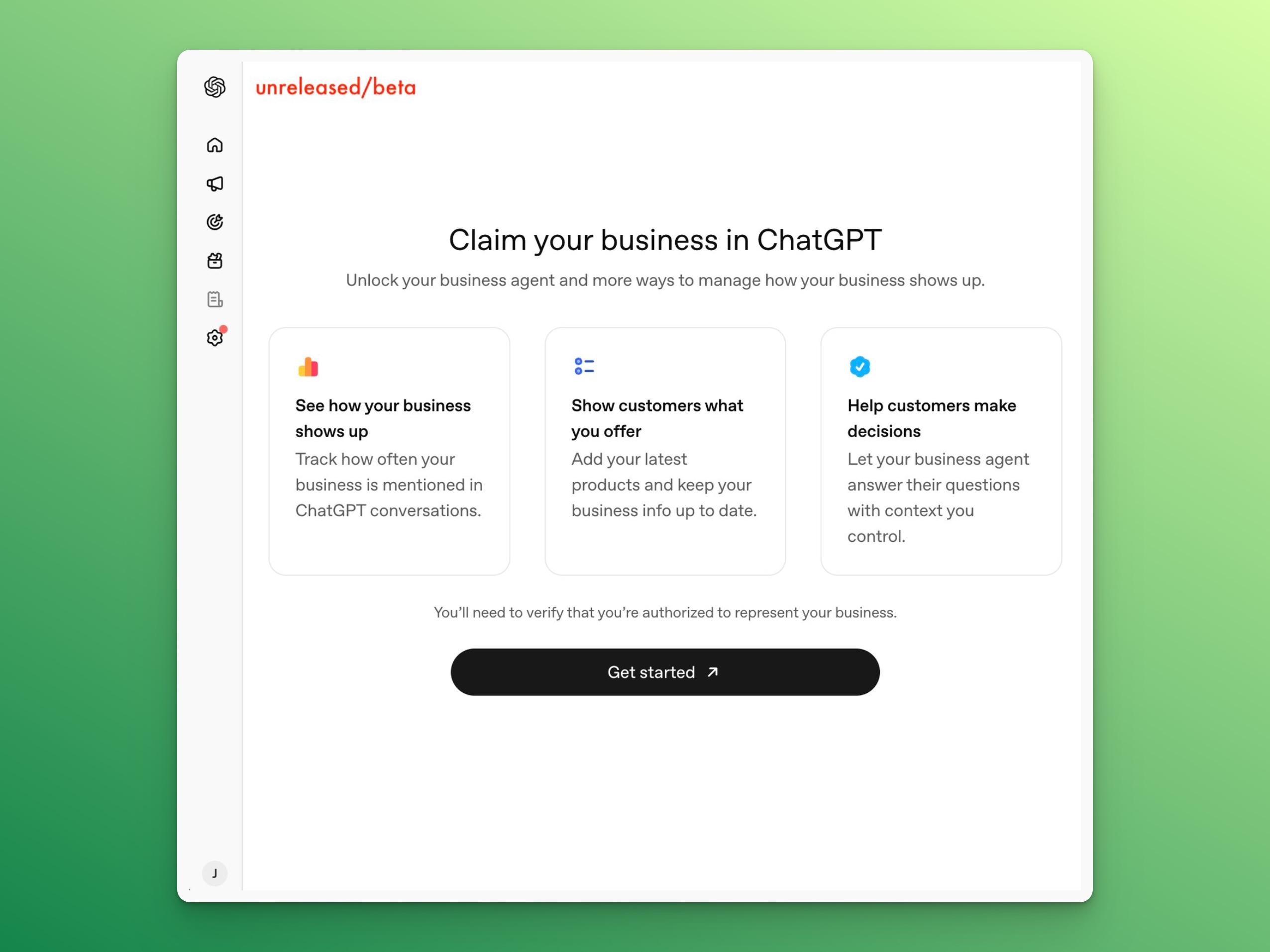
The screenshot Kaziukėnas shared shows a banner inviting businesses to claim their business in ChatGPT. Search Engine Roundtable reproduced its three promises. A business can see how it shows up by tracking mentions in ChatGPT conversations, show customers what it offers by adding products and keeping business information current, and help customers decide by letting a business agent answer questions with context the business controls.
The screen does not show a populated chart. The screen shows no metric glossary, eligibility list or export button. It establishes the shape of the offer. Reporting, information management and an agent are bundled under one claim flow.
How the reports spread
Every write-up traces to the same LinkedIn post. Barry Schwartz's Search Engine Roundtable article credits Kaziukėnas directly, and the Search Engine Land article quotes the same text. Lily Ray's widely shared LinkedIn post and Aleyda Solís's repost reproduce his wording.
That makes the coverage one observation amplified several times, not several independent account tests. No coverage reports an OpenAI comment, and two outlets state that OpenAI had not announced or commented on the feature. Search Engine Land added that the tool is not live yet.
Official capabilities next to the reported hub
OpenAI has shipped several business-facing products that sit close to the reported hub, and they are documented:
- Organic shopping through Shopify Catalog: OpenAI's March 24, 2026 update says Shopify merchant product data is already integrated through Shopify Catalog, with no additional work required from individual merchants. The same update says OpenAI is letting merchants use their own checkout while it focuses on product discovery.
- Direct commerce feeds: OpenAI's product discovery page says merchants can apply to share product data, and that Shopify and Etsy catalogs are already integrated.
- Ads Manager: OpenAI began rolling out a beta self-serve Ads Manager on May 5, 2026. Its help pages still label it a beta.
- Sponsored Agents: OpenAI's Sponsored Agents help article describes them as an ad format for chatting with an AI representative of a business, available only to selected advertisers in a limited alpha, with no early access requests accepted.
OpenAI's product-feed campaign documentation states that products from an Ads Manager feed are eligible only for ads during the beta and will not appear in organic ChatGPT conversations, though OpenAI may offer that later. OpenAI's feed reference marks ads eligibility as independent of search eligibility.
A dated timeline of OpenAI business signals
Each row below carries a date printed on the source named beside it:
| Date | Signal | Source |
|---|---|---|
| July 13, 2023 | AP licenses part of its text archive to OpenAI | AP press release |
| May 22, 2024 | News Corp signs a multi-year partnership | News Corp release |
| July 25, 2024 | SearchGPT prototype opens to a small group of users and publishers | OpenAI announcement |
| August 20, 2024 | Condé Nast partnership announced | OpenAI announcement |
| December 16, 2024 | ChatGPT search reaches all logged-in users | Update on OpenAI's ChatGPT search page |
| February 5, 2025 | ChatGPT search opens to everyone, no signup | Update on OpenAI's ChatGPT search page |
| September 29, 2025 | Instant Checkout and the Agentic Commerce Protocol launch | OpenAI announcement |
| February 9, 2026 | Ad testing begins in the United States | OpenAI Help Center |
| March 24, 2026 | Product discovery update, Shopify Catalog integration, shift away from standalone Instant Checkout | OpenAI announcement |
| May 5, 2026 | Self-serve Ads Manager beta begins rolling out | OpenAI announcement |
| September 16, 2026 | Sponsored Agents announced, tested with select US advertisers | OpenAI announcement |
| October 21, 2026 | ChatGPT Ads expands to 89 countries, with over 100,000 advertisers having run campaigns | OpenAI announcement |
| November 6, 2026 | Business Hub analytics observed, not announced | Trade coverage |
Three hypotheses for what OpenAI is building
The observation fits more than one product. All three are inference from public evidence, not an OpenAI roadmap.
Merchant-first console
The merchant-first console bundles business verification, catalog management, basic visibility reporting and an associated agent setup. This is the best-supported near-term footprint. The only access route anyone has observed is a Shopify store connection, and OpenAI already runs organic shopping through Shopify Catalog, direct merchant feeds and a Shopify app for ChatGPT Ads. A merchant console would reuse identity and catalog plumbing that commerce partners already touch.
The weakness is the banner's language. The screen speaks about businesses and business information, not stores and SKUs.
Broader verified-business hub
A broader hub would let any verified business manage its identity and authoritative facts across organic answers, owned agents and advertising. The screen's wording supports this reading. So do adjacent official pieces. OpenAI's developer docs describe a Get Quote button that appears on a business card or sidebar when a user searches for an eligible local business with a configured partner plugin, and OpenAI's Ad Tools Terms already define a Business Agent as an advertiser-sponsored conversational representative.
What's missing is any confirmed eligibility for B2B software companies, local service businesses or non-US firms. Rollout timing and scope are unknown.
Full webmaster and search console platform
A full platform would add query-level diagnostic reports, URL inspection, indexing and crawl controls, complete performance breakdowns and an API. The evidence for this is weak. The observer explicitly said the tool shows no prompts, which removes the query layer a search console is built on. OpenAI's existing publisher controls live in robots.txt and its crawler documentation, not in a dashboard, and nobody has reported a roadmap for URL-level diagnostics.
Why the evidence favors a business hub
The first two hypotheses match the observation's ingredients, which are verification, business information, an agent and two aggregate counts. The third requires features the observer said are absent. We'd plan around a business hub that starts merchant-first and may widen, and treat a true webmaster console as unlikely in the near term.
This table lists what each hypothesis has going for it and what would change the call:
| Hypothesis | Supporting evidence | What would strengthen it | What would falsify it |
|---|---|---|---|
| Merchant-first console | Shopify connection as the verification example, Shopify Catalog integration, merchant feeds, Shopify ads app | Documentation limiting claims to commerce platforms or approved feed merchants | B2B or local businesses claiming profiles without any catalog |
| Broader verified-business hub | Business-level banner language, business agent promise, local Get Quote spec, Business Agent definition in ad terms | An eligibility policy naming services, local or software businesses, or a domain-based claim route | Access staying tied to commerce platforms after launch |
| Full webmaster platform | Industry framing and the impressions-plus-clicks pairing | Query reports, URL inspection, crawl status or an API in official docs | A metric glossary limited to appearances and clicks with no query dimension |
How a verified-business hub would likely work
A business hub of this kind would need five layers, and each one raises its own questions for your team. These layers describe a plausible mechanism in plain terms, without claiming knowledge of OpenAI's internal systems, model training or implementation.
Verified entity
The first layer decides who may manage which business. That covers the legal entity, its brands, its domains and any storefronts. The Shopify connection suggests one route, where control of a commerce account proves control of a business.
OpenAI already verifies something adjacent. Its Help Center describes domain verification for workspace identity and SSO, and states that verifying a domain does not by itself grant product access. That is identity for employees, not a business-verification program. How OpenAI would map one company to several brands or domains is unknown.
Information inputs
The second layer is what the business supplies, meaning catalogs and current business facts such as products, descriptions and policies. OpenAI already runs several separate input routes, each with its own eligibility:
- Shopify Catalog for Shopify merchants
- Approved direct feeds for other merchants
- Ads Manager feeds, which are ads-only during the beta
- Partner plugins for conversion actions such as local quotes
Owner-supplied context is an input to the system and leaves the generated answer outside the owner's control. The banner promised a business agent that answers with context you control, which describes the agent's conversation. It says nothing about owners editing ChatGPT's independent answers.
Customer interaction surfaces
The third layer is where a buyer meets the business, and the surfaces carry different permissions. OpenAI's shopping help article says product results are selected independently and not influenced by partnerships. Sponsored Agents are ads, and OpenAI describes the Sponsored Agent conversation as clearly labeled and separate from ChatGPT's independent answers.
An owned business agent, as promised on the banner, would be a third surface with its own rules. A hub could manage all three from one screen without merging their eligibility. OpenAI's feed spec already keeps ads eligibility separate from search eligibility.
Measurement layer
The fourth layer counts events tied to a business, such as an appearance in a response or a click on a website link, and aggregates them by day. The observed daily chart fits that design.
Beyond that, we don't know what counts as an appearance (a name mention, a cited link, a product card), whether ad impressions are excluded, how much of ChatGPT's traffic the counts cover, how privacy thresholds work, or whether any export exists. Search Engine Roundtable's read was that the tool targets organic responses rather than ads, which is a reasonable inference and nothing more.
Why OpenAI might want this
The incentives below are strategic inference, not statements of OpenAI's intent:
- Fresher information: Owner-maintained facts and catalogs can be more current than crawled pages.
- Accountable ownership: A verified owner is someone OpenAI can hold responsible for business content, the same principle its ad terms apply to Business Agents.
- Measurement as a reason to participate: OpenAI has offered businesses no native count of ChatGPT appearances (tagged referrals show only the clicks that arrive), so a count gives them a reason to claim a profile.
- A bridge to agents and ads: A verified business is a short step from a business agent. OpenAI already runs a self-serve Ads Manager in beta and is testing Sponsored Agents with selected advertisers in a limited alpha.
What native ChatGPT reporting would and would not answer
Native reporting would likely answer two questions well. How often did our business appear in ChatGPT responses each day, and how many clicks reached our website from them? Citations might appear as a third metric, though the observation didn't mention them. For counted events, first-party data beats any sample, because it reflects real conversations rather than synthetic prompts.
Native reporting would leave four gaps:
- Why answers changed: With no prompt data, a drop in appearances can't be traced to a topic, a competitor or a model change.
- Private conversations: The observer said no user data appears, so you won't see what buyers asked.
- Category demand: Appearances have no denominator. A rise could mean you gained share or that more people asked about your category.
- Proof that AEO worked: A daily count is not a controlled test. Model updates and reasoning modes move the line alongside your content changes.
How Google and Bing AI reporting compare
Google and Bing already report AI visibility, but each counts a different population, so matching dashboard labels can mislead. Google's generative AI performance report counts how many times links to your website were shown in AI Overviews and AI Mode, and Google's help page says the report reached all websites worldwide as of August 31, 2026. Google also blends AI feature traffic into the main Performance report under the Web search type, and its help docs say a click on an external link in AI Mode or an AI Overview counts as a click.
Bing's AI Performance report, launched as a public preview on February 10, 2026, counts citations across Microsoft Copilot, AI-generated summaries in Bing and select partner integrations. Bing describes its grounding-query data as a sample of overall citation activity, and the report shows no clicks.
This table lines up what each source counts:
| Source | Population counted | Metrics | Clicks | Query data | Status |
|---|---|---|---|---|---|
| Google Search Console | Links to your website shown in AI Overviews and AI Mode | Impressions by page, country, device and date in the AI report | Counted in the main Performance report, blended under Web | Available in the main report | Available to all websites |
| Bing Webmaster Tools | Citations in Copilot, Bing AI summaries and select partners | Citations, average cited pages, grounding queries, citation share, intents, topics | Not shown | Sampled grounding queries | Public preview |
| ChatGPT (observed) | Business appearances in ChatGPT responses | Daily appearances and website-link clicks | Shown | None reported | Not launched, verified businesses only |
Google counts link impressions, Bing counts citations, and the ChatGPT tool reportedly counts business appearances, which may include mentions with no link. Take a hypothetical business that sees 10,000 Google AI impressions and 400 ChatGPT appearances. It hasn't learned which engine values it more. It has learned that two different events happened different numbers of times.
How websites get cited in ChatGPT search today
Today the unit of visibility in ChatGPT search is the citation, a source link attached to an answer. OpenAI's search help article says responses that use web search may include citations, that users can open a Sources panel showing cited sources and other links, and that placement is not guaranteed.
Inclusion has one documented gate. OpenAI's Publishers and Developers FAQ says any public website can appear in ChatGPT search, provided OAI-SearchBot is not blocked. OpenAI's help article adds that your host or CDN must allow traffic from OpenAI's published searchbot IP addresses.
Publisher partnerships have no documented effect on ranking. OpenAI's ChatGPT search launch page thanks partners including the Associated Press, Axel Springer, Condé Nast, the Financial Times, News Corp and Reuters, and on the same page says any website or publisher can choose to appear. OpenAI publishes no ranking criteria beyond saying it uses multiple factors.
Training crawlers and search crawlers are different
OpenAI's crawler documentation lists four user agents, each with its own robots.txt consequence:
- OAI-SearchBot: Surfaces websites in ChatGPT search. Blocking it removes your pages from ChatGPT search answers, though they can still appear as navigational links.
- GPTBot: Crawls content that may be used to train OpenAI's foundation models. Blocking it signals that your content should not be used for training, and the documentation states no search effect.
- ChatGPT-User: Fetches pages for user-initiated actions. OpenAI says robots.txt rules may not apply to these requests and that this agent doesn't decide search inclusion.
- OAI-AdsBot: Checks landing pages submitted as ads. OpenAI says its data isn't used for training, and its advertiser guidance says advertisers must allow it.
The settings are independent, so a company can allow OAI-SearchBot and block GPTBot. OpenAI says robots.txt changes take about 24 hours to affect search results. On October 30, 2026, OpenAI said it plans to support a shared robots.txt signal for AI training preferences in the coming months, alongside existing controls.
A page OAI-SearchBot can reach still has to be the source ChatGPT picks for the answer. And pages that GPTBot crawls may inform future models, which nobody outside OpenAI can verify.
Measure ChatGPT visibility before an official console arrives
Until a native report ships, ChatGPT visibility has to be assembled from partial signals. ChatGPT's outbound links carry the utm_source=chatgpt.com parameter documented in OpenAI's publisher FAQ, and Google Analytics added an AI Assistant default channel on May 13, 2026 that groups referrals from recognized AI assistants.
Each method answers a different question:
| Method | What it shows | Blind spots |
|---|---|---|
| chatgpt.com referrals in analytics | Tagged clicks that reach your website, by landing page | Clicks from in-app browsers can lose the referrer and land in Direct. In October 2026 ChatGPT briefly dropped its UTM tags, which practitioners reported as a bug that was then fixed |
| ChatGPT artifacts in Google Search Console | Practitioners reported leaked prompts as GSC impressions in late 2025. Separately, Google indexed shared ChatGPT conversations in mid-2025 | Not a measurement method. The discoverable-sharing feature was reportedly removed, and practitioners reported that OpenAI said it fixed the prompt leak |
| Manual prompt testing | The exact answer text, how competitors are framed, which sources are cited | A handful of runs, personalization, and high run-to-run variance |
| Server logs | Which pages OAI-SearchBot and ChatGPT-User fetched, and how often | A fetch is not a citation, and logs show nothing about the answer |
| Prompt tracking tools | Appearance rates across a sampled prompt set, competitor comparisons, cited sources | Synthetic prompts, sampling choices, variance, and no demand denominator |
How reliable prompt tracking tools are
Prompt tracking measures a sample you designed, so its reliability depends on how many prompts you run, how often, and how you report the spread. In one repeated-prompt test, 600 volunteers ran 12 identical prompts 2,961 times through ChatGPT, Claude and Google's AI during November and December 2025. The study found under a 1 in 100 chance of getting the same brand list twice, and about 1 in 1,000 for the same list in the same order.
Visibility percentage, meaning how often a brand appears across many runs, held up better than rank. The study came from SparkToro and Gumshoe.ai, a tracking startup, and wasn't peer reviewed.
Gartner's Innovation Insight on answer engine visibility tools says the tools help with AI search but raise concerns about data accuracy and overreliance. We read that as a reporting instruction. Run each tracked prompt several times per engine, report appearance rates as ranges, and stop presenting single-run ranks to leadership.
CheckThat data, as of September 2026, measures AI visibility across 5,800+ brands, nearly 200 B2B software categories, and 2.6M+ AI responses. That data carries the same sampling limits, which is why a native first-party count would complement tracking rather than replace it.
What B2B and commerce teams should do next
Commerce teams have an access route OpenAI already documents, and B2B teams don't. Each group should act on what exists today and prepare for a hub without depending on it.
Commerce and retail teams
Start with catalog accuracy, because that's what ChatGPT already reads. Shopify's help docs say Shopify Catalog products reach ChatGPT with no merchant setup, that B2B-only products aren't supported, and that legal disclosures belong in the first 6,000 characters of a product description. Fix titles, variants, prices and availability there first.
If you sell outside Shopify or Etsy, apply for direct feed access through OpenAI's product discovery page. Keep any Ads Manager feed as a separate project with its own owner, because those products stay ads-only during the beta and buying ads won't place them in organic answers.
Then prepare for verification. Confirm who controls the Shopify admin, your domains and any OpenAI business or ads accounts, so a claim flow doesn't stall on access when it opens.
B2B technology teams
Check crawler access before anything else. Allow OAI-SearchBot in robots.txt, confirm your CDN or WAF doesn't block OpenAI's published IP ranges, and decide on GPTBot as a separate training question.
Next, make your pages citable. Answer buyer questions directly under clear headings, and keep your pricing model, integrations, customer segments and category consistent across your own website, review profiles and partner listings.
Build an interim measurement stack from tagged referrals, server logs, Google's and Bing's AI reports, and repeated-run prompt tracking. For the board, report appearance ranges and referral trends separately, and say plainly what none of these sources can show. That includes the share of category demand you capture and proof that a specific content change caused a lift.
Signals that would confirm the hub
These events would move the business hub from attributed observation to confirmed product:
- An OpenAI Help Center article describing the Business Hub or the claim flow
- An eligibility policy naming business types, countries and verification methods
- A metric glossary defining an appearance, a click and the counting window
- An access route for B2B software, services or local businesses without a commerce catalog
- An export, a connector or an API for the daily data
- A statement on whether ad impressions and Sponsored Agent conversations are excluded from the organic counts
Recheck each signal before publishing internal guidance, and update your measurement plan when the glossary appears, because the definition of an appearance decides whether the numbers belong next to Google's impressions or Bing's citations. If keeping that measurement and the content work it feeds running across separate tools is the bottleneck, book a demo to see how the GrowthX platform runs it in one workspace.