If you've made an attempt to align output from an agent or AI-enabled workflow that bears any alignment to your brand guidelines then you know it's not easy to get anything, well, good.
A lot of the stabs at this look something like slapping your 40-page brand book into ChatGPT, asking for a blog post, and getting back copy that's pure middle-of-the-road mediocrity. And that's a best case scenario! Sometimes it's a disastrous hash of your brand positioning with general milquetoast takes.
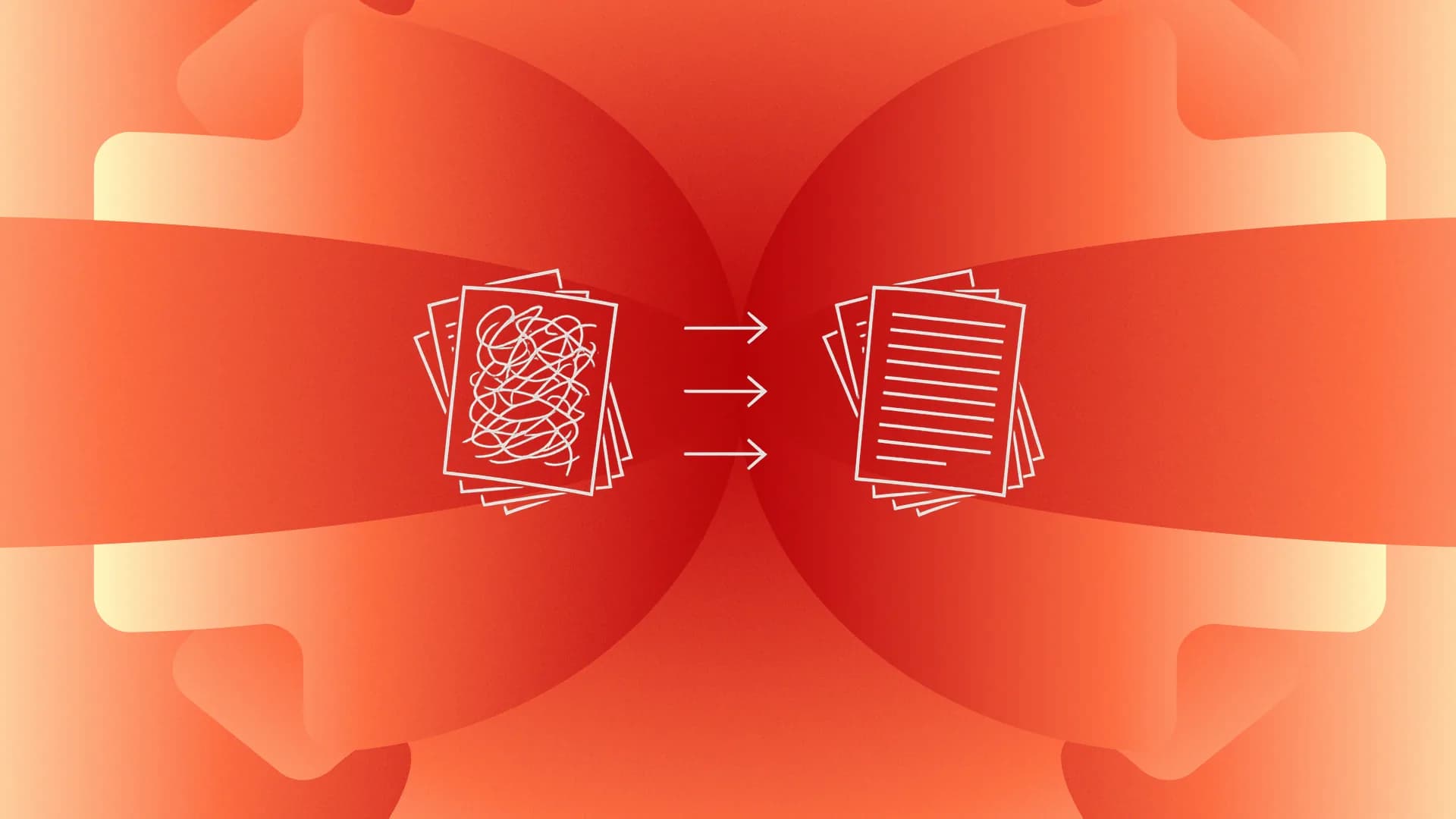
Generally, we've found that the model is fine. The input is the problem, because a document written to inspire a human designer or content creator carries almost nothing a language model can act on. What closes the gap is a set of machine-readable rules that persists across every session and every tool. Here's how to build one.
Why standard brand books fail with AI
Teams build brand books for human interpretation, and a language model interprets nothing. It predicts the next token. When your guidelines say the voice is "confident, approachable, and bold," the model has no way to convert those adjectives into word choices, sentence structures, or the specific phrases you'd never publish. It reaches for the statistical average of the internet instead.
We run content programs for client brands every day and see the same result everywhere. And it's not just our anecdotal evidence. One 2024 audit of 1,200 drafts, unedited first drafts from general-purpose models averaged a measly 62% alignment to documented brand voice.
The PDF format compounds the problem. A brand book is unstructured, aspirational, and disconnected from the tool generating the copy, so the model can't tell a hard rule from a nice-to-have. The fix is translation, from inspiration for humans into constraints for machines.
Otherwise known as context engineering.
How to train AI on brand guidelines: step by step
To train AI on brand guidelines, convert an abstract style document into explicit rules and approved examples, then store those rules where every tool can read them. The process has six steps. The first four make drafts sound like your brand. The last two keep them that way as volume grows.
Step 1: Translate brand voice into AI-ready rules
Convert every tone adjective into a rule a model can execute. "Professional but friendly" tells the model nothing. "Contractions allowed, no exclamation points, sentences under 25 words, address the reader as 'you'" tells it exactly what to do.
Score your brand on the four tone dimensions, humor, formality, respectfulness, and enthusiasm, then translate each position into concrete instructions using the 37 tone words.
For each personality trait, write the rule and the reason:
- Enthusiasm: matter-of-fact. Lead with the claim and the proof. No superlatives like "amazing" or "revolutionary."
- Sentence rhythm: varied. Mix short declaratives with longer explanatory sentences, and never three uniform sentences in a row.
Step 2: Build a golden dataset of approved copy
Next, assemble a brand corpus before you configure any tool. This is the step we see teams skimp on, and it's the highest-leverage of the six. A minimum viable corpus runs 30-50 pieces across at least three content types, with 300-word calibration samples drawn from the same format you want the model to produce. Feed it blog posts and you get blog voice, not landing-page voice.
Structure it in four parts:
- On-brand examples: Tag ten to fifteen publish-ready pieces by format and audience.
- Prohibited phrases: A managed term list. Writer's system enforces four term types in real time, a useful model even if you build the list by hand.
- Format patterns: How you open, how you structure a comparison, where CTAs go, how long paragraphs run.
- Audience-specific variants: Separate voice notes for the technical buyer versus the economic buyer.
Step 3: Choose a configuration method
Then match the configuration method to your scale, because durability depends on where the rule lives. As a rule of thumb, fine-tune for stable traits like voice and output format. Use RAG (retrieval-augmented generation, which fetches facts from a knowledge base at query time) for knowledge that changes and needs attribution.
| Method | Best for | Persistence | Technical resources |
|---|---|---|---|
| One-off prompts | Solo users or testing, low volume | Per-session | None |
| Custom Instructions | Standard ChatGPT workflows | Persistent in standard chats, not forwarded to Custom GPTs | None |
| Custom GPT | Mid-size teams standardizing one workflow | Persistent within the GPT | Low, no code |
| RAG | Teams needing current product facts and citations | Persistent, updatable knowledge base | Moderate to high |
For most content teams, a Custom GPT is frankly the practical starting point. In OpenAI's GPT Builder, admins set Instructions (the system prompt), upload Knowledge files, and toggle Capabilities. Account-level Custom Instructions do not carry into Custom GPTs, so configure the GPT directly.
Step 4: Write system prompts with do/don't examples
Embed the brand rules as system instructions, and lead with concrete do/don't pairs instead of style adjectives. A model can't act on "write with confidence." It can act on a matched pair. "Don't write 'We're excited to announce our innovative new feature.' Do write 'The new export tool cuts report prep from three hours to twenty minutes.'"
Order the system prompt so the load-bearing rules come first:
- Role and audience: Who the model writes as and who reads it.
- Do/don't pairs: Five to ten matched examples covering your most frequent voice violations.
- Hard constraints: Banned words, required formatting, sentence-length limits, the term list from Step 2.
- Output format: Structure, length, and how sections open.
Done well, you stop re-explaining the brand every chat. Team-wide writing-style preferences pushed guideline compliance up 30-65% in one internal study.
Step 5: Add a knowledge layer for factual grounding
Voice is only half the configuration. System prompts do nothing for accuracy. Ask a general model for your pricing tiers and it will confidently generate plausible fiction. A knowledge layer, RAG retrieval or uploaded reference documents, feeds verified facts into the draft at query time.
Load it with the material a strong writer would need on hand:
- Product facts: Specs, pricing, feature names, and positioning. RAG keeps these current without retraining.
- Market and institutional context: Campaign history, launch narratives, competitive framing, objection-handling language, and the decisions behind your positioning.
Factual errors erode trust faster than flat voice, and 67% of B2B buyers report they can usually identify unedited AI content. Size the layer to your actual reference set, not the maximum your tool allows.
Step 6: Prevent brand drift with QA and review loops
Finally, build human review checkpoints and a refresh cadence, because brand configuration decays without maintenance. Configuration reduces the editing burden, but it doesn't remove the editor. We hold that line on every piece we ship. Long chat sessions also drift off-voice, so start fresh for each new piece.
Run three governance loops on a schedule:
- Human review before publish: Every piece gets an editorial pass. In the same 2024 audit, structured human edits raised voice alignment from 62% to 91%.
- Periodic corpus and prompt updates: Refresh the golden dataset quarterly, and version your prompts and guidelines so you can trace what changed.
- Hybrid validation: Score drafts against your rules before they reach the editor, so systematic violations get caught by machine, not by tired human eyes at 6 p.m.
Data privacy and security considerations
Before you upload anything, decide which tier of tool is allowed to see it. Consumer tiers can expose proprietary brand assets to training use. OpenAI may train on ChatGPT consumer content unless you opt out, but not on Team, Enterprise, or API tiers. Anthropic excludes commercial and Enterprise content and makes consumer training opt-in. Google trains on Gemini Apps data by default, but not Workspace or paid API.
Samsung engineers pasted confidential semiconductor source code into ChatGPT within 20 days of its rollout, and the company banned generative AI on company devices within a month.
Two precautions cover most of the risk:
- Use enterprise or API tiers for brand work. That's where the explicit no-training terms live.
- Choose certified tools and handle PII deliberately. Writer, Notion AI, and Grammarly Enterprise list SOC 2 Type II and ISO 27001 certifications. Never paste customer data into prompts, something 34% of office professionals admit to doing with public AI tools.
Shadow AI is the hardest part to control. 78% of AI users bring their own tools to work without clearance, and a sanctioned, well-configured tool is your most effective control.
Legal and compliance guardrails
U.S. law does not protect purely AI-generated copy. The D.C. Circuit affirmed in Thaler v. Perlmutter that the Copyright Act requires human creative control over the expressive elements, and prompts alone do not make the user an author. Work-for-hire doesn't rescue you either, so the practical ownership mechanism is contractual assignment. Review your vendor's terms of service before your team assumes it owns the output.
Then write an AI code of conduct that applies to employees and outside partners alike. Governance friction is already the leading blocker to scaling AI, up 3.4x year over year among marketers. Two lists keep it usable:
- Acceptable use: Drafting from the approved corpus and prompts, research summarization, and format conversion, always with human review before publish.
- Prohibited use: Customer or confidential data in consumer tiers, publishing unedited output, unapproved tools, and copyright claims on unedited AI copy.
Scaling to visual and multilingual brand output
The same rules-and-review logic extends to images and languages, with one caveat. No current image generator hard-locks exact brand colors or reliably reproduces logos and named fonts. Midjourney's style-reference parameter influences color as inspiration only, and GPT-4o image generation accepts hex codes but still produces knock-off logos when you feed it your real one. Adobe Firefly is the one tool with post-generation enforcement. Its Brand Intelligence Validate skill checks generated assets against color-palette, font, and logo-placement rules. For brand-critical visuals, validation after generation beats hoping the prompt held.
Multilingual output amplifies every text risk. A 2025 study of 17 LLMs reported translation hallucination rates of 33% to nearly 60%. The fix mirrors the text playbook. One localization provider trained a client's in-house LLM on a 100-page style guide with 500-plus rules across 47 languages, lifting translation quality from 80% to 99%. Cultural nuance goes in the knowledge layer or the prompt, and a human who speaks the language signs off.
When prompt engineering isn't enough
Per-tool, per-session configuration breaks the moment you scale past one workflow. You configure a Custom GPT for blogs, a separate voice profile in your writing tool, and a third set of instructions for your localization vendor. Each holds its own copy of the brand, and each drifts independently. You've become the integration layer for a stack that won't talk to itself.
The durable pattern is a persistent context layer that every agent reads from, versioned briefs that travel with the work, and feedback loops that make each correction improve the next draft instead of evaporating at session end. We built the GrowthX platform around that architecture. Onboarding starts with the Context layer, where the system maps competitors, extracts personas from real data, and calibrates voice against your site. Upload brand documents, decks, and transcripts once. When positioning shifts, change the Context and the whole system recalibrates, with human review in the loop before anything publishes. If you're re-entering brand context into a different tool every week, book a demo and see what one persistent context layer replaces. Engagements start from $6,000/mo.