To know whether AI recommends your brand, track three results separately: being cited, being mentioned and being recommended. Run the questions buyers ask while building a shortlist, on the same AI tools, asked the same way, over time. And always say what each number is out of, so you can tell a strong result from a weak one.
Here's why that matters. AI can use your page as a source and still tell the buyer to pick a competitor. A single visibility score won't show you that.
Cited, mentioned and recommended are three different results
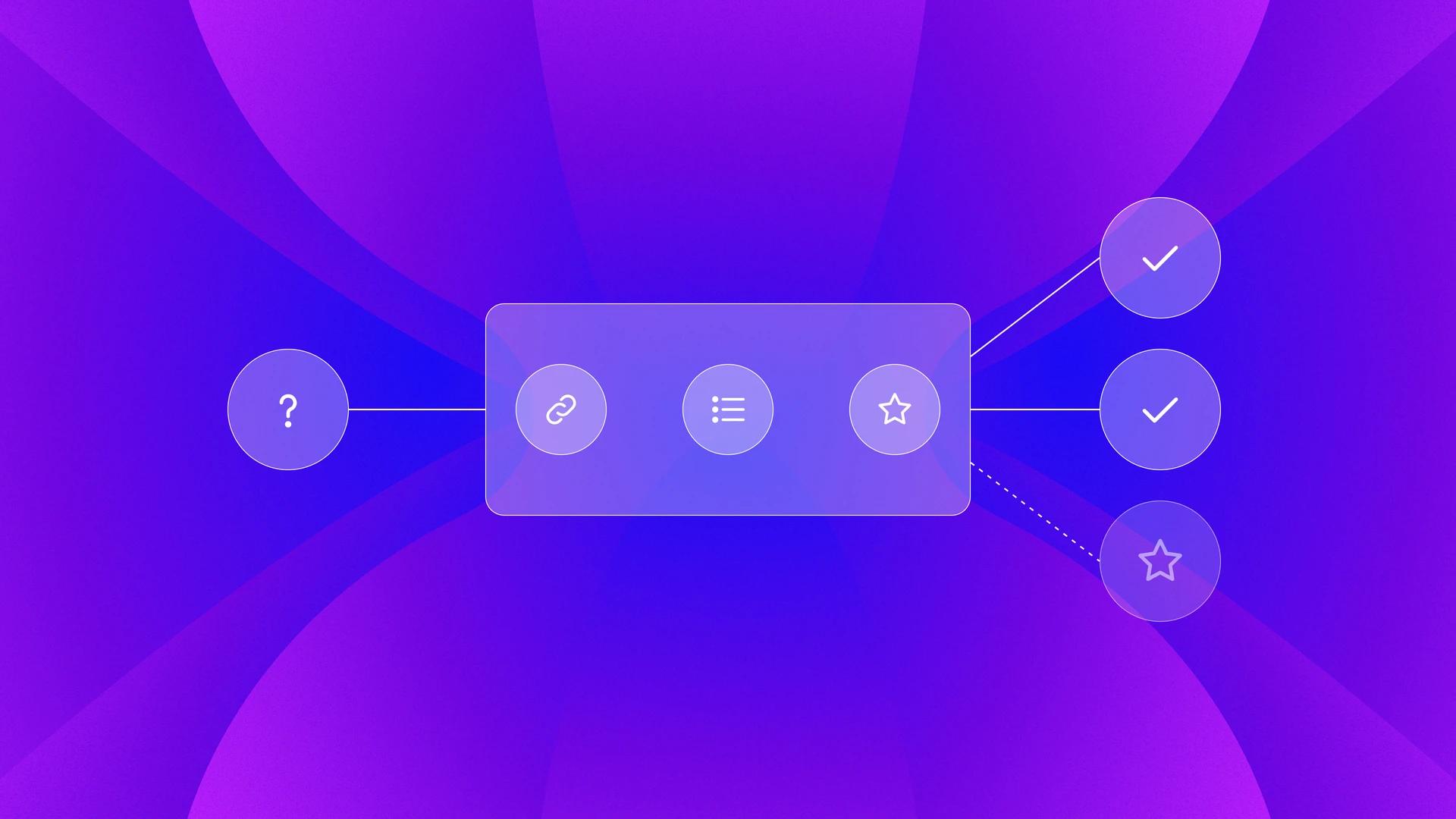
All three results come from the same answer, and each one shows something different:
- Cited: The AI lists your page as a source for its answer.
- Mentioned: The AI names your brand in the answer, when your name isn't in the question.
- Recommended: The AI tells the buyer to consider or choose you.
Each result answers its own question. Cited asks which sources the AI uses, and whether yours are among them. Mentioned asks whether you come up when your name isn't in the question. Recommended asks how the answer describes you, and whether it tells the buyer to pick you. Our ebook calls these Influence (cited), Presence (mentioned) and Perception (recommended).
A single visibility score blends all three results into one figure. If that figure drops, you can't tell whether you lost citations, mentions or the recommendation. Each of those losses has a different fix, and a blended score hides which one you need.
Two more checks sit behind the three results
Reputation is what outside sources say about you. For Alignment, check whether what AI tools and outside sources say matches the facts about your business.
A citation can still send the buyer to a competitor
A company can be cited without being recommended, and it can be recommended for the wrong reason. These are separate failures, and each one needs its own fix.
Cited without being recommended means the AI used your page as evidence but formed its verdict elsewhere. The AI might use your integration docs to support a claim in the answer while recommending Competitor A.
AI trusts your content, but it doesn't see you as the best pick. The fix is in how you're described as a choice.
Build pages that state who you're for and when you win. Then review the third-party sources (Reputation) the AI cites in its comparison answers, and check what each one says about you.
Recommended for the wrong reason is an Alignment problem. You make the shortlist, but the answer calls you the cheap option when you sell the premium tier, or it places you in the wrong category.
In a Search Engine Land study of dental practice software brands, the AI engines were asked which dental practice software is built for Canadian dentists. They recommended Curve Dental, though only Oryx Dental offers a Canadian version. The fix is to correct the facts where the AI reads them: who you're built for, your pricing and tiers, on your own pages and the review profiles AI cites.
Count every result against the right denominator
Every rate needs a stated denominator, or it means nothing. Being recommended in 4 of 6 answers that recommended anyone is very different from being recommended in 4 of 10 answers overall.
The first shows that you win most of the shortlists that exist. The second mixes in answers that recommended nobody, so the same performance looks weaker.
Choose the denominator before you look at the results, and print it next to every number you report.
- Mention rate belongs against all answers.
- Recommendation rate belongs against answers that recommended any vendor.
- Citation rate belongs against all answers.
Treat the test like a survey you repeat. Ask the same questions with the same wording every run, use the same AI tools, and repeat the test over time. Keep the session conditions fixed too, so each run starts from the same setup.
The results show what happened in your tests. They can't show you everything AI tools say about you.
Repeat each question several times so you can distinguish a pattern from run-to-run variation.
Treat small moves as noise until they repeat
AI answers change from run to run, even when nothing about your brand has changed. For the same question, the AI can recommend you in one run and leave you off the shortlist in the next, so a single answer is one sample. Repeat each question several times and report the share of answers that name or recommend you.
Our own visibility study shows how much answers move. Of 410 page-and-question pairs we observed on three or more days, 59% were cited on exactly one of those days. A 1 or 2 point move in a noisy score is not market impact. Call a change real only when it holds across repeated runs and points the same way on several questions.
Put most of your tracking on shortlist questions
Most of your tracking effort belongs in evaluation, because that is where buyers form a shortlist. Early-journey tests still have a job: they show whether your explanation shapes the criteria buyers use. Shortlist tests show whether you get picked. For how to read results at the other buying stages, and how to check the reasoning behind a recommendation, see what AI visibility can tell you.
A worked example from one B2B SaaS category
This example is hypothetical. A contract lifecycle management (CLM) vendor runs 10 evaluation questions once on ChatGPT and logs each answer. A real test repeats every question several times and runs it on two or three AI tools.
Here is the log, with a short note on each gap:
| # | Evaluation question | Cited | Mentioned | Recommended | What the gap means |
|---|---|---|---|---|---|
| 1 | Best CLM software for mid-market legal teams | Yes | Yes | Yes | Winning. Keep the pages that support it current. |
| 2 | CLM tools that integrate with Salesforce | Yes | Yes | No (Competitor A) | Your docs are evidence, but A wins the verdict. Perception gap. |
| 3 | Easiest CLM for a small legal team to roll out | No | Yes | Yes, as "cheapest" | Recommended for the wrong reason. Alignment gap. |
| 4 | How long does CLM implementation take | Yes | No | No vendor named | Cited but unnamed. Influence without Presence. |
| 5 | Alternatives to Competitor B | No | Yes | Yes | Winning without a citation. Outside sources carry it. |
| 6 | What CLM software typically costs | No | Yes | No vendor named | Named with an old price. Alignment gap. |
| 7 | CLM with the best AI clause review | No | No | No (Competitor C) | Absent. Outside sources don't connect you to this. Reputation gap. |
| 8 | Questions to ask CLM vendors in a demo | Yes | No | No vendor named | Cited but unnamed. Influence without Presence. |
| 9 | Best CLM for regulated industries | No | Yes | Yes | Winning. Confirm it holds on repeat runs. |
| 10 | Security certifications a CLM should have | No | No | No vendor named | Low stakes. Watch the trend over time. |
Count each result separately. The brand is cited in 4 of 10 answers and mentioned in 6 of 10. The brand is recommended in 4 of the 6 answers that recommended anyone. That denominator measures performance only within answers that produced a vendor shortlist. Measured against all 10 answers, the same result is 4 of 10.
If you average these into a blended score, you hide the work list. Use the log to identify three jobs. Sharpen positioning on integration questions. Correct pricing and tier facts at the source. Earn outside coverage for AI clause review.
Run your first honest test in two weeks
You can run this test with a spreadsheet:
- Pick one buying category you sell into.
- List the 10 most important questions buyers ask while evaluating vendors in that category.
- Run each question on the same two or three AI tools, such as ChatGPT, Perplexity and Google AI Overviews, in a clean session.
- For every answer, mark whether you were cited, mentioned and recommended. Write down why the answer recommended you or someone else, and note which sources it cited.
- Record the denominator for each rate next to the number.
- Repeat the full run in two weeks under the same conditions.
- Compare your results with your real competitors, the ones who show up in your deals, rather than the ones on your slide.
Fix the result you are missing
If citations are missing, build pages that answer the question well enough to be used as evidence. If mentions are missing, check whether the sources and pages you reviewed associate your brand with that topic.
If recommendations are missing or wrong, review your positioning and the facts outside sources repeat. Every page you build should have a clear purpose, as covered in the jobs every page does.
To prioritize those fixes, decide which questions are worth winning first using the content prioritization framework. For the full measurement method, read the ebook, What 10,000 Hours of AEO Taught Us.
See which evaluation questions to track for your category. Get your question map.