Most teams evaluate content by traffic alone. But a page can do up to seven jobs for three audiences at once: your buyers, search engines and AI, and your own team. Most of those jobs never show up in a traffic report, so judge your website as a portfolio, not one page at a time. That matters more now that AI shapes your buyers' journey long before they're ready to buy. The pages doing that shaping are often the quiet ones in your report.
Your website is where your expertise becomes visible
Your team understands its customers, products, category and point of view, and your website is where that understanding becomes visible to everyone else. Buyers use it to learn about a problem and how to solve it, to evaluate and choose a solution, and later to use and succeed with what they bought. Search engines discover it. AI systems may retrieve it when they answer a question, or come across its solutions through the wider web. You can't force either outcome. What you can do is publish accurate, useful content that reflects your company's expertise and connects the topics that matter to your buyers.
The seven jobs a page can do
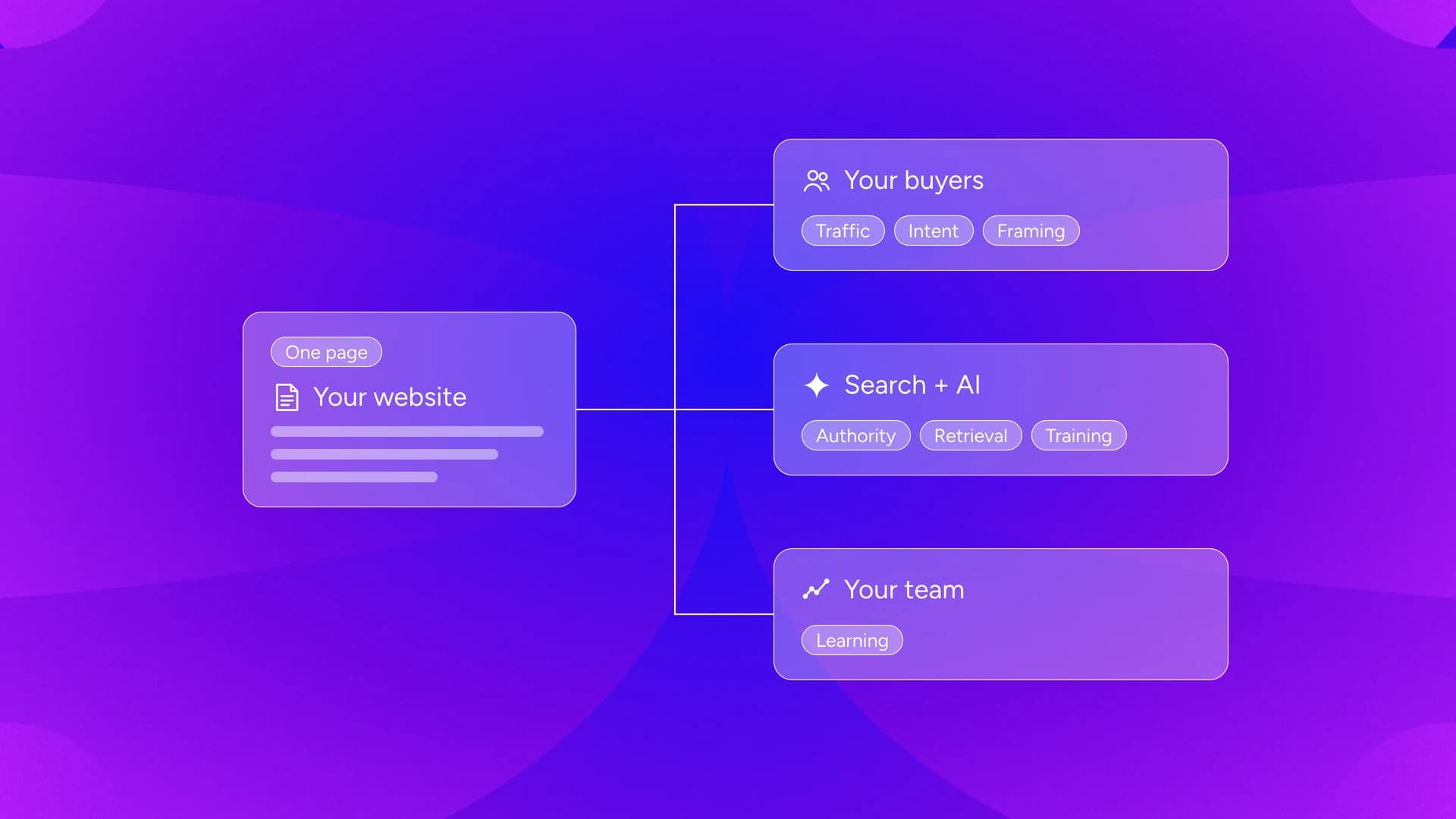
Each of the seven jobs serves one of three audiences: your buyers, search engines and AI, or your own team. A single page can do several at once. If you've used jobs to be done for products, the same thinking works for pages.
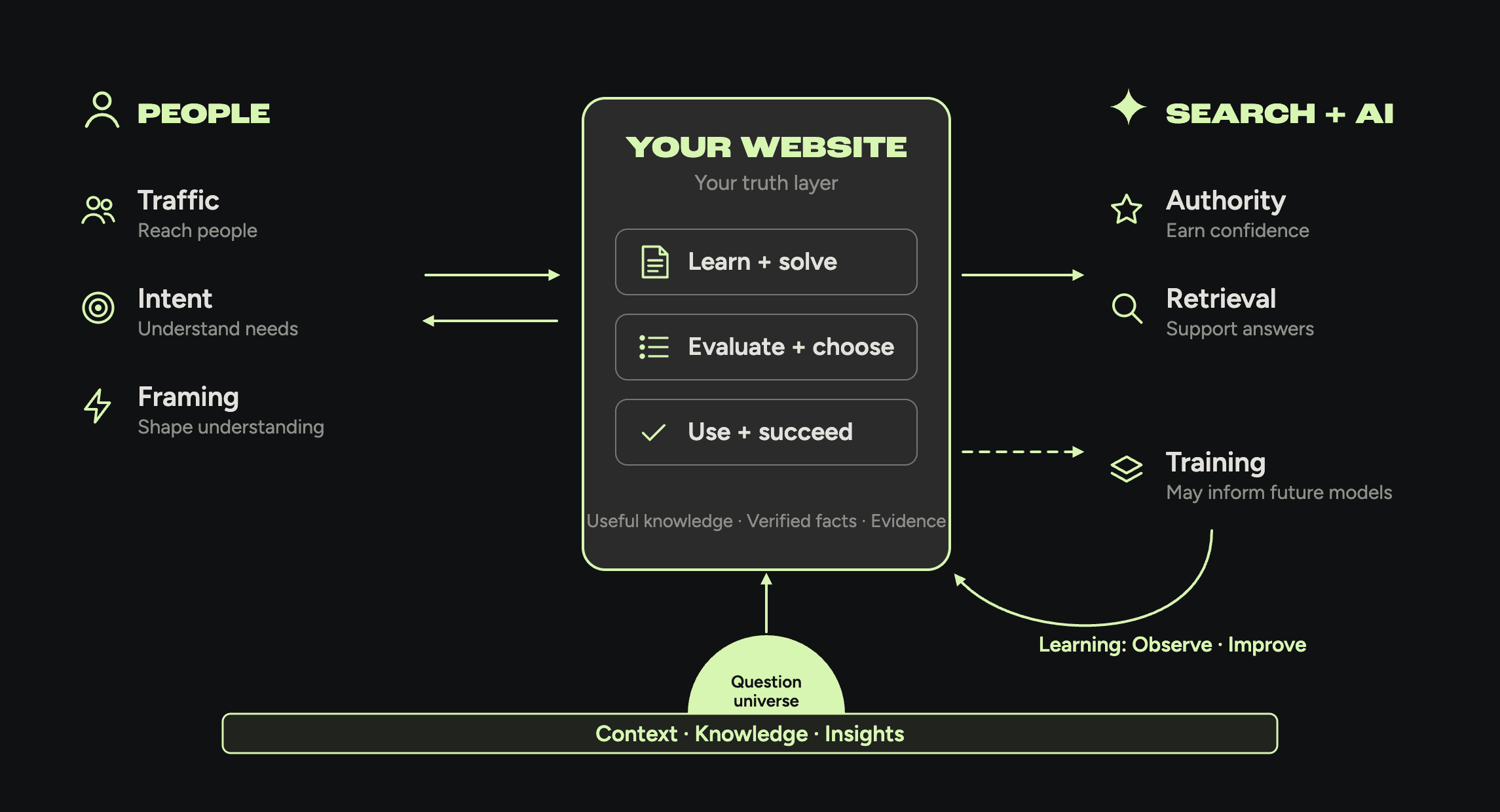
Figure: Your website sits at the center. Buyers are on one side, search engines and AI on the other, and a learning loop runs from both back to your pages.
What a page does for your buyers
With your buyers, a page does three jobs. It brings them in, it tells you what they care about, and it shapes how they think.
- Traffic: The page brings qualified buyers to your site and moves them toward an action. A guide to choosing a first road bike does this job when people shopping for one find it, and random clicks from unrelated searches don't count.
- Intent: Every visit is a signal. What someone reads and clicks tells you what they care about, and that's information you can act on. Someone who reads your pricing page and then your financing page tells you more than someone who only visits your homepage.
- Framing: The page shapes how buyers understand their problem and which solutions fit, so they arrive already thinking about it the way you do. When a physical therapy clinic explains that recurring back pain often starts with posture, it changes which treatments a reader goes looking for.
What a page does with search engines and AI
With search engines and AI, a page does three more jobs:
- Authority: The page builds credibility on its subject, which search engines weigh before they rank a page or trust it. An accounting firm with ten accurate, connected pages on small-business tax deadlines makes a stronger case than a firm with one post.
- Retrieval: The page becomes a source that AI tools pull from and cite when they answer a question. A hardware store's guide to choosing deck screws may be the page an AI assistant pulls from when someone asks which screws to buy.
- Training: The page may become part of what future AI models learn, because public pages get collected over time. A cooking site's explanation of why you rest meat may shape how a future model talks about the topic. Nobody can confirm in advance that a specific page will end up in a specific model.
What a page does for your team
For your team, a page does one more job:
- Learning: The page shows what's working through impressions, visits and actions, so you know what to improve. If a page gets steady visits but nobody clicks through to learn more, that tells you where to look.
Why one dashboard can't see all seven
The seven jobs pay off on different timelines, and some are hard to observe at all. Traffic shows up fast. Framing, authority and training build slowly and rarely appear in a report.
Search engines work on long clocks. Google's own starter guide says some changes take effect in a few hours while others can take several months.
Evaluate each page based on its intended purpose or job and the timeline for achieving it, rather than dismissing its value because your dashboard doesn't capture every metric.
Think in portfolios, not pages
Every page on your website is an investment. Some pay off right away, some take months, and some pay off in ways a report never shows. Together, they make up your portfolio. As in any portfolio, each page has a purpose, a question it serves and a potential return. Some bring traffic, some help a buyer through a hard decision, and some connect a set of related answers so the whole subject hangs together.
Their value comes from the work they do together, and one page showing up in one screenshot of an AI answer tells you little. Search engines look at the whole set as well. Google's guidance for sites that lose ground in a core update asks owners to check whether the site overall, and not only individual pages, delivers helpful, reliable content.
A portfolio also needs upkeep. Pages go stale, overlap each other, or drift away from the question they were written for. Publishing is the start of a page's life, not the finish line.
Try this with your ten most important pages
Start with the pages you already have. Pick your ten most important ones, and for each, write down:
- The buyer question it serves. One question, in the words a buyer would actually use.
- The job it does best. Pick one of the seven: traffic, intent, framing, authority, retrieval, training or learning.
- Who it does that job for. Your buyers, search engines and AI, or your own team.
- Whether your reports can see that job. If the job is framing or authority, a traffic report won't show it.
Any page where you can't name the question and the job needs a closer look.
The next time a page sits near the bottom of your traffic report, check which job it was built to do before you decide it isn't working.
This post summarizes chapter 2 of GrowthX's playbook, What 10,000 hours of AEO taught us. Download the full playbook to get the full framework for judging each page on the job it does.