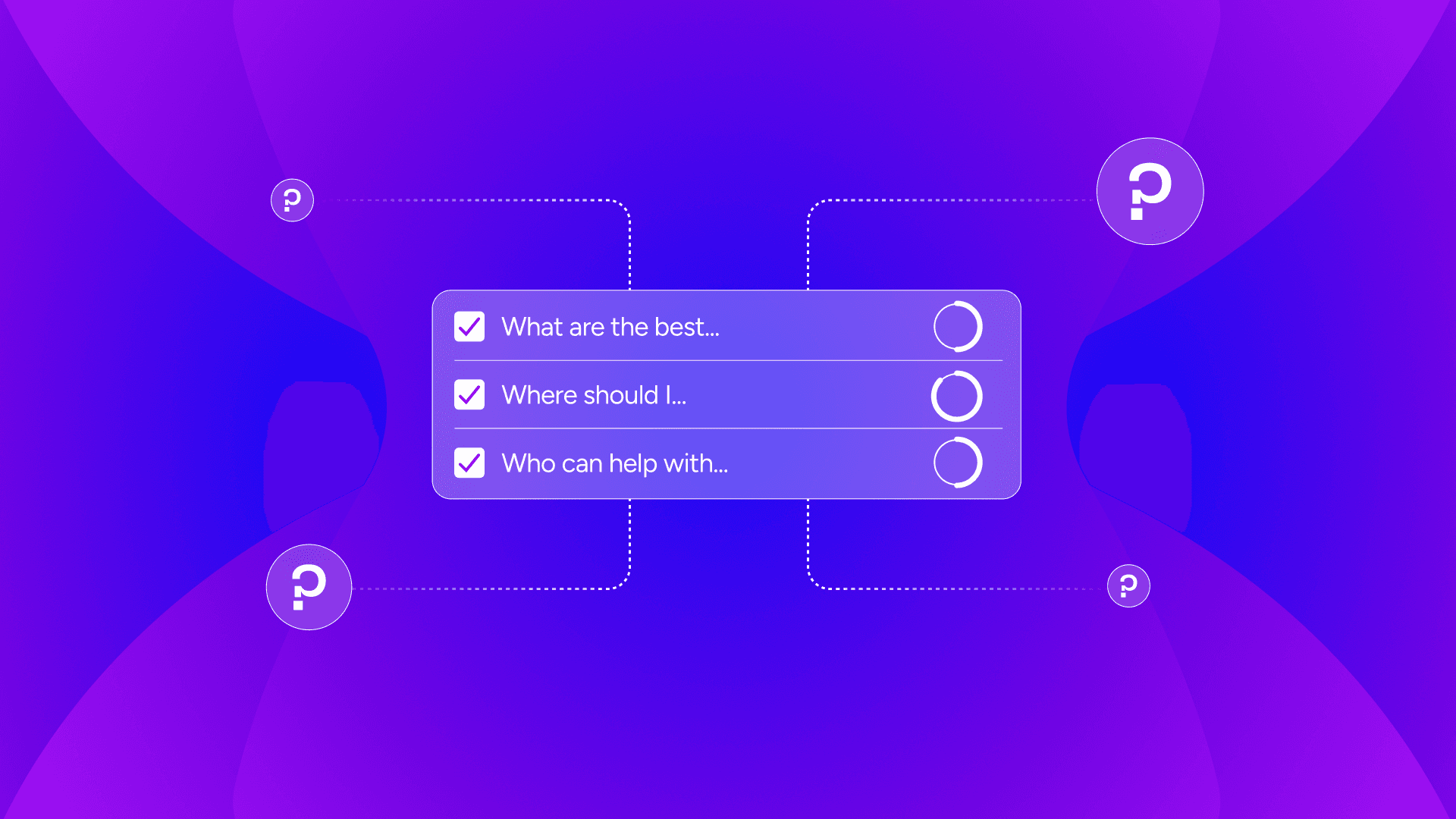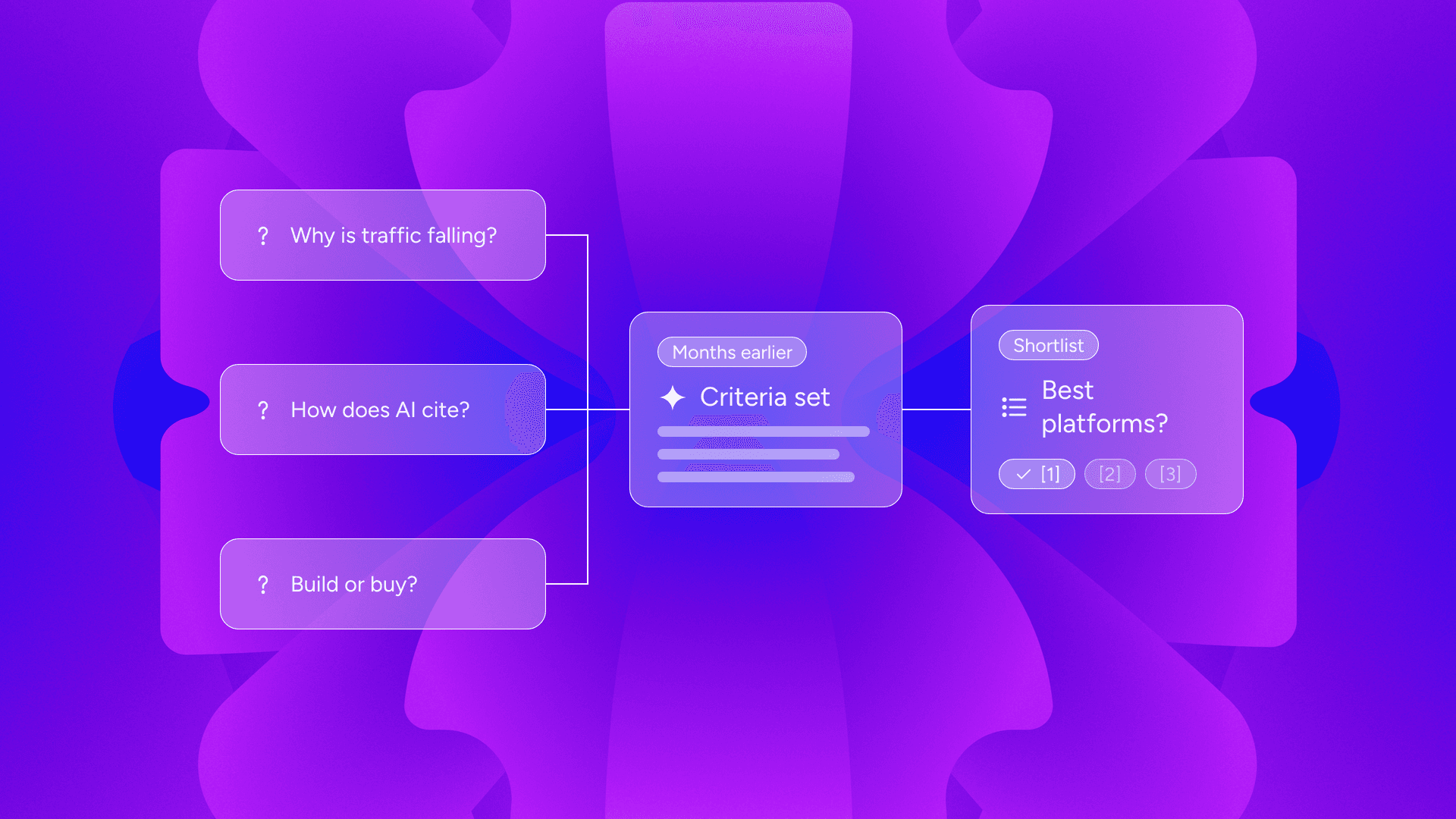
Your buyers are asking AI about their problem long before they shop. They ask why organic traffic is falling while rankings hold steady, and the answers teach them what the problem is and what a fix needs to do. Months later, they ask for the best AI visibility platform for a team like theirs. The shortlist answer reflects criteria they formed in those earlier conversations. Most vendors and tracking tools only watch that later question.
Buyers research the problem with AI before they shop
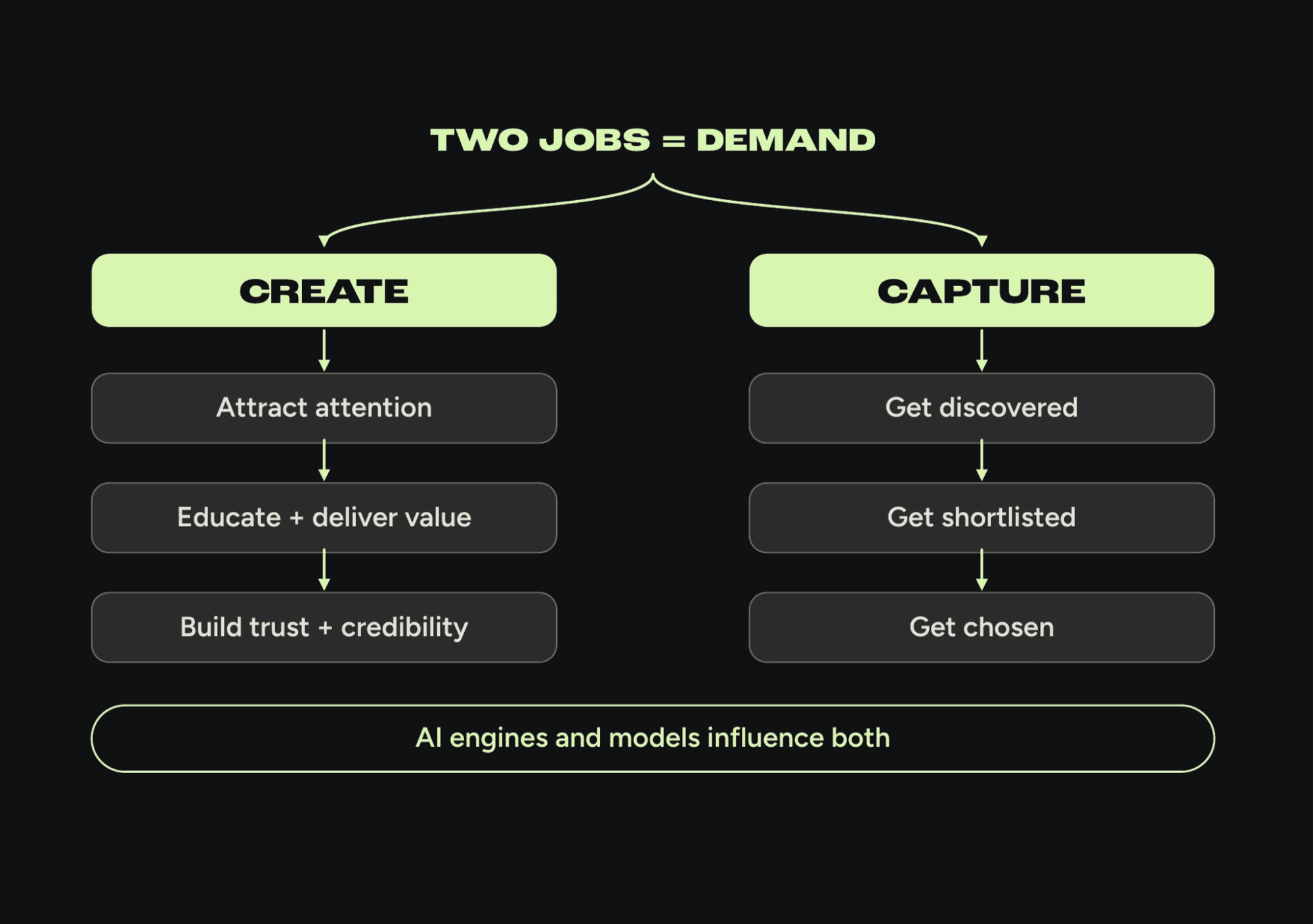
The AI buying journey starts with a problem, long before buyers know what kind of solution they need. Here’s what that path can look like. Each question does one of two jobs: create demand (shape how buyers understand the problem) or capture demand (be the obvious choice once they start shopping). The five questions below follow the path in order from first curiosity to final check:
- Why is our organic traffic falling when rankings look fine? (create demand)
- How do AI answers decide which sources to cite? (create demand)
- Should we build AI visibility in-house or buy a platform? (create demand)
- What are the best platforms to fix this for a team like ours? (capture demand)
- Does this vendor work with our CMS and our approval process? (capture demand)
The first three questions name no vendor. In them the buyer defines the problem and learns how it works. They also learn what kind of fix suits their team. The fourth question is the one most tracking tools watch. The fifth is a fit check that usually lands with sales.
Our view at GrowthX is that the vendor who answered the first three questions well has the best chance of being named in the fourth. By then the buyer has absorbed that vendor's explanation and vocabulary. They use those same words when they ask AI which product to choose.
AI shapes the criteria before any vendor is named
When a buyer asks AI to explain a problem, the answer gives them a definition of that problem and a list of requirements for fixing it. That list becomes the checklist they score vendors against later.
Framing decides the shopping list. If AI explains falling traffic as a citation problem, they go looking for help getting cited. If it explains the drop as a ranking problem, they shop for rankings. The two lists barely overlap.
A buyer who heard the citation explanation wants to know how vendors track what AI answers say about their category and how vendors would help their pages get quoted. A buyer who heard the ranking explanation asks about keyword positions and technical fixes, and a vendor that leads with AI answers sounds off-topic to them.
In both cases, the criteria are set before any vendor is named. That makes the explanation a separate point of influence from the recommendation, and it comes first. This is the create-demand job.
Most AI visibility work aims only at capture demand, which is getting discovered, shortlisted and chosen. Create demand decides what buyers count as the right choice before a shortlist exists.
Both kinds of questions belong in your strategy. Some show an immediate buying need, and others come months earlier. What matters is knowing why you are answering each one and how it connects to the business. Capture still matters, though it covers only part of the journey.
You can shape those criteria from your own site in three steps:
- Collect the questions and understand the intent behind them. Gather buyer questions in buyers' own words, before they know a fix exists, from sales calls and support tickets. Focus on what the buyer is trying to figure out, not just what they asked.
- Give the question context and explain the why. Publish public pages that explain in plain language why the problem happens and answer the question without being self-serving. Keep your answer pages ungated, because buyers, AI engines, and training bots can only learn from what they can reach.
- Offer a solution and the options. Lay out the ways to solve the problem, what a good solution has to do, and where the trade-offs sit, so the buyer can evaluate options in any process. This is also where you give them reasons to look further into your product.
The shortlist answer reflects what buyers already learned
Buyers now use AI chatbots to start building shortlists before they talk to anyone in sales. In a March 2026 survey of 1,076 B2B software buyers, 51% said they start research with an AI chatbot more often than with Google. Those buyers also ranked chatbots as the top influence on which vendors make the shortlist.
Buyers' preferences are mostly settled before a seller gets a call. A 2025 6sense buyer experience study of nearly 4,000 buyers found that 94% of buying groups had ranked their preferred vendors before first contact, and the vendor they favored before that contact still won about 80% of deals.
When buyers type "best platform for a team like ours," they have already decided what "best" means. The answer they get reflects their criteria and the sources that taught them those criteria.
G2 reads the same data and concludes that the thing to do is track the prompts. We disagree. Buyer questions are the unit to build around. Every shortlist prompt inherits what the buyer learned from the questions they asked before they typed it.
Buyers still validate with reviews, peers and sales
Buying happens in two stages. AI builds the shortlist, and then people check it through review sites, peers, the rest of the buying group and sales conversations. G2's own reading of its survey is that chatbots assemble the shortlist and review sites confirm it.
Sales still matters at this stage. In a survey of 645 B2B buyers conducted August through September 2025, 69% said they prefer to validate AI-generated insights with sales reps.
More people are involved in the check, too, and each of them can ask an assistant the same questions and compare what comes back.
Your site, your reviews, your customers and your reps therefore need to tell one consistent story. If AI explains the problem one way and your rep explains it another, the buyer has to work out which version to believe.
AI's reach keeps extending past the shortlist, but the final call still runs through people.
Build where the work compounds
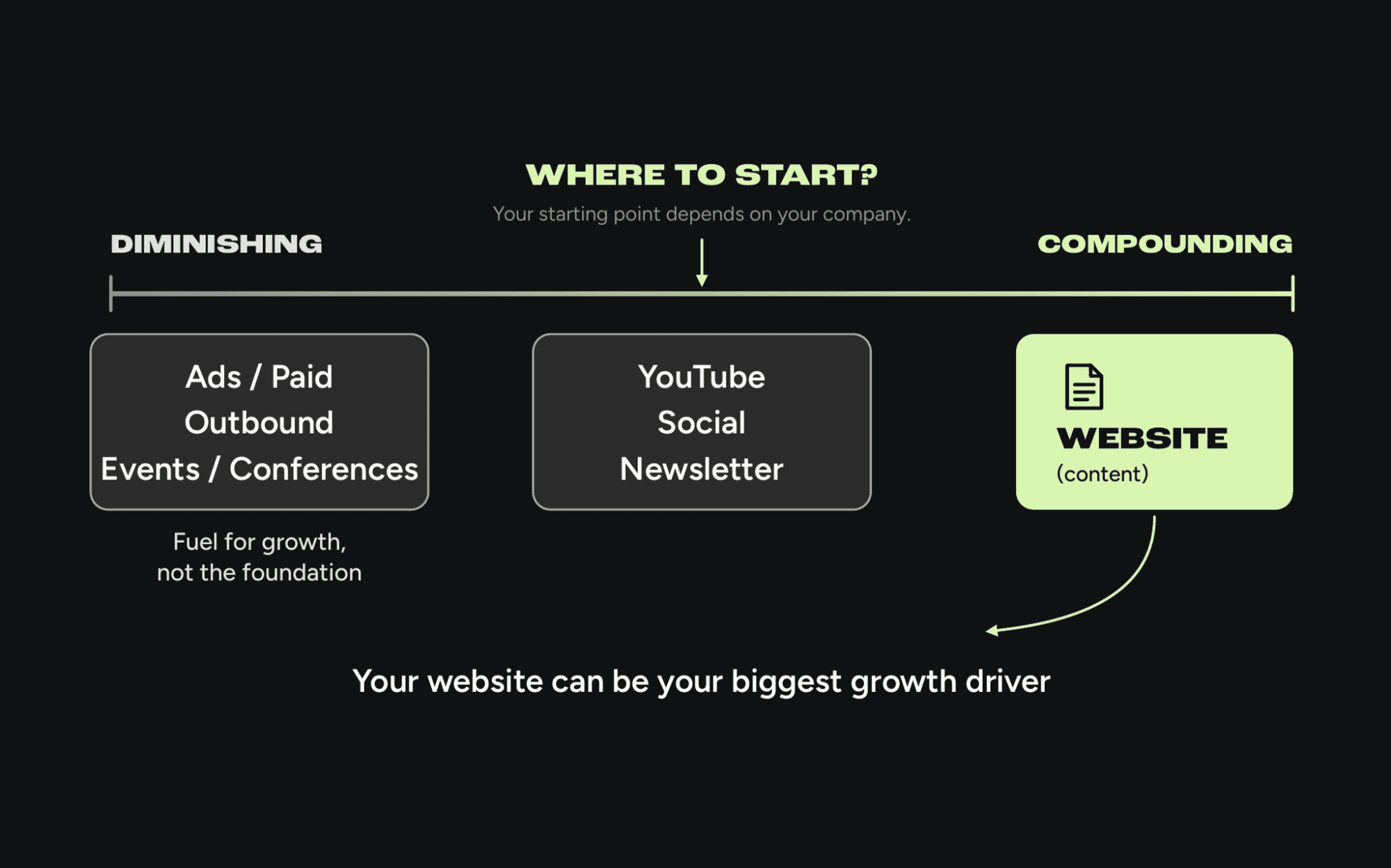
Paid, outbound and events each have a job. Paid puts a message in front of a chosen audience this week, outbound opens conversations with accounts that fit, and events build trust face to face. Their results depend on continued spending, so they work while you fund them, stop when the spending stops, and bring diminishing returns.
Video, social and newsletters sit in the middle. They build an audience, but they compound less than your website does. Where you start depends on your company.
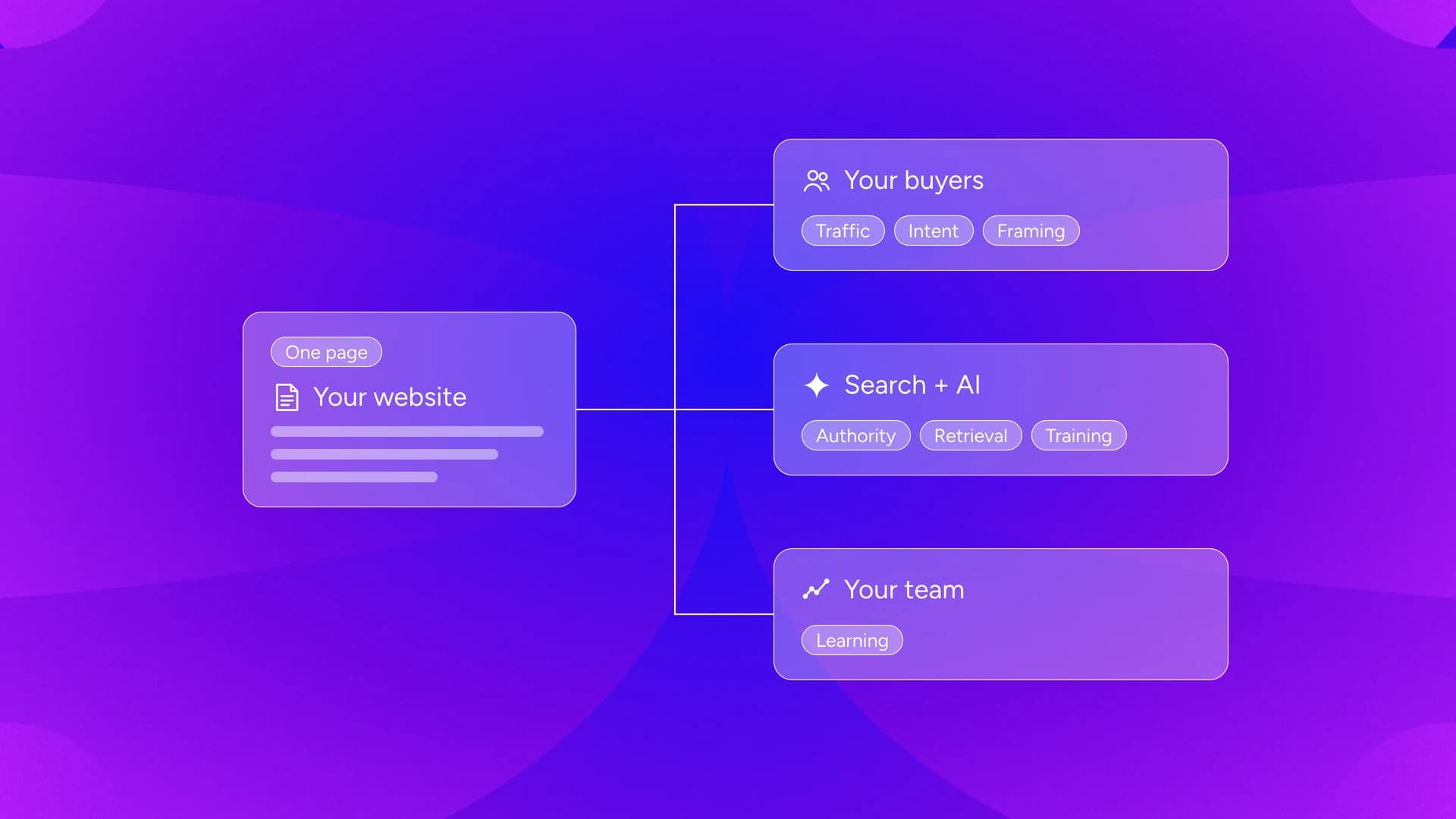
Your website is the lasting base, because each answer you publish stays in place and buyers keep reading it. AI engines and training bots read it too, and what the bots crawl may inform future models. A campaign ends, but buyers can keep using a clear explanation to understand their problem, so the same work keeps compounding.
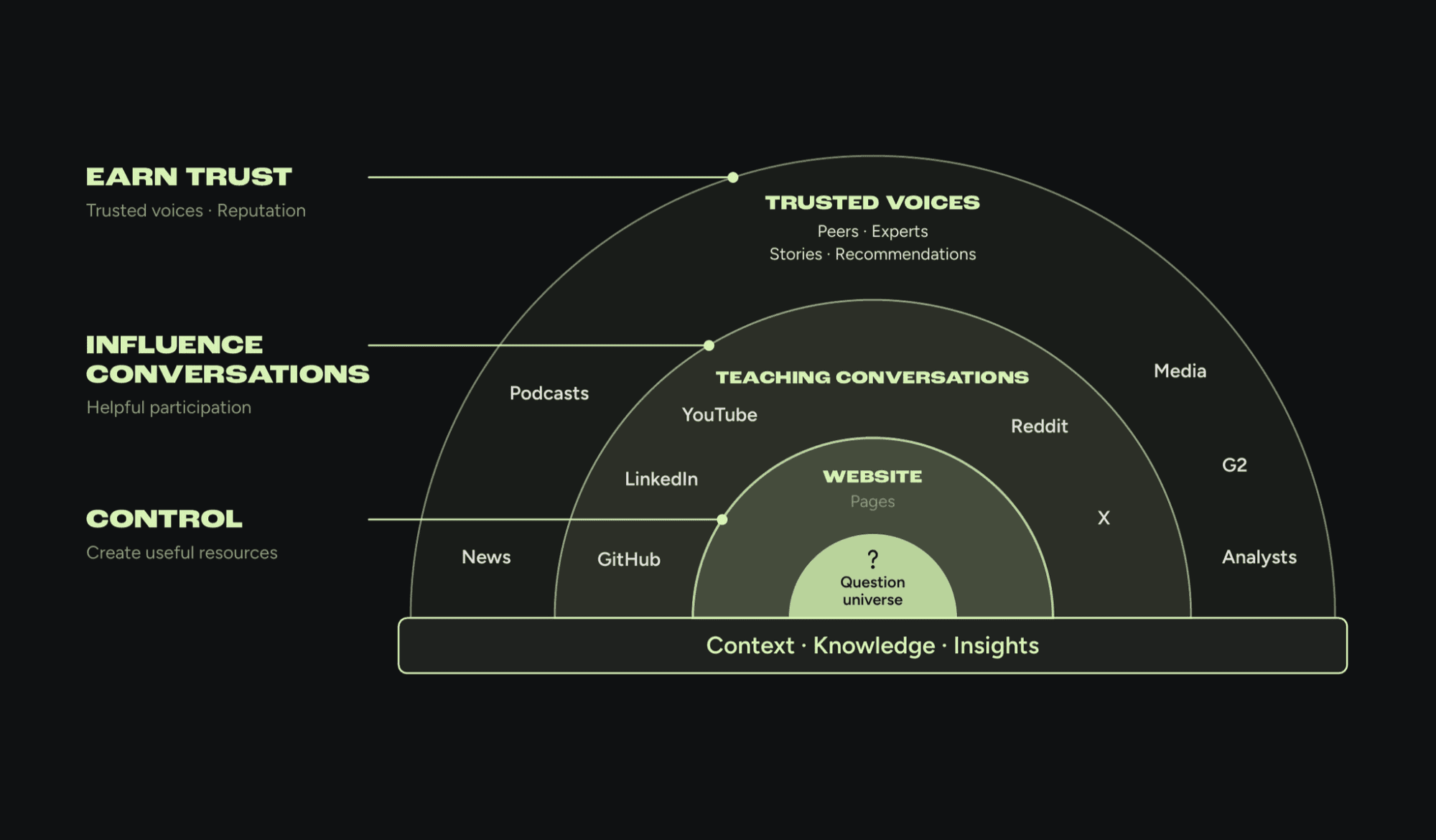
Influence builds in three rings, from the center out:
- Own the answers on your own site, because every other move needs something to point to.
- Join the conversations where buyers ask the same questions, such as communities, forums, social threads and podcasts.
- Earn trusted voices, such as customers, reviewers, analysts and publications, who repeat your explanation in their own words.
Each ring depends on the one inside it. A forum reply needs a page behind it, and a reviewer can only repeat a position you've stated clearly.
The rings are also connected. People read what you publish, share it and argue about it, and those conversations become part of the public record that buyers and AI systems both draw on. This is why the off-site rings shape AI visibility as well as reach.
Run these exercises this quarter:
- Place every channel you fund on the fuel-to-foundation spectrum. What share of team time sits at the compounding end?
- Write the 10 questions your buyer asks before they know your category exists. Mark which ones your site answers.
- Pick one early question, make your site the best answer to it, then carry that answer into one conversation channel.
How to tell if it's working
Track five signals: page performance, AI referral traffic, self-reported attribution, repeated AI tests and question coverage. Read all of them as trends over months, and don't treat any one of them as a score.
Page performance: Check whether each page that answers an early buyer question is earning impressions, clicks and visits. Use Search Console and your analytics. Each published answer adds data, so a handful of pages tells you little and a growing set shows patterns. Search Console now has generative AI performance reports that show impressions within AI Overviews and AI Mode.
AI referral traffic: GA4 now has an AI Assistant channel for visits from assistants such as ChatGPT, Gemini and Copilot. Google's own AI Overviews and AI Mode stay in Organic Search. Some AI visits arrive with no referrer, often from mobile apps, and land in Direct, so treat this number as a floor.
Self-reported attribution: Add an open-text "How did you hear about us?" field to your demo or contact form, and have sales ask the same question on first calls. When someone names ChatGPT or Perplexity, ask what they asked it. Those answers show you which early questions are bringing buyers in.
Repeated AI tests: Pick 10 to 20 early-journey questions and run each one several times a month in the assistants your buyers use. Answers vary from run to run, so a single reading means little, and a small monthly sample is directional only. Note how AI describes the problem and which criteria it suggests. Record whether your explanation shows up, then compare the pattern month over month.
Question coverage: Expand your question map outward. Start with the questions directly tied to your buyer's problem. Then add complementary questions adjacent to your market and buyers. Use what the attribution answers and AI tests reveal to choose the next questions to answer.
The full playbook covers the buyer path and sphere of influence in more depth. It also explains the measurement setup. Download What 10,000 hours of AEO taught us.