No AI assistant gives you a log of what your buyers asked it. Prompt trackers fill the gap with prompts written on your behalf, which tells you how an engine answers a guess about your buyer.
The questions buyers bring to AI aren't new. They're the same questions buyers ask your sales team, type into your help center search, post in communities, and leave in competitor reviews. The wording changes from channel to channel while the question underneath stays the same, so you can find most of them in places buyers have already left them.
At UNBOUND in Boston last month, GrowthX CEO Marcel Santilli walked through the three sources we draw on when we build a question universe: your customers, the market, and your own expertise. Each one catches questions the other two miss.
To make this concrete, say you sell expense management software to finance teams at companies with 200 to 1,000 employees.
Start with what your customers already ask you
Your customers have been asking questions in writing for years, mostly in systems marketing never reads.
Sales call transcripts are the richest source. Search them for question shapes such as "can it," "does it," "how do we" and "what happens if." Discovery calls surface early questions about the problem: "How do other teams stop month-end close from waiting on late expense reports?" Late-stage calls surface the evaluation questions that decide deals: "Can we set different per-diem limits by country?"
Give closed-lost notes their own pass. A question your team couldn't answer well is often the reason the deal went elsewhere.
Support tickets and your help center's search log show what people ask once they're using the product, and plenty of them double as evaluation questions. "Why was my receipt rejected?" comes from a customer. A careful buyer asks the same thing before signing, phrased as "How does receipt matching handle a blurry photo?"
Your own search data adds the questions people typed before they reached your site. In Google Search Console, filter the Performance report's queries with a regex such as ^(how|what|why|can|does|is|which)\b to isolate the question-shaped ones, then look at which of your pages they landed on.
Record each question in the buyer's original wording. You'll merge variations later. Rewrite everything into your own vocabulary now and you lose the way buyers describe the problem, which is how your pages need to describe it too.
Customer evidence has one blind spot. It only covers people who already talk to you.
Read the market for questions asked before anyone contacts you
Most buyer research happens before anyone fills out your demo form, and the market is where you can see it.
Start with search results for your category's core questions. People Also Ask boxes and related searches show what Google has seen people ask next. Run the same questions through ChatGPT, Perplexity and Gemini, and note the follow-ups they suggest and the sources they cite. Read those answers for questions you hadn't listed yet.
Competitor sites are a record of questions someone else decided were worth answering. Every FAQ entry, comparison page and docs heading is a question a competitor heard often enough to publish. Note which ones they answer clearly and which ones get a paragraph of positioning instead of an answer.
Communities and review sites hold the questions buyers ask each other when no vendor is in the room. A Reddit thread titled "Is it worth moving off spreadsheets for expenses at 250 employees?" is an early-stage question in the buyer's own words.
Reviews are useful for a different reason. The complaints in a review are often questions the reviewer wishes they had asked before buying. "Nobody told us card reconciliation was a separate add-on" becomes "Is card reconciliation included, or does it cost extra?"
Customers and the market both show you questions people already know to ask. Your team covers the ones buyers haven't thought of yet.
Use your own expertise for the questions buyers don't know to ask
Your team knows things about the problem that buyers learn too late. Your implementation lead knows most expense rollouts stall while finance agrees on approval chains. Your sales engineers know which integration question decides a deal three weeks after it should have come up.
Write that knowledge down as questions in buyer terms. "Who approves an expense when the approver is the one traveling?" "What breaks if we connect expense data to our ERP mid-quarter?" Start from what buyers are trying to achieve and the problems that block them, then add your team's hypotheses about what buyers will need to know.
Mark these as hypotheses. A question nobody has asked yet can still be worth answering, because an early answer shapes how buyers frame the problem. It can also turn out to be a question only your team cares about, and the next step tells you which.
By now you have a long list from three sources, with duplicates and some questions that don't belong. Test it before any of it turns into a content plan.
Check every candidate against evidence
Treat everything on the list as a question to investigate rather than a commitment. Relevance, demand and fit sort it.
Relevance asks whether the question is yours to answer. "How do I deduct a home office on my personal taxes?" might land in an expense software support queue, and it still sits outside what you sell.
Demand asks whether anyone outside your team asks it. A question that turns up in sales calls, community threads and search data has evidence from three directions. A team hypothesis with no outside evidence stays a hypothesis until something confirms it.
Fit asks whether you can give a credible answer. If your product can't set per-diem limits by country, you can still publish an honest page about it, but that page won't win the evaluation.
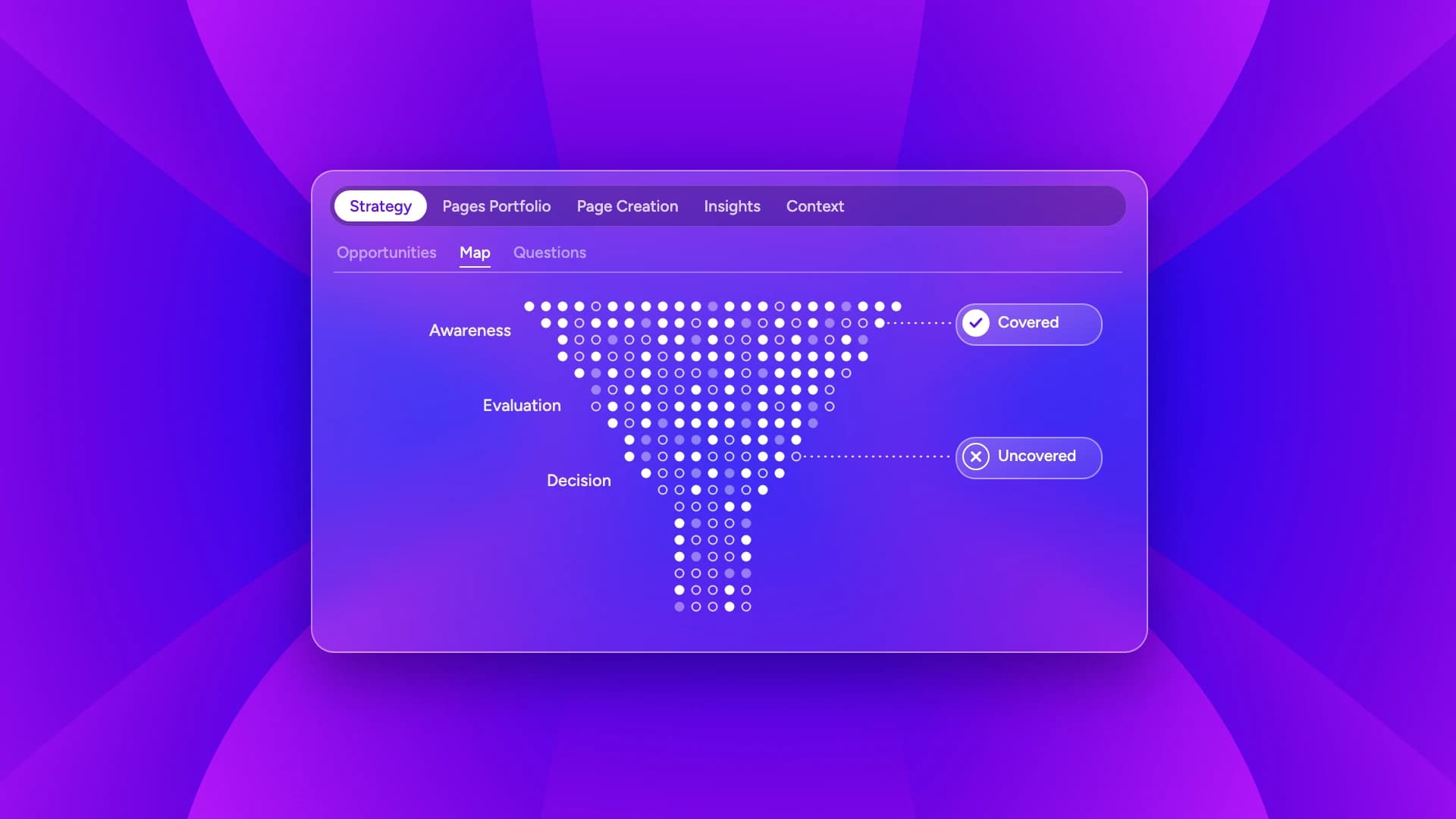
The questions that pass become your question universe, the raw material for a question map. What a complete question map looks like shows what that map holds once it's built, and what question intelligence actually is covers how to tell answered questions from unanswered ones.
That universe is accurate on the day you finish it, and your market keeps moving after that.
Keep the list growing after the first pass
The first pass by hand takes weeks. After that, every product release, competitor page and new objection adds questions the list doesn't have yet. Add a monthly pass through new call transcripts and support tickets so the list keeps up.
In the GrowthX platform, the core of your question map is built from research on your market and your company's context. When a sales call or a search trend turns up something new, you can add questions from your own keywords, a list, specific pages, or lookalikes. Nothing reaches your map until you review it.
Marcel walks through a real buyer-question map at our free virtual workshop this Thursday, October 22, and everyone who registers gets the replay. To see the questions in your own market, book a demo.