If you’re running an organic content program, you’re probably already tracking prompts using a tool. And that tool likely gives you some kind of score for how you’re doing against your competitors.
But a sample of data from a cluster of prompts, maybe supplemented with some keyword research, does not constitute a content plan.
To illustrate why you can’t just rely on prompt sampling, SparkToro had 600 volunteers run the same prompts through ChatGPT, Claude and Google's AI a combined 2,961 times. The finding was that there is less than a 1-in-100 chance that ChatGPT or Google's AI would give the same list of brands in any two of 100 responses.
If you want a strategy that will result in growth, you need a real connection between the intent behind the questions buyers ask and the content you're about to create.
A complete question map gives you a plan that connects each buyer question to the answer you have and the work it needs. You can use it to decide what deserves attention so that the content you assign is aligned with your goals, every time.
Building a map like that begins with, shockingly, questions.
Start with the questions your buyers need answered
Your question universe is the full set of questions a buyer could ask in your territory, gathered from sales calls, search data, customer conversations, competitor sites, communities and support tickets. What question intelligence actually is covers how to build this out.
A question map, in its simplest form, is a list of questions that your site can answer.
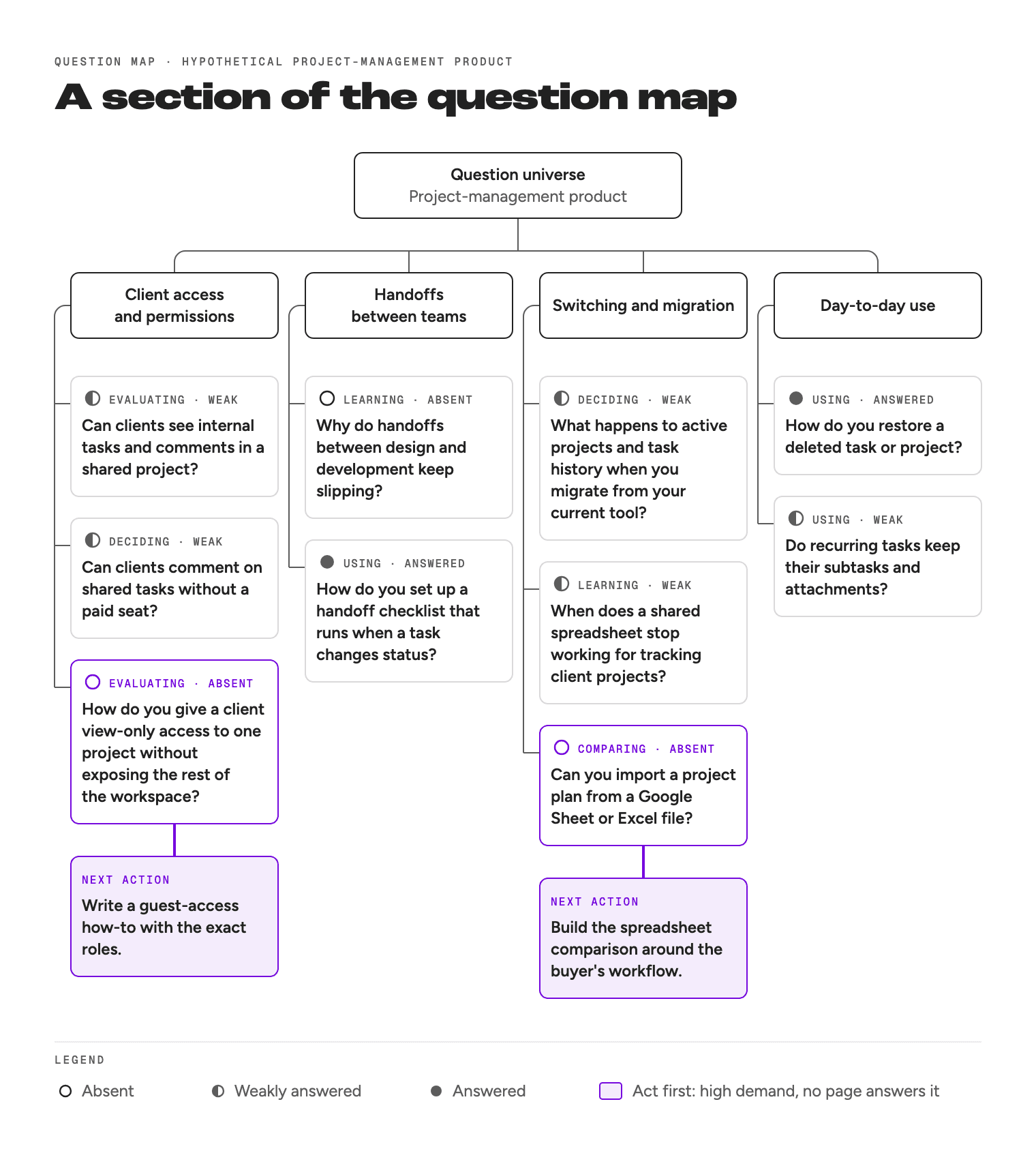
Imagine you sell project management software. A buyer might ask, "Can our clients see internal tasks?" Another might ask, "Can we hide tasks from external users?" One answer could address both questions.
If a question has a distinct answer that involves another part of the product, give it its own row, so you stay honest about what your site actually answers.
"Can clients comment on shared tasks?" gets its own entry because it concerns a different capability from restricting access, and filing it under a broad topic like collaboration would hide work your site may still need.
Clusters group related rows into a strategic view, such as client access, but the question stays the unit of work. Open a cluster and you should see exactly what a buyer still needs to know.
Once you have a list of questions, it's time to start setting some priorities.
Use journey placement and scores to set priorities
Add journey placement to each row. If a buyer wants to know why project handoffs fail, they're definitely going to need their own specific answer. The same goes for someone deciding how to migrate an active project.
An explanation of handoff problems may introduce your approach to a buyer. An accurate migration answer may resolve an objection before someone commits.
Winning those questions can depend on the current state of your business and what kinds of customers you're focused on.
You will want to attach a measurement of demand and difficulty to each question so that you understand how to fill in your coverage gaps and how much effort it's going to take to do so.
A question with strong demand and no current answer on your site goes to the top of your queue. You may take a harder question because it concerns an essential buying requirement, or an easier one your team can ship fast to close a gap.
In our own CheckThat visibility study, the top tenth of queries held 60% of the citations in ChatGPT. That gives you a reason to find where citations concentrate in your own question universe.
With scores on individual questions, you can start using your map to set priorities. You can open a high-priority cluster and still see which question makes it urgent.
Most content queues or calendars rely on individuals to make decisions about prioritization, and they often do so without any understanding of the broader strategy or business needs. A question map helps prevent that.
Now you're ready to start determining what coverage you actually have.
Connect coverage to a specific change
For each question, record whether it's answered, weakly answered, or absent. Coverage means questions answered out of questions found. If you've been running content programs for a long time, then you know that page titles can often be deceiving, so make sure the question is truly answered on the page.
For the hypothetical project management product, a section of the map could look like this:
Now you can start determining what to do about your coverage gaps.
If your permissions page describes flexibility without saying what a client can see, queue it up for a rewrite. If a claim lacks support, add proof. If buyers can't tell which workflow the product supports, clarify the positioning before commissioning more content.
Include the competitive context in that assessment. Where a competitor answers the question better, record what their answer resolves that yours leaves unclear.
The best opportunity is a question none of your competitors explains well, because you can publish a useful answer without duplicating anyone.
Some of the gaps you’ll find will need fresh documentation, and some need a comparison a buyer can use to examine tradeoffs. A new page is a good bet when the question needs an answer with its own place on the site, but several related questions may be resolved by improving one existing page.
Our content gap analysis guide covers how to order rewrites against new pages.
The next thing to address is that your question map will probably be accurate for about 24 hours. We all know that your product and the market that you're addressing will keep changing. So how do you keep it current?
Keep the map useful as your market changes
When your product changes, the answers to the questions that people are asking can easily change as well. Something that you had a really strong answer to may now be weak because of the new product context.
New buying objections can also expose questions that you haven't really answered well or that your competitors are answering better than you.
Add questions to the universe as those changes arrive, and revisit the affected answers on your site. Remember, your website is your company's truth layer for buyers and AI systems. It’s the one source that you control completely, so make sure it’s comprehensive and accurate.
In the GrowthX platform, the core of your question map is built as it researches your market. Then you can update it over time as new keywords, company context, or marketing plans arise.
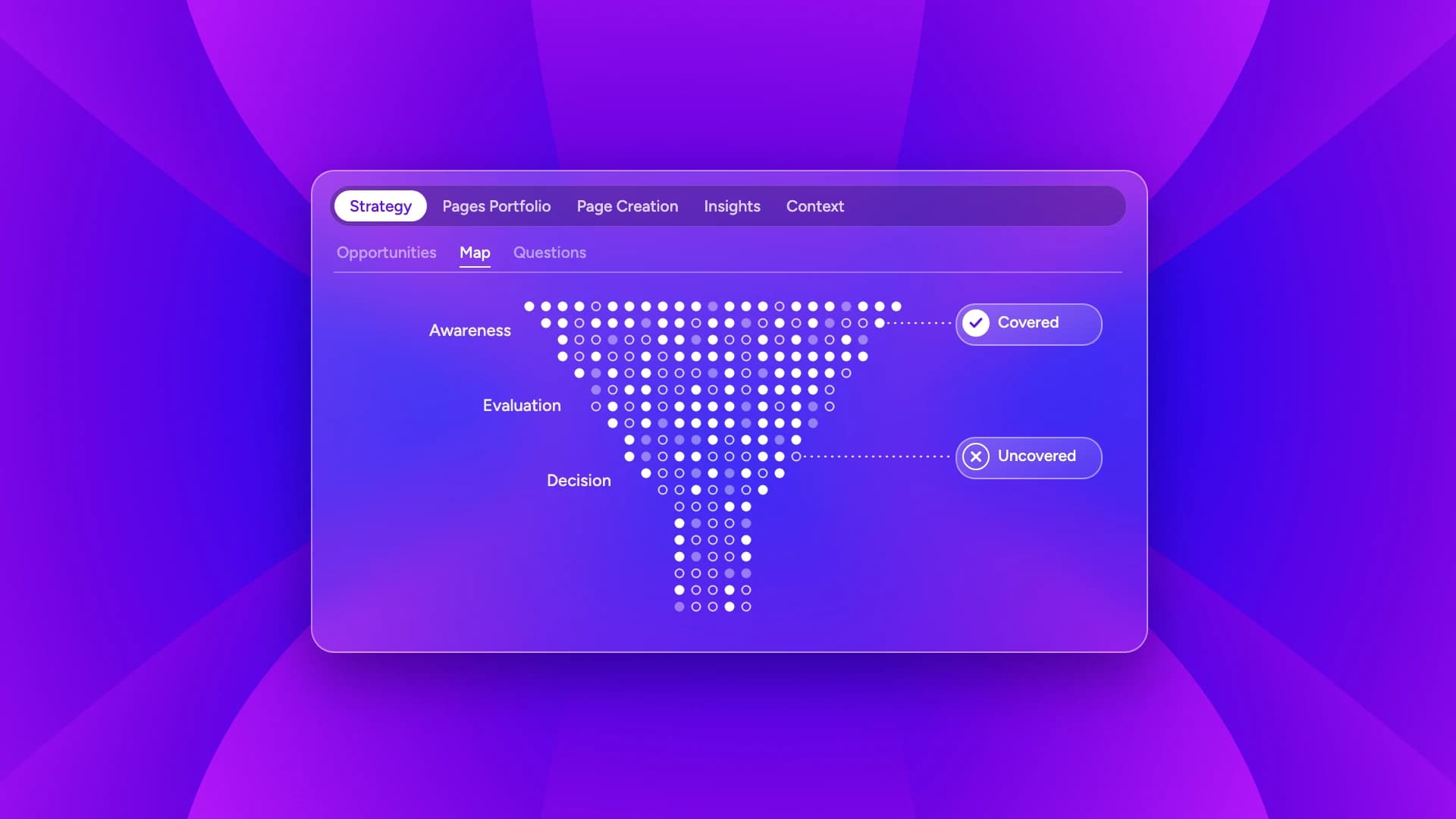
Topics shows each topic's search demand, AI demand, the questions research found inside it, and its coverage as questions answered out of questions found. This means that you can always see which subjects have real demand and thin coverage.
If you want to see how your question map can guide your strategy, book a demo.