Legacy AI visibility tools gave marketing teams something they naturally wanted: a way to quantify how often their company appeared in AI-generated answers.
The dashboards look familiar because they borrow the language of traditional marketing analytics. A company has 17% visibility. A competitor has 23%. Visibility increased two points this week or declined 30% from the previous period. The numbers look objective and comparable, which makes them easy to report and, seemingly, easy to act on.
The problem is that the systems being measured are not nearly that precise.
Large language models are non-deterministic. The same question can produce different answers across repeated runs, and relatively small changes in wording, context, or retrieval can change the result. So a visibility score can read like a hard number when it is really one snapshot of a system that keeps moving.
That does not mean AI visibility cannot be measured. It means the measurement has to reflect the limits of the underlying data, particularly when marketing teams are using it to make decisions.
That is the core issue in AI visibility today: precision is being mistaken for accuracy.
Why accuracy is more important than precision
Suppose a dashboard tells you that your AI visibility declined 30% this week.
The number is precise, but the meaning is not. A change like that could reflect a real shift in how models understand your company, or it could simply reflect normal variation in the outputs.
Now compare that to a different kind of finding: across the questions your buyers actually ask, AI models consistently describe you as a reporting tool rather than a full workflow platform.
That conclusion may not come with a neat percentage attached to it, but it is much more useful. A team can trace it back to how their own site, docs and help center describe the product, confirm the gap is real, and rewrite the pages the models are pulling from.
That is the difference between a precise measurement and an accurate understanding of what is happening.
The goal is not to avoid measurement. It is to make claims only at the level the data can reliably support.
Where prompt tracking falls short
Prompt tracking was a reasonable starting point for AI visibility, but it captures only a narrow sample of a much larger system.
A company creates a set of prompts, runs them across models, and records what comes back. That gives you a snapshot of a specific set of outputs at a specific point in time.
Because those outputs vary, a visibility score can look definitive when it is not. A move from 17% visibility to 19% may reflect normal variation rather than meaningful improvement.
There is a bigger limitation, too. The score does not tell you enough about what is shaping the result or what you should do about it. It may tell you that you showed up less often, but not why models perceive your company the way they do or where the underlying gaps are.
Prompt-level data is still useful as an input. On its own, it is too narrow to be the basis for an AI visibility strategy. Prompts are infinite and worded by the buyer, so chasing them one at a time is activity, not growth.
A better approach looks for consistent patterns across the buyer journey. That gives teams a clearer view of how they are perceived and what needs to change.
The buyers questions matter more than the precise prompt
Buyers do not all ask the same question in the same way.
A finance leader looking for forecasting software might ask:
- What is the best software for improving forecasting accuracy?
- How can I reduce the gap between our forecast and actual revenue?
- What tools help finance teams forecast more reliably?
Same buyer, same need, three different wordings. You might show up for one of them and be missing from the other two.
That makes the exact prompt a poor foundation for strategy. Prompts are useful as probes, but the buyer question behind them matters more.
Companies should start with the questions buyers are trying to answer, express each as one canonical question, then probe AI systems repeatedly and report how often they're cited. This helps test how consistently answer engines respond to the same underlying intent.
This gives a clearer view of how a brand is perceived and where the gaps are.
Measurement has to lead to action
Once you have the right buyer questions mapped, they should directly shape what your team creates.
Most marketing teams still build editorial calendars around keywords, topic clusters, or lists of prompts. Those are still useful inputs, but they often miss the actual intent behind the search. Teams end up producing content around a term or narrow phrase instead of answering the question the buyer is trying to solve.
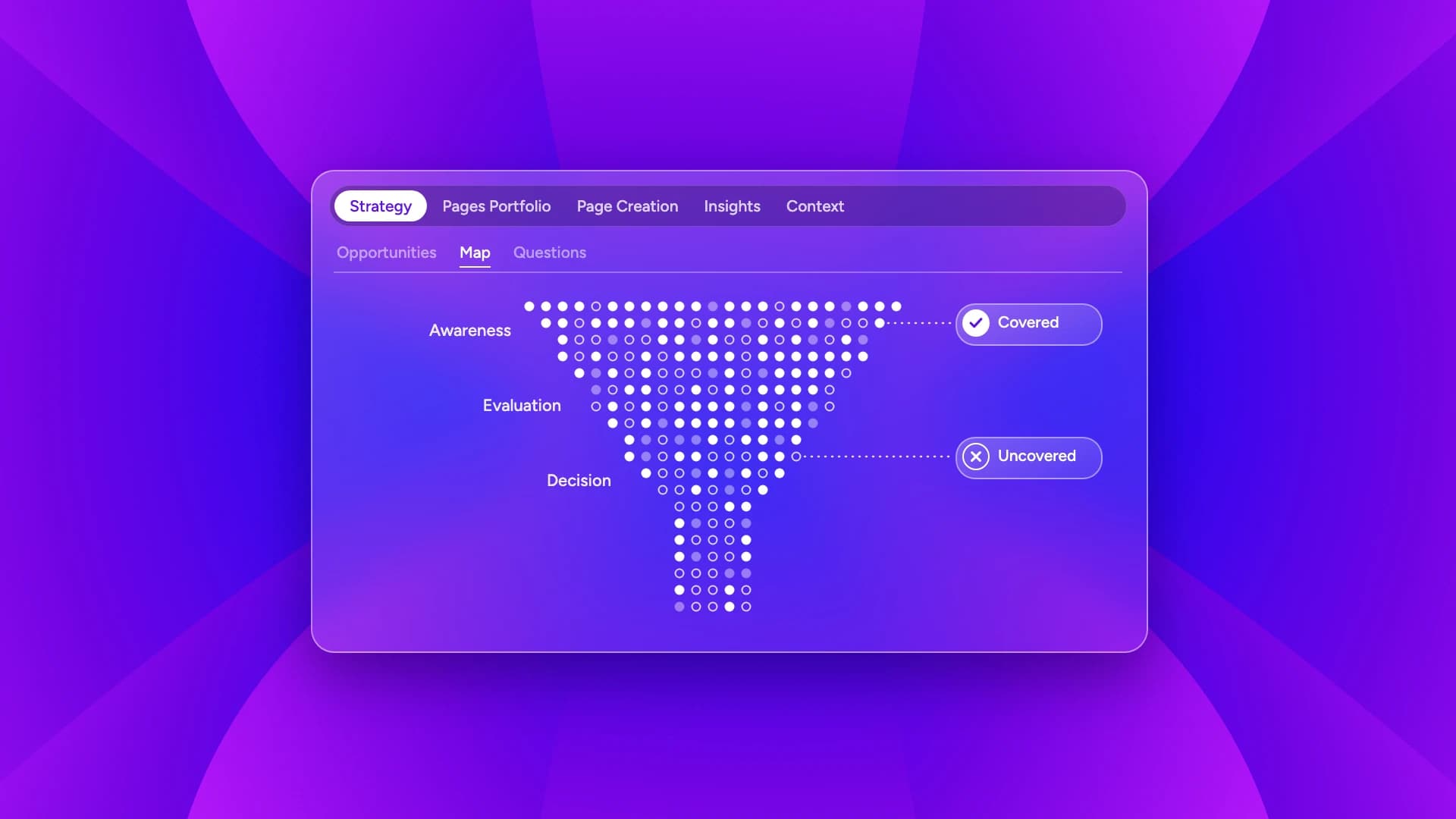
A buyer-question map with comprehensive AI visibility scoring changes that. It shows where you already have a strong answer and where the gaps are, so the next piece of content is based on a real buyer intent rather than another keyword or prompt.
The map also needs to stay current. As buyer questions change and as companies evolve, teams should refresh the content behind them and create new answers where gaps emerge.
This is where accuracy becomes useful in practice. Better measurement should tell you what buyers need to know, where your answer is falling short, and what to work on next.
AEO and SEO are the same growth strategy
We fundamentally believe buyers do not have SEO questions and AEO questions. They just have questions.
Sometimes they ask those questions in Google. Sometimes they ask them in ChatGPT, Gemini, Claude, or Perplexity. The channel changes, but the need does not.
That is why treating AEO as a separate strategy misses the point.
The same buyer questions should shape both search and AI visibility. The work is to understand what buyers are trying to learn, make sure your company has the best answer, and keep that answer current wherever it can be found.
SEO and AEO are not two different games. They are one growth strategy built around the same buyer intent.
The future of AI visibility
The goal is not to produce a more precise-looking score. It is to build an accurate view of how buyers and AI systems understand your company, then use that understanding to improve the answer.
That brings us back to first principles. Marketing's job is to make your company the best answer to the questions your buyers are asking, regardless of where they ask them.
Prompt tracking alone will not get you there. At best, it is a narrow and noisy signal. At worst, it gives teams confidence in numbers that look scientific but do little to improve the outcome.
The future of AEO will not be won by the company that tracks the most prompts or reports the most precise visibility score. It will be won by the company that understands what buyers are asking and gives them the best, most accurate answer.