Leadership wants to know whether ChatGPT and Perplexity recommend the company when buyers look for tools in your category. So the team builds a spreadsheet of a few hundred prompts, runs them, and pastes screenshots into a deck. A week later, the same prompts return a different set of brands in a different order. The meeting turns into a debate about which week was the real one.
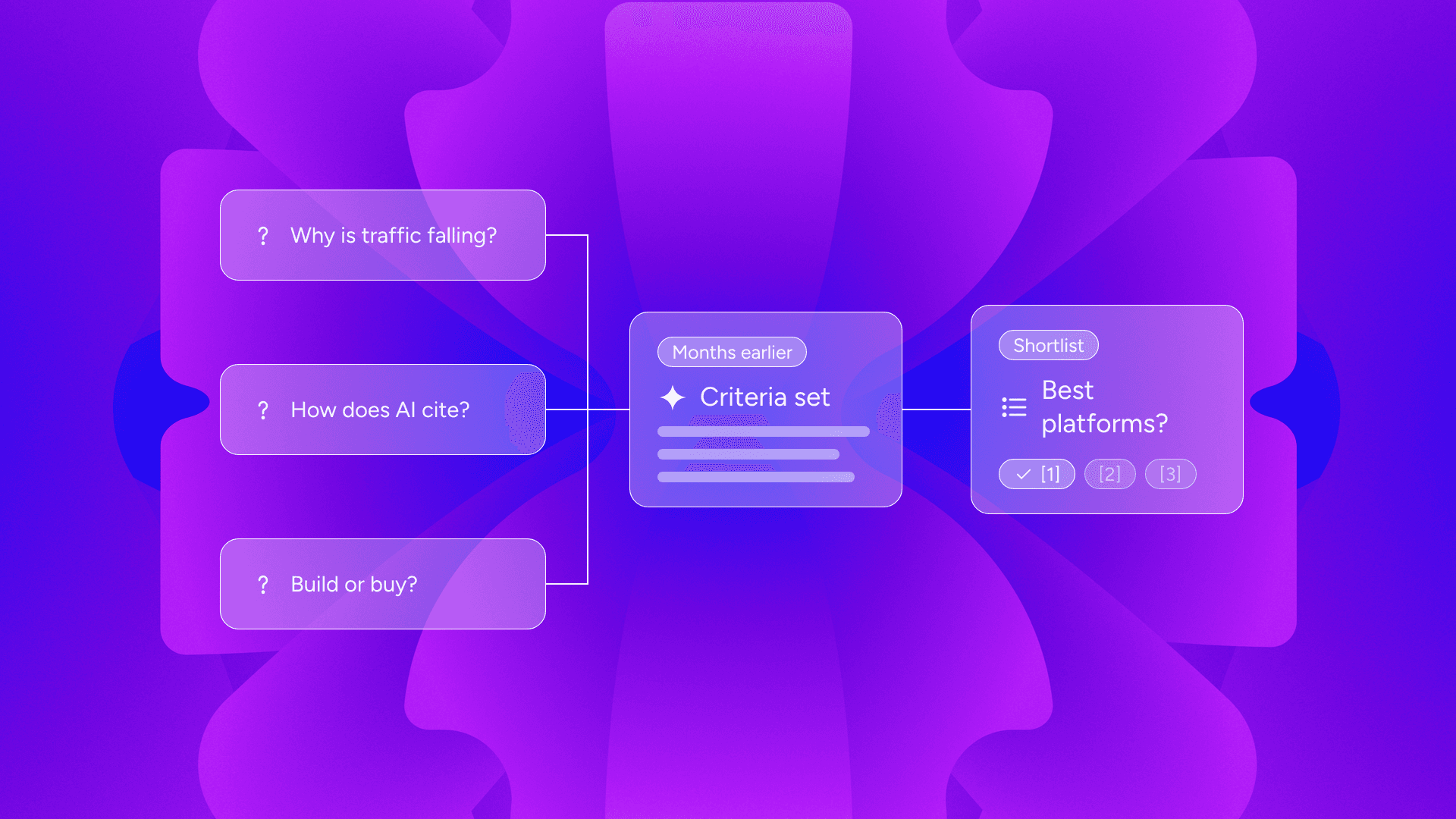
A prompt list can't settle that question. A prompt is one wording of one need, captured on one run. Your buyers phrase the same need dozens of ways, and the engines answer each phrasing a little differently every time. Leadership is asking about the need itself, which sits one level above any string you can type.
Buyer questions beat prompts as the unit of AI visibility
Buyer questions are the better unit because a market has a finite, stable set of them, while prompt strings are endless and shift with every rewording and rerun. Plan content and report visibility against the question, and treat each prompt as one sample of it.
The buying journey gives you more questions to cover, not fewer. IAB and Talk Shoppe published a study in October 2025 that combined 450+ screen-recorded AI shopping sessions from 150 US AI users with a survey of 600 US consumers aged 18–64. In the sessions they measured, shoppers took an average of 1.6 online steps before consulting AI and 3.8 steps afterward. Most of the added steps were validation, with buyers checking what the AI told them on retailer websites, reviews and follow-up searches.
That study measured consumer shopping, so read it as directional for B2B, where a software purchase runs longer and involves more people. The planning lesson still carries over. Each validation step is another question a buyer asks, often in an AI engine, sometimes on your website, sometimes on a review page. Those questions repeat across buyers even when the wording never does.
Buyer questions and prompts defined
A buyer question is the underlying need a prospect is trying to resolve at a stage of the purchase, such as which expense tools fit a 300-person company with three legal entities. A prompt is one specific string someone types into an AI engine to express that need. Prompts carry the accidental detail of the moment, like a persona, a constraint, a typo or a competitor's name.
One question produces many prompts. The comparison below shows why that ratio matters for tracking:
| Dimension | Buyer question | Prompt |
|---|---|---|
| Stability | Holds steady for months, because the need changes only when the market does | Changes with every rewording, follow-up, persona detail and model update |
| Coverage | A category has a finite set you can list and review with sales | Variants are effectively unlimited, so any list is a small sample |
| Tracking cost | Grows with the number of questions, which stays manageable | Grows with prompts multiplied by engines and run frequency |
| Link to revenue | Maps to a funnel stage and a deal conversation sales recognizes | Rarely maps to anything sales hears on calls |
| Mapping to content | One question maps to one page or section that answers it | Many prompts point at the same page, so prompt-level targets breed duplicate pages |
How AI engines turn many phrasings into one need
AI engines expand a buyer's exact string into several searches, retrieve passages by meaning, and write a fresh answer, so the wording matters less than the need underneath. Fan-out, retrieval and differences between platforms explain why questions stay stable while prompt strings vary.
Query fan-out breaks one question into sub-queries
Google's documentation says AI Overviews and AI Mode may use a query fan-out technique, issuing multiple related searches across subtopics and data sources to build a response. Its optimization guide gives an example in which a question about fixing a weedy lawn fans out into separate searches about lawn herbicides, chemical-free weed removal and weed prevention. OpenAI describes the same pattern for ChatGPT search, which typically rewrites a query into one or more targeted queries before sending them to search providers.
Fan-out is why a single prompt string carries less weight than teams assume. Two buyers who word the same question differently trigger overlapping sets of sub-queries, and the pages that answer those sub-queries well get retrieved either way. The same Google guide warns that creating separate content for each fan-out variation to manipulate results violates its scaled content abuse policy. Page-per-prompt planning runs straight into that line.
Retrieval resolves different wording to the same intent
Retrieval systems match on meaning. An embedding model turns a query and each candidate passage into a vector, a list of numbers that places text with similar meaning close together. Text embeddings can represent both the meaning and the intent of a user's query, so a vector search returns nearby passages even when they share few words with the query. Retrieval-augmented generation (RAG) then hands the closest passages to the language model, which writes the answer from them.
So "expense software that ends receipt chasing" and "how do I get sales reps to send receipts on time" land near the same passages. A page that answers the need clearly can be retrieved for both.
ChatGPT, Perplexity, Gemini and AI Overviews answer differently
Each engine runs its own retrieval stack, rewrites queries its own way and weighs sources differently, so one question can produce different shortlists and different citations on each platform. In a University of St. Gallen preprint, researchers tracked ChatGPT, Perplexity, Google AI Mode and Gemini daily for 45–46 days between January and March 2026, across four industries with eight questions each. They found cited sources overlapped by a Jaccard similarity of only 0.34 to 0.42 from one day to the next, which means roughly two-thirds of sources changed daily.
Teams accustomed to traditional keyword search expect something steadier. AI answers behave more like a distribution. Report them as ranges across repeated runs, broken out by engine, and drop the single position from your reports.
Tracking every prompt variation breaks down
Prompt-level tracking fails because the variants never run out and the answers won't hold still. And you pay for every string you add.
- Start with the permutations. Take one buyer question and add the details real buyers include, such as company size, industry, a competitor's name, a current tool, a budget or a region. Every combination is a new string, and a single need quickly produces more variants than any team can track, before anyone counts follow-up turns in a conversation.
- Rerunning the same string doesn't produce a stable reading. In one study, 600 volunteers ran 12 prompts through ChatGPT, Claude and Google's AI Overviews a combined 2,961 times in November and December 2025, and the tools returned the same list of brands less than once in 100 runs. The same list in the same order appeared less than once in 1,000. The researchers concluded that visibility percentage across many prompts run many times is a reasonable metric, and an AI ranking position isn't.
- Rewording moves results even further. An arXiv audit of commercial recommendations on OpenAI and Anthropic models compared paraphrased buying prompts against same-prompt reruns and found paraphrases overlapped far less in the brands they surfaced than reruns did. Its authors concluded that the prompt string, more than the buyer's intent, decides which brands appear in any single answer. A brand that shows up for one wording and disappears for its paraphrase gives you two readings of one question. Use the spread across many readings to estimate how visible the brand is.
- Then there's cost. Most trackers price by tracked prompts, multiplied by engines and run frequency, so every variant costs money on every engine on every run. When you build a list to cover phrasings, you increase the bill without reducing the uncertainty.
Collapse prompt variants into core buyer questions
Group variants by the need they express, then report visibility once per group. Use a practical test. Two prompts belong to the same buyer question when a good answer to one fully answers the other. When a detail changes the right shortlist, such as a regulated industry or a hard ERP requirement, split it into its own question.
The illustrative example below collapses 24 prompt variants for an expense management category into four buyer questions:
| Buyer question | Stage | Prompt variants |
|---|---|---|
| Which expense management tools fit a mid-market company? | Discovery, top of funnel | best expense software for mid-market / top expense tools for a 300-person company / expense platforms for growing finance teams / what mid-size companies use for expenses / expense tools better than spreadsheets / recommend expense software for a scaling startup |
| How do I stop chasing receipts from field sales? | Problem-first, top of funnel | get sales reps to submit receipts on time / automate receipt collection for field teams / stop chasing receipts at month-end / receipt capture app for traveling employees / why expense reports are always late / cut manual expense follow-ups |
| How does [Brand] compare with [Competitor] for our team? | Comparison, middle of funnel | [Brand] vs [Competitor] / alternatives to [Competitor] / is [Brand] cheaper than [Competitor] / [Competitor] or [Brand] for 300 employees / switching from [Competitor] to [Brand] / pros and cons of [Brand] and [Competitor] |
| Will [Brand] work with our ERP and pass an audit? | Validation, bottom of funnel | does [Brand] integrate with NetSuite / is [Brand] SOC 2 compliant / [Brand] audit trail features / can [Brand] handle multi-currency reimbursements / [Brand] implementation time / who shouldn't use [Brand] |
Once you've grouped the variants, list each question as a row in your report. For every question and engine, show the mention rate as a range across all its variants and runs, the brands that share the answer with you, and the domains the engine cited.
When you appear for some variants and not others, the gap usually sits in the sub-need those missing variants add. A question where you never appear while two competitors always do deserves more attention than any single prompt result.
Find the questions your buyers actually ask
Pull buyer questions from records of real buyer conversations, then normalize them. Brainstormed prompt lists reflect how marketers talk, and the engines are answering the words buyers use.
These sources cover most of the buying journey:
- Sales call recordings and transcripts, where prospects ask comparison and fit questions in their own words.
- Support tickets, which carry the validation and implementation questions new customers wish they'd asked before buying.
- CRM notes and closed-lost reasons, which record objections and the competitors that came up.
- Review websites, where buyers describe the problem they bought the product to solve and what almost stopped them.
- Google Search Console, where long, question-shaped queries appear alongside classic keywords.
Search Console takes one extra step. Google counts AI Overviews and AI Mode activity inside the Web search type of the Performance report, with no filter that separates it out, but you can still isolate the conversational queries. The custom regex filter uses RE2 syntax and matches partially and case-insensitively by default. A pattern like ^(?:\S+\s+){9,}\S+$ returns queries of ten words or more, and ^(what|which|why|how|can|does|is) returns queries that open with a question word. Export both lists, and expect gaps, since privacy filtering hides many rare long-tail queries.
Turn the raw material into a question list with a repeatable method:
- Collect verbatim questions from each source for the last two quarters, keeping the buyer's wording and the deal stage where each came up.
- Rewrite each one as the need underneath, removing names, typos and incidental detail.
- Merge needs that pass the answer test from the previous section.
- Tag each question with its intent and funnel stage.
- Count how many buyers and sources raised it, and keep the questions that recur across at least two sources.
Measure AI visibility per buyer question
Roll every prompt run up to the question it samples, and report the question. Vendors calculate the core metrics with different denominators, so pick one definition for each and keep it fixed. These are the three that carry most of the reporting:
- Mention rate, the share of a question's responses that name your brand at least once.
- Share of voice, your brand's mentions as a share of all brand mentions across that question's responses.
- Citation rate, the share of a question's responses that cite a page on your domain.
A question's mention rate is the share of all runs, across all its variants, that name you. Report it per engine as a range over a rolling window, and wait for a shift that persists across several windows before calling it a win or a loss. Sample size matters here. The St. Gallen researchers recommend at least seven runs per prompt per day for brand-level estimates, read over rolling windows of two to four weeks.
Then tag each question by funnel stage, because each stage asks your content to do a different job. Top-of-funnel questions need pages that educate. Middle-of-funnel questions need comparison support, and bottom-of-funnel questions need validation material such as integration docs, security pages and pricing context. A strong mention rate on discovery questions paired with weak citations on validation questions tells you exactly where the next page goes.
Category context keeps the numbers honest, since a mention rate means little without the competitors beside it. CheckThat, the AI visibility index we operate, tracks more than 6,000 brands across 200 categories.
Prompts still have a role as test samples
Prompts are the samples you run to estimate visibility on a question. Write them deliberately, by type, so the sample reflects how buyers ask:
- Non-branded discovery prompts, which test whether you make the shortlist at all.
- Branded prompts, which test how engines describe you once a buyer knows your name.
- Comparison prompts that name a competitor, which show whose consideration set you're in.
- Decision-stage prompts about integrations, security, pricing and fit, which test the validation answers.
Prompt trackers such as Profound, Semrush's AI Visibility Toolkit, OtterlyAI and Peec AI run these samples at scale, and each supports grouping prompts by topic or tag. Set that grouping to mirror your buyer questions so every tracked prompt rolls up to exactly one question.
A few habits make each sample worth its cost:
- Write prompts in the language of your extracted questions, at the length buyers use.
- Keep three to five variants per question so one odd wording can't swing the reading.
- Run every variant repeatedly on each engine you report.
- Rotate variants on a schedule, and mark each rotation in the report so a new wording isn't read as a visibility change.
- Retire any prompt whose wording no buyer source supports.
Turn buyer questions into content that earns citations
Write one clear answer for each buyer question and make it easy for an engine to lift. Put the question's language in a heading, answer it in the first sentence underneath, then support the answer with specifics a buyer can check. Engines extract passages rather than whole pages, so each heading plus its opening paragraph should resolve one question on its own.
Schema plays a supporting role. Google's guide states that structured data isn't required for generative AI search and that no special schema.org markup is needed, though markup still helps with rich-result eligibility. Keep markup that matches your visible text, and put every fact you want cited in that text.
Your own pages are only part of the answer. For B2B software questions, engines draw heavily on third-party pages such as review websites, community threads, publisher comparisons and listicles. For each core question, list the third-party pages the engines cite, then work on being accurately represented there through reviews, press and analyst coverage, and partner content.
Use questions to structure the content plan. Organize a topic your company wants to own into a Content Cluster, the named territory you build authority in, then turn each core buyer question inside it into a page opportunity, either a new page or a rewrite of an existing one. Map each question to exactly one URL. When you target the same question with two pages, you split the signal and risk the duplicate content Google's guide warns against.
Question-level planning is where AI visibility is heading
Keywords and prompts are both expressions of buyer questions. A keyword is the short version a buyer types into Google, a prompt is the long version typed into ChatGPT, and both point back to a need you can name, answer and measure. When you plan at that level, you get a list sales can review, a content map with one page per need, and visibility reports that compare like with like from month to month.
Start with last quarter's sales call transcripts and closed-lost notes. Pull every question a buyer asked, collapse them with the answer test, and choose the five questions closest to a buying decision. Write or rewrite one page for each, then sample each question with a handful of prompts across the engines you report on.
The GrowthX platform is heading the same direction. Its Questions capability is rolling out and isn't in every workspace yet. Today, Opportunities ranks new-page and rewrite work by relevance, demand, difficulty, Content Cluster priority and AI visibility gaps, and AI visibility is tracked on the segments a team chooses. If maintaining this workflow across separate tools is the bottleneck, book a demo to see how the GrowthX platform runs it in one workspace.