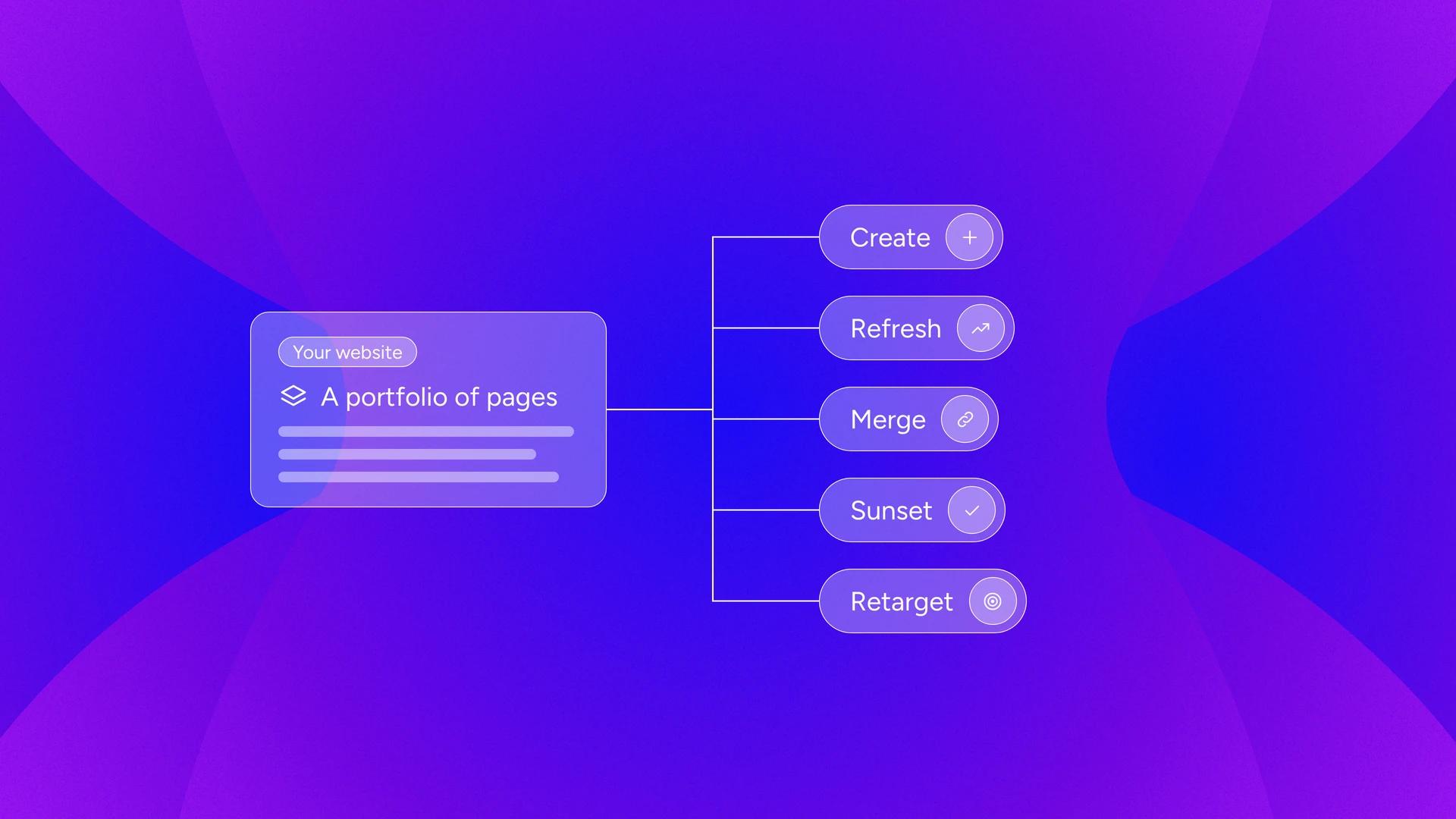
Balance content quality and quantity by deciding what each buyer question needs, then picking the move that delivers it. Quality comes first, but volume still has a job. The balance comes from mixing five moves: create, refresh, merge, sunset, and retarget.
Most content plans skip that decision. They list new posts and publish dates, which turns one move into the whole strategy.
The right ratio depends on your library. A young website with forty pages should spend most of its effort creating. A mature one with a thousand pages gets more from improving what it already has.
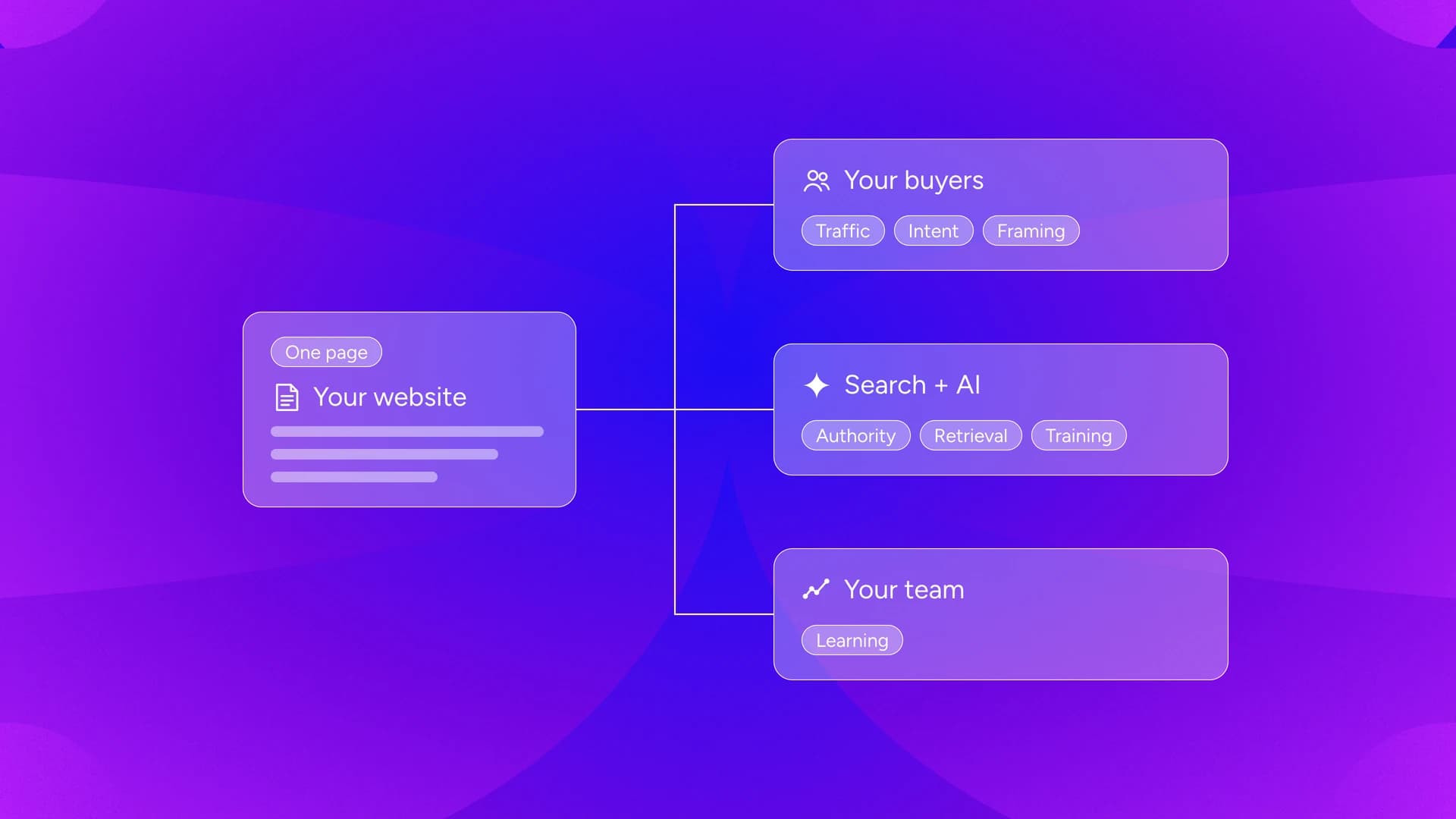
That's why you must manage your website as a portfolio of pages. Every page has a job, whether that's educating a buyer early, supporting a comparison or validating a decision. A portfolio manager grows a fund by adding to winners, consolidating overlapping positions and exiting the ones that no longer earn their place, as well as by buying new assets.
Quality comes first
Quality outweighs raw volume. Treating content quality vs quantity as an either/or choice misses what volume does for a team.
Publishing gives a team reps, extends coverage across the questions buyers ask and builds share of voice (how often your brand shows up next to competitors in a category). A small library can't win questions it never answers.
Quality needs a working definition before you can manage it. A quality page has a clear purpose, fits a specific audience and fully answers a question that audience is asking. Polish and word count aren't on that list, and a short page that resolves one buyer question beats a long one that half-answers five.
Why net-new became the default move
Net-new became the default because it's the easiest work to produce and the easiest to count. AI has made drafting cheap, so one more post feels almost free. Calendars reward output, and "we shipped 40 pages" fits neatly on a slide.
Cheaper drafting hasn't produced better results. Orbit Media's 2026 survey of 1,042 content marketers found only 14% reported strong results from their blogs, the lowest share in the survey's 12 years.
New pages also start from zero. Ahrefs tracked 1 million random URLs first seen in September 2023 and found only 1.74% reached Google's top 10 within a year.
An existing page already carries its history, links and indexing. A new URL has to earn all three from scratch, which is the strongest case against a create-only plan.
Publishing more helps search only when each page answers a real question
Google has been consistent that frequency isn't the lever. Its Search Relations team has said there's no absolute answer to how often a website should publish. Its guide to generative AI features goes further and says a high quantity of pages doesn't make a website higher quality or more relevant to users.
Volume turns into a liability when cheap drafts become thin pages. Google's spam policies define scaled content abuse as generating many pages mainly to manipulate rankings rather than help users, however the pages are made. Short of a penalty, a page aimed at a question nobody asks usually goes unseen.
Start with the question, not the calendar
Every move starts from a buyer question you've already decided is worth winning. That decision, qualifying each question and sorting it into defend, reinforce or expand, is covered in which buyer questions to win. Once a question makes the cut, work through three checks in order.
- Do we already answer it? Look for an existing page, confirm people and search engines can find it, and judge whether it fully answers the question.
- Are we winning? Look at rankings, AI citations, and whether the right visitors take action.
- What should we do about it? Pick one move.
Run them in that order. Teams that skip straight to the last check default to "create," because creating needs no audit.
Five moves for every buyer question
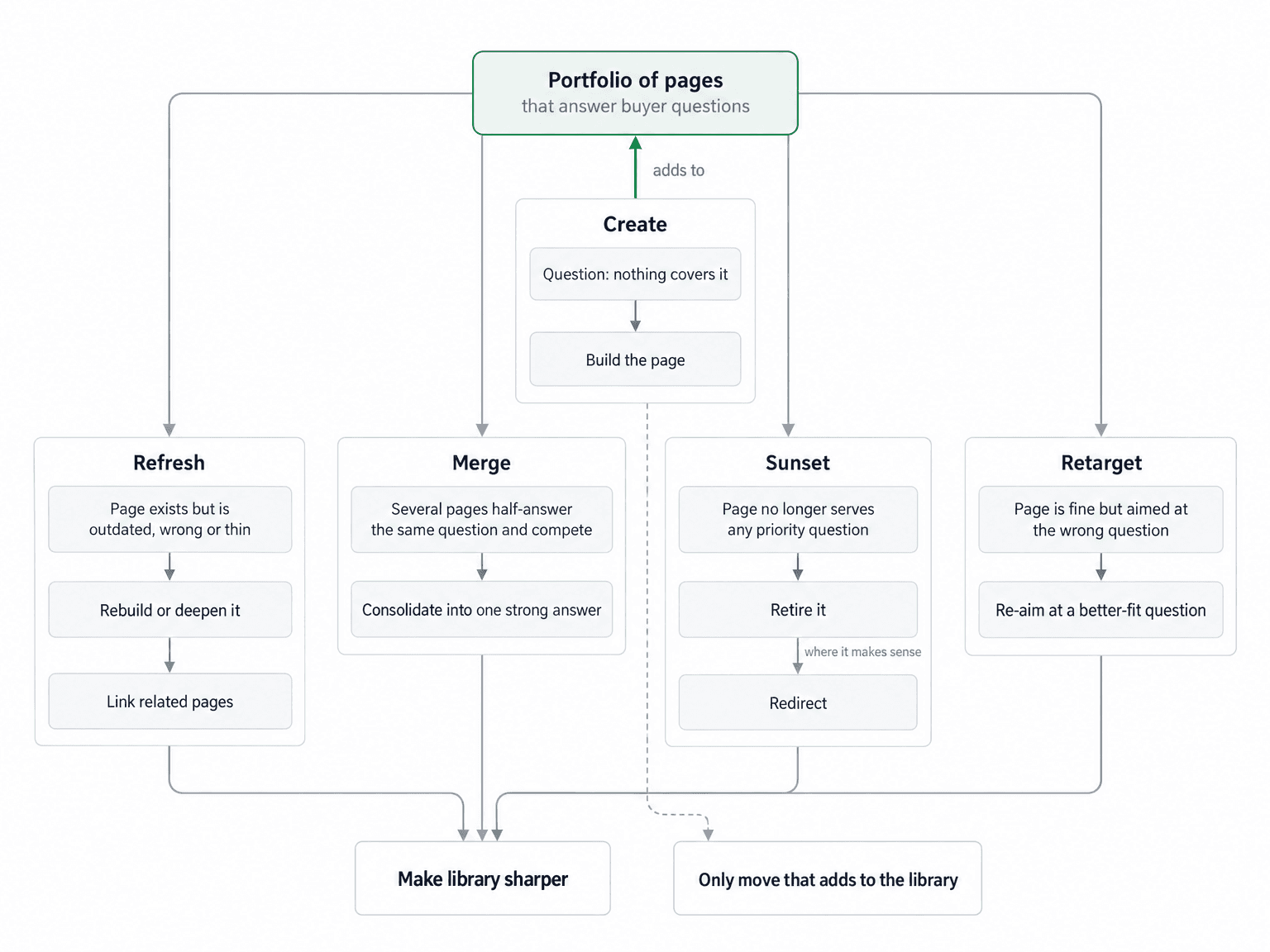
Each move has a signal that calls for it, a way to do it and a mistake teams make with it. Together they put into practice the idea that every page does a job.
Create when nothing covers the question
Create a page when nothing on your website answers the question yet, and aim it at that question and the buyer asking it. For newer or smaller websites, creation is legitimately most of the work.
The common mistake is building a page for a keyword rather than a question. That's how libraries fill up with pages nobody searches for.
Refresh pages that are outdated, wrong or thin
Refresh a page when it exists but its facts are stale, its product details are wrong or its answer is shallow. Enrich it with current information and extend it to cover the follow-up questions buyers ask next.
Then link related pages with descriptive anchor text so readers and AI engines can follow the thread. Google's link guidance says every page you care about should be linked from at least one other page on your website.
Workshop Digital's May 2026 analysis of 95 refreshed pages found organic sessions rose 447.7% in the 90 days after refresh, while comparable untouched pages fell 20.2% over the same windows (an agency's own analysis, not randomized). The common mistake is changing the date without changing the substance, which Google lists as a warning sign, not a freshness signal.
Merge pages that compete for the same question
Merge when several pages each half-answer the same question and split the attention between them. Pick the strongest page, fold the best material from the others into it, and redirect the rest.
Google treats redirects as a strong canonical signal, and consolidating combines signals such as links into the preferred URL. The mistake is merging pages that serve different intents, since a how-to guide and a pricing page can share a keyword without competing.
Sunset pages that no longer serve a priority question
Sunset a page when it answers no question you care about anymore, such as a retired feature, an expired campaign or a topic outside your market. If a related page serves the same need, redirect to it. If nothing does, Google's guidance is to return a 404 or 410, and it treats the two the same.
The mistake is sunsetting by age or page views alone. Low traffic doesn't make a page useless if it answers a question late-stage buyers ask.
Retarget a good page aimed at the wrong question
Retarget when a page is well written but aimed at a question your buyers don't ask, or ranks for queries it was never built for. The usual signals are impressions without clicks, or clicks from visitors who never take the next step.
Re-aim the title, opening and structure at the question the page should answer. It's the lightest of the five moves, and teams skip it because it doesn't look like new work.
Balance the mix by library stage
Four of the five moves make your library sharper. Only one adds to it. A plan made only of "create" is a volume plan in disguise, and the ratio should shift as the library grows.
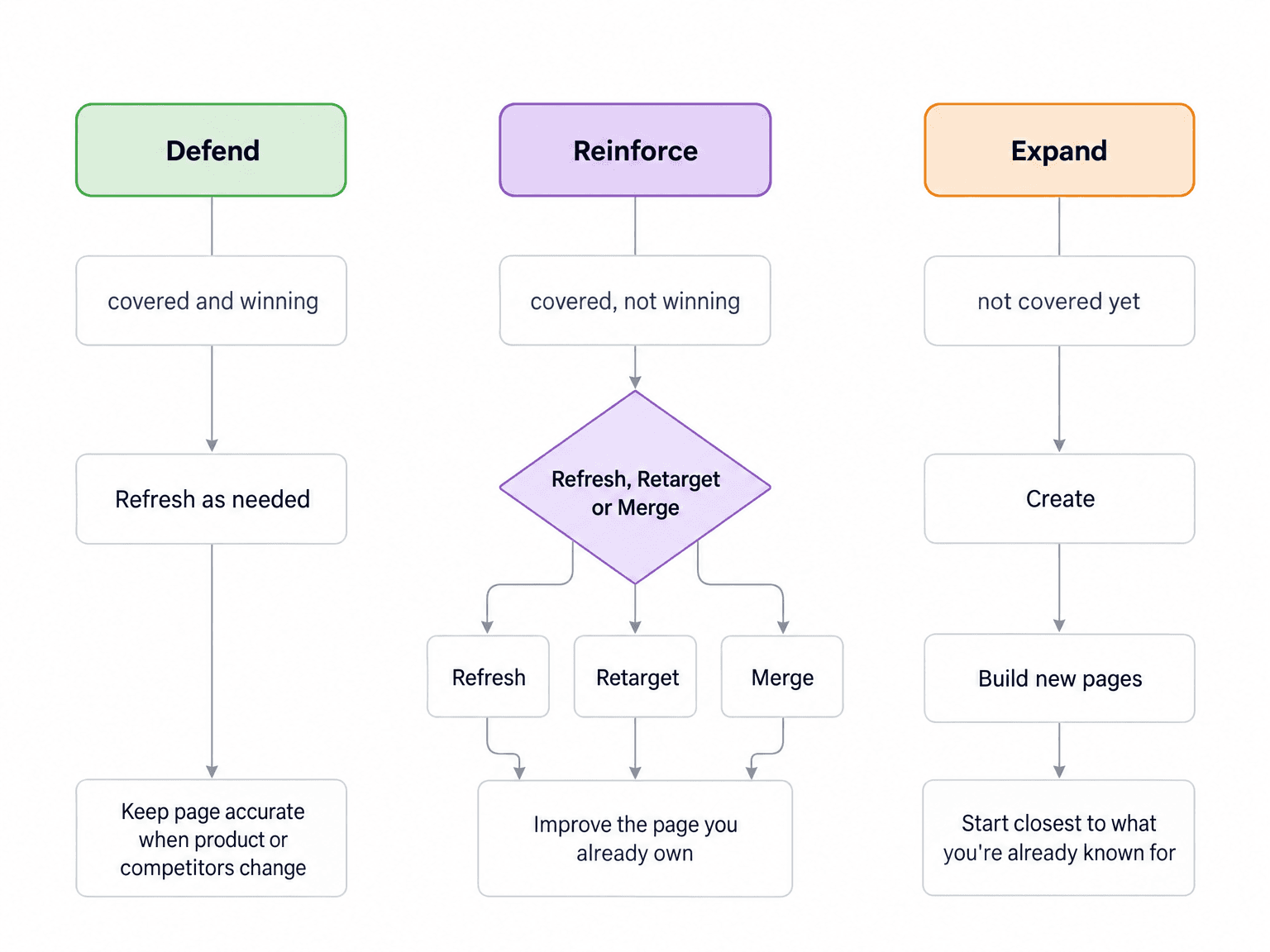
If you've already sorted your questions into defend, reinforce and expand, you know roughly where your mix lands. A reinforce-heavy map turns into a plan heavy on refresh, retarget and merge. An expand-heavy map leans on create.
| Library stage | Dominant moves | What to check before the quarter starts |
|---|---|---|
| Young or small | Mostly create | Every new page maps to a real buyer question with demand |
| Growing | Create and refresh in balance | Pages older than a year that still target priority questions |
| Mature | Refresh, merge and sunset carry more weight than create | Pages competing for the same question, and pages no priority question needs |
A two-person team at a young company should spend most of its hours creating, with a small slice for refreshing early winners. A mid-size team with a growing library can split its time roughly evenly. A larger team running a mature library should spend most of its capacity improving what exists and keep a smaller share for net-new pages that fill real gaps.
A worked example from one B2B SaaS topic
Pick up the hypothetical expense management vendor from which buyer questions to win. It has already sorted its buyer questions into defend, reinforce and expand. Now each question it chose to work on gets one move, along with two pages its audit turned up that no priority question needs.
| Buyer question or page | Move | Reason |
|---|---|---|
| Should we build approvals into our ERP or buy a tool? (reinforce) | Retarget | The page lists ERP features but never answers build-or-buy, so re-aim its title, opening and structure at that question |
| How does this vendor compare with its main competitor? (reinforce) | Refresh | The comparison page has weak proof and outdated plan details, so update the plans and add named customer evidence |
| How much does expense software cost for 300 employees? (reinforce) | Refresh | The pricing page lists tiers but never answers cost at that size, so extend it with a worked estimate |
| Is the vendor SOC 2 Type II compliant, and how is card data handled? (expand) | Create | No page answers it, and security review decides who makes the shortlist |
| Does it integrate with NetSuite? (expand) | Create | No page exists, and it sits next to the close-process content the vendor already wins |
| Three blog posts on receipt capture tips (audit) | Merge | Each half-answers the same question and they compete in search |
| 2022 webinar recap on expense policy trends (audit) | Sunset | No priority question needs it, so redirect it to the expense policy guide |
Only two of the seven are creates, and both come from the expand territory. The reinforce questions became refreshes and a retarget, and the audit added a merge and a sunset that the territory split alone wouldn't show. To sequence those rewrites against the new pages, see content gap analysis.
Revisit the mix as the market moves
Moves aren't permanent. When your team launches a product or a competitor publishes a stronger answer, check whether healthy pages need a refresh and whether winning pages have started to decline. As your market shifts, reassess once-central pages for sunsetting.
Run the loop continuously: target and cover the question, earn engagement, drive action, then reassess. Most of the opportunities this turns up are fixes to existing pages, not new ones.
Try this with one topic you already cover
Pick one topic where you have five or more pages. Assign each page one of the five moves, then count the creates. If most of them are creates, look again before the quarter starts, and use What 10,000 Hours of AEO Taught Us for the full method.
GrowthX runs this audit continuously as website portfolio management: Portfolio scores every page, Opportunities surfaces what to create or rewrite next, and Creation runs the work, with your team making the calls. Get your question map.