A question map shows everything your buyers ask, but not what to work on next. A content prioritization framework does. Qualify each buyer question on fit, relevant demand and commercial intent. Skip anything that fails fit, whatever its search volume. Sort the rest into defend, reinforce or expand, and invest across the three on purpose.
Search volume is a sort order, not a strategy
Teams usually do the same thing after they finish a question map. They sort by monthly searches and start at the top. A complete question map shows what you cover and what's missing. Deciding which of those questions deserves next quarter is a separate job.
Volume counts how many people type something. It says nothing about whether those people buy what you sell. A high-volume question unrelated to your product is worth less than a low-volume question asked right before a buying decision.
Take someone who owns a vacation home they rarely use and wants another income stream. They move through a path of questions:
- Is rental income really passive?
- Could my vacation home earn income?
- Does my homeowners insurance cover short-term rentals?
- How do I buy landlord insurance?
Each question is a different moment with a different job. The best answer moves their current task forward: explain what they need to know now, then offer the natural next step. An insurer that only answers question 4 shows up after the buyer has already formed a view.
B2B buying follows the same timing. Among 4,611 recent B2B buyers in the 2026 Buyer Experience Report, buyers chose the vendor they favored before contacting a seller 82% of the time. Treat the questions that shape that early favorite as priority work, whatever their volume.
Qualify each question before you sort it
Every question passes three filters before it earns a spot in the queue:
- Fit: The question has to fit your business and the buyer's job, so a question about a problem you don't solve fails here.
- Relevant demand: This is how many people need the answer. 15% of the searches Google sees each day are new, so treat volume data as a directional signal at best, especially in young categories. When tools show nothing, count how often the problem comes up in sales calls.
- Commercial intent: This is how strongly a question predicts that the person asking it needs a solution you actually deliver. It differs by business, so the same question can carry high intent for one company and none for another. A question can also carry high intent without being a compare, choose or buy question, because an early problem-framing question can still come from a buyer who needs what you sell.
Fit works as a gate. A question that fails it gets skipped, regardless of volume. Demand and intent work as weights, and a strong reading on intent can outweigh a weak reading on demand.
If your list is still thin, go back to finding the questions buyers ask AI and question intelligence before you sort anything.
Sort what fits into defend, reinforce or expand
Place each qualifying question by checking whether you already answer it and whether that answer wins. Defend calls for maintenance, reinforce for improvement and expand for new content.
Defend the questions you already win
Defend holds the questions you already answer well and win. Keep those pages accurate and strong. Treat them as the pages competitors are coming for.
These pages go stale when your product changes. They lose ground when a competitor publishes a better answer. When the product ships a change, update every defend page that describes it in the same sprint.
Reinforce the questions you answer but don't win
Reinforce holds the questions you answer, but not well enough to win. You can often get the fastest return here. The page already has history, links and indexing, and you can rewrite it without changing its URL.
Before you rewrite, find out why the page isn't winning. The cause is usually one of these:
- Incomplete answer: The page covers part of the question and leaves the buyer's next concern unanswered.
- Wrong question targeted: The page answers a neighboring question, often the one the team wanted to rank for.
- Not discoverable: Crawlers can't reach or read the page. A page has to be indexed and eligible to show with a snippet before it can appear in AI Overviews or AI Mode.
- Weak proof: The claims are right but unsupported, with no numbers, examples or named specifics.
The guide to content gap analysis covers how to order rewrites against new pages once you know the cause.
Expand into questions you don't answer yet
Expand holds the questions you don't answer yet. Build new pages here, starting closest to what you're already known for. We treat adjacent territory as easier to claim than unrelated ground, because it builds on topics you already cover well.
Work outward from your strongest defend pages. A question close to what you already win can borrow that credibility. A question in unrelated territory gets little of that lift.
Concentrate your investment across the three
How you split the work depends on what your website already has. A mature website with years of indexed pages should weight toward reinforce, because the history is already paid for. A younger website should weight toward expand, since there's little to reinforce yet. Defend is a standing maintenance budget that never closes, sized to how often your product and your competitors change.
Within expand and reinforce, concentrate. Fifteen pages in one territory read as authority. Fifteen pages spread across fifteen subjects read as noise. Treat your question map like a strategic account list. Pick the territories you intend to win the way you'd pick target accounts, then measure how well you cover the questions in each one. Google's self-assessment for creators asks whether a website has a primary purpose or focus. We cover the reasoning in committing to a few.
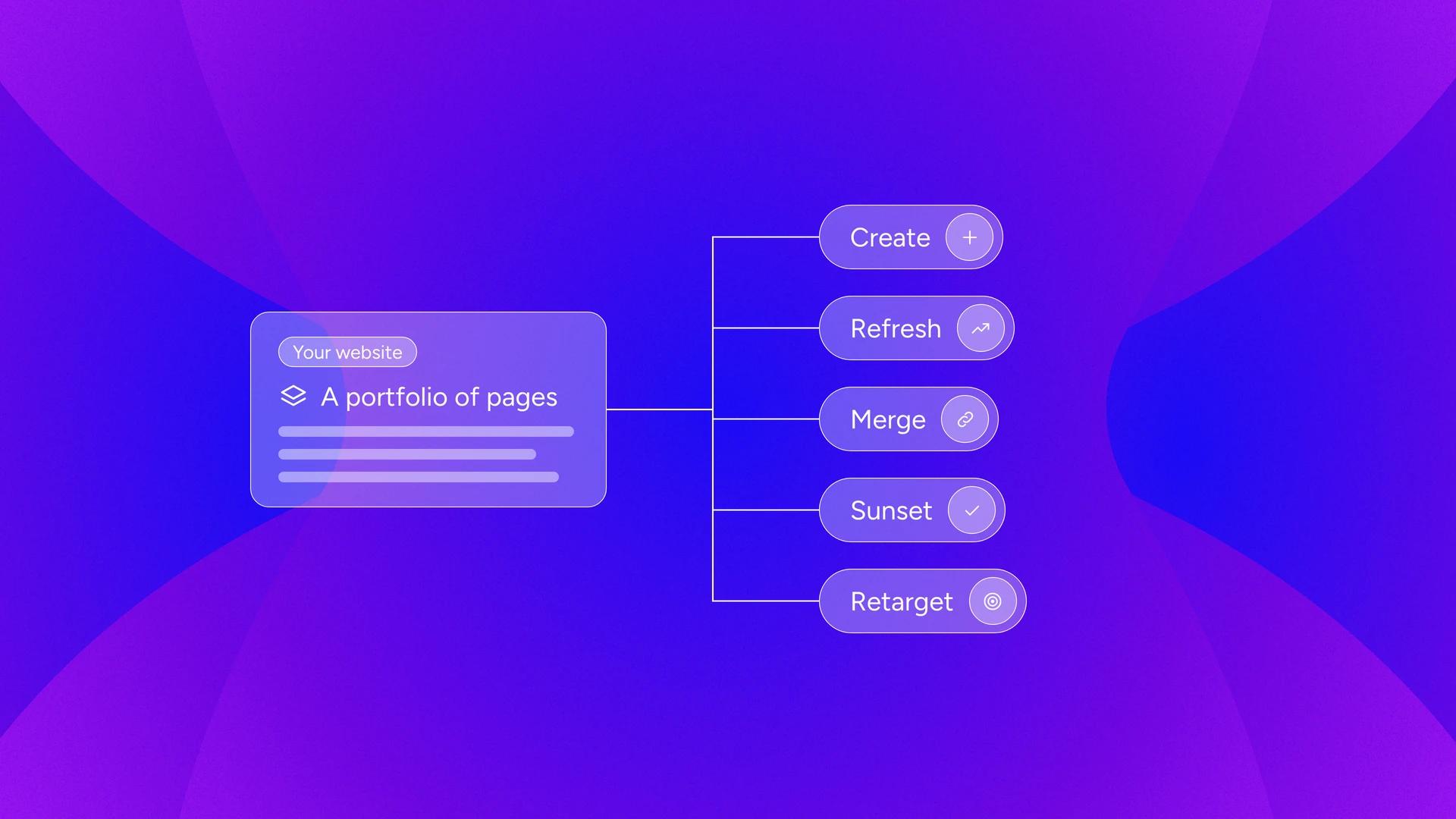
The page-level moves (create, refactor, enrich and link, retarget, merge or sunset) come after this decision and get their own treatment.
A worked example sorts eight B2B SaaS buyer questions
Take a hypothetical mid-market expense management vendor with a mature blog. Here's how eight of its buyer questions sort:
| Buyer question | Territory | Rationale |
|---|---|---|
| Why does our month-end close slip when expenses come in late? | Defend | The vendor already wins this problem-framing question with its guide, so the team needs to schedule accuracy checks. |
| What is the best expense management software for a 300-person company? | Defend | The vendor shows up in AI answers today, and every competitor is targeting this question. |
| Should we build approvals into our ERP or buy a tool? | Reinforce | The existing page lists ERP features and never answers the build-or-buy question. |
| How does this vendor compare with its main competitor? | Reinforce | The comparison page exists but has weak proof and outdated plan details. |
| How much does expense software cost for 300 employees? | Reinforce | The pricing page lists tiers but never answers cost at 300 employees. |
| Is the vendor SOC 2 Type II compliant, and how is card data handled? | Expand | Volume is tiny, but security review decides who makes the shortlist. |
| Does it integrate with NetSuite? | Expand | There's no page yet, and the question sits next to the close-process content the vendor already wins. |
| How do freelancers deduct business expenses on personal taxes? | Skip | Volume is high, but the question fails fit because the vendor doesn't serve freelancers. |
Map 20 buyer questions in one category this week
Pick one buying category. Write down 20 questions a buyer asks on the way to choosing a solution in it, from first curiosity to final decision. Mark each one: covered, covered weakly or missing.
That marking gives you your split. Questions you cover and win go to defend. Weak coverage goes to reinforce. Missing questions go to expand, and the ones nearest your strongest pages go first. The full method is in the ebook, What 10,000 Hours of AEO Taught Us.
If keeping this split current across separate tools is the bottleneck, the GrowthX platform shows every page you own and what to create or refresh, in one workspace. Book a demo to get your question map.