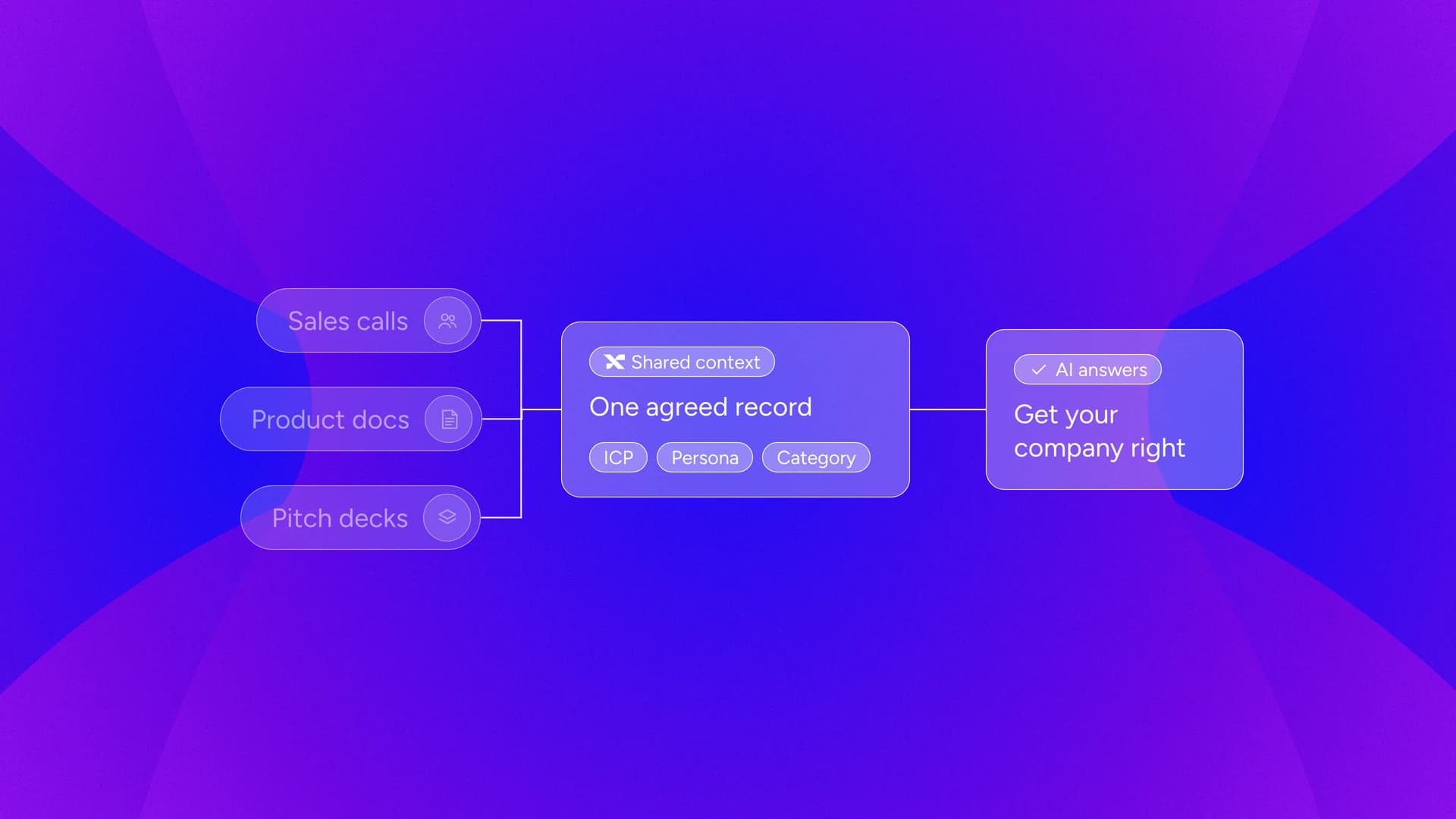
AI needs four things to describe your company correctly: who you sell to, what you sell, where you compete and what you can prove. That record is your shared company context, and it's the highest-leverage work in your content program. It only works if it's complete, consistent and kept current, and most teams fall short on consistency.
AI repeats whatever your business context says
Ask ChatGPT what your company does and you may get last year's positioning, a retired product, or a category your sales team stopped using two quarters ago. Read your own website and you'll often find the same outdated or mixed descriptions, because both draw on the same scattered record.
Your shared company context shapes the pages your team publishes. Those pages, along with your docs, review profiles and press coverage, are what AI tools read when they describe you. So when the context has a gap, a stale fact or two competing versions, your pages carry it and the AI answers repeat it.
AI models fill gaps with whatever they can find. In an Ahrefs experiment with a made-up brand, Gemini first said it could find no evidence the company existed. After fake stories about the brand were published, the same model described an invented founder and city as fact.
Buyers are reading those answers. In a Gartner survey of 645 B2B buyers fielded August to September 2025, 45% used GenAI during a recent purchase, mainly to gather information on vendors and products.
AI multiplies whatever you give it, including the parts your teams describe differently. A faster content process makes this worse. If writers and AI tools pull from three versions of your story, every new page publishes one of them, and ChatGPT and similar assistants reading your website pick up all three.
Context breaks when it's incomplete, outdated or inconsistent
Three failures cause most of the damage, and each gets worse as output grows:
- Incomplete: Nobody wrote down which category you compete in or what you can prove, so the model guesses.
- Outdated: Old pricing, a retired feature or last year's positioning stays live on a page, in a deck or on a review profile, and gets repeated.
- Inconsistent: Teams describe the business differently. In a Gartner sales survey published June 2025, 69% of B2B buyers reported inconsistencies between a vendor's website and what its sellers told them.
Inconsistency is the hardest of the three to fix. This work rarely fails because information is hard to find. It fails because teams never agree on one version. If marketing describes the category one way and sales sells into a different one, each team's draft is right on its own terms, and the company still tells two stories.
The facts live in sales calls, product docs, pitch decks and the heads of your longest-tenured people. Pull them together and check each claim against evidence: the live pricing page, signed contracts, release notes, deals you've won. Then get the people who own the business to agree on one version.
AI can help organize and test this record. It can read call transcripts, cluster how reps describe the product and flag where the deck contradicts the docs. People have to settle the disputed claims, because only they can decide whether you're "the CRM for agencies" or "a CRM agencies happen to like."
Keep ICP, persona and buying category separate
Keep ICP, persona and buying category apart, because these three terms get blurred all the time and AI inherits the blur. Even Forrester's definition folds buyer personas into the ICP. Take a CRM built for agencies:
- ICP: The kind of company likely to benefit from what you sell. Agencies with 20 to 200 people.
- Persona: A person's role, pressures and part in the decision. The head of operations who has to get the team using it.
- Buying category: The set of alternatives that buyer will compare. CRMs for agencies, not CRMs in general.
The category decides who you're compared against. April Dunford describes the best market category as the context in which your value is obvious to target customers. An agency CRM described as a general CRM gets measured against the biggest names in that category and asked questions it can't win.
One product can sit in several categories at once. G2 lists a product in every category whose feature criteria it meets, and its alternatives pages rank competitors partly by how many categories they share. The agency CRM might also compete as agency project management, with a different competitor set, a different evaluating persona and different buyer questions. Write down your position in each category separately.
Connect the facts so AI can use them
A context document is a record of your company's facts. A context map holds the same facts but links each one to the other facts that depend on it. That makes it more useful than a single document that only lists them. We organize it into six areas, and every fact in them has an owner and a source:
- Entity: Legal name, one-line description, founders, timeline, structure and the identifiers that confirm them. This area keeps AI tools from mixing you up with a company that has a similar name. In one weekly test, some assistants confused Fathom with financial-reporting software.
- Product: Every product and plan, current pricing, the technology behind it, and what each one does and doesn't do.
- Audience: ICPs, personas, the jobs each persona is trying to get done and the path they take to a purchase.
- Messaging: Positioning, terminology, voice and tone, content themes, and the approved claims with the proof behind each one. If three teams use three names for the same feature, a writer has no way to know they mean one thing.
- Market: Buying categories, the competitors in each, your position per category and how the categories relate.
- Sources: The places that shape how each persona sees you, from analyst firms and review platforms to communities, publications, podcasts and influential people.
The map earns its value through the links between areas. Each product connects to the job it solves, the category it competes in, the persona who evaluates it there and the sources that shape that persona's view.
Run the agency CRM through it. In Product, record the current plan and price. In Audience, identify the evaluating persona as the head of operations at a 20-to-200-person agency. In Market, place it in CRMs for agencies, against that category's competitors. In Sources, list where that head of operations reads before building a shortlist.
A writer or an AI tool briefed on a comparison page can follow those links and check connected facts against the same record. Without them, writers reassemble the company from memory for each brief, and their drafts land a little differently.
Manage context continuously, not once
Build every area with the same loop, and keep running it:
- Define the scope: what the area has to answer.
- Gather evidence from calls, docs, contracts and live pages.
- Reconcile conflicting accounts with the people who own them.
- Write the agreed version in plain sentences.
- Connect it to the facts in other areas that depend on it.
- Verify and update it against your live pages and AI answers.
Record an owner and a last review date for every fact. Product marketing usually owns Product and Messaging. Sales leadership signs off on ICPs and personas. The CEO settles the buying category and your position in it, because that's a strategy call.
Then decide what triggers an update. Any of these should send someone back to the map:
- Pricing or packaging changes.
- A product launches or enters a new category.
- Sales hears buyers describe you differently than your pages do.
- An AI answer repeats an outdated or wrong fact about you.
When one fires, update the fact once, then check every page that depends on it. The sooner you make those updates, the fewer outdated facts reach your pages and the AI answers built from them.
Shared company context is the foundation for the rest of the method. Your ICPs, personas and buying categories define every question buyers might ask in the categories you compete in, and every page you publish answers some of them. Context also shows which of those questions create demand and which capture it. Your next step is to read the full method in the ebook, What 10,000 hours of AEO taught us.
GrowthX keeps this record in one workspace, with your company overview, ICP, personas and competitors in its Context area. Your team decides what changes. If you're ready to start building your company context and question map, book time with us.