OpenAI's documentation doesn't name B2B or SaaS as eligible or excluded for Businesses in ChatGPT, which leaves B2B teams unsure whether they can act. B2B, SaaS and service businesses can try to claim and manage a profile today, because OpenAI ties claim eligibility to location and business type rather than to a B2B or consumer label. The Business Agent is narrower. At launch it is limited to eligible US ecommerce and online service businesses with a website.
For B2B teams, profile management and insights are available once eligibility, claim approval and Persona verification are satisfied. Agent access requires a separate eligibility review.
Businesses in ChatGPT series: Overview · Claim and verify · Measure visibility · B2B and services (this article) · Update business information · Create a Business Agent · Search-console comparison and history
Expansion beyond that is a stated plan with no dates attached. The sections below keep current support, announced plans and plausible future uses apart, because only the first is something you can act on this week.
Each row pairs a capability with its status and the check to run:
| Capability | Status for B2B and service businesses (November 10, 2026) | What to do now | Reference |
|---|---|---|---|
| Claim a profile | Open to eligible businesses where ChatGPT is available. B2B and SaaS are not named as included or excluded. | Search for your company in Business Hub and start a claim. Line up whoever controls your DNS. | Setup help article |
| Edit profile details | Website, description, product or service category, logo and cover photo apply to any business. Delivery and return policies are retail-shaped. | Prepare a government ID, registration details and proof of authority for Persona verification. | Setup help article |
| View insights | 28 days of mentions, website clicks and discovery topics, shown only above privacy thresholds. | Expect blanks if your category has low conversation volume. A blank is not a zero. | Setup help article |
| Publish a Business Agent | US ecommerce and online service businesses with a website only. OpenAI reviews each category and intended use. | Read the industry rules before building anything. | Business Agents Policy |
| Expansion to more categories | Planned, with no date or category list. | Track OpenAI's announcement and policy pages for changes. | Launch announcement |
What Businesses in ChatGPT is
OpenAI launched Businesses in ChatGPT in beta on November 10, 2026. The product lets companies claim their presence inside ChatGPT, correct the information shown about them, and see aggregated data on how people engage with them. OpenAI's launch announcement frames the audience as the 1.2 billion people who use ChatGPT each week, which is OpenAI's own count of weekly users.
Four names come up, and B2B teams tend to mix them up:
- Businesses in ChatGPT: The umbrella offering. OpenAI's terms define it as the interfaces, tools and services it provides to businesses.
- Business Hub: The interface, opened from the ChatGPT sidebar, where you claim a listing, edit it and view insights.
- Business Agent: An optional conversational agent that a verified, eligible business can build and publish. People chat with it in a clearly labeled conversation that sits apart from ChatGPT's independent answers.
- ChatGPT Business: The paid workplace subscription formerly called ChatGPT Team. It covers your employees' use of ChatGPT and has no connection to your public profile.
OpenAI can create and display a listing for your company whether or not you claim it. Claiming gives you a verified way to edit that listing. It doesn't give you exclusive control over the contents, and OpenAI states that claiming doesn't guarantee higher placement or give you control over ChatGPT's independent recommendations.
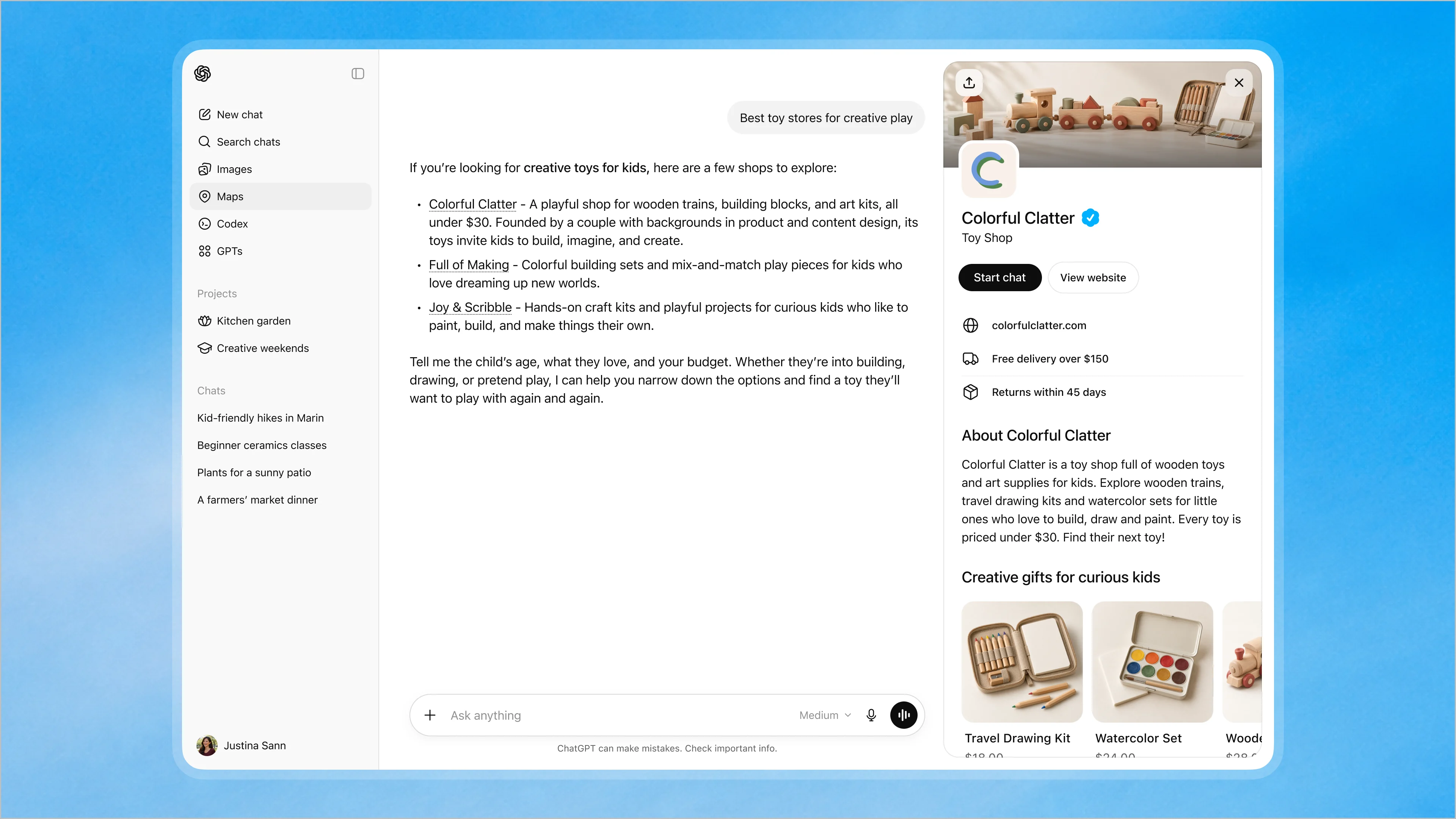
The business profile presents a route to the agent conversation alongside a route to the website. OpenAI’s product illustration. Source: OpenAI, November 10.
This retail example illustrates the interface, not approval of a B2B category.
Which businesses can participate today
Participation splits into four separate permissions, and a B2B company can qualify for some without qualifying for others. Each one has its own gate.
Claiming a business profile
You can claim a business if you own it or are authorized to represent it. The setup help article says availability depends on the business's location and type, and on whether the required verification is supported where you are. You don't need an Ads account or a ChatGPT Enterprise agreement, though existing Enterprise customers and advertisers can also claim through their OpenAI representative.
The claim flow runs in this order:
- Sign in to ChatGPT, open Business Hub from the sidebar, and search for your business by name.
- Select the matching listing and confirm which ChatGPT account will manage it.
- Verify through a code sent to your business phone or business email, a TXT record added to your domain's DNS, or a Shopify store connection.
- Wait for OpenAI to review the claim and email its decision or a request for more information.
- Complete identity verification with Persona. You may need a government-issued ID, business registration information and proof that you can represent the business.
The blue verified badge appears only after Persona approval. If a check fails, OpenAI's guidance is to make sure the business name, address and any registration or tax number match your official records.
The help article never uses the words B2B or SaaS. OpenAI's Businesses in ChatGPT policy adds that not every business can create or claim a profile, and that OpenAI may hold off on some categories until it has the safeguards to support them.
Two current limits hit B2B companies directly. Local stores and restaurants can only claim an existing US listing. And each brand is managed separately, so a company with several product brands claims each one on its own, because central management across a parent company's brands isn't available yet.
The clearest firsthand account of the signup flow comes from Kevin Indig. In his launch-day post, he reported that the signup offered three business categories (services, marked as not yet available, plus ecommerce and local) and that he created an account for his newsletter, Growth Memo, even though it didn't fit any of them.
One account proves little. Still, it suggests a B2B company should attempt the claim rather than assume it's shut out.
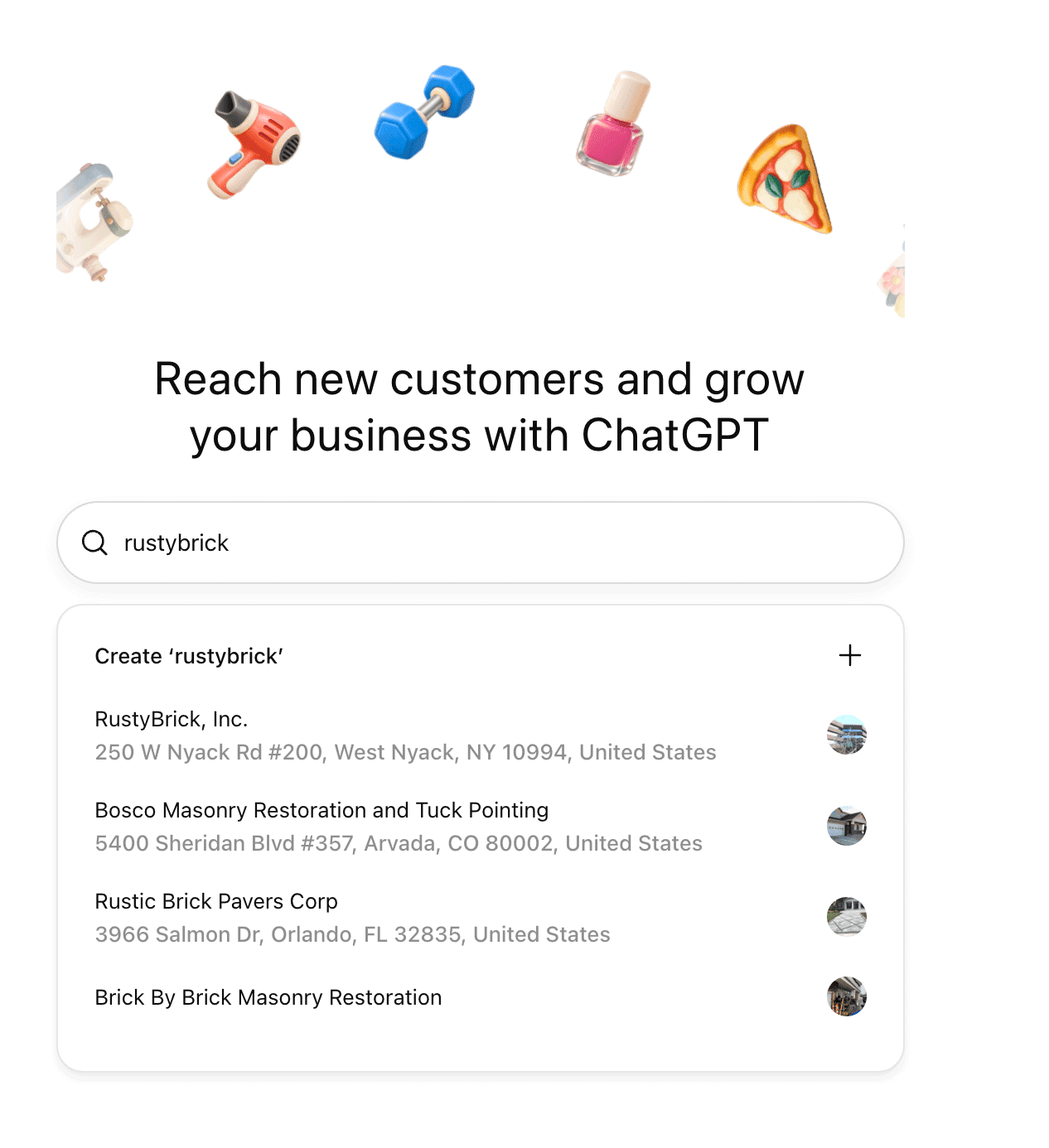
Finding the correct business listing is distinct from proving that you may manage it. Screenshot published by Barry Schwartz. Source: Search Engine Roundtable, November 10.
Managing profile information
After the claim and Persona verification are approved, you can update your website, business description, product or service category, logo, delivery policy and return policy, plus a cover photo and other optional details. Delivery and return policies are retail fields. Everything else applies to a SaaS company or a consultancy as readily as to a store, and the category field explicitly covers services.
Submitting a change doesn't publish it. OpenAI reviews and publishes changes, review time varies, and the help article says a saved change won't show up in every answer immediately. ChatGPT may also draw on other sources when it answers questions about your business. Your profile is one input among several.
Two rules deserve attention before you write anything. The policy requires profile information to represent the business truthfully and stay current, covering name, category, address or service area, hours, contact details, and products or services. And only unpublished drafts can be deleted, since OpenAI Support won't unpublish or hide a published profile as part of a setup request.
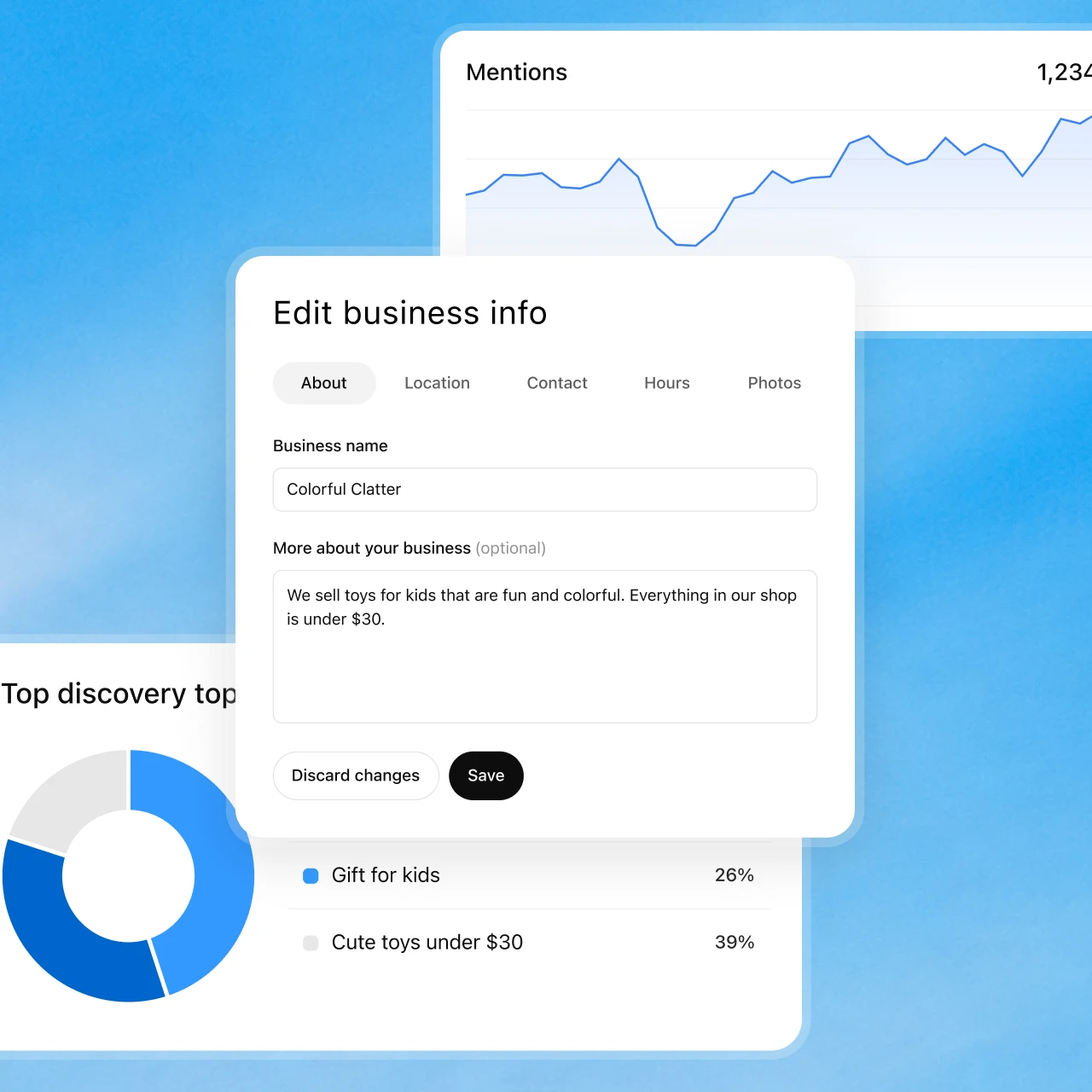
Official business-information review example. Supplying accurate facts is different from controlling ChatGPT’s independent recommendations. Source: OpenAI.
Business insights
Insights become available after Persona verification, and you can use them without publishing an agent or running ads. The help article describes the dashboard this way:
- Mentions: For an online business, a mention counts only when ChatGPT references your website. The brand name alone doesn't count.
- Website clicks: How often people click through to your website.
- Discovery topics: Aggregate themes from ChatGPT answers that mentioned or cited your business. They are not individual prompts and don't measure intent directly.
- Profile views: Listed in the dashboard caption on OpenAI's announcement.
The window covers the past 28 days. OpenAI doesn't share user conversations or Business Agent chats with businesses, and metrics appear only once activity crosses unstated thresholds. A blank field can mean too little activity, data still being collected, or reporting that isn't available yet.
No OpenAI page restricts insights by tier or by B2B status. The practical limit is volume. A niche B2B category with fewer conversations than a consumer brand may sit below the threshold for weeks.
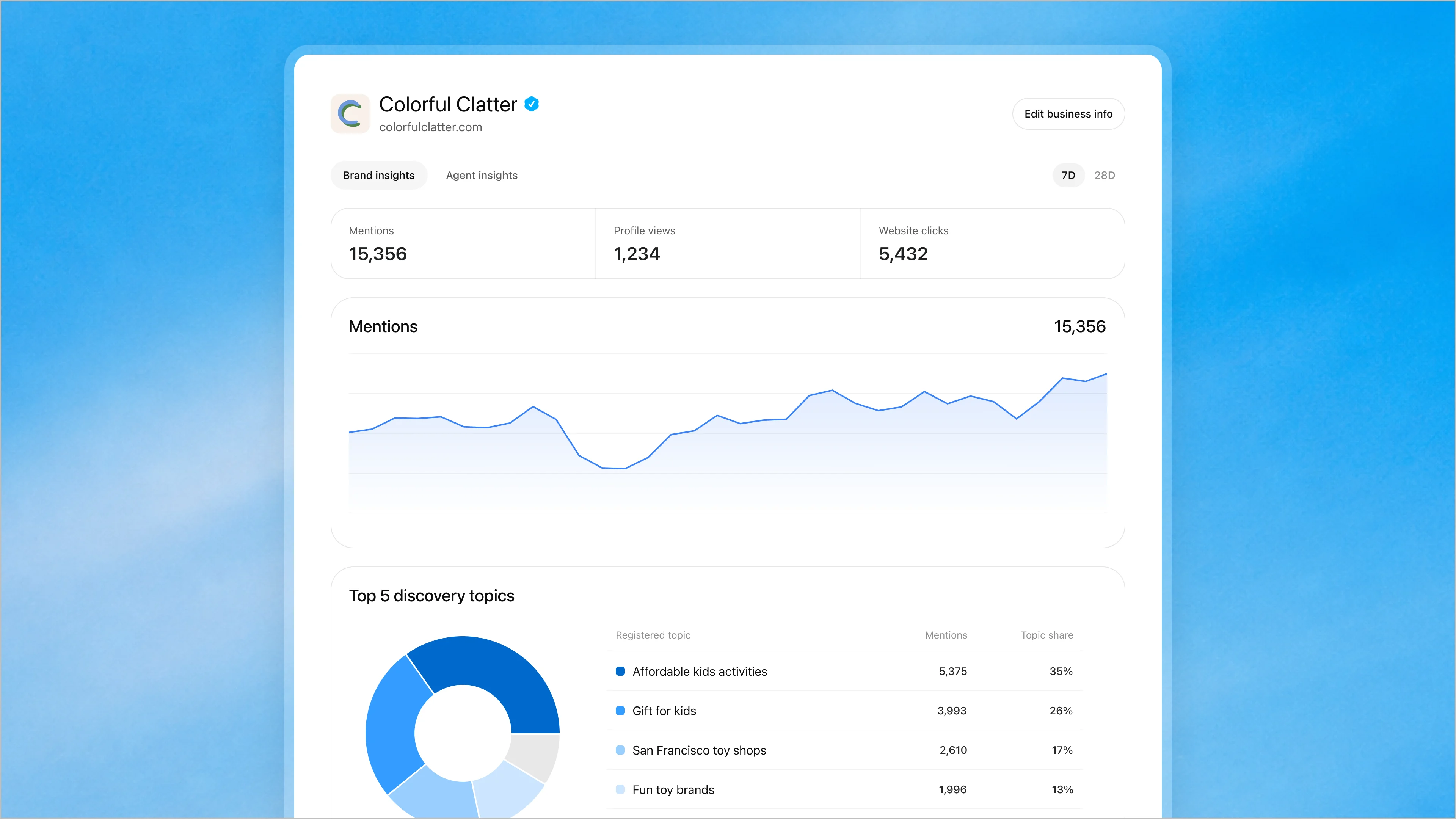
Source: OpenAI’s November 10 announcement. This is OpenAI’s product illustration, not GrowthX or customer performance data.
Business Agent eligibility
The Business Agent is where B2B eligibility gets narrow. The help article limits agents to eligible ecommerce and online service businesses in the US with a website, which must also meet the industry requirements in the Business Agents Policy. That policy says OpenAI weighs both the business category and the agent's intended use before allowing publication, may defer a category until it can support it safely, and won't treat business verification alone as proof of eligibility.
OpenAI doesn't define "online service business." A SaaS product delivered over the web may well fit that phrase. OpenAI's agent eligibility review determines whether your category and intended use qualify, and some businesses can manage a profile without ever becoming eligible for an agent.
Professional services firms face one more constraint. The policy bars agents from giving advice that legally requires a professional license, automating high-stakes decisions without human review, or claiming professional credentials. That rules out a law firm's agent offering legal opinions, though an agent explaining engagement scope would sit outside those limits.
Publishing an agent is a separate, optional step, and businesses can sponsor their agent as the destination for ChatGPT Ads. Our Business Agent setup guide covers setup and configuration in more depth.
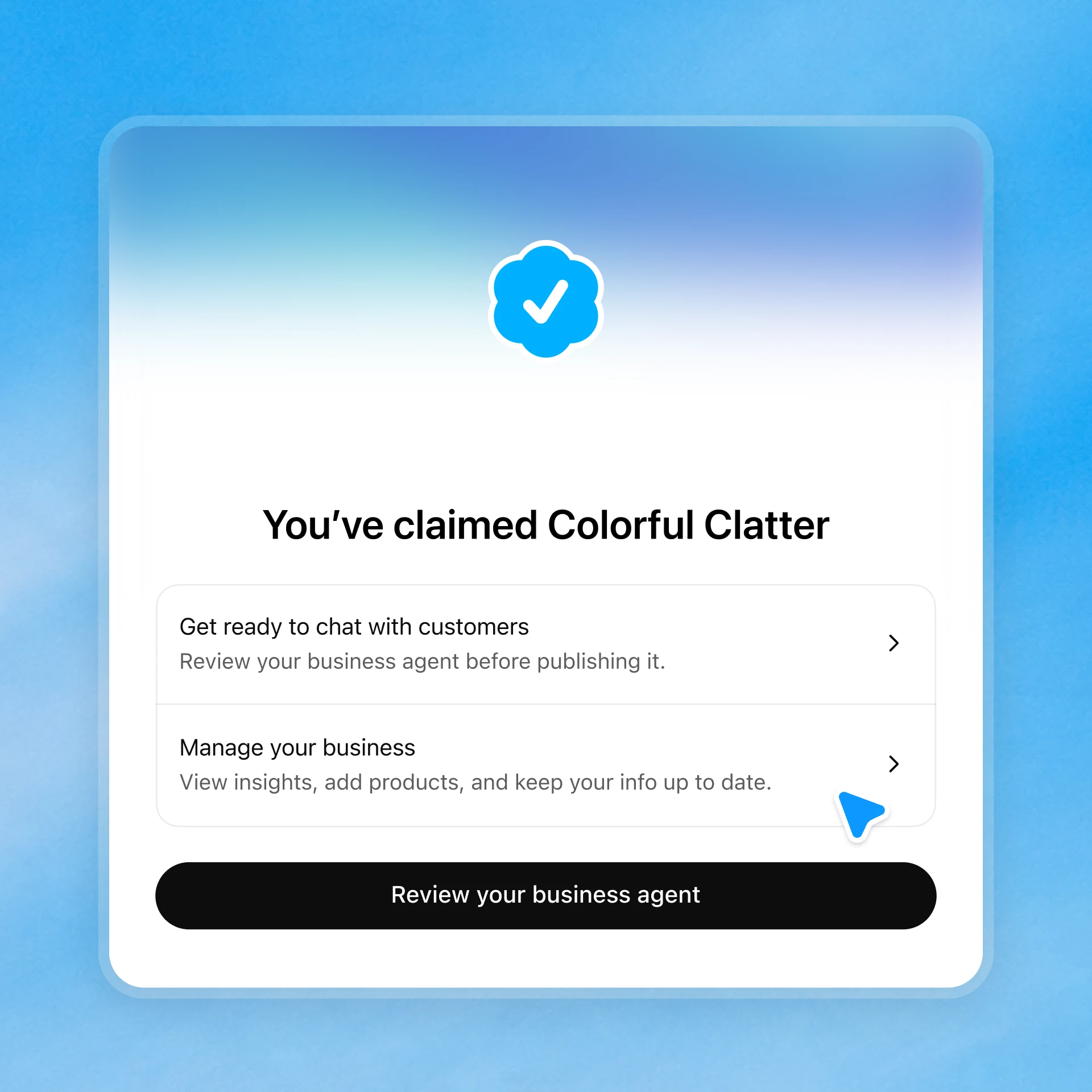
The confirmation offers separate actions to review the agent and manage the business. A claimed profile does not mean an agent is already published. Source: OpenAI.
This retail example illustrates the interface, not approval of a B2B category.
How the retail and ecommerce launch shapes the B2B picture
The launch's commercial features are built around physical products, and most of them don't transfer to B2B. Verified businesses can add self-service product feeds with pricing and availability, Shopify merchants can connect their stores, and eligible Shopify products already appear in ChatGPT through Shopify Catalog. Instant Checkout and the Agentic Commerce Protocol sit next to all of this, described in OpenAI's commerce documentation in terms of carts, merchants of record and fulfillment.
Product feeds are the gray area. The help article offers feeds to anyone who sells products and doesn't restrict them to retail. But OpenAI's feed specification expects one row per purchasable item with a price, availability and an image. That fits a self-serve SaaS plan with a published price far better than quote-based enterprise pricing.
What carries over to B2B is the core of the product. You get verification, profile editing, insights and, for online services, the agent. OpenAI's commerce spec index also lists a Get Quote spec and a Restaurant reservation spec under conversion specs, without a public description of either. Those names hint that non-retail conversions are on OpenAI's radar, but they are not a documented feature.
What OpenAI has announced for expansion
OpenAI has announced expansion plans without dates. The launch announcement says that over time OpenAI plans to bring Businesses in ChatGPT and Business Agents to more markets and business categories, and to build tools for organizations with more complex needs. Digiday reported that Benji Shomair, OpenAI's VP of monetization, declined to share a timeline for further rollout.
Here is every relevant OpenAI statement and its status:
| Statement | Status | Date | Reference |
|---|---|---|---|
| Businesses in ChatGPT launches in beta, and claiming opens to eligible businesses where ChatGPT is available | Live | November 10, 2026 | Launch announcement |
| Business Agents available to eligible US ecommerce and online service businesses | Live | November 10, 2026 | Business Agents Policy |
| Businesses can sponsor a Business Agent as a ChatGPT Ads destination | Live | November 10, 2026 | Launch announcement |
| Expansion to more markets and business categories, plus tools for complex organizations | Plan, no date | Stated November 10, 2026 | Launch announcement |
| OpenAI may defer a category until it can support it safely | Policy | November 10, 2026 | Business Agents Policy |
| Sponsored Agents in testing, with HubSpot named the first CRM partner for ChatGPT advertising | Testing | September 16, 2026 | Advertising announcement |
The HubSpot integration belongs to ChatGPT Ads and sits outside Businesses in ChatGPT. It is the only dated OpenAI announcement that names a B2B sales system.
How B2B and service businesses could use it later
None of the uses below is announced. Each one extends a capability that exists today into a category OpenAI hasn't confirmed, so treat them as planning scenarios.
- SaaS discovery: A verified profile states your product category accurately, and discovery topics show which themes lead ChatGPT to cite your website. If agents open to SaaS, an agent could answer integration, security and plan-fit questions from information you supply.
- Professional services questions: A consultancy or accounting firm could use an agent for scope, process and engagement questions while staying inside the policy's ban on licensed advice.
- Agency-managed clients: This part works today. The admin who claimed a business can grant an agency access to manage the business or its agent, and each person uses their own ChatGPT account.
- Quote and demo requests: OpenAI's terms already define Lead Information as separate from insight data, and its commerce index lists a Get Quote spec. Combined with the HubSpot ads partnership, these point toward lead capture, but OpenAI hasn't announced demo or quote routing for Businesses in ChatGPT.
Demo-request routing is the one we'd watch most closely, because it would turn ChatGPT from a discovery surface into a pipeline source for B2B teams.
How it differs from the ChatGPT Business subscription
ChatGPT Business is an internal workplace plan, and Businesses in ChatGPT is your public presence. OpenAI renamed ChatGPT Team to ChatGPT Business on August 29, 2025. The Business overview prices Standard seats at $25 per user per month billed monthly or $20 billed annually, and Premium seats at $125 or $100, with a two-seat minimum. Subscribing doesn't claim your profile, and claiming doesn't require a subscription.
Treat everything you submit through Business Hub as public, since its purpose is to be shown to anyone using ChatGPT, and don't paste anything into a workspace chat that you wouldn't want your admins to read. The data rules differ too, because OpenAI's enterprise privacy commitments say it doesn't train on ChatGPT Business data by default, while the same page's Business FAQ says workspace admins can view, access, export and delete end users' conversations. Our Businesses in ChatGPT overview covers the wider product context.
How Businesses in ChatGPT relates to AI visibility
A claimed profile is the information you submit about yourself. Organic visibility is what ChatGPT says based on the wider web. A mention is your brand named in an answer. A citation is your URL used as a source. OpenAI counts only answers that reference your website in its "mention" metric for online businesses, which makes it closer to a citation count.
Your website still shapes answers. OpenAI's policy says profiles may include information from other sources, and claiming doesn't give you control over ChatGPT's independent recommendations. For ChatGPT search, OpenAI's crawler documentation recommends allowing OAI-SearchBot in robots.txt. Websites that block it won't appear in ChatGPT search answers except as navigational links, and robots.txt changes take about 24 hours to register. GPTBot, the training crawler, is controlled separately, so you can allow search while blocking training.
Business Hub reports only your own numbers, with no prompts or competitor benchmarks. CheckThat, GrowthX's AI visibility index, measures how AI engines describe brands across Presence, Reputation, Perception and Influence, which covers the comparative view that Business Hub leaves out.
Prepare your B2B presence now
Most of the preparation is website work you control, and none of it depends on OpenAI widening eligibility. Here is the order we'd run it in:
- Confirm eligibility: Start a claim in Business Hub this week. Check agent eligibility separately. OpenAI reviews both the business category and the agent's intended use.
- Clear verification blockers: Make sure someone can add a DNS TXT record, and gather a government ID, registration details and proof of authority that match your official records.
- Align business details: Use the same name, category, service area and contact details on your website, your ChatGPT profile and your major listings. OpenAI requires the profile to stay current and may fill gaps from other sources.
- Clarify service and product pages: Each offering needs a page that states what it does, who it's for and how buying works. Those are the pages ChatGPT can cite and your insights can count.
- Keep structured data, with modest expectations: OpenAI's documentation doesn't mention schema.org markup. Keep existing markup accurate.
- Open the crawl path: Allow OAI-SearchBot in robots.txt and check that your CDN and bot protection don't block OpenAI's published IP ranges.
- Track how ChatGPT describes you: Run the same buyer prompts on a schedule and record the answers. Results vary between runs, so report how often you appear across several runs rather than one snapshot.
If your team keeps rebuilding the brief across disconnected tools, explore the GrowthX platform.
Signals to watch next
Check these official channels for changes.
- The setup help article shows only a relative "updated" timestamp, which makes rereading it the most direct check on eligibility wording.
- The Business Agents Policy carries a calendar update date (November 10, 2026). When that date changes, check whether OpenAI revised the industry rules.
- The launch announcement, the ChatGPT release notes and OpenAI's X account round out the official sources.
Firsthand practitioner posts fill the gaps those pages leave. Barry Schwartz used DNS for his claim on launch day and saw no data yet. On LinkedIn, Nathan Ojaokomo urged SaaS marketing teams to claim their profiles while warning that small brands may see nothing for a while.
Watch for posts from SaaS or agency teams reporting a published agent or a rejected claim. Use those reports to understand individual cases, not to establish eligibility for an entire category.
Your next step is to open Business Hub, search for your company, and start the claim with your DNS owner on the thread, since the claim review and Persona check both have to clear before a single insight appears.