4.1 · Align on strategy
Confirm the territories you intend to own, so effort compounds instead of scattering across subjects.
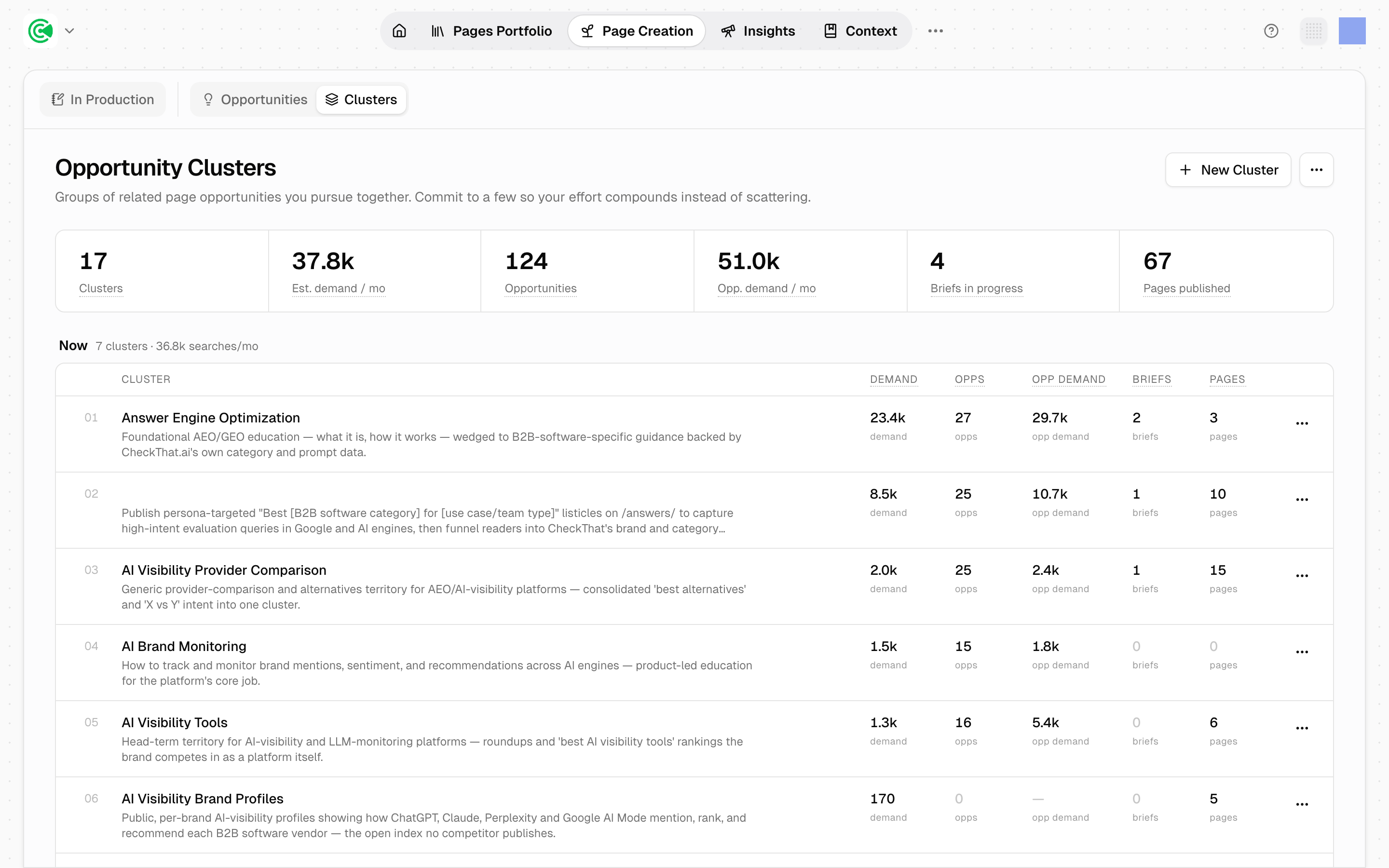
Clusters are groups of related opportunities, the pages worth writing or rewriting that agents propose, built around one topic and worked as a set. GrowthX's content strategy work shapes the cluster portfolio you arrive to; you confirm and own the direction, and the platform executes it. Clusters are the connection point, the place where your strategy is represented in the product.
If you have done editorial strategy work before, clusters are the topic territories that fall out of a content map. The difference is what happens after: here, each cluster becomes a living surface that generates and organizes opportunities, so committing to one puts research behind it.
Where they live
Open Page Creation, then the Clusters view. The page is titled Opportunity Clusters, and its one-line definition is worth internalizing: groups of related page opportunities you pursue together. Commit to a few so your effort compounds instead of scattering.
Clusters sit in priority bands:
| Band | What it means |
|---|---|
| Now | The territories you are actively pursuing. Opportunity scoring favors these |
| Next | Committed, but queued behind Now |
| Later | Believed in, not yet resourced |
| Unprioritized | Not yet triaged into the roadmap |
Each cluster row shows its demand, how many opportunities it holds, and how many briefs (the plan a page is built from) and published pages it has driven, so the list doubles as a strategy scoreboard.
What's inside a cluster
Open a cluster and you see its pattern (the page-shape bet, like Pillar + spokes for a hub with supporting pages, or Comparison set for head-to-head pages), its persona and taxonomy chips (the buyers it speaks to and the categories it is classified with), and 2 tabs:
- Opportunities: every opportunity in this territory, with scores and statuses.
- Cluster Brief: the written rationale. If it is empty, Write the brief opens the editor for you to write one. The brief is where the "why this territory" argument lives, and it is worth reading before you back the cluster.
The Find Opportunities button on each cluster puts an agent, an automated researcher, to work on the territory and streams scored opportunities into your backlog. That is covered in 4.2 · Generate opportunities.
Your job: back them or challenge them
Your workspace arrives with a proposed cluster portfolio, built from your context (what GrowthOS knows about your company) and market. Treat it as a hypothesis to challenge, not a plan to approve. For each cluster, ask:
- Is this a territory we should own? If your strategy says no, delete it or push it to Later. A cluster you do not believe in produces opportunities you will keep rejecting.
- Is it sharp enough? Good clusters are few and specific. If 2 overlap, use Merge into from the row menu; if one is really 2 bets, carve the second out with New Cluster. There is no one-click split.
- Is the priority honest? Now should stay small. Cluster priority feeds opportunity scoring, so an inflated Now band blurs the signal that ranking is supposed to give you.
Deleting a cluster removes the territory itself: its topics and their questions. Opportunities the cluster already produced survive, losing only the cluster link. A cluster you might come back to belongs in Later rather than the bin.
Edit freely: name, description, priority, and brief are all yours to change, and New Cluster adds a territory the proposal missed.
Why backing them explicitly matters
Everything downstream inherits this decision. Opportunities are scored partly by cluster priority, briefs carry their cluster's context, and your portfolio gets read cluster by cluster in reports. A direction you genuinely backed means the research works on things you will actually ship. A direction you rubber-stamped means you fight the backlog one opportunity at a time, which is slower than fixing the clusters once.
Common questions
How many clusters belong in Now? Fewer than feels natural. 2 or 3 territories pursued hard beat 6 pursued politely, and you can promote from Next as pages ship.
Our strategy changed. What do I do here? Re-band the clusters, edit the briefs, add or merge territories. The portfolio follows within days: scoring shifts with the new priorities and new research lands in the territories you promoted.