AI Viz Segments
The market slices GrowthOS watches inside AI answer engines, and where you are absent from them.
App route: /brand_context/ai_visibility_segments
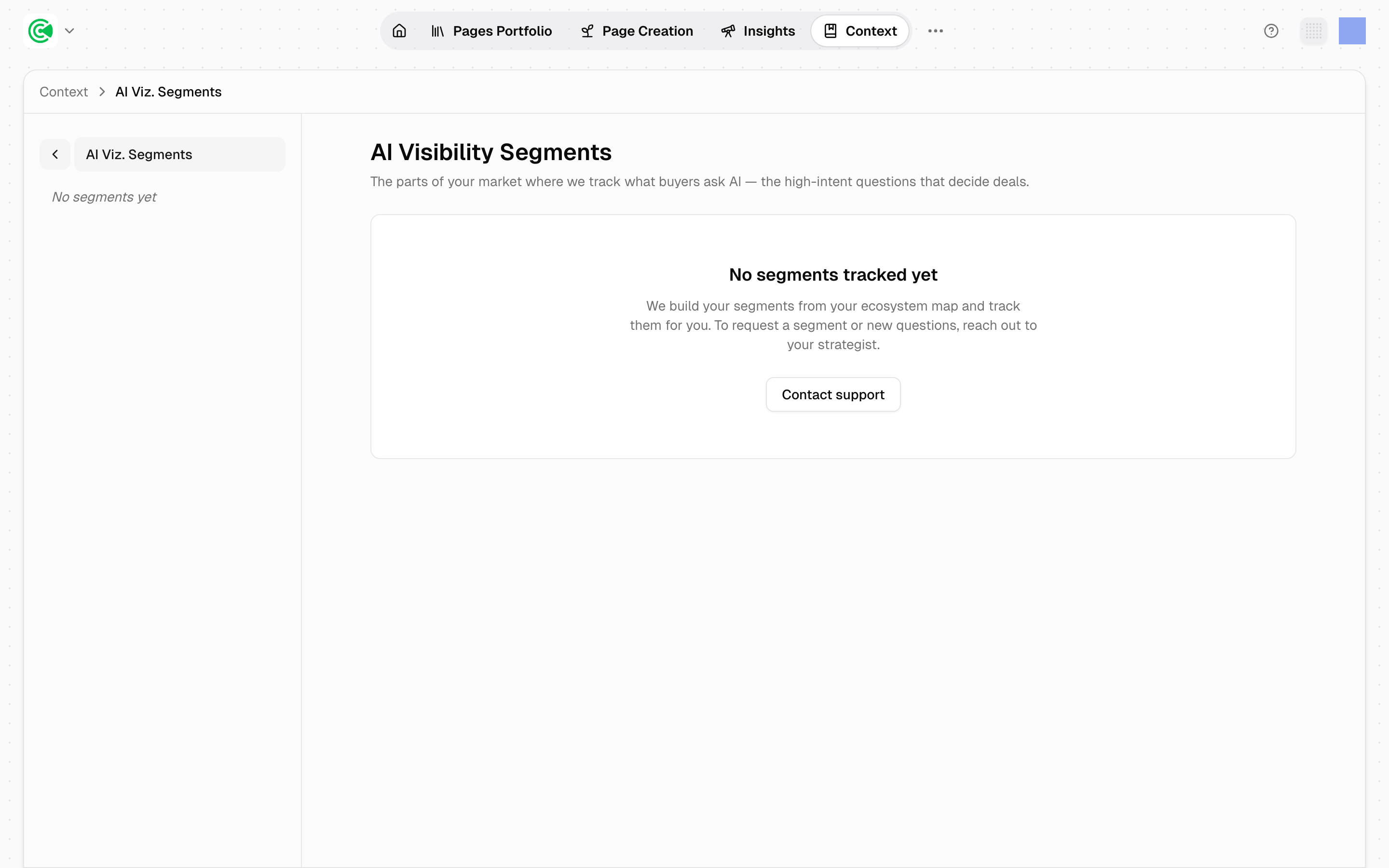
AI Visibility Segments are the slices of your market that GrowthOS watches inside AI answer engines, the AI products that answer questions directly instead of returning links. For each segment it asks a panel of buyer questions across the engines and records whether you were cited, who was cited instead, and which sources the answers drew on. This is where you learn whether the engines answering your market mention you at all, which is the read the rest of your content work responds to.
GrowthX manages this screen, and you read it rather than edit it. Segments are derived from your ecosystem map by an agent: if a segment is missing or wrong, that's a conversation with your strategist, not a form to fill in.
Doing this rather than looking it up? The Tutorial walks this screen step by step in 3 · Context & voice.
Reference
| Field | What it means |
|---|---|
| Visibility score | Share of the segment's prompts where you were cited |
| Status | cited, absent, or unprobed: unprobed means the question hasn't been asked yet, not that you lost |
| Buyer questions | The prompt panel the segment is measured on |
| Cited domains / URLs | What the engines actually pointed at, yours and everyone's |
| Vendor rankings | Who the engines name in this segment, per engine |
Engines covered on this screen: Google AI Overviews, ChatGPT, Perplexity and Claude. The AI Engine Visibility report covers a slightly wider set, adding Google AI Mode. Note that the Google surfaces are included: they're where most citation volume sits, and a summary that omits them understates the picture.
The buyer questions in a segment come from a shared panel GrowthX maintains rather than being written for you alone. What's yours is the result.
Absent is a result, not a gap in the data. A segment where you're consistently absent while 3 competitors are cited is the clearest signal in the product: the market is being answered, and not with you.
Per-page citation tracking exists too. Pages inside an analysis zone (the part of your site GrowthOS crawls and analyzes) get registered for tracking individually, and a page's own AI Visibility panel shows its citation status, cited prompts and per-engine ranking. This screen is the market-level read; the page detail is the page-level one.
Known issue
Acting on a segment finding is a manual step today. Segments are read-only, and nothing turns a finding into an opportunity or a brief: the only consumers are this screen, the AI Engine Visibility report and the MCP tools. Closing that loop is tracked. Meanwhile, take a weak segment to Page Creation yourself and raise it with your strategist.