Personas
The buyers your content is written for, how to read the counts, and how to correct the set.
App route: /brand_context/personas
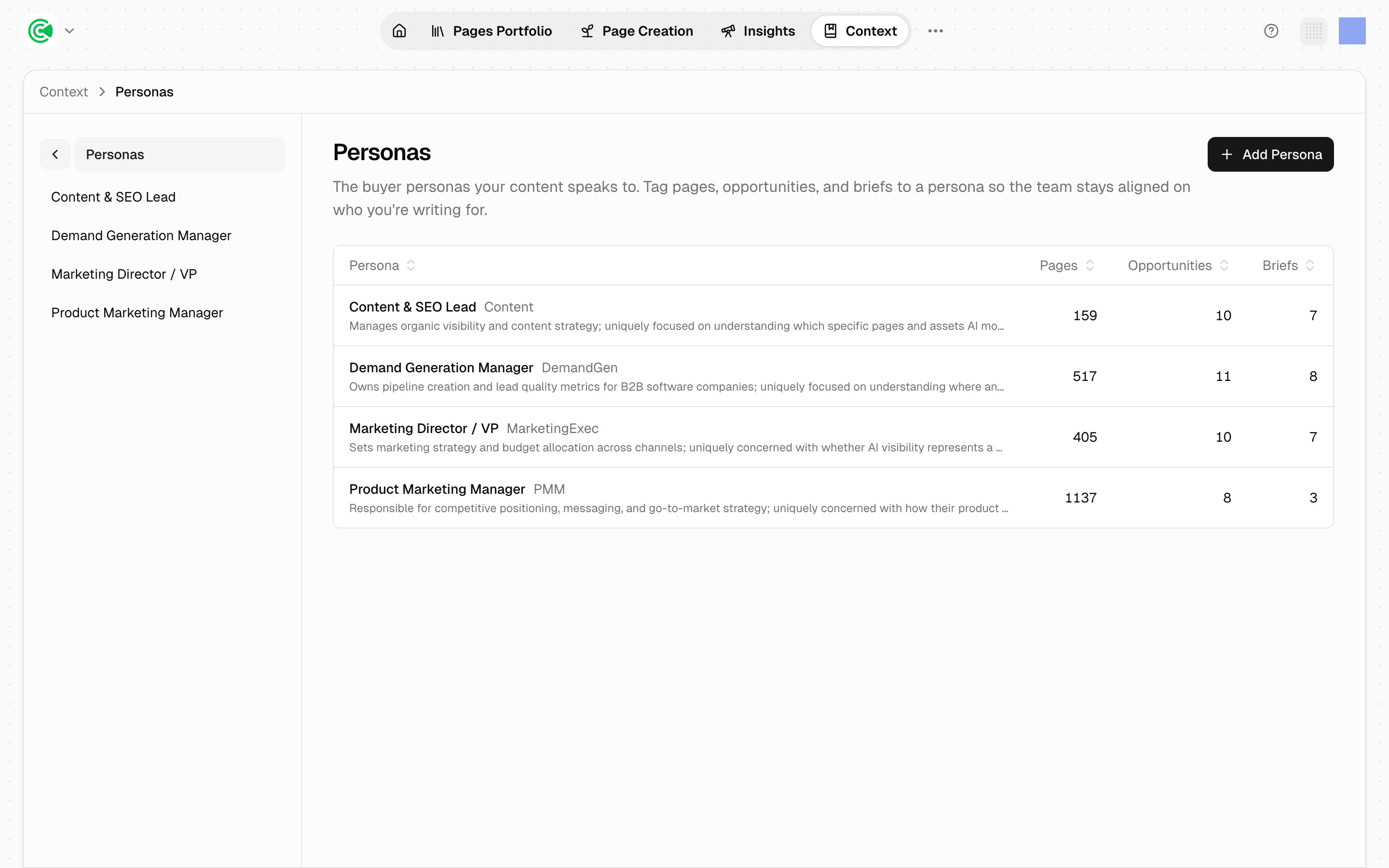
Personas are the buyers your content speaks to. Each one is a short profile of a role: what they own, what they're measured on, and what they're specifically trying to find out. Every agent (the automated workers that research, draft and score) reads these profiles before it writes, so a persona that describes the wrong buyer misdirects every draft aimed at them. Correct the set here and everything downstream speaks to the buyers you actually win.
Pages, opportunities (pages an agent proposes writing or rewriting) and briefs (the plan a draft is written from) can all be tagged to a persona, which is how the team stays aligned on who a given piece is for.
Like the rest of context, personas arrive drafted by agents from market research and are yours to correct.
Doing this rather than looking it up? The Tutorial walks this screen step by step in 3.1 · Review your context.
Reference
The table lists each persona with a short code and 3 counts.
| Column | What it tells you |
|---|---|
| Persona | The role name, its Short Name (PMM, DemandGen) and a one-line description. The full profile lives on the persona's own page, not here |
| Pages | Pages tagged to this persona |
| Opportunities | Opportunities tagged to them |
| Briefs | Briefs tagged to them |
All 3 counts are lifetime totals, not current state. They tally every tagged record regardless of status, so Opportunities includes dismissed and archived ones, and Briefs includes published and discarded ones. Read them as "how much work has ever pointed at this persona", not "how much is live". A persona with nothing in any column is either genuinely irrelevant or an oversight, and it's worth knowing which.
Persona profiles are written to a consistent shape: what the role owns, followed by what they are uniquely concerned with. That second half is the part that changes what a writer does.
Short Name is optional and falls back to the persona's name. The table only shows it when it differs, and it's editable on the persona's page rather than in the create form.
Changing the set
Personas are added and removed one at a time. Add one when a real buyer has no profile; remove one when no real buyer matches it, because the set here defines who agents write for.
There is no batch regeneration for personas. Each one is added and removed individually, so work through the set persona by persona rather than expecting a single rebuild.