Topics
What your market asks about, how much of it you already answer, and where the gaps are.
App route: /topics
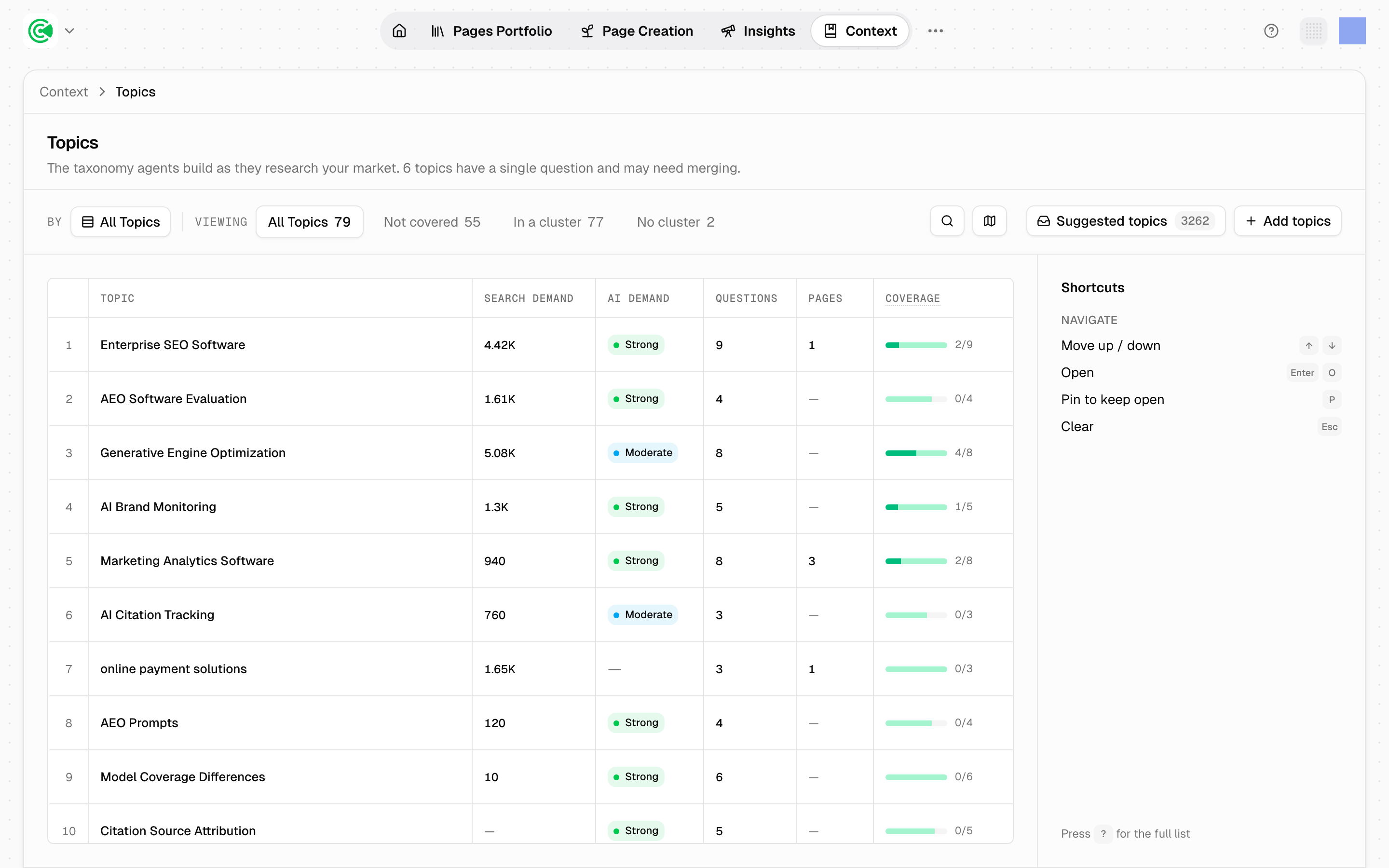
Topics is the map of what your market is asking about, and how much of it you currently answer. Agents (the automated workers that research, draft and score) build it as they research your market, so it isn't a taxonomy you author: it's a picture of demand you read. What you accept or dismiss here shapes the question set every coverage number and research pass draws on.
It's the bridge between research and production. Topics is where you see that a subject has real demand and thin coverage; Clusters, the groups of related opportunities worked as a set, is where you commit to doing something about it.
Doing this rather than looking it up? The Tutorial walks this screen step by step in 4.1 · Align on strategy.
Reference
| Column | What it means |
|---|---|
| Topic | The subject, as research named it |
| Search demand | Traditional search volume for the topic |
| AI demand | Strong, Moderate, Emerging, or a dash: see below for what it actually measures |
| Questions | Distinct questions research found inside the topic |
| Pages | Live pages mapped to it: which is why this won't reconcile with the Pages Portfolio, where archived pages still count |
| Coverage | Questions answered out of questions found (e.g. 2/9) |
AI demand is a proxy, and worth understanding before you lean on it. Nobody can measure query volume inside AI assistants: no such API exists. So the grade is inferred from the Google SERP instead: how many People-Also-Ask questions the topic's prompts pull, with the presence of an AI Overview setting a floor. Both signals come from the same keyword data as search volume, read differently.
That makes it a genuine signal about how question-shaped and answer-engine-ready a topic is, but not a measurement of AI traffic. A topic with negligible search volume and Strong AI demand is one the SERP treats as a question rather than a destination.
Coverage counts questions, not pages. 22 pages against a topic with 0/4 coverage means you've published a lot about the subject without answering what people actually ask. The uncovered remainder is split further behind the scenes: a question already on an accepted opportunity or an in-progress brief (the plan a draft is written from) counts as neither covered nor a gap.
Suggested topics
Suggested topics is a triage queue, not a filter on the list above, which is why its count runs into the thousands while the topic list stays small. Proposals live in their own store and only become topics once resolved.
Each one is pending, accepted or dismissed. Accepting mints a real topic and moves any questions and opportunities that were waiting on it across, which is why accepting is the step that puts a subject's demand into your coverage numbers.
Dismissing is durable. A rejected name is remembered and won't be proposed again, so dismiss only the subjects you're sure don't belong in your market.
Proposals arrive from 5 places: a broad market sweep, discovery from a URL you shared, the opportunity finder hitting a subject with no topic yet, a cluster's own topic developer, and gaps found on a live page. Some of those accept themselves automatically; the ones raised by cluster development and by page analysis wait for a person.
Pending proposals don't count toward coverage. Their demand isn't in the question set yet, so a topic area can look thinner than it is while its proposals sit unresolved. They aren't inert, though: opportunities can be parked on a proposal, clusters own theirs, and pending names are fed back to the research agents so the same subject isn't proposed twice.
The Topic taxonomy is system-managed. You can't edit it the way you edit other taxonomies: it's derived from research rather than authored, and it's hidden from the Taxonomy screen entirely. It does still appear as a built-in grouping in the Portfolio's Group by; what you can't do is build a new grouping on the Topic category. It's also the layer strategic territories are built on: a cluster owns topics, and a topic's questions are what its coverage is measured against.
Cluster is the word; you may still meet "Bet." The API and the MCP tools call the
same object a Bet: a rename that landed in the backend vocabulary and not in the
front end. Cluster is canonical, and these docs use it throughout. If you query the
API or point an agent at the MCP server and get back bets, that is this same
object under its older name.
Demand without coverage is the only signal that matters here. High demand with high coverage is a subject you already own. Low demand is a subject to skip. The whole screen is a way of finding the third case, and everything else on it is context for that read.